Alexandria's founded by Alexander

Alexandria's founded by Alexander the Great (by year BC): 334 Alexandria in Troia (Turkey) - 333 Alexandria at Issus/Alexandrette (Iskenderun, Turkey) - 332 Alexandria of Caria/by the Latmos (Alinda, Turkey) - 331 Alexandria Mygdoniae - 331 Alexandria (Egypt) - 330 Alexandria Ariana (Herat, Afghanistan) - 330 Alexandria of the Prophthasia/in Dragiana/Phrada (Farah, Afghanistan) - 330 Alexandria in Arachosia (Kandahar, Afghanistan) - 330 Alexandria in the Caucasus (Begram, Afghanistan) - 329 Alexandria of the Paropanisades (Ghazni, Afghanistan) - 329 Alexandria Eschate or Ultima (Khodjend, Tajikistan) - 329 Alexandria on the Oxus (Termez, Afghanistan) - 328 Alexandria in Margiana (Merv, Turkmenistan) - 326 Alexandria Nicaea (on the Hydaspes, India) - 326 Alexandria Bucephala (on the Hydaspes, India) - 325 Alexandria Sogdia - 325 Alexandria Oreitide - 325 Alexandria in Opiene / Alexandria on the Indus (confluence of Indus & Acesines, India) - 325 Alexandria Rambacia (Bela, Pakistan) - 325 Alexandria Xylinepolis (Patala, India) - 325 Alexandria in Carminia (Gulashkird, Iran) - 324 Alexandria-on-the-Tigris/Antiochia-in-Susiana/Charax (Spasinou Charax on the Tigris, Iraq) - ?Alexandria of Carmahle? (Kahnu)

Tuesday, September 26, 2023

An unknown kingdom in Turkey, lost in time

The time of great discoveries is not behind us. The world still holds many surprises to be unveiled, believe it or not! 

As recently as last winter, a farmer in southern Turkey unearthed a large stone stuck in an irrigation canal. This stone carried mysterious inscriptions belonging to an ancient, lost civilization. 


The archaeologists determined that the writing was in Luwian, an ancient Indo-European language from Anatolia. It was used by the people living in western and southern Asia Minor from the 2nd millennium BC, prior to the arrival of the Hittites. The hieroglyphic symbols were read in alternating sequences from right to left and left to right.

This newly discovered inscription mentions an ancient civilization that might have defeated the Phrygians, best known through their King Midas, in the late 8th century BC (see: Gordion, a name with a resonance). A specific symbol on the stone indicated that the message came directly from their ruler, King Hartapu. The name Hartapu was known from a previously discovered inscription on a mound some 16 kilometers away, but at that time neither his title nor kingdom was mentioned. 


The kingdom, whose name is not known yet, existed between the 9th and the 7th centuries BC. Its capital was probably located near Turkmen-Karahöyük, less than 20 kilometers from the UNESCO site of Çatalhöyük. 

Imagine, this was 300-500 years before Alexander! Maybe he had the answers we hope to find in future research?

[Pictures from Archaeology World]

Wednesday, September 20, 2023

The beauty of Alexandrine mosaics

The first time I was confronted with the fine and delicate mosaics created in Alexandria was in Libya. 

Unexpectedly, this was in the eastern city of Ptolemais, seeing the centerpieces of the mosaic floors in the Summer Triclinium of the Palazzo delle Colonne. It was as if I could zoom in time and again to discover ever more details! 

Another striking example was exhibited at the local Museum of Sabratha in western Libya. Here it was a carpet-like mosaic depicting the Triumph of Bacchus. The three central roundels executed in fine Alexandrine mosaics stood out against the otherwise rather rough tesserae of the outer mosaic. The top roundel showed Bacchus, after whom the mosaic was named, followed by a lively lion head and a panther head. 


Another example was presented at the Bozar Museum in Brussels during the Exhibition on Alexandria in 2022. Here the fine centerpiece of the mosaic was a wild Medusa face on loan from the Museum of Alexandria dated also from the 2nd century AD. 


Scenes of gods and goddesses were very common in antiquity, but it seems that animals were generally introduced by the Romans. 

Lesser known is the panel of a colorful parakeet, one of three centerpieces that decorated a floor of Palace V in Pergamon. This is the only one that made it to the Museum of Pergamon; the other two are lost in the mist of time. 

Now the story of this parakeet requires some extra information. To start with, it has been identified as the Psittacula eupatria, noble fatherland or of noble ancestry. Apparently, it was Alexander the Great who sent the first birds from Punjab to the West, where they were received as exotic pets by the rich and famous of his time. 

The mosaic panel was made in Pergamon in the days of Eumenes II or Attalus II to decorate the so-called altar room of Palace V on the city’s acropolis.

The technique also used the opus vermiculatum meant to emphasize the contours of the bird – a parakeet in this case. To that effect, one or more rows of dark tesserae would be inserted around the subject to enhance the pictorial effect and create an extra contrast or a shadow.   

It is hard to imagine how the artisans of those days were still able to see what they were doing handling those tiny bits of stone, marble, and glass varying between 0.5 to 1 millimeter in size and keeping an eye on the contrast effect at the same time. High-skilled craftsmanship, no doubt.

Wednesday, September 13, 2023

The Thrasyllos Monument in Athens

The rock on which the Athenian Acropolis has been built holds several caves that were used in antiquity as sanctuaries. Early settlers were attracted by the clean water from its hidden natural sources. Some of these caves led very far inside but most were rather small. Over time, some of these spaces were turned into sanctuaries. 

The most striking example is the Thrasyllos Monument, a temple inside a large cave on the south slope of the Acropolis. It was created around 320 BC by Thrasyllos, a judge in the Great Dionysia Festival. His son, Thrasykles, modified the monument in 270 BC.

Few people know that its façade was an almost exact copy of the west façade of the south wing of the Propylaea on the Acropolis above. It has two door openings with pilasters and a central pillar, crowned with a Doric architrave displaying a continuous row of guttae, a frieze, and a cornice. The frieze depicts five olive wreaths on either side of the central ivy wreath. The three columns above the cornice supported the bronze choragic tripods. Pausanias tells us that the cave held a representation of Apollo and Artemis killing the children of Niobe. 

Paintings inside the cave referred to a marble statue of Dionysus probably added to the top of the monument in the 4th century AD. It was removed in 1802 by Lord Elgin, who took it to the British Museum in London

Under Ottoman rule, a small chapel was built inside the cave known as the Virgin Mary of the Cave. It was used by the Athenians who came to pray for the health of their sick children. The chapel was decorated with Biblical frescos, and a marble icon of the Assumption of the Virgin Mary, recently restored. 

Most of the marble entrance collapsed in 1827 during the Ottoman siege and bombardment of the Acropolis. As so often, the stone material was reused elsewhere in the city and, in particular, for the restoration of the Byzantine Church of Panaghia Sotiras tou Nikodimou. 

The restoration of the Thrasyllos Monument started in 2011 assisted by archaeologists of the National Archaeological Museum in Athens. We have to thank the English architects James Stuart and Nicholas Revett for having left us so many drawings of what they witnessed in 18th-century Athens. Their work was of great help to reconstruct the Thrasyllos Monument and provided a clear copy of the original Greek inscriptions. 

This impressive Choragic Monument was meant to be seen by all of ancient Athens. Today, it is an eye-catcher overlooking the Theater of Dionysus. The Monument is clearly visible from the terrace of the New Acropolis Museum as seen in my picture from 2015.  

For safety reasons, the interior of the Thrasyllos Monument is not open to the public yet.

Tuesday, September 5, 2023

Bronze equestrian statuette from Albania

The Getty Villa Museum in Malibu, California, is hosting a special exhibition, The Horse and Rider from Albania from July 26, 2023, through January 29, 2024. The centerpiece is a beautiful bronze equestrian statuette that was found in 2018 by a farmer plowing his land. This happened near the ancient city of Arnisa, modern Babunjë. Based on the Geography of Claudius Ptolemy from the 2nd century AD, Arnisa belonged to the Illyrian Taulantians. 

Greek, 520–500 B.C. Bronze. Albanian Institute of Archaeology, Tirana.

The city was settled by people from nearby Apollonia (see: Along the Via Egnatia: from Ohrid to Elbasan) in the early 6th century BC. It was an ideal location close to the river Seman with ample fertile land. Arnisa itself was built according to the Hippodamian plan (see: The Hippodamian plan, not so Greek after all) and covered an area of five to six hectares. It was surrounded by a fortification wall made of carefully carved blocks that perfectly fit together as seen in other Illyrian cities in Albania. 

Although only a small part of Arnisa has been excavated so far, archaeologists believe that the city flourished in the 5th and 4th centuries BC, and was abandoned in the 3rd century BC when Macedonia rose to power after Alexander's conquests. Others are inclined to put an end to its prosperity in the days it was defeated by the Romans. 

The small Horse and Rider is approximately 14.5 cm high and has been tentatively dated to around 500 BC. It was cast in one piece of solid bronze and the rider’s face and the horse’s nostrils and eyes were carefully carved. 

Nothing of the kind has been found so far in Albania and scholars hope that future excavations will provide more information about the site of Arnisa and the history of Albania. 

After the exhibition at the Getty, the precious statuette will return home and find a proper place at the National Historical Museum of Tirana.

Wednesday, August 30, 2023

The Tabula Chigi quoting Alexander

“Kings have knelt before my spear, and their peoples too,
how many are the embraces of the Ocean around the earth.
I am the son of Philip, by Heracles a descendant of Zeus,
and of my mother Olympias, of the race of the Aeacids.”

This inscription is in Greek as it appears on the Tabula Chigi, in which Alexander speaks in the first person. 

This Tabula Chigi is a tablet made of antique yellow marble, 15.5 x 9 cm and 1.5 cm thick, from between the 1st century BC and the 1st century AD. It belongs to a series of “tabula iliaca” named after the Iliad because most of the scenes tell episodes from Homer’s book. 

[Picture from Rai Cultura, Arte]

We don’t know for whom or why these panels were created. They may have served to decorate some libraries or to disseminate a story, or they simply had a votive function. The latest opinion is that they were a kind of conversation piece for the ‘nouveaux riches’ who had no access or the skills to read literary texts. 

Another study has suggested that the Chigi iliaca were meant to be read and understood by a selected group of connoisseurs of Greek calligrams (sets of words arranged in such a way that they form a thematically related image). So far, we know twenty-two tabulae iliacae existed. Italy has the largest collection with seven tablets spread among the Capitoline Museums, the Villa Albani, the Vatican Museums in Rome, and the National Archaeological Museum of Naples. 

The Tabula Chigi was discovered in 1777 in a quarry belonging to the Chigi family. Over the years, the tablet disappeared and was known only from 19th-century illustrations. In 1928, the last member of this powerful family gave the tablet to his American wife. It was officially called lost in 2012. However, it resurfaced recently in New York and was handed over to the Italian State in the name of the last daughter of the Chigi family. It ended up in the National Roman Museum,Palazzo Massimo, in Rome.   

The tablet shows two female figures facing each other, Europa and Asia as mentioned in the inscriptions. Between them stands an altar with a relief of a cithara player, probably Apollo, flanked by two dancers, Muses or Graces. With one hand, they hold up a tondo (round relief) with various figures; and with the other hand, they hold a dish for libations and offerings. A Greek inscription fills the space between the roundel and the altar, Europa and Asia, and this is the text mentioned above. The Tabula Chigi has survived in excellent condition. 

This unique tablet has been on display during the exhibition “The instant and eternity. Between us and the ancients” together with 300 exceptional artifacts from Greek, Roman, Etruscan, Italic, medieval, modern, and contemporary civilizations. For the occasion, a section of the Baths of Diocletian, part of the National Roman Museum in Rome reopened after decades of closure. 

Wednesday, August 23, 2023

Roman soldiers in China

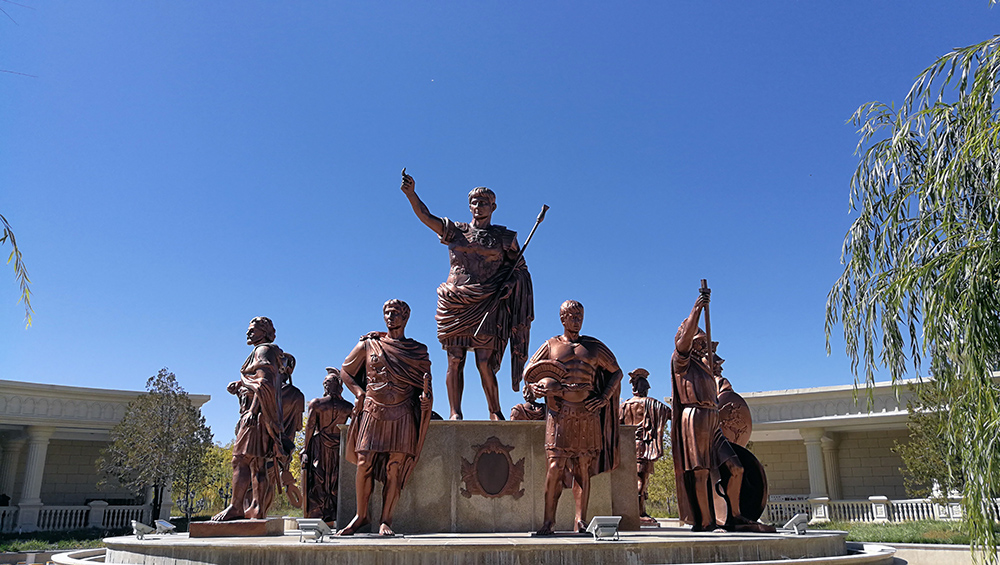
Entering China from the depression of Mongolia, the modern visitor is in for a remarkable surprise. High on top of a Corinthian column stand two bronze figures, a Chinese and a Roman soldier, greeting each other. Behind it, two rows of white columns line up in sharp contrast with the cloudless blue sky. 

A short distance away, a group of eleven, life-size Roman legionaries is immortalized in bronze. Behind it is the entrance gate to a Roman world in the style of Disneyland. The monument is a mixture of a Buddhist and a Roman temple with Ionic columns holding a pediment. A unique way to attract tourists to the Chinese frontier! What happened here? What triggered this staging? What is the truth behind this story? 

We must go back to 60 BC when Rome’s First Triumvirate was formed between Caesar, Pompey, and CrassusPompey is envious of Caesar’s successes in Gaul and recent friendship with CrassusThey were three very different men who came together to achieve their own goals. Once they agreed to their role in this new form of government, Caesar returned to Gaul, Pompey stayed in Rome, and Crassus went east.

Crassus was the richest man in Romebut he was not a military man. Still, he sought glory on the battlefield similar to that of his co-rulers and decided to attack Asia Minor. His army was defeated by the Parthians and Crassus was killed at the Battle of Carrhae in 53 BC (see: Harran, better known under its Roman name Carrhae). Some 20,000 soldiers died on the battlefield and 4,000 returned to Syria. 

Yet 10,000 of his troops were taken prisoner by the Parthians (see: Who were the Parthians?) and sent to Margiana to man the frontier. In 36 BC, the Parthians forced the Roman prisoners to participate in the Battle of Zhizhi, Kazakhstan, against the Chinese. The victorious Chinese of the Western Han Dynasty were so impressed by the fighting skills of their opponents that they took them to the city of Liqian or Li-chien – maybe a transliteration of Alexandria or the Roman word Legion - in the region of Gansu in western China. 

A number of inscriptions discovered in the Kara-Kamar caves on the border between eastern Uzbekistan and Turkmenistan were written in Bactrian, Greek, Arabic, and Latin. The latter one was composed of three lines and was left by the Roman soldiers of the Pannonian Legio XV Apollinaris around the 2nd century AD (see: First contacts with China). A proof that the Romans had been there? 

It is a fact that about 50% of the population of Liqian has green and blue eyes and a Roman aquiline nose. This may be wishfully attributed to the Roman presence some 2,000 years ago. Another theory circulates that the Chinese mingled with people from Siberia. As so often, it is unclear where history and legend start or end.

[top and bottom pictures from That's Mags]

Thursday, August 17, 2023

An important update on Side

These days, the main attraction of Side seems to be centered on what is called the Monumental Nymphaeum, opposite the main city gate. 


This fountain belongs to the 2nd century AD when Side prospered and its Roman occupants did not shy away from making a statement. The richly decorated construction was three stories high and adorned with many statues, which have been moved to the local Museum. The three niches on the lower floor above the water basin are still standing, but otherwise, the Nymphaeum has been heavily reconstructed. Originally, the water would have cascaded down through the slots in the façade, not unlike what we can see in Sagalassos (see: Sagalassos in Alexander’s campaign). 

The Roman architects built an aqueduct to supply the water for the Nymphaeum. It also fed the public baths, fountains, and cisterns, whereas the wealthiest citizens had running water and a sewer in their homes. 

The water came from the Manavgat River, whose waterfalls are another modern tourist attraction. The source of the river was in the Taurus Mountains, some 40 kilometers from the city center of Side. The renovation of the aqueduct in the early 3rd century AD was financed by Side’s benefactor Lollianods Bryonianos and his wife Quirina Patra. Today, sections of the aqueduct are still visible in the landscape. Also in an opening in the city walls pipes and water channels made of marble, terracotta, and lead can be seen. 

[My own picture taken in 2009]

The above is proof, if needed, that it is not enough to visit a site just once. New excavations are carried out, even intermittently. I realize that my last post on Side was written ten years ago with Alexander as the focal point (see: Side didn’t put up any resistance to Alexander). It happened after my more in-depth exploration done earlier, in 2009. 

The more recent exploration and excavations focusing on the Roman aqueduct and the monumental Nymphaeum triggered the present update.

Friday, August 11, 2023

Museum of Tripoli, Libya

There are several reasons to write about the Archaeological Museum of Tripoli. It is one of those ‘must-see’ places that sadly are off the beaten track for the average tourist, especially since Gaddafi has been eliminated and the country has not regained its stability. 

I was privileged to visit this wonderful collection just before the outbreak of the Arab Spring, unaware of the quantity and high quality of artwork that awaited me. It must be said that I discovered these treasures on my first day in Libya, and, as always, I should have returned after my tour of the archaeological sites as well. 

Anyway, I took in as much as I could, fully aware that the best pieces from any excavation made their way to the museum in the country’s capital. Tripoli was no exception. 

The bulk of the collection comes from Leptis Magna, second to Rome (see: An introduction to Leptis Magna in Libya). 

The first statues I see are two magnificent Roman copies of Praxiteles’ originals from the 4th century BC. One is the Diadumenos, a young athlete who is tying the ribbon of victory around his head. The other is Apollo-Antinous, hinting at Dionysus, combining the body of Apollo with the head of Antinous, the lover of Emperor Hadrian. Both life-size marbles were recovered from the Baths of Hadrian in Leptis Magna. The arched vaults of these baths from the 2nd century AD have simply collapsed, burying and saving their precious statues in the process. 

Stealing the show is the marble Apollo playing the lyre. He is a little taller than life-size and as true to life as imaginable. Apollo’s delicate hands and fingers seem to strike the strings as he holds his instrument with his left hand and the plectrum in his right. The lyre is intact, except for the strings, and it is a unique opportunity to have a close-up look. His eyes, whose traces of paint make them alive, stare melancholically into the distance. They are a vivid reminder of all the painted statues in antiquity. Apollo’s body is truly worthy of a god. 

The elegant Muse Calliope is sitting nearby, listening carefully to his tune. More remarkable statues gather around Apollo. An unspecified sea goddess is looking up to him, and Mars is standing in a niche behind him. The slender Isis is wearing a diadem, and Venus is very similar to other copies of the famous Aphrodite of Cnidos (see: Was Alexander the Great aware of Cnidos?). Hadrian definitely had an outspoken taste for beauty! 

Another large group of statues and busts is brought together from the theater of Leptis Magna, consisting mainly of Roman emperors: Augustus, Tiberius, Claudius, Marcus Aurelius, Lucius Verus, etc. Even Augustus' wife, Livia and granddaughter, Agrippina the Elder, are present. Upstairs, in the Mezzanine, there is a statue of Faustina, the wife of Marcus Aurelius. 

Inside the theater of Leptis Magna stood a small temple dedicated to Ceres-Augusta, goddess of the harvest – our word for cereal derives from the name Ceres. A seated statue of this goddess also found its way to the museum. 

The goddess Cybele, with the many breasts (or whatever they represent) as worshiped in Ephesos, was unearthed in the sanctuary of the amphitheater. A Roman copy of a Greek original Diana/ Artemis, as displayed at the Louvre in Paris and the Archaeological Museum of Antalya, is also exhibited. 

The Ancient Forum of Leptis Magna yielded a rather damaged Dionysus with satyr and panther, and a headless Lady Fortuna wearing a beautifully draped tunic. 

The museum’s impressive main hall also displays four delicate mosaics from a private villa in Leptis Magna. It dates from the 2nd century AD and depicts scenes of daily life in and around the Nile – hence its name, Villa of the Nile. 

Upstairs, a special room holds the original reliefs of the Arch of Septimius Severus (see: A solid gold bust of Septimius Severus), proof of the political loyalty of the inhabitants of Leptis Magna in the 3rd century. The relief of Septimius Severus standing between his two sons, Caracalla and Geta, was meant to express the good harmony inside the imperial family. Here is also a statue of Caracalla as a child. 

The Cyrene Room has a wooden scale model of the Agora, which, unfortunately, is meaningless unless one has visited the site. Nearby are faceless goddesses believed to represent Persephone from the necropolis of Cyrene. Also, a rare Minerva wearing the Aegis tied to her waist as opposed to her Greek version, Athena, who wears it around her shoulders. She also holds her owl and carries the spear and shield. The statue is carefully carved in pure Greek tradition. 

The Archaeological Museum of Tripoli has a rich collection of mosaics from the 2nd century AD. Many villas were built along the Mediterranean coast by wealthy landowners who loved to show off. One such example is the Roman Villa of Zliten, some 200 km east of Tripoli. It yielded a large floor mosaic executed in a wonderful combination of opus sectile and clearly outlined opus vermiculatum. The central panel is filled with different sorts of fish, and the border with less peaceful scenes of gladiator fights. From the same villa comes the floor mosaic representing the Four Seasons. Tajura is located closer to Tripoli, where another Roman villa from the 2nd century AD has been spotted. A large mosaic with geometric figures and the head of the sea god, Amfitritus, in its center has been removed from the Villa of the Nereids. 

Unfortunately, I did not visit any of these villas since they were usually closed to preserve them. Under the present chaotic regime, I wonder how many of these precious villas have survived the revolt and looting in the wake of Gaddafi’s execution. 

From Ghirza, a Roman fortress near Misrata, an entire Mausoleum from the 4th century AD has been moved to the entrance hall of the museum. It has a strange mixture of different styles that can hardly be defined. 


It is, of course, preferable to leave such constructions and the precious statues and mosaics in situ, but in case of political unrest and war, the artifacts are generally better protected inside the walls of a museum. It so happens that the Archaeological Museum of Tripoli is housed inside the so-called Red Castle of Tripoli. In 2011, following the outbreak of the Libyan Civil War, the museum was closed, but rebels managed to break into the museum and steal a few of Gaddafi’s belongings that were kept in a special room. Previously, the most valuable artifacts had been moved to a safer location. As of 2020, the museum is still closed.

Saturday, August 5, 2023

A steam engine in antiquity?

We tend to think that inventions belong to our modern world, but deep down, we know that is not true. The wheel was one of the oldest inventions – somebody had to come up with the idea! 

The main problem may simply be that many inventions were not documented, and, if they were, the documents did not survive. They certainly were not patented. 

This being said, a special case is to be made for Hero of Alexandria (c. 10 – 70 AD), who was a mathematician and an engineer.  


Hero created the first steam engine ever, the Aeolipile, meaning “wind ball”. The concept was rather simple. He used a sealed caldron filled with water, which he placed over a fire. As the water boiled, steam rose through a pipe to fill the hollow sphere above. This sphere was equipped with two bent outlet tubes, and when the steam escaped through the tubes, the sphere started to spin. 

For Hero, this was only one of his inventions that he considered a toy or gimmick – a piece of conversation, who knows! 

Imagine what would have happened to our world if Hero or any of his contemporary inventors had sought a way to turn the Aeolipile into something useful. The industrial revolution started in the 18th century when James Watt presented his steam engine. 

We lost 2000 precious years of evolution! Are there more examples of such lost chances?

Monday, July 31, 2023

Another aspect of Alexander’s personality?

Life is full of surprises and Alexander’s life is no exception. Our best sources are extant books by Arrian, Diodorus, Curtius, Plutarch, and Justinbut contemporary documents are far more difficult to find (see: Eyewitness accounts of Alexander's life). Alexander’s Royal Journals carefully kept by Callisthenes and Eumenes have not survived, except for some rare fragments whose origins cannot be verified with certainty.

Browsing through Robinson’s book, The History of Alexander the Great and the Ephemerides of Alexander’s Expedition, I was intrigued by the few lines that survived Ephippus’ writing. 

Ephippus of Olynthus was a historian and contemporary of Alexander. It is unclear whether this man is the same as Ephippus of Chalcis, mentioned by Arrian as one of the superintendents Alexander installed in Egypt. The reason to link both names is that the city of Olynthus is part of Chalcis. Otherwise, our Ephippus may well have lived at the king’s court or shortly after his death. 

He is known as the author of a lost pamphlet “On the death (or funeral) of Alexander and Hephaistion,” as mentioned by Athenaeus of Naucratis, who lived about the end of the 2nd/beginning of the 3rd century AD. The document held an account of the burial of Hephaistion and Alexander as well as of the king’s death. 

Robinson is quoting Athenaeus in several separate issues, shedding a different light on Alexander than what other, usually Greek, sources tell us. 

According to Ephippus, Alexander spent one hundred minas on a dinner with his friends, i.e., sixty or seventy of them. It seems the author is reacting to some critics about Alexander’s expenses compared to those of the Persian king, who spent four hundred talents for his 15,000 invites. Converting the currencies, however, both expenditures come to the same amount per capita.


Another observation made by Ephippus is that the Macedonians never understood how to drink in moderation, but drank a lot of wine at the beginning of a feast. The case of Proteas of Macedonia, who was a sturdy guy, is highlighted because he drank a great deal all his life. Alexander, Ephippus said, once ordered a six-quart cup of wine, and after a drink, toasted Proteas, thereby extending a challenge to him. Proteas took the cup, sang praises to his king, and drank the rest of the wine under the wide applause of those present. A little later, Proteas ordered another such cup, toasted the king, and took a drink. Alexander then (accepting the challenge) took it but could not hold it, falling back on his cushion and dropping the cup from his hands. The king fell ill and died. 

This scene inspired Oliver Stone in his Alexander movie during a scene played in India. However, this is not how the king died, and the text puts serious question marks behind the assumption that Ephippus lived at Alexander's court at the time of his death. The truth about Alexander’s death, for me, lies elsewhere as I discussed on previous occasions (see: A personal approach to the cause of death for Alexander).

Regarding the luxury of Alexander, Ephippus tells us that the king had a golden throne, and couches with silver feet “on which he used to sit and transact business with his companions”. These couches are known from the Susa wedding party, but the link is not made in this text. 

Ephippus continues by stating that Alexander also wore “sacred vestments”, such as the purple robe, cloven sandals, and horns of Ammon as if he were a god. At times, he would imitate Artemis, wearing her dress while driving his chariot. Alexander also had a Persian robe and displayed the bow and javelin of the goddess above his shoulder. Sometimes, he dressed as Hermes, and sitting with his friends, he wore the god’s sandals and the petasus, holding the caduceus in his hand. In everyday use, he would appear wearing a purple riding cloak and a purple tunic with white stripes, and the Macedonian causia holding the royal diadem. Referring to Heracles, Alexander would wear a lion’s skin and carry the god’s club. 

To my own astonishment, Ephippus also says that Alexander used to have the floor sprinkled with perfumes and fragrant wine, while incense and myrrh were burnt in his presence. If this is true, I presume it would happen only while the king resided in one of the Persian palaces? The bystanders are said to remain silent out of fear of his violence, “with no regard for human life.” 

Athenaeus further quotes Ephippus, saying that Alexander arranged a festival for Dionysus at Ecbatana. He does not tell us when this sacrifice occurred but I would assume it was in 324 BC, maybe around the death of Hephaistion. 

The local satrap Satrabates had invited all the troops (just try to picture the scene!) for his lavish feast, and many speeches of praise and flattery were made to impress Alexander. As in Samarkand, some of these praises turned into insolence. However, with the king’s complicity one of his armorers totally went overboard by having the herald announce that he, Gorgus, would shower the son of Ammon with 3,000 gold coins; and whenever Alexander would besiege Athens, he would add 10,000 full suits of armor and as many catapults and other missiles needed for the war. 

Such words clearly illustrate how preposterous and absurd these flatteries of Alexander were! Freedom of speech? 

Shifting through Ephippus' lines, it is difficult and even impossible to determine what is correct and what is not. As always, opinions are divided. Ephippus’ version of the facts is examined in detail by Antony Spawforth in his article The Pamphleteer Ephippus, King Alexander and the Persian Royal Hunt.