On my earlier blog Link
between Egypt and Gandhara under Ptolemy Philadephus, I received an
interesting comment referring to the article which I am sharing hereafter.
Ancient trade between India and Rome A Note on Muziris
A.Yesterday
1. Muziris,
as the ancient Greeks called it, was an important port on the Malabar Coast in Southern India . It was frequented by the ancient Greeks,
Egyptians and Romans. Eudoxus of Cyzicus sailed into Muziris during
his two voyages undertaken between 118 and 116 BC. Muzris, is mentioned
in the Periplous of the Erythraean Sea and in Ptolemy’s Geography and
is prominent on the Peutinger Table. Pliny referred to it several times in his Naturalis
Historia. Pliny called this port primum emporium Indiae. *
The Periplus
of the Erythraean Sea, which was written by an anonymous Greek
merchant in the second half of the first century AD, shows a great increase in
Roman trade with India.
The author of
the Periplus, who probably visited India
personally, described in detail the Roman trade with the ports of the Malabar Coast.
The most
important port of the Malabar Coast was Muziris (Cranganore near Cochin) in the kingdom
of Cerobothra (Cheraputra), which
‘abounds in ships sent there with cargoes from Arabia
and by the Greeks’.
According to
the Periplus, numerous Greek seamen managed an intense trade
with Muziris:[29]
“Muziris and
Nelcynda, which are now of leading importance (…) Muziris, of the same kingdom,
abounds in ships sent there with cargoes from Arabia,
and by the Greeks; it is located on a river, distant from Tyndis by river and
sea five hundred stadia, and up the river from the shore twenty stadia.” – Paul Halsall. The Periplus of the Erythraean Sea,
53-54
They
send large ships to the market-towns on account of the great quantity and bulk
of pepper and malabathrum [cinnamon].
There are imported here, in the first place, a great quantity of coin; topaz,
thin clothing, not much; figured linens, antimony, coral, crude glass, copper,
tin, lead, wine, not much, but as much as at Barygaza [Broach]; realgar and
orpiment; and wheat enough for the sailors, for this is not dealt in by the
merchants there. There is exported pepper, which is produced in quantity in
only one region near these markets, a district called Cottonora [North Malabar?]. Besides this there are exported great
quantities of fine pearls, ivory, silk cloth, spikenard from the Ganges, malabathrum from the places in the
interior, transparent stones of all kinds, diamonds and sapphires, and tortoise
shell; that from Chryse Island, and that taken among the islands along the
coast of Damirica [Tamil Nadu]. They make the voyage to this place in favorable
season that set out from Egypt
about the month of July, which is Epiphi.
This provides
evidence for a great volume of trade in both directions. The Periplus reported
the influx of coins; and, the largest number of Roman gold hoards has been
found in the hinterland of Muziris; most from the period of the Roman emperors
Augustus (r. 27 B.C.E.–14 C.E.) and Tiberius (r. 14–37 C.E.).
Black pepper was a major item of trade with
the West along both the western and eastern coasts. This rich trade
continued on the Malabar Coast through the
medieval period. Other items traded were spices, semiprecious stones, ivory,
and textiles. Western products coming into India included wine, olive
oil, and Roman coins—and in later centuries horses.
A text of the
Sangam era highlights this, too: ‘The beautifully built ships of the Yavanas
came with gold and returned with pepper, and Muziris resounded with the noise’
There is no
doubt Muziris was a major port in its time and was an Emporium, as Pliny called
it.
[Strabo was
more interested in northern India
and in the ports between the mouth of the Indus and present Bombay
and he reported next to nothing about South India, Sri
Lanka and the east coast of India.]
When Ptolemy
wrote his geography around AD 150 Roman knowledge of India had increased even more. He
wrote about the east coast of India and also had a vague idea of Southeast
Asia, especially about ‘Chryse’, the ‘Golden Country’ (Suvarna-bhumi)
as the countries of Southeast Asia had been known to the Indians since the
first centuries AD. However, recent research has shown that this so-called
Roman trade was integrated into an already flourishing Asian network of coastal
and maritime trade.
Pliny the
Elder also commented on the qualities of Muziris, although in unfavorable terms:[30]
“If the wind,
called Hippalus, happens to be blowing, it is possible to arrive in forty days
at the nearest market of India,
called Muziris. This, however, is not a particularly desirable place to
disembark, on account of the pirates which frequent its vicinity, where they
occupy a place called Nitrias; nor, in fact, is it very rich in products. Besides,
the road-stead for shipping is a considerable distance from the shore, and the
cargoes have to be conveyed in boats, either for loading or discharging.” – Pliny the Elder, Historia Naturae 6.26
Regarding Muziris , Maddy in his webpage writes:
Muchiri pattanam, a location
close to today’s Kodungallur, was not really a sea port as some believed. It
was a city on the banks of the Periyar somewhat inland and accessed through the
maze of canals. Roman Ships anchored out in the sea and transported their goods
in small boats guided by local pilots through the canals to Pattanam. From
centuries in the past until the 14th, the city was well known to the Arab and
especially the Roman sailors who conducted trade with Malabar. Sometimes the
ships went to Barygaza or Baruch, sometimes to Nelycinda (will be covered in a
separate blog) other times, they landed up in Muziris. They came in with
Western luxury goods and gold and took away spices and Eastern goods. Sometimes
the ships went around the Cape Comorin and docked at Kaveri Poompattinam close
to Pondicherry.
The Romans had expatriate
settlements or colonies in both places as I mentioned before and much
information about them can be found in Sangam Era writings like the
Silappadhikaram and Manimekhalai. The Peutinger table shows Muziris on the
Roman map and even alludes to an Agustus temple (later studies assume it was an
Agasthya temple) in Muziris. Writers like Ptolemy, Pliny and so on had written
much about the trade, so also the Tamil poets. So let us conclude that robust
trade took place, until the floods of the Periyar wherein the riverbed got
silted in the 13th Century. Since that event and due to other issues at the
Roman and Arab areas, the trade petered off and veered off to other places like
the Cochin and Calicut. But by then the Arab traders had a
stronghold on the route and they staved off any competition until the next
aggressive bunch – the Portuguese came in – followed by the Dutch and finally
the English who eventually settled down and colonized the lands they came to
trade with. But we will not talk about all the events that took place in the
process, we will instead focus on the Muziris papyrus, something that you do
not see often mentioned in mainstream media. And so we go to the rather active
Roman Colony or river port called Pattanam well before the advent of Christ

2. In what is called a third century map (perhaps a copy of an earlier
map) Muziris is shown prominently by drawing a circle round it. (Taprobane
, indicated at the bottom of the map refers to Sri Lanka ). Pliny in his Natural
History(6.26) mentioned that if one followed the wind Hippalus , one
would reach Muziris in about forty days ( he was referring to the South
West monsoon) . He also mentioned that the roadstead for shipping was at a
considerable distance from the shore and that the cargoes are to be
conveyed in boats, for either loading or discharging. He was indicating that
Muziris was not along the coast but situated inland , reachable by a creek or a
river. This was confirmed by the later Roman sources according to which
“Muziris is located on a river, distant from Tindis – by river
and sea, 500 stadia; and by river from the shore, 20 stadia”. Incidentally ,
Pliny did not recommended alighting at Muziris, as it was infested by
pirates .
3. Since the
days of Eudoxus, the Greeks and Egyptians established a flourishing trade with
Southern India by taking advantage of what they called the Hippalus wind , meaning
the South West monsoon winds. (Please see my post” Other Ancient Greeks in India ” for further details).The commodities the
Greeks/Egyptians and Romans imported from India were precious gems, aromatics
, spices – specially the pepper , besides cotton.

4. According
to Prof AL Basham (The Wonder That Was India) :
The main
requirements of the West were spices, perfumes,jewels and fine textiles, but
lesser luxuries, such as sugar, rice and ghee were also exported, as well as
ivory, both raw and worked. A finely carved ivory statuette of a goddess
oryaksi has been found in the ruins of Herculancum . Indian iron was much
esteemed for its purity and hardness, and dye stuffs such as lac and indigo
were also in demand. Another requirement was live animals and birds; elephants,
lions, tigers and buffaloes were exported from India in appreciable numbers for
the wild beast shows of Roman emperors and provincial governors, though these
larger beasts went mainly overland through the desert trading city of Palmyra;
smaller animals and birds, such as monkeys, parrots and peacocks, found their
way to Rome in even larger quantities as pets of wealthy Roman ladies. The
Emperor Claudius even succeeded in obtaining from India
a specimen of the fabulous phoenix, probably a golden pheasant, one of the
loveliest of India’s
birds.
In return for her exports India wanted
little but gold. Pottery and glassware from the West found their way to India, and many shreds of Arretine and
other wares, mass-produced in Western factories, have been found in the remains
of a trading station at Arikamedu, near Pondicherry.
As regards
the Gemstones , Muzris acted as the collecting and clearing point . The garnets
and quartz came from Arikamedu region (on the East coast of south India), the pearls were from Gulf
of Mannar , while lapis lazuli beads were from Kodumanal in the
neighboring region. The other stones included diamonds, agate, beryls, citrines
etc. Please check the following links that carry abundant details on the Gem
trade: http://www.thebeadsite.com/abm-rio.html
There was some demand for wine, and the Western traders also
brought tin, lead, coral and slave-girls. But the balance of trade was very
unfavorable to the West, and resulted in a serious drain of gold from the Roman Empire. This was recognized by Pliny, who,
inveighing against the degenerate habits of his day, computed the annual drain
to the East as lOO million sesterces, “so dearly do we pay for our luxury
and our women”.30 The drain of gold to the East was an important cause of the
financial difficulties in the Roman Empire from the reign of Nero on wards. Not
only gold, but coinage of all types was exported to India; Roman coinage has
been found in such quantities in many parts of the Peninsula and Ceylon that it
must have circulated there as a regular currency.
[Indian traders were active at both the Indian and the foreign ends
of this maritime trade. Archaeological sites on the Red
Sea have turned up potsherds with the names of Indians written in
Tamil and in Prakrit. In India,
archaeologists have identified the port of Arikamedu
as the site of an ancient southeast Indian port mentioned in The
Periplus of the Erythraean Sea.
Excavations
there revealed Roman pottery, beads, and evidence of wines imported from
southern Italy and Greece. Arikamedu
seems to have traded with the eastern Mediterranean region from as early as the
first century B.C.E.]
There is
good evidence that subjects of the Roman Empire, if not actual Romans, settled
in India.
There is mention of a temple of the Emperor Augustus at Muziris. Early Tamil
literature contains several references to the Yavanas, who were employed as
bodyguards by Tamil kings, or as engineers, valued for their knowledge of
siege craft and the construction of war-engines. While the term Yavana was
often used very vaguely, and, from its original meaning of “a Greek”, came to
be applied to any Westerner, it is by no means impossible that the Yavanas of
South India included fugitives from the Roman legions in their number.

Ptolemy’s geography of Asia
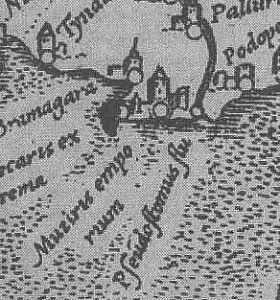
A section of the map of India drawn
after Ptolomy’s Geographia, showing Muziris emporium
5. An
indication of the importance of Muziris as a place for finalizing business
deals by Roman traders was brought to light by L. Casson , a scholar, in his
paper” New light on marine loans” .He mentioned about a papyrus (called P.
Vindob. G 40822 -for identification purposes ), discovered during the year 1985 in Vienna ,
which sets out the details of a maritime loan agreement between a ship owner –
possibly of the Hermapollon mentioned on the verso of the
papyrus – and a merchant using the ship as security. The
document suggests that the loan arrangement was agreed to while the
parties were in Muziris (though possibly signed on arrival at the Red Sea), indicating a rather active Roman merchant
colony on the Kerala coast
(http://www.uni-koeln.de/phil-fak/ifa/zpe/downloads/1990/084pdf/084195.pdf).
6. The
heightened trade between Greece/Egypt and India
came as a culmination of the trade relations that existed between India and the
West even centuries earlier to Christian era.
7. Historians
say Muziris, might be of significance in another way too. They say Christianity
may have been introduced to the sub-continent through Muziris.
8. The
successful run of the Greek/Egyptian trade with India suffered a temporary setback
due to the rise of a new Parthian Empire that formed a sort of barrier between
the Greeks and the Indians. However, when Rome
started to absorb the remnants of the Empire of Alexander, Egypt
came under the control of Romans. Egypt became a Roman province in 30
B.C. Thereafter, Augustus settled down and took charge of Egypt , as his
personal property.
Interestingly
, According to Pliny , writing in about 51 AD , the use of monsoon
winds to shorten the passage to /from India was made known to the Romans
only in the days of Claudius .( Pliny, N. H., 8, 101, 86). This
development, therefore, must have come around 51 AD. There was,
therefore, a long period of lull in the Egypt-India trade after 34BC.
9. The Roman
trade with India, through Egypt, began in earnestness in the first century AD. Muziris
then became an important Romans’ trading centre. The Rome/Egypt/India trade
lasted famously until about sixth century.
10. Then suddenly
and mysteriously, Muziris went off the radar. It was not mentioned again
for a very long time. Dr Roberta Tomber of British Museum
said.
“What is
interesting is that in the 6th Century, a Greek writer, writing about the
Indian Ocean , wrote that the Malabar coast
was still a thriving centre for the export of pepper – but he doesn’t mention
Muziris”.
No one has
a clue how Muziris disappeared so completely.
[ Please read Indo-Roman
trade by Ajoy Kumar Singh, Janaki Prakashan, 1988]

Regarding the
trade in South India, Prof. Hermann Kulke and
Prof. Dietmar Rothermund in their A History of India (Rutledge, London, Third Edition 1998-) write:
In the area
around Coimbatore, through which the trade route
from the Malabar Coast led into the interior of South
India and on to the east coast, eleven rich hoards of gold and
silver Roman coins of the first century AD were found. Perhaps they were the savings
of pepper planters and merchants or the loot of highwaymen who may have made
this important trade route their special target.
It also
indicates that the South Indian ports served as entrepôts for silk from China, oil from the Gangetic plains which were
brought by Indian traders all the way to the tip of South India, and also for
precious stones from Southeast Asia. But, as
far as the Eastern trade was concerned, the Coromandel Coast to the south of
present Madras soon eclipsed the Malabar Coast. To the north of Cape
Comorin (Kanya Kumari) there was the kingdom of the Pandyas where
prisoners were made to dive for precious pearls in the ocean. Still further
north there was a region called Argaru which was perhaps the early Chola
kingdom with its capital, Uraiyur. The important ports of this coast were
Kamara (Karikal), Poduka (Pondichery) and Sopatma (Supatama) (see Map 5). Many
centuries later European trading factories were put up near these places: the
Danes established Tranquebar near Karikal, the French Pondicherry, and the
British opted for Madras which was close to Supatama
B.Today
1.BBC News in
its edition of 11 June 2006 , reported an archaeological investigation by two
archaeologists – KP Shajan and V Selvakumar – has placed the ancient port as
having existed where the small town of Pattanam now stands, on India’s
south-west Malabar coast. The team believes Pattanam as the place where Muziris
once stood. Until recently, the best guesses for the location of Muziris
centred on the mouth of the Periyar River , at a place called Kodungallor
– but now the evidence suggests that Pattanam is the real location of Muziris.
http://news.bbc.co.uk/2/hi/south_asia/4970452.stm

2. Pattanam
is a small town some 12 km
south of the Periyar river mouth (present day Kodungallur) , in Kerala state. The
artefacts recovered from the excavation site include amphora (holding vessels)
of Roman make and Yemenis, Mesopotamian, and West Asian ones too, indicating
that Pattanam had trade not only with Rome but
also with places in the Persian Gulf . The
other artefacts recovered include pottery shards, beads, Roman copper coins and
ancient wine bottles.
http://www.hindu.com/lf/2004/03/28/stories/2004032800080200.htm
3.There is no
doubt that Pattanam was a major port and was important to the Indo-Roman trade
But more collaborative evidence is needed to support the view that Pattanam was
indeed Muziris.
http://www.hindu.com/2006/03/01/stories/2006030102540200.htm
4. The remote
sensing data revealed that a river close to Pattanam had changed its course
.The port may have been buried due to earthquakes or floods. This may perhaps
explain the disappearance of the Muziris port. However, there are no definite answers yet.
http://news.bbc.co.uk/2/hi/south_asia/4970452.stm
5.
Interestingly, while the excavations at Muziris are on, another set of
archaeologists from UCLA and University
of Delaware have excavated Berenike, a
long-abandoned Egyptian port on the Red Sea near the border with Sudan . The
team has uncovered the largest array of ancient Indian goods ever found along
the Red Sea , including the largest single cache of black pepper from antiquity
– 16 pounds
– ever excavated in the former Roman Empire .
Dr. Willeke
Wendrich, an archaeologist at the University of California at Los Angeles, said
the research showed that themaritime trade route between India and Egypt in antiquity appeared to be
even more productive and lasted longer than scholars had thought.
In addition,
it was not an overwhelmingly Roman enterprise, as had been generally assumed. The
researchers said artefacts at the site indicated that the ships might have been
built in India
and were probably crewed by Indians.
These again
confirm the trade relations that existed between ancient Egypt and India

http://mailman.geo.uu.nl/pipermail/maphist/2002-July/000840.html
http://historicalleys.blogspot.in/search?updated-max=2010-07-10T08:03:00-04:00&max-results=1&start=80&by-date=false


