Alexandria's founded by Alexander

Alexandria's founded by Alexander the Great (by year BC): 334 Alexandria in Troia (Turkey) - 333 Alexandria at Issus/Alexandrette (Iskenderun, Turkey) - 332 Alexandria of Caria/by the Latmos (Alinda, Turkey) - 331 Alexandria Mygdoniae - 331 Alexandria (Egypt) - 330 Alexandria Ariana (Herat, Afghanistan) - 330 Alexandria of the Prophthasia/in Dragiana/Phrada (Farah, Afghanistan) - 330 Alexandria in Arachosia (Kandahar, Afghanistan) - 330 Alexandria in the Caucasus (Begram, Afghanistan) - 329 Alexandria of the Paropanisades (Ghazni, Afghanistan) - 329 Alexandria Eschate or Ultima (Khodjend, Tajikistan) - 329 Alexandria on the Oxus (Termez, Afghanistan) - 328 Alexandria in Margiana (Merv, Turkmenistan) - 326 Alexandria Nicaea (on the Hydaspes, India) - 326 Alexandria Bucephala (on the Hydaspes, India) - 325 Alexandria Sogdia - 325 Alexandria Oreitide - 325 Alexandria in Opiene / Alexandria on the Indus (confluence of Indus & Acesines, India) - 325 Alexandria Rambacia (Bela, Pakistan) - 325 Alexandria Xylinepolis (Patala, India) - 325 Alexandria in Carminia (Gulashkird, Iran) - 324 Alexandria-on-the-Tigris/Antiochia-in-Susiana/Charax (Spasinou Charax on the Tigris, Iraq) - ?Alexandria of Carmahle? (Kahnu)
Showing posts with label Archelaus. Show all posts

Saturday, March 11, 2023

How Macedonian is a Macedonian shield?

When talking about Macedonian shields, our thoughts automatically turn to those carrying a 16-rayed star like the one on the lid of King Philip's golden larnax displayed at the Museum of Vergina. 

What should be simple and straightforward, in reality, isn't. 

The first king to use the Macedonian sun emblem may be Archelaus (413-399 BC), i.e., well before Philip II came to power. In Alexander's days, the number of sun rays varied from eight to twelve or sixteen. Alternatively, the center of the shield could be a disc that remained blank or was filled with a Gorgon's head, the face of Heracles, etc. Such a disc was usually surrounded by a varying number of crescents. Other shields may seem unadorned, but it has been documented that many were painted only. That would make sense when looking at the row of armor and shields lining the street in Dion. The monument was commissioned by Alexander after his victory at the Granicus. 

As I have come across many examples of shield decorations, either on paintings, reliefs, coins, or other works of art, it might be interesting to highlight some examples. 

For a start, today's flag of the Republic of Macedonia shows a sun with 16 rays, the so-called "Vergina-Sun." 

A bucranium found in Apollonia Pontica, modern Sozopol, Bulgaria, shows an eight-rayed star, which leads that country to claim that the origin of the "Vergina-Sun" is theirs (see: The Origin of the Macedonian star was Thracian?)

The excavations in Albania have so far yielded several examples of shields they call Illyrian but look very Macedonian at first glance. I was told that the difference with a Macedonian shield was the curving. Whether that is true or not, I don't know (see: Looking for Illyrian remains in Albania).

At the small Museum of Apollonia, Albania, I saw my first Illyrian shield from the 4th century BC that looked very much like the Macedonian one. A series of triple crescents surrounds the central Medusa head with shiny eyes.

The Skanderberg Museum proudly exhibits an Illyrian shield with similar half-crescents but with a six-rayed star at its center.

Two Illyrian shields are embossed on a leather belt buckle at the Archaeological Museum of Tirana. In this case, we see a central disc surrounded by respectively four and five larger double crescents. 

From the same period, a striking limestone mold for a leather shield cover was found in Egypt. It was made for the soldiers of Ptolemy in 330 BC. It has typical Macedonian features with a central Medusa head surrounded by triple concentric circles holding a small eight-rayed Macedonian star (see: Alexander's Legacy. Allard Pierson Museum in Amsterdam). 

The Tomb of Agios Athanasios from the era of Alexander has been attributed to a Macedonian nobleman. Although looted in antiquity, the narrow frieze above the entrance holds precious information about Macedonian daily life and its army in blazing colors. The lively scenes have been photographed in detail and digitally restored for all to examine at the Archaeological Museum of Thessaloniki (see: The Macedonian Tomb of Agios Athanasios in Thessaloniki). Of particular interest are the three shields, two of which show an eight-rayed star surrounded by a broad-colored rim. These shields are painted, as are other examples on the walls of grave monuments. It remains an intriguing question whether shields used in combat were painted as well. Color coding may have contributed to bringing soldiers of the same unit together. Still, I fail to see how Alexander's Macedonians would have carried paint to maintain the distinctive coding during the many skirmishes and battles.

A unique set of shields can be admired inside the Tomb of Lyson and Kallikles in Lefkadia, Greece (see: Alexander's schooling at Mieza). The one painted in the north lunette has a blue eight-rayed star at its center and is edged with a crown of leaves. The shield in the south lunette is defined as the 'familiar Macedonian' shield with an empty disc at its center and surrounded by eight crescents. The tomb is dated to c.250 BC. 

Another specimen is a bronze shield from the collection of the Getty Museum in Malibu, California. It definitely has a Macedonian look because of the central six-rayed star (see: A magnificent Greek shield). The inscription reveals that it was made in Pontus on the Black Sea for King Pharnaces I. Since we do not know when exactly Pharnaces died, we can only assume it was made between 160 and 154 BC, when his brother Mithridates IV succeeded him to the throne. 

From the cities that disappeared under the ashes of Mount Vesuvius after the eruption of 79 AD, I like the fresco from Boscoreale, now at the Archaeological Museum of Naples (see: Fresco of a Macedonian at Boscoreale). The painting, based on a mid-3rd century BC original, was retrieved from the Villa of P. Fannius Synistor and shows a scene in which the principal figure sits next to an eight-rayed Macedonian shield resting at his feet. According to some sources, it would depict Antigonus II Gonatas (the son of Demetrios I of Macedonia) with his mother, Phila, or simply be the personification of Macedonia and Asia/Persia.

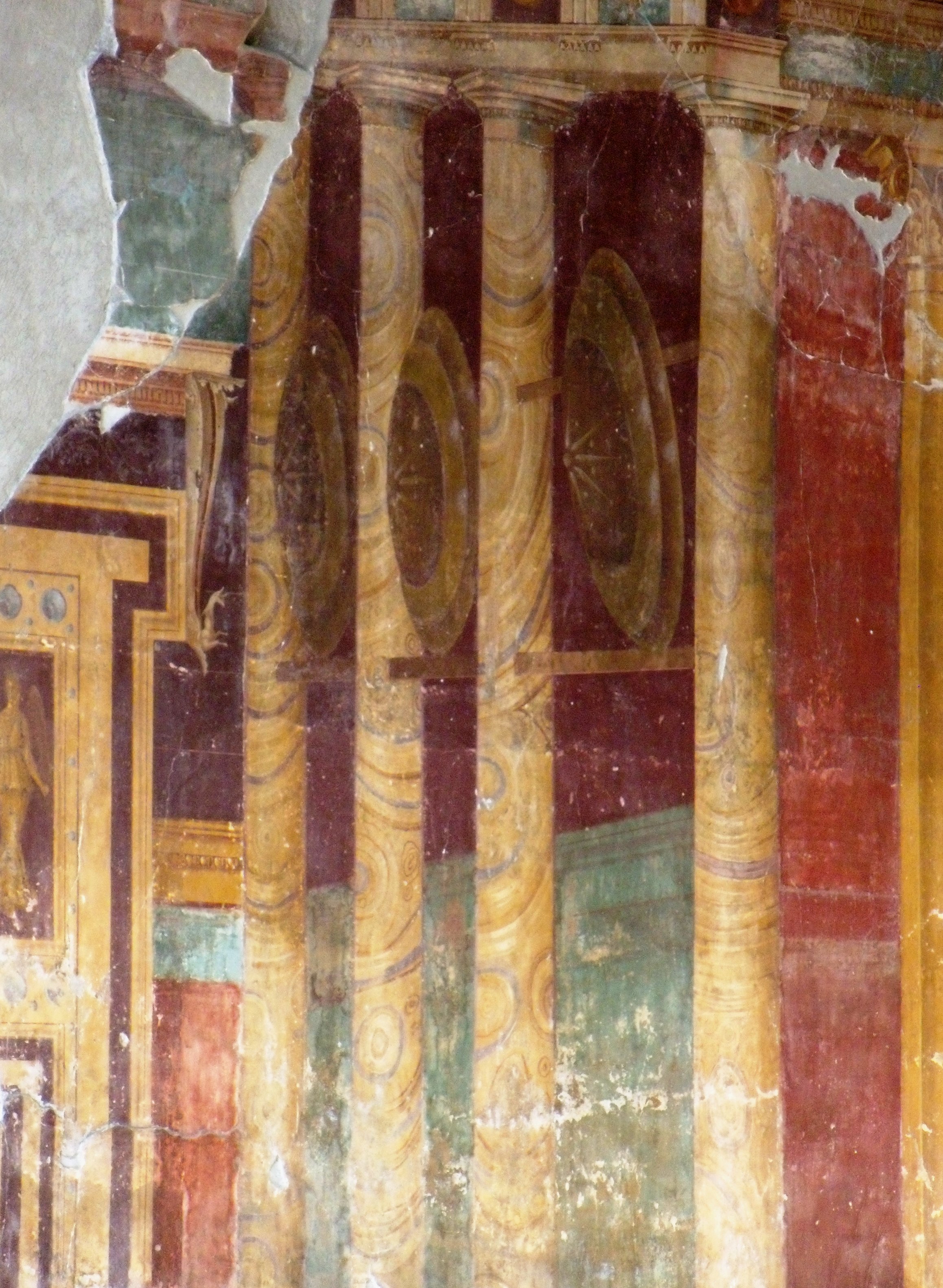
Another magnificent fresco is still in situ at the Villa of Poppea, Nero's wife, in nearby Oplontis. A life-size view of the Temple of Apollo with eight-rayed Macedonian shields painted between the columns covers a wall in the large sitting room. Wow! 

Later rulers and countries held Alexander and Macedonia in great esteem, and the Romans' admiration is an obvious example!

Sunday, September 30, 2018

A closer look at Euripides

Several years ago, most of the collection of Hellenistic art at the Louvre was housed in one of the larger ground-floor rooms. The lighting there was relatively poor, and in my memory, the statues were only touched by the changing moods of daylight.

There were no huge crowds in those days, although this is where we would find the Resting youth by Polycleitus; the elegant Aphrodite said to be a replica of Callimachus’ original; a young satyr playing the flute, a replica of an original Praxiteles; the touching elderly Faun holding a Child; a copy of Hermes attaching his sandal; the Hunting Diana in full swing; the Eros ready to shoot his arrow which is a replica of Lysippos as well as the famous Azara Hermes of Alexander the Great another replica of an original Lysippos, and several others. I often sighed that the statues were so dusty, itching to get some water and soap out to wash them off. Despite all this, the unique atmosphere in that half-lit room made you feel close to times long gone. 

Almost lost in a corner near one of the large windows stood the small statuette of a seated Euripides staring out into a world that was not his. However, it caught my attention because the back panel of this statuette listed 32 of his plays. Exhibited at eye level, I would read the titles one by one, and it was as if each name disclosed an entire shelf of papyri ready to be unscrolled.

Then the room was closed for years until the entire collection was moved elsewhere and arranged in a way that complied with the demands of today’s visitors, where each piece of art is highlighted in appropriate floodlights. There was, however, no trace of “my” Euripides, and I wondered what had happened to him. Maybe he was moved to a different room to fit another topic. Who knows?

Yet, all was not lost! At times, it takes patience, and the reward came last year when I visited a temporary exhibition at the Louvre-Lens called Music, Echoes from Antiquity. Many old musical instruments had been brought together, not only from the Greek and Roman era but also from Egyptian, Persian, Sogdian, Assyrian, and Sumerian times. To complement the instruments, several paintings, vases, reliefs, and statues represent the musicians in action.

For no apparent reason, it was here that I suddenly found my precious Euripides! The reason for this presence among the vases and small musicians was not obvious, except that Greek theater plays included choral songs that told the story. I was overjoyed to find my friend sitting in front of this oversized window presiding over his oeuvre.  

Euripides was by far the most prolific tragedian of his time, producing more than his contemporaries Aeschylus and Sophocles together. During his lifetime (ca. 480 - ca. 406 BC), he stayed in Pella at the court of King Archelaus, Alexander’s great-grandfather, and at least two of his plays were performed in Macedonia, one of which is the Bacchae. It tells the story of the  king of Thebes, Pentheus, who is killed by his mother and other women in a maenadic frenzy.

It seems no coincidence that the Bacchae is being performed this summer at the theater of the Getty Villa in Malibu, California. This production is directed by Anne Bogart (one of the three Co-Artistic Directors of the SITI Company and Professor at Columbia University)  and translated by Aaron Poochigian (who earned a Ph.D. in Classics from the University of Minnesota and an MFA in Poetry from Columbia University). This is an excellent opportunity to immerse ourselves in history and watch a play that Alexander must have seen more than once!

It is not surprising that Alexander grew up with an intimate knowledge and great love for theatrical performances, which he loved to organize all through his eastern campaigns – often inviting celebrated actors from Athens for the occasion.

Isn’t it amazing how much one small statuette has to tell?

Monday, August 26, 2013

About Greek theater plays

Whoever travels to Greece or Turkey cannot miss the ever-present remains of antique theaters, all in relatively good condition.  

The origin of theater tragedies goes back to the 6th century BC, thanks to the feasts that were held in honor of Dionysos, the Dionysia. For the first time in 534 BC, they are considered a permanent program element. Theaters are no longer exclusively used for religious performances but have become the place where the lives of heroes and half-gods are related. The tragic poet is the most essential element. He not only writes the tragedy but also expresses his songs as an actor, accompanied by 12-15 singers and dancers.

Aeschylus (525-456 BC) is the first author to break traditions by introducing a second actor to create a dialogue between two people. Although the choir is still essential, it is now pushed to the background. In those days, we discovered a difference between light comedy and tragedy, which treated the conflicts between men and the gods.

A third actor is introduced by Sophocles (405-406 BC), enabling the creation of intrigue between the other two persons. The choir at this stage serves only to support the action. When in 460 BC, Sophocles stops performing, an actual separation between writing theater plays and acting occurred.

The third playwriter was Euripides (ca. 480-405 BC), who spent several years at the Macedonian court in the days of King Archelaus, where he died. He must have written more than ninety plays, of which at least 20% have come to us more or less complete. His fame is because he actually wrote dialogues that sounded like spontaneous conversations instead of carrying the ritual contexts from older plays. In his lifetime, most of his public did not appreciate this "modern" style. Only after his death did he become the favorite of Athenian theaters.

It is evident that Alexander grew up with theater plays, as his father before him, as well as his ancestors, who all loved to watch a good play. From 449 BC onward, the Greek States chose plays with three main actors: the principal role was performed by the Protagonist, who in turn hired the supporting actors, i.e., the second actor, the Deuteragonist, and the third actor, the Tritagonist. The choir was not composed of professional actors but of civilians appointed by the city. The principal actors, however, were also allowed to compete for prizes in special competitions. The peak of acting was reached in the fourth century BC, and actors even became more important than playwriters. The most famous players went so far as to adapt parts of the play to match their egos or ambitions. In the heyday, actors were exonerated from taxes and military service. Thanks to their popularity, they enjoyed the admiration and protection of kings and the social elite. In return, the kings and the nobility entrusted them with significant political and diplomatic missions, by which the actors could make history away from the theater.

We will remember the Pixodarus affair when Alexander asked the tragic actor Thettalus to plead in his favor with the Carian satrap for his daughter's hand. By this maneuver, Alexander hoped to thwart his father's plan, who had offered his retarded son, Arrhidaeus, Alexander's half-brother, in marriage to the infant daughter of Pixodarus of Caria. Because of their political immunity, actors were often asked to act as mediators with rulers or politicians, and Alexander knew how to exploit that possibility. This time, however, Alexander had to pay a high price for interfering with his father's plans, as King Philip banished all Alexander's friends from Macedonia except Hephaistion.

In the summer of 331 BC, when Alexander installed himself temporarily at Tyre after leaving Egypt, he organized a grand celebration in honor of Melqart-Heracles. The kings of Salamis and Soli, who sponsored the event, hired the most celebrated actors of the day, including evidently Thettalus, who by now had become a personal friend of the king. Unfortunately for Alexander, Thettalus did not win the contest.

The same actor was again invited by Alexander in 324 BC when he organized the mass wedding in Susa, where he married the Persian princess Stateira (or Barsine). Her sister, Drypetis, was given to Hephaistion. Alexander's close companions were all married to girls from high Persian nobility. Eighty other couples shared the feast in a wonderfully idealistic dream to bring East and West closer together.

Tuesday, July 31, 2012

Alexander exhibition at the Louvre, Paris

« Au Royaume d’Alexandre le Grand. La Macédoine Antique. » Quite a mouthful for an exhibition, but definitely one that was worth seeing. Such a pity it ran for so short a period of time (from 13 October 2011 to 16 January 2012), and I wasn’t able to visit the Louvre till near the very end. Consequently, there was no point in sharing my impressions anytime soon.

I found the title of this exhibition rather confusing: was it about Alexander the Great, or was it about Macedonia? Well, in the end, it was about both, of course, but the accent was set around old Macedonia, and it was a well-deserved recommendation. Today, like in antiquity, it seems that Macedonia is some kind of stepchild, not entirely part of Greece or worthy to be part of it. The excavations of the past thirty years or so prove much to the contrary.

The very first excavations date back to 1861, when two French archaeologists (of course, we are referring to France and the French here!), Léon Heuzey and Henri Daumet made their first discoveries under the close watch of the Ottoman rulers. They uncovered the remains of the Royal Palace of Aegae, not knowing that this was Aegae, the old Macedonian capital, in what is called today Vergina. After that, we have to wait till after the First World War, when Konstantinos Rhomaios started new diggings in the area in 1920. He is the one who put Pella on the map, the second capital of Macedonia, about 25 kilometers further inland than expected because of the silting up of the Axios River. He also discovered several tombs in the Vergina area. By far the largest and most sensational discovery happened in 1977 when Manolis Andronicos localized the unspoiled Tomb of King Philip II, Alexander’s father. Huge quantities of precious gifts were found in his burial chamber as well as in the nearby tombs underneath this same tumulus. In the wake of this discovery, other promising diggings were generally started elsewhere.

Strangely enough, new finds show that the art in archaic Macedonia was closely akin to what we have seen in Mycenae, here only one hundred years later. Clear traces of this influence can be found mainly in the area of Pieria, in the westerly region. But meanwhile, it is obvious that the so-called Hellenistic art first and foremost originated here in Aegae and in Pella at the court of the Kings and in the houses of the Macedonian elite. As early as the 5th century, the Macedonian Kings attracted notable artists like Zeuxis of Heraclea, who decorated the Palace of King Archelaus, or Euripides, who wrote his Iphigenia in Aulis, Archelaus, and The Bacchantes here. Later on, we find more famous artists at the Court of Pella, like Lysippos, the official sculptor of Alexander, and Apelles, his official court painter; but also top painters like Aristides of Thebe or Philoxenus of Eretria. Even if the names had come to us, we still had no idea about the quality of their work till the now famous frescos in the Tomb of Persephone were discovered in Vergina; they give a totally unexpected image of their craft, in this case, the skills of Nicomachus of Thebe – a most lively and unique testimony. Wall paintings from the houses in Pella, on the other hand, turn out to be of such high quality and colour that they are considered as the precursors of the Pompeian style, which we meet in Pompeii – yet five centuries later!

The Louvre has done a thorough job with this exhibition, and they have not limited themselves to collecting a random number of objects from the Greek Museums. It all starts right at the entrance with a splendid copy of the pebble mosaic showing a lion hunt with Alexander on the left and Craterus to the right. A great welcome from the homeland, Macedonia!

I recently traveled through Macedonia myself, visiting many of the museums, and seeing all these objects over here was like meeting old friends again. Purely from memory, the following is what I remember having seen again in Paris (the Louvre didn’t allow any pictures!)

  • From the Museum in Aiani (Pieria), clay figures and vases;
  • From Vergina, silver jars, a bronze lamp, gold crowns with delicate leaves and flowers, or tied with Heracles’ knot;
  • From Amphipolis, a multicolored vase, a dashing terracotta dancer, and a true-to-life painted head of a terracotta woman;
  • From Polygoros, one of the arrows engraved with “Philippou”, i.e., with the compliments of Philip (used during the siege of Olynthus);
  • From Veroia, the intriguing bust of Olganos of Kopanos, which reminded me of Alexander;
  • From Pella, molds for terracotta statues and finished clay statuettes, pots, jars found around the Agora, earthenware roof decorations, and pieces of burial furniture in wood, bone, and ivory;
  • From Dion, a striking relief of Demeter;
  • From Thessaloniki where evidently most of the objects came from, with gold masks in the style of Agamemnon; bronze helmets with or without a gold trimming; an earthenware pyxis painted with a garland of flowers on a black background; gold jewelry like bracelets, necklaces, earrings, fibulae, etc; gold, silver and bronze coins; a lovely bronze medallion of Athena in high relief; the painted inside walls of a tomb; etc.
  • From the Louvre, a small bronze Alexander with a spear (not very resembling); a drum and capitals of columns from Aegae (brought back by Heuzey and Daumet but apparently never exhibited), which are now placed in the frame of a life-size drawing of the colonnades surrounding the central square of the Palace of Aegae. It’s as if you are truly walking inside. In the very center, I find the head of Young Alexander from the Museum of Pella.
Also, a showcase filled with Greek vases, bowls, drinking vessels, pots, and jars, all beautifully decorated, of course. And all around this on the walls, I recognize pictures of the frescos from different tombs in and around Vergina, Pella, and Lefkadia.

The Louvre has unveiled more hidden treasures from its catacombs, i.e., remains from the Palace of the Roman Emperor Galerius (305-311 AD), who promoted Thessaloniki to the capital of his tetrarchy. These are tall square marble pillars, approximately two meters high, with on the front and back a relief of a recognizable figure, like a Menead, Victory, Dionysos, Aura, Ariane, one of the Dioscuri, Leda with the Swan, and Ganymedes. The building to which the pillars belonged is called “Incantada” and once stood at the northern entrance to the Agora of Thessaloniki. This is all new to me and very revealing.

At this stage, I wonder why Alexander the Great is supposed to be the central personage of this exhibition, since, besides the head from Pella and the scanty bronze statue with the lost lance, I haven’t seen him. He turns out to be the surprise, probably meant to be the very climax … not very successful, if you ask me! When I’m about ready to leave, I discover a rather narrow window in a black box where Alexander is waiting for me. Gee, why cramp him behind this one window? They could have put him in a full-size showcase entirely made of glass, no? Anyway, this is where I find the true treasures of the entire exhibition (in my eyes, that is, of course), Alexander in person! For a start, there is the most striking Azara Hermes from the Louvre – after all, this is a copy of an original made by nobody less than Lysippos! Also, Alexander as Pan from the Museum in Pella, the Guimet Alexander from the Louvre, a torso that is being attributed to him, and an inscription from Thessaloniki, of which I remember nothing. And finally, at the very corner of this same dark showcase, a long, narrow glass étagère with the gold medallions of his Royal parents, King Philip II of Macedonia and Queen Olympias – precious pieces pushed aside in an almost forgotten corner. True sacrilege, I would say!

Sunday, October 9, 2011

Dion, the Macedonian Sanctuary

Dion, at the feet of Mount Olympus, has been Macedonian Sanctuary for eons. It was here that Alexander brought offerings to Zeus before crossing to Asia. It was here that his father, King Philip II, came to celebrate his many glorious victories. It was here that King Archelaos started brightening up the festivals with athletic and theatrical performances. But all Macedonian kings had one thing in common: they gathered here to sacrifice and bring offerings to the Olympian gods, whatever the occasion. Enough reason for me to take a close look at the place, not the least because of Alexander’s multiple visits.

Although Dion became part of a Roman colony founded by Emperor Augustus in the 1st century AD, the city managed to preserve its Greek character up to the Byzantine times. Yet, after a combination of natural disasters and repeated invasions by the Goths in the 5th century AD, Dion sank into oblivion.

The drive from Thessaloniki takes me south past the antique sites of Methoni and Pydna, past modern Katerini till mighty Mount Olympus looms at the horizon on my right, an unforgettable and most rewarding view!

Directions in and around Dion (modern Dio) are very clear. The town has been able to lead tourist traffic in such a way as not to interfere too much with the community's daily life. Not much has changed here except for a handful of souvenir stores and cafés. I decided to start with the Museum as it is said to close at 3 pm (the excavation site is open until 7 pm) - we are never sure what to expect when walking through a museum or an archaeological site, are we?

The Museum is not big but offers some interest, although I am still trying to decide whether to visit the Museum before or after seeing the antique Dion. I have done it both ways, once in 2006 and now in 2011, but it does not make the explanations any easier. I still have difficulty matching one with the other. Dion is a sanctuary, meaning, in fact, a collection of temples and altars ranging from the 4th century BC all the way to the 5th century AD. Even walking around Dion, it is very confusing to sort out the array of buildings, especially here at the Museum, where bits and pieces must match the remains in the field.


I pick out the pieces that most appeal to me: some statues (like that of Hygeia); heads (Demeter and Niké); funeral steles (Hunter with his dog and Mother and Child); slender funeral craters that are well preserved; terracotta statuettes (a lovely Macedonian boy); coins of all kinds and mainly Macedonian; glass beads and other pieces of jewelry; small ivory heads from funeral couches; mosaics (spiral mosaic from the Villa of Dionysos); and a superbly reconstructed hydraulic organ. I even spent some time checking out the inscribed slabs: like the Treaty between King Perseus and the Boeotians, a Letter that Philip V wrote to a certain Eurylochus, and the base for a statue of Cassander. Outside in the grass, I find a dozen or so Roman tombs with Greek inscriptions and, in the shelter of a portico, a stone tomb door, much like the one reconstructed at the Museum of Pella.

The Museum has no cafeteria, but I find the place across the street inviting enough. Their coffee (Greek) is excellent, and their toilets are clean. It is a good thing to take a short break to digest all the impressions before heading for the actual site of Dion, which is, in fact, within walking distance.

Obviously, this location was chosen by the gods in a broad flat valley under the watchful eye of snowcapped Olympus. Its icy waters ran and still run through Dion, and this holy river saved the city from plundering when it disappeared under two meters of water and mud after heavy earthquakes. We had to wait for centuries to put the town back on the map, as many pumps and sluice gates are still helping to keep our feet dry.

I start with the Greek theater, where a wooden reconstruction has been implemented, and the original layout is still visible. It was located outside the actual city walls and built during the reign of Philip V (221-179 BC). It looks out over a splendid park-like field, where Alexander pitched the tents to entertain his one hundred guests, friends, officers, and ambassadors from all over Greece to celebrate his departure for Asia. The huge Altar of Zeus, where he made his offerings, is situated near the other end, close to the Roman Theatre from the 2nd century AD. Not often can one come so close to Alexander as we can here.

I wonder if it was in this area that I should picture the famous bronze group made by Lysippos, Alexander’s dedicated sculptor. It represented and was dedicated to 25 cavalrymen who had fallen during the Battle of the Granicus, Alexander’s first victorious confrontation with Persia.

Evidently, the main god worshiped in Dion was the Olympian Zeus, after whom the city was named (the genitive of "Zeus" being Dios). The sanctuaries were used not only by the inhabitants of Dion but also served the religious needs of a more significant number of people during the festivals, with thousands of visitors. Here, the base of a large statue of King Cassander was found, now in the Museum. Various pilgrims' offerings were placed in the sanctuaries of Dion. At the Sanctuary of Olympian Zeus, inscriptions referred to important state affairs such as peace treaties, regulation of boundaries, honorary decrees, etc., some of which are now in the Museum. The Macedonians who crowded these festivals could read these texts and be informed – an official newspaper, in a way.

It is a most pleasant walk along the banks of the clear, fast-flowing stream where fish and crabs have found a home till I reach the Sanctuary of Demeter. This is the earliest Macedonian sanctuary known to date and was used uninterruptedly from the late 6th century BC to the early 4th century AD. For a layman, it is not easy to figure out the remains of walls and chambers, but with some effort, one can discern two small temples of the megaron type with an open antechamber and a cella. This is where most of the offerings were found, statuettes, lamps, vessels, beads, etc., which all indicate that an earth goddess of fertility was worshiped here, confirmed by an inscription referring to Demeter (4th century BC).

I now have to cross the lowest part of this cult area, which always seems to be more or less flooded – no wonder, when to my great surprise, I see the many springs bubbling up amidst the ruins! Reflecting in the water and amidst lush green growths lie the elegant Sanctuaries of Serapis, Isis, and Anubis that came to this region during the Hellenistic period thanks to the propaganda of the Ptolemies of Egypt. It is a pleasant sight to see how these statues bathe in the water or admire their mirror image. A metal bridge has been put in place so we can walk closely through this eerie setting. When I climb out of this depth, I pass a Byzantine wall where an unknown deity and the head of Aigle have been reused in its construction. How dare they!

Past the remains of the Roman city wall, I finally enter the city of Dion, which is generally Roman from the 2nd century. There is an entire network of streets along which many buildings, warehouses, private houses, and public baths have risen. A few of these constructions stand out, of course, for instance, the Roman Baths with parts of the mosaic floors and the hypocaust still in place, or the Polygon Villa with a 12-sided courtyard surrounded by columns giving access to the house. At the entrance, we can still admire the 3rd-century mosaic of wrestlers at practice, a very Roman portrait. Further down to the east, we find the remains of the Villa of Dionysos, which takes its name from the large mosaic depicting the god that covers the floor of the banqueting room. And then there is the set of reliefs showing very Macedonian cuirasses and shields that have been set up alongside one of the streets dedicated by Alexander after the Battle of the Granicus. In some places, you can even see sewage conduits underneath these streets. It always makes me wonder how we managed to lose this knowledge in our Middle Ages and had to entirely reinvent the system. If you look closely, you’ll also notice that many mosaic floors have been covered with plastic and gravel to protect them, but it’s so unfortunate that we cannot see them!

Dion is much less well-known than the Sanctuary of Delphi, for instance, but it is certainly not less inspiring. It definitely completes a thorough visit to Greek Macedonia. 

Monday, July 4, 2011

Philip's Boyhood - Macedonia forged by Philip II - 1

Philip’s boyhood (383-382BC)
Although we have a pretty good idea of what Macedonia looked like when Alexander succeeded his father in 336 BC, we have only a vague vision of this country when Philip became king some twenty years earlier. Since it was Philip who put Macedonia on the map to start with (something we generally tend to forget), I decided to investigate this chapter of history. Without his relentless efforts and strong ambition, he would not have succeeded – and let’s not forget his excellent judgment of characters and his evaluation of political and military situations, which have largely contributed to achieving his goal.

Macedonia was hardly a country to be reckoned with, and the only envy of the surrounding enemy tribes was its fertile lowlands. Greece as such did not exist yet, only leading city-states and dispersed bands of tribes constantly at war with one another. And Macedonia was no exception. However, the situation was going to change dramatically after the death of King Perdiccas III in 359 BC.

At that time, Macedonia covered a rather restricted area that started north of Mount Olympus and was squeezed between the valleys of the rivers Haliakmon in the west and Axios in the east, where they flow into the Thermaic Gulf. The most fertile part and the very heart of Macedonia was, of course, this rich coastal plain, also called Lower Macedonia, whereas Upper Macedonia stretched vaguely to the west into the remote cantons of the Illyrians. The Illyrians envied the good agricultural land and lush grasslands of the Macedonian floodplains and invaded the country on a more or less regular basis. It was during such an attack by the Illyrian King Bardylis that Perdiccas III was killed, and with him 4,000 brave Macedonian soldiers. This incursion left the door open for further invasions, for not only could the Illyrians push all the way down to the Thermaic Gulf, but neighboring tribes like the Paeonians from the north and the Thracians from the east could also seize this opportunity. And we shouldn’t forget Thebes, which was the dominant military power at that time, and Athens, which had an eye on several harbors up north serving as safe havens for their wheat ships on their way home from the Pontus Euxinus.


The situation in Macedonia at this point was rather dramatic. The borders were open game; its manpower was very much depleted with so many men killed in action, and to make things worse, they had lost their King and leader. Perdiccas’ son Amyntas, the heir to the throne, was only an infant, so all eyes were turned toward Philip, Perdiccas’ youngest brother, who, according to the ruling laws, should be named regent until Amyntas’ coming of age. However, hard decisions had to be made very quickly. Instead of being called to the regency, Philip, then 24 years of age, was proclaimed King by the Macedonian Assembly. King Philip II of Macedonia made his entry on the stage of history.

Now, who was this Philip? Philip was born in 383 or 382 as the third son of King Amyntas III and Queen Eurydice. The eldest son, Alexander II, lost the battle against mighty Thebes, which demanded the surrender of 50 sons of noble Macedonians as hostages, including his youngest brother Philip. Philip must have been about 13 years old at that time, just a year or so older than Alexander when he tamed Bucephalus when he was led to Thebes. He must have spent about 3 years there at the house of Pammenes, a leading general and statesman during the days that Thebes was the dominant power in Greece. According to Justin, Philip learned much about military strategy from Pammenes’ friend Epaminondas, especially when it came to the use of shock tactics and the combined attack from infantry and cavalry. He must have watched when the famous Sacred Band was training, the elite corps made of 300 Theban soldiers – supposedly 150 pairs of lovers who would fight to the death to defend their partner in battle. Epaminondas, despite Thebes being so far inland, also had solid plans to build a naval force to face mighty Athens in due time, a tactically important prowess that certainly was not lost on Philip. And there was the fact that Thebes was a polis, a true city with its benefits and shortcomings, something that was not known in Macedonia yet.


Although Philip was only a teenager, we should not forget that Macedonian princes learned by example. From an early age, they were trained in warfare, to admire courage and to aspire to excellence, schooled in the great battles of the Iliad, no doubt. Philip was no exception. We will remember how the story goes that Alexander, at the age of seven, inquired with the Persian envoys about their communication routes and their army. Philip would not have done less.


Living the daily life of a city like Thebes, Philip had witnessed the importance of military power, and although this was essential, he was also aware that a state needed to be unified and able to keep actual and potential opponents from uniting with others against him. Securing its borders was an important component of this complex pattern.

After the death of Alexander II (who was killed by his mother’s lover, Ptolemy), his brother Perdiccas III took over after murdering this Ptolemy, and during this time, Philip apparently returned to Macedonia. From the little that is known from that period, it seems that Perdiccas gave his brother part of his kingdom, probably not to rule in his place but merely to rule on his behalf. According to speculations, he would be entrusted with the territory of Amphaxitis, a strategic stretch of land between the Axios River and the Thermaic Gulf. At this time, Philip married his first wife, Phila, the daughter of Derdas II of Elimeia, probably a diplomatic alliance arranged by Perdiccas, as was his right as king. Macedonia was in turmoil, and Philip may have done his share in the fights to secure its borders, especially with the Paeonians and the Thracians. It is not impossible that he experimented with some of the military tactics he had picked up in Thebes.


So, when in 360/59 BC Perdiccas III was killed in a battle against the invading Illyrians, as mentioned above, Macedonia was faced with several threats to the kingdom’s security. And there was also the matter of succession to the throne since the dead king’s son, Amyntas, was still a youngster. The Athenians tried to interfere, pushing forward a certain Argaeus and the Thracians with a certain Pausanias who already marched towards the capital city of Pella. Given all these threats, the Macedonian Assembly unexpectedly proclaimed Philip as King, and the people swore their oath of allegiance to him. There is no question (according to Ian Worthington) that Philip was more experienced in military and administrative affairs than either the infant Amyntas or Philip’s three half-brothers (the sons of Gygaea), whose interference, if any, was inconsequential. It is possible that at this point Philip had his oldest half-brother, Archelaus, killed as a warning to the others who found shelter at Olynthus, which Philip besieged later on.

Click here to read the full story about Philip II from the beginning