Alexandria's founded by Alexander

Alexandria's founded by Alexander the Great (by year BC): 334 Alexandria in Troia (Turkey) - 333 Alexandria at Issus/Alexandrette (Iskenderun, Turkey) - 332 Alexandria of Caria/by the Latmos (Alinda, Turkey) - 331 Alexandria Mygdoniae - 331 Alexandria (Egypt) - 330 Alexandria Ariana (Herat, Afghanistan) - 330 Alexandria of the Prophthasia/in Dragiana/Phrada (Farah, Afghanistan) - 330 Alexandria in Arachosia (Kandahar, Afghanistan) - 330 Alexandria in the Caucasus (Begram, Afghanistan) - 329 Alexandria of the Paropanisades (Ghazni, Afghanistan) - 329 Alexandria Eschate or Ultima (Khodjend, Tajikistan) - 329 Alexandria on the Oxus (Termez, Afghanistan) - 328 Alexandria in Margiana (Merv, Turkmenistan) - 326 Alexandria Nicaea (on the Hydaspes, India) - 326 Alexandria Bucephala (on the Hydaspes, India) - 325 Alexandria Sogdia - 325 Alexandria Oreitide - 325 Alexandria in Opiene / Alexandria on the Indus (confluence of Indus & Acesines, India) - 325 Alexandria Rambacia (Bela, Pakistan) - 325 Alexandria Xylinepolis (Patala, India) - 325 Alexandria in Carminia (Gulashkird, Iran) - 324 Alexandria-on-the-Tigris/Antiochia-in-Susiana/Charax (Spasinou Charax on the Tigris, Iraq) - ?Alexandria of Carmahle? (Kahnu)
Showing posts with label Agathocles. Show all posts

Monday, October 2, 2023

The Attalids, rulers of Pergamon

The Attalid Dynasty of Pergamon started with Philetairos in 282 BC, roughly fifty years after the death of Alexander

It remains difficult to imagine the wealth Alexander had accumulated from his conquest of Asia.  The rise of the Ptolemaic and Seleucid dynasties can hardly be compared to that of Lysimachos, who did not draw the best cards. The War of the Diadochi was a very intricate and complex bickering and conniving from which all parties did not profit equally. However, Lysimachos put his share of the booty to good use and his trusted treasury keeper, Philetairos, did the same giving Pergamon the jump start it needed.

The starting date of the Pergamon Dynasty is much later than for the empires of  Seleucos in 312 BC, and Ptolemy in 305 BC founded at the end of the War of the Diadochy

Philetairos was a eunuch who had served under Antigonus Monophtalmos. In 302 BC he deserted him to join Lysimachos, the king of Northwest Asia Minor. At the death of Antigonus, Lysimachos rewarded Philetairos for his loyalty by putting him in charge of his treasury (inherited from Alexander) in Pergamon

But when Lysimachos, upon the instigation of his wife, murdered his only son, AgathoclesPhiletairos joined Seleucos I. Soon afterwards, Seleucos’ forces murdered Lysimachos leaving Philetairos to rule Pergamon until 263 BC. Seleucos granted him great autonomy, which enabled him to expand his territory. Unable to have children of his own, Philetairos had adopted his nephew, the future Eumenes I, who would succeed him in 263 BC. 

One year into his kingship, Eumenes defeated the Seleucid King Antiochus near Sardes, which enabled him to create an independent city-state of PergamonEumenes did not have children either and the throne went to his nephew and cousin, Attalus, who went down into history as Attalus I SoterAttalus ruled from 241 to 197 BC and many historians still consider him as the founder of the Attalid Dynasty, with Pergamon as its capital. 

The reign of Attalus I was all but peaceful. The Seleucids had lost power over Lysimachos' territories of Pergamon, Bithynia, Nicomedia, and Cappadocia, which gained their independence. Attalus expanded his territory but lost much of it to Seleucos II later on. However, he managed to save Pergamon from the attacks of the Galatians on his northern border and to establish friendly relations with the Romans. That’s how he got involved in the Second Macedonian War (200-197 BC), which opposed the weakening kingdom of Macedonia to Rome, as an ally of Pergamon. Attalus suffered a stroke during peace negotiations in Thebes and was brought back to Pergamonwhere he died in 197 BC. 

Eumenes II took over where his father left off but mingling in the affairs of the Seleucids in Syria did not sit well with the Senate of Rome. No reason for Eumenes to be distracted from carrying out his own large expansion program in Pergamon, where he built the unique Great Altar and the massive Library, second only to that of Alexandria. The Romans resented the power and independence Eumenes displayed, which in their eyes reduced their own sphere of influence in Asia Minor. Sadly, although still in his early sixties, Eumenes’ health began to deteriorate, and he appointed his brother Attalus II as a co-ruler. One year later, in 159 BC, Eumenes died. His own son was still an infant, and consequently, Attalus II, who conveniently married his widow, became the new king. He also adopted his brother’s young son, who was to become the future Attalus III

Attalus II continued Eumenes’ building projects in Pergamon, this time including the Palace. He also funded the construction of a new temple to Hera Basileia between the lower Agora and the Gymnasium. 

He was familiar with the political situation he inherited. He had no real enemies and was careful to recognize the authority of Rome. Instead of going to war, Attalus II expanded his influence by spending lavish amounts of money on prestige projects. For instance, he contributed to the construction of a splendid Stoa in the Agora of Athens, at the foot of the Acropolis. This is the Stoa of Attalus II, which was restored/ reconstructed by the American School of Classical Studies in the early 1950s. Another Stoa carrying his name was built in Termessos next to the Corinthian temple.

As always, all kinds of taxes were raised to pay for these grand expenses, but Attalus equally improved trade in his kingdom, building markets and safe harbors. He certainly needed reliable access to a harbor, and Attalus attempted to subdue Side. In the wake of this failed attempt, he added part of Pamphylia to his kingdom, where he founded an entirely new port. He named it Attaleiaafter himself, i.e., modern Antalya. Attalus II died at the blessed age of 81 or 82 in 138 BC. 

His successor was his nephew and adopted son, Attalus III. However, the new king was not interested in his kingship or in Pergamon. No wonder that he was rather unpopular among his citizens. When he died five years later of disease, he bequeathed Pergamon to Rome, which made it the capital of their Provincia Asia.

Although there may have been one last pretender to the throne, a supposed illegitimate son of Eumenes II, the Attalid Dynasty came to an abrupt end in 133 BC. 

In hardly 150 years, the Attalids had built one of the greatest Hellenistic centers for culture and art, mainly under the reigns of Eumenes II and Attalus II, which still intrigues us.

The end of Pergamon was all but glorious. After being hit by a severe earthquake in 262 AD, its decline was set in motion. The Muslims sacked what remained standing during their raid of 663 AD. More setbacks followed after the conquests by the Byzantine Empire and around 1300 AD by the Ottoman Empire. Slowly, the majestic site deteriorated to the point it was abandoned and forgotten until the first explorers of the 18th and 19th centuries rediscovered Pergamon.

Friday, February 17, 2023

An introduction to Pyrrhus of Epirus

It was quite a surprise to stand face-to-face with Pyrrhus in Albania. It happened at the entrance to the Skanderberg Museum in Kruje, where his life-sized bust stood right next to the imposing relief figure of Skanderbeg, Albania’s hero. 

Pyrrhus of Epirus was a great-nephew of Olympias and cousin of Alexander the Great – not a small introduction. He was born in c.319 BC – not the right time to be the heir to the Molossian throne of Epirus. He got caught up in the fiery dispute between the sons of Cassander and Thessalonica, and, reigning briefly as a minor, he had to flee his homeland. He joined the court of Demetrios I (Poliorketes) as an exile, and in 301 BC, aged 18, he fought at the Battle of Ipsus

As a pawn in the War of the Diadochi, Demetrios, to befriend Ptolemy, gave him Pyrrhus as a hostage. That’s how Pyrrhus arrived in Alexandria. Well, it was not the worst place to grow up, and Pyrrhus most certainly took advantage of the situation, not unlike what Philip II had done at the court of Thebes. He made his way in Egypt and eventually married one of Ptolemy’s daughters, Antigone

Four years later, in 297 BC, with Ptolemy’s support, Pyrrhus returned to Epirus and began taking control of his own life. He started expanding his kingdom by annexing Illyria. His ambitions were not small, for when Antigone died, Pyrrhus made three diplomatic marriages to live peacefully with his neighbors. His first wife was Lanassa, the daughter of Agathocles, tyrant of Syracuse. Her dowry was the islands of Leucas and Corcyra (modern Corfu). The next bride was the daughter of King Audoleon of the Paeonians living north of Macedonia. His third marriage was to Bircenna, daughter of the Illyrian King Bardylis II. Demetrios Poliorcetes as king of Macedonia, it should be said, had married Pyrrhus sister. 

By 288 BC, Pyrrhus turned against Demetrios and succeeded in getting the Macedonian army on his side. With Lysimachos as his new ally, they jointly ruled over Macedonia. Only for a while, though, since Lysimachos still had his mind set on all of Macedonia and expelled Pyrrhus. 

Once more, Demetrios and Pyrrhus made peace, which was again short-lived. When in 286 BC, Demetrios invaded Asia Minor, ruled by Lysimachos, the latter asked Pyrrhus to invade Thessaly to attack Demetrios from GreecePyrrhus soon defeated Antigonus GonatasDemetrios’ son, who surrendered Thessaly to him to make peace. 

Pyrrhus’ empire now included half of Macedonia, larger Epirus, and Thessaly. Yet, he still wanted more and eyed Magna Graecia, including the wealth of Sicily. His opportunity arose when Taras (modern Taranto) called for his help to repel an imminent Roman attack. Pyrrhus led his army across the Adriatic Sea, including 20 war elephants. He was victorious at Heraclea (modern Policoro, southwest of Metaponto) in 280 BC and a year later at Ausculum (modern Ascoli Satriano south of Foggia)

At this point, Pyrrhus decided to stay in Italy, offering his help to Syracuse. He successfully lifted the Carthaginians’ siege in 278 BC and, in return, was proclaimed King of Sicily. The Medagliere, the strongbox room at Syracuse’s Museum, proudly exhibits coins of King Pyrrhus

His moment of glory would not last either because of the renewed threat from Carthage, ending Pyrrhus siege of Lilybaeum (modern Marsala) in a disaster. The people of Syracuse then decided not to continue the war. The Carthaginians defeated Pyrrhus in 275 BC on his return to Syracuse

At the end of that same year, Pyrrhus sailed back to Epirus, which, in his mind, offered new opportunities as his son, Ptolemy, tried to expand the kingdom. The next campaign took Pyrrhus to Argos in the Peloponnesus, where caught in a narrow street, he was killed by a woman who threw a tile from the housetop. 

This was not the death a man like Pyrrhus would have planned. He had fought in so many battles, always leading his men. He had been schooled by Demetrios Poliorketes, who had walked in the footsteps of Alexander and his father, Philip. He was not meant to die such an inglorious death. 

In the 2nd century AD, Pausanias witnessed a memorial to King Pyrrhus at Argos, integrating a panorama ‘carved in relief.’ The king was buried in his capital, Ambracia (a colony of Corinth in Epirus). 

Pyrrhus may have led a glorious life, but the Macedonians resented him because he let his Gauls plunder the tombs of the Macedonian kings at Aegae – an unforgivable crime!

Sunday, December 21, 2014

Alexander’s presence in Ephesos

Picturing Alexander walking through the streets of Ephesos is relatively easy. When he arrived, most cities of Asia Minor were occupied by armed forces and notables loyal to the Great King. The population generally was known to have amicable relations with Macedonia. In Ephesos, they even erected a statue in honor of King Philip II, Alexander’s father.

Three days after leaving Sardes, Alexander arrived in Ephesos and was received with open arms. He immediately expelled the pro-Persian oligarchy and installed a democratic government. Now that the people felt liberated from their political masters, they didn’t waste time putting the collaborators to death. Some victims had sought refuge inside the temples and were now being dragged outside and stoned to death. Alexander reacted immediately, realizing that if he didn’t stop this rage immediately, the vengeance offensive would run out of control, and innocent citizens would be killed. He halted this revolt with a firm hand. The people of Ephesos listened, and Alexander’s popularity never stood higher than after his intervention.

The city probably became a member of the League of Corinth, which meant that it was subject to Macedonian rule and had to pay the tribute previously granted to Persia. In reality, this tribute went to the reconstruction of the famous Temple of Artemis, which was burnt down the night Alexander was born, set afire by a certain Herostratus who wanted his name to be remembered for eternity. A new temple was now under construction, and Alexander initially suggested it should be dedicated to him, but the Ephesians refused. The Artemis cult was old, going back to the worship of Cybele, and probably reached the first Greek settlers around 1000 BC. Artemis was the virgin goddess of nature who assisted women in delivering their babies. She was represented with many breasts (linked to the fertility cult) and a miniature temple on her head as a crown. The three stories of the crown indicated that she protected the cities, while the sickle on her forehead referred to the moon goddess. She also wore the symbol of the bee, i.e., the emblem of Ephesos, indicating that she originated from Anatolia.

The first Temple of Artemis goes back to the 7th century BC, and after its destruction, it was rebuilt on an unheard-of scale. The new temple rested on a plinth of 13 steps, and the sanctuary itself, measuring 115x55 meters, was surrounded by a double row of 18-meter-high Ionic columns, 127 in total. The 36 columns on the front side are said to have been decorated with reliefs by Skopas, while nobody less than Praxiteles built the altar. After its reconstruction, it became one of the Seven Wonders of the Ancient World.

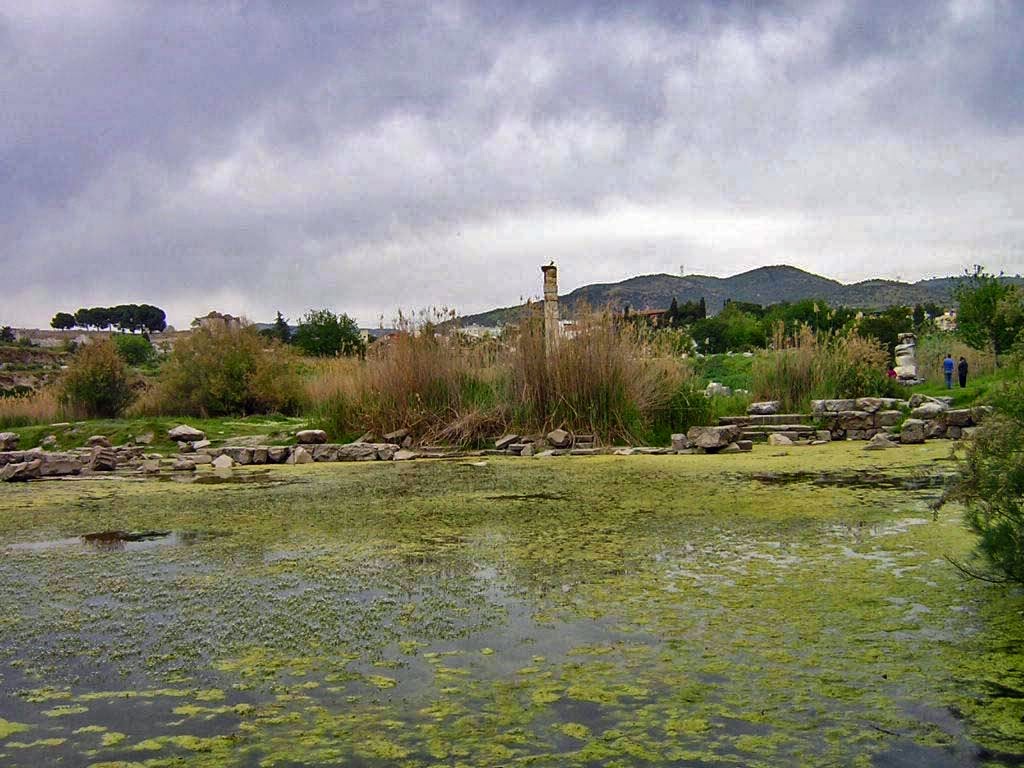
Unfortunately, all that is left today are some flooded foundations and a single not-too-well-reassembled column. The scattered remains go back to the time of Lysimachos, one of the generals and successors of Alexander the Great in the 4th century BC. In Alexander’s days, the city was centered on the Artemision. Lysimachos chose the location for the new town, which he surrounded with defensive walls. The place looks wild and overgrown, an eerie picture accentuated by the cackling chickens and screaming geese on the adjacent farm. At one time, even the gods made sure I heard them. The sky had turned pitch dark, and soon enough, the thunder rumbled while lightning flashes tore the clouds apart. A sign from Zeus, no doubt, but not from Artemis. Strangely enough, I was not surprised by the god’s manifestation.

After twenty years of rest, new excavations started again in 2014 because this year’s drought made the ruins far more accessible. Archaeologists hope to find remains from the Roman era, which may answer whether this famous temple was converted into a Christian church. In its present condition, it is not drawing much interest from tourists, but this may change when enough of the layout is exposed. After all, the sanctuary occupies the size of a football field, something worth considering, right?

Pausing at the edge of the poorly excavated parcel, I wonder about the traders, tourists, craftsmen, and kings who visited this temple over the centuries when it was a market and a religious center. They all came to honor Artemis and to share their profits with her. Excavations have shown that many people came to offer their gifts: gold and ivory statues of Artemis, but also earrings, bracelets, and necklaces from faraway countries like Persia and even India. An excellent collection of these gifts can be seen at the local Museum of Selçuk.

The temple may not have been finished when, in 268 AD, the Goths raided the city, destroying or partly destroying it. In 614, Ephesos was hit by an earthquake, severely damaging the buildings. The town lost its importance as a commercial center, aggravated by the silting up of the Cayster River that constituted its harbor.

While he was in Ephesos, Alexander received representatives from the towns of Magnesia and Tralles offering their submission. Parmenion was dispatched with a force of 5,000 foot soldiers and 200 Companion cavalry to ensure recognition by all Aeolian and Ionian towns in the area. At the same time, Alcimachus, son of Agathocles, set out with an equal force. They established a popular government replacing the existing Persian rule, ensuring that all would keep their own laws and customs and pay their taxes to Alexander instead of to the Persians.

Alexander, meanwhile, stayed in Ephesos and offered sacrifices to Artemis. It is probably at this time that he frequently visited the studio of Apelles, who became the only painter allowed to paint pictures of Alexander. We know of at least one painting made especially for the Temple of Artemis, in which Alexander was represented holding a thunderbolt. Apelles depicted the King using only four colors to create a more wondrous work. Alexander also organized a ceremonial parade of his troops in battle order, wearing their best outfit. He definitely knew how to put up a show!

Leaving the temple area, I drive up the nearby hill where it is said that the Virgin Mary spent her last days. From here, I have an eagle’s view of Roman Ephesos. In 190 BC, the city was included in the Kingdom of Pergamon, which, in turn, was incorporated into the Roman Empire in 133 BC and the later Byzantine Empire. In the early days of Christianity, Ephesos was still significant, if only because Apostle Paul lived here, as well as Apostle John, who is said to have taken care of Mary, who is buried here.

Of course, the Romans turned Ephesos into the largest seaport of the Aegean, which prospered till the harbor silted up, leaving the grand city about 6 miles inland from the coast. The most remarkable monument from those times is the Temple of Hadrian with the Baths behind it, the Fountain of Trajan, the Library of Celsus, and the magnificent villas (see: Ephesos and its terrace houses and The Grandeur of Ephesos).