Alexandria's founded by Alexander

Alexandria's founded by Alexander the Great (by year BC): 334 Alexandria in Troia (Turkey) - 333 Alexandria at Issus/Alexandrette (Iskenderun, Turkey) - 332 Alexandria of Caria/by the Latmos (Alinda, Turkey) - 331 Alexandria Mygdoniae - 331 Alexandria (Egypt) - 330 Alexandria Ariana (Herat, Afghanistan) - 330 Alexandria of the Prophthasia/in Dragiana/Phrada (Farah, Afghanistan) - 330 Alexandria in Arachosia (Kandahar, Afghanistan) - 330 Alexandria in the Caucasus (Begram, Afghanistan) - 329 Alexandria of the Paropanisades (Ghazni, Afghanistan) - 329 Alexandria Eschate or Ultima (Khodjend, Tajikistan) - 329 Alexandria on the Oxus (Termez, Afghanistan) - 328 Alexandria in Margiana (Merv, Turkmenistan) - 326 Alexandria Nicaea (on the Hydaspes, India) - 326 Alexandria Bucephala (on the Hydaspes, India) - 325 Alexandria Sogdia - 325 Alexandria Oreitide - 325 Alexandria in Opiene / Alexandria on the Indus (confluence of Indus & Acesines, India) - 325 Alexandria Rambacia (Bela, Pakistan) - 325 Alexandria Xylinepolis (Patala, India) - 325 Alexandria in Carminia (Gulashkird, Iran) - 324 Alexandria-on-the-Tigris/Antiochia-in-Susiana/Charax (Spasinou Charax on the Tigris, Iraq) - ?Alexandria of Carmahle? (Kahnu)
Showing posts with label Miletus. Show all posts

Saturday, May 23, 2026

Hecate, an ancient Greek goddess still honored today

Hecate is a very recognizable goddess, the only one to be depicted with three heads or three bodies, as her realm includes the heavens, the earth, and the sea. Since she could easily move from one to the other, she was known to be the guardian of crossroads. That is where we often find her striking statues, but also at cemeteries, as she was associated with communication with the dead. 

A very well-preserved example of Hecate is this statue made in Italy after an original created by the sculptor Alcamenes between 430 and 420 BC for the Acropolis in Athens, where she marked the transition from the sacred hill to the rest of the city. 

Hecate’s roots go back 8,000 years, when she was seen as ‘the guardian of the threshold’, standing at city gates, for instance. In the figurative sense, she became an inner guide to those coping with a personal crisis. 

Hecate had her own temple, and the largest is to be found in Lagina, near the modern city of Muğla in southwest Turkey. It stood in the center of the sacred precinct and dates to the 2nd century BC.  Her sanctuary invites even today’s visitor to look beyond the archaeological site to find a place of profound energy. 

The frieze that ran around the temple walls can now be seen at the Archaeological Museum of Istanbul, where the scenes are astutely presented high above the ground to mimic their original placement. We recognize mythological scenes, including the life of Zeus and the Carian gods, as well as scenes of Gigantomachy and Amazonomachy.

In Hellenistic times, the Seleucids expanded the sanctuary to become one of the most important in Caria. Lagina continued flourishing under Roman rule. Emperor Augustus helped rebuild the sacred shrine after it was damaged by a Parthian attack in 40 BC. Thereafter, the Romans popularized the Temple of Hecate by creating a yearly festival that attracted people from all over the Empire. 

Lagina kept its importance until it was destroyed by the catastrophic earthquake of 365 AD that hit the entire Eastern Mediterranean. The rise of Christianity led to building a large Basilica on the ruins between the central altar and the Temple of Hecate. It is known to have served until the 6th century AD. 

Lagina was connected to nearby Stratonikeia by a Sacred Road, 8.5 kilometers long and about 3.5 meters wide. This situation clearly reminds me of the Sacred Road that linked Miletus to Didyma (see: Miletus, Alexander’s first siege in Asia). A similar stone-paved road was lined with Nymphaea and wells, and dotted with small settlements offering comfort to the pilgrims. Yearly processions in honor of Hecate were organized between Stratonikeia and Lagina, beside the grand religious festivities that were held every four years, like those between Miletus and Didyma. 

Unique and significant was the key-carrying ceremony that symbolized the ability to move between life and death, the conscious and the unconscious, the old and the new. A young girl, the key-bearer, would carry a sacred key between Lagina and Stratonikeia, accompanied by a choir of young girls singing hymns. They would enter the sanctuary and start religious ceremonies. At this point, the gates of the temple would be opened by the key-bearer as the participants would take their places on the steps along the western edge of the sanctuary to attend the ceremony. 

Amazingly, even today, Lagina continues to be a place of pilgrimage where many visitors still bring their offerings of pomegranates, apples, wheat, garlic, and, occasionally, even fish. Archaeologists do not support this kind of gift as they fear damaging the fragile ruins. 

All in all, today’s visitors have their own way to interpret the worship of Hecate. It must be said that the journey feels very symbolic because her temple of Lagina stands close to a power plant, near a three-way junction. The location still underscores the role of the goddess of the crossroads. 

Although initially, Hecate was known for positive qualities as a protector, a source of wisdom, and a cosmic force, modern pilgrims and devotees particularly revere Hecate as a goddess of pathways and a bringer of light. 

What a beautiful support and safe haven in our troubled world!

Wednesday, February 14, 2024

The Periplus of the Euxine Sea by Arrian – Part 3

In this last part of the PeriplusArrian takes us from Dioscuras/Sebastopolis to Byzantium. 

He starts his story where he left off at the conclusion of part 1, i.e., in Sebastopolis (see: Tour of Colchis: From Trapezus to Sebastopolis). This section, the Cimmerian Bosporus, was not controlled directly by Rome but by a so-called client king. In Hadrian’s day, that was Cotys II, in full Tiberius Julius Cotys, who ruled from 123/4 AD until he died in 131/2 AD. His appointment was made for life, and his successor needed to be officially recognized by Rome. 

At the news of his death, Arrian decided that Hadrian would be interested in having the latest information about the Bosporan Kingdom since it supplied a great deal of wheat, clothing, wine, and slaves. His territory was also an important buffer zone with the warlike Alans living to the north. 

Arrian sailed along the mountainous coastline below the Caucasus to Pityus, some 65 kilometers away. These lands were occupied by the Zilchi, ruled by a certain Stachemphax, also recognized as a king by Hadrian. Follows a list of cities, harbors, and rivers, including the distances between them, from Crimea to the mouth of the Danube River. More familiar are the Greek cities on the south coast of Crimea, such as Panticapaeum (Kerch), Theodosia, Cercinitis, and Chersonesus (Kherson). Panticapaeum, which lies only 11 kilometers from the Tanais River (modern Don River) and flows into Maeotis Lake (Sea of Azov) was seen as the place where Europe ended and Asia started. 

Sailing further west, Arrian stops at the Greek city of Olbia at the mouth of today’s Dnieper River. Next, he heads for the harbor of Odessos, a trading post founded by the Greeks from Istria. From here, he continues to the wide delta of the Ister River (Danube), where he reaches the Island of Achilles or Leuke (possibly Snake Island in Ukraine). Legend has it that Thetis gave it to her son. The island was known for its Temple of Achilles, which held a wooden statue of the hero, as well as Greek and Latin inscriptions in honor of Achilles and his dear PatroclusArrian speaks of many offerings that were made, including sacrifices of animals. Those who sail by the island may “see” Achilles in their dreams or hallucinations. 

Proceeding further down the coast of the Black SeaArrian arrives at Tomis, a colony founded by the Greeks, where Emperor Augustus banished the poet Ovid. The next port was Callatis, established by the Carians, followed by Odessos (another harbor by that name), where he entered Thracia. 

Passing the eastern end of the Haemus Mountains (in central Bulgaria), Arrian reaches Miletus colony of Apollonia, which once held a colossal statue of the god Apollo. From here, he sailed to the not-so-good harbor of Salmydessus (roughly 150 km east of Hadrianopolis, modern Edirne), where Xenophon helped Seuthes II to become King of Thracia. 

By now, Arrian has landed on the Thracian side of the Bosporus. This area is reputed for the Cyanean Islands or Symplegades (also Clashing Rocks), a pair of rocks that clash together when a ship sails through. In Greek mythology, the rocks were defeated by Jason on his way to Colchis on board his ship, the Argo. 

Byzantium is Arrian’s final destination. He concludes by mentioning the local Temple of Zeus Ourios (who grants favorable winds), where Jason and the Argonauts erected an altar to the Twelve Olympian Gods on their return from Colchis. 

In our modern days of traveling by plane and high-speed trains, it is hard to imagine the pace in antiquity when people and armies moved on foot. Ships and barges were a comfortable alternative, although winds and currents were not always reliable. Travelers could never predict the duration of a trip or the time of arrival, but in those days, time was not so much of the essence as it is today. 

Though Arrian wrote his Periplus 130-131 AD, we don’t know how many months or weeks he actually spent at sea. Considering that the circumference of the Black Sea is over 4,000 kilometers, it may be safe to speculate that he spent most of those two years “on the road”. Quite an achievement!

[For the locations, please consult this map]

Tuesday, January 30, 2024

Zopyrion, governor of Thracia in Macedonian service

Thracia had been annexed by Philip II in his efforts to extend the power of the Macedonian kingdom and to safeguard its borders. After his death, Alexander had to stamp his authority and his rule over the many tribes once again, all the way to the mighty Danube River to protect his back before setting out to Asia. 

One would expect the northern tribes to live happily ever after, especially since Alexander took a substantial contingent of Thracians with him as far as India and back under the command of their general Sitalces (see: Sitalces, commander of the Thracians). 

However, the many Thracian tribes never united and kept fighting among themselves, putting their individual interests above all. It was one of Antipater’s tasks, as Regent of Macedonia, to enforce the peace. 

Ancient historians have left us very little information about what happened in Alexander’s homeland while he moved further east. One governor of Thrace is known as Zopyrion. His name caught my attention after seeing the picture of a helmet found in Olanesti, Moldova, that is linked to Zopyrion’s army. 

Unfortunately, the only reliable source of Zopyrion comes from Curtius. He simply stated that the governor made an expedition against the Getae and that his army was overwhelmed by sudden tempests and gales. He allegedly lost 30,000 men - a figure that is probably exaggerated. At that time, about 324 BC, Alexander was in Persia, facing the misconduct of many satraps he had left in charge before moving on to Central Asia. 

However, another, much less trustworthy story is told by Justin. This one circulates widely on the internet, mostly repeating the content of the Wikipedia page. 

Justin, in full Marcus Junianus Justinus, probably lived in the 2nd/3rd century AD and got hold of the 44 books called the Philippic Histories by Pompeius Trogus that are now lost. Justin decided that Trogus’ history was far too voluminous, and he wrote his own abridged version. Sadly, accuracy was not Justin’s strong point, and he was not very concerned about his sources or the chronology of the events, already a weak point in Trogus’ account. 

As a result, the vivid description found on Wikipedia and the like is fraudulent with pitfalls. Here, Zopyrion is said to have assembled an army of 30,000 men. He started his march along the southern banks of the Black Sea and laid siege on Olbia, a colony of Miletus. At that time, Miletus was already incorporated into Alexander’s Empire, but Olbia was not. Left on its own, the city managed to survive the siege by granting freedom to its slave population and citizenship to the foreigners living there. An alliance with the Scythians counteracted Zopyrion’s ambition even further, and he ran out of resources. At this point, he ended his siege of Olbia and started to retreat. At the same time, his navy was apparently hit by a severe storm, devastating his fleet. In Justin’s account, Zopyrion’s campaign was short-lived, and he died with his troops at the end of 331 BC. He also reports that Antipateras regent of Macedonia, conveyed the news to Alexander in a letter that also informed him that his uncle and brother-in-law, Alexander of Epirus, was killed in Italy. 

While it is correct that Alexander of Epirus was killed in Italy in 331 BC, the ambitious campaign of Zopyrion took place seven years later, in 324 BC. In the end, the details based on Justin’s account may contain some truth, but it is hard to filter them out. 

Tuesday, January 23, 2024

The Periplus of the Euxine Sea by Arrian – Part 2

The second part of the Periplus covers the section From the Thracian Bosporus to Trapezus. 

As mentioned earlier in About Arrian’s Periplus of the Euxine Sea, it could not be established whether this chapter reflects Arrian's personal experience or not. One theory is that he wrote it upon arrival in Trapezus after Hadrian appointed him governor of Cappadocia in 131 AD. 

We should also keep in mind that Arrian was a native of Bithynia, which bordered the south shores of the Black Sea over approximately one-third of its total length. Consequently, he knew the people and the geography of that area very well. As an admirer of Xenophon, he was familiar with the route followed by the Ten Thousand as they marched from Trapezus to Byzantium following the seashore.

[Bust of Xenophon, Carole Raddato (CC BY-NC-SA)]

Whatever the case, this section of the Periplus includes an impressive list of the harbors and rivers on the southern shore of the Black Sea among which are the cities of Herakleia-Pontus founded by the Megarians and the Boeotians at the mouth of the Lycus River; Tios, at the mouth of the Billaeus River and a colony of MiletusAmastris (modern Amasra) that had a harbor 17 kilometers from the River Parthenius; Sinope, another colony of Miletus and home of Diogenes; Amisus, an Athenian colony between the Halys and the Iris River deltas; and, finally, Cotyora, a colony of Sinope. 

Ever since the days of the Hittite Empire, which reached its height in the 14th century BC, the Halys River was the border between several kingdoms; first between Lydia and the Persian Empire, then between the Pontic Kingdom and the Kingdom of Cappadocia. By the 6th century BC, it separated Lydia from Media until King Croesus crossed the river to attack Cyrus the Great and was defeated. 

[From the Greek Reporter]

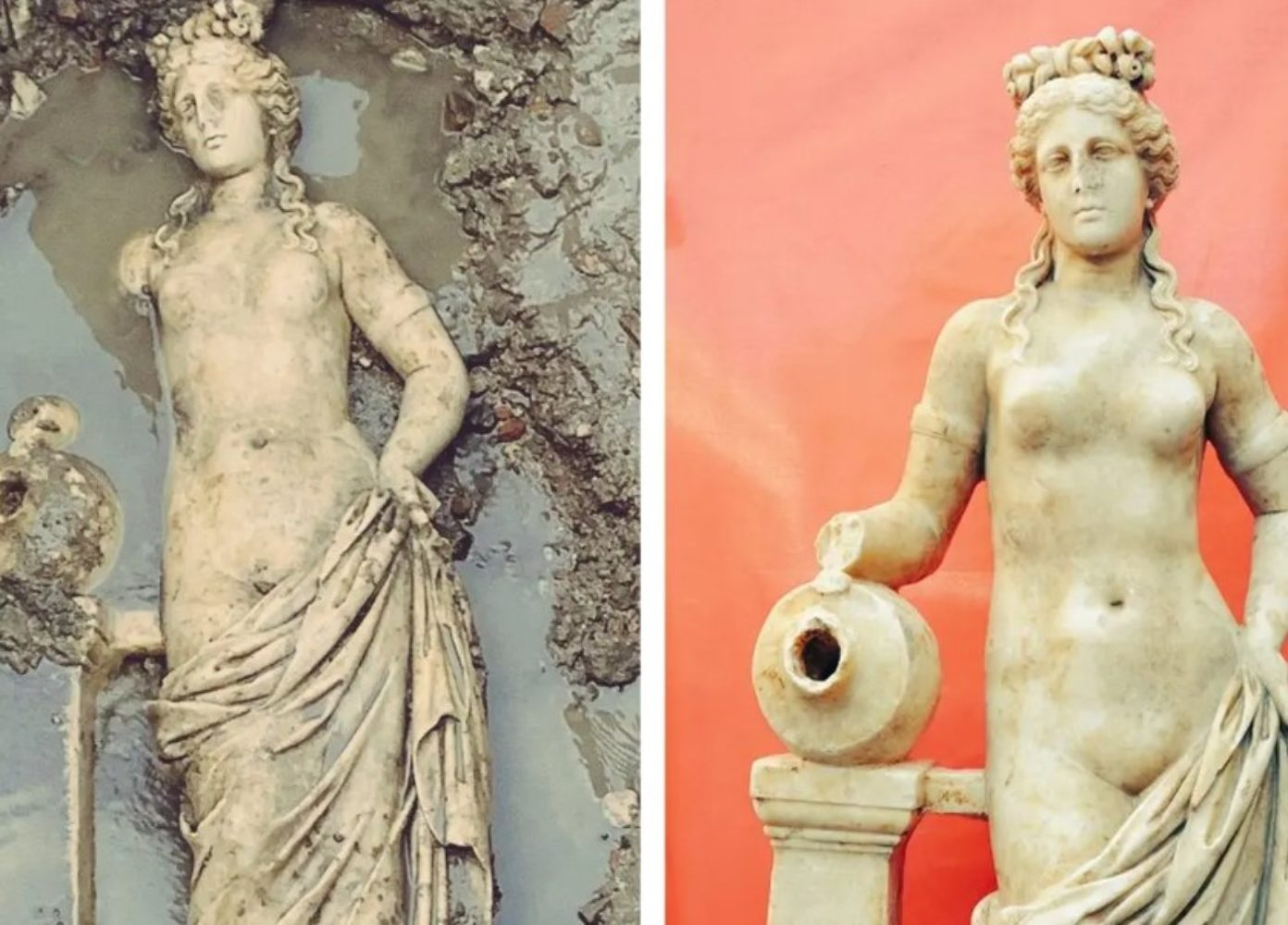
It is worth mentioning that a 1.50-meter-tall statue of Aphrodite has been discovered recently in ancient Amastris. It could be established that it is a Roman copy from between 180 and 200 AD that was inspired by Praxiteles school in the 4th century BC. The ancient city was named after Amastris, the niece of King Darius III, who married Dionysos, the tyrant of Herakleia-Pontus.

The map included in my post About Arrian’s Periplus of the Euxine Sea is most useful for locating all the cities, harbors, and rivers mentioned above. 

It should be said that while inspecting the Cappadocian frontier harbors in 123 AD, Emperor Hadrian had already visited part of the southern Euxine Sea, including Trapezus. With this in mind, Arrian now informed the emperor that Trapezus was building a new harbor, replacing the mooring where ships could only anchor in summer. 

It is quite amazing to see so much geography and history being exchanged. We tend to forget the many lines of communication that existed in antiquity, with traders, merchants, scholars, philosophers, astronomers, kings, and emperors traveling far and wide, by land and by sea.

[to be continued in Part 3]

Wednesday, January 17, 2024

The Periplus of the Euxine Sea by Arrian – Part 1

Arrian, to the Emperor Caesar Trajan Hadrian  Augustus, greetings. We came to Trapezus, a Greek city, as Xenophon says, founded on the sea, a colony of the Sinopeans; and gladly we looked down on the Euxine Sea from the very same spot as both Xenophon and you.

With these words, Arrian starts his letter to Hadrianintroducing the first part of his report, Tour of Colchis: From Trapezus to Sebastopolis. 

As mentioned in my previous blog, About Arrian’s Periplus of the Euxine SeaArrian started his journey in Trapezus. Here, he visited the sanctuary of Hermes, which was also devoted to Emperor HadrianArrian tells the emperor that his statue needs to be replaced with a better resemblance to the original. He also shared his critiques on the rough stone altars and the “incorrectly written” inscriptions. 

From TrapezusArrian sailed east to inspect the garrison of Hyssus. Here, he organized a display of javelin throwing and reminded the soldiers of Hadrian’s observations and address made in 128 AD at Lambaesis, Numidia (modern Algeria), which survived on a column found northwest of its parade ground. 

His next stop was at the temple of Athena in Athenae, where he was marooned for two days due to a violent storm of thunder and lightning, during which he lost one of his triremes. Arrian’s fleet consisted of liburnas, small galleys suitable for raiding and patrols, and large triremes. 

When it was safe to travel onwards, he anchored at the fortress of Apsarus (Gonio in modern Georgia). He inspected the weapons and provisions of the five cohorts and paid the 2,500 soldiers. Remains of this impressive Roman fortress are still standing on the left bank of the River Chorokhi, where it controlled the access to the hinterland. In 135 AD, Arrian established his headquarters in Apsarus when he led the Cappadocian legions against the invading Alans.

[Remains of the Apsarus Roman Fort, Carole Raddato (CC BY-NC-SA)]

At this point in his letters, Arrian provides a list of all the rivers between Trapezus and Phasis that flow into the Euxine Sea, adding the distances between them. 

These details are helpful to follow the governor as he moved on to Phasis (see: The many colonies of Miletus), some 67 kilometers further north at the mouth of the Phasis River. This was the most important river in Colchis. It arose in the Caucasus, and its water was unusually soft and sweet with a changeable light color. In Phasis, he dug a ditch to protect the harbor and the settlement that had developed around the stronghold. 

Arrian’s interest and respect for the history of Jason is tickled when the locals show him an iron anchor claiming it belonged to Jason’s ship, the Argo. However, he was skeptical as it looked too recent. It seems that even in ancient times, people liked to spread tales and myths! 

The last leg of this trip took Arrian to Dioscurias, another colony of Miletus, known to him as Sebastopolis. He is said to have visited the sick, which raises the question about their ailments. He also checked the city walls and the ditch to be sure they would resist any attack from the native Colchian tribes on the eastern coast. He provided a list of their rulers subject to Rome as established by Hadrian. They were Malassas of the Lazi, Rhezmegas of the Abasci, and Spadagas of the Sanigs. 

He further inspected Sebastopolis, including the grain supply vital to the army’s survival. He paid the soldiers and watched the cavalry in their exercises, leaping upon horses. 

From that harbor, the governor could see the highest peak of the Caucasus, the Strobilus, where, according to myth, Prometheus was bound and an eagle ate his liver that grew back overnight. The mountain was Mount Elbrus. 

This completed Arrian’s mission, and he returned to the naval base of Trapezus422 kilometers away.

[To be continued in Part 2]

Wednesday, July 26, 2023

A Colosseum in Mastaura, Turkey

The ancient city of Mastaura is unknown to me and the internet is not proving to be very helpful. The site is situated 50 kilometers east of Aydin, Turkey. 

In the middle of nowhere, aerial pictures revealed a circle around a depression that was too perfect to be natural. The untrained eye may miss it altogether but the hidden contours belonged to a Colosseum. A lot of vegetation and a thick layer of soil has hidden this Roman construction from view for centuries. It was discovered in 2020 and as the archaeologists started clearing the site by cutting trees and bushes that had held the stone remains in their grip, they realized it belonged to Mastaura. 

[Picture from Arkeonews]

Having lain buried for centuries, the Colosseum underground is rather well-preserved. The parts of the building above ground reveal rows of seats, the central area where the spectacles took place, and the outside supporting walls and vaults. It is definitely smaller than its counterpart in Rome. 

The amphitheater could soon be dated to about 200 AD, i.e., the days when emperors of the Severan Dynasty ruled, 193-235 AD. 

Usually, amphitheaters are oval-shaped, but this is one of the rare circular examples, measuring 30x40 meters. The only round example I have ever seen was in Cyrene, modern Libya. There, its life started as a theater but the expansion of the city called for an amphitheater. Lacking the space for an oval shape, the builders simply mirrored the existing theater to create a round amphitheater (see: Cyrene, founded by the Greeks). 

The Colosseum of Mastaura offered seating to 15,000-20,000 people, which may have come from neighboring cities such as Aphrodisias, Miletus, Priene, and Ephesos. It is one of three such arenas discovered so far in Turkey. The spectacles were similar to the gladiator battles and animal fights organized all over the Roman Empire. 

Mastaura appears to be built inside a narrow valley, maybe along a small river and covered an amazing surface of 160,000 m2. Over the past two years, researchers unearthed an impressive underground sewage system that spread over the entire city. Based on the engineering technique and the materials used, it can be dated to around 200 BC and was probably used well into the days of Roman imperial rule. The size of the sewer is such that one can comfortably walk inside them. For now, the passage is blocked some 20 meters into the system because the walls caved in. 

[Picture from Arkeonews/IHA]

A lot of work remains to be done at Mastaura, like reinforcing some sections of the walls and brickwork of the Colosseum, clearing the sewage system, and exposing more buildings and artifacts around the city.

Mastaura was important enough to mint its own coins in Roman times, and a substantial number has been found so far and needs to be further analyzed.

Wednesday, July 12, 2023

Does age matter?

Writing about Alexander over the years, I have been handling chronological dates for his whereabouts in the correct time frame. There is, however, another approach to consider and that is Alexander’s age. 

We know he became king at the age of twenty and started his invasion of Asia at the age of twenty-two. He died a month short of his 33rd birthday. All his marches, sieges, battles, and fighting are condensed within this last period of roughly ten years. 

A comparison with any modern monarchy is impossible because there are hardly any kings left and they no longer go to war at the head of their army. To compare Alexander with young men his age today is out of the question also simply because life and the circumstances of living are too far apart. 

Alexander has been taught by Aristotle but again this kind of education cannot be identified with the teaching of a young man in our modern world. I believe that even Philip, although he intended to do what was best for his son, underestimated the vastness of Aristotle’s knowledge. Alexander was meant to rise above Philip because he understood how to draw from Aristotle’s vast database (to use modern terminology) and merge it expertly with his innate infallible instinct - his genius. 

However, Philip may well have realized the potential of his 16-year-old son when he entrusted him with the seal of Macedonia while campaigning against Byzantium. The young prince honored his assignment as Regent by successfully putting down the Maedi revolt on the country’s northern border. 

Two years later, Philip put his son in command of his cavalry at the Battle of Chaironeia. Alexander did more than his share and annihilated the entire Theban Band, all three hundred of them! 

We don’t know how much time the young prince spent among the soldiers growing up in Pella, but I think it is safe to assume it was a lot. Leading the small contingent against the Maedi and the cavalry in Chaironeia speaks volumes. An army has that instinctive flair to recognize a true leader, one they can and will trust. 

This trust would only grow when Alexander became king after his father was murdered. In the next two years, he successfully led his troops against the Illyrians and the Thracians to secure his northern borders, sacked the city of Thebes in retribution for its betrayal, and confirmed his position as Hegemon of Greece as per the Treaty of Corinth. Alexander could never have contemplated his campaign in Asia without the full trust and commitment of his army. 

He crossed the Hellespont shortly before his 22nd birthday and fought the Persian army for the first time at the Granicus River. Later that summer, he marched to Sardes and took Ephesos, Priene, Miletus, Didyma, and Halicarnassus. Alexander spent the following winter in Lycia, after which he conquered Phaselis and Perge. 

When he was 23 years old, he headed north to Sagalassos and from there to Gordion, where he cut the knot. Crossing Cappadocia, he returned to the shores of the Mediterranean. At Tarsus, he fell sick with a fever, which incapacitated him for several weeks. By the end of the year, he was engaged in the Battle of Issus, his first personal confrontation with King Darius. 


In two years, Alexander fought two major battles (see: The Battle of the Granicus and The Battle of Issus, where Alexander and Darius faced each other for the first time), besieged two cities, Miletus and Halicarnassus, and occupied all the major ports in Asia Minor. In our modern world, this means that he crossed all of Turkey. 

At the age of 24, he laid siege to two more cities, Tyre (building a mole in the process) and Gaza. His reception in Egypt was that of a liberator, and he was soon acclaimed as their new Pharaoh - a title that automatically made him a god in the eyes of the Egyptians. At the western end of the Nile Delta, he founded his first Alexandria, a city that still exists and prospers today! 

Many more sieges and battles were to follow in Central Asia and India. We almost take them for granted, despite that every siege and every battle came with its own technicalities and challenges. Alexander faced many hardships as he traveled through deserts, waded through countless rivers, and crossed mountains as high as those of the Hindu Kush! 

The three years Alexander spent in Sogdiana and Bactria, from his 27th to his 30th birthday, were an uninterrupted succession of skirmishes and fights in guerrilla wars he was totally unfamiliar with. The events culminated with his victory at the Battle of the Hydaspes against the Indian King Porus. By then, he and his men had covered some 28,000 kilometers, creating many new Alexandrias in the process. 

Although Alexander is usually depicted sitting on his horse, we have to keep in mind that he moved at the pace of his foot soldiers. Riding bareback was not comfortable, not for the rider and not for the horse (see: No saddles and no stirrups for Alexander’s cavalry). 

It is impossible to imagine anyone covering such a distance on foot. It would imply walking an average of 2,800 kilometers a year, ten years in a row! Let us keep in mind that many of his troops were veterans of his father’s days, men in their fifties, sixties, and even seventies! Not a leisurely trip for the fainthearted. 

Speaking of walking: how many pairs of shoes, boots, and sandals would the Macedonians have worn out? Providing new ones for some 40,000 men or more would have implied production on an industrial scale! Maybe we should believe the sources suggesting that the soldiers fought and walked sections of the route barefoot?

Sadly, Alexander died far too young, and so did Hephaistion, but men like Ptolemy and Seleucos lived to the ages of 84 and 77, respectively. Age clearly is not everything!

Wednesday, January 4, 2023

Dacia before Alexander

Dacia is a Roman name. When Emperor Trajan conquered the territory of what is now Romania in 106 AD, he called it the province of Dacia Felix. The new capital was Ulpia Traiana Sarmisegetusa, i.e.,  today’s Sarmizegetusa Regia.

The Dacians, however, were known to the Greeks as Getae, the very people Alexander chased across the Danube in 335 BC (see: Crossing the Danube River and The King is dead, long live the King). After the king’s death, Lysimachos, who became king of neighboring Thrace, waged repeated wars against the Getae without success. He was even captured by their king, who forced him to withdraw from the Lower Danube in 292 BC. 

Interestingly, Strabo states that although the language of the Dacians is the same as the Getae's, the name applies to their location. The Getae lived close to the Pontus Euxinus, the Black Sea, and the Dacians, closer to Germany and the sources of the Ister, the Danube River. They somehow managed to co-exist if they did not mingle with earlier settlers. 

In the second half of the 7th century BC, Ionian Greeks had already emigrated to the shores of the Black Sea to escape the expansion of the Persian Empire. The most prominent group of colonies came from Miletus, who, in 630 BC, founded their first town Histria, at the mouth of the Danube (see: The many colonies of Miletus). The Greek colonists remained in Dacia until 46 AD. 

Before them, the nomadic Scythians driving their cattle ever further west from the steppes of Central Asia were in regular contact with the Getae/Dacians from c. 550 to 250 BC. The Scythians left us no writing, but the artifacts found in and around their occasional settlements testify of highly skilled artists. 

Three years ago, in 2020, the Gallo-Roman Museum in Tongeren, Belgium, organized a wonderful exhibition Dacia Felix taking us back in time. The selected objects came from various Romanian museums, particularly the National Museum of Romanian History in Bucharest, which most of us will not readily visit. It offered a unique opportunity to see these unique artifacts brought together. 

Particularly striking are the Getae’s parade helmets with eyes to ward off the evil spirits. One such helmet is made of gold and is decorated with mythological figures. It has been dated to 425-375 BC. Another example from 400-300 BC is made of gilded silver. Although these were ritual helmets, it is easy to imagine how piercing eyes would scare off the enemy if worn in close combat! A silver gilded greave with a tattooed face, dated 340-330 BC, is another example of Getaen art influenced by the Scythians and the Greeks. 

The smaller gold and silver artifacts also call for attention. There are appliques, otherwise known from Scythian art, used to decorate the horses’ bridles and harnesses. Some specimens even show Persian influences (400-300 BC). 

The Getaen men of power, such as high priests and kings, wore finely crafted bracelets. A solid gold spiral specimen with ram heads (500-400 BC) weighs no less than one kilogram! Another eye-catcher is a gold diadem with panthers and flowers (400-200 BC). 

To illustrate that the Getae were not limited to today’s Romania, there are two very similar goblets on display, one silver gilded from neighboring Bulgaria, 400-300 BC, and the other found in Romania, made in silver and dated to 340-330 BC. 

The Celts, in turn, occupied the fertile lands of Dacia roughly from 320 until 175 BC, i.e., after one group of warriors had sacked Rome in 387 BC. These tribes never intended to settle but were constantly hunting for precious goods. Although the Celts shared the same language and religion, they roamed in separate bands along the northern borders of Thracia, Macedonia, and Italy. 

As expected, the Celts left us weapons, helmets, and decorations for horse harnesses, mainly from their grave sites. The most remarkable legacy is an iron helmet holding a falcon on top dated from 250-175 BC. The chief who wore it must have impressed his opponents with his stature, as the bird made him look much taller. Besides, the realistic falcon acted as a symbol of power.

Dacia sometimes stretched beyond Romania, including northern Bulgaria, southwestern Ukraine, and Hungary east of the Danube. The rich testimonies of Scythians, Getae, and Celts are left undocumented, as these peoples did not have any writing. Their heritage is solely based on archaeological excavations, which yielded a wide array of artifacts, including precious jewelry and decorative items.


It should be noted that the battle depicted in Trajan’s Column in Rome reflects the emperor’s sacking of Ulpia Traiana Sarmisegetusa in 106 AD after the Dacians failed to respect the peace conditions of their surrender. Something worth remembering during our next visit to the eternal city!

Thursday, November 18, 2021

Herakleia-by-Latmos

Herakleia-by-Latmos is one of those odd places to visit. The remains of the ancient city are squeezed between the Latmos Mountains and the edge of Lake Bafa. However, you have to find them! 

Today’s village of Kapıkırı holds few promises of interesting ruins as its houses are built on top of the ancient remains. It takes a careful eye to spot abandoned walls, towers, column drums rooted into a tree, and other heart-shaped drums among the modern constructions. 

To start with, the place is off the beaten path and hard to find. That was not always the case because, in antiquity, Herakleia had full access to the sea deep inside a vast gulf. Over the centuries, this gulf has mainly been silted up with the alluvia carried along by the Meander River. By the end of the 3rd century AD, access from the sea was cut off, and all that remained was Lake Bafa. 

When Alexander the Great besieged Miletus, he and his army arriving from Priene had to march along the shores of this vast Latmian Gulf. Now, looking south from Priene towards Miletus, we’ll notice a flat plain that was once at the bottom of the sea. 

It is generally admitted that Herakleia was founded by Pleistarchus, son of Antipater (see: Antipater and Alexander), in the early 3rd century BC. He ruled over large parts of Caria and made Herakleia his capital, initially named after him, Pleistarcheia. 

Pleistarcheia/Herakleia prospered in Hellenistic times as goods arriving by sea from the west were forwarded further by road into the Carian hinterland. An extensive network of roads, probably conceived by Pleistarchus exiting the city, has been discovered. It is not easy to piece the remaining sections together because, over the centuries, its stones have been reused elsewhere. As the pavement shows no ruts from carts and is occasionally interrupted by stairs, these roads were only used by pedestrians, horses, and beasts of burden. They connected, however, with essential thoroughfares in the valley of the Meander. 

Archaeologists eventually bring the scattered remains to life by recognizing the constructions from antiquity. The open space of the Agora is easiest to spot by the modern visitor as it functions as a parking lot. The marketplace measured an impressive 60x110m and was surrounded by marble colonnades in the Doric style. This was the center for commerce and trade of cattle, agricultural products, and honey in particular. 

Overlooking the Agora are the walls of a temple built in the Doric order with two, now missing, columns at the entrance. It was most probably dedicated to Athena. Inscriptions on the outside walls of the temple reveal that it served as an archive to the city. They also give us essential information about the history of Herakleia and Asia Minor in the early 2nd century BC. In those days, the ambition of the Seleucid king Antioch III was to rule over all of Asia Minor. However, the Romans defeated him at the Battle of Magnesia ad Sipylum in 190 BC. The blocks with these inscriptions are scattered on the temple's north side. From the south side, another inscription was recovered that is being kept at the Louvre. This is a letter by Lucius Cornelius Scipio, Consul of Rome, and Publius Scipio, his brother, addressed to the Boulé and the people of Herakleia. 

Also dating from the 2nd century BC are the Bouleuterion, the theater, and the Gymnasium. There are, of course, many other remains from temples and houses that need further investigation. From later dates are the Roman Baths, a Nymphaeum, as well as remains of the city walls. The ramparts are among the best-preserved of their time, extending for more than 6 km and counting over 40 towers. In places, they stand to a height of 6 meters. 

Herakleia’s necropolis is located in the far south of the city, as always outside the walls. A large, not yet excavated tumulus is believed to belong to Pleistarchus. Hundreds, maybe even thousands, of rock-cut graves do not immediately catch the eye as they appear as mere rectangular openings in the rock wall. 

The conclusion is that there is far more to explore and discover than one would expect at first sight! As mentioned in my bibliography, I’ll gladly refer to the beautiful book, although written in German Herakleia in Latmos by A. Peschlow-Bindokat.