Alexandria's founded by Alexander

Alexandria's founded by Alexander the Great (by year BC): 334 Alexandria in Troia (Turkey) - 333 Alexandria at Issus/Alexandrette (Iskenderun, Turkey) - 332 Alexandria of Caria/by the Latmos (Alinda, Turkey) - 331 Alexandria Mygdoniae - 331 Alexandria (Egypt) - 330 Alexandria Ariana (Herat, Afghanistan) - 330 Alexandria of the Prophthasia/in Dragiana/Phrada (Farah, Afghanistan) - 330 Alexandria in Arachosia (Kandahar, Afghanistan) - 330 Alexandria in the Caucasus (Begram, Afghanistan) - 329 Alexandria of the Paropanisades (Ghazni, Afghanistan) - 329 Alexandria Eschate or Ultima (Khodjend, Tajikistan) - 329 Alexandria on the Oxus (Termez, Afghanistan) - 328 Alexandria in Margiana (Merv, Turkmenistan) - 326 Alexandria Nicaea (on the Hydaspes, India) - 326 Alexandria Bucephala (on the Hydaspes, India) - 325 Alexandria Sogdia - 325 Alexandria Oreitide - 325 Alexandria in Opiene / Alexandria on the Indus (confluence of Indus & Acesines, India) - 325 Alexandria Rambacia (Bela, Pakistan) - 325 Alexandria Xylinepolis (Patala, India) - 325 Alexandria in Carminia (Gulashkird, Iran) - 324 Alexandria-on-the-Tigris/Antiochia-in-Susiana/Charax (Spasinou Charax on the Tigris, Iraq) - ?Alexandria of Carmahle? (Kahnu)
Showing posts with label Trapezus. Show all posts

Wednesday, February 14, 2024

The Periplus of the Euxine Sea by Arrian – Part 3

In this last part of the PeriplusArrian takes us from Dioscuras/Sebastopolis to Byzantium. 

He starts his story where he left off at the conclusion of part 1, i.e., in Sebastopolis (see: Tour of Colchis: From Trapezus to Sebastopolis). This section, the Cimmerian Bosporus, was not controlled directly by Rome but by a so-called client king. In Hadrian’s day, that was Cotys II, in full Tiberius Julius Cotys, who ruled from 123/4 AD until he died in 131/2 AD. His appointment was made for life, and his successor needed to be officially recognized by Rome. 

At the news of his death, Arrian decided that Hadrian would be interested in having the latest information about the Bosporan Kingdom since it supplied a great deal of wheat, clothing, wine, and slaves. His territory was also an important buffer zone with the warlike Alans living to the north. 

Arrian sailed along the mountainous coastline below the Caucasus to Pityus, some 65 kilometers away. These lands were occupied by the Zilchi, ruled by a certain Stachemphax, also recognized as a king by Hadrian. Follows a list of cities, harbors, and rivers, including the distances between them, from Crimea to the mouth of the Danube River. More familiar are the Greek cities on the south coast of Crimea, such as Panticapaeum (Kerch), Theodosia, Cercinitis, and Chersonesus (Kherson). Panticapaeum, which lies only 11 kilometers from the Tanais River (modern Don River) and flows into Maeotis Lake (Sea of Azov) was seen as the place where Europe ended and Asia started. 

Sailing further west, Arrian stops at the Greek city of Olbia at the mouth of today’s Dnieper River. Next, he heads for the harbor of Odessos, a trading post founded by the Greeks from Istria. From here, he continues to the wide delta of the Ister River (Danube), where he reaches the Island of Achilles or Leuke (possibly Snake Island in Ukraine). Legend has it that Thetis gave it to her son. The island was known for its Temple of Achilles, which held a wooden statue of the hero, as well as Greek and Latin inscriptions in honor of Achilles and his dear PatroclusArrian speaks of many offerings that were made, including sacrifices of animals. Those who sail by the island may “see” Achilles in their dreams or hallucinations. 

Proceeding further down the coast of the Black SeaArrian arrives at Tomis, a colony founded by the Greeks, where Emperor Augustus banished the poet Ovid. The next port was Callatis, established by the Carians, followed by Odessos (another harbor by that name), where he entered Thracia. 

Passing the eastern end of the Haemus Mountains (in central Bulgaria), Arrian reaches Miletus colony of Apollonia, which once held a colossal statue of the god Apollo. From here, he sailed to the not-so-good harbor of Salmydessus (roughly 150 km east of Hadrianopolis, modern Edirne) where Xenophon helped Seuthes II to become King of Thracia. 

By now, Arrian has landed on the Thracian side of the Bosporus. This area is reputed for the Cyanean Islands or Symplegades (also Clashing Rocks), a pair of rocks that clash together when a ship sails through. In Greek mythology, the rocks were defeated by Jason on his way to Colchis on board his ship, the Argo. 

Byzantium is Arrian’s final destination. He concludes by mentioning the local Temple of Zeus Ourios (who grants favorable winds), where Jason and the Argonauts erected an altar to the Twelve Olympian Gods on their return from Colchis. 

In our modern days of traveling by plane and high-speed trains, it is hard to imagine the pace in antiquity when people and armies moved on foot. Ships and barges were a comfortable alternative, although winds and currents were not always reliable. Travelers could never predict the duration of a trip or the time of arrival, but in those days, time was not so much of the essence as it is today. 

Though Arrian wrote his Periplus 130-131 AD, we don’t know how many months or weeks he actually spent at sea. Considering that the circumference of the Black Sea is over 4,000 kilometers, it may be safe to speculate that he spent most of those two years “on the road”. Quite an achievement!

[For the locations, please consult this map]

Tuesday, January 23, 2024

The Periplus of the Euxine Sea by Arrian – Part 2

The second part of the Periplus covers the section From the Thracian Bosporus to Trapezus. 

As mentioned earlier in About Arrian’s Periplus of the Euxine Sea, it could not be established whether this chapter reflects Arrian's personal experience or not. One theory is that he wrote it upon arrival in Trapezus after Hadrian appointed him governor of Cappadocia in 131 AD. 

We should also keep in mind that Arrian was a native of Bithynia, which bordered the south shores of the Black Sea over approximately one-third of its total length. Consequently, he knew the people and the geography of that area very well. As an admirer of Xenophon, he was familiar with the route followed by the Ten Thousand as they marched from Trapezus to Byzantium following the seashore.

[Bust of Xenophon, Carole Raddato (CC BY-NC-SA)]

Whatever the case, this section of the Periplus includes an impressive list of the harbors and rivers on the southern shore of the Black Sea among which are the cities of Herakleia-Pontus founded by the Megarians and the Boeotians at the mouth of the Lycus River; Tios, at the mouth of the Billaeus River and a colony of MiletusAmastris (modern Amasra) that had a harbor 17 kilometers from the River Parthenius; Sinope, another colony of Miletus and home of Diogenes; Amisus, an Athenian colony between the Halys and the Iris River deltas; and, finally, Cotyora, a colony of Sinope. 

Ever since the days of the Hittite Empire, which reached its height in the 14th century BC, the Halys River was the border between several kingdoms; first between Lydia and the Persian Empire, then between the Pontic Kingdom and the Kingdom of Cappadocia. By the 6th century BC, it separated Lydia from Media until King Croesus crossed the river to attack Cyrus the Great and was defeated. 

[From the Greek Reporter]

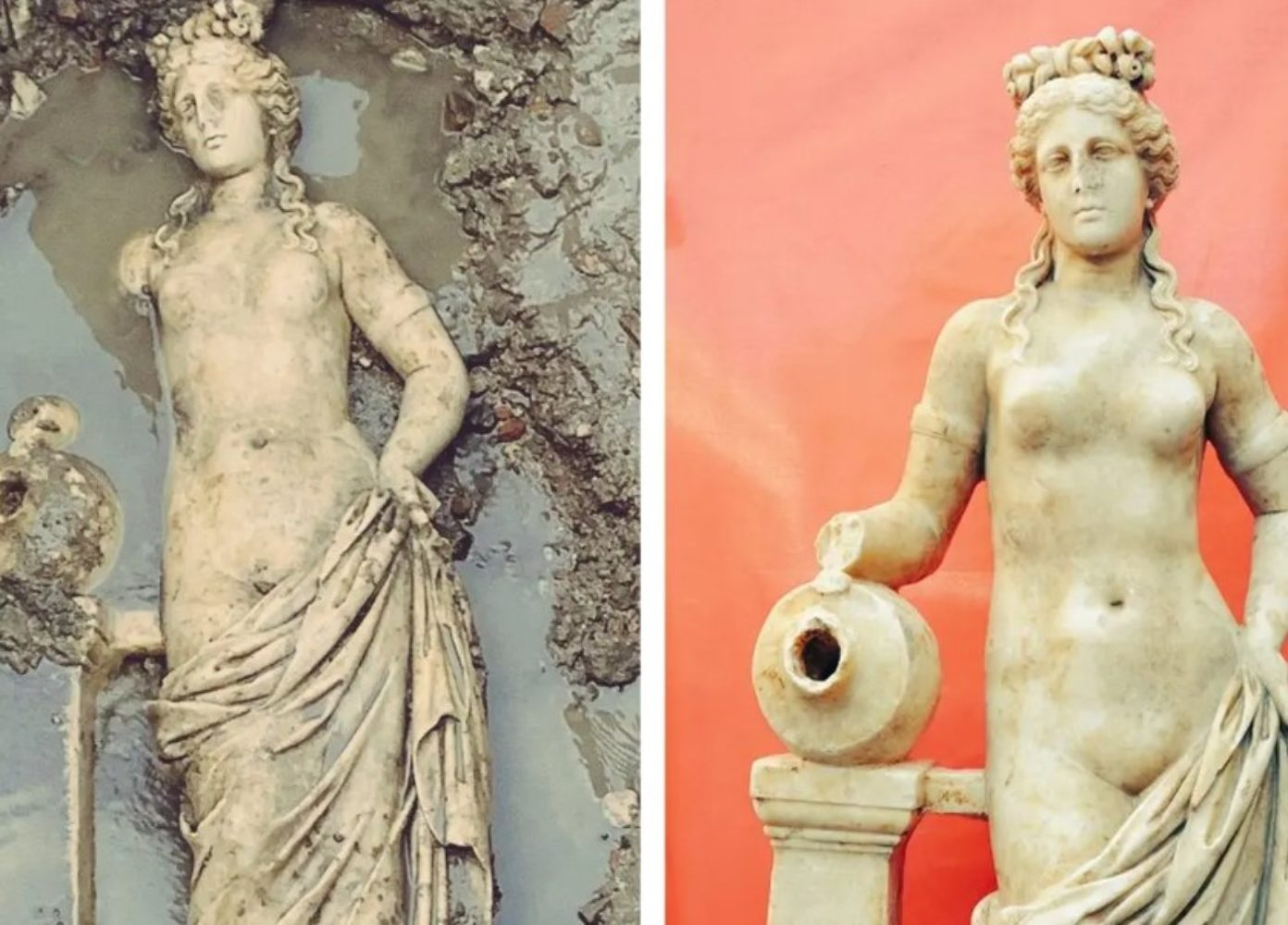
It is worth mentioning that a 1.50-meter-tall statue of Aphrodite has been discovered recently in ancient Amastris. It could be established that it is a Roman copy from between 180 and 200 AD that was inspired by Praxiteles school in the 4th century BC. The ancient city was named after Amastris, the niece of King Darius III, who married Dionysos, the tyrant of Herakleia-Pontus.

The map included in my post About Arrian’s Periplus of the Euxine Sea is most useful for locating all the cities, harbors, and rivers mentioned above. 

It should be said that while inspecting the Cappadocian frontier harbors in 123 AD, Emperor Hadrian had already visited part of the southern Euxine Sea, including Trapezus. With this in mind, Arrian now informed the emperor that Trapezus was building a new harbor, replacing the mooring where ships could only anchor in summer. 

It is quite amazing to see so much geography and history being exchanged. We tend to forget the many lines of communication that existed in antiquity, with traders, merchants, scholars, philosophers, astronomers, kings, and emperors traveling far and wide, by land and by sea.

[to be continued in Part 3]

Wednesday, January 17, 2024

The Periplus of the Euxine Sea by Arrian – Part 1

Arrian, to the Emperor Caesar Trajan Hadrian  Augustus, greetings. We came to Trapezus, a Greek city, as Xenophon says, founded on the sea, a colony of the Sinopeans; and gladly we looked down on the Euxine Sea from the very same spot as both Xenophon and you.

With these words, Arrian starts his letter to Hadrianintroducing the first part of his report, Tour of Colchis: From Trapezus to Sebastopolis. 

As mentioned in my previous blog, About Arrian’s Periplus of the Euxine SeaArrian started his journey in Trapezus. Here, he visited the sanctuary of Hermes, which was also devoted to Emperor HadrianArrian tells the emperor that his statue needs to be replaced with a better resemblance to the original. He also shared his critiques on the rough stone altars and the “incorrectly written” inscriptions. 

From TrapezusArrian sailed east to inspect the garrison of Hyssus. Here, he organized a display of javelin throwing and reminded the soldiers of Hadrian’s observations and address made in 128 AD at Lambaesis, Numidia (modern Algeria), which survived on a column found northwest of its parade ground. 

His next stop was at the temple of Athena in Athenae, where he was marooned for two days due to a violent storm of thunder and lightning, during which he lost one of his triremes. Arrian’s fleet consisted of liburnas, small galleys suitable for raiding and patrols, and large triremes. 

When it was safe to travel onwards, he anchored at the fortress of Apsarus (Gonio in modern Georgia). He inspected the weapons and provisions of the five cohorts and paid the 2,500 soldiers. Remains of this impressive Roman fortress are still standing on the left bank of the River Chorokhi, where it controlled the access to the hinterland. In 135 AD, Arrian established his headquarters in Apsarus when he led the Cappadocian legions against the invading Alans.

[Remains of the Apsarus Roman Fort, Carole Raddato (CC BY-NC-SA)]

At this point in his letters, Arrian provides a list of all the rivers between Trapezus and Phasis that flow into the Euxine Sea, adding the distances between them. 

These details are helpful to follow the governor as he moved on to Phasis (see: The many colonies of Miletus), some 67 kilometers further north at the mouth of the Phasis River. This was the most important river in Colchis. It arose in the Caucasus, and its water was unusually soft and sweet with a changeable light color. In Phasis, he dug a ditch to protect the harbor and the settlement that had developed around the stronghold. 

Arrian’s interest and respect for the history of Jason is tickled when the locals show him an iron anchor claiming it belonged to Jason’s ship, the Argo. However, he was skeptical as it looked too recent. It seems that even in ancient times, people liked to spread tales and myths! 

The last leg of this trip took Arrian to Dioscurias, another colony of Miletus, known to him as Sebastopolis. He is said to have visited the sick, which raises the question about their ailments. He also checked the city walls and the ditch to be sure they would resist any attack from the native Colchian tribes on the eastern coast. He provided a list of their rulers subject to Rome as established by Hadrian. They were Malassas of the Lazi, Rhezmegas of the Abasci, and Spadagas of the Sanigs. 

He further inspected Sebastopolis, including the grain supply vital to the army’s survival. He paid the soldiers and watched the cavalry in their exercises, leaping upon horses. 

From that harbor, the governor could see the highest peak of the Caucasus, the Strobilus, where, according to myth, Prometheus was bound and an eagle ate his liver that grew back overnight. The mountain was Mount Elbrus. 

This completed Arrian’s mission, and he returned to the naval base of Trapezus422 kilometers away.

[To be continued in Part 2]

Wednesday, January 3, 2024

About Arrian’s Periplus of the Euxine Sea

Beyond doubt, Arrian is best known for his Campaigns of Alexander the Great but as I mentioned in my earlier post, What do we know about Arrian of Nicomedia, he was a prolific writer. However, most of his works have now been lost. 

Such was the case for his Periplus of the Euxine Sea, the Circumnavigation of the Black Sea, an official military report Arrian wrote in Latin to Emperor Hadrian, who had inspected the area before him. Additionally, he composed a series of informal letters to Hadrian using Greek.

Although Arrian was a member of the Roman imperial administration, he also belonged to the Greek literary elite. As a native of still very Greek Bithynia in Asia Minor, Arrian grew up with this dual identity making him a true Graeco-Roman. Addressing his Greek account to the Philhellenic emperor underscores his friendly and personal relationship with Hadrian.

Arrian was very much inspired by Xenophon, a philosopher, and historian from the 4th century BC – hence his nickname of “Second Xenophon.” In fact, Arrian picked up Xenophon’s tracks on the Black Sea at Trapezus as he led his Ten Thousand according to his Anabasis.

Arrian’s Greek version of the Periplus with its valuable information about the Black Sea region luckily survived. It dates from 131 AD, one year after he had been appointed governor of Cappadocia.

In his days, Cappadocia was a Roman frontier with forts along the coast of the Black Sea. Arrian’s duty was to protect that line of defense and the routes into the hinterland up to the Parthian Empire further east. He was also responsible for the Pontic Fleet based in Trapezus (modern Trabzon) and for protecting the grain supply from Crimea. Besides those matters about his military and diplomatic mission, Arrian outlined the navigation routes and ports of the Black Sea and concentrated on economic activities and resources.

His Periplus covers a counter-clockwise voyage around the Black Sea, made in three separate trips. During his first journey, he sailed from Trapezus to Sebastopolis. His letters to Hadrian are bundled in chapters 1 to 11 and constitute the longest and most interesting part of his Greek Periplus.

His second expedition contained in chapters 12 to 17 took him from the Bosporus to Trapezus, and the third one is covered in chapters 18 to 25 traveling from Sebastopolis to Byzantium. These two voyages may well have been undertaken by different people as the narration is less personal and less fluent.

Much of the writing focuses on the rivers, landmarks, harbors, and cities, including the distances and other relevant information for sailors and travelers alike. It also includes information regarding the local population and the safe havens. True to himself, Arrian likes to insert local stories from Greek mythology such as Jason and the Argonauts and Prometheus, and often quotes Homer.

In short, a complete traveler’s guide that may still be helpful today!

[Continue reading in Part 1]