Alexandria's founded by Alexander

Alexandria's founded by Alexander the Great (by year BC): 334 Alexandria in Troia (Turkey) - 333 Alexandria at Issus/Alexandrette (Iskenderun, Turkey) - 332 Alexandria of Caria/by the Latmos (Alinda, Turkey) - 331 Alexandria Mygdoniae - 331 Alexandria (Egypt) - 330 Alexandria Ariana (Herat, Afghanistan) - 330 Alexandria of the Prophthasia/in Dragiana/Phrada (Farah, Afghanistan) - 330 Alexandria in Arachosia (Kandahar, Afghanistan) - 330 Alexandria in the Caucasus (Begram, Afghanistan) - 329 Alexandria of the Paropanisades (Ghazni, Afghanistan) - 329 Alexandria Eschate or Ultima (Khodjend, Tajikistan) - 329 Alexandria on the Oxus (Termez, Afghanistan) - 328 Alexandria in Margiana (Merv, Turkmenistan) - 326 Alexandria Nicaea (on the Hydaspes, India) - 326 Alexandria Bucephala (on the Hydaspes, India) - 325 Alexandria Sogdia - 325 Alexandria Oreitide - 325 Alexandria in Opiene / Alexandria on the Indus (confluence of Indus & Acesines, India) - 325 Alexandria Rambacia (Bela, Pakistan) - 325 Alexandria Xylinepolis (Patala, India) - 325 Alexandria in Carminia (Gulashkird, Iran) - 324 Alexandria-on-the-Tigris/Antiochia-in-Susiana/Charax (Spasinou Charax on the Tigris, Iraq) - ?Alexandria of Carmahle? (Kahnu)
Showing posts with label Lampsacus. Show all posts

Wednesday, March 6, 2024

A handful of Alexander coins from Chania

Chania on Crete’s northwestern coast is best known for its beaches and hotels that attract today’s tourists. Its history, however, goes back to the 14th century BC and is centered on the ongoing excavations of the Minoan Palace of Kydonia which was destroyed by an earthquake one century later. 

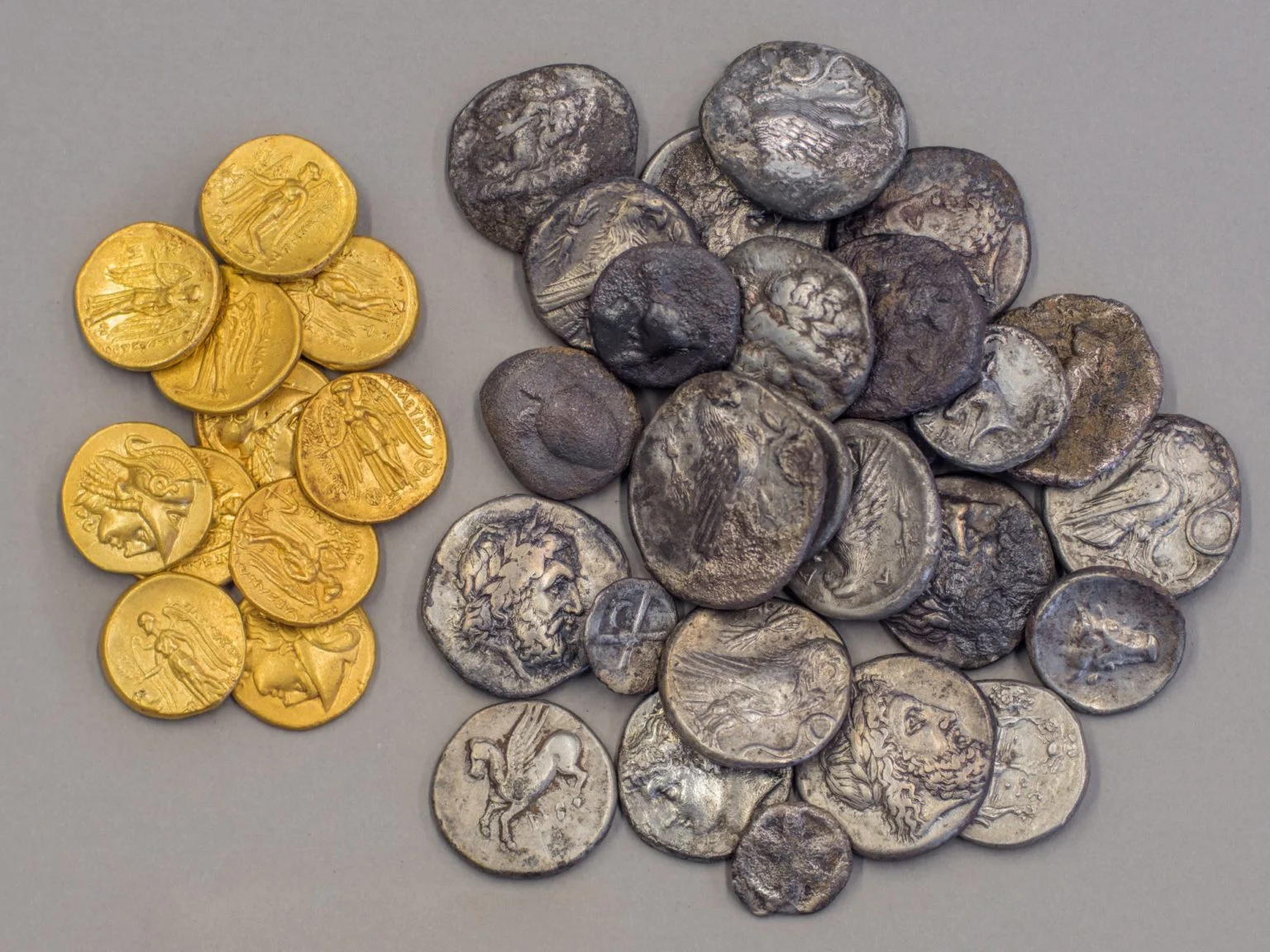
The Old Town of Chania proper has yielded a cache of 37 rare coins, including eleven gold staters of Alexander. The hoard together with two coins of Kydonia, was hidden in a space behind the wall of the acropolis of Kydonia probably by a mercenary between 300 and 280 BC. That is quite a find considering one gold stater equaled a mercenary month's salary. 

It has been established that the coins were mostly minted after Alexander’s death in the name of Philip Arrhidaeus, Seleucos or Lysimachos in different locations such as Amphipolis, Abydos, Lampsacus, etc. 

[Picture of the two-drachms of Cyrene, Greek Reporter,

The hoard also included 15 silver staters minted in Olympia during the Olympic Games at some time in the 4th century BC. Also one Corinthian stater of the Palace of Acarnania, a colony on the Ionian Sea; and one stater of Praisos (on the peninsula of Sitia at the eastern end of Crete). Further one two-drachms of Cyrene (North Africa), two drachms of Phaistos (62 km south of Heracleion), one drachma of Hyrtakina (in the northwest of Crete), and two pseudo-hemi-drachms of the Aegina type found in Kydonia. Last but not least, there are two early versions from Aegina showing the sea and land turtles.
Saturday, April 25, 2020

The Moon was not a God

Anaxagoras was one of the first persons to state that the moon was a rock. His theory was that the moon had been flung into space by the Earth. The Sun, in turn, was labeled as being a burning rock. The philosopher probably was born in 499 BC in Klazomenai, when Asia Minor was still under Persian rule.

His greatest merit was his attempt to describe the occurrence of eclipses, meteors, rainbows, and the behavior of the Sun and the Moon. The eclipse that he witnessed in 463 BC while he was travelling through Greece may have contributed to his further in-depth observations.

His most surprising “discovery” – that certainly was very disconcerting to people in antiquity – was his statement that the moon’s face was illuminated from the Sun on the opposite side of the Earth. He realized that the phases of the moon resulted from the alignment of the Moon, Sun and Earth. In short, he described the solar eclipse.

He wrote a book about this and other theories but, as so often, his knowledge only percolated through fragmentary work by later scholars among which we find Aristotle. As a consequence, Anaxagoras’ concepts may have been part of Alexander’s schooling baggage.

Contrary to the generally accepted theory of the time, he declared that the Moon and the Sun were objects (rocks) and not gods. The Athenians deeply resented this impiety and Anaxagoras was accused of blasphemy. Consequently, the philosopher was arrested and sentenced to death. However, thanks to the personal intervention of Pericles, Anaxagoras was exiled to Lampsacus on the Hellespont.

None of his contemporaries could have imagined that Anaxagoras’ ideas about the eclipses and lunar phases would live on for 2,600 years, that is until this day.

Tuesday, June 18, 2019

The new Archaeological Museum of Troy

Despite the many centuries of excavations in Troy, the time has come (at last!) to build its own museum on the site. It is located some 800 meters outside the ancient city, and from the pictures, it looks very promising.


Beyond Troy, about 40,000 artifacts have been transferred from the Archaeology Museum in Istanbul, the Museum of Anatolian Civilizations in Ankara, and the Archaeological Museum of Çanakkale. It is nice to have the finds concentrated in one single building.

Besides Troy, artifacts from the greater area are being exhibited here also. Those archaeological remains include finds from cities like Assos, Tenedos, Parium, Alexandria Troas, Smintheion, Lampsacus, Thymbra, Tavolia, and Imbros.

It is a wonderful idea to have this collection together in one place, more so since that corner of Northwestern Turkey is often overlooked by tourists.