Alexandria's founded by Alexander

Alexandria's founded by Alexander the Great (by year BC): 334 Alexandria in Troia (Turkey) - 333 Alexandria at Issus/Alexandrette (Iskenderun, Turkey) - 332 Alexandria of Caria/by the Latmos (Alinda, Turkey) - 331 Alexandria Mygdoniae - 331 Alexandria (Egypt) - 330 Alexandria Ariana (Herat, Afghanistan) - 330 Alexandria of the Prophthasia/in Dragiana/Phrada (Farah, Afghanistan) - 330 Alexandria in Arachosia (Kandahar, Afghanistan) - 330 Alexandria in the Caucasus (Begram, Afghanistan) - 329 Alexandria of the Paropanisades (Ghazni, Afghanistan) - 329 Alexandria Eschate or Ultima (Khodjend, Tajikistan) - 329 Alexandria on the Oxus (Termez, Afghanistan) - 328 Alexandria in Margiana (Merv, Turkmenistan) - 326 Alexandria Nicaea (on the Hydaspes, India) - 326 Alexandria Bucephala (on the Hydaspes, India) - 325 Alexandria Sogdia - 325 Alexandria Oreitide - 325 Alexandria in Opiene / Alexandria on the Indus (confluence of Indus & Acesines, India) - 325 Alexandria Rambacia (Bela, Pakistan) - 325 Alexandria Xylinepolis (Patala, India) - 325 Alexandria in Carminia (Gulashkird, Iran) - 324 Alexandria-on-the-Tigris/Antiochia-in-Susiana/Charax (Spasinou Charax on the Tigris, Iraq) - ?Alexandria of Carmahle? (Kahnu)
Showing posts with label Perseus. Show all posts

Friday, June 21, 2024

The roaring times of the Antigonid dynasty

The Wars of the Diadochi broke out after Alexander’s death in 323 BC and his huge Empire went to “the strongest” as he may have intended to say on his deathbed in Babylon. However, it did not go to one single ruler as none of his generals had his vision or charisma. 

After endless battles, intermarriages, and lots of intrigues, Alexander’s generals eliminated each other and, in the end, started four distinct dynasties. Ptolemy initiated the Ptolemaic dynasty in Egypt, and Seleucos the Seleucid dynasty in Asia. Cassander, the son of Antipater, founded the Antipatrid dynasty (the ancient Kingdom of Macedonia). In 306 BC, Antigonus Monophthalmus (the One-Eyed) declared himself and his son Demetrios kings. By doing so, the Antigonid dynasty replaced the Antipatrid dynasty. 

Antigonus may well have served under Philip II and lost an eye during the Siege of Perinthus in 340 BC. He later joined Alexander on his Persian campaign and was promoted to satrap of Phrygia in 334 BC. His main duty was to maintain Alexander’s line of communication and supply. As a result of the Partition of Babylon following Alexander’s death, he also received Pamphylia and Lycia. 

During the Wars of the Diadochi, Antigonus picked up momentum and managed to rule over all of Asia Minor, Greece, Syria, Phoenicia, and northern Mesopotamia. Fearing his increasing power, Seleucos, Ptolemy, Lysimachos, and Cassander joined forces against him. Antigonus was defeated and killed at the Battle of Ipsus in 301 BC after which his realm was split between Lysimachos and Seleucos. 

However, Antigonus’ son Demetrios Poliorcetes, by now having earned his stripes as Besieger survived said battle and took control of Macedonia in 294 BC. Cassander died in 297 BC without a successor as his sons had eliminated each other, paving the way for Demetrios to become King of Macedonia. Not for long because in 288 BC he was driven out by Pyrrhus and Lysimachos, and died as a prisoner of Seleucos. 

It was not until 277 BC that Demetrios’ son, Antigonus II Gonatas, regained the title of King of Macedonia. He ruled till about 239 BC, to be succeeded by Demetrios II Aetolicus, followed by Antigonus III Doson ten years later. 

Meanwhile, Rome became the rising power in the eastern Mediterranean, and soon the first conflicts with Antigonid Macedonia led by King Philip V (221-179 BC) erupted. His successor, Perseus, put up a fierce resistance against the expanding Roman Empire that coveted Macedonia’s wealth. The Romans conquered Antigonid Macedonia in 168 BC at the Battle of Pydna, turning Alexander’s homeland into a mere Roman Province. 

Although very eventful, the Antigonid dynasty was short-lived and lasted less than 150 years. 

Macedonia’s grand palaces of Aegae, Pella, Bylazora, and Dimitrias were thoroughly looted, and the houses of the wealthy Macedonians were plundered. Statues, paintings, jewelry, and other wonderful, precious artifacts from Greece and Asia were up for grabs. Roman generals and common soldiers alike took as much as they could carry. Only the gods know what happened to the collection of Macedonia’s precious libraries.

Tuesday, April 2, 2024

Bylazora, the last Macedonian Palace

The Paeonians occupied the land north of ancient Macedonia and functioned as a buffer zone with the Dardanians on their northern border. Bylazora, in fact, was situated in a commanding position at the natural pass leading from Dardania into Macedonia. 


Philip V of Macedonia, who ruled from 221 until 179 BC, captured Bylazora in 217 BC. By blocking the Dardanian access road to Macedonia, he freed his country from its repeated menacing raids. Perseus, Philip’s son, who succeeded his father, sent mercenaries to Bylazora to confront the Romans, but he was defeated in 168 BC. He was taken to Rome to be shown in their victory parade, together with the incredible wealth of Macedonia. The rich kingdom became a mere Roman province. 

Although Bylazora was the largest city of Paeonia and was mentioned by Livy and Polybius, its location remained a mystery. It was tentatively identified with (Titov) Veles, but the results were inconclusive. As so often, the city was discovered by accident in 1994. Road works exposed a buried pool-like building close to modern Sveti Nikole in the Republic of North Macedonia, some 50 kilometers southeast of Skopje, between the Axios and the Strymon Rivers. 

Excavations started in 2008 after the Museum of Sveti Nikole invited the Texas Foundation for Archaeological & Historical Research (TFAHR) to a joint cooperation. 


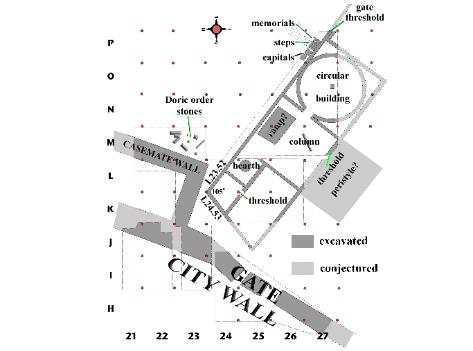
It was a slow process of searching for clues that started at the top of the hill, the Acropolis. Soon, a section of the northern defensive wall was exposed, followed by the discovery of a ramp leading up to the Propylon. Next, a Stoa with Doric columns was identified and dated to the days of Philip V based on a similar gallery built by Attalus II in Athens. 

A long wall and successive rooms were unearthed, making the archaeologists realize they had found the Palace of Philip V and Perseus, the last two kings of Macedonia. 

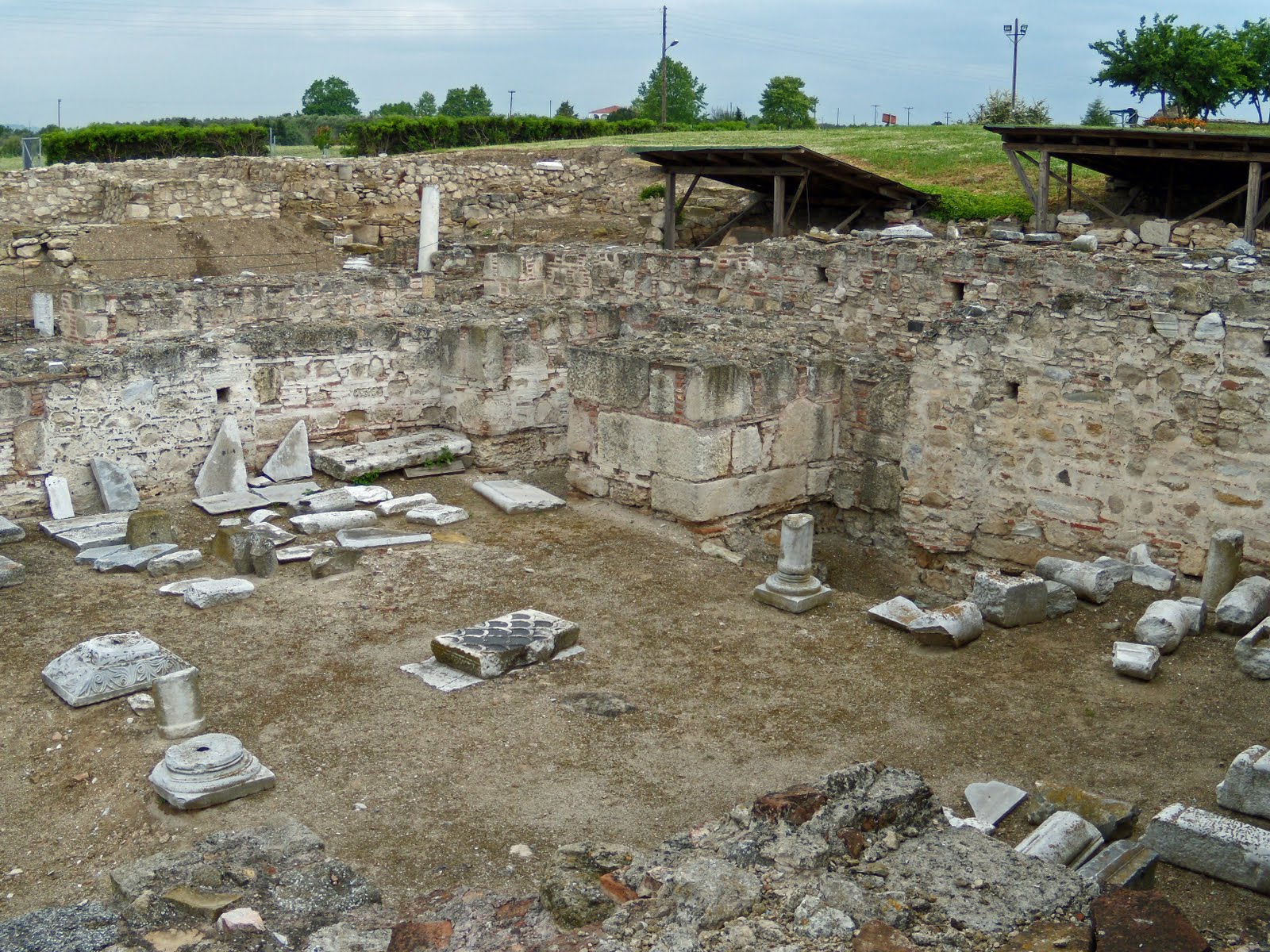
The first room they explored had all the characteristics of a kitchen, with a fireplace, much pottery, plates, vessels, and amphorae from the 3rd-2nd century BC. The walls were covered with a thick layer of plaster with traces of paint. Followed a room with columns and capitals, which was named Ante-room since it connected to a more important Tholos. For those who visited the Palace of Aegae in Greece, that space is very recognizable. On the other side of this Tholos lies the Entrance Hall, which in turn is connected to the Vestibule. This large room opened onto the Outer Courtyard via a monumental staircase. 

Keeping the layout of the Palace of Aegae in mind, the archaeologists projected the same series of rooms around the Inner Courtyard. The picture seems to fit perfectly. It also matches the Palace of Dimitrias, situated just south of Volos in Greece. The city was built by Demetrios Poliorcetes when he was king of Macedonia, i.e., 294-288 BC. 

Until now, and as opposed to Aegae and Pella, I had no knowledge of the Macedonian Palaces of Bylazora or Dimitrias. The destruction of the Palaces of Aegae and Pella by the Romans is well-documented. Dimitrias, however, was entirely dismantled, and it is assumed that the same happened in Bylazora, although it was never finished. 

Much more pertinent information with clear maps and unique details can be found in this lecture given by Dr.William J. Neidinger of the TFAHR.

[Pictures from TFAHR]

Monday, November 9, 2020

Remembrance Day

Each year again the British celebrate their Remembrance Day with great pride. Inevitably my thoughts drift off to Alexander and what he would have thought of this tradition. I truly believe he would have liked it very much. He even would have implemented a similar honorific parade had he lived long enough.

Without Cassander’s cruel rule, the situation in Macedonia would have been entirely different in spite of the Wars of the Diadochi that dragged on for about forty years. The successors in the end ruled over their share of Alexander's huge empire following the king's example. Inevitably, their Macedonian pride could not survive down to the following generations but whoever ruled over Alexander’s home country would have valued him highly. After all, the Macedonians of northern Greece still do. 

In the aftermath of those glorious years, several rulers certainly tried to keep Macedonia on the map. Most noteworthy are kings like Demetrios Poliorcetes (306-286 BC), Pyrrhus of Epirus (306-272 BC), Philip V (221-179 BC) and Perseus (179-166 BC). I'm sure they still held Alexander in high esteem and true to the great example of his troops. They would have found a way to honor those soldiers and remember them.

In the end, it may be nothing more than wishful thinking because history always takes turns of its own. It is incontestable that the Romans still envied and tried to emulate Alexander but they were foreigners and outsiders, who could never match the greatness of the king who died too young.

Thursday, August 25, 2016

Possible Burial Site of the Attalids at Pergamon

The news sounds very promising! The burial site of the Attalid kings may have been located inside a huge mound next to the ancient city of Pergamon, modern Bergama. The hilltop is known as Yigma Tepe, where the first excavations took place two centuries ago and were abandoned.


The mound is impressive enough with its height of 31 meters and diameter of 159 meters, indicating that it was meant to be a monument for a very important person or even persons. This theory is also based on the location, right next to the famous Great Altar and on the western side of the Temple of Athena. So far, it has been dated to the 2nd century BC.

At the start of this excavation season, archaeologists will conduct geophysical surveys and seismic prospecting to obtain all possible information about the underlying structure before starting digging.

Pergamon has been a grand and well-defended city for many centuries, known for its opulence and a vast number of temples, sanctuaries, and palaces. Its location was so well chosen that even Alexander the Great did not consider attacking it but marched around it instead to isolate the city. 

After his death, his general Lysimachos, by then King of Thrace, chose Philetairos of Pergamon to secure his share of Alexander’s treasury. As expected, this Philetairos used it in 281 BC to found his own kingdom. Twenty years later, he left his realm to his nephew Eumenes I, who ruled from 263 to 241 BC. After Eumenes, this splendid city fell into the hands of his heir, Attalus I (241-197 BC). 

The Attalid rulers were allies of Rome, much to the discontent of Philip V and Perseus of Macedonia, who fought over this wealthy territory during the three Macedonian Wars. Thanks to their support for the Seleucids, the Attalids were rewarded with extended possessions in Asia Minor. By 188 BC, the Pergamon Empire had grown considerably and outshone all others, certainly as far as Hellenistic art was concerned. 

The last Attalid ruler, Attalus III, surrendered Pergamon to the Romans in 133 BC when it became the capital of their Provincia Asia.

Sunday, April 13, 2014

Pergamon is simply huge

Pergamon, whose first settlement goes back to the 8th century BC, lies on a strategic hill above the modern city of Bergama in western Turkey. The location was so well chosen that even Alexander the Great did not consider attacking this fortified city but marched instead around it with the purpose of isolating it. After his death, his general Lysimachus by then King of Thracia chose Philetairos of Pergamon to secure his share of Alexander’s treasury. As can be expected, this Philetairos used it in 281 BC to found his own kingdom. Twenty years later, he left his realm to his nephew Eumenes I who ruled from 263 to 241 BC. After Eumenes, this splendid city fell into the hands of his heir, Attalus I (241-197 BC). The Attalid rulers were allies of Rome, much to the discontent of Philip V and Perseus of Macedonia, who both fought over this wealthy territory during the three Macedonian Wars. Thanks to their support against the Seleucids, the Attalids were rewarded with extended possessions in Asia Minor. By 188 BC, Pergamon and, with it, the Pergamon Empire had grown considerably and outshone all others, certainly as far as Hellenistic art was concerned. The last Attalid ruler, Attalus III, surrendered Pergamon to the Romans in 133 BC, thus becoming the capital of their Provincia Asia.

During one of my very first and not too brightest guided trips, I sat on the bus pounding over the brilliant history of Pergamon, trying to visualize Alexander's approach. We maneuvered through the narrow old and wide modern streets of Bergama till we reached a smaller road that rose up towards the four-kilometer-long city wall above the steep slopes. Square bulges overgrown with grass revealed that there were still a lot of stone blocks hidden there awaiting excavation. This impressive wall is the work of Eumenes II (197-159 BC), who wanted to build an Acropolis that would even outshine that of Athens – nothing less. 

The size of Pergamon is simply huge. My misfortune was that I had to follow my unforgiving guide, who just marched on, ignoring the streets, columns, and arches on our way – a very frustrating experience. It’s hard to get my bearings, maybe because excavations since 1875 were done by German archaeologists who like to leave things the way they find them unless they can take them apart as they did with the Altar of Zeus to bring the pieces to their museums. It comes as quite a shock to me when my guide points out the barren space once occupied by that very altar in the landscape. Not a single hint is left of that once so proud building! Such a pity since it is considered to be one of the most beautiful altars ever built and a very unusual one as well since it never served as a crepidoma to any temple at all. This enormous marble offer table dating from 180 BC stood on a huge plinth that also supported the double row of Ionic columns. The Pergamon Museum in Berlin houses this great altar, and the visitor has to use all his imagination to mentally transpose that building to this poor wind-stricken hill.

I give up trying to locate where I am, running after my guide and secretly vowing to return one day. I am impressed by the Temple of Trajan, which was completed after his death by Emperor Hadrian, measuring 68 x 58 meters and easily recognizable by its Corinthian columns, with an extra colonnade running all around the outside of the temple.

The Library, on the contrary, needs some guesswork. In antiquity, it was one of the richest in the world, and its 200,000 parchment scrolls went to Alexandria as Marc Antony’s wedding gift to his Queen Cleopatra. I think it is worth mentioning that until that time, all writing was done on papyri. It was only when Egypt decided to stop its exports that alternative solutions had to be found. It was here in Pergamon that the idea was born to use sheep and goat skins instead. These hides were smoothened with pumice and cut into handy sheets. That is how our parchment, the name borrowed from the city of Pergamon, was born. A strange paradox of life to see parchments enter Egypt, the land of the papyri.

After passing a large marble column carrying the symbols of Asclepius, i.e., two intertwined snakes facing each other across a wheel, I reach the Asclepion Complex. It was believed that since snakes shed their skins to be ‘reborn”, the patients would shed their ailments and illnesses to recover their health. The Asclepion was founded by the great healer Galen (Aeleus Galenus), who was born in Pergamon in 130 BC, where he studied medicine. Asclepius, the Greek god of health and medicine, was known since the 4th century BC, and Galen made great use of his knowledge not only as a doctor but also as a psychologist, although the very word did not yet exist. Galen had a thorough knowledge of human anatomy, physiology, and neurology. He had acquired his knowledge by studying wounded gladiators at the healing shrine of Asclepius. As the patients were led through a long vaulted corridor that had at regular intervals circular openings in the ceiling to let in the light, he may have resorted to the therapeutic use of water and music. Water from a nearby source runs down the stairs and follows the entire length of the corridor wall - the longest such passageway I’ve ever seen. I’m not sure if the echo under these vaults was beneficial to the patients and if I can believe my guide, who suggested that the patients were drugged with opium in their drinking water, meaning that by the time they reached the end of the corridor, they were so confused that they wandered around in the labyrinth that awaited them at the end of this dark passage. Of course, there were caretakers to guide them further to the Temple of Asclepion, where the priests gave them psychoanalysis two thousand years before Sigmund Freud was born! Next to the temple lies the theater belonging to the Asclepion Complex, in front of which one can still see several sacred pools that, even today, are generally filled with water in spring. The entire complex was, without any doubt a top-notch spa in antiquity! Well, even now, it is quite rewarding to walk here and imagine what must have been going on. 


In the center of Pergamon, one simply can’t miss the large theater, the steepest in the world. The oldest parts date from the 3rd century BC but, as always, it has been improved and enlarged several times, particularly under Emperor Caracalla. The portico of this theater measures no less than 246 meters and is approximately 16 meters wide. Unique is that this portico was removable since it covered the adjacent street. Strange, however, that it seated only 15,000 people, less than the theater in Ephesos, although this theater in Pergamon looks much larger. 

It is frightening to walk down the steep steps for the precipice is luring below. From the top rows, however, the visitor has a commanding view over the land around this acropolis and easily can appreciate the strategic location of Pergamon. Undoubtedly the very location of this city must have impressed Alexander. I definitely have to come back one day, were it only to put the many remains of so many buildings on the map of my mind, and more so after seeing its treasures in Berlin.

At the Pergamon Museum of Berlin, the entire Altar of Zeus has been carefully reconstructed, meaning that all the friezes that ran around it have been put in their right sequence. However, the visitor is looking at them inside-out. Instead of actually walking around the altar, the elements have been placed against the wall surrounding the central part with the flight of stairs leading to the platform. Somehow I find it hard to figure this out properly. But then there is a wonderful reduced model in what looks like marble, reflecting the full impact of what this famous altar must have looked like. Such a shame there is close to nothing left in Pergamon, though …

[Click here to see all pictures of Pergamon]

Sunday, October 9, 2011

Dion, the Macedonian Sanctuary

Dion, at the feet of Mount Olympus, has been Macedonian Sanctuary for eons. It was here that Alexander brought offerings to Zeus before crossing to Asia. It was here that his father, King Philip II, came to celebrate his many glorious victories. It was here that King Archelaos started brightening up the festivals with athletic and theatrical performances. But all Macedonian kings had one thing in common: they gathered here to sacrifice and bring offerings to the Olympian gods, whatever the occasion. Enough reason for me to take a close look at the place, not the least because of Alexander’s multiple visits.

Although Dion became part of a Roman colony founded by Emperor Augustus in the 1st century AD, the city managed to preserve its Greek character up to the Byzantine times. Yet, after a combination of natural disasters and repeated invasions by the Goths in the 5th century AD, Dion sank into oblivion.

The drive from Thessaloniki takes me south past the antique sites of Methoni and Pydna, past modern Katerini till mighty Mount Olympus looms at the horizon on my right, an unforgettable and most rewarding view!

Directions in and around Dion (modern Dio) are very clear. The town has been able to lead tourist traffic in such a way as not to interfere too much with the community's daily life. Not much has changed here except for a handful of souvenir stores and cafés. I decided to start with the Museum as it is said to close at 3 pm (the excavation site is open until 7 pm) - we are never sure what to expect when walking through a museum or an archaeological site, are we?

The Museum is not big but offers some interest, although I am still trying to decide whether to visit the Museum before or after seeing the antique Dion. I have done it both ways, once in 2006 and now in 2011, but it does not make the explanations any easier. I still have difficulty matching one with the other. Dion is a sanctuary, meaning, in fact, a collection of temples and altars ranging from the 4th century BC all the way to the 5th century AD. Even walking around Dion, it is very confusing to sort out the array of buildings, especially here at the Museum, where bits and pieces must match the remains in the field.


I pick out the pieces that most appeal to me: some statues (like that of Hygeia); heads (Demeter and Niké); funeral steles (Hunter with his dog and Mother and Child); slender funeral craters that are well preserved; terracotta statuettes (a lovely Macedonian boy); coins of all kinds and mainly Macedonian; glass beads and other pieces of jewelry; small ivory heads from funeral couches; mosaics (spiral mosaic from the Villa of Dionysos); and a superbly reconstructed hydraulic organ. I even spent some time checking out the inscribed slabs: like the Treaty between King Perseus and the Boeotians, a Letter that Philip V wrote to a certain Eurylochus, and the base for a statue of Cassander. Outside in the grass, I find a dozen or so Roman tombs with Greek inscriptions and, in the shelter of a portico, a stone tomb door, much like the one reconstructed at the Museum of Pella.

The Museum has no cafeteria, but I find the place across the street inviting enough. Their coffee (Greek) is excellent, and their toilets are clean. It is a good thing to take a short break to digest all the impressions before heading for the actual site of Dion, which is, in fact, within walking distance.

Obviously, this location was chosen by the gods in a broad flat valley under the watchful eye of snowcapped Olympus. Its icy waters ran and still run through Dion, and this holy river saved the city from plundering when it disappeared under two meters of water and mud after heavy earthquakes. We had to wait for centuries to put the town back on the map, as many pumps and sluice gates are still helping to keep our feet dry.

I start with the Greek theater, where a wooden reconstruction has been implemented, and the original layout is still visible. It was located outside the actual city walls and built during the reign of Philip V (221-179 BC). It looks out over a splendid park-like field, where Alexander pitched the tents to entertain his one hundred guests, friends, officers, and ambassadors from all over Greece to celebrate his departure for Asia. The huge Altar of Zeus, where he made his offerings, is situated near the other end, close to the Roman Theatre from the 2nd century AD. Not often can one come so close to Alexander as we can here.

I wonder if it was in this area that I should picture the famous bronze group made by Lysippos, Alexander’s dedicated sculptor. It represented and was dedicated to 25 cavalrymen who had fallen during the Battle of the Granicus, Alexander’s first victorious confrontation with Persia.

Evidently, the main god worshiped in Dion was the Olympian Zeus, after whom the city was named (the genitive of "Zeus" being Dios). The sanctuaries were used not only by the inhabitants of Dion but also served the religious needs of a more significant number of people during the festivals, with thousands of visitors. Here, the base of a large statue of King Cassander was found, now in the Museum. Various pilgrims' offerings were placed in the sanctuaries of Dion. At the Sanctuary of Olympian Zeus, inscriptions referred to important state affairs such as peace treaties, regulation of boundaries, honorary decrees, etc., some of which are now in the Museum. The Macedonians who crowded these festivals could read these texts and be informed – an official newspaper, in a way.

It is a most pleasant walk along the banks of the clear, fast-flowing stream where fish and crabs have found a home till I reach the Sanctuary of Demeter. This is the earliest Macedonian sanctuary known to date and was used uninterruptedly from the late 6th century BC to the early 4th century AD. For a layman, it is not easy to figure out the remains of walls and chambers, but with some effort, one can discern two small temples of the megaron type with an open antechamber and a cella. This is where most of the offerings were found, statuettes, lamps, vessels, beads, etc., which all indicate that an earth goddess of fertility was worshiped here, confirmed by an inscription referring to Demeter (4th century BC).

I now have to cross the lowest part of this cult area, which always seems to be more or less flooded – no wonder, when to my great surprise, I see the many springs bubbling up amidst the ruins! Reflecting in the water and amidst lush green growths lie the elegant Sanctuaries of Serapis, Isis, and Anubis that came to this region during the Hellenistic period thanks to the propaganda of the Ptolemies of Egypt. It is a pleasant sight to see how these statues bathe in the water or admire their mirror image. A metal bridge has been put in place so we can walk closely through this eerie setting. When I climb out of this depth, I pass a Byzantine wall where an unknown deity and the head of Aigle have been reused in its construction. How dare they!

Past the remains of the Roman city wall, I finally enter the city of Dion, which is generally Roman from the 2nd century. There is an entire network of streets along which many buildings, warehouses, private houses, and public baths have risen. A few of these constructions stand out, of course, for instance, the Roman Baths with parts of the mosaic floors and the hypocaust still in place, or the Polygon Villa with a 12-sided courtyard surrounded by columns giving access to the house. At the entrance, we can still admire the 3rd-century mosaic of wrestlers at practice, a very Roman portrait. Further down to the east, we find the remains of the Villa of Dionysos, which takes its name from the large mosaic depicting the god that covers the floor of the banqueting room. And then there is the set of reliefs showing very Macedonian cuirasses and shields that have been set up alongside one of the streets dedicated by Alexander after the Battle of the Granicus. In some places, you can even see sewage conduits underneath these streets. It always makes me wonder how we managed to lose this knowledge in our Middle Ages and had to entirely reinvent the system. If you look closely, you’ll also notice that many mosaic floors have been covered with plastic and gravel to protect them, but it’s so unfortunate that we cannot see them!

Dion is much less well-known than the Sanctuary of Delphi, for instance, but it is certainly not less inspiring. It definitely completes a thorough visit to Greek Macedonia. 

Tuesday, August 9, 2011

Discovering Pydna

Pydna is generally known for the decisive battle of 22 June 168 BC opposing the Roman general Aemilius-Paulus and King Perseus of Macedonia (179-168 BC). In one single battle, the Romans killed as many as 20,000 Macedonians, an absolute first in history. It meant the end of the Antigonid dynasty of Macedonia, and consequently, the Kingdom of Macedonia ended. Besides the men that fell on the battlefield, another 6,000 fled to Pydna to fall into enemy hands, and another 5,000 were taken prisoner as they tried to escape. A bloody encounter, to say the least. From then on, the Romans divided Macedonia into four republics. It seems that in 150 BC, a certain Andriscus claiming to be the son of the late King Perseus ascended the throne as Philip VI. He just came and went, a victim of another futile war, of course, and in 148 BC, Macedonia was finally subdued and became a Roman province.

To me, Pydna is the place where Queen Olympias took refuge after the death of her son, Alexander the Great, taking his wife Roxane and his son Alexander IV with her. Cassander, who, as the son of Alexander's regent Antipater, had taken over power in Macedonia, besieged and captured the city in 317 BC. Olympias was left with no choice but to surrender to Cassander, who knew no mercy and immediately had her executed. Roxane and Alexander IV were to follow her fate soon.

Well, so much for history, besides the fact that Philip II, Alexander’s father, had annexed the territory in the first place. In any case, enough reason for me to take a look around.

Today’s nearest town is Makrygialos, approximately 65 kilometers south of Thessaloniki, right next to the freeway. Pydna has not really been excavated. The only finds come from occasional discoveries made during construction activities or after illicit diggings. The fertile lands have been inhabited since the 7th century BC, and many graves and tombs have been unearthed going back that far in time. The finds have been split between the Museum of Thessaloniki and the nearby Museum of Katerini.

It is not easy to read the landscape, especially on this rainy day when I’m driving through sleepy villages and settlements. On my way through Methone, in the curve after the seaside fish restaurants, I am being waved at by King Philip in person! Of course, Methone was one of the main cities that Philip conquered from Athens back in 355-354 BC, but I wasn’t expecting to meet up with his bronze statue in this bend of the road. What a pleasant surprise. It shows the king in his prime, which he most probably was at the time of this battlefield. The Greek, as well as the Macedonian flag, proudly enfold above him. I look around for more signs but cannot find any.

I pick up the road again, heading further south till I reach Pydna or what is left of it. A fenced field on my left overlooking the sea is catching my eye. The entrance gate is ajar, an invitation to enter. This just might be the place of the old fort, and it is!

Once again, I’m struck by the strategic location as I can look north all the way to Methone and beyond, while to the south, on a clear day, we may even see Mount Olympus. This stronghold fits in the center of a wider bay, ideal to watch enemy ships approaching.

Within the perimeter of the fence, the remains are definitely Byzantine. Typical, of course, as they built their forts and churches right on top of older Roman or Greek construction, reusing the stones they found at hand. This site is no different, and as I question the local archaeologist and guardian, he willingly shows me the scattered remains from Greek temples, Macedonian city walls, and Roman olive- or winepresses. Further in the landscape, he also points to the line in the trees, walls, and houses that are supposedly part of this old fort. Excavations over here certainly are still in their infancy, and I can imagine how many archaeologists’ hands are itching to start digging for more treasures before they disappear through the illegal circuit, forever ripped out of their context.