Alexandria's founded by Alexander

Alexandria's founded by Alexander the Great (by year BC): 334 Alexandria in Troia (Turkey) - 333 Alexandria at Issus/Alexandrette (Iskenderun, Turkey) - 332 Alexandria of Caria/by the Latmos (Alinda, Turkey) - 331 Alexandria Mygdoniae - 331 Alexandria (Egypt) - 330 Alexandria Ariana (Herat, Afghanistan) - 330 Alexandria of the Prophthasia/in Dragiana/Phrada (Farah, Afghanistan) - 330 Alexandria in Arachosia (Kandahar, Afghanistan) - 330 Alexandria in the Caucasus (Begram, Afghanistan) - 329 Alexandria of the Paropanisades (Ghazni, Afghanistan) - 329 Alexandria Eschate or Ultima (Khodjend, Tajikistan) - 329 Alexandria on the Oxus (Termez, Afghanistan) - 328 Alexandria in Margiana (Merv, Turkmenistan) - 326 Alexandria Nicaea (on the Hydaspes, India) - 326 Alexandria Bucephala (on the Hydaspes, India) - 325 Alexandria Sogdia - 325 Alexandria Oreitide - 325 Alexandria in Opiene / Alexandria on the Indus (confluence of Indus & Acesines, India) - 325 Alexandria Rambacia (Bela, Pakistan) - 325 Alexandria Xylinepolis (Patala, India) - 325 Alexandria in Carminia (Gulashkird, Iran) - 324 Alexandria-on-the-Tigris/Antiochia-in-Susiana/Charax (Spasinou Charax on the Tigris, Iraq) - ?Alexandria of Carmahle? (Kahnu)
Showing posts with label Vergina. Show all posts

Monday, August 11, 2025

Another Macedonian tomb

The large number of tombs that dot ancient Macedonia never ceases to amaze me. They do not immediately stand out, but driving around on local roads in the wider area of Pella and Vergina (ancient Aegae), they appear as solitary structures or ruins. Occasionally, their names are announced on promising road signs pointing you to mysterious sites. 

Most visitors flock to the Great Tumulus housing the Tomb of Philip II in Vergina, along with the Tomb of Persephone (based on her frescoed depiction on the wall), and the Tomb of the Prince, attributed to Alexander IV. 

[Picture of the Abduction of Persephone from The Maritime Explorer]

The large necropolis to the east of the city and the many tombs outside the ancient city walls are generally ignored. In this area, it is nearly impossible to miss other beautiful examples like the Rhomaios Tomb, the Tomb of Eurydice (Alexander’s grandmother), the Macedonian Tomb on the Bloukas Farm, or a series of tombs on the Bella Farm (see: There is more to Aegae than the Royal Palace and the Great Tumulus). These tombs are rarely open to the public.  

Excavations are still ongoing, and more than one thousand tombs have been uncovered at Pella alone since 2000. They often carry the names of Macedonian families, and many monuments still display their vivid original colors. 

Closer to Náousa  (some 50 kilometers east of Pella), the Tomb of the Judgment, the Tomb of the Palmettos, the Tomb of Lyson and Kallikles, and the neglected Tomb of Kinch are worth visiting if the opportunity arises (see: Alexander's schooling at Mieza. Visit of the surrounding area). These tombs are not always open to the public.


Earlier this year (2025), the Tomb of the Philosophers, situated in the eastern necropolis of Pella, made headlines. The burial chamber measures 4.40x1.95 meters and is three meters high. It dates from around 300 BC and shows frescoes of six unnamed philosophers that document the richness of Pella’s intellectual development and cultural life at the time, when philosophy and sciences were a common good. 

The frescoed figures, who gave their name to the burial site, call for our attention. The most intriguing picture is that of a man wearing a red himation (kind of mantle), holding a wooden rod, pointing at a celestial globe, indicating that he might be a philosopher interested in astronomy. The theme is likely influenced by Aristotle’s teachings and other works written by philosophers and poets living at the Macedonian Court of Antigonus II Gonatas in the 3rd century BC. 

On the wall to his right, a bearded man is studying a papyrus scroll. The left wall depicts another wreathed, bearded ‘philosopher’. Above them are scenes of horsemen and grave steles inspired by Homeric funeral games. 

Excavations have revealed that the grave was probably built for a family. It contained the remains of three individuals: a man in his forties, a woman in her thirties, and an infant. The presence of this elaborate decoration with symbolic elements indicates that the family belonged to the higher social elite of Pella. The man could well have been a scholar or an astronomer who cared for his family after their death. 

The tomb’s frescoes are of high quality, giving a telling insight into the personal identity and the cultural values of the deceased. What’s more, the elements testify to the vibrant intellectual and artistic level that was reached in Pella some one hundred years after the death of Alexander

[Pictures of the Philosopher's Tomb from the Teacher Curator]

Monday, August 4, 2025

What Alexander really looked like.

Over the centuries, endless theories have circulated about the real appearance of Alexander. Statues, busts, paintings, and sketches have depicted Alexander as imagined by their creators, just as ancient and modern authors have described their version of Alexander. 

It is inevitable since Alexander became a legend during his lifetime. The legend took a life of its own, and still does today. 

I have just read an article on the Greek Reporter, “Beyond the Busts: Unveiling Alexander the Great’s True Face” by Paula Tsoni.  A very promising title that misleads the reader in many ways. The most absurd theory is the one quoted towards the end, reading: 

"A fresco depicting a hunt scene at the tomb of Philip II, Alexander’s father, at the archaeological site of Aegae is the only known surviving depiction of Alexander produced during his lifetime in the 330s BC."      

"A most disruptive theory is proposed by Greek-French academic Byzantinologist Helene Glykatzi-Ahrweiler, who has herself been identified by the 2008 show Great Greeks as one of the 100 greatest Greeks of all time. In her 2018 book published by Gutenberg, the famous scholar suggests that the tomb in Aegae is, in fact, Alexander’s, and not his father’s. This would explain why the young king was depicted in the famous fresco inside that tomb."

First of all, it has been clearly demonstrated that the tomb in Vergina, ancient Aegae, belongs to Philip II and not to Alexander, who was entombed in ancient Alexandria. The latest confirmation of Philip’s presence in the Vergina tomb has been established by studying the adjacent tomb that turned out to be Cynane’s, Philip’s daughter (see: Cynane buried next to her father, Philip II). 

Secondly, stating that the hunting scene in Philip’s tomb (which is unclear) is “the only known surviving depiction of Alexander” is not correct. It has been established that the ivory heads recovered from a Macedonian funerary couch in Vergina belong to Philip and Alexander. Greek archaeologists agree that the Alexander head is the only one made during Alexander’s lifetime. 

There have been repeated tentative efforts to recreate the Macedonian King’s face, even showing occasional look-alikes. A lot of wishful thinking, no doubt, but not very realistic. 

The question about Alexander’s real face already arose in 2016, when I wrote about a hoard found at Mir Zakah in north-eastern Afghanistan (see: Alexander’s real face). The hoard had been hidden in a well for over two thousand years and contained an estimated 550,000 coins. One of them showed Alexander with wide-open eyes, a crooked nose, and wild curls on the obverse and a tiptoeing elephant on the reverse. This is Alexander as he saw himself - invulnerable, verging on godhood, immortalized in the moment of his triumph after his battle against Porus on the Hydaspes in India in 326 BC. 

Osmund Bopearachchi was the first to recognize the medallion, and together with Frank Holt, he wrote a book on the subject, “The Alexander Medallion, Exploring the Origins of a Unique Artefact.” This information is ignored by or unknown to the eminent Greek-French academic Byzantinologist Helene Glykatzi-Ahrweiler, used by the Greek Reporter!

[Picture of the coin is from The Hindu]

Monday, January 6, 2025

Updating the location of the Granicus Battlefield

We like to believe that archaeologists merely scratch the soil to expose some remains of times past and ideally discover some gold and silver treasure. That is a very idealistic picture, far from the truth. 

Many people forget that excavations can take up to a lifetime to yield some results. Famous examples are men like Heinrich Schliemann in Troy, Arthur Evans in Crete, and more recently Prof. Marc Waelkens in Sagalassos and Manolis Andronicos in Vergina. However, the historical picture they created has been revised since. Schliemann erroneously dated the layers of Troy, Evans partially fabricated Crete by wishful thinking, and the occupant of Vergina’s Tomb is still disputed. 

[Picture from Arkeonews]

The Granicus Battlefield is no exception. Based on excavations and observations since the 19th century, the site of the battle had been identified north of the village of Çınarköprü on the River Biga, which in antiquity was known as the Granicus. That was the site I visited in 2007 (see: The Battle of the Granicus). It lies about 100 kilometers east of Çanakkale on the river that empties into the Propontis, modern Sea of Marmara. 

For the past 20 years or so, Prof. Reyhan Korpe, historian from Çanakkale Onsekiz Mart University (ÇOMÜ), led the team that shed new light on the location of the battlefield. It is obvious that I have to revise my standpoint. 

His recent excavations using modern techniques, including geomorphological surveys, exposed new evidence. For instance, the city of Hermaion, which Arrian calls Hermoton, was located on Alexander’s route to the Granicus. It could also be determined that the hitherto assumed site of the battle was a marsh in antiquity, making it unsuitable for an army to move, and that the course of the Granicus River had not changed much in the past two thousand years. Further investigation led to a hill to the east of the battlefield that has now been established near Gümüşçay, i.e., further south than previously reported. Said hill matches the spot where Greek mercenaries in Persian service were positioned, as documented in ancient sources. 

Now, 18 years after my last visit to the Granicus, the area of the battlefield has shifted further south. In my eyes, this new enlarged location makes more sense since there is more space on the wide plain for both armies to maneuver. I hope the river banks are not as steep as near Çınarköprü, where I wondered how the phalanx was able to stay in formation during the crossing. I may well have to return to the Granicus soon! 

                                                  [Picture from Arkeolojikhaber]

It is interesting to read Prof. Reyhan Korpe’s analysis of this part of the Troad region, where he has identified nine ancient cities. We tend to forget that this area was one of the richest in the Persian Empire – hence the numerous tumuli that dot the landscape. No wonder the Persians meant to stop Alexander’s advance immediately after he landed in Asia Minor.

It is worth mentioning that the overall landscape of the Granicus Battlefield has retained much of the appearance it would have had in Alexander’s days, as the agricultural activities have not led to any substantial destruction. 

Tuesday, December 3, 2024

Owner of the Tomb of Vergina still questioned

Historical events are gladly twisted and turned to make an interesting or commercially profitable story. Some or even many of these tales can stay alive for years, even centuries. 

The most absurd theory is about Alexander being buried in Macedonia and not in Egypt. The other recurring discussion is about the Tomb in Vergina that has been attributed to Philip IIAlexander’s father, by Manolis Andronicos in 1977 (see: Vergina, The Royal Tombs by Manolis Andronicos).


The next best candidate for the Tomb of Vergina is Philip III Arrhideus, as discussed in my post Questioning the Tomb of King Philip II, father of Alexander the Great, in November 2009, and Philip’s Tomb at Vergina, is it or is it not in January 2016. This last one is based on studies by Antonis Bartsiokas, Democritus, University of Thrace, Komotini, who worked on the Vergina tombs. 

Only recently, a sacred purple-dyed cotton chiton of Alexander has been discovered in the golden larnax of Tomb II, thought to be Philip’s. 

This garment is most remarkable because cotton was first introduced to the Macedonians when they reached India in 327 BC. According to Antonis Bartsiokas, the tunic matches the description of a ceremonial outfit, a sarapis, as worn by King Darius and later adopted by Alexander. A closer analysis revealed the presence of huntite, a bright white mineral uncommon in Greece but used in ancient Persia, between the layers of cotton. These white stripes are also seen in Alexander’s outfit as depicted in the fresco above the entrance door of what is supposedly Philip’s tomb. This, the author says, strengthens his theory that this sarapis is “the same one that Alexander would have worn in official ceremonies”. 

Why this fabric suddenly appears inside the larnax is puzzling, to say the least, since the cremated bones and a large gold wreath of oak leaves and acorns were removed years ago.

Why the chiton is linked to the image of a juvenile Alexander in the fresco of the tomb is not exactly in line with Alexander as King of Persia wearing a cotton chiton with traces of huntite.

And why can we be sure this sarapis is the one Alexander wore and not Philip III Arrhideus, as he too became King of Kings? 

Presently, Antonis Bartsiokas also states “that many objects found in Tomb II actually belonged to Alexander the Great,” including a golden diadem, a scepter, and the earlier mentioned oak wreath. Here, Philip II is not even mentioned! This would imply that Andronicos had it all wrong. Of course, this is history in the making, and new discoveries and interpretations surface time and again. 

We’ll see…

Wednesday, January 10, 2024

The Palace of Aegae/Vergina in full glory

Back in May 2018, the restored Palace of Aegae in Vergina was expected to open to the public (see: At last, the Palace of Aegae reopens to the public) but for some unknown reason, it was delayed. 

[Picture from the Greek Reporter]

Finally, in the first week of 2024, the site has officially been opened and visitors will be able to see the Palace of Aegae in all its glory at last. 

Ever since it was built by Philip II and throughout the heyday of Macedonia, the magnificent palace was visible from afar. Set on a hillside, it was a clear symbol of power, three times larger than the Parthenon and as impressive. 

The Palace is built around a large square Peristyle surrounded by the roofed colonnade of the Stoa. The Tholos on the east side entrance, part of the impressive Propylon, has been tentatively defined as a place of worship, and the large room on the opposite west side as banqueting halls. The Palace’s living quarters occupied the south wing, including mosaic-paved Andrones. It should be noted that this architecture illustrates the innovative concept in Philip’s days. 

Interestingly, the mosaic floors that have not yet been moved to the Museum of Vergina are left in situ. Initially, the stonework and architectural decorations were covered with high-quality marble stucco that could easily be mistaken for marble. 

In December 2022, the New Museum of Aegae has been inaugurated with the Polycentric Museum which will house the statues and sculptures unearthed in the many sanctuaries of the city. It will also be used for temporary exhibitions and, most importantly, it will contain a virtual museum named “Alexander the Great: from Aegae to the World”. The multipurpose space incorporates and unites the central building with the entire archaeological site, including the Palace of Philip, the Royal Tombs cluster (see: There is more to Aegae than the Royal Palace and the Great Tumulus) and the Museum of the Royal Tomb

Let’s go!

Saturday, March 11, 2023

How Macedonian is a Macedonian shield?

When talking about Macedonian shields, our thoughts automatically turn to those carrying a 16-rayed star like the one on the lid of King Philip's golden larnax displayed at the Museum of Vergina. 

What should be simple and straightforward, in reality, isn't. 

The first king to use the Macedonian sun emblem may be Archelaus (413-399 BC), i.e., well before Philip II came to power. In Alexander's days, the number of sun rays varied from eight to twelve or sixteen. Alternatively, the center of the shield could be a disc that remained blank or was filled with a Gorgon's head, the face of Heracles, etc. Such a disc was usually surrounded by a varying number of crescents. Other shields may seem unadorned, but it has been documented that many were painted only. That would make sense when looking at the row of armor and shields lining the street in Dion. The monument was commissioned by Alexander after his victory at the Granicus. 

As I have come across many examples of shield decorations, either on paintings, reliefs, coins, or other works of art, it might be interesting to highlight some examples. 

For a start, today's flag of the Republic of Macedonia shows a sun with 16 rays, the so-called "Vergina-Sun." 

A bucranium found in Apollonia Pontica, modern Sozopol, Bulgaria, shows an eight-rayed star, which leads that country to claim that the origin of the "Vergina-Sun" is theirs (see: The Origin of the Macedonian star was Thracian?)

The excavations in Albania have so far yielded several examples of shields they call Illyrian but look very Macedonian at first glance. I was told that the difference with a Macedonian shield was the curving. Whether that is true or not, I don't know (see: Looking for Illyrian remains in Albania).

At the small Museum of Apollonia, Albania, I saw my first Illyrian shield from the 4th century BC that looked very much like the Macedonian one. A series of triple crescents surrounds the central Medusa head with shiny eyes.

The Skanderberg Museum proudly exhibits an Illyrian shield with similar half-crescents but with a six-rayed star at its center.

Two Illyrian shields are embossed on a leather belt buckle at the Archaeological Museum of Tirana. In this case, we see a central disc surrounded by respectively four and five larger double crescents. 

From the same period, a striking limestone mold for a leather shield cover was found in Egypt. It was made for the soldiers of Ptolemy in 330 BC. It has typical Macedonian features with a central Medusa head surrounded by triple concentric circles holding a small eight-rayed Macedonian star (see: Alexander's Legacy. Allard Pierson Museum in Amsterdam). 

The Tomb of Agios Athanasios from the era of Alexander has been attributed to a Macedonian nobleman. Although looted in antiquity, the narrow frieze above the entrance holds precious information about Macedonian daily life and its army in blazing colors. The lively scenes have been photographed in detail and digitally restored for all to examine at the Archaeological Museum of Thessaloniki (see: The Macedonian Tomb of Agios Athanasios in Thessaloniki). Of particular interest are the three shields, two of which show an eight-rayed star surrounded by a broad-colored rim. These shields are painted, as are other examples on the walls of grave monuments. It remains an intriguing question whether shields used in combat were painted as well. Color coding may have contributed to bringing soldiers of the same unit together. Still, I fail to see how Alexander's Macedonians would have carried paint to maintain the distinctive coding during the many skirmishes and battles.

A unique set of shields can be admired inside the Tomb of Lyson and Kallikles in Lefkadia, Greece (see: Alexander's schooling at Mieza). The one painted in the north lunette has a blue eight-rayed star at its center and is edged with a crown of leaves. The shield in the south lunette is defined as the 'familiar Macedonian' shield with an empty disc at its center and surrounded by eight crescents. The tomb is dated to c.250 BC. 

Another specimen is a bronze shield from the collection of the Getty Museum in Malibu, California. It definitely has a Macedonian look because of the central six-rayed star (see: A magnificent Greek shield). The inscription reveals that it was made in Pontus on the Black Sea for King Pharnaces I. Since we do not know when exactly Pharnaces died, we can only assume it was made between 160 and 154 BC, when his brother Mithridates IV succeeded him to the throne. 

From the cities that disappeared under the ashes of Mount Vesuvius after the eruption of 79 AD, I like the fresco from Boscoreale, now at the Archaeological Museum of Naples (see: Fresco of a Macedonian at Boscoreale). The painting, based on a mid-3rd century BC original, was retrieved from the Villa of P. Fannius Synistor and shows a scene in which the principal figure sits next to an eight-rayed Macedonian shield resting at his feet. According to some sources, it would depict Antigonus II Gonatas (the son of Demetrios I of Macedonia) with his mother, Phila, or simply be the personification of Macedonia and Asia/Persia.

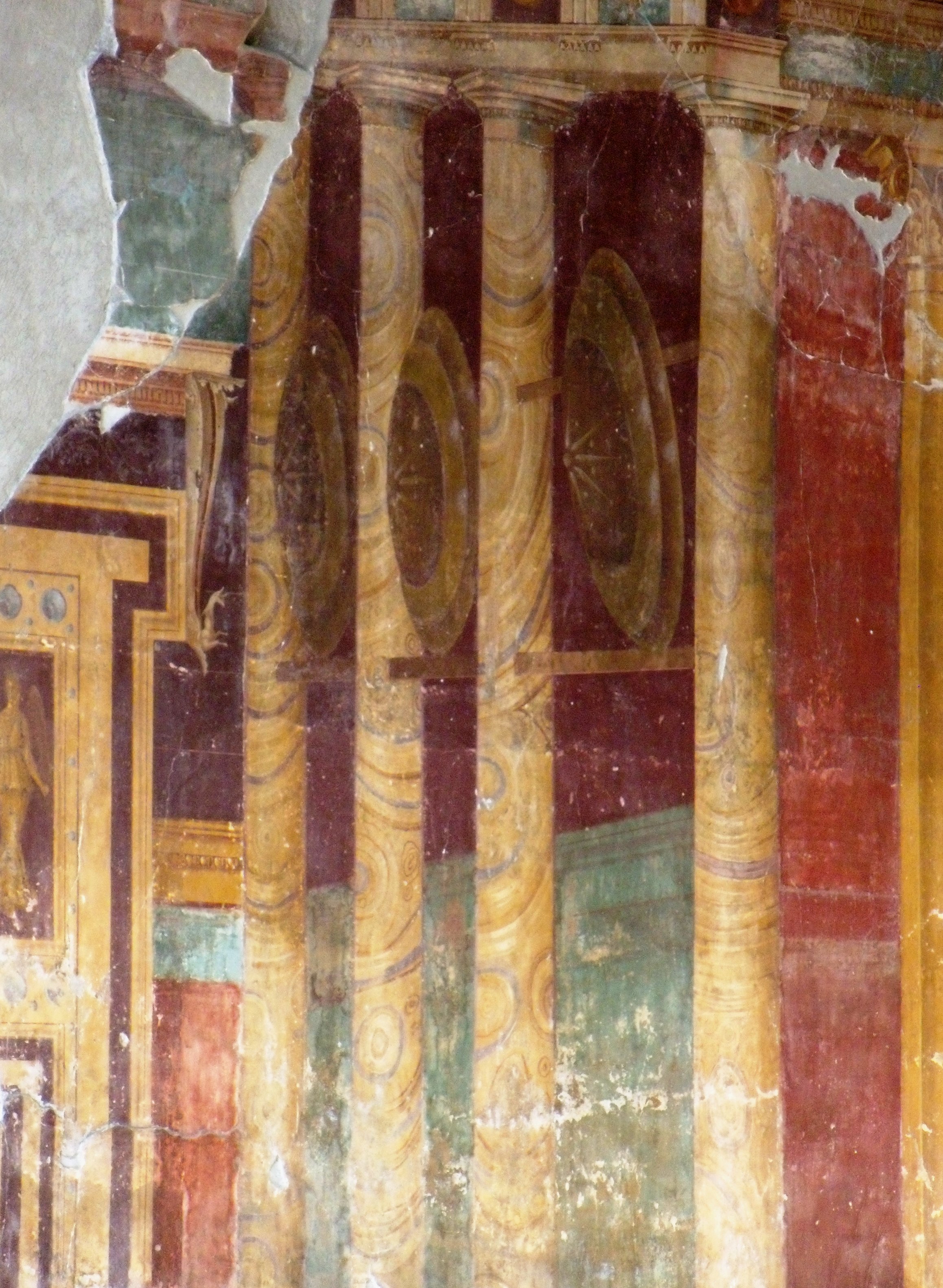
Another magnificent fresco is still in situ at the Villa of Poppea, Nero's wife, in nearby Oplontis. A life-size view of the Temple of Apollo with eight-rayed Macedonian shields painted between the columns covers a wall in the large sitting room. Wow! 

Later rulers and countries held Alexander and Macedonia in great esteem, and the Romans' admiration is an obvious example!

Monday, February 21, 2022

Wreaths and crowns of leaves or gold

Exploring the rooms of an archaeological museum, one inevitably comes across a concentration of gold and silver jewelry. Among them, the gold crowns with their quivering leaves call for our attention. 

The gold wreaths and crowns originated in ancient times when leaves and flowers were commonly used to mark festive occasions like processions or special dinners. Golden crowns were the privilege reserved for honors on behalf of the community or as funerary reverence. 

Wreaths of leaves were recognized as prizes for those victorious at competition games, marking a moment of triumph for the athlete. The most famous event was the Olympic Games, where the winner received a crown of olive leaves. Variants are laurel, Apollo’s sacred tree, at Delphi, dried celery at the Isthmian games, and green celery at the Nemean games. 

However, they were also appropriate on many other occasions. Those attending a Symposium would wear wreaths made of roses, violets, or myrtle leaves. Such wreaths appear clearly in Oliver Stone's movie Alexander in the wedding scene of King Philip.


They were also a sign of exceptional merit and military conduct and were worn by orators and priests as they performed their sacrifices. The Maenads and other followers of Dionysus wore wreaths of ivy or vine leaves, and so did the Chorus in ancient Greek theater. 

The ritual of crowning even extended to altars, statues, and temples. Wreaths were also part of funerary practices as the deceased would be crowned; the urns containing their ashes had a wreath, or the wreath was placed inside the tomb. 

Many such examples made in gold have reached us and found their way to the museums. For instance, the crown of oak leaves and acorns discovered in the tomb of King Philip in Aegae and the silver funerary urn from an unspecified Macedonian tomb are at the Museum of Vergina. 

However, most of the finds are on display at the Archaeological Museum of Thessaloniki (see: Exploring the Archaeological Museum of Thessaloniki). The wreaths come, for instance, from Cassandreia, Apollonia, Sedes, Aenea, and the greater area around Thessaloniki and ancient Aegae. These precious grave goods may be the legacy of Alexander’s conquests and the wealth Macedonia amassed in his wake. 

It is a pure pleasure to wander through the museum’s rich collections to find, for instance, two myrtle wreaths, one splendidly executed with colored flowers, and another funerary one with bronze gilt leaves and clay gilt fruit (Aenea) from 350-325 BC. Two olive crowns, one from Tomb A and another very elaborated one with the knot of Heracles from Cassandreia (3rd century BC). The gold ivy wreath was found in Apollonia and dated 350-325 BC. The gold oak crown, very typical for the Macedonian court, was also unearthed in Cassandreia and carried the fascinating knot of Heracles as well. 

Although Athens holds far fewer examples, they may be kept in their reserves. The National Archaeological Museum exhibits a myrtle wreath with berries from the 4th century BC. The lesser-known Benaki Museum displays an oak leaves crown from the late 2nd/early 1st century BC found in Alexandria and another crown with gold ivy and flowers from Macedonia, 1st century BC. 

Eventually, wreaths appeared on funerary monuments or were painted on their walls. In time, a wreath might be carved on the tomb to mark the site. 

It is noteworthy that wreaths were sacred objects. It was a sacrilege to wear somebody else’s crown without authorization. It was also forbidden to remove a wreath or dispose of it if you were not supposed to touch it. 

Crowns were not a privilege of Greece. Earlier Thracian gold wreaths were found in Bulgaria and are now at the Museum of Sofia. 

A most striking and uncommon crown surfaced at Tillya-Tepe in northern Afghanistan (see: Bactrian Gold, the Hidden Treasures from the Museum of Kabul). The burial site belongs to some steppe people. It has been dated to the first century AD revealing a true mixture of art from the steppes (possibly Scythian art), Greek, Indian, and Chinese art. The princess’ crown is a travel crown with gold spangles and flowers. It can be taken apart as it consists of five separate pieces mounted around a tiny stem holding flattened branches that fit into the band of the crown itself. The spangles are gently shaking as people walk by, so imagine this crown out in the open steppe where the wind can play freely with every tiny detail! A true gem! 

How many more such treasures remain hidden, waiting for us to discover them?

[Picture from Oliver Stone's movie AlexanderThe crown from Tillya Tepe is from the Australian]

Friday, December 10, 2021

Ways to preserve mosaics

Most archaeological sites we can visit nowadays date from Roman times. In the 2nd century AD, Rome reached its apogee under the reign of the five "good" emperors: Nerva, Trajan, Hadrian, Antoninus Pius, and Marcus Aurelius. They constructed monumental public buildings, and the houses of the Roman citizens were also lavishly decorated, often with frescoed walls and telling mosaic floors. 

The best-known examples are the houses and villas in and around Pompeii and Herculaneum. Still, many sites in Greece (like Pella and Vergina) and Turkey (like Ephesos and Sagalassos) also treasure such striking walls and floors. 

Some mosaic floors are left in situ where they rightfully belong, in which case they need to be protected from the elements. Shelters for this purpose are then constructed. However, even these shelters need to be maintained, which is not always the case. 

Another way of protection is to cover the mosaics with a tarp held in place with a layer of gravel. This procedure requires less maintenance as only the edges have to be checked. Many curious visitors will be tempted to push the tarp and the gravel aside to look underneath. The mosaic floors are "eaten" away from the fringes without careful and repeated care. 

Anyway, this manner of preservation is a favorite among archaeologists because it requires little or no maintenance. However, plants' roots may damage and displace the tiny tesserae. 

The most appropriate way to save a mosaic is to remove it from its spot and entrust it to the care of a museum, where it hopefully will be on display. 

Such removal is very time-consuming and expensive, as the top layer of the tesserae has to be detached from the existing floor in one piece. For this purpose, archaeologists use a large wooden cylinder around which the mosaic is rolled face down. A facing of two layers of fabric and an adhesive is applied to prevent losing tesserae or damaging the surface during this tricky operation. The entire mosaic floor can then be moved to its new location using a panel of aluminum honeycomb and resin, following the most recent techniques. 

When strolling through a museum, the visitor is seldom aware of the effort and delicate work involved in displaying the mosaics for us to enjoy. We'd better take a closer look next time we visit a museum!

Friday, July 16, 2021

There is more to Aegae than the Royal Palace and the Great Tumulus

Driving from modern Vergina towards the Royal Palace of Aegae, we take little notice of the open fields to our left, where the necropolis of ancient Aegae is waiting to be fully excavated. The very area is uninspiring as it consists of a succession of more or less conic bumps in the landscape. These are, in fact, mounds covering the tombs dating as far back as 1000 BC. The cemetery remained in use until the 2nd century BC. 

Proceeding further south, we encounter the Rhomaios Tomb and the Tomb of Eurydice, Alexander’s grandmother, a few meters onward. Further north lies an undefined Public Building and the so-called Hellenistic House and the Sanctuary of the Mother of the Gods to the west

With its 8.50 meters, the Rhomaios Tomb is one of the longest tombs. It consists of two rooms, an antechamber, and the chamber proper. The antechamber measures 4.50 x 2.50 m and is 2.20 m high. A narrow band runs around the walls and is painted with flowers. The colors alternate on the deep blue background using combinations of red-blue, white-blue, yellow-blue successively, and again red-blue, etc. A marble door separates the antechamber from the main vaulted chamber, which is square (4.50x4.50 m) and 4.45 m high. Here too, a dark blue band decorates the walls, but it is plain blue this time. An impressive marble throne stands in the back of the tomb with a footstand and a kind of bed. The throne is remarkable because of its large size. It is decorated with small painted friezes in the lower part, and its armrests display sculpted sphinxes. 

This tomb has been totally robbed in antiquity, making dating very difficult. However, comparing its features and style to those of the nearby Palace, it has been possible to date it to the first half of the 3rd century BC. Last, but not least, it is essential to note that this tomb was never covered by a tumulus and that its location so close to the village is puzzling.

Hades and Persephone, Vergina
Unknown author, Public domain, via Wikimedia Commons

The Tomb of Eurydice is another large burial monument, which appears to be the earliest known Macedonian tomb. As expected, this gravesite has been plundered in antiquity. However, based on the shards left behind, it could be dated to around 340 BC. The dating, the wealth of the tomb, and the dedications found in the nearby  Temple of Eukleia led us to believe that this grave belonged to Queen Eurydicethe mother of Alexander’s father. The monument is 10.60 m long and nearly 8m wide. It is divided into an antechamber and the chamber proper, which measures 5.50x4.40 m with a 5.80-meter-high vault. The chamber's back wall displays an elegant but straightforward Ionic façade of a Macedonian tomb whose stucco and architectural details have been well-preserved. The trompe-l’oeil painting reveals a central door flanked by two stucco windows separated by two pairs of Ionic half-columns. The frieze of flowers and the cornice of the entablature are painted in vivid blue, red, and green. Like in the Rhomaios Tomb, we find a richly decorated throne two meters high. The back of the seat surprises with a superbly painted panel showing the Underworld, with the gods Pluto and Persephone, standing in full majesty on a quadriga drawn by two white and two brown horses. The throne itself is decorated with reliefs, gilded flowers and animals, and even with statuettes of korai. 

Other remarkable tombs in the area are the Tomb of the Bella Farm (first half of the 3rd century BC) with its delicate facade paintings, the tomb on the Bloukas field (c. 200 BC), and the cist grave of Palatitsa (c. 350 BC) – none of which are open to the public. 

The Temple of Eukleia is situated some 80 meters north of Aegae’s theater and close to the road leading to the Palace. Not much of this sanctuary survived, but it could be established that it had a small pronaos of 4x2.5 m and a square naos of 4x4 m. Archaeologists assume that the pronaos was an open space because the bases for statues were found in the two corners of the naos and possibly flanking a sacrificial table. It is striking that the temple faced north. Along the west side of the temple, three bases for statues were found at regular intervals. On the face of the southernmost base, a valuable inscription was found, reading ΕΥΡΙΔΙΚΑ ΣΙΡΡΑ ΕΥΛΛΕΙΑ, in other words, ”Eurydice, daughter of Sirra (erected this statue) to Eukleia.” The finesse of the letter curving has helped to date the inscription to the second half of the 4th century BC. These elements indicate that Queen Eurydice dedicated her statue to the goddess Eukleia, worshiped in this temple. It is assumed that the other bases carried similar offerings by members of the royal family. 

Roughly 400 meters east of the Temple of Eukleia are the remains of the Sanctuary of the Mother of the Gods. This archaic deity had a close relationship with the cult of Dionysus. By the early 6th century BC, the Mother of the Gods was linked with her Asian counterpart, Cybele. The goddess was worshiped with orgiastic dances and music. On votive reliefs and terracotta statuettes, she is depicted holding a large libation bowl in one hand and a large drum for the orgiastic dances in the other. Her head is crowned with a kind of fortress, referring to her role as goddess of cities and fortification walls.

Together with the information left by ancient writers, the remains of this Sanctuary reveal the importance of the cult. A large square building of 32x32 m has been unearthed in recent years. It contained separate rooms playing an essential role during initiation and worship. Various terracotta figures of the goddess, incense burners, vases, coins, loom weights, and all kinds of architectural relics from the earlier building from the 4th century BC have been found. The excavation showed that this sanctuary, destroyed by a severe fire around 150 BC, dates from Hellenistic times. 

A recent article in the Archaeology News Network mentions new studies of a large building complex close to the northwest gate of Aegae and the “queen’s burial cluster.” However, it is not clear whether this is close to the tombs mentioned above or the sanctuaries, but I suppose it is the case. 

The building complex from the 4th century BC has been associated with the worship of the royal family. It was built with stone from the nearby Mount Vermion and set up in successive square and rectangular rooms reaching 100 square meters. They are organized around a large courtyard. The space on the east side resembles a temple with a very large antechamber and two Doric columns on the courtyard side.

More exciting are the stamps carrying the Macedonian shield, which were also used on the coins by the Macedonian kings in Hellenistic times. Importantly, roof panels bearing the inscriptions AMYNTOΥ. This may refer to King Amyntas III, the husband of Eurydice and grandfather of AlexanderIn any case, it testifies of a close relationship with the Macedonian royal family. Other tiles are imprinted with ΠΕΛΛΗΣ, indicating that this particular sacred building must have belonged to Amyntas, who was given the status of hero. A similar cult is known to have existed in Pydna. Moreover, the presence of Eurydice in her nearby temple cannot be a coincidence. 

Despite the thorough looting by the Roman general Metellus in 148 BC, extensive renovations occurred under Philip V during the late 3rd/early 2nd century BC. For instance, the walls are covered with painted plaster. The favorite color was purple, with touches of green and ochre, and the scenes are divided with reliefs, not unlike those known from  Pompeii. The floors are inlaid with marble, as seen in the Palace of AegaeHowever, it could be established that the cracks and irregularities in the floor levels were due to catastrophic landslides in the 1st century AD. After a period of decline, the city of Aegae disappeared under the debris.

 It is clear that the cult of Alexander was kept alive and that the building complex was a way to confirm and legitimize his power and that of his successors.