Alexandria's founded by Alexander

Alexandria's founded by Alexander the Great (by year BC): 334 Alexandria in Troia (Turkey) - 333 Alexandria at Issus/Alexandrette (Iskenderun, Turkey) - 332 Alexandria of Caria/by the Latmos (Alinda, Turkey) - 331 Alexandria Mygdoniae - 331 Alexandria (Egypt) - 330 Alexandria Ariana (Herat, Afghanistan) - 330 Alexandria of the Prophthasia/in Dragiana/Phrada (Farah, Afghanistan) - 330 Alexandria in Arachosia (Kandahar, Afghanistan) - 330 Alexandria in the Caucasus (Begram, Afghanistan) - 329 Alexandria of the Paropanisades (Ghazni, Afghanistan) - 329 Alexandria Eschate or Ultima (Khodjend, Tajikistan) - 329 Alexandria on the Oxus (Termez, Afghanistan) - 328 Alexandria in Margiana (Merv, Turkmenistan) - 326 Alexandria Nicaea (on the Hydaspes, India) - 326 Alexandria Bucephala (on the Hydaspes, India) - 325 Alexandria Sogdia - 325 Alexandria Oreitide - 325 Alexandria in Opiene / Alexandria on the Indus (confluence of Indus & Acesines, India) - 325 Alexandria Rambacia (Bela, Pakistan) - 325 Alexandria Xylinepolis (Patala, India) - 325 Alexandria in Carminia (Gulashkird, Iran) - 324 Alexandria-on-the-Tigris/Antiochia-in-Susiana/Charax (Spasinou Charax on the Tigris, Iraq) - ?Alexandria of Carmahle? (Kahnu)
Showing posts with label Demetrios-Poliorcetes. Show all posts

Friday, June 21, 2024

The roaring times of the Antigonid dynasty

The Wars of the Diadochi broke out after Alexander’s death in 323 BC and his huge Empire went to “the strongest” as he may have intended to say on his deathbed in Babylon. However, it did not go to one single ruler as none of his generals had his vision or charisma. 

After endless battles, intermarriages, and lots of intrigues, Alexander’s generals eliminated each other and, in the end, started four distinct dynasties. Ptolemy initiated the Ptolemaic dynasty in Egypt, and Seleucos the Seleucid dynasty in Asia. Cassander, the son of Antipater, founded the Antipatrid dynasty (the ancient Kingdom of Macedonia). In 306 BC, Antigonus Monophthalmus (the One-Eyed) declared himself and his son Demetrios kings. By doing so, the Antigonid dynasty replaced the Antipatrid dynasty. 

Antigonus may well have served under Philip II and lost an eye during the Siege of Perinthus in 340 BC. He later joined Alexander on his Persian campaign and was promoted to satrap of Phrygia in 334 BC. His main duty was to maintain Alexander’s line of communication and supply. As a result of the Partition of Babylon following Alexander’s death, he also received Pamphylia and Lycia. 

During the Wars of the Diadochi, Antigonus picked up momentum and managed to rule over all of Asia Minor, Greece, Syria, Phoenicia, and northern Mesopotamia. Fearing his increasing power, Seleucos, Ptolemy, Lysimachos, and Cassander joined forces against him. Antigonus was defeated and killed at the Battle of Ipsus in 301 BC after which his realm was split between Lysimachos and Seleucos. 

However, Antigonus son Demetrios Poliorcetes, by now having earned his stripes as Besieger survived said battle and took control of Macedonia in 294 BC. Cassander died in 297 BC without a successor as his sons had eliminated each other, paving the way for Demetrios to become King of Macedonia. Not for long because in 288 BC he was driven out by Pyrrhus and Lysimachos, and died as a prisoner of Seleucos. 

It was not until 277 BC that Demetrios son, Antigonus II Gonatas, regained the title of King of Macedonia. He ruled till about 239 BC, to be succeeded by Demetrios II Aetolicus, followed by Antigonus III Doson ten years later. 

Meanwhile, Rome became the rising power in the eastern Mediterranean, and soon the first conflicts with Antigonid Macedonia led by King Philip V (221-179 BC) erupted. His successor, Perseus, put up a fierce resistance against the expanding Roman Empire that coveted Macedonia’s wealth. The Romans conquered Antigonid Macedonia in 168 BC at the Battle of Pydna, turning Alexander’s homeland into a mere Roman Province. 

Although very eventful, the Antigonid dynasty was short-lived and lasted less than 150 years. 

Macedonia’s grand palaces of Aegae, Pella, Bylazora, and Dimitrias were thoroughly looted, and the houses of the wealthy Macedonians were plundered. Statues, paintings, jewelry, and other wonderful, precious artifacts from Greece and Asia were up for grabs. Roman generals and common soldiers alike took as much as they could carry. Only the gods know what happened to the collection of Macedonia’s precious libraries.

Tuesday, April 2, 2024

Bylazora, the last Macedonian Palace

The Paeonians occupied the land north of ancient Macedonia and functioned as a buffer zone with the Dardanians on their northern border. Bylazora, in fact, was situated in a commanding position at the natural pass leading from Dardania into Macedonia. 


Philip V of Macedonia, who ruled from 221 until 179 BC, captured Bylazora in 217 BC. By blocking the Dardanian access road to Macedonia, he freed his country from its repeated menacing raids. PerseusPhilip’s son, who succeeded his father, sent mercenaries to Bylazora to confront the Romans, but he was defeated in 168 BC. He was taken to Rome to be shown in their victory parade, together with the incredible wealth of Macedonia. The rich kingdom became a mere Roman province. 

Although Bylazora was the largest city of Paeonia and was mentioned by Livy and Polybius, its location remained a mystery. It was tentatively identified with (Titov) Veles, but the results were inconclusive. As so often, the city was discovered by accident in 1994. Road works exposed a buried pool-like building close to modern Sveti Nikole in the Republic of North Macedonia, some 50 kilometers southeast of Skopje, between the Axios and the Strymon Rivers. 

Excavations started in 2008 after the Museum of Sveti Nikole invited the Texas Foundation for Archaeological & Historical Research (TFAHR) to a joint cooperation. 


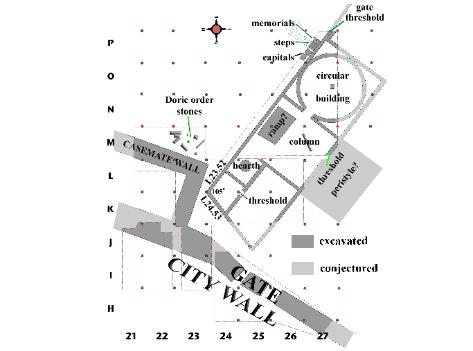
It was a slow process of searching for clues that started at the top of the hill, the Acropolis. Soon, a section of the northern defensive wall was exposed, followed by the discovery of a ramp leading up to the Propylon. Next, a Stoa with Doric columns was identified and dated to the days of Philip V based on a similar gallery built by Attalus II in Athens. 

A long wall and successive rooms were unearthed, making the archaeologists realize they had found the Palace of Philip V and Perseus, the last two kings of Macedonia. 

The first room they explored had all the characteristics of a kitchen, with a fireplace, much pottery, plates, vessels, and amphorae from the 3rd-2nd century BC. The walls were covered with a thick layer of plaster with traces of paint. Followed a room with columns and capitals, which was named Ante-room since it connected to a more important Tholos. For those who visited the Palace of Aegae in Greece, that space is very recognizable. On the other side of this Tholos lies the Entrance Hall, which in turn is connected to the Vestibule. This large room opened onto the Outer Courtyard via a monumental staircase. 

Keeping the layout of the Palace of Aegae in mind, the archaeologists projected the same series of rooms around the Inner Courtyard. The picture seems to fit perfectly. It also matches the Palace of Dimitrias, situated just south of Volos in Greece. The city was built by Demetrios Poliorcetes when he was king of Macedonia, i.e., 294-288 BC. 

Until now, and as opposed to Aegae and Pella, I had no knowledge of the Macedonian Palaces of Bylazora or Dimitrias. The destruction of the Palaces of Aegae and Pella by the Romans is well-documented. Dimitrias, however, was entirely dismantled, and it is assumed that the same happened in Bylazora, although it was never finished. 

Much more pertinent information with clear maps and unique details can be found in this lecture given by Dr.William J. Neidinger of the TFAHR.

[Pictures from TFAHR]

Saturday, March 11, 2023

How Macedonian is a Macedonian shield?

When talking about Macedonian shields, our thoughts automatically turn to those carrying a 16-rayed star like the one on the lid of King Philip's golden larnax displayed at the Museum of Vergina. 

What should be simple and straightforward, in reality, isn't. 

The first king to use the Macedonian sun emblem may be Archelaus (413-399 BC), i.e., well before Philip II came to power. In Alexander's days, the number of sun rays varied from eight to twelve or sixteen. Alternatively, the center of the shield could be a disc that remained blank or was filled with a Gorgon's head, the face of Heracles, etc. Such a disc was usually surrounded by a varying number of crescents. Other shields may seem unadorned, but it has been documented that many were painted only. That would make sense when looking at the row of armor and shields lining the street in Dion. The monument was commissioned by Alexander after his victory at the Granicus. 

As I have come across many examples of shield decorations, either on paintings, reliefs, coins, or other works of art, it might be interesting to highlight some examples. 

For a start, today's flag of the Republic of Macedonia shows a sun with 16 rays, the so-called "Vergina-Sun." 

A bucranium found in Apollonia Pontica, modern Sozopol, Bulgaria, shows an eight-rayed star, which leads that country to claim that the origin of the "Vergina-Sun" is theirs (see: The Origin of the Macedonian star was Thracian?)

The excavations in Albania have so far yielded several examples of shields they call Illyrian but look very Macedonian at first glance. I was told that the difference with a Macedonian shield was the curving. Whether that is true or not, I don't know (see: Looking for Illyrian remains in Albania).

At the small Museum of Apollonia, Albania, I saw my first Illyrian shield from the 4th century BC that looked very much like the Macedonian one. A series of triple crescents surrounds the central Medusa head with shiny eyes.

The Skanderberg Museum proudly exhibits an Illyrian shield with similar half-crescents but with a six-rayed star at its center.

Two Illyrian shields are embossed on a leather belt buckle at the Archaeological Museum of Tirana. In this case, we see a central disc surrounded by respectively four and five larger double crescents. 

From the same period, a striking limestone mold for a leather shield cover was found in Egypt. It was made for the soldiers of Ptolemy in 330 BC. It has typical Macedonian features with a central Medusa head surrounded by triple concentric circles holding a small eight-rayed Macedonian star (see: Alexander's Legacy. Allard Pierson Museum in Amsterdam). 

The Tomb of Agios Athanasios from the era of Alexander has been attributed to a Macedonian nobleman. Although looted in antiquity, the narrow frieze above the entrance holds precious information about Macedonian daily life and its army in blazing colors. The lively scenes have been photographed in detail and digitally restored for all to examine at the Archaeological Museum of Thessaloniki (see: The Macedonian Tomb of Agios Athanasios in Thessaloniki). Of particular interest are the three shields, two of which show an eight-rayed star surrounded by a broad-colored rim. These shields are painted, as are other examples on the walls of grave monuments. It remains an intriguing question whether shields used in combat were painted as well. Color coding may have contributed to bringing soldiers of the same unit together. Still, I fail to see how Alexander's Macedonians would have carried paint to maintain the distinctive coding during the many skirmishes and battles.

A unique set of shields can be admired inside the Tomb of Lyson and Kallikles in Lefkadia, Greece (see: Alexander's schooling at Mieza). The one painted in the north lunette has a blue eight-rayed star at its center and is edged with a crown of leaves. The shield in the south lunette is defined as the 'familiar Macedonian' shield with an empty disc at its center and surrounded by eight crescents. The tomb is dated to c.250 BC. 

Another specimen is a bronze shield from the collection of the Getty Museum in Malibu, California. It definitely has a Macedonian look because of the central six-rayed star (see: A magnificent Greek shield). The inscription reveals that it was made in Pontus on the Black Sea for King Pharnaces I. Since we do not know when exactly Pharnaces died, we can only assume it was made between 160 and 154 BC, when his brother Mithridates IV succeeded him to the throne. 

From the cities that disappeared under the ashes of Mount Vesuvius after the eruption of 79 AD, I like the fresco from Boscoreale, now at the Archaeological Museum of Naples (see: Fresco of a Macedonian at Boscoreale). The painting, based on a mid-3rd century BC original, was retrieved from the Villa of P. Fannius Synistor and shows a scene in which the principal figure sits next to an eight-rayed Macedonian shield resting at his feet. According to some sources, it would depict Antigonus II Gonatas (the son of Demetrios I of Macedonia) with his mother, Phila, or simply be the personification of Macedonia and Asia/Persia.

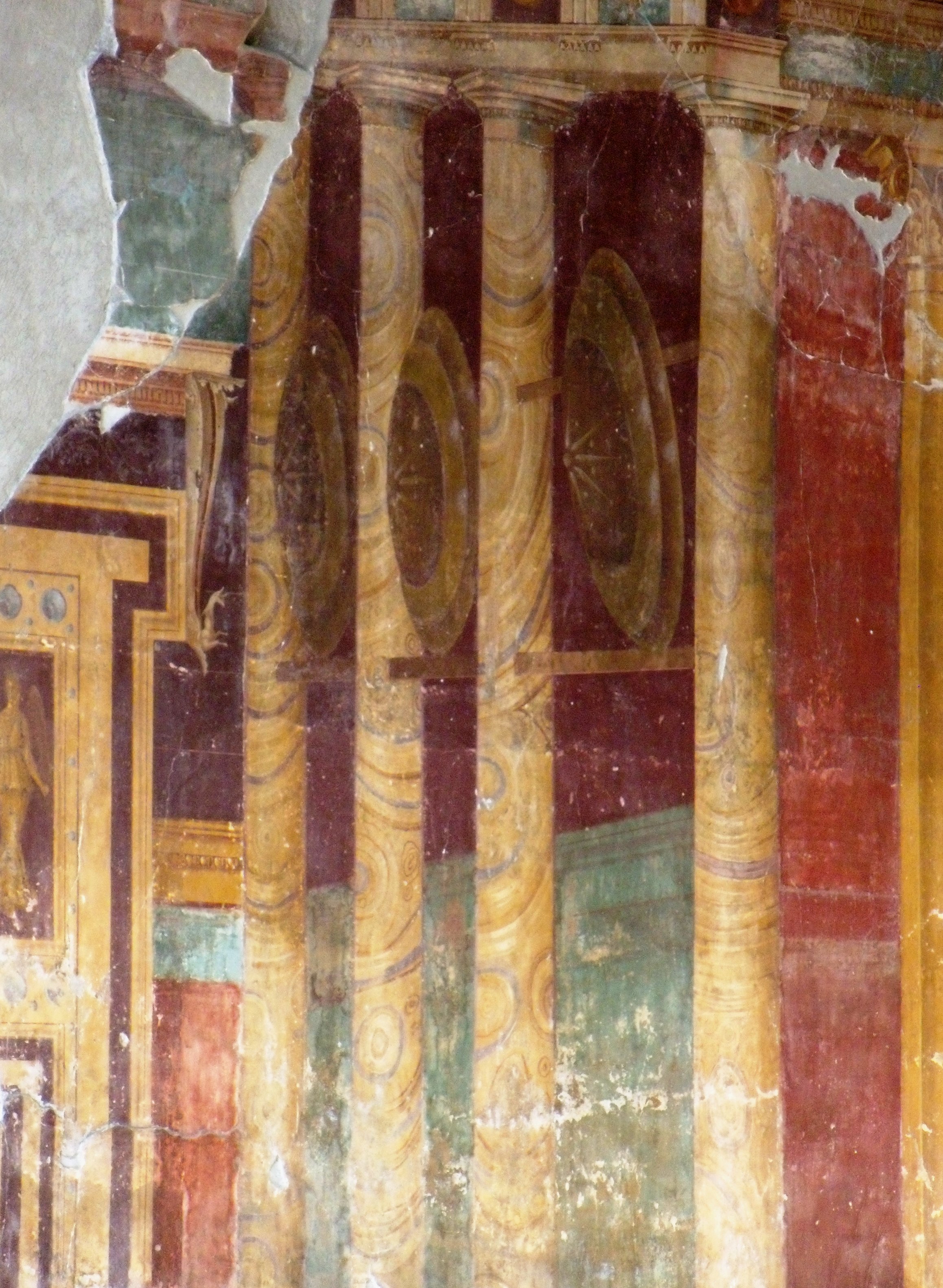
Another magnificent fresco is still in situ at the Villa of Poppea, Nero's wife, in nearby Oplontis. A life-size view of the Temple of Apollo with eight-rayed Macedonian shields painted between the columns covers a wall in the large sitting room. Wow! 

Later rulers and countries held Alexander and Macedonia in great esteem, and the Romans' admiration is an obvious example!

Friday, February 17, 2023

An introduction to Pyrrhus of Epirus

It was quite a surprise to stand face-to-face with Pyrrhus in Albania. It happened at the entrance to the Skanderberg Museum in Kruje, where his life-sized bust stood right next to the imposing relief figure of Skanderbeg, Albania’s hero. 

Pyrrhus of Epirus was a great-nephew of Olympias and cousin of Alexander the Great – not a small introduction. He was born in c.319 BC – not the right time to be the heir to the Molossian throne of Epirus. He got caught up in the fiery dispute between the sons of Cassander and Thessalonica, and, reigning briefly as a minor, he had to flee his homeland. He joined the court of Demetrios I (Poliorketes) as an exile, and in 301 BC, aged 18, he fought at the Battle of Ipsus

As a pawn in the War of the Diadochi, Demetrios, to befriend Ptolemy, gave him Pyrrhus as a hostage. That’s how Pyrrhus arrived in Alexandria. Well, it was not the worst place to grow up, and Pyrrhus most certainly took advantage of the situation, not unlike what Philip II had done at the court of Thebes. He made his way in Egypt and eventually married one of Ptolemy’s daughters, Antigone

Four years later, in 297 BC, with Ptolemy’s support, Pyrrhus returned to Epirus and began taking control of his own life. He started expanding his kingdom by annexing Illyria. His ambitions were not small, for when Antigone died, Pyrrhus made three diplomatic marriages to live peacefully with his neighbors. His first wife was Lanassa, the daughter of Agathocles, tyrant of Syracuse. Her dowry was the islands of Leucas and Corcyra (modern Corfu). The next bride was the daughter of King Audoleon of the Paeonians living north of Macedonia. His third marriage was to Bircenna, daughter of the Illyrian King Bardylis II. Demetrios Poliorcetes as king of Macedonia, it should be said, had married Pyrrhus sister. 

By 288 BC, Pyrrhus turned against Demetrios and succeeded in getting the Macedonian army on his side. With Lysimachos as his new ally, they jointly ruled over Macedonia. Only for a while, though, since Lysimachos still had his mind set on all of Macedonia and expelled Pyrrhus. 

Once more, Demetrios and Pyrrhus made peace, which was again short-lived. When in 286 BC, Demetrios invaded Asia Minor, ruled by Lysimachos, the latter asked Pyrrhus to invade Thessaly to attack Demetrios from GreecePyrrhus soon defeated Antigonus GonatasDemetrios’ son, who surrendered Thessaly to him to make peace. 

Pyrrhus’ empire now included half of Macedonia, larger Epirus, and Thessaly. Yet, he still wanted more and eyed Magna Graecia, including the wealth of Sicily. His opportunity arose when Taras (modern Taranto) called for his help to repel an imminent Roman attack. Pyrrhus led his army across the Adriatic Sea, including 20 war elephants. He was victorious at Heraclea (modern Policoro, southwest of Metaponto) in 280 BC and a year later at Ausculum (modern Ascoli Satriano south of Foggia)

At this point, Pyrrhus decided to stay in Italy, offering his help to Syracuse. He successfully lifted the Carthaginians’ siege in 278 BC and, in return, was proclaimed King of Sicily. The Medagliere, the strongbox room at Syracuse’s Museum, proudly exhibits coins of King Pyrrhus

His moment of glory would not last either because of the renewed threat from Carthage, ending Pyrrhus siege of Lilybaeum (modern Marsala) in a disaster. The people of Syracuse then decided not to continue the war. The Carthaginians defeated Pyrrhus in 275 BC on his return to Syracuse

At the end of that same year, Pyrrhus sailed back to Epirus, which, in his mind, offered new opportunities as his son, Ptolemy, tried to expand the kingdom. The next campaign took Pyrrhus to Argos in the Peloponnesus, where caught in a narrow street, he was killed by a woman who threw a tile from the housetop. 

This was not the death a man like Pyrrhus would have planned. He had fought in so many battles, always leading his men. He had been schooled by Demetrios Poliorketes, who had walked in the footsteps of Alexander and his father, Philip. He was not meant to die such an inglorious death. 

In the 2nd century AD, Pausanias witnessed a memorial to King Pyrrhus at Argos, integrating a panorama ‘carved in relief.’ The king was buried in his capital, Ambracia (a colony of Corinth in Epirus). 

Pyrrhus may have led a glorious life, but the Macedonians resented him because he let his Gauls plunder the tombs of the Macedonian kings at Aegae – an unforgivable crime!

Monday, June 27, 2022

Lysimachos in the wake of Alexander – Part II

 [continued from Lysimachos in the wake of Alexander - Part I]

Skipping the many details and intertwined relationships, let us pick up the story when Seleucos added his forces to those of Lysimachos and his allies to fight the elderly Antigonus Monophthalmus and his son Demetrios Poliorcetes. The battle took place in 301 BC at Ipsus and ended with Antigonus’ defeat and death. The victors subsequently divided his territory among them. Lysimachos acquired a significant share with Lydia, Ionia, and Phrygia, including the entire north coast of Asia Minor. Seleucos received Syria, and Cassander was now secure in Macedonia and Greece. 

Until then, Antigonus Monophthalmus had been the most successful among the generals in recreating Alexander’s empire. His son Demetrios attempted to follow in his father’s footsteps, but he lacked a broader view. 

Around that time, Nicaea died, and Lysimachos honored her by naming a city in Asia Minor after her, modern Iznik in Turkey. 

As Seleucos was growing ever more powerful, Lysimachos thought it wise to seek the support of Ptolemy. Around 300 BC, he elected to marry Arsinoe, the daughter of Ptolemy, and his mistress Berenice. Amastris, as said above, stepped back and divorced herself from Lysimachos, moving back to Herakleia Pontus. 

Although this marriage of Lysimachos was not a happy one, Arsinoe stayed with her husband till his death. She bore him three sons: Ptolemy I Epigonos, Lysimachos, and Philip. Her jealousy, however, incited her to convince her husband to kill his oldest son and heir, Agathocles (from his marriage to Nicaea), based on treason. The murder happened in 284 BC despite the young man successfully leading his father’s army in combat. Although he was only in his early thirties, his men loved him much. 

Meanwhile, Cassander died in 297 BC. His sons were more interested in fighting each other for power than ruling the country. Macedonia eventually fell into the hands of Demetrios. So, in 287 BC, Lysimachos agreed to fight alongside Pyrrhus to drive Demetrios out of Macedonia. They successfully ruled the country jointly until Lysimachos broke up with Pyrrhus and seized Macedonia for himself. 

Lysimachosgreed and thirst for power equaled that of the other generals, now kings in their realms. The fighting was not over yet. 

Seleucos, in 282 BC, broke his alliance with Lysimachos as he attempted to take his territory in Asia Minor. The final clash happened in Lydia at Corupedium in 281 BC. It ended with the death of Lysimachos. By then, the King of Thracia must have been in his late 70s. He had lived a life of almost continuous and repeated battles, inspired by the greatest conqueror of all times, Alexander the Great. 

Like the other new self-proclaimed kings, Lysimachos had minted his own coins. However, he did not follow them by stamping his personal image on these coins but kept using the effigy of Alexander instead. Could that be seen as a late posthumous homage and tribute to his boyhood friend? 

Lysimachos is also being honored as a friend and benefactor of Samothrace. He received the title of Lysimachos Euergetes as inscribed on the altar erected in his honor and used during annual festivals. A stele found on the island reads a dedication of King Lysimachos from between 288 and 281 BC. Based on the surviving first fifteen lines, Lysimachos was honored for restoring sacred lands on the mainland initially granted to Samothrace by either Philip II or Alexander the Great or by Philip Arrhidaeus III and Alexander IV. There were boundary stones for said sacred land near Alexandroupolis in Greece. 

Money was never an issue throughout all those years of bickering, conniving, and fighting. Lysimachos, like all the other generals, had cashed his share of Alexander’s fortune. In his case, it was a mere 9,000 talents in silver and gold, roughly worth several billion in today’s value. The money was safely kept on the Acropolis of Pergamon. However, when Attalus III gave the city to Rome in 133 BC, the entire treasure (not limited to Lysimachos share) fell into Roman hands. This fortune contributed largely to the rise of the Roman Empire – but that is another story.

Sunday, December 20, 2020

Aratus of Soli, poet and astronomer


Aratus was an astronomer and poet who was born in Soli (near modern Mersin) in 315 BC. He came in the news after this year’s ongoing excavations in Soli, the Roman Pompeiopolis, as archaeologists discovered a memorial tomb. This grave site was surrounded by two rows of hexagonal structures and arches and is being described as “a crater with a circular plot worthy of an astronomer”.

These elements led the scholar to link the monument to their citizen Aratus, although he died in Alexander’s birthplace Pella, in 240 BC.

It so happened that Aratus was invited to the Macedonian court by Antigonus II Gonatas, the son of Demetrios Poliorcetes, in 276 BC. One year later, the poet penned down the king’s victory over the Gauls in verse form.

While he resided in Pella, Aratus wrote a hexameter poem on astronomy. In the first half of his Phenomena, he retells the work of Eudoxus of Cnidos, describing the constellations and other celestial phenomena, which he set into verse. The second half was known as Diosemeia and talks about the weather. The interest in Aratus’ poem was such that it was translated into Latin, and his work triggered a great number of comments from the Greek and Latin-speaking public.

However, he was also active in the field of philosophy, grammar, and medicine (some pretend he was a doctor).

He spent some time in Syria as a guest of Antiochus I Soter, but returned to Pella, where he died in 240/239 BC.

[Pictures from Greek City Times]

Monday, November 9, 2020

Remembrance Day

Each year again the British celebrate their Remembrance Day with great pride. Inevitably my thoughts drift off to Alexander and what he would have thought of this tradition. I truly believe he would have liked it very much. He even would have implemented a similar honorific parade had he lived long enough.

Without Cassander’s cruel rule, the situation in Macedonia would have been entirely different in spite of the Wars of the Diadochi that dragged on for about forty years. The successors in the end ruled over their share of Alexander's huge empire following the king's example. Inevitably, their Macedonian pride could not survive down to the following generations but whoever ruled over Alexander’s home country would have valued him highly. After all, the Macedonians of northern Greece still do. 

In the aftermath of those glorious years, several rulers certainly tried to keep Macedonia on the map. Most noteworthy are kings like Demetrios Poliorcetes (306-286 BC), Pyrrhus of Epirus (306-272 BC), Philip V (221-179 BC) and Perseus (179-166 BC). I'm sure they still held Alexander in high esteem and true to the great example of his troops. They would have found a way to honor those soldiers and remember them.

In the end, it may be nothing more than wishful thinking because history always takes turns of its own. It is incontestable that the Romans still envied and tried to emulate Alexander but they were foreigners and outsiders, who could never match the greatness of the king who died too young.

Sunday, May 3, 2020

The caltrop, a weapon to be reckoned with

A caltrop is a little-known gadget used over the centuries by many armies as an effective and unnerving weapon. Basically, it is made up of two or more sharp nails or metal contraptions arranged in such a way that one of the “legs” always points upward. In antiquity, it was an effective means to slow down enemy soldiers, their horses, and elephants. The upward nails would injure and impair the infantry soldier who stepped on them. The caltrop would also seriously hurt the feet of the unshod horses and the sensitive soles of the elephants’ feet.

It is not known who actually invented the caltrops or even who used them first. Caltrops are hardly mentioned in our historical records. In weaponry, it is clear that our attention goes to the protective outfit of the soldiers and to their apparent weapons like swords and lances, and the kind. 

The caltrops may have measured about 5 or 6 cm. They were easy to make, easy to transport, and easy to sew around.

The very first recorded use of the caltrop happened in Gaugamela, where the Persians had thrown plenty of so-called crow’s feet on the ground in front of the army. They must have caused Alexander some headaches. Firstly, to discover and locate these weapons, which were often partially hidden or entirely buried; secondly, to avoid them as the troops rushed forward to attack the Persians. In any case, he managed to bypass the trap as he cleared many of these crowfeet and otherwise safely maneuvered around the devices. His infantry, as well as his cavalry, successfully penetrated the enemy lines.

It is still to be determined whether the Greeks were familiar with the caltrops or saw them for the first time on the Battlefield of Gaugamela. Whatever the case, their effectiveness did not go unnoticed, as Alexander’s successors used them repeatedly in their later combats.

At the Battle of Gaza in 312 BC, Ptolemy and Seleucos threw these spiked caltrops in front of their lines to annihilate Demetrios’ elephants. The trick worked perfectly, and after shooting down the mahouts, the elephants were captured by the joint forces of Ptolemy and Seleucos.

A few years earlier, in 318 BC, caltrops or iron spikes were used to stop Polyperchon’s elephants at the siege of Megalopolis. In this case, they were driven in heavy wooden frames connected by chains and thrown in front of the elephants - spikes up. Eventually, Megalopolis did not accept the old general as the new Regent of Macedonia and chose to side with Cassander and Antigonus Monophthalmus. Unfortunately, the siege of Polyperchon failed.

The Romans, who learned a lot from Macedonian warfare, were also quick to implement the caltrop, although nothing is mentioned about Julius Caesar using them. He probably was the exception, for the Romans used the caltrops effectively in their war against the Parthians in 217 AD and again against the Sassanids in 637 AD. 

The caltrop was used throughout the Middle Ages, from Europe to North Africa and Asia - including China! The “fashion” did not die, and caltrops were again used during the Korean War. The principle of the caltrop is still effectively implemented today by the military and police to block vehicles.