Alexandria's founded by Alexander

Alexandria's founded by Alexander the Great (by year BC): 334 Alexandria in Troia (Turkey) - 333 Alexandria at Issus/Alexandrette (Iskenderun, Turkey) - 332 Alexandria of Caria/by the Latmos (Alinda, Turkey) - 331 Alexandria Mygdoniae - 331 Alexandria (Egypt) - 330 Alexandria Ariana (Herat, Afghanistan) - 330 Alexandria of the Prophthasia/in Dragiana/Phrada (Farah, Afghanistan) - 330 Alexandria in Arachosia (Kandahar, Afghanistan) - 330 Alexandria in the Caucasus (Begram, Afghanistan) - 329 Alexandria of the Paropanisades (Ghazni, Afghanistan) - 329 Alexandria Eschate or Ultima (Khodjend, Tajikistan) - 329 Alexandria on the Oxus (Termez, Afghanistan) - 328 Alexandria in Margiana (Merv, Turkmenistan) - 326 Alexandria Nicaea (on the Hydaspes, India) - 326 Alexandria Bucephala (on the Hydaspes, India) - 325 Alexandria Sogdia - 325 Alexandria Oreitide - 325 Alexandria in Opiene / Alexandria on the Indus (confluence of Indus & Acesines, India) - 325 Alexandria Rambacia (Bela, Pakistan) - 325 Alexandria Xylinepolis (Patala, India) - 325 Alexandria in Carminia (Gulashkird, Iran) - 324 Alexandria-on-the-Tigris/Antiochia-in-Susiana/Charax (Spasinou Charax on the Tigris, Iraq) - ?Alexandria of Carmahle? (Kahnu)
Showing posts with label Mir-Zakah. Show all posts

Monday, August 4, 2025

What Alexander really looked like.

Over the centuries, endless theories have circulated about the real appearance of Alexander. Statues, busts, paintings, and sketches have depicted Alexander as imagined by their creators, just as ancient and modern authors have described their version of Alexander. 

It is inevitable since Alexander became a legend during his lifetime. The legend took a life of its own, and still does today. 

I have just read an article on the Greek Reporter, “Beyond the Busts: Unveiling Alexander the Great’s True Face” by Paula Tsoni.  A very promising title that misleads the reader in many ways. The most absurd theory is the one quoted towards the end, reading: 

"A fresco depicting a hunt scene at the tomb of Philip II, Alexander’s father, at the archaeological site of Aegae is the only known surviving depiction of Alexander produced during his lifetime in the 330s BC."      

"A most disruptive theory is proposed by Greek-French academic Byzantinologist Helene Glykatzi-Ahrweiler, who has herself been identified by the 2008 show Great Greeks as one of the 100 greatest Greeks of all time. In her 2018 book published by Gutenberg, the famous scholar suggests that the tomb in Aegae is, in fact, Alexander’s, and not his father’s. This would explain why the young king was depicted in the famous fresco inside that tomb."

First of all, it has been clearly demonstrated that the tomb in Vergina, ancient Aegae, belongs to Philip II and not to Alexander, who was entombed in ancient Alexandria. The latest confirmation of Philip’s presence in the Vergina tomb has been established by studying the adjacent tomb that turned out to be Cynane’s, Philip’s daughter (see: Cynane buried next to her father, Philip II). 

Secondly, stating that the hunting scene in Philip’s tomb (which is unclear) is “the only known surviving depiction of Alexander” is not correct. It has been established that the ivory heads recovered from a Macedonian funerary couch in Vergina belong to Philip and Alexander. Greek archaeologists agree that the Alexander head is the only one made during Alexander’s lifetime. 

There have been repeated tentative efforts to recreate the Macedonian King’s face, even showing occasional look-alikes. A lot of wishful thinking, no doubt, but not very realistic. 

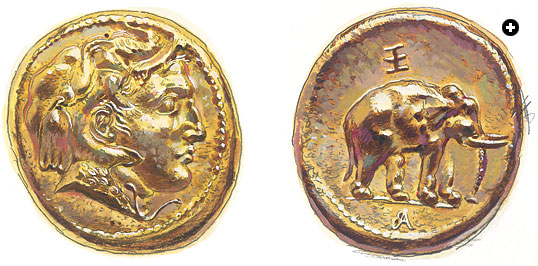
The question about Alexander’s real face already arose in 2016, when I wrote about a hoard found at Mir Zakah in north-eastern Afghanistan (see: Alexander’s real face). The hoard had been hidden in a well for over two thousand years and contained an estimated 550,000 coins. One of them showed Alexander with wide-open eyes, a crooked nose, and wild curls on the obverse and a tiptoeing elephant on the reverse. This is Alexander as he saw himself - invulnerable, verging on godhood, immortalized in the moment of his triumph after his battle against Porus on the Hydaspes in India in 326 BC. 

Osmund Bopearachchi was the first to recognize the medallion, and together with Frank Holt, he wrote a book on the subject, “The Alexander Medallion, Exploring the Origins of a Unique Artefact.” This information is ignored by or unknown to the eminent Greek-French academic Byzantinologist Helene Glykatzi-Ahrweiler, used by the Greek Reporter!

[Picture of the coin is from The Hindu]

Tuesday, August 16, 2016

The Alexander Medallion: Exploring the Origins of a Unique Artefact By O. Bopearachchi and F. Holt

Osmund Bopearachchi and Frank Holt have co-written the book “The Alexander Medallion, Exploring the Origins of a Unique Artefact” (ISBN 978-2-95166-796-9).

It treats in detail a golden coin showing us Alexander with the elephant headdress, the horns of Ammon, the Gorgon around his neck, and the coiling snakes worn as an aegis, but with an unfamiliar face. With his wide-open eyes, crooked nose, and wild curls, he reminds us of the picture on the mosaic from Pompeii. For once, his image has not been idealized! It is a rare portrait created during the lifetime of Alexander the Great that survived into modernity. The reverse of the coin shows a cute dancing elephant; this image, together with the elephant skin on Alexander’s head, connects the coin immediately to his battle against Porus on the Hydaspes in India that took place in 326 BC. This is Alexander as he saw himself - invulnerable, verging on godhood, immortalized in the moment of his triumph.

The medallion was part of a hoard found at Mir Zakah in north-eastern Afghanistan, where it had been hidden in a well for more than two thousand years. An estimated 550,000 coins, together with hundreds of other objects of silver and gold, have been retrieved from this well, the oldest pieces dating back to the 5th century BC and the most recent ones to the 2nd century AD.

The entire context of this hoard and the Alexander Medallion, in particular, is largely complicated by the fact that it was found in a war zone. Located on a vague border between Afghanistan and the northwest of Pakistan, where warlords impose and apply laws of their own, nobody really knows what is going on. Any treasure quickly moves from hand to hand and is ushered out of the country to potential buyers in America and Europe. The hoard has been stuffed in sacks of about 50 kg each and found its way to the obscure bazaars of Peshawar, where the coins were sold by the sack. A quick examination by Bopearachchi revealed that they were from different origins, Greek city-states, Seleucid, Indo-Greek, Indo-Scythian, Indo-Parthian, and even Kushan.

In their book, both authors examine the authenticity of the medallion and also very effectively attack and eliminate the many critics contesting it. The medallion is, of course, being compared with other existing Alexander coins minted in the wake of his victory over Porus, with and without elephants, made of gold or silver. The bottom line is that both Osmund Bopearachchi and Frank Holt accept the medallion as being authentic and that it was minted during Alexander’s lifetime after his invasion of India in 326 BC. As Holt puts it: Since we cannot prove this is a forgery, we can only assume it is genuine.

In the end, some three tons of these valuable coins are stashed in the vaults of a bank in Basle, Switzerland, awaiting a multimillionaire buyer in spite of repeated calls (including UNESCO's) to at least allow numismatic scholars to study the content.

This book gives something to think about and only lifts a corner of the veil surrounding illegal artifacts that are bought and sold all over the planet. It sketches an excellent view of this secret world surrounding the illegal art business. It is extremely well-written and illustrated with magnificent photographs.

Friday, July 29, 2016

Hidden treasures in northern Pakistan

It is beyond doubt that Alexander marched through northern Pakistan after crossing the Hindu Kush to India. His exact route has not been established mainly because little or no excavations have been undertaken in that part of the country. From time to time, however, some spectacular and less spectacular finds trickle to the outside world, like the enormous hoard of coins retrieved from a well at Mir Zakah (see: Alexander’s real face).

At Barikot in Pakistan, ancient Bazira, archaeologists recently discovered a large amount of weapons and coins from the Indo-Greek period (2nd century BC to 1st century AD), as well as earthenware that had been imported from Greek Bactria and even from as far away as the Mediterranean at some time during the 2nd century BC.


It is evidently not a direct legacy of Alexander’s passage, but the successive layers of occupation of Bazira could clearly be identified. Beneath the Indo-Greek remains that included a defensive wall from the 2nd century BC, archaeologists exposed the Mauryan settlement from the 3rd century BC. Outside the defense wall, they found remains from the Gandhara culture going back to the 8th and 7th century BC. These excavations confirmed that all the pre-Greek layers have been purposely destroyed in order to build the defensive wall and a fortress that could be Greek. Only one tenth of the fort has been excavated so far and the work will take at least another thirty years or so to be completed.

During these operations, a large late Kushan temple from the 3rd century AD has also been located at the northern end of the site. It is a little surprising to hear about this Buddhist temple considering that today’s inhabitants are either Muslim or share the Kalash belief of multiple gods.

The Swat Valley is still shrouded in mystery and the most recent excavations reveal that several towns were built one on top of previous settlements. Archaeologists are hoping to gather more information about the origin of the mysterious Kalash people. The most recent studies seem to indicate that their forefathers came from Europe and it remains to been proven whether these people arrived in the wake of Alexander the Great or were traders passing through the Swat Valley.

Sunday, May 29, 2016

Alexander’s real face

Whatever its history and origin, we have a superb gold coin showing Alexander on the obverse and a tiptoeing elephant on the reverse.

This may well be the best-kept secret about Alexander for the past ten years or so, a golden coin showing us Alexander with the elephant headdress, the horns of Ammon, the Gorgon around his neck, and the coiling snakes worn as an aegis, but with an unfamiliar face. With his wide-open eyes, crooked nose, and wild curls, he reminds us of the picture on the mosaic from Pompeii. For once, his image has not been idealized! This is believed to be the only portrait created during Alexander the Great's lifetime to survive into modernity. The coin's reverse shows a cute dancing elephant; this image, together with the elephant skin on Alexander’s head, connects the coin immediately to his battle against Porus on the Hydaspes in India in 326 BC. This is Alexander as he saw himself - invulnerable, verging on godhood, immortalized in the moment of his triumph.

We must remember the small ivory head found at the Tomb in Vergina and said Pompeian mosaic to find another picture of Alexander, true to life, which has been kept away from us?

Well, not entirely, although I personally have had no knowledge of its existence until now. A dear friend sent me an article from the Sunday Times, “Getting hold of the Alexander Medallion,” dated 25 September 2011. How could I have missed such important news? After further investigation, I found a similar article in the Greek Reporter, which in turn is dated 4 April 2014. What has happened here?

Both articles are detailed and refer to the famous hoard found at Mir Zakah in north-eastern Afghanistan, a village along the ancient road from Ghazni in Afghanistan to Gandhara in Pakistan. The hoard had been hidden in a well for over two thousand years and contained an estimated 550,000 coins and hundreds of other objects in silver and gold. The oldest pieces date back to the 5th century BC; the most recent belong to the 2nd century AD.

Osmund Bopearachchi was the first to recognize the medallion in 1993. It has since then been evaluated and discussed by many scholars, and has ended in a fight about whether it is authentic or fake. For this study and scrutiny, Bopearachchi luckily called in the help of Frank Holt, famous for his research on the Elephant Medallions (see: Alexander the Great and the Mystery of the Elephant Medallions). With Frank Holt in the picture, my own skepticism soon ebbed away.

Digging in further, I discovered that Osmund Bopearachchi and Frank Holt have co-written a book on this very medallion, “The Alexander Medallion, Exploring the Origins of a Unique Artefact.” The bottom line is that there should be no doubt about the authenticity of this coin. It is not because it is unique that one should automatically label it fake. Picking it by chance from among the countless bags of coins is the proverbial needle in a haystack of nearly 4 tons of gold. The hoard had been stuffed in sacks of about 50 kg each, which found their way to the obscure bazaars of Peshawar, where they were sold by the bag. Bopearachchi came to see what he called “a rain of coins” and tried desperately to sort the coins out by their origins, Greek city-states, Seleucid, Indo-Greek, Indo-Scythian, Indo-Parthian, Kushan, but the task was colossal! Were there any more Alexander Medallions? Who knows.


In their book, both men examine the medallion's authenticity and very effectively attack and eliminate the many critics contesting it. The medallion is, of course, being compared with other existing Alexander coins minted in the wake of his victory over Porus, with and without elephants, made of gold or silver. The gold has been tested to determine its origin, which could be traced back to the area where the medallion was found. Typically, gold does not oxidize when it contains no impurities, which was the case here. It has been determined that the Alexander Medallion contained 97.7% of gold, 1.8% of silver, 0.4% of copper, and traces of other elements (no wonder it looks brand new!).

The entire context of this hoard and the Alexander Medallion, in particular, is primarily complicated because it was found in a war zone. Initially, Afghan authorities could exert some influence on what was excavated, but things soon ran out of hand after the invasion of the Allied forces and the growing power of the Taliban. Located on a vague border between Afghanistan and the northwest of Pakistan, where warlords impose and apply laws of their own, people need to learn what is going on. Any treasure quickly moves from hand to hand and is ushered out of the country to potential buyers in America and Europe. The case of the Mir Zakah hoard was no exception, and the coins were sold by the bag without any qualified investigation.

The bottom line is that both Osmund Bopearachchi and Frank Holt accepted the medallion as authentic and minted during Alexander’s lifetime after he invaded India in 326 BC. As Holt puts it: Since we cannot prove this is a forgery, we can only assume it is genuine. Let’s not forget that for a forger to “create” this otherwise unknown coin, had to be exceptionally well trained in ancient coin making, knowledgeable in the history of Alexander to include so many of the recognizable elements of this medallion (headdress, Gorgon, Ammon horns), as well as in minting gold, which I honestly think is impossible.

Meanwhile, some three tons of these valuable coins are stashed in the vaults of a bank in Basle, Switzerland, awaiting a multimillionaire buyer despite repeated calls (including UNESCO) to at least allow numismatic scholars to study the content.


[Bottom picture is from The Greek Reporter]