Alexandria's founded by Alexander

Alexandria's founded by Alexander the Great (by year BC): 334 Alexandria in Troia (Turkey) - 333 Alexandria at Issus/Alexandrette (Iskenderun, Turkey) - 332 Alexandria of Caria/by the Latmos (Alinda, Turkey) - 331 Alexandria Mygdoniae - 331 Alexandria (Egypt) - 330 Alexandria Ariana (Herat, Afghanistan) - 330 Alexandria of the Prophthasia/in Dragiana/Phrada (Farah, Afghanistan) - 330 Alexandria in Arachosia (Kandahar, Afghanistan) - 330 Alexandria in the Caucasus (Begram, Afghanistan) - 329 Alexandria of the Paropanisades (Ghazni, Afghanistan) - 329 Alexandria Eschate or Ultima (Khodjend, Tajikistan) - 329 Alexandria on the Oxus (Termez, Afghanistan) - 328 Alexandria in Margiana (Merv, Turkmenistan) - 326 Alexandria Nicaea (on the Hydaspes, India) - 326 Alexandria Bucephala (on the Hydaspes, India) - 325 Alexandria Sogdia - 325 Alexandria Oreitide - 325 Alexandria in Opiene / Alexandria on the Indus (confluence of Indus & Acesines, India) - 325 Alexandria Rambacia (Bela, Pakistan) - 325 Alexandria Xylinepolis (Patala, India) - 325 Alexandria in Carminia (Gulashkird, Iran) - 324 Alexandria-on-the-Tigris/Antiochia-in-Susiana/Charax (Spasinou Charax on the Tigris, Iraq) - ?Alexandria of Carmahle? (Kahnu)
Showing posts with label Heracles-son-of-Alexander. Show all posts

Saturday, August 31, 2024

“To the strongest”

“To the strongest” are the last words Alexander pronounced on his deathbed in Babylon when pressed to name his successor. 

His Companions and generals were obviously panicking at the thought of being left behind so many miles away from Macedonia without their king to guide them. They desperately needed him. 

Ever since he became king in 336 BC Alexander had shown his commanders the way and led his men by example. He certainly did not expect to die at the age of 33 and not in his bed. How could he have foreseen to be incapacitated and unable to be his own self? 

The only person who had always been at his side and enjoyed his full confidence had died the previous year. Hephaistion had been officially appointed as his Chiliarch, his second in command. The sudden death of his dearest friend left him in total disarray and maddened by grief. He was truly alone at a time when he had to make the hardest decision of his life and elect a successor. “Who, Alexander? Tell us who!” are the words Oliver Stone put in the mouth of Ptolemy. How appropriate! 

“To the strongest” has often been understood as a weak and evasive statement, although, in reality, Alexander’s last words are one final proof of his genius! Had he not been so much afflicted by his illness and impaired by the high fever, he would have found the strength to elaborate a solution to the Succession with his close Companions. He would likely have appointed Perdiccas. Even so, Alexander’s decision may have lost its power two years onward, and the commanders would have taken the matter into their own hands anyway.

Of course, everyone around the king’s deathbed still hoped to be appointed and hear his name called out. However, matters were not as straightforward as one might think. On the one hand, he had to name an heir since, as King, he needed a successor, and on the other hand, as commander in chief of his army, he had to appoint a capable military leader. 

At this point, his most experienced generals were Craterus and Perdiccas. Yet, Craterus was in Cilicia taking 10,000 veterans back to Macedonia with Alexander’s instructions to replace Antipater as Regent in PellaPerdiccas was in Babylon and took the king’s succession into his hands. 

Roxane was pregnant, but the child had not been born yet, and there was no guarantee it would be a boy. Alexander had never recognized Heracles, his son by Barsine. In any case, Roxane’s son and Heracles were too young to rule, and the generals would have to choose a Regent pending their coming of age. The next best option was to push Arrhideus forward. He was Alexander’s simple-minded half-brother and not capable of becoming the de facto ruler. As a result, Perdiccas was elected Regent at the Partition of Babylon. 

This implied, however, that he would rule over Alexander’s Companions and generals. Perdiccas success was short-lived, though, and in 321 BC he was sidelined at Triparadeisus as the commanders decided to divide the kingdom among themselves. When Perdiccas escorted Alexander’s remains to be buried in Macedonia, Ptolemy hijacked the mummified body and took it to Egypt. In a desperate attempt to recover his king’s remains, Perdiccas failed totally to march his men across the Nile. His losses were so excessive that his soldiers revolted and killed him. 

These were uncertain times for all the parties involved in the Succession WarsThey all had the ambition to rule over Alexander’s Empire and felt equally qualified to do so, but none shared Alexander’s vision. Ultimately, they eliminated each other until the empire was divided between Ptolemy, Seleucos, Antigonus, and Cassander (see: Dividing the Spoils. The War for Alexander’s Empire by Robin Waterfield).

None of the great men who fought alongside Alexander for almost twelve years emerged as the strongest. They all had learned a lot, but none could come close to Alexander’s charisma and exceptional genius.

Thursday, April 14, 2022

How important was Barsine?

The question is actually double: How important was Barsine for Alexander? And how important was Barsine in the geopolitical world of her time? 

Authors from antiquity have not spent much ink on her, and she is only mentioned when she comes to the foreground, which isn’t often.  

Barsine was the daughter of Artabazus II, satrap of Hellespontine Phrygia in northwestern Turkey. Artabazus’ first wife was from Rhodes and was the sister of two capable generals, Mentor and Memnon. 

Artabazus revolted against the newly appointed Persian king, Artaxerxes III Ochus. Artaxerxes had ordered the dismantling of his mercenary army, which the satrap did not accept. Artabazus and his family (including Memnon) went into exile and found refuge at the court of Philip II in PellaBarsine, who was fluent in Greek, must have met the younger Alexander during their stay. We don’t know the nature of their encounters or conversations, but we may safely assume that Alexander inquired about life and customs in Persia. After all, he impressed the Persian envoys at a young age as he questioned them pending his father’s return to the Palace. 

Three years later, Artabazus reconciled with the Persian king, and he returned to Persia, taking Barsine and his family with him. That happened in 343 BC, about one year after Aristotle arrived on the scene to teach Prince Alexander. Over the years, the entire company probably met the philosopher along with other distinguished visitors to the Macedonian court. 

Barsine married her uncle Mentor, a Greek mercenary general in Persian service, while she still was young. Mentor died soon afterward, leaving her with a daughter. In those circumstances, Memnon took her as his wife that same year, 338 BC. He already had several sons from a previous marriage. We can safely assume that Barsine’s opinion in these matters didn’t count. What’s more, she became a second mother to her husband's (teenage?) sons. Just as MentorMemnon led an army of mercenaries for the Great King. Having a lovely wife familiar with the Greek language and culture, no doubt, added to his prestige. 

In 334 BC, when Alexander, now king of Macedonia, faced the Persian army at the Granicus RiverMemnon fought on the enemy’s side. Although the battle was lost, the general’s capabilities were recognized by Darius, and he was appointed as commander of the Persian fleet in the Aegean. This honor may be a questionable trust because, in exchange, Barsine had to stay at King Darius’ court with her father, Artabazus. 

A year later, during the siege of Lesbos Memnon fell ill and died. Barsine was widowed for a second time. 

Around that time, Alexander had reached Issus where he defeated Darius in November 333 BC. When Parmenion rode to Damascus to take hold of the Persian treasury, the baggage train, and the women of the aristocrats, he met Barsine and brought her to Alexander. 

Her relationship with Alexander lasted five or six years. I wonder whether she traveled with Darius’ mother, wife, and children, who had been taken in Issus. Alexander was constantly on the move, conquering the eastern Mediterranean and Egypt and marching to Babylon and Susa, where he finally installed the Persian Royal Family. Barsine stayed at Alexander’s side, and we can only guess which quarters she occupied when the army was on the road. 

During that time, Artabazus remained faithful to Darius until the Great King was murdered by Bessus, who then proclaimed himself the new king of PersiaArtabazus refused to submit to Bessus and left, taking his mercenaries with him. He joined Alexander, who rewarded him with the satrapy of Bactria. Here he was reunited with Barsine. 

She is mentioned again by ancient historians about 327 BC at the end of Alexander’s campaign in Sogdia. However, it is unclear in which order the events unfolded precisely. 

The fact is that Barsine became pregnant and gave birth to Heracles. Alexander never recognized his son, his first-born, although he must have loved him, giving him the name of his ancestors. Is it possible that Alexander resented Barsine for having Heracles without his consent? She and little Heracles stood in his way for his bigger plans, meaning to marry Princess Stateira as – probably – agreed with SisygambisBarsine must have known of those plans, so she had no excuse. 

It is, in any case, a strange coincidence that Alexander almost immediately married Roxane, the daughter of a local chieftain. This was not love at first sight, as most authors claim. It was a purely political move to end the three-year wars through Bactria and Sogdia. 

Artabazus requested to be relieved of his duties in Bactria because of his old age. Alexander accepted his resignation and Artabazus left for Pergamon taking Barsine and the little boy with him. Artabazus seems to have produced an elegant way to retire, and, at the same time, he created the best solution for Barsine since there was no longer a place for her at Alexander’s court. She had to say goodbye to the snow-topped mountains of the Hindu Kush after sharing so many miles with the Macedonian troops and her great love.

Barsine met Alexander again in 324 BC when she attended the mass wedding at Susa. Her daughter from Mentor married Nearchus. Two of her sisters were also given in marriage to Alexander’s companions, but the sources (Plutarch and Arrian) are at odds with each other about the names. 

Hardly a year later, Alexander died in Babylon. I wonder whether Barsine was still in nearby Susa, close enough to say her goodbyes to the man she once loved? If she returned to Pergamon after the wedding, she could never make it to Babylon in time. 

She and Heracles quietly spent the next decade in PergamonIn 310 BC, Cassander as king of Macedonia, summoned Alexander IV, Alexander’s 14-year-old legitimate son with Roxane, to Pella to be poisoned. 

The news traveled fast and eventually reached Pergamon, as poor Heracles was now at the center stage in the drama of the Succession War. Initially, general Polyperchon had been defending the cause of the now 17-year-old Heracles, but in 309 BC, he fell into Cassander’s vicious trap. Cassander made many great promises of money and power in exchange for eliminating Heracles. For one hundred talents, Polyperchon tricked Heracles into accepting an invitation for dinner and poisoned him. Barsine, who had traveled with her son, was murdered shortly afterward, although some sources pretend she was murdered simultaneously. Sadly, Heracles didn’t even receive a proper burial in the cemetery of his ancestors, and neither did Barsine. 

Now about my questions formulated at the beginning of my post. How important was Barsine for Alexander? Well, she was important enough to keep her at his side for about six years. All this time, she managed not to get pregnant. Barsine knew that Alexander dearly wanted and needed an heir during those years of intimacy. She also knew that his plan was to marry a Persian princess. Barsine spoiled this by wanting a child of her own. Alexander had his principles and stuck to them. Nobody, not even sweet and gentle Barsine, was allowed to interfere. His sudden marriage to Roxane may be seen as a statement toward Barsine. Historians say Alexander fell in love with Roxane because of her beauty. In my mind, her beauty may be a nice bonus, but it was not the main reason. 
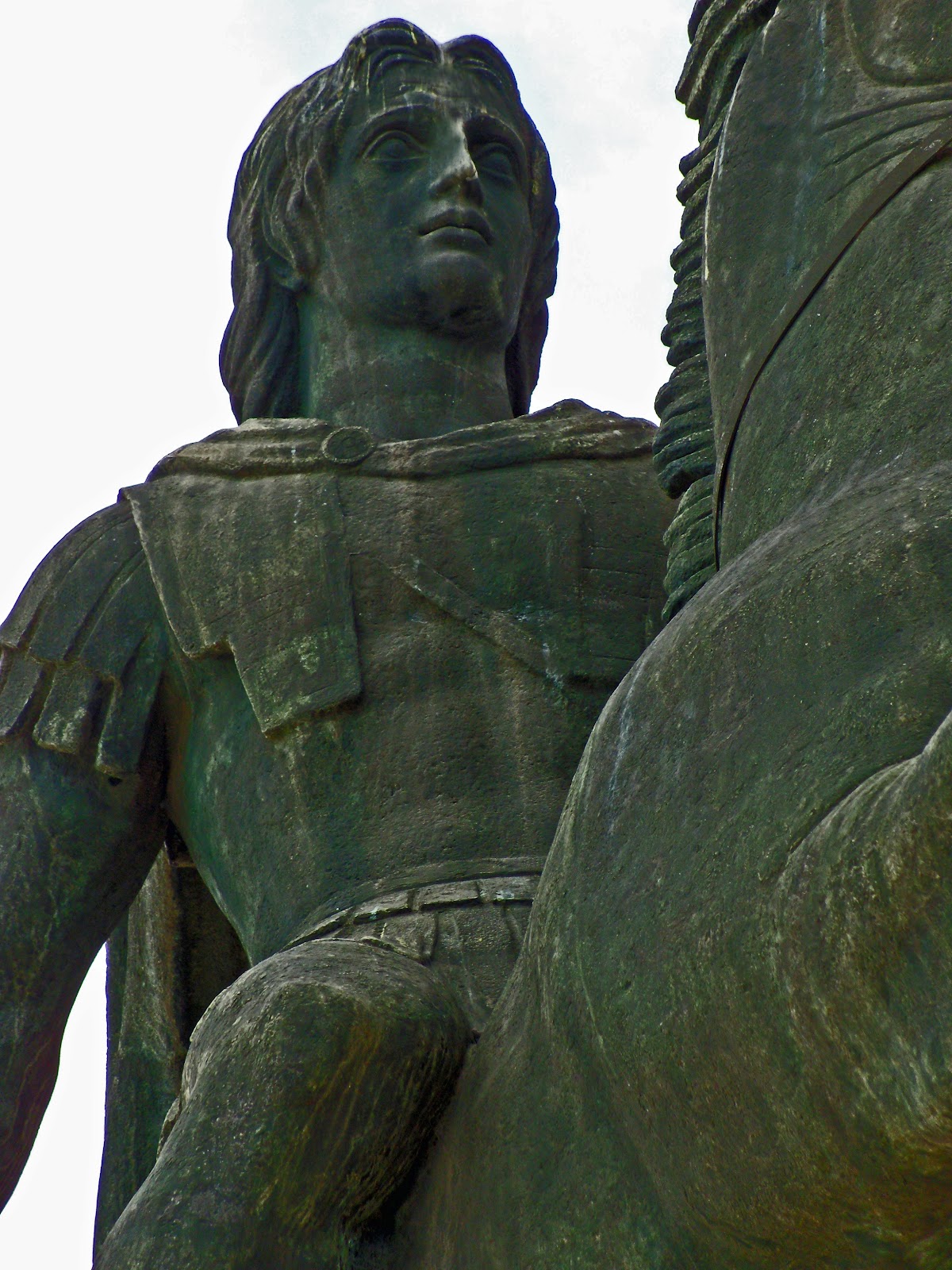

How important was Barsine in the geopolitical world of her time? Barsine was a beneficial source of information about the Persian court, Persian habits, and culture. After all, she had lived at least three years at the court of King Darius. Speaking Greek was an important asset to avoid misunderstandings. Alexander was an excellent judge of character, and having met Artabazus at Pella, he knew that he was a man of his word and could be trusted. Artabazus was loyal to Alexander. Having his daughter at the king’s side was a warranty that worked both ways. Barsine and her father contributed to Alexander’s larger plan. The birth of Heracles disturbed this goal – something Alexander never could or would accept. Barsine no longer fit his purpose in the new world he was building.

Sunday, August 22, 2021

The tomb of Olympias found?

Last month, the Greek City Times published an article with the resonating title “Professor Bidas: Tomb of Alexander the Great’s mother was found in Korinos.” The news is worth making headlines, and I’m puzzled because it didn’t. 

It is all about one of the tombs of Korinos, some 13 kilometers south of Pydna. These tombs were discovered back in 1860 by the French archaeologists L Heuzey and H Domet, who named them A and B. Both tombs had been plundered in antiquity, and the artifacts left behind were recuperated by Heuzey to be sent to the Louvre in Paris. The tombs, which were covered by a tumulus, are dated to the 4th century BC. 

[Entrance to the tomb by Daumet 1855. Picture from Greek City Times]

In 1991, the Greek archaeologist, M Besios, restarted the excavations and concentrated on the largest tomb. The burial complex is 22 meters long compared to the 9.5 meters of King Philip’s tomb in Aegae. The size alone is enough to raise the question of the possible occupant of such a large gravesite. 

As he uncovered a rare construction of three consecutive burial chambers, M Besios concluded that the grave was intended for an important person. He found a marble case in the burial chamber that once held the vessel with the cremated remains on the east side. This result indicates that the remains belonged to a woman since women were buried with their heads facing east. 

The logical conclusion was that this tomb must have belonged to Queen Olympias. She had been assassinated by Cassander in 316 BC at the issue of the siege of Pydna and buried outside the city. 

At the tomb's entrance are the building remains of what seems to refer to a temple in honor of the deceased. Three epitaphs were found in the area. They mention the Aiakides, who were relatives of Olympias living in the outskirts of Pydna. A good reason for choosing this location for the burial. Remarkably, one of the epitaphs refers to a memorial dedicated to Neoptolemus I that stood opposite the tomb attributed to his daughter Olympias, the spouse of Philip II of Macedon. A wide road separated both constructions. 

In light of the above, Emeritus Professor Athanasios Bidas claimed to have located the tomb of Queen Olympias here in Korinos (see also: Is the Mother of Alexander the Great in the Tomb at Kasta Hill near Amphipolis?) The announcement was made public in December 2019, but competent authorities in Greece remain reticent to accept his argumentation. 

This lack of reaction is as surprising as the one that followed the discovery of the (doubtful) grave of Alexander the Great in Siwah in 1995. At that time, archaeologist Liana Souvaltzi substantiated her finds, but her digging permit was blocked by the Greek government as soon as she did. They sent an advisor of the Greek Embassy to the Egyptian government to withdraw her excavation permit and prevent her further excavations of the tomb. Twenty-five years later, Liana Souvaltzi still fights to return to Siwah and resume her excavations. 

It makes one wonder if nobody in the world wants to know the truth about what happened to the remains of Alexander the Great, his mother Olympias, his wife Roxane and their son Alexander IV, as well as those of Heracles and his mother, Barsine. Until now, it remains unsure whether the tomb of the young prince discovered next to the grave of Philip in Aegae belongs to Alexander IV.

Sunday, November 1, 2020

A masterpiece of Hellenistic art

A while ago, the bronze statue of The Boxer at Rest made headlines in The Greek Reporter. It certainly is one of the most lifelike and realistic masterpieces from antiquity that has survived the recycling melting ovens.

Sadly, no picture of this exceptional bronze does any credit to what it truly embodies, neither the whole statue nor the details.

[Picture from The Greek Reporter]

Nowadays, this amazing sculpture is kept at the Museo Nazionale Romano, Palazzo Massimo alle Terme in Rome, Italy. Unfortunately, I couldn’t find out how it is being presented as it certainly deserves a royal space of its own.

I was very fortunate to see it for myself a few years ago in Florence, Italy as part of the exhibition “Power and Pathos, Bronze Sculpture of the Hellenistic World”. The boxer left a deep impression as he commanded attention and respect.

He was placed on the floor like an occasional visitor, unwinding after the intense fight he just went through. His body showed the many scars and cuts left by his opponent. His hands were still wrapped in leather strips meant to protect them but also to inflict as many injuries as possible to his adversary. His oozing wounds colored red with blood (red bronze inserts) illustrated how fierce and unforgiving the fight must have been.

The combat apparently just finished, and the fighter starts to relax. Obviously, the adrenaline is still rushing through his veins and it seems he could jump into fighting mode at the first wrong sparkle from the onlookers. Walking around him, one has to tread with care. He is so life-like that he could look up at you at any moment! (see: A grand collection of Greek bronze masterpieces)

The bronze was found buried in the gardens of the Palazzo Quirinale in Rome in 1885. Admirers of art or lovers of boxing-fights may have wanted to safeguard the statue for better times, whatever their motives or circumstances. We know nothing about the origin of this marvelous boxer. The sculptor remains anonymous and the name of the commissioner, who must have been a wealthy man, is still unknown.

The statue has been dated to 330-50 BC, which is, in fact, the entire Hellenistic era. We have only a few such examples whereas Hellenism must have produced countless numbers of magnificent sculptures. 

With a twist of my mind, I am reminded of the lifelike statues of Alexander and Craterus on a lion hunt that stood in Delphi (see: An unexpected encounter with Alexander at Delphi). It is said that when Cassander visited this work of art and saw Alexander standing in the dim light, he became “so terrified that his body shuddered and trembled” according to PlutarchCassander is said to have nearly fainted as the lifelike Alexander undoubtedly stared back at him. Plutarch further adds that it took Cassander a long time to recover.

His fear for Alexander and his wrath must have run very deep. Of course, he had every reason to be afraid. After all, he had murdered Alexander’s mother Olympias, wife Roxane, son Alexander IV, his long-time mistress Barsine and her son Heracles. With so much blood on his hands, one may wonder whether Cassander could sleep at night. He was a profoundly frustrated and evil man and does not deserve any consideration or pity.

Thursday, November 21, 2019

The Alexander Mosaic

Needless to explain what I mean with “The Alexander Mosaic,” we are all familiar with the picture. The detailed images of Alexander facing Darius on the battlefield are common knowledge and widespread. However, to truly appreciate this mosaic, you have to see it for yourself.

Initially, this piece of art covered the floor of a Roman Villa in Pompeii, the city that was destroyed by the eruption of the Vesuvius in 79 AD. This villa is known today as the House of the Faun, where the lovely dancing and balancing bronze figure was found. This Faun stood in the atrium of the villa and has been replaced with a copy since the original is safely moved to the museum.

The “Alexander Mosaic,” created around 100 BC, is one of the largest ever found and most probably one of the finest also. It measures some 5m x 3m (the exact measurements vary according to the sources) and counts more than one million and a half tesserae made of stone and glass. This splendid piece of craftsmanship occupies a place of its own in the Archaeological Museum of Naples – very close to the Faun.

Scholars established that the composition is based on a wall painting created around 320 or 317 BC, most probably by Philoxenos of Eritrea, but Apelles, Alexander’s personal painter, is another candidate. 

Manolis Andronikos, who discovered and studied the Tomb of Philip in Vergina, made a rather convincing comparison between the hunting painting above the tomb’s entrance at Vergina and the original battle scene as later transposed onto the Alexander Mosaic. Both panels are about the same length, but the Vergina one is less than half in height. The composition of this hunting scene is very similar to that of the battle scene. Besides, both paintings have been executed in the typical style “of four colors” (yellow, red, black, and white), which was initiated by Apelles. Based on his study, Andronikos likes to attribute the painting that led to the mosaic to Philoxenus because he was a pupil of Nikomachos. This artist painted the fascinating Persephone that was discovered in the same Vergina tumulus. 

According to Pliny the Elderthe battle painting of Alexander and Darius was commissioned by Cassander, who was aspiring to become King of Macedonia at that time. It is a chilling thought that we owe such a masterpiece to Cassander, who had Alexander’s blood on his hands.  Hacking his way to the throne, he successively murdered Olympias, Alexander’s own mother, Roxane, his wife, Alexander IV, his son with Roxane, as well as Heracles, his son with his mistress Barsine. He used Alexander’s name and fame only as a means of propaganda to flatter his own ego. It makes you wonder which traits of Alexander he wanted to promote, considering his own brutality. It cannot have been too flattering, to say the least.

By 148 BC, however, Macedonia had been conquered by the Romans, who helped themselves to its many treasures. One of the key figures was Consul Quintus Caecilius Metellus Macedonicus, who plundered Pellas rich art collection and extensive Library. The original painting may well have been among his trophies to be used some fifty years later to create this mosaic. Many of Rome’s wealthy citizens, to escape the oppressing summer heat, could afford expensive seaside resorts in the Vesuvian area. Their villas were lavishly decorated with paintings, mosaics, and statues robbed or copied from the newly conquered Greek provinces.  

There have been some discussions as to which battle this mosaic is supposed to represent. But lately, scholars have agreed that we are looking at the Battle of Issus rather than the Battle of Gaugamela. The main argument leading to that conclusion is the dead tree behind Alexander. Marco Polo, on his trek with the caravans of Central Asia, learned that late Arabian sources knew the Battle of Issus as The Battle of the Dead Tree.

The dead tree, in fact, opens a whole new discussion as we find two similar dead trees in the Vergina painting. A few years ago, Frank Holt wrote an extensive article on the meaning of these strange lone trees (published by academia.edu under the title Alexander the Great, Lightning, and the Lone Dead Tree), but in the end, no theory was really conclusive. 

The entire setting is theatrical, with the central position of Darius’ turning chariot and horses. The dismounting figure just below Darius has been identified as his brother, Oxyathres. He is standing over his wounded horse (notice the front leg that has been chopped off above the hoof) as Alexander’s sarissa hits him. In reality, no mounted soldier ever carried a sarissa simply because it was too long and too heavy and needed both hands to handle. The cavalry, and in this case, Alexander on horseback, used spears. Well, we can explain this as artistic liberty, I suppose.

Each person and each animal is on the move, nothing is static, and the faces and bodies show an excellent understanding of the human form and anatomy. Connoisseurs speak of the outstanding use of foreshortening – an artistic way to reduce or distort objects and figures to produce a 3-D effect. How on earth did we lose that knowledge and technique in the dark Middle Ages! Stepping back for a moment, I am looking straight at the behind of a horse galloping away from me. Only a master artist is capable of creating such a realistic and daring composition!

It is quite exciting to study this monumental mosaic in all its minute details – of which there are very many. For a start, there is the layout of the tesserae themselves. The scientific name is opus vermiculatum, also known as “worm work,” because the tiny stones are set in a pattern resembling the slow motion of a worm. Studying the legs of the horses at my eye level, I realize that I can almost “feel” the texture of the horse’s robe.

Unbelievable! I also notice the detailed patterns on the pants of the Persians in the foreground, the harnesses of the horses, including the little bell on top of their head, the figures of ducks and lions applied on the bridles, and the thick tassel on their breast. Oxyathres’ pants are particularly elaborate, and I love the comfort of his low leather boots with the flaps. And then there is the gorgeous gold torque worn by the Persian next to Darius, holding his headwear as he is staring at Alexander.

Darius’ chariot is another subject worth to be scrutinized. The rims of its panels show motives of winged animals (dragons and aurochs) reminiscent of Babylons walls. I am amazed to see how the front wheel, with its border of beads, throws a shadow onto the body of the chariot. Darius’ large cloak is flung to the side by the sudden turn of his chariot, and I am surprised to find it trimmed with a Greek meander motif. Looking more closely, I even notice that the end of the horse’s tail is tied in an elegant knot. There is much determination in the face of the driver whipping the span he is leading in the turn. There even is a dialogue between two of the Persians in the back who raise their arms as if they are signaling to each other. Their eyes are meeting. There is fear on the face of the fallen Persian at the bottom right, looking up as he is on the point of being trampled by the horses around him. The Persian in the foreground watches his reflection in the Macedonian shield that he is pushing away to avoid being crushed underneath. The scene makes me think about what effect the reflection of hundreds of such shiny shields would have on a battlefield? It must be terrifying!

The Macedonian side of the mosaic is damaged to the point that there is close to nothing to tell about the army and their outfit. Luckily, the image of Alexander the Great has been spared. He has his wide eyes fixed on Darius. He is supposed to ride his black Bucephalus, but this horse is brown. Did that color look better in the picture? Who knows? On the other hand, Alexander’s outfit is correctly rendered with his off-white linen corselet and the lively Medusa head on his chest to avert the evil and the thunderbolts on his shoulder straps. His sword is still sheathed. The one officer behind Alexander is wearing a Thessalian helmet. Otherwise, the tesserae are gone. It makes me wonder if the visitors to the villa had eyes for Alexander only. After all, these were the days when those who could afford it went to Egypt to visit Alexander’s tomb – men like Caesar, Marc Antony, Augustus, Caligula, etc.

The space below the raging battle is filled technically with lost arms: a bow, a sword, a scabbard, and a javelin that still has the Ankyle, leather strip wrapped around its end (meant to increase the throwing distance). 

The commotion and the disarray of the battlefield are very palpable! The Persian spears in the background not only fill the space from an artistic point of view but also provide a line of focus toward Alexander. What a masterly composition!

It is unknown what led the owner of this villa to use this battle theme for his main floor, the one which every visitor would cross upon arrival. There are several theories. One is that the owner was a mercenary in Roman service during the war against King Perseus of Macedonia. Another is that one of his ancestors was involved in the fight against King Alexander of Epirus in Italy. Well, in both cases, they refer to close ties with Macedonia.

Whatever the speculations, this mosaic certainly is a rare piece of art that survived in close memory of Alexander. We still cannot imagine the immense wealth that the Romans hauled away from Macedonia - a wealth we owe to Alexander! 

Thursday, January 29, 2015

What if … Alexander had died a few months earlier, before Craterus left with his veterans for Macedonia?


Another interesting point of view for after Hephaistion died one year earlier, Craterus became Alexander’s second-in-command. Craterus was now the most powerful man after Alexander, at least in the east, for Antipater still ruled undisturbed over Macedonia and Greece.

Well, maybe Craterus could have kept his high position and could have shaped a new ruling system, although the empire still needed a king. Roxane’s pregnancy may not yet have been established, in which case the more or less obvious appointment of Arrhidaeus/PhilipIII would have materialized. But simple-minded as he was, he too would need a regent to rule in his place. Would the generals present at Babylon have accepted Craterus’ superiority? Maybe in the immediate future but for the next 18 years till Alexander IV was old enough to be king?

It does not sound very probable, for meanwhile, Arrhidaeus/Philip III would have picked up momentum together with his wife, the ambitious Adea/Eurydice. The ambition of the generals and their faithful troops is likely to have demanded their share pending the coming of age of Alexander IV. The main difference with what really happened is that Craterus would have been in Babylon with his 10,000 veterans to reinforce the local troops. He had a strong case against Antipater since he had the majority of the troops on his side. This situation could have made the situation more manageable and appeased possible opposition – at least for a while.

On the other hand, however, Craterus could have gained the support of Olympias, but whether that was enough to stop Cassander from working out his devilish plans after Antipater’s death in 319 BC depended entirely on the replacement Craterus had in mind. Polyperchon seems to be an excellent candidate since Alexander himself had sent him along with Craterus in the first place, should anything happen to him, Polyperchon, a highly skilled diplomat, was to take over. Craterus was obviously aware of these plans and could have acted accordingly.

We know that Polyperchon, in the end, played a foul game as he was responsible for the murder of  Heracles and his mother, Barsine. Polyperchon’s dream to rule over Greece had clashed with Cassander’s ambitions time and again, and in 310 BC, Cassander promised him peace and promotion as military governor of the Peloponnese. In exchange, the 75-year-old Polyperchon had to kill Heracles and Barsine. He accepted the deal.