Alexandria's founded by Alexander

Alexandria's founded by Alexander the Great (by year BC): 334 Alexandria in Troia (Turkey) - 333 Alexandria at Issus/Alexandrette (Iskenderun, Turkey) - 332 Alexandria of Caria/by the Latmos (Alinda, Turkey) - 331 Alexandria Mygdoniae - 331 Alexandria (Egypt) - 330 Alexandria Ariana (Herat, Afghanistan) - 330 Alexandria of the Prophthasia/in Dragiana/Phrada (Farah, Afghanistan) - 330 Alexandria in Arachosia (Kandahar, Afghanistan) - 330 Alexandria in the Caucasus (Begram, Afghanistan) - 329 Alexandria of the Paropanisades (Ghazni, Afghanistan) - 329 Alexandria Eschate or Ultima (Khodjend, Tajikistan) - 329 Alexandria on the Oxus (Termez, Afghanistan) - 328 Alexandria in Margiana (Merv, Turkmenistan) - 326 Alexandria Nicaea (on the Hydaspes, India) - 326 Alexandria Bucephala (on the Hydaspes, India) - 325 Alexandria Sogdia - 325 Alexandria Oreitide - 325 Alexandria in Opiene / Alexandria on the Indus (confluence of Indus & Acesines, India) - 325 Alexandria Rambacia (Bela, Pakistan) - 325 Alexandria Xylinepolis (Patala, India) - 325 Alexandria in Carminia (Gulashkird, Iran) - 324 Alexandria-on-the-Tigris/Antiochia-in-Susiana/Charax (Spasinou Charax on the Tigris, Iraq) - ?Alexandria of Carmahle? (Kahnu)
Showing posts with label Methone. Show all posts

Thursday, November 28, 2013

The trireme, a ship to remember

The trireme seems to be the most intriguing type of ship built and used in the ancient world. It was, in fact, the most dangerous and effective warship of its time, built for mobility and speed. We know that Tyre had a fleet of triremes when they attacked Alexander to hamper him from working on the causeway to connect the island to the mainland. Arrian clearly states that he “took the quinqueremes and five triremes,” he quickly assembled to meet the Tyrians and eventually “rammed the majority and made them unsailable”.


Triremes were meant to be used as a ramming weapon and were powered by 170 oarsmen arranged in three rows. The bottom row of oarsmen sat hardly 18 inches above the water level, meaning that the ship was not fit to be used in rough weather or to be handled in the open ocean. Yet they were ideal for short battles as they were very fast and maneuverable, a huge advantage during critical encounters. They are known to have been the decisive weapon during the Battle of Salamis in 480 BC when the 371 Greek ships defeated the much larger Persian fleet of 1207 ships.

The first trireme was invented around 700 BC by Ameinocles the Corinthian. It could move fast and under sail under favorable conditions, could even reach a speed of 10 knots. So it is not surprising that these triremes were favorites and were optimized over time to be the fastest ships in antiquity. They were used all over the eastern Mediterranean and the practical Romans sailed them until the 4th century AD.

In the past thirty years or so, there have been a lot of discussions about their shapes, the three levels of oars, and their overall measurements. All we could go by were vase paintings, coins, and pictures of different sculptures, as no wreck was ever found. A few construction details were revealed in ancient texts, like the performances of the rowers or the fact that each oar was handled by one single man. Some building sheds, however, seem to have come to us, providing us with at least the maximum length and beam of a trireme. The length of the oars was a main subject of debate since they plunged into the water from different levels. In the end, a general agreement has been reached to establish the length of a trireme at 120 feet (37 meters). They were manned by 170 oarsmen, of whom 31 sat on the top row, 27-29 on the middle and bottom rows.

By the end of the last century, the debates flared up, and eventually, a Trireme Trust was created in 1982 to rebuild a full-size ship. It took about five years to launch the prototype, which was baptized gallantly as Olympias. I like to believe that was in honor of Queen Olympias, the mother of Alexander the Great but I couldn’t find any evidence to support my assumption. The modern replica was born in the shipyards of Piraeus using Oregon pine since adequate Greek pine had declined and was not expected to stand up to the strains. Some 20,000 wooden wedges were used to connect the hull planks, which, according to tradition, were made of beech wood, while the required 25,000 bronze spikes were all handmade. The ramming front was made of cast bronze in two separate pieces. The sails, on the other hand, were made of linen in Scotland, the only place capable of making such sails.

By 1987 sea trials were carried out in the Saronic Gulf around the island of Poros (1 day), in 1988 with a voyage to Methana and the subsequent circuit of Poros (1 day), in 1990 around the coast to Porto Heli when speed records were reached (5 days), in 1992 the first trireme passage through the Canal of Corinth was achieved and the longest voyage to Corinth, via Aegina and Salamis (6 days) and in 1994 the Olympias was used for public relation purposes with several Greek film crews. Remarkably, the ship even sailed up the River Thames in 1993 to mark the 2,500th anniversary of Greek democracy (I wonder why democracy had to be celebrated in London?).


All these trials led to interesting conclusions in spite of the opposition by the purists who thought that any reconstruction should be based on an archaeological wreck, of which none exists. The
Olympias sailed under favorable conditions in a sprint under oar at a speed of 9 knots (very close to the 10 knots mentioned above), while she was rowed continuously for more than 30 miles at a cruising speed of close to 6 knots. She turned out to be extremely maneuverable, and a lot of practical information was gleaned during these trials about the practicalities and logistics of using both oar and (square) sail.

The story of the Olympias has been dormant since, but suddenly I hear that scientists believe to be close to tracing the wood from which these ancient triremes were made. They are actually focusing on the Macedonian fir and pine tree of Olympus in the Pieria area, southern Macedonia, Greece, because their wood, locally known as “liacha” has no knots but is very resistant to salt water. This theory is based partly on Theophrastus, Aristotle’s successor, who recorded that these trees were used in the construction of paddles and ships, and partly on the results of archaeological excavation that were carried out in Methone in 2003. Since 2011, scientists from Greece have been joined by those from the USA, Britain, and Ireland in a collective effort to discover pure pieces of wood from the 8th century at the excavation site of Methone. I can hardly wait for the results of this study, especially since this city is part of Alexander’s homeland!

Meanwhile, more exciting news comes from recent diving expeditions off the east coast of Sicily near the Egadi Islands, where ten bronze ship-rams have been discovered together with a variety of arms and utensils. The site is where the last battle of the First Punic War (241 BC) was fought between Carthage and Rome, which was won by the Romans thanks to their smart planning. The ten rams, each weighing as much as 125 kg, were mounted on the bow of the triremes or quinqueremes to be used to simply ram the enemy ship to pieces. This find is quite significant considering that till now only four rams have been recovered for all antiquity. Follow the latest developments on The Archaeology News Network. Another interesting article appeared lately in the Daily Mail. 

Sunday, October 9, 2011

Dion, the Macedonian Sanctuary

Dion, at the feet of Mount Olympus, has been Macedonian Sanctuary for eons. It was here that Alexander brought offerings to Zeus before crossing to Asia. It was here that his father, King Philip II, came to celebrate his many glorious victories. It was here that King Archelaos started brightening up the festivals with athletic and theatrical performances. But all Macedonian kings had one thing in common: they gathered here to sacrifice and bring offerings to the Olympian gods, whatever the occasion. Enough reason for me to take a close look at the place, not the least because of Alexander’s multiple visits.

Although Dion became part of a Roman colony founded by Emperor Augustus in the 1st century AD, the city managed to preserve its Greek character up to the Byzantine times. Yet, after a combination of natural disasters and repeated invasions by the Goths in the 5th century AD, Dion sank into oblivion.

The drive from Thessaloniki takes me south past the antique sites of Methoni and Pydna, past modern Katerini till mighty Mount Olympus looms at the horizon on my right, an unforgettable and most rewarding view!

Directions in and around Dion (modern Dio) are very clear. The town has been able to lead tourist traffic in such a way as not to interfere too much with the community's daily life. Not much has changed here except for a handful of souvenir stores and cafés. I decided to start with the Museum as it is said to close at 3 pm (the excavation site is open until 7 pm) - we are never sure what to expect when walking through a museum or an archaeological site, are we?

The Museum is not big but offers some interest, although I am still trying to decide whether to visit the Museum before or after seeing the antique Dion. I have done it both ways, once in 2006 and now in 2011, but it does not make the explanations any easier. I still have difficulty matching one with the other. Dion is a sanctuary, meaning, in fact, a collection of temples and altars ranging from the 4th century BC all the way to the 5th century AD. Even walking around Dion, it is very confusing to sort out the array of buildings, especially here at the Museum, where bits and pieces must match the remains in the field.


I pick out the pieces that most appeal to me: some statues (like that of Hygeia); heads (Demeter and Niké); funeral steles (Hunter with his dog and Mother and Child); slender funeral craters that are well preserved; terracotta statuettes (a lovely Macedonian boy); coins of all kinds and mainly Macedonian; glass beads and other pieces of jewelry; small ivory heads from funeral couches; mosaics (spiral mosaic from the Villa of Dionysos); and a superbly reconstructed hydraulic organ. I even spent some time checking out the inscribed slabs: like the Treaty between King Perseus and the Boeotians, a Letter that Philip V wrote to a certain Eurylochus, and the base for a statue of Cassander. Outside in the grass, I find a dozen or so Roman tombs with Greek inscriptions and, in the shelter of a portico, a stone tomb door, much like the one reconstructed at the Museum of Pella.

The Museum has no cafeteria, but I find the place across the street inviting enough. Their coffee (Greek) is excellent, and their toilets are clean. It is a good thing to take a short break to digest all the impressions before heading for the actual site of Dion, which is, in fact, within walking distance.

Obviously, this location was chosen by the gods in a broad flat valley under the watchful eye of snowcapped Olympus. Its icy waters ran and still run through Dion, and this holy river saved the city from plundering when it disappeared under two meters of water and mud after heavy earthquakes. We had to wait for centuries to put the town back on the map, as many pumps and sluice gates are still helping to keep our feet dry.

I start with the Greek theater, where a wooden reconstruction has been implemented, and the original layout is still visible. It was located outside the actual city walls and built during the reign of Philip V (221-179 BC). It looks out over a splendid park-like field, where Alexander pitched the tents to entertain his one hundred guests, friends, officers, and ambassadors from all over Greece to celebrate his departure for Asia. The huge Altar of Zeus, where he made his offerings, is situated near the other end, close to the Roman Theatre from the 2nd century AD. Not often can one come so close to Alexander as we can here.

I wonder if it was in this area that I should picture the famous bronze group made by Lysippos, Alexander’s dedicated sculptor. It represented and was dedicated to 25 cavalrymen who had fallen during the Battle of the Granicus, Alexander’s first victorious confrontation with Persia.

Evidently, the main god worshiped in Dion was the Olympian Zeus, after whom the city was named (the genitive of "Zeus" being Dios). The sanctuaries were used not only by the inhabitants of Dion but also served the religious needs of a more significant number of people during the festivals, with thousands of visitors. Here, the base of a large statue of King Cassander was found, now in the Museum. Various pilgrims' offerings were placed in the sanctuaries of Dion. At the Sanctuary of Olympian Zeus, inscriptions referred to important state affairs such as peace treaties, regulation of boundaries, honorary decrees, etc., some of which are now in the Museum. The Macedonians who crowded these festivals could read these texts and be informed – an official newspaper, in a way.

It is a most pleasant walk along the banks of the clear, fast-flowing stream where fish and crabs have found a home till I reach the Sanctuary of Demeter. This is the earliest Macedonian sanctuary known to date and was used uninterruptedly from the late 6th century BC to the early 4th century AD. For a layman, it is not easy to figure out the remains of walls and chambers, but with some effort, one can discern two small temples of the megaron type with an open antechamber and a cella. This is where most of the offerings were found, statuettes, lamps, vessels, beads, etc., which all indicate that an earth goddess of fertility was worshiped here, confirmed by an inscription referring to Demeter (4th century BC).

I now have to cross the lowest part of this cult area, which always seems to be more or less flooded – no wonder, when to my great surprise, I see the many springs bubbling up amidst the ruins! Reflecting in the water and amidst lush green growths lie the elegant Sanctuaries of Serapis, Isis, and Anubis that came to this region during the Hellenistic period thanks to the propaganda of the Ptolemies of Egypt. It is a pleasant sight to see how these statues bathe in the water or admire their mirror image. A metal bridge has been put in place so we can walk closely through this eerie setting. When I climb out of this depth, I pass a Byzantine wall where an unknown deity and the head of Aigle have been reused in its construction. How dare they!

Past the remains of the Roman city wall, I finally enter the city of Dion, which is generally Roman from the 2nd century. There is an entire network of streets along which many buildings, warehouses, private houses, and public baths have risen. A few of these constructions stand out, of course, for instance, the Roman Baths with parts of the mosaic floors and the hypocaust still in place, or the Polygon Villa with a 12-sided courtyard surrounded by columns giving access to the house. At the entrance, we can still admire the 3rd-century mosaic of wrestlers at practice, a very Roman portrait. Further down to the east, we find the remains of the Villa of Dionysos, which takes its name from the large mosaic depicting the god that covers the floor of the banqueting room. And then there is the set of reliefs showing very Macedonian cuirasses and shields that have been set up alongside one of the streets dedicated by Alexander after the Battle of the Granicus. In some places, you can even see sewage conduits underneath these streets. It always makes me wonder how we managed to lose this knowledge in our Middle Ages and had to entirely reinvent the system. If you look closely, you’ll also notice that many mosaic floors have been covered with plastic and gravel to protect them, but it’s so unfortunate that we cannot see them!

Dion is much less well-known than the Sanctuary of Delphi, for instance, but it is certainly not less inspiring. It definitely completes a thorough visit to Greek Macedonia. 

Friday, September 2, 2011

Philip’s involvement in the Sacred Wars - Macedonia forged by Philip II - 5

Philip’s involvement in the Sacred Wars (355 BC)
But soon thereafter, another situation called for Philip’s full attention when, in 356 BC, the state of Phocis seized Delphi, the home of Apollo’s oracle. His involvement in this Sacred War could and would boost Macedonia’s power dramatically.

Now, the very name of Sacred War raises some questions with most of us, and we tend to associate or compare it with our Crusaders heading for the Holy Land in the Middle Ages. Yet, nothing is less true. Here it is all about the oracle site of Delphi, which the Greeks considered to be far too important for a single state or city to control. As a result, they created an association of states called the Amphictyonic League to protect them - the word “amphictyony” means as much as “those that dwell around or near”. This Amphictyonic League was very powerful and at some point even counted as many as 24 states. This League was led by a Council functioning as its executive arm. So, whenever the oracle was violated, the Amphictyonic Council would meet and declare a Sacred War against the offending state, calling to the other league members to defend the rights of the Delphian Apollo.

The Third Sacred War that lasted from 355 to 346 BC was the one in which Philip got involved, fighting over the occupation of Delphi by Phocis, roughly the territory locked between Thessaly and Attica, because the Phocians cultivated land on which the sacrificial animals of Delphi were kept. But there was also a matter of unpaid fines, not only by Phocis but by other states as well, which made matters worse.

This situation escalated when Phocis tried to take advantage of the hostile feelings between Thebes - then a formidable military power - on one side, and Athens and Sparta on the other; while taking sides with Athens, Phocis arrogantly invaded Delphi with a nice promise to protect its treasuries. A sensitive matter since this is the place where, besides the famous oracle, precious offerings and money from all over Greece were kept. All the states got involved one way or another, and in 355 BC, the Amphictyonic Council declared the Sacred War against Phocis.

Phocis stubbornly went on the warpath, bluntly seizing part of the temple’s treasury in order to hire mercenaries, some ten thousand of them. It is interesting to learn from Ian Worthington that a mercenary in those days was nothing like what we understand it to be today. And I quote: “Mercenaries formed a distinct group that was an accepted part of Greek society; they had their own identity as a group regardless of where they came from, and they played a political and economic role in relations between states. States and generals who provided or led mercenary armies for rulers and the like made political and trading contacts with them. The Greeks had no word for ‘mercenary’ as such, but instead used terms like epikouros, ‘fighter-alongside’, misthophoros, ‘wage-earner’ and xenos misthophoros, ‘foreign wage-earner’ (cfr Philip of Macedonia, Ian Worthington).” This army defeated the states of eastern Thessaly, splitting the territory in two. Facing this threatening situation, Larissa in eastern Thessaly turned to Philip for help. But Philip was busy laying siege to Methone, and when that was taken care of the next summer (354 BC), he went on to take four towns in eastern Thracia, which were key ports on Athens’ corn route from the Black Sea.


Yet Larissa’s call for help was something that Philip could not ignore, as Macedonia’s southern border could not be compromised. Besides, it was a convenient stepping stone for him to get more closely involved in the politics of Central Greece. Surprisingly and unexpectedly, Philips’ army was defeated by the Phocians – or should I say by the mercenaries they had hired. Antique sources tell us that Philip’s army had fallen into a trap set by Phocis and that the king had to leave behind a large number of dead and injured soldiers. Of the men still alive, many deserted him, and it was only with great difficulty that he instilled them enough courage and discipline to obey his orders in the retreat.

The outcome of this battle rattled like a thunderbolt through the streets of Eastern Thracia and Athens, followed by Illyria, Paeonia, and even Epirus who all welcomed a potential disintegration in Philip’s power. Eastern Thracia was the first to renew its alliance with Athens, which meant a serious blow to Philip’s arduous diplomatic maneuvers. Then Olynthus, in spite of its treaty of 357 BC with Philip, sought an alliance with Athens. The blow must have hit Philip very hard, making him realize how vulnerable Macedonia still was and how easily it could fall back into the chaos he found when he became king.

Tuesday, August 9, 2011

Discovering Pydna

Pydna is generally known for the decisive battle of 22 June 168 BC opposing the Roman general Aemilius-Paulus and King Perseus of Macedonia (179-168 BC). In one single battle, the Romans killed as many as 20,000 Macedonians, an absolute first in history. It meant the end of the Antigonid dynasty of Macedonia, and consequently, the Kingdom of Macedonia ended. Besides the men that fell on the battlefield, another 6,000 fled to Pydna to fall into enemy hands, and another 5,000 were taken prisoner as they tried to escape. A bloody encounter, to say the least. From then on, the Romans divided Macedonia into four republics. It seems that in 150 BC, a certain Andriscus claiming to be the son of the late King Perseus ascended the throne as Philip VI. He just came and went, a victim of another futile war, of course, and in 148 BC, Macedonia was finally subdued and became a Roman province.

To me, Pydna is the place where Queen Olympias took refuge after the death of her son, Alexander the Great, taking his wife Roxane and his son Alexander IV with her. Cassander, who, as the son of Alexander's regent Antipater, had taken over power in Macedonia, besieged and captured the city in 317 BC. Olympias was left with no choice but to surrender to Cassander, who knew no mercy and immediately had her executed. Roxane and Alexander IV were to follow her fate soon.

Well, so much for history, besides the fact that Philip II, Alexander’s father, had annexed the territory in the first place. In any case, enough reason for me to take a look around.

Today’s nearest town is Makrygialos, approximately 65 kilometers south of Thessaloniki, right next to the freeway. Pydna has not really been excavated. The only finds come from occasional discoveries made during construction activities or after illicit diggings. The fertile lands have been inhabited since the 7th century BC, and many graves and tombs have been unearthed going back that far in time. The finds have been split between the Museum of Thessaloniki and the nearby Museum of Katerini.

It is not easy to read the landscape, especially on this rainy day when I’m driving through sleepy villages and settlements. On my way through Methone, in the curve after the seaside fish restaurants, I am being waved at by King Philip in person! Of course, Methone was one of the main cities that Philip conquered from Athens back in 355-354 BC, but I wasn’t expecting to meet up with his bronze statue in this bend of the road. What a pleasant surprise. It shows the king in his prime, which he most probably was at the time of this battlefield. The Greek, as well as the Macedonian flag, proudly enfold above him. I look around for more signs but cannot find any.

I pick up the road again, heading further south till I reach Pydna or what is left of it. A fenced field on my left overlooking the sea is catching my eye. The entrance gate is ajar, an invitation to enter. This just might be the place of the old fort, and it is!

Once again, I’m struck by the strategic location as I can look north all the way to Methone and beyond, while to the south, on a clear day, we may even see Mount Olympus. This stronghold fits in the center of a wider bay, ideal to watch enemy ships approaching.

Within the perimeter of the fence, the remains are definitely Byzantine. Typical, of course, as they built their forts and churches right on top of older Roman or Greek construction, reusing the stones they found at hand. This site is no different, and as I question the local archaeologist and guardian, he willingly shows me the scattered remains from Greek temples, Macedonian city walls, and Roman olive- or winepresses. Further in the landscape, he also points to the line in the trees, walls, and houses that are supposedly part of this old fort. Excavations over here certainly are still in their infancy, and I can imagine how many archaeologists’ hands are itching to start digging for more treasures before they disappear through the illegal circuit, forever ripped out of their context.

Wednesday, August 3, 2011

A moment of glory - Macedonia forged by Philip II - 4

A moment of glory in 356 BC

Three years into his kingship, in 356 BC Philip must have looked back at his achievements with some degree of satisfaction. He now had secured most of Macedonia’s borders and built up a nearly invincible army, money was flowing in from the recently acquired mines of Philippi (more than 1,000 talents a year), his race-horse had won at the Olympic games, and most important of all Olympias bore him a son, Alexander.


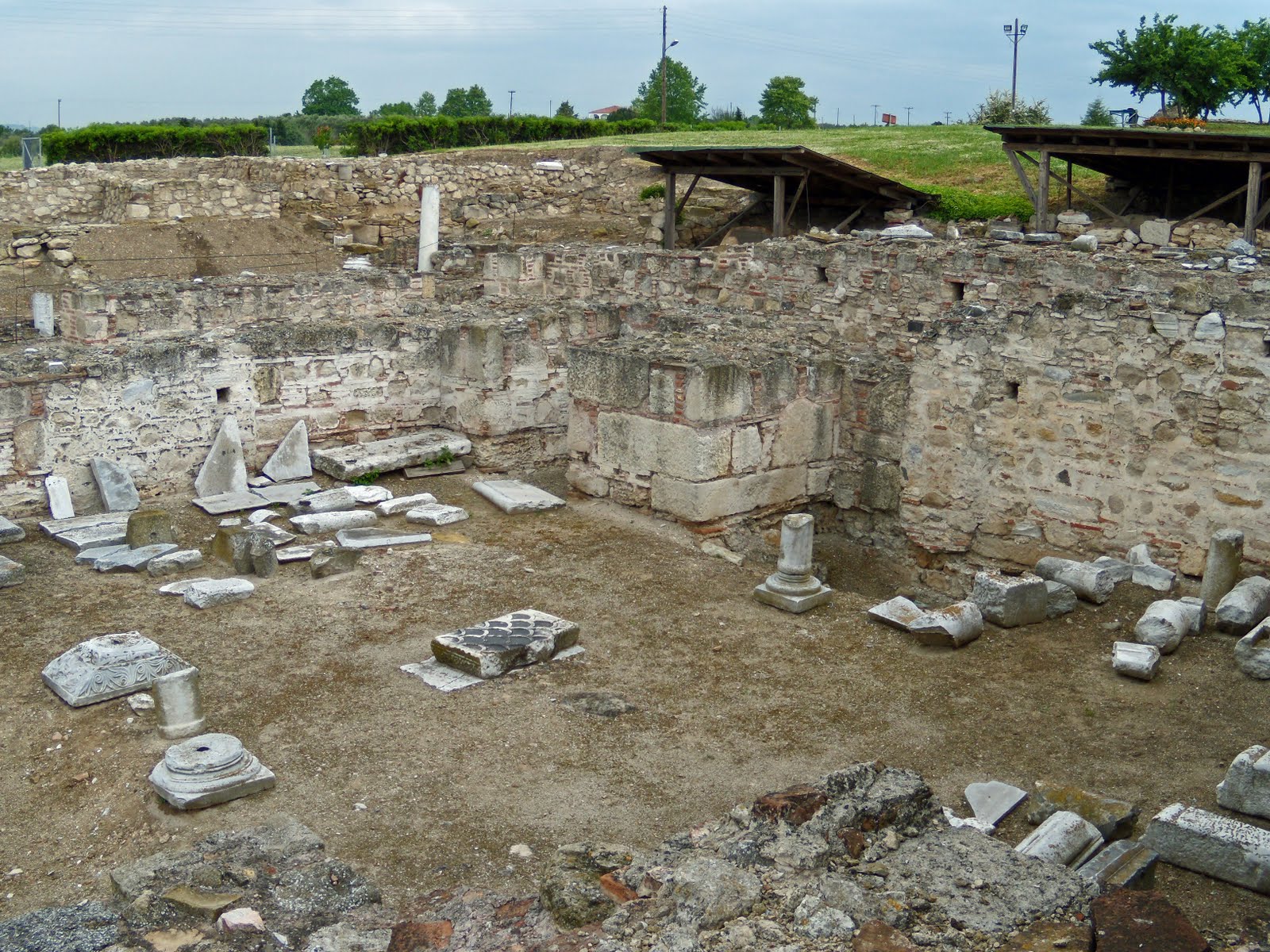
Towards the end of 355 BC, Philip decided to besiege Methone in order to complete his control of the entire coastline towards Thessaly. Besides, Methone was located on a strategic communication route to Dion, Macedonia’s major religious sanctuary. He generously gave the people a chance to surrender but when they refused, he besieged the city. Methone had huge walls and in spite of Philip’s equipment and repeated efforts, it took him several months to succeed. But while he was inspecting his own siege craft, an arrow from an enemy catapult hit him in the eye. It seems that an eye injury is a bloody affair and one can easily imagine the commotion among his men. The siege may have been brought to a halt for a while, waiting for the outcome of the king’s wounds. The city was eventually taken in the early summer of 354 BC. Methone’s walls and buildings were razed to the ground so that even today it is difficult to locate.

The result of these moves meant that Macedonia’s coastline was now free of Greek cities, that Chalcidice was bound to Macedonia by a thorough treaty, and that the country reaped large revenues from the Crenides mines – more than enough to cover his military expenses and provide regular pay to his soldiers. Athens, by contrast, had exhausted its finances and was lucky enough to be saved by its archon Eubulus who created a special fund to stimulate the city’s economy.


Friday, July 15, 2011

Start of Philip's reign - Macedonia forged by Philip II - 2

Start of Philip’s reign (359 BC)

At twenty-four, Philip II became king of Macedonia. That is only four years older than Alexander was when he succeeded his father, but the Macedonia he inherited was a coherent one whereas Philip was facing a formidable and nearly impossible task. He had to set his priorities, and quickly too.

The most urgent threat came from the Illyrians who had just defeated his brother, and it seems that Philip managed some treaty which may have included his marriage with Audata (Philip’s second wife), King Bardelys’ granddaughter. He then turned towards the Paeonians, whom he corrupted with gifts and generous promises to reach a peace agreement. Athens with Argaeus was a far more serious problem and Philip tricked them into believing he was giving up any claim on Amphipolis by withdrawing his Macedonian soldiers. The Athenians took the bait and their commander stayed in Methone with his troops. Argaeus, meanwhile tried to gain support for his cause from Aegae, the Macedonian capital but left unsuccessfully for Methone also. En route, Philip and a small force surprised him and Argaeus disappeared from the scene. To settle this matter, a peace treaty was signed with Athens, stipulating clearly that Amphipolis no longer would be claimed by Macedonia. Another potential danger however was coming from the Chalcidians who sent an embassy from the main city of Olynthus to Athens for support against Philip, but now that Athens had made peace with Philip they rejected this request.

Within a year, Philip had accomplished the miracle of putting an end to the four major threats that had led to his accession to the throne. The means he used became his trademark: diplomacy, deceit, bribery, and political marriage as well as the lightning speed of his actions. He must have known however that these arrangements were only buying him time. His priority now was to get his kingdom and his army organized.

Philip began by switching the main attacking force of his army from infantry to cavalry as had always been the common practice. He had the cavalry attack the flanks of the enemy lines where his infantry would push down in the centre. He also equipped his infantry with the new sarissa, a long pike of about 4.25 to 5.50 meters long made of cornel wood. The shape of the head was designed in such a way that it would penetrate the armor and the body of the enemy as the previous conventional pikes were meant only to wound the opponent. The cavalry on the other hand was set up in a wedge formation instead of the usual frontal charge lines, which Philip had copied from the Thracians and Scythians. Thus the Macedonian soldiers became highly trained and learned to carry their own arms, equipment, and food – ensuring them to be self-sufficient at all times. Instead of poorly trained farmers and unreliable mercenaries, Philip put in place a full-time army in which the soldiers received regular pay for the first time in history.

Philip was also keen to introduce new war machines. Where he originally used the mechanically drawn catapults (see Olynthus in 348 BC and Perinthus in 340 BC), he used a new type of siegecraft, the torsion catapult that was far more powerful than the other catapults as proven during the siege of Byzantium in 340 BC.
In addition, he created the new body of Royal Pages, i.e., boys (at least two hundred of them) who entered service at the age of fourteen for four years. They were the personal attendants to the king, meaning that they prepared his horse, accompanied him on his hunting or warring expeditions, and watched over him at night. It was an enviable position which at the same time meant that the boys lived and were educated at the Macedonian court and served as hostages to ensure the loyalty of their families.