The description
of the findings remains vague. The latest is about the heads of Aphrodite and
Dionysus but without the location where they were found or in what context.
Down the line, I read that two Aphrodite and three Dionysus statue heads were
discovered. No idea where or what happened to them. Also, a statue of Heracles
has been found.
In fact, except
for these two heads, there is nothing to be added to my blog The
magical site of Aizanoi posted in October 2021.
Aizanoi has a lot to offer but it is sad that the news about ongoing excavations is
not treated with more care.
Today’s visitors
will inevitably come across many inscriptions when visiting ancient sites or museums. Reading Greek or Latin is not for everybody, and understanding the meaning of the text and context is reserved only for the happy few. The stone or marble
support has more often than not suffered from wear and tear, leaving the
untrained eye to merely guess its value.
We are lucky to
find an explanation next to the inscription, rarely a full translation, as those are
reserved for scholars. Well, the text may be boring, but it also may contain some
exciting twists and turns. Yet, who wants to know?
In antiquity,
people would read the latest laws and decrees, regulations and agreements,
peace treaties, manumission of slaves, grave markers, boundary stones, milestones, etc., as
they walked through public spaces. Some of these texts are still in situ, particularly those engraved on
the walls of still-standing monuments. The majority, however, has found a place
in the museum for safekeeping and is often out of sight.
The most
familiar examples of inscriptions are those chiseled on grave steles,
sarcophagi, and tombs. They also appear on the pedestals of statues lining streets such as Phaselis’Harbor
Street or Olympia’s
road to the Stadium. Others serve to identify the deities, kings, and emperors that
fill the sanctuaries and agoras, or the niches of theatres, stadiums,
libraries, baths, Nymphaeums, and other public buildings.
But some inscriptions will surprise many of us.
For instance, this stele at the Louvre Museumholds the
accounts of the Parthenon Treasury. The text covers both sides of the stele
made of Pentelikon marble and illustrates how democracy works. Athens’
magistrates submitted the public accounts to the citizens for all to see. The
front side, beneath a relief of the Sacred Olive Tree flanked by Athena and the
people (demos), displays the expenses for military operations, religious
ceremonies, and the Panathenaic festival held in honor of their patron goddess
for 410-409 BC. The reverse side has the expenditures for 407-406 BC.
In Butrint,
Albania, a
striking series of inscriptions is carved on the outside walls of the Roman
Theater of Buthrotum, as the city was called in antiquity.
They are hard
to read but worth our attention because these are manumissions, slaves who had
gained their freedom for whatever reason. Their sheer number is mind-blowing!
As surprising
and revealing are the Edicts on prices! Who would have thought that there were strict rules to define the prices of goods in antiquity!
Also by Diocletian is the Edict on maximum prices for products and labor discovered in Halicarnassus, dated to 301 AD. The Emperor hoped to stave off a financial crisis and prevent inflation.
Although this tablet was unearthed in Bodrum (the modern name for Halicarnassus),
bits of similar Edicts were also found in Pergamon, Aizanoi, Aphrodisias, andStratonikea. It is quite surprising to read that the Edict from Halicarnassusconsists of 37 parts. Part 9, for instance, is about shoes and boots … 27
different kinds and sizes are listed!
Taxes are
another matter that deserves attention. One such inscription that is hard to
miss can be seen on Curetes Street
in Ephesos,
close to the Library.
This tax law was written in the second half of the 4th
century AD, during the rule of Emperors
Valentian I, Valens, and Gratian.
Less obvious is Alexander’s tax remission from the wall
of the Temple of Athena
in Priene,
now exhibited in the British Museum in London.
Alexander contributed to the cost of building the unfinished temple, and in
return, he was allowed to dedicate it: “King Alexander dedicated the temple of Athena Polias”.
This text was followed
by a longer inscription setting out the terms of an agreement between Alexander and Prieneunder which the
city was to be exempt from taxation.
Not all
inscriptions were written in Greek or Latin, and I find it fascinating to hunt
for these exceptions.
Having a closer
look at Lycia’s sarcophagi strewn throughout the landscape, I discovered texts that seemed to be written in Greek but are in Lycian, as they
contain several odd letters that do not exist in the Greek alphabet. Antiphellosand Limyrahave good illustrations of Lycian texts.
Another case is
to be found in Sillyum, some 25 kilometers northeast of Antalya,
an often overlooked site, although the hillside is easily spotted in the
otherwise flat plain of Pamphylia.
It
takes some detective work to locate the inscription in the Pamphylian language carved in the doorpost of a Hellenistic building – a very rewarding effort
though!
The people of ancient
Side also had a language of their own. A small inscription has survived and can be
seen at the local museum located inside the remains of the Roman Baths.
After Alexander conquered Lycia and Pamphylia, Greek became the lingua franca, and the local tongues
disappeared.
Aizanoi, regretfully, doesn’t make
headline news - yet. Several years ago, I watched a program on TRT TV that
showed many imposing monuments from Roman times at this site which was
otherwise unknown to me. After that, I haven’t heard anything about further excavations or remarkable finds until today. The massive entrance to the Temple of Zeus
has been re-erected, which rightfully makes it one of the best-preserved
temples in Anatolia.
As always, I like to put things in context. Looking at the map, Aizanoilies roughly 200 km south of Bursa, in the heart of ancient Phrygia.
The city occupies both sides of the KocaçayRiver (Penkalas). The
first settlements date back to 3000 BC, but what we see today are
roughly the remains of the Roman city from the 2nd century BC.
The Temple
of Zeus indeed commanded
the view, as it still does today, standing on its podium on top of a low hill. It
measured 33x37 meters, counted 15 x 8 columns, and was commissioned by Emperor Hadrian. Thanks to an
inscription on the architrave, the temple could be dated to the second quarter
of the 2nd century BC. The inscription also mentions M.
Apuleius as a benefactor of
the city.
The base of the podium of this temple is covered with vaults – an
unusual and unique occurrence in Roman Anatolia. Archaeologists concluded that
this was a double temple, with the one dedicated to Zeus beckoning us, and a
vaulted underground space where the cult of Cybele was practiced. This goddess
was worshipped under the name Metre Steunene in Aizanoi. However, more recent in-depth research has
revealed that this temple could not be devoted to both Zeus and Cybele. Consequently,
the underground space is thought to be a prophecy center or a mere storage
room. Whatever its purpose, it is an odd construction.
Opposite the temple are the remains of a small Bouleuterion, but its
history remains unknown. The same problem applies to the Heroon and the Agora
and surrounding Stoa because the remains were either reused on other structures
or disappeared under the modern houses.
Aizanoi counts remains of many monuments, among which a rare combined
theater-stadium complex linked together by a large stage building. Its
construction started shortly after 160 AD and was completed halfway through
the 3rd century AD. Several inscriptions have been found in the stadium and the
theater, and they confirm that the same M. Apuleius contributed substantially to building this complex.
The excavations done between 1970 and 2011 have exposed two public
Baths, a Gymnasium, a Macellum, five bridges, an ancient dam, a colonnaded
street, and a large necropolis.
One of the Baths stood between the theatre-stadium complex and the Temple of Zeus and included a Palaestra or
Gymnasium. With its recognizable frigidarium and caldarium, the Bath has been dated to
the end of the 2nd century AD. In the largest side room, a marble statue of
Hygeia was found. Also, the water and heating pipes are still in
situ. Despite its rich
marble décor, it has been recognized as a precursor of the Turkish-style Bath. The Palaestra is located at the northeast end of the Baths.
The second Turkish-style Bath
built a century later was found northeast of the city center. Here a beautiful
mosaic floor representing a satyr and a maenad has been exposed.
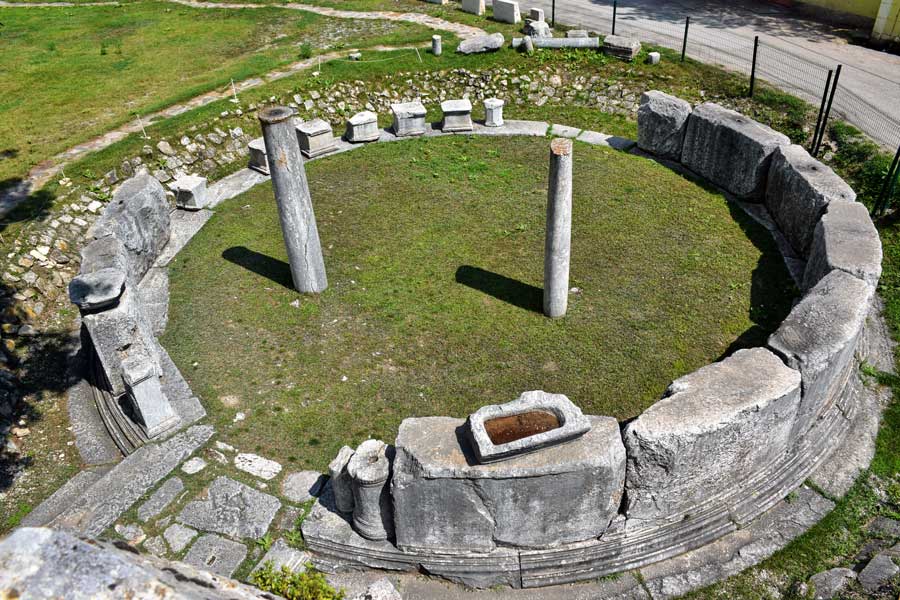
The circular Macellum of Aizanoiwas built simultaneously with the
first Bath and
was used as a food market. Here, a copy of the Price Edict of Diocletianfrom 301 AD
was found. The edict aimed to limit the severe inflation that followed the
debasement of the coinage initiated by Emperor Nero.
During recent excavations, remains of a colonnaded street have been
uncovered over a length of 450
meters. This street had its own Stoa, which could be
dated to ca. 400 AD. A pedestal carried a marble statue of a satyr dressed with
panther skin stands at the very end of the Stoa.
The Roman city of Aizanoioccupied both sides of the KocaçayRiver and was protected against the rise
of the water level by walls or dams made of large cut stones. Two of the five
bridges are still used today. They both have five arches, and one of them still
supports modern-day traffic. In between these two examples, we can recognize
the remains of a bridge with three arches that fell in disuse. Further north, a
low wooden bridge was used as a pedestrian crossing.
The main bridge displays an inscription on the pedestal of the railing
and tells us it was opened in September 157 AD. An illustrating relief shows
the sea voyage undertaken by M. Apuleius as he paid for the bridge’s construction. It may be
essential to mention that M. Apuleius represented Aizanoiin the Panhellion Union held in Athens from 153 to 157 AD. The new railing was installed
in 1990.
The large necropolis of Aizanoireflects the size of the city. It includes a wide
array of tombs, including door-shaped Phrygian tombs from the 2nd century AD. The
typical tomb doors, which often bore the name of the deceased or donor,
symbolized the passage to the other world. These tombstones usually showed
bulls, lions, or eagles for the men and baskets of wool or a mirror for the
women.
In one of the tombs, archaeologists made a remarkable discovery. They
found a “lykion,” a typical jar made to contain a precious salve to
treat eye dryness which frequently occurred to soldiers traversing large
stretches of dry lands or deserts (see: Eye cream from antiquity).
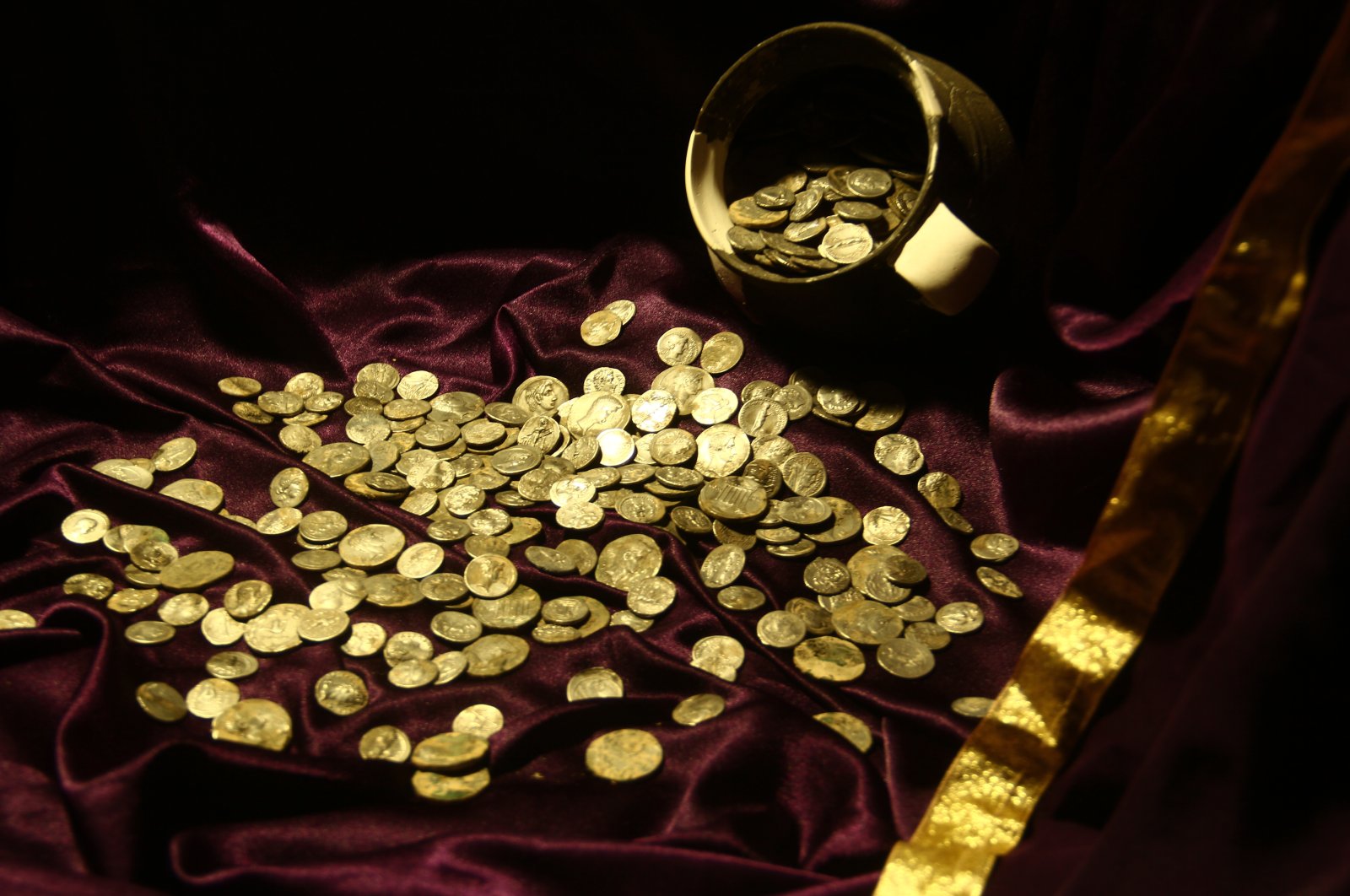
More recently, they unearthed a jug containing an exceptional hoard
of 651 silver coins from the days of Emperor Augustus. Remarkably, 439 coins were standard Roman silver
denarii, but 212 were cistophoruscoins typically from Pergamon. This is not surprising considering that Aizanoiwas ruled by Pergamon until the kingdom was bequeathed to the Romans
in 133 BC.
Aizanoistarted minting its first coins in the second and first
centuries BC. During the days of the Roman Empire,
the city grew wealthy thanks to the production of grain, wine, and wool. Aizanoifell into decline in Late Antiquity.
One would not expect to find rules defining the maximum price for goods and services in the year 301 AD, but this is exactly what happened.
On the 1st of September 301, the Roman Emperor Diocletian issued an edict to this purpose containing as many as 1,400 items for raw materials and manufacturing goods as well as for services in order to curb the high inflation. It was posted all over his empire, and so far, it is known that, for instance, in Anatolia, parts of the decree have been found in Pergamon, Aizanoi, Aphrodias,Stratonikeia, andHalicarnassus.
The entire edict consists of 37 parts, and the Museum of Halicarnassus proudly exhibits part 9 and a bit of part 10. Today, Aphrodisiasclaims to have unearthed the complete list that was inscribed on the façade of the Civil Basilica. With restoration works in progress, archaeologists hope to reassemble the entire decree inside the building, where future visitors will be able to see it. It is written in Greek, but authorities plan to make the text available in Latin, English, and Turkish translations.
This will certainly shed extra light on the social and economic life of Diocletian’s days. The list mentions such a range of items as the travel fee from AlexandriatoRome, the ostrich fee, or the price for a rabbit’s belly fur.
Moreover, I remember having seen this edict of Diocletian in Ptolemais (modern Libya). It was found on the Via Porticata, the Monument Street, which corresponded to the Decumanus. The panel that was retrieved here is slightly damaged and is now exhibited at the local Museum of Ptolemais. There must be many other such places, but it is not easy to track them down.
Finding such legislation all over the Roman Empire clearly shows their widespread organizational skills. It makes me wonder whether such a law existed before, maybe already in Hellenistic times.
It is not difficult to imagine that even in antiquity, soldiers who
traversed large stretches of dry lands or deserts would suffer from xerophthalmia, i.e. eye dryness. Yet, it
is far more difficult to accept that they knew how to treat their sore eyes.
Sifting through the grave gifts in ancient tombs can obviously be very
rewarding but finding a jar that once contained this eye balsam is quite
surprising.
It happened during recent excavation works in Aizanoi, in western Turkey. Here,
archaeologists unearthed several tombs from the 2nd and 1st
centuries BC and among the grave goods, they found a “lykion”, a typical jar made to contain the precious cream.
The salve was made using a plant that was
common in Lycia
until the end of the 18th century. A similar plant is also known in India. This
makes me wonder whether Alexander
could have taken this remedy with him to India
or if it had been imported to Asia Minor by his
Macedonians on their way back home.
According to ancient sources, Romans used
this eye cream while marching through Egypt.