Alexandria's founded by Alexander

Alexandria's founded by Alexander the Great (by year BC): 334 Alexandria in Troia (Turkey) - 333 Alexandria at Issus/Alexandrette (Iskenderun, Turkey) - 332 Alexandria of Caria/by the Latmos (Alinda, Turkey) - 331 Alexandria Mygdoniae - 331 Alexandria (Egypt) - 330 Alexandria Ariana (Herat, Afghanistan) - 330 Alexandria of the Prophthasia/in Dragiana/Phrada (Farah, Afghanistan) - 330 Alexandria in Arachosia (Kandahar, Afghanistan) - 330 Alexandria in the Caucasus (Begram, Afghanistan) - 329 Alexandria of the Paropanisades (Ghazni, Afghanistan) - 329 Alexandria Eschate or Ultima (Khodjend, Tajikistan) - 329 Alexandria on the Oxus (Termez, Afghanistan) - 328 Alexandria in Margiana (Merv, Turkmenistan) - 326 Alexandria Nicaea (on the Hydaspes, India) - 326 Alexandria Bucephala (on the Hydaspes, India) - 325 Alexandria Sogdia - 325 Alexandria Oreitide - 325 Alexandria in Opiene / Alexandria on the Indus (confluence of Indus & Acesines, India) - 325 Alexandria Rambacia (Bela, Pakistan) - 325 Alexandria Xylinepolis (Patala, India) - 325 Alexandria in Carminia (Gulashkird, Iran) - 324 Alexandria-on-the-Tigris/Antiochia-in-Susiana/Charax (Spasinou Charax on the Tigris, Iraq) - ?Alexandria of Carmahle? (Kahnu)
Showing posts with label Philip-II. Show all posts

Thursday, June 18, 2026

Booty of war, a rare case

Speaking of the booty of war raises images of soldiers plundering palaces or the houses of the wealthy citizens in the territory they just conquered. In antiquity, the booty was the soldier’s pay or the common citizen’s way to take revenge on their lords for the suffering they had endured. 

Philip II, Alexander’s father, was the first to introduce a regular professional army and pay his soldiers for their services. Alexander followed suit, but old habits are hard to break, and his soldiers did not shy away from helping themselves to the enemies’ wealth when the opportunity arose. 

There were cases where Alexander forbade his troops from appropriating the treasures they found (see: Fire over Persepolis) and restrained his army from looting Babylon and Susa. But once they arrived in Persepolis, he let them loose to rampage the city, all but the palace. The Macedonians were unstoppable in their insatiable greed, storming through the houses and plundering the premises. The Persian wealth had rubbed off onto the common people, and it was said they possessed much silver and gold. Diodorus speaks of an “orgy of plunder”. Alexander’s proud army definitely was drunk with craving. The rampage became so outrageous that Alexander had to intervene in person.  

Today’s warfare is totally different from antiquity and can hardly be compared, but looting still exists. 

Let me, for instance, stop the time clock at WW2. Although it is hardly 80 years ago, it is difficult to separate looting from saving an artifact from bombed or burned buildings. If it happens to be a museum, we can speak of looting when the precious content is carried off as a trophy. However, it can be labeled as stolen when it is taken illegally out of the country of origin, although it may be retrieved for safekeeping. 

No matter the qualifier used, the object has been removed unknowingly from its established and documented environment. 

[Picture from Smithsonian Magazine]

Recently, an intriguing case made headlines. A Roman tombstone from the 2nd century AD was found in a garden in New Orleans, USA. The fine marble slab carried an inscription in Latin, reading: “To the Spirits of the Dead for Sextus Congenius Verus, soldier of the praetorian fleet Misenensis, from the tribe (natio) of the Bessi [i.e., a Thracian], (who) lived 42 years (and) served 22 in the military, on the [trireme] Asclepius. Atilius Carus and Vettius Longinus, his heirs, made (this) for him well deserving.” 

The tombstone was clearly out of place and out of its context. After further in-depth research, the New Orleans owners discovered that this artefact had been reported missing from the Archaeological Museum of Civitavecchia, near Rome, after it was bombed by Allied forces during WW2. In the process, the museum and its collection were destroyed. The museum reopened as late as 1970. 

The tombstone had been part of an ancient cemetery in Civitavecchia that contained some twenty graves of Roman soldiers. It had been discovered in the 1860s, and its Latin inscription had been carefully recorded in a catalogue from 1910 before the stone was moved to the local Archaeological Museum. This being established, and with the help of professionals, the American and Italian authorities are presently in the process of returning the stone to Civitavecchia. 

How exactly this tombstone ended up in New Orleans is another story. The previous owners of the house came forward when the media reported on this odd discovery. The lady of the house had received the plaque from her grandparents, who lived in Italy during WW2. Her grandmother was Italian, and her grandfather was from New Orleans. 

Our world is not perfect, as we are still debating whether the Parthenon friezes, now at the British Museum, should be returned to Athens. In antiquity, the strongest or the most powerful party simply took what they wanted. 

I developed the concept of looting in antiquity in an earlier post entitled, Wartime looting in antiquity. We have come a long way since then, yet not long enough.

Monday, August 11, 2025

Another Macedonian tomb

The large number of tombs that dot ancient Macedonia never ceases to amaze me. They do not immediately stand out, but driving around on local roads in the wider area of Pella and Vergina (ancient Aegae), they appear as solitary structures or ruins. Occasionally, their names are announced on promising road signs pointing you to mysterious sites. 

Most visitors flock to the Great Tumulus housing the Tomb of Philip II in Vergina, along with the Tomb of Persephone (based on her frescoed depiction on the wall), and the Tomb of the Prince, attributed to Alexander IV. 

[Picture of the Abduction of Persephone from The Maritime Explorer]

The large necropolis to the east of the city and the many tombs outside the ancient city walls are generally ignored. In this area, it is nearly impossible to miss other beautiful examples like the Rhomaios Tomb, the Tomb of Eurydice (Alexander’s grandmother), the Macedonian Tomb on the Bloukas Farm, or a series of tombs on the Bella Farm (see: There is more to Aegae than the Royal Palace and the Great Tumulus). These tombs are rarely open to the public.  

Excavations are still ongoing, and more than one thousand tombs have been uncovered at Pella alone since 2000. They often carry the names of Macedonian families, and many monuments still display their vivid original colors. 

Closer to Náousa  (some 50 kilometers east of Pella), the Tomb of the Judgment, the Tomb of the Palmettos, the Tomb of Lyson and Kallikles, and the neglected Tomb of Kinch are worth visiting if the opportunity arises (see: Alexander's schooling at Mieza. Visit of the surrounding area). These tombs are not always open to the public.


Earlier this year (2025), the Tomb of the Philosophers, situated in the eastern necropolis of Pella, made headlines. The burial chamber measures 4.40x1.95 meters and is three meters high. It dates from around 300 BC and shows frescoes of six unnamed philosophers that document the richness of Pella’s intellectual development and cultural life at the time, when philosophy and sciences were a common good. 

The frescoed figures, who gave their name to the burial site, call for our attention. The most intriguing picture is that of a man wearing a red himation (kind of mantle), holding a wooden rod, pointing at a celestial globe, indicating that he might be a philosopher interested in astronomy. The theme is likely influenced by Aristotle’s teachings and other works written by philosophers and poets living at the Macedonian Court of Antigonus II Gonatas in the 3rd century BC. 

On the wall to his right, a bearded man is studying a papyrus scroll. The left wall depicts another wreathed, bearded ‘philosopher’. Above them are scenes of horsemen and grave steles inspired by Homeric funeral games. 

Excavations have revealed that the grave was probably built for a family. It contained the remains of three individuals: a man in his forties, a woman in her thirties, and an infant. The presence of this elaborate decoration with symbolic elements indicates that the family belonged to the higher social elite of Pella. The man could well have been a scholar or an astronomer who cared for his family after their death. 

The tomb’s frescoes are of high quality, giving a telling insight into the personal identity and the cultural values of the deceased. What’s more, the elements testify to the vibrant intellectual and artistic level that was reached in Pella some one hundred years after the death of Alexander. 

[Pictures of the Philosopher's Tomb from the Teacher Curator]

Monday, August 4, 2025

What Alexander really looked like.

Over the centuries, endless theories have circulated about the real appearance of Alexander. Statues, busts, paintings, and sketches have depicted Alexander as imagined by their creators, just as ancient and modern authors have described their version of Alexander. 

It is inevitable since Alexander became a legend during his lifetime. The legend took a life of its own, and still does today. 

I have just read an article on the Greek Reporter, “Beyond the Busts: Unveiling Alexander the Great’s True Face” by Paula Tsoni.  A very promising title that misleads the reader in many ways. The most absurd theory is the one quoted towards the end, reading: 

"A fresco depicting a hunt scene at the tomb of Philip II, Alexander’s father, at the archaeological site of Aegae is the only known surviving depiction of Alexander produced during his lifetime in the 330s BC."      …

"A most disruptive theory is proposed by Greek-French academic Byzantinologist Helene Glykatzi-Ahrweiler, who has herself been identified by the 2008 show Great Greeks as one of the 100 greatest Greeks of all time. In her 2018 book published by Gutenberg, the famous scholar suggests that the tomb in Aegae is, in fact, Alexander’s, and not his father’s. This would explain why the young king was depicted in the famous fresco inside that tomb."

First of all, it has been clearly demonstrated that the tomb in Vergina, ancient Aegae, belongs to Philip II and not to Alexander, who was entombed in ancient Alexandria. The latest confirmation of Philip’s presence in the Vergina tomb has been established by studying the adjacent tomb that turned out to be Cynane’s, Philip’s daughter (see: Cynane buried next to her father, Philip II). 

Secondly, stating that the hunting scene in Philip’s tomb (which is unclear) is “the only known surviving depiction of Alexander” is not correct. It has been established that the ivory heads recovered from a Macedonian funerary couch in Vergina belong to Philip and Alexander. Greek archaeologists agree that the Alexander head is the only one made during Alexander’s lifetime. 

There have been repeated tentative efforts to recreate the Macedonian King’s face, even showing occasional look-alikes. A lot of wishful thinking, no doubt, but not very realistic. 

The question about Alexander’s real face already arose in 2016, when I wrote about a hoard found at Mir Zakah in north-eastern Afghanistan (see: Alexander’s real face). The hoard had been hidden in a well for over two thousand years and contained an estimated 550,000 coins. One of them showed Alexander with wide-open eyes, a crooked nose, and wild curls on the obverse and a tiptoeing elephant on the reverse. This is Alexander as he saw himself - invulnerable, verging on godhood, immortalized in the moment of his triumph after his battle against Porus on the Hydaspes in India in 326 BC. 

Osmund Bopearachchi was the first to recognize the medallion, and together with Frank Holt, he wrote a book on the subject, “The Alexander Medallion, Exploring the Origins of a Unique Artefact.” This information is ignored by or unknown to the eminent Greek-French academic Byzantinologist Helene Glykatzi-Ahrweiler, used by the Greek Reporter!

[Picture of the coin is from The Hindu]

Monday, July 28, 2025

Cynane buried next to her father, Philip II

Cynane was Alexander’s half-sister, born around 357 BC. Her mother was Audata from Illyria (see: The many wives of Philip II of Macedonia), whom King Philip had married to secure his expanding kingdom. 

Philip gave Cynane in marriage to Amyntas, who was the legal successor to the throne of Macedonia after his father, King Perdiccas III of Macedonia, died in combat in 359 BC. As Amyntas was only a child, Philip, Perdiccas' younger brother, became his tutor and regent. Later that year, Philip was elected king instead.

After Philip's murder in 336 BC, Amyntas could have taken his chances, but he did not, for whatever reason. The newly elected King Alexander, however, did not hesitate and had Amyntas killed. He could have suspected that Cynane would manipulate her husband to gain power. Cynane was left a widow, raising her daughter Adea alone. Not for long, though.

When Alexander made his way to Pelium in 335 BC, he faced a threatening revolt of the Illyrians, and Langaros, King of the Agrianes, came to his rescue. In recognition of his assistance, Alexander invited Langaros to Pella, offering his half-sister Cynane in marriage. Before this wedding could materialize, Langaros fell ill and died (see: The short-lived appearance of King Langaros).  

Cynane stayed in Macedonia as Alexander left for Asia. Having been raised by her mother in the Illyrian tradition as a warrior, equal to any man, she now instilled the same values in her daughter. 

Upon Alexander’s death, Cynane saw her chances, not for herself but for Adea. She mobilized her troops and led her daughter and her army to Babylon to secure their future by arranging the marriage of Adea with Alexander’s successor. 

As the daughter of Philip II and Alexander’s half-sister, Cynane enjoyed the loyalty of the Macedonian army, despite General Perdiccas’ disagreement. The general tried to stop her in every possible way and sent Alcetus, who killed Cynane before she could speak. This assassination did not sit well with the Macedonian army, who revolted and demanded that Adea, Alexander’s niece, marry Alexander’s half-brother, the simple-minded Arrhidaeus. Arrhidaeus, who was the only available bloodline, would rule as King Philip III, and Adea would become Queen Eurydice II. She was the power behind Philip III, which was not to the liking of Queen Olympias. She had Philip III killed in 317 BC and Eurydice II imprisoned and forced her to commit suicide. 

This long introduction brings me to the tomb of Philip II and the adjacent tomb of a woman in Vergina. Since its discovery in 1977 when Manolis Andronicos attributed the tomb to Philip II and the remains in the smaller room to his seventh and last wife, Cleopatra, many arguments have erupted, presenting different theories. 

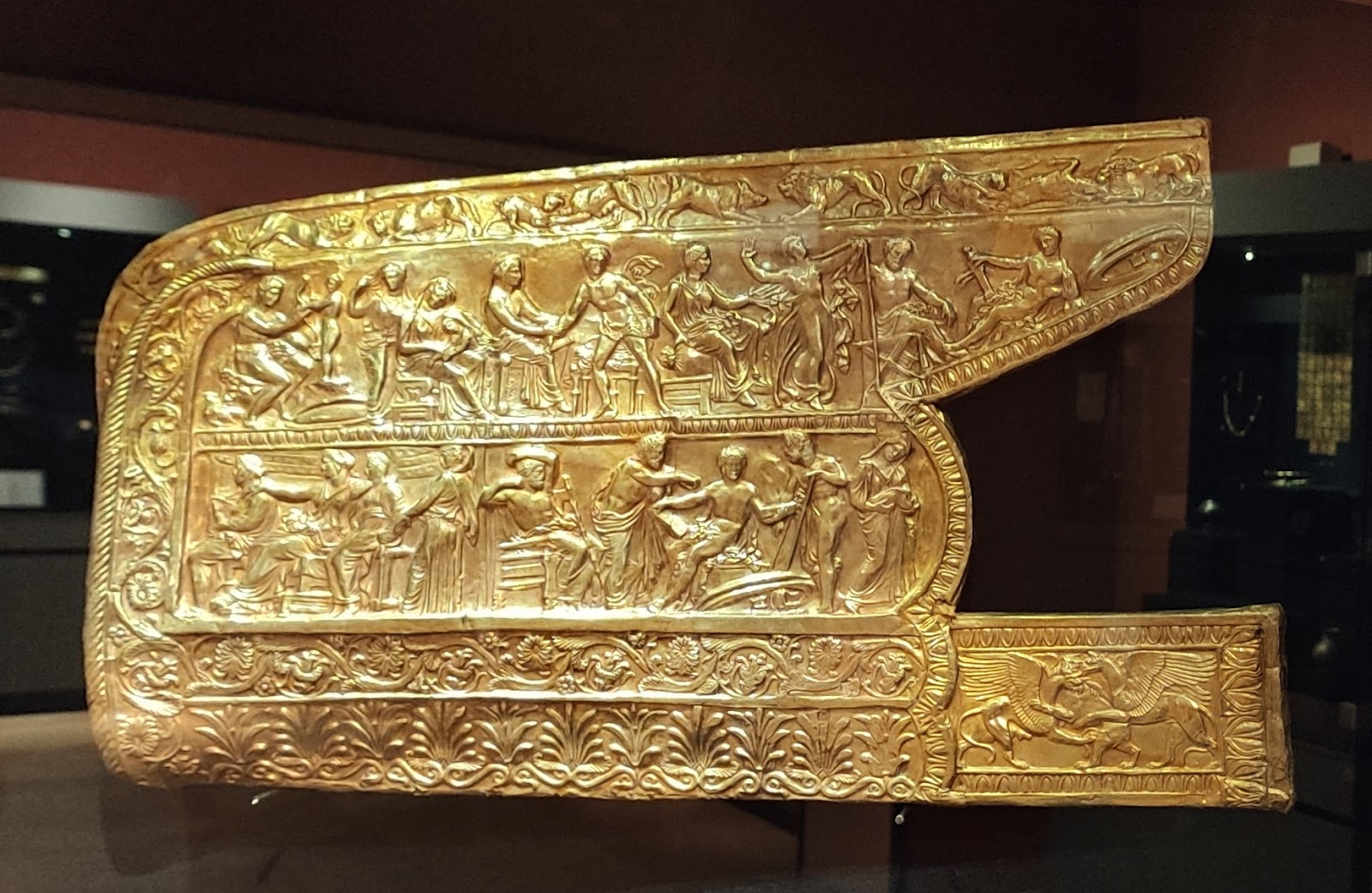
Recently, I watched a presentation on the History Channel*, about the gold quiver or goritos found in this tomb. Scholars agree that it is Scythian and not Macedonian, made between 900 and 200 BC. Next, the question arose whether it had belonged to Philip or to the woman. If it was the woman’s, who was she, and could she be a descendant of the fiercest Scythian female warriors, the mythical Amazons? 

The breakthrough occurred when the female bones and pelvis from the smaller room were analyzed. It is known that a woman’s pelvis changes during life, and it could be determined that this example was between 30 and 35 years old. 

Adea/Eurydice was only 20 years old when she had to take her life. She is not a candidate to be interred in Vergina. This conclusion automatically excludes earlier debates presenting Philip Arrhidaeus as the main occupant. 

The only remaining person obviously is Cynane, Alexander’s half-sister, who was 34 years old when she was murdered on the orders of General Perdiccas. 

It was also established that the two chambers of the Vergina Tomb were not built at the same time. Since Cynane died 13 years after her father, it is entirely plausible that her tomb was added next to her father’s at a later date. 

The program concluded with an extra note regarding the Scythian goritos (that was worn around the waist). After examining the DNA of the remains found in the Scythian kurgans, the scholars concluded that not all warriors were men, as 1/3 of the burial sites were built for women. 

Cynane must have been quite a character, raised as a warrior and a match to any man. No wonder the Macedonian troops were horrified when she was murdered in cold blood. It is quite remarkable that she lived one year longer than Alexander. Whoever arranged for her to be buried next to Philip was well aware of her courage and battle spirit. Maybe her father had been attracted to Audata for that same reason, who knows?

*2023 Strangest Things on History Channel
[Picture of Cynane's larnax and Facade of Philip's tomb are from Wikipedia; Goritos picture from this link Wikipedia]

Monday, June 30, 2025

The case of Alexander of Lyncestis

The name Alexander is already very popular in the days of Alexander the Great and may lead to confusion. 

For a start, there was King Alexander of Epirus, Olympias’ brother and Alexander’s uncle. I usually refer to him as Alexandros to make the difference. He is the one who married Alexander’s sister Cleopatra in 336 BC, the day King Philip of Macedonia was assassinated. 

Then there is Alexander of Lyncestis, in Upper Macedonia, son of Aeropus and son-in-law of the general and later regent Antipater. He had two brothers, Heromenes and Arrhabaeus, who were soon accused of plotting the murder of Philip II and put to death. Brother Alexander is said to have been the first to proclaim Alexander of Macedonia as king and thus avoided punishment, for now at least. 

In Alexander’s campaign, the Lyncestian was soon appointed to command the Thracian detachment and later the Thessalian cavalry. However, two years later, Parmenion, who was spending the winter near Gordion, caught a messenger carrying a secret letter from the Persian King Darius for Alexander of Lyncestis. It revealed that Darius promised to pay him a thousand talents of gold to kill Alexander and would proclaim him King of Macedonia instead! Parmenion sent the messenger with a trusted escort to Alexander, where the man repeated the same story. 

This was an extremely serious matter that Alexander put before his assembled Companions in order to make the appropriate decision. It was agreed to send a trusted man, a brother of Craterus, to Parmenion. He would travel incognito, dressed as a local and accompanied by guides from Perge, and deliver his message verbally, as it was thought better not to write down anything on a matter of this importance. Alexander’s envoy reached Parmenion without being detected and reported the instructions he was carrying. Alexander of Lyncestis was arrested and put in chains. He was tried for plotting against his king and put in prison. Being the son-in-law of Antipater, acting as the king’s Regent in Macedonia, was an important factor in his favor. 

The Lyncestian was dragged around for about three years, when in 330 BC, in the wake of Philotas’ trial and execution for a similar plot, the Macedonians demanded that he should be tried and punished accordingly as well. When he was brought in from confinement to plead his case, he was faltering and nervous, and found no words to reply and defend himself. This was perceived as a guilty conscience, and the bystanders ran him through with their spears. 

It should be noted that Queen Eurydice I, Alexander’s paternal grandmother, was born in Lyncestis. She married King Amynthas III of Macedonia, the father of Philip II, in 390 BC to consolidate the relations between the two countries.

Tuesday, December 3, 2024

Owner of the Tomb of Vergina still questioned

Historical events are gladly twisted and turned to make an interesting or commercially profitable story. Some or even many of these tales can stay alive for years, even centuries. 

The most absurd theory is about Alexander being buried in Macedonia and not in Egypt. The other recurring discussion is about the Tomb in Vergina that has been attributed to Philip II, Alexander’s father, by Manolis Andronicos in 1977 (see: Vergina, The Royal Tombs by Manolis Andronicos).


The next best candidate for the Tomb of Vergina is Philip III Arrhideus, as discussed in my post Questioning the Tomb of King Philip II, father of Alexander the Great, in November 2009, and Philip’s Tomb at Vergina, is it or is it not in January 2016. This last one is based on studies by Antonis Bartsiokas, Democritus, University of Thrace, Komotini, who worked on the Vergina tombs. 

Only recently, a sacred purple-dyed cotton chiton of Alexander has been discovered in the golden larnax of Tomb II, thought to be Philip’s. 

This garment is most remarkable because cotton was first introduced to the Macedonians when they reached India in 327 BC. According to Antonis Bartsiokas, the tunic matches the description of a ceremonial outfit, a sarapis, as worn by King Darius and later adopted by Alexander. A closer analysis revealed the presence of huntite, a bright white mineral uncommon in Greece but used in ancient Persia, between the layers of cotton. These white stripes are also seen in Alexander’s outfit as depicted in the fresco above the entrance door of what is supposedly Philip’s tomb. This, the author says, strengthens his theory that this sarapis is “the same one that Alexander would have worn in official ceremonies”. 

Why this fabric suddenly appears inside the larnax is puzzling, to say the least, since the cremated bones and a large gold wreath of oak leaves and acorns were removed years ago.

Why the chiton is linked to the image of a juvenile Alexander in the fresco of the tomb is not exactly in line with Alexander as King of Persia wearing a cotton chiton with traces of huntite.

And why can we be sure this sarapis is the one Alexander wore and not Philip III Arrhideus, as he too became King of Kings? 

Presently, Antonis Bartsiokas also states “that many objects found in Tomb II actually belonged to Alexander the Great,” including a golden diadem, a scepter, and the earlier mentioned oak wreath. Here, Philip II is not even mentioned! This would imply that Andronicos had it all wrong. Of course, this is history in the making, and new discoveries and interpretations surface time and again. 

We’ll see…

Thursday, April 11, 2024

The short-lived appearance of King Langaros

Alexander’s campaign into the Balkans before marching east to conquer the Persian Empire is often neglected and even forgotten in literature. 

Only occasionally do we find a name. This is the case for Langaros, King of the Agrianes, who had openly chosen to side with Alexander as he had done with Philip before him. 

When Alexander made his way to Pelium in 335 BC, he faced a threatening revolt of the Illyrians led by Cleitus, king of the Dardanians. Cleitus had persuaded the Autariatae and the Taulantians to join forces (see: Alexander's psychological warfare in Pelium, Illyria). The situation looked bleak for Alexander, who needed to know more about the strength of these Autariatae. 

Langaros, faithful to Alexander, attended him with his bodyguard, the finest and best-equipped troops, and told his friend that he would take care of this warlike tribe. He actually did so, and with Alexander’s consent, he invaded and occupied the Autariatae territory, causing severe losses to their common enemy. 

Alexander showered Langaros with every mark of honor and gifted him with many high-valued presents as proper at the Macedonian court. He also promised Langaros that if he visited him at Pella, he would give him his half-sister Cynane in marriage. Cynane was the daughter of Philip II and his Illyrian wife Audata (see: The many wives of Philip II of Macedonia). It was not to be, as Langaros, after returning home, fell ill and died. 

Our only source for this story is Arrian, who kindly remembered him. 

Recent archaeological digs near the city of Kumanova in North Macedonia have revealed remains of an important yet unknown town from the 4th century BC. Besides a pool with a plastered floor, some plastered walls, capitals and bases of columns, and appliqués have been found. They are consistent with similar details from Aegae and Pella. 

It is far too early to draw any conclusions right now and to link the ruins to King Langaros’ capital. The pictures of the site are not adding much to the story yet. As we know, excavations in that part of the world are slow to materialize. 

This King Langaros is not to be confounded with the Illyrian King Longarus, who ruled over the Dardanians from 231 to 206 BC. 

Longarus, however, played an important role in the life of Philip V of Macedonia, who regularly attacked the Dardanians. Taking advantage of Philip’s campaign in the Peloponnesus in 219 BC, Longarus occupied Bylazora, the capital of Paeonia. His success was short-lived, though, as two years later, in 217 BC, Philip V captured Bylazora, blocking the Dardanian access road to Macedonia.

Thursday, February 29, 2024

Restoration or reconstruction?

A thin line separates the restoration of an object or building from its reconstruction. A good restorer will preserve the authenticity of the piece, like a statue, while strengthening and improving its overall condition.
 
When it comes to monuments, the restoration is meant to improve the visual impression and to help the onlooker imagine how it looked in its days of glory. A reconstruction, however, numbs our imagination and produces a modern rendition instead of recreating what once was. 

An example of excellent restoration is, for instance, the Philippeon in Olympia, Greece. When I first visited the site in the early 1970s, only a few stone blocks outlined the contour of the monument; there was not much to get excited about. When I returned more recently, I was much impressed by the skillful restoration of the Philippeon showing three steps on which three full-size Ionic columns had been reassembled. It does not seem like much, but it was enough to complete my mental picture of Philip’s monument. 

Meanwhile, it has become fashionable to create an environment that will attract tourists, meaning to cash in on the money. Plans to that effect have been suggested, for instance, to clear the swamp occupying the old harbor of Ephesos and turn it into a place where tourists can anchor their yachts. A ridiculous idea because it does not help recreate the aspect of the ancient harbor and it truly destroys any possible picture from antiquity. 

There also is the case of the Monument of Opramoas, a wealthy citizen of Rhodiapolis, Turkey. This benefactor contributed largely to the reconstruction of the city that was hit by the severe earthquake of 141 AD. The walls of a monument built in his honor were covered with an inscription – the longest in Lycia - to commemorate his deeds. Archaeologists carefully retrieved these stones and piled them up next to the theater, where I discovered them in 2008.

The plan was to sort them out to reproduce the original inscriptions. Well, the project has materialized, but the gaps of the missing stone blocks have been amply filled with bright white marble blocks. The shiny out-of-place square monument draws the visitor's attention away from the theater and other noteworthy monuments. A bad reconstruction. 

[The reconstructed Opramoas Monument]

Very recently, the Palace of Aegae (modern Vergina) reopened to the public after being closed since 2007. I agree that it was in dire need of being cleaned and restored. The ruins were covered with moss and dirt after years of neglect and did close to nothing to reflect the wealth and glory of Macedonia’s heyday.

When I saw the first pictures of the Palace as it is presented to us today, my heart sank. The result is a reconstruction. Archaeologists reused the bits of broken columns they found on the spot, but the new white marble column drums dwarf the original elements. As they stand mostly around the central Peristyle, they are taking my attention away from the general layout and the precious mosaic floors. The most beautiful mosaic, the Rape of Europa next to the entrance, which was hitherto hidden underneath a tarp, is now exposed to full view. Thank you.

[Picture of Aegae's Palace from The Archaeologist]

The difference between restoration and reconstruction is very thin, I agree. The Palace of Aegae, the scene of so much history, was hardly visited. Not everybody is blessed with the ability to mentally rebuild the missing walls, columns, corridors, and rooms. The present reconstruction will draw crowds of tourists who do not have to make that effort and simply accept what is there. 

[Picture from Smithsonianmag]

This is especially true for the Parthenon on Athens' Acropolis. To see a temple as it would have looked on the day it was built is a major incentive for those who lack imagination or who are too lazy to make the effort. The excuse in Athens is that the Parthenon had been badly restored in the 1930s. The cement parts had to be replaced with marble and the rusted metal clamps had to make way for titanium ones. In the long run, this kind of repair does pay off. Besides, we have much more advanced techniques and deeper insight into the construction of a Classical temple than 150 years ago. Still, it remains debatable whether the transformation of the Parthenon is to be seen as a restoration or a reconstruction.

Tuesday, January 30, 2024

Zopyrion, governor of Thracia in Macedonian service

Thracia had been annexed by Philip II in his efforts to extend the power of the Macedonian kingdom and to safeguard its borders. After his death, Alexander had to stamp his authority and his rule over the many tribes once again, all the way to the mighty Danube River to protect his back before setting out to Asia. 

One would expect the northern tribes to live happily ever after, especially since Alexander took a substantial contingent of Thracians with him as far as India and back under the command of their general Sitalces (see: Sitalces, commander of the Thracians). 

However, the many Thracian tribes never united and kept fighting among themselves, putting their individual interests above all. It was one of Antipater’s tasks, as Regent of Macedonia, to enforce the peace. 

Ancient historians have left us very little information about what happened in Alexander’s homeland while he moved further east. One governor of Thrace is known as Zopyrion. His name caught my attention after seeing the picture of a helmet found in Olanesti, Moldova, that is linked to Zopyrion’s army. 

Unfortunately, the only reliable source of Zopyrion comes from Curtius. He simply stated that the governor made an expedition against the Getae and that his army was overwhelmed by sudden tempests and gales. He allegedly lost 30,000 men - a figure that is probably exaggerated. At that time, about 324 BC, Alexander was in Persia, facing the misconduct of many satraps he had left in charge before moving on to Central Asia. 

However, another, much less trustworthy story is told by Justin. This one circulates widely on the internet, mostly repeating the content of the Wikipedia page. 

Justin, in full Marcus Junianus Justinus, probably lived in the 2nd/3rd century AD and got hold of the 44 books called the Philippic Histories by Pompeius Trogus that are now lost. Justin decided that Trogus’ history was far too voluminous, and he wrote his own abridged version. Sadly, accuracy was not Justin’s strong point, and he was not very concerned about his sources or the chronology of the events, already a weak point in Trogus’ account. 

As a result, the vivid description found on Wikipedia and the like is fraudulent with pitfalls. Here, Zopyrion is said to have assembled an army of 30,000 men. He started his march along the southern banks of the Black Sea and laid siege on Olbia, a colony of Miletus. At that time, Miletus was already incorporated into Alexander’s Empire, but Olbia was not. Left on its own, the city managed to survive the siege by granting freedom to its slave population and citizenship to the foreigners living there. An alliance with the Scythians counteracted Zopyrion’s ambition even further, and he ran out of resources. At this point, he ended his siege of Olbia and started to retreat. At the same time, his navy was apparently hit by a severe storm, devastating his fleet. In Justin’s account, Zopyrion’s campaign was short-lived, and he died with his troops at the end of 331 BC. He also reports that Antipater, as regent of Macedonia, conveyed the news to Alexander in a letter that also informed him that his uncle and brother-in-law, Alexander of Epirus, was killed in Italy. 

While it is correct that Alexander of Epirus was killed in Italy in 331 BC, the ambitious campaign of Zopyrion took place seven years later, in 324 BC. In the end, the details based on Justin’s account may contain some truth, but it is hard to filter them out. 

Wednesday, January 10, 2024

The Palace of Aegae/Vergina in full glory

Back in May 2018, the restored Palace of Aegae in Vergina was expected to open to the public (see: At last, the Palace of Aegae reopens to the public) but for some unknown reason, it was delayed. 

[Picture from the Greek Reporter]

Finally, in the first week of 2024, the site has officially been opened and visitors will be able to see the Palace of Aegae in all its glory at last. 

Ever since it was built by Philip II and throughout the heyday of Macedonia, the magnificent palace was visible from afar. Set on a hillside, it was a clear symbol of power, three times larger than the Parthenon and as impressive. 

The Palace is built around a large square Peristyle surrounded by the roofed colonnade of the Stoa. The Tholos on the east side entrance, part of the impressive Propylon, has been tentatively defined as a place of worship, and the large room on the opposite west side as banqueting halls. The Palace’s living quarters occupied the south wing, including mosaic-paved Andrones. It should be noted that this architecture illustrates the innovative concept in Philip’s days. 

Interestingly, the mosaic floors that have not yet been moved to the Museum of Vergina are left in situ. Initially, the stonework and architectural decorations were covered with high-quality marble stucco that could easily be mistaken for marble. 

In December 2022, the New Museum of Aegae has been inaugurated with the Polycentric Museum which will house the statues and sculptures unearthed in the many sanctuaries of the city. It will also be used for temporary exhibitions and, most importantly, it will contain a virtual museum named “Alexander the Great: from Aegae to the World”. The multipurpose space incorporates and unites the central building with the entire archaeological site, including the Palace of Philip, the Royal Tombs cluster (see: There is more to Aegae than the Royal Palace and the Great Tumulus) and the Museum of the Royal Tomb. 

Let’s go!