Alexandria's founded by Alexander

Alexandria's founded by Alexander the Great (by year BC): 334 Alexandria in Troia (Turkey) - 333 Alexandria at Issus/Alexandrette (Iskenderun, Turkey) - 332 Alexandria of Caria/by the Latmos (Alinda, Turkey) - 331 Alexandria Mygdoniae - 331 Alexandria (Egypt) - 330 Alexandria Ariana (Herat, Afghanistan) - 330 Alexandria of the Prophthasia/in Dragiana/Phrada (Farah, Afghanistan) - 330 Alexandria in Arachosia (Kandahar, Afghanistan) - 330 Alexandria in the Caucasus (Begram, Afghanistan) - 329 Alexandria of the Paropanisades (Ghazni, Afghanistan) - 329 Alexandria Eschate or Ultima (Khodjend, Tajikistan) - 329 Alexandria on the Oxus (Termez, Afghanistan) - 328 Alexandria in Margiana (Merv, Turkmenistan) - 326 Alexandria Nicaea (on the Hydaspes, India) - 326 Alexandria Bucephala (on the Hydaspes, India) - 325 Alexandria Sogdia - 325 Alexandria Oreitide - 325 Alexandria in Opiene / Alexandria on the Indus (confluence of Indus & Acesines, India) - 325 Alexandria Rambacia (Bela, Pakistan) - 325 Alexandria Xylinepolis (Patala, India) - 325 Alexandria in Carminia (Gulashkird, Iran) - 324 Alexandria-on-the-Tigris/Antiochia-in-Susiana/Charax (Spasinou Charax on the Tigris, Iraq) - ?Alexandria of Carmahle? (Kahnu)
Showing posts with label Herculaneum. Show all posts

Friday, October 17, 2025

A bust of Alexander dug up in the UK

The news is not entirely new, but digging up a bust of Alexander the Great in the UK deserves all our attention. The Daily Mail made headlines saying that a 2,000-year-old bust of Alexander was recovered from the gardens of Sutton Place, near Guildford, UK. This property once belonged to Paul Getty, who later built a copy of the Villa dei Papiri from Herculaneum in California. 

[Picture from Daily Mail]

It was the estate’s gardener who discovered this bust during restoration works in 1984. The property was owned by an American art collector, who had acquired it from Mr. Getty’s son in 1980. Apparently, this art collector did not know the value of the find, and the gardener was allowed to keep his find, which he did all these years. 

He recently had a clear-out and took his belongings to an auction house. There, it was thought to be an 18th or 19th-century copy of the Roman god Hercules. 

Luckily, it caught the attention and interest of antiquity dealers, who recognized this 38-centimeters tall bust as a young Alexander, wearing the lion headdress. It was dated to the 1st century BC, but apparently nothing transpired about its country of origin or the name of the sculptor. 

How or when it arrived in the UK remains a mystery. It must have been buried before Paul Getty owned the property, as he most certainly would have recognized an original Alexander. 

This beautiful bust was eventually sold for almost 400,000 GBP and could have reached a higher price had it not undergone some repair of its nose and headdress. 

Statues from antiquity always have a story to tell, but here we have nothing to go by. As the new owner may be a private party, the likelihood of getting a thorough analysis is very slim. 

Thursday, September 25, 2025

Plato’s Grave in Athens

According to the Greek Reporter, the Italian archaeologist Graziano Ranocchia located the site of Plato’s grave in the garden of his Academy in Athens near the sacred shrine to the Muses. 

[The archaeological site of Plato’s academy. Credit: Tomisti, CC BY-SA 3.0/Wikipedia]

This discovery is based on the latest deciphering of a carbonized papyrus from Herculaneum (see: Reading Papyrus scrolls from Herculaneum). The scroll revealed the history of the Academy by Philodemus of Gadara, a poet and philosopher who lived in Herculaneum

Plato's Academy included thinkers such as Theaetetus of Sunium (from Cape Sounion), Archytas of Tarentum, a Pythagorean scientist and philosopher, Leodamas of Thasos, and Neocleides, both Greek mathematicians. 

The garden where Plato decided to establish his Academia was originally a sacred grove of olive trees dedicated to Athena, appropriately the goddess of wisdom, situated outside Athens city walls. 

Although Plato’s grave site has been established, nothing is said about whatever remains. Is there a tombstone or any kind of marker, something for us to see? After all, the garden is a large area. 

Wikipedia writes that “The site of the Academy is located near Colonus, approximately, 1.5 km north of Athens' Dipylon gates. The site was rediscovered in the 20th century, in modern Akademia Platonos neighbourhood; considerable excavation has been accomplished.” ... “the Peristyle Building (4th century BC), which is perhaps the only major building that belonged to the actual Academy of Plato”.

The modern Academy of Athens is Greece’s National Academy, established in 1926 based on the same principles as the ancient Academy of Plato. The main building in Greek neoclassical style is a landmark in the city and a clear reminder of ancient Greece.

Friday, June 13, 2025

Saving documents and books in antiquity

Nowadays, saving our documents and information on our computers is very obvious. Before the digital era, we relied on typewriters and printers to distribute our pamphlets, advertisements, letters, and books. 

It is hard to imagine that in antiquity nothing of the kind existed, but then the needs were entirely different. Public information, laws, decrees, and other important notices were inscribed on stone slabs or posted on walls in conspicuous places throughout the city, and eventually shared with other cities.  

Exchanging documents and letters over longer distances, as during Alexander’s campaigns, required writing on papyrus, a lightweight material that could be easily transported. His correspondence with Antipater, Olympias, Aristotle, Sisygambis, governors, and generals all over his ever-growing empire required an active exchange of news and information.

Eumenes and Callisthenes, serving as Alexander’s secretaries, must have been very busy and very organized. We tend to forget that they also kept copies of Alexander’s correspondence, official documents, and perhaps private letters as well. This becomes apparent when Eumenes tent went up in flames after a conflict that arose as Nearchus was preparing the fleet to sail the Southern Sea. 

Alexander had exhausted his own treasury and had to borrow money from his friends, including Eumenes, to finance Nearchus expedition. His secretary was to contribute 300 talents, but being stingy, he gave only 100 talents. Alexander did not accept Eumenes excuse that it was not without difficulty and decided to set his friend’s tent on fire. He expected Eumenes to rush his money out, and thus admit he had been lying. The plan went wrong, and the tent burned down entirely, leaving a clump of smelted gold and silver worth one thousand talents. In the process, Alexander’s archives were reduced to ashes. It is Plutarch who tells us that Alexander asked several governors and generals to send Eumenes copies of the papers that had been destroyed. This proves that Alexander did indeed keep a record of his correspondence! 

We so often read of papers and books that have only partially survived or are only known second-hand or not at all, except for the title. This situation is inherent to the mindset of the time and to the degradation of the natural support used (papyrus). 

Papyrus is a vegetal product and a very practical writing support, but it is also fragile. It has been calculated that papyrus documents had a lifespan of a maximum of one hundred years. This may have suited the needs at the time, but the chances of having them still around two thousand years later are very slim. 

Chances of survival were greater if there were many copies of a text, like, for instance, for theater plays. Yet, professional writers were expensive, and the costs were borne by the author. In Roman times, wealthy citizens could afford to have certain scrolls copied for their own use, but they would hardly survive after the Fall of the Roman Empire. 

Under exceptional conditions, some scrolls or bits of papyrus, however, reached us. The most telling example is the scrolls that survived the fire in Herculaneum after the volcanic eruption of Mount Vesuvius in 79 AD. Only recently have we been able to decipher their content without having to unroll the brittle carbonized scrolls (see: Reading the papyrus scrolls from Herculaneum). 

Another situation developed in Egypt. The garbage dump in Oxyrhynchus that served as fuel to the local population in the 19th century appeared to contain a huge amount of hitherto unknown papyrus texts ranging from the Ptolemaic era to the Muslim conquests in the 7th century AD. The papyri consist of private letters and public documents, such as a variety of official correspondence, theater plays, records, sales, wills, and inventories. The deciphering of the papyri is ongoing, as only a handful of scholars are capable of recognizing where the bit of papyrus text belongs. 

When parchment was introduced in the 2nd century BC, documents stood a better chance of survival, although even animal skins had their limits. However, parchment was extremely expensive to make. 

With the passage of time, interest and taste evolved and changed. Treatises, studies, analyses, and even books and poems went out of fashion and vanished altogether. 

As the writing supports were decaying, it is not surprising that documenting Alexander’s life is a nearly impossible task, despite the second-hand recordings by Arrian, Diodorus, Curtius, and Plutarch, who could still access some original documents (see: Eyewitness accounts of Alexander’s life).

[Top picture Derveni papyrus 340 BC, Thessaloniki Museum.
Bottom picture from Archaeology News, Digs & Discoveries

Friday, January 10, 2025

Fire threatening the Getty Villa in Malibu

Doomsday pictures fill the screens of our computers, televisions, and portable phones. Fierce fires fueled by stormy Santa Ana winds rage over the Los Angeles area in Southern California. Names of famous areas such as Pacific Palisades, Sunset Boulevard, Pasadena, and Malibu appear intermittently. Familiar beaches along the Pacific Coast Highway are almost unrecognizable. 

Many homes and businesses are in ruins and I wondered what was happening to the Getty Villa in Malibu with its priceless art collection from Etruscan, Greek, and Roman antiquity – more than 40,000 artifacts (see: The renovated Getty Villa in Malibu). 

Although the fire came very close to the Getty Villa burning some trees and vegetation, the museum housed inside the reconstructed Villa dei Papiri from Herculaneum is still safe (see: The Getty Villa, an invitation to Roman life). 

The golden rule for homeowners in southern California is to regularly clear the brush around their property. It appears that Getty had made great efforts to clear the immediate perimeter. They had also implemented additional prevention measures such as on-site water storage and in-house irrigation systems. 

Luckily, the art galleries and the library archives could be efficiently sealed off from the smoke and safely relied on a double-walled construction. 

Let us hope all the means deployed by Getty will suffice to protect the invaluable treasures held within their walls.

Wednesday, May 22, 2024

Plato, more than a philosopher

Plato is a highly fascinating figure. Not only was he a student of Socrates, but he also taught Aristotle, who, in turn, passed his knowledge on to young Alexander. 

Plato, born in 427 BC, received the best education of his time. Although we know him mainly as a philosopher, he was educated in martial arts and horse riding, besides mathematics and music, painting, and drawing. 

When about the age of twenty, he encountered Socrates teaching on the Agora of Athens, and he realized that philosophy was a more worthy goal to pursue. 

Socrates hardly wrote anything down. We know him from Plato and Xenophon, who are not always in agreement. Socrates preferred talking, or rather asking questions, to the point of embarrassing and irritating his audience. 

Plato followed his master until the Athenians executed him on the charge of impiety in 399 BC. He then left Athens and traveled to other philosophical centers, such as Megara and Syracuse in Sicily, and later to Egypt and Cyrene. He became a student of Pythagoras, Euclid, and Heraclitus, and concentrated on the religion and metaphysics of Egypt. 

Before the Museum of Alexandria was founded, the center of knowledge was in Heliopolis, where priests studied philosophy, astronomy, and theology. Many Greeks, like HomerPythagoras, Plato, and Solonconsulted the Library that contained the history of Egypt going back thousands of years. For us, Egypt's ancient history is lost in the mists of time… How much was (still) available in Plato’s days? Probably far more than we can imagine. 

In the 380s BC, Plato returned to Athens, where he started the Academy. The philosopher educated his followers in a shrine of olive groves, sacred to the Greek hero Academos, and called it, therefore, Academia. Plato’s school would continue to thrive till the early 6th century AD when it was shut down by Emperor Justinian. This Byzantine emperor was determined to erase paganism for good and impose Christianity instead to regain control over the Western Roman Empire. 

Plato is best known for his Dialogues and his Letters. He contributed hugely to our Western culture and religion, although few people realize his impact on monotheistic religions like Christianity, Judaism, and Islam. He was the first philosopher to mention and underscore the soul's immortality. For that reason, his work was not destroyed but accepted by the Christian religious leaders. Plato also stressed the importance of ‘objective truth’ in order to live well. 

As a result of the recent advanced imaging diagnostic techniques to read the carbonized papyri from Herculaneum (see: Reading the papyrus scrolls from Herculaneum), scholars have discovered more details about Plato’s life, of which very little is otherwise known. By virtually realigning the bits of burnt papyrus, they were able to restore the continuity of the text and obtain more information. 

The scroll revealed that Plato was sold into slavery on the island of Aegina, south of Athens, either in 404 BC when Sparta conquered the island, or in 399 BC upon the death of Socrates. It was previously and erroneously accepted that this event took place while he resided at the court of Dionysios of Syracuse in 387 BC. 

We also learned more about the final hours of Plato. While battling a fever, he listened to flute music played by a Thracian slave girl. He was still very lucid as he had the strength to criticize the girl’s lack of rhythm. A perfectionist to the end? 

Plato died in 348/347 BC, and it is now understood that he was buried in the garden of his Academia of Athens. This is very telling since the Academy is considered the world’s first university, which he founded next to the Mouseion. 

Deciphering the papyrus scrolls is a lengthy process that may well require many more years. Who knows what more we will learn?

Thursday, April 18, 2024

Reading the papyrus scrolls from Herculaneum

The Villa dei Papiri as reconstructed in Malibu, California, got its name from the huge amount of papyrus scrolls found inside the house’s Library in Herculaneum. 

Unlike Pompeii, Herculaneum did not burn after the eruption of Vesuvius in 79 AD but was buried under a meters-thick layer of pumice. That saved the Library of the Villa that once belonged to Julius Caesar’s father-in-law. The collection consists of more than 1800 papyrus scrolls and is considered the largest surviving library from Graeco-Roman antiquity. 

When the carbonized scrolls were discovered in the early 1800s, hopes were high to explore the long-lost literary works from antiquity. These scrolls were, however, very fragile and disintegrated as soon as they were touched. 

Attempts to open and unroll the rolls destroyed many of them, although some painstaking efforts by a monk revealed philosophical texts written in Greek. Three centuries later we are still trying to understand how to read the papyrus scrolls. 

In 2015, a process called micro-computed tomography (micro-CT) was developed to virtually unwrap fragile scrolls. It was used successfully to digitally recover a burned Hebrew scroll. 

Hopes ran high to apply the same technique for the papyri of Herculaneum. Unfortunately, they present another challenge as these texts are written in carbon ink, called “lamp black”. This type of ink is not detected by the micro-CT imaging system and the writing becomes ‘invisible’. More in-depth studies and new ‘learning machines’ eventually opened the path to reading four passages inside the unopened carbonized scrolls. 

In order to read entire scrolls, two key technical problems need to be solved. The first is to trace the papyrus surface inside the scan of the scroll, which is called segmentation. For the time being, this can only be done manually and costs a fortune. The other issue is the scanning, which is currently carried out using a particle accelerator in England. This involves a precious conservator-supervised transfer of the scrolls, two at a time, from Naples to England! 

The entire process requires much more fine-tuning and careful planning to finally set up a workable and above all affordable technique – as the entire organization is very expensive. With a little luck, it is expected that the scanning and reading of the 300 scrolls from Naples could be completed in two to three years. 

This will be a huge step forward to disclose the contents of hitherto unknown books and even new titles. So much history, literature, philosophy, and poetry that remained buried for two thousand years would finally be available! This is absolutely mind-blowing! 

Yet, there may be hundreds or even thousands of scrolls still buried in the Library of the Villa dei Papiri and, who knows, elsewhere among the ruins of Herculaneum! As we know, excavations are time-consuming and will depend on the funds made available to that effect. Only time will tell.

[Pictures from Vesuvius Challenge]

Monday, February 27, 2023

About daily life after Alexander the Great

How exciting to read about daily life as it was after the conquests of Alexander! It sounds like a fiction story, but the truth may be closer than we think! 

Artificial Intelligence, AI, in short, is a relatively new digital means that offers endless possibilities with unexpected results. Machine learning is a branch of AI researchers use to read faint traces of ink on still rolled-up papyrus scrolls. If successful, this technology opens exciting possibilities to decipher Herculaneum's thousands of carbonized scrolls. 

These latest results have been published in Live Science. The study concentrates on an otherwise “lost book” that supposedly discusses the dynasties that succeeded Alexander. 

Although till now only small fragments can be read, hopes are high to learn more about the Macedonian leaders that followed in the wake of Alexander. So far, the names of Seleucos and Cassander have been recognized together with “several mentions of Alexander himself!” 

[Picture from Live Science, credit Michèle Hannoosh]

The “lost book” is one of the many works discovered at the Villa dei Papiri in Herculaneum. Other books contain writings by Philodemus of Gadara, an Epicurean philosopher who lived from c. 110 until 30 BC and resided in the city. 

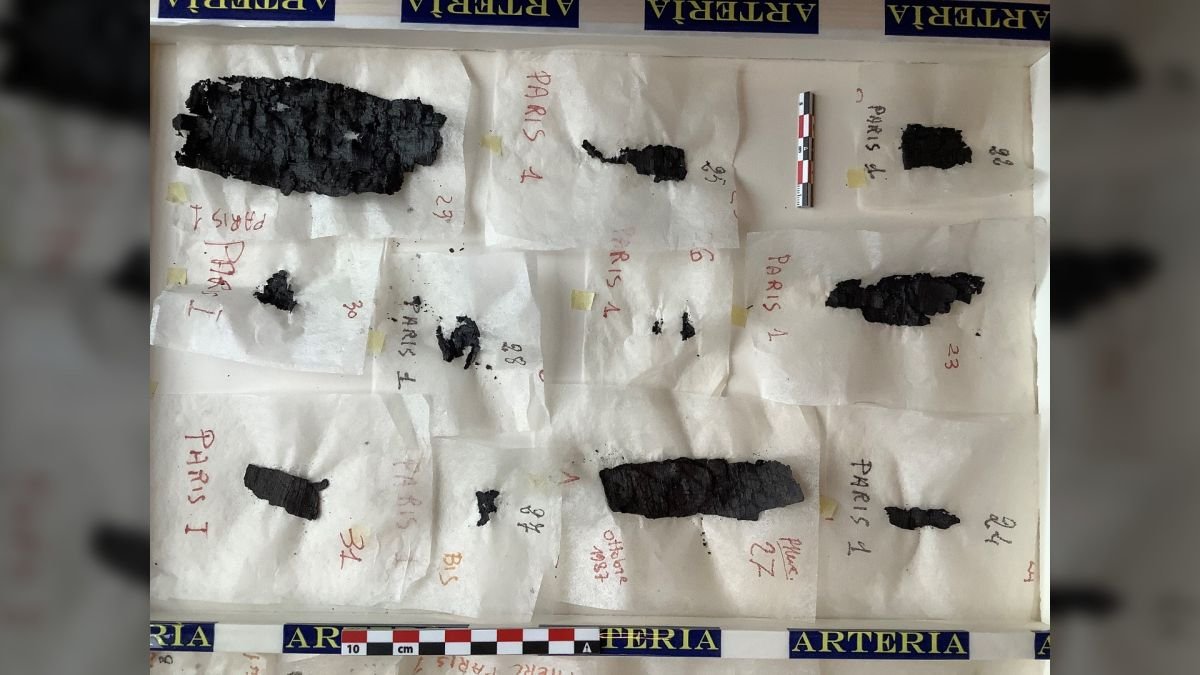
The fragile carbonized scrolls ended up at the Institut de France in Paris. Over the years, several attempts were made to unroll the scrolls, but they failed. The papyri crumbled into bits and pieces or volatilized into pure dust. 

Clearly, AI gives us new hope to unravel more about our past.

Friday, December 10, 2021

Ways to preserve mosaics

Most archaeological sites we can visit nowadays date from Roman times. In the 2nd century AD, Rome reached its apogee under the reign of the five "good" emperors: Nerva, Trajan, Hadrian, Antoninus Pius, and Marcus Aurelius. They constructed monumental public buildings, and the houses of the Roman citizens were also lavishly decorated, often with frescoed walls and telling mosaic floors. 

The best-known examples are the houses and villas in and around Pompeii and Herculaneum. Still, many sites in Greece (like Pella and Vergina) and Turkey (like Ephesos and Sagalassos) also treasure such striking walls and floors. 

Some mosaic floors are left in situ where they rightfully belong, in which case they need to be protected from the elements. Shelters for this purpose are then constructed. However, even these shelters need to be maintained, which is not always the case. 

Another way of protection is to cover the mosaics with a tarp held in place with a layer of gravel. This procedure requires less maintenance as only the edges have to be checked. Many curious visitors will be tempted to push the tarp and the gravel aside to look underneath. The mosaic floors are "eaten" away from the fringes without careful and repeated care. 

Anyway, this manner of preservation is a favorite among archaeologists because it requires little or no maintenance. However, plants' roots may damage and displace the tiny tesserae. 

The most appropriate way to save a mosaic is to remove it from its spot and entrust it to the care of a museum, where it hopefully will be on display. 

Such removal is very time-consuming and expensive, as the top layer of the tesserae has to be detached from the existing floor in one piece. For this purpose, archaeologists use a large wooden cylinder around which the mosaic is rolled face down. A facing of two layers of fabric and an adhesive is applied to prevent losing tesserae or damaging the surface during this tricky operation. The entire mosaic floor can then be moved to its new location using a panel of aluminum honeycomb and resin, following the most recent techniques. 

When strolling through a museum, the visitor is seldom aware of the effort and delicate work involved in displaying the mosaics for us to enjoy. We'd better take a closer look next time we visit a museum!

Wednesday, May 12, 2021

About the preservation of mosaics

Mosaics from whatever time period or location always have a lot to tell about customs, religion, and simple daily life, and as such are very valuable testimonies of our past. 

Yet, as soon as the precious tesserae are exposed, the question arises about what to do with the mosaic and about the best way to preserve it. 

The problem was first confronted during the 18th century when sites like Pompeii and Herculaneum were excavated. In those days, archaeology was not established as a proper science and most of the finds were carried away to be displayed in the mansions of the rich and famous. As a result, the mosaics were taken apart and the most pleasing pictures were framed in simple or elaborate frames. 

As the number of excavations steadily grew in the 19th and 20th centuries, archaeology matured equally and it became clear that not all mosaics – and certainly not the larger ones – could be moved for conservation inside a museum. 

Another option was to rebury the mosaics. To this purpose and probably by trial and error, different materials such as soil, gravel, or sand were used to cover the mosaics. The most obvious material was the soil, which was readily available at the excavation site. Besides, it made sense to rebury the mosaics using the same material that had contributed to their survival for many centuries. Nowadays, sand and gravel with or without plastic netting are often implemented all over antique sites. 

I often regret that I cannot actually have a look at those hidden treasures although I totally understand the logic behind this decision. However, standing at the entrance of the Royal Palace in Aegae and not being able to see the large round mosaic of the Tholos or Sanctuary is rather frustrating. In other places, like in Dion, Greece, (see: Dion, the Macedonian Sanctuary), strolling among the remains of Roman houses is not as rewarding as it could be if the many floors were exposed. 

At times, in order to help the visitor visualize the wealth of the mosaics in situ, shelters have been built to protect the precious stones under all circumstances. There are many such cases, such as Pella, Greece, or Nea Paphos in Cyprus. 

In the end, it all depends on the circumstances and the locations where the mosaics are discovered. In Zeugma, Turkey, (see: Zeugma, Border-town along the Euphrates River) even larger floors were removed from the site because the old city was to be flooded after the construction of a dam on the Euphrates. The only way to save what could be saved was to remove the mosaics and shelter them in a newly constructed museum in Gaziantep. 

Mosaic floors that belong to extensive villas are nowadays generally kept intact. A good example is the huge Villa of Piazza Armerina in Sicily (best known for the pictures of the bikini-girls) which has been largely roofed. On other occasions, the entire basement of the villa is cleared and made accessible underground as is the case in Ravenna, Italy. This site, called Tapeti di Pietra (carpets of stone) had been discovered during the construction of a parking lot underneath a modern building. Another similar situation occurred in Antakya, Turkey (see: Antakya’s rich collection of mosaics) where the heavily undulating mosaic floor will be incorporated into the hotel that is under construction. 

It appears that there are many options to safeguard a mosaic floor, all depending on the location and the circumstances in which they are found. Overall, the best and safest conservation choice is the reburial technique. However, this has to be done very carefully and the site must be kept under surveillance. It is sad to find mosaics disintegrating because the layer of sand and gravel is not thick enough and curious or malicious visitors scratch the protection away to expose the mosaics underneath. Many archaeological sites in the Middle East and North Africa are being damaged beyond repair like in Ptolemais, Libya (see: Ptolemais, heritage of the Ptolemies in the Cyrenaica).

Friday, February 12, 2021

Pompeii’s Antiquarium reopens at last

Very few people are aware that Pompeii has a museum of its own, generally known as the Antiquarium. This is not surprising because the premises have been closed since 1980, when they were damaged by a severe earthquake. From 2016 onward, some rooms were occasionally open for temporary exhibitions, but the Antiquarium’s own collection was entirely out of sight.

Today, after forty years, the Antiquarium has finally fully reopened. It offers an introduction to what Pompeii has to offer through its display of artifacts going back to the 4th century BC.

[Silver table set known as the Moregine Treasure (Courtesy of Italy's Ministry of Cultural Heritage and Activities / Archaeological Park of Pompeii) Smithonian Mag]

Visitors will be treated to objects of daily use, including tableware, among which is a rare silver dining set. Also exhibited are more decorative items like frescos and mosaics, as well as an array of marble and bronze statues. The casts of people who fell victim to the eruption of Mount Vesuvius in 79 AD are also on display.

At the time of the disaster, it is estimated that Pompeii counted some 12,000 inhabitants. Although the majority of the population was able to escape the catastrophe, the total death toll in Pompeii and Herculaneum combined is estimated at a minimum of 2,000 people.

The first excavations in Pompeii started in 1738, but the museum was created only around 1873. Archaeology was still in its infancy, and excavations at the site were interrupted and restarted repeatedly, depending mainly upon the money that was made available. Work has intensified since 2012, when scholars and specialists would deploy all the modern technology that is available nowadays. Among the most recent discoveries is, for instance, a charcoal inscription suggesting that the eruption of Mount Vesuvius occurred in late October 79 AD and not in August as assumed till now.

[The goddess Venus stands on a quadriga drawn by elephants in this first-century A.D. fresco (Courtesy of Italy's Ministry of Cultural Heritage and Activities / Archaeological Park of Pompeii)  Smithsonian Mag]

We only have a vague idea of the museum’s content, and the bombing that occurred during World War II destroyed hundreds of artifacts. By 1948, however, the museum reopened but was forced to close once again in 1980 after being hit by a severe earthquake.  Since 2016, the museum has received several temporary exhibitions, but it is only now, in 2021, that all the rooms and all the treasures are accessible for all to admire!

Tuesday, October 20, 2020

The Getty Villa, an invitation to Roman life

 The Getty Villa in Malibu, California is more than a museum. The premises offer a priceless insight into daily life as it was during the 1st century AD of the Roman Empire.

The Villa is a reconstruction of the Villa dei Papiri in Herculaneum and the truthful recreation of what once was. Whereas most people may expect some kind of Disneyland recreation, the Getty Villa is as close to reality as can be. Instead of imagining what such a house would look like while strolling through the streets of Herculaneum or Pompeii, Paul Getty has done the work for us. For those who ever visited Athens, it can be compared to the careful reconstruction of the Stoa of Attalus.

This means that, although most visitors will rush to the entrails of the Villa to have a close look at the superb collection of antiquities, it is worth spending time looking at the building itself.

I already gave a detailed description of the Villa in my earlier blog, The renovated Getty Villa in Malibu, California.

It so happened that the Getty Villa posted this revealing video, which interestingly entirely matches my own impressions.

The 1,200 antiquities on display at the Villa are all of extremely high quality and often tell a story of their own. Given the total of approximately 44,000 such artifacts to choose from, you’ll find something new to discover each time you visit the Getty Villa.

We should keep in mind that the layout of a Roman villa is a mere copy of what Alexander experienced back home in Macedonia a few centuries earlier. Enough impressions to dream away!

Tuesday, January 7, 2020

Fresco of a Macedonian at Boscoreale

The Archaeological Museum of Naples has a very rich collection of frescoes coming from the many cities that were buried by the ashes of the Vesuvius in 79 AD.

The first cities that spring to mind are, of course, Pompeii and Herculaneum, but there are many more resorts in the Bay of Naples that were occupied by the rich and the famous in the first century AD. To name just a few, we may remember, besides Boscoreale, cities like Stabiae, Pozzuoli, Cuma, Baiae, Portici, Boscotrecase, and the nearby islands of Capri and Ischia.

It is hard to single out the most beautiful, most original, most telling, or most colorful fresco. Some pieces have been reassembled to reflect the room in which they originally stood, and others are lonely images of a framed item.

One of the frescoes that truly catches my attention is this one from Boscoreale. It was retrieved from the Villa of P. Fannius Synistor and shows clear Macedonian links as the main figure wears the typical kausia and has a Macedonian star shield standing next to him. According to some sources, it may depict Antigonus II Gonatas (the son of Demetrios I of Macedonia) and his mother Phila, or simply be the personification of Macedonia and Asia/Persia. The lone standing figure to the left has been labeled as a philosopher.

Many more frescoed panels of the same villa have been acquired at some stage by the Metropolitan Museum in New York, where a so-called cubiculum has been entirely reconstructed.

The overall link with Macedonia has been developed in my earlier post about the Alexander mosaic

The Villa of Boscoreale was probably built around 40-30 BC and had three stories. The ground floor alone counted more than thirty rooms, including several peristyles or inner courtyards. After its discovery in 1900, it was only partially excavated, and most of the remains were reburied for safekeeping.

Thursday, August 2, 2018

The renovated Getty Villa in Malibu, California

For many years, the Getty Villa was a most wonderful place to visit – not only because of its precious collection of antiquities but mostly for the general atmosphere it created. One could so readily imagine walking through the gardens and rooms of a real Roman villa. After all, the Getty Villa is a near-faithful replica of the Villa dei Papiri from Herculaneum as it shone in all its splendor till it was destroyed during the eruption of the Vesuvius in 79 AD.


Entering the villa through one of the Stoas or alongside the central pool is pure luxury as new perspectives along the box hedges and oleanders are revealed at each step. The walls of the Stoas are painted imitating ancient frescoes and the Doric columns on the garden side alternate with hanging bronze lamps whose light is dimmed by the alabaster “glass”. When visiting the villa at night, these lamps are lit and shine in a most intimate and melancholic way. The gardens and the pool are enhanced with faithful copies of original bronze statues. At the far end of this Peristyle, the Villa is luring with its clean white façade decorated with slender Corinthian columns. Even the blue skies and the light of Southern California are merging with that of Southern Italy. The illusion is perfect.

Once inside the Main Vestibule, the visitor is immediately taken by the overwhelming details of the geometric patterns of the marble walls which are in strong contrast with the floral ornamentation of the painted ceiling. The colored marble floors and white fluted columns make the picture complete. Looking back over your shoulder, the shimmering Pacific Ocean blends with pictures of the Mediterranean.

From the Vestibule, you step back into the daylight of the Inner Peristyle (actually copied from the House of the Faun in Pompeii) with its narrow pool guarded by five bronze female statues. This courtyard is surrounded by a roofed gallery supported by Ionian columns and otherwise decorated with stucco. To the left, it opens up into the Atrium, the heart of the Roman house from where we can access several small rooms, which originally were meant as bedrooms. The Atrium is rather simple with its black and white mosaic floor laid out around a rectangular pool.

Behind the Inner Peristyle and following the straight line from the Main Peristyle Garden through which you entered, there is a temple dedicated to Heracles next to a small Basilica. The circular Temple of Heracles is domed and its floor is covered with a round spiral mosaic recovered from a sanctuary at Monte dell’Incastro in central Italy. The showpiece Hercules (Roman name for Heracles) is an original marble from 125 AD. The Basilica, on the other hand, is a gem by itself. The barrel-vaulted ceiling is made using coffered panels and supported by eight white marble columns dividing the Basilica into three naves. In between these columns stand a few marble statues, smaller than life-size, among which those of four gracious muses from Kremna in Turkey and dated to 200 AD. A true pleasure for the eye.

East and west of the back of the villa there is a garden, the west one serving as an herb garden – partially occupied by a tea room. Well, this was still the case when I visited the Villa before the Getty Center was built in 1997 to house the collection of European art that was crammed in the upstairs rooms of the Getty Villa.

It is obvious that I enjoyed the reconstructed villa far beyond its precious collection. I feel that the initial idea of Paul Getty was to build an environment that would be appropriate to house his selected artifacts. In my eyes, this is the true success of the Getty Villa.

But times have changed and today’s visitors have a different knowledge and background of antiquities. As a result, the new Getty Center was built on a grand location some 10 miles east of the Villa and this is where the entire European collection of paintings, sculptures, and furniture found an adequate space.

The Getty Villa, in turn, underwent three years of thorough restoration. Rethinking the entire layout, the upstairs’ space is now made available for artifacts from ancient Greece, the Roman Empire, and the Etruscan civilization.  Today’s visitor will discover the collection in chronological order, starting with the Neolithic and Bronze Age (Cycladic, Minoan, Mycenaean), to continuing with the Greek art ranging from the Archaic period to the Classical and Hellenistic. He will end with the ancient Roman sculptures.

Parallel and complementary to the Villa’s collection, the Getty Villa will organize a number of exhibitions that will explore the exchange and influence of classical cultures with neighboring countries but also highlight the influence of the classical world on contemporary art.

As always, admission to the Getty Villa is free and an advance timed-entry ticket is required.

[The two top pictures are from Chasing Aphrodite; the bottom picture is from the Getty Villa blog]