Alexandria's founded by Alexander

Alexandria's founded by Alexander the Great (by year BC): 334 Alexandria in Troia (Turkey) - 333 Alexandria at Issus/Alexandrette (Iskenderun, Turkey) - 332 Alexandria of Caria/by the Latmos (Alinda, Turkey) - 331 Alexandria Mygdoniae - 331 Alexandria (Egypt) - 330 Alexandria Ariana (Herat, Afghanistan) - 330 Alexandria of the Prophthasia/in Dragiana/Phrada (Farah, Afghanistan) - 330 Alexandria in Arachosia (Kandahar, Afghanistan) - 330 Alexandria in the Caucasus (Begram, Afghanistan) - 329 Alexandria of the Paropanisades (Ghazni, Afghanistan) - 329 Alexandria Eschate or Ultima (Khodjend, Tajikistan) - 329 Alexandria on the Oxus (Termez, Afghanistan) - 328 Alexandria in Margiana (Merv, Turkmenistan) - 326 Alexandria Nicaea (on the Hydaspes, India) - 326 Alexandria Bucephala (on the Hydaspes, India) - 325 Alexandria Sogdia - 325 Alexandria Oreitide - 325 Alexandria in Opiene / Alexandria on the Indus (confluence of Indus & Acesines, India) - 325 Alexandria Rambacia (Bela, Pakistan) - 325 Alexandria Xylinepolis (Patala, India) - 325 Alexandria in Carminia (Gulashkird, Iran) - 324 Alexandria-on-the-Tigris/Antiochia-in-Susiana/Charax (Spasinou Charax on the Tigris, Iraq) - ?Alexandria of Carmahle? (Kahnu)
Showing posts with label Venice. Show all posts

Saturday, October 19, 2024

Another pertinent theory about Alexander’s Tomb

All accounts on the whereabouts of Alexander’s Tomb agree up to and including Ptolemy X, who, in 89 BC used the King’s golden sarcophagus to wipe up his financial situation. He replaced the coffin with a translucent alabaster one. 

It has been documented that Cleopatra and several Roman emperors visited the tomb. Caligula and Caracalla did not shy away from taking some of Alexander’s regal attributes, nor did Aurelian and Diocletian in the 3rd century AD. 

Alexander’s remains were saved from the disastrous tsunami that flooded the North African coast in 365 AD. They were moved to a safe location until the new Christian Emperor Theodosius decided that the cult of Alexander was a threat to his dogma. In the early 5th century the tomb disappeared from the radar. 

Andrew Chugg in his book The Lost Tomb of Alexander the Great links the disappearance of Alexander’s corpse to the first appearance of St Mark’s tomb when in 828 AD, the Saint was abducted by the Venetians. ‘San Marco’ was placed in a tomb in the crypt of the Basilica built for that purpose in 1094 – or was it Alexander? 

Alexandre Schoedler-Tziamouranis has followed another track using Arab writings. He picked up the account of Hassan-Al-Wassan, also known by his Roman name Leonis Africanus, published in Venice in 1551. He stated having seen the body of Alexander in the crypt of a small chapel.

Another source is found in the 16th century’s description of Luis del Marmol de Carvajal, a Spanish geographer, trader, and historian also known as Claude Marmal. While in Alexandria, he actually saw the embalmed Alexander in his sarcophagus in a place close to the church of St. Mark.

The next witness is said to be George Sandys, a geographer and emissary who saw Alexander’s mummified body and sarcophagus in the same crypt in 1621. The tomb's guardians told him that in 954 Alexander was visible at the mosque Dûl-I-Qarnaïn-Nabi. In the Quran, to this day, Alexander is considered a prophet. From that mosque, Alexander was moved to another mosque and again to where Sandys saw him. 

[Picture from Anabasis, Source jeanclaudegolvin.com]

Alexander may well have a special god looking after him because, in the 18th century, he was found safely hidden in underground tunnels in Alexandria. This seems to be the site where the French diplomat, Octave Borelli came to see the tomb in 1898. After a diplomatic meeting at the consulate, he was led to the basement where he allegedly caught a glimpse of some gold through a crack in the wall. This most certainly was not the gold of his sarcophagus since Ptolemy X had removed it. Somehow Borelli managed to dig deeper inside the basement where he recognized the body of Alexander the Great, his shield, and other artifacts and gifts (maybe this is the gold Borelli saw?) The tale sounds too good to be true! 

Alexandre Schoedler-Tziamouranis’ account mentions that Borelli returned several times to sketch the tomb and take notes with the intention of bringing Alexander to France. Unfortunately, in 1911, before he could materialize his plans Borelli was murdered. He had not shared the location except with one close friend, whose descendant Alexandre Schoedler-Tziamouranis met. Thanks to this descendant, he had all the pertaining information to locate Alexander’s tomb, which he did with the help of an archaeologist in 2020. 

Apparently, Alexander's sarcophagus had not moved from the consulate’s basement since the early 20th century, but the consulate no longer exists. It has been replaced by a residential building whose owner refuses access or any excavation to be carried out. 

The above is widely based on an article Alexandre Schoedler-Tziamouranis published in the Greek Reporter in November 2022. 

There may be some truth in this theory, but Alexander’s tomb always eludes us. That is the case for the tomb of St Mark in Venice which may hold the body of Alexander and where the church refuses to open the tomb to have it analyzed. It is again the case in this basement in Alexandria where the owner refuses entry. 

A previous claim was made ten years ago when the crypt of an early Christian church in Alexandria yielded a richly decorated mausoleum that was attributed to Alexander based on the inscription reading “King of Kings, and Conqueror of the World, Alexander III”. That story was never updated (see: New speculation about Alexander’s tomb). 

And let us not forget the ongoing excavation project in Alexandria’s Shalallat Gardens where a beautiful statue of Alexander was unearthed in 2017 (see: Magnificent Alexander statue found in Alexandria)

One may wonder what hidden reasons are keeping Alexander hidden over the centuries.

Monday, September 16, 2024

Alexander’s presence in Venice – Part 4, the Doge’s Palace

Who would check every detail of the Palace of the Doge in Venice, except the dedicated scholar? None of the millions of tourists has the patience or dedication to investigate, beyond the general overview. 

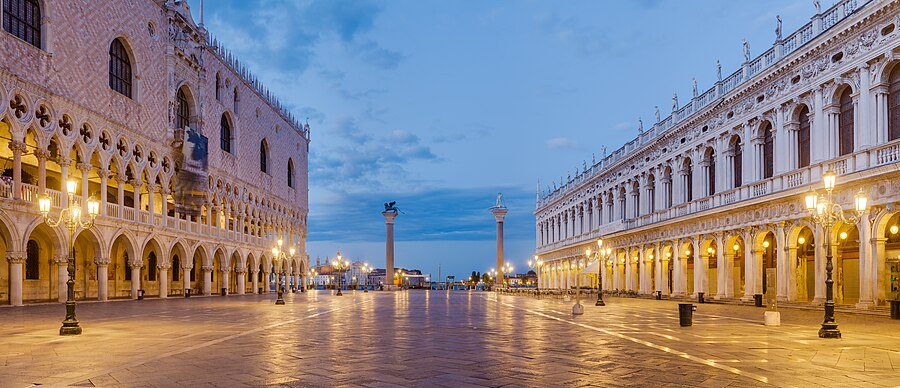
[San Marco Square, Doge's Palace on the left]

The Palace was built in the 12th century. The concept is atypical, displaying a smooth wall with a geometric pattern of white and pink stone, which rests upon two levels of colonnades. At ground level this is an arched white stone colonnade; on the first floor, it is a loggia enhanced with quatrefoil openings in white Istrian stone. The top of the Palace is crowned with white lace stonework merlons as seen in Persepolis and Central Asia. 

The capitals on top of the columns are all different and have many stories to tell. They serve not only as decorations but also as examples of historical, moral, and political teaching. We will recognize biblical scenes, Christian virtues, medieval symbolism, the Twelve Signs of the Zodiac, aspects of everyday life, and people of the world. 

[Doge’s Palace, south facade, Alexander the Great, ca. 1350 from Engramma]

It is in this last group that Alexander the Great pops up with the inscription ALEXANDER MACEDONIAE REX as one of the Kings of the World. He is to be found on top of the fifth column counting from the Ponte della Paglia. The picture from Engramma is not the best but is the only one available. It will have to do…

Thursday, August 8, 2024

Alexander’s presence in Venice – Part 3, the Pala d’Oro

Finding Alexander on the Pala d’Oro, the high altar of the Basilica San Marco in Venice is extremely difficult. 

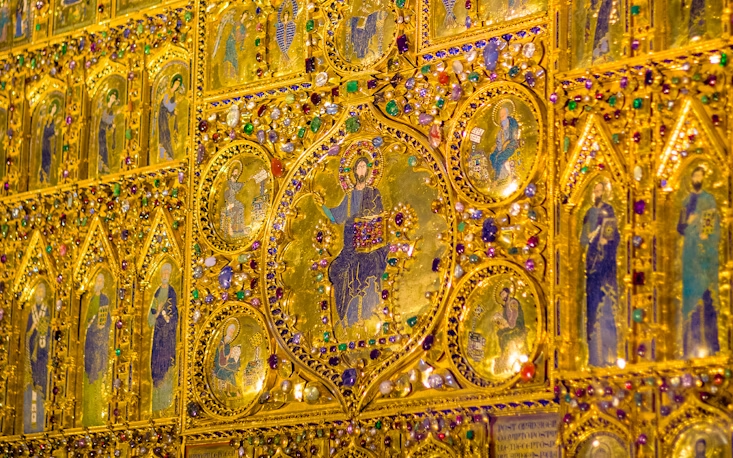
[Pala d'Oro from Saint Mark's Basilica]

The golden altarpiece is a unique work of Byzantine enamel thought to be commissioned in 976. It acquired its present shape and size (three meters wide and two meters high) in 1345. It is made of gold and silver and counts 187 enamel plaques alternating with nearly 2,000 gemstones. 

The enamels in the top part of the Pala d’Oro are a group of six images representing the Life of Christ arranged around Archangel Michael. The bottom section tells the life of St Mark. A central picture of Christ Pantocrator is surrounded by the Four Evangelists and flanked by twelve Apostles, six on either side. 

Hardly noticeable in this opulence of precious metal and colorful stones are the small roundels and busts of Saints in the surrounding cornice. 

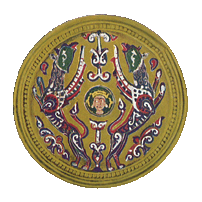
Of particular interest are the six enamel Byzantine plaques of 4.4 cm in diameter at the very bottom dated to the 11th century. 

They depict three scenes of falconers on horseback (as in Eastern iconography): 

The stylized image of Alexander the Great elevatus ad aerem (lifted into the skies) as seen in the relief on the north façade of the Basilica San Marco in Venice:

The Tree of Life, a representation of the world, is seen as a paradisiacal garden. In the center is a tree surrounded by two serpents, but also the rivers that circumscribe the emerged lands. It is the world that, in the ancient and medieval versions of the Romance, Alexander sees from above, in the cosmic vision that concludes his mystical flight. 

And a bust of Emperor Constantine of which I have no picture. 

There is nothing to link these themes together except perhaps that the enamels were gifts from the Imperial Court of Constantinople to the Doge of Venice. They were interpreted as divine inspiration through the centuries from the days of Alexander the Great to the Roman Emperor Constantine, the Byzantine emperors, and finally to the Venetian Republic. 

The six roundels, in fact, summarize the vision of Doge Dandolo to make the Venetian Republic the true and rightful heir of the Roman Empire. It is not surprising that he turned the Pala d’Oro into a most splendid centerpiece of the Basilica. 

It is remarkable to find Alexander still present as Kosmokrator (Ruler of the World) some 1700 years after his untimely death. Even today, we greatly underestimate his wide contribution to mankind, which is way beyond his military and political achievements.

[Pictures of the enamel roundels are from Engramma]
[Continue reading Alexander's presence in Venice - Part 4, the Doge's Palace]

Wednesday, August 7, 2024

Alexander’s presence in Venice – Part 2, from Constantinople

Alexander is also featured on the north façade of the Basilica di San Marco in Venice. Here is a relief taken from Constantinople after the sack and looting by the Crusaders in 1204 together with the bronze horses that found a prominent place above the entrance to the Basilica. 

[Alexander lifted into the skies – from Engramma]

Looking at the photograph in the article published by Engramma, my thoughts immediately go back to a similar picture of Alexander in the Cathedral of Otranto in southern Italy where he is part of a huge mosaic floor created between 1163 and 1165 (see: Alexander’s presence in Magna Graecia). 

In the Venetian relief, Alexander is seated on a chariot, which is not clearly visible in Otranto's mosaic, pulled by winged griffins who lift him up into the skies. The motif is said to be very common in the 12th-13th century. 

Initially, the relief was not a decorative piece but a precious trophy like the famous bronze quadriga and other artifacts used to represent the transfer of the symbolic continuity from Constantinople to Venice. The ambition of the Venetian Doge was boundless as he strived to move in Alexander’s footsteps as ruler of the world. Nothing less …!

[Continue reading Alexander's presence in Venice - Part 3, the Pala d'Oro]

Tuesday, August 6, 2024

Alexander’s presence in Venice – Part 1, his tomb

It should not come as a surprise to find traces and testimonies of the glory of Alexander in Venice, Italy, centrally located between East and West. It is remarkable though that it dates to so many centuries after his death! 

The first time I heard of Alexander being linked to Venice was in Andrew Chugg’s book, The Lost Tomb of Alexander the Great. During his investigation, the author found a stone in the Cloister of Sant’Apollonia displaying a well-preserved relief of a Macedonian star together with remains of military panoply. 

In his next book, The Quest for the Tomb of Alexander the Great Chugg develops his findings leading to the time where the worship of Alexander as the Founder of Alexandria is curiously overlapped by St Mark, the Founder of the Alexandrian Church shortly after 391 AD. This coincides with the disappearance of Alexander’s corpse and the first appearance of St Mark’s tomb. In 828 AD, the corpse of St Mark was abducted by the Venetians, who on 8th October 1094 placed it in a tomb in the crypt of the Basilica of San Marco in Venice. Because of the repeated flooding, the tomb became at risk in its downstairs crypt, and in 1811 it was moved to the high altar on the main floor where it still stands today. 

The key question is: are these remains indeed those of St Mark or could they belong to Alexander the Great, swapped somewhere back in the obscure days of the 4th century AD? 

A simple visual examination could give enough clues to assert whether or not this body is Alexander’s, based on the wounds he received during his life. Another possibility would be a facial reconstruction that would faithfully disclose the face of either Mark or Alexander. A stunning thought! But the Church does not allow any access to the corpse or any form of examination whatsoever. 

Returning to the artifacts at the Cloister of Sant’Apollonia, they were recovered when the corpse was moved from the crypt to the present location in the Basilica. One stone of 140x120x30 cm displays a Macedonian shield of 70 cm in diameter, i.e., life-size. Besides the typical relief of the 8-pointed starburst shield, the relief shows a Macedonian sword, the kopis, and a pair of greaves. How or why it ended up at the Cloister remains a mystery despite Chugg’s insistence on an independent thorough examination of the stone! 

The material itself holds its secret. An early analysis in 1998 established that the bloc must have belonged to a large Hellenistic monument dated to the 3rd or early 2nd century BC. The article from “La Rivista di Engramma” n. 76, December 2009, describes it as decoration for a Roman commemorative, honorary, or funerary monument honoring Alexander the Great from the 1st century BC. It also defines the stone as Aurisina, after a marble quarry about 15 kilometers from Trieste. This origin is hard to reconcile with a sarcophagus imported from Alexandria. 

For now, the mystery remains intact.

[Continue reading Alexander's presence in Venice - Part 2, from Constantinople]

Thursday, June 17, 2021

The birth of Egyptology under Napoleon

Napoleon was fascinated by Alexander the Great, and for that reason, he deserves some attention as France celebrated the bicentenary of Napoleon’s death on 5 May 2021. 

The young general launched his Egyptian campaign in 1798 in order to cut off the British route to India. At the same time, he intended to free Egypt from the Mameluk warriors. With his fleet, he landed in Alexandria and fought his way inland to Cairo and the Pyramids. Unfortunately for him, the British Royal Navy, under the command of Lord Nelson, sunk the French fleet on the Nile, and Napoleon was forced to return to France, leaving his troops behind – something Alexander would never have done! 

However, Napoleon somehow managed to turn his disastrous campaign into a cultural and scientific victory. Egypt, in those days, had little or no interest in the legacy of the great pharaohs from antiquity, which they dismissed as pagan. 

Inspired by Alexander, Napoleon added a large number of scientists, engineers, artists, cartographers, botanists, mathematicians, and art connoisseurs to his army. History does not remember most of their names, but it is worth mentioning, for instance, Mathieu de Lesseps, whose son Ferdinand built the Suez Canal half a century later (see also: The canal of the pharaohs, the Suez Canal of antiquity). Napoleon founded the Institute of Egypt with four distinctive sections: Mathematics, Physics, Political Economy, and Literature and Arts. 

Napoleon’s scientific expedition made extensive studies of the pyramids and temples of Egypt, and in particular of the statues of Pharaohs like the head of Amenhotep III, which can still be admired in the Louvre today. At that time, a slab of black basalt was discovered at Rosetta, some 35 miles from Alexandria, displaying a trilingual inscription in Greek, Demotic, and Egyptian hieroglyphs. 

After the Battle of the Nile in 1798, Napoleon lost most of the excavated objects to the British, including the Stone of Rosetta and the Sarcophagus of Nectanebo II, which, among other items, ended up in the British Museum. 

Importantly, the French Egyptologist Jean-Francois Champollion deciphered the hieroglyphs using the Greek text on the Stone of Rosetta to guide him. This was a huge step forward in discovering and studying the culture of ancient Egypt. Interestingly, the inscription on the stone honors Ptolemy V, who lived from 210-180 BC. 

During his extensive campaigns, Napoleon didn’t shy away from acquiring whatever artifact pleased him or was of some value. Most of his collection ended up at the Louvre and included, for instance, the Horses of San Marco in Venice (which originally stood in the Hippodrome of Constantinople) and one splendid frieze from the Parthenon in Athens.

Wednesday, April 3, 2019

The elusive tomb of Alexander the Great

Once again, the hunt is on for the tomb of Alexander - and not only in Alexandria. On a more or less regular base, we are bombarded with articles of archaeologists who have found the great conqueror’s tomb or are stepping on its tail.

The huge tumulus of Kasta Hill near Amphipolis triggered a storm of speculations, with Alexander as the main suspected occupant (see: Nonsense about Alexander’s grave in Amphipolis). Such news was only a side track from the many excavations carried out in the depths of Alexandria (see: The Lost Tomb of Alexander the Great in Egypt?) and also (see: New speculation about Alexander’s tomb). More professional studies were made by Nicholas J. Saunders (see: Alexander’s Tomb, the Two Thousand Year Obsession to Find the Lost Conqueror) and Andrew Chugg (see: The Lost Tomb of Alexander the Great and The Quest for the Tomb of Alexander the Great).

None of these “red alerts” are really conclusive, except maybe Andrew Chugg’s speculations about the tomb at San Marco in Venice, which could be checked if the church agreed to open the sarcophagus of the saint for inspection.


This being said it is not surprising to read about yet another near-discovery of Alexander’s tomb in Alexandria. How optimistic or how skeptical should we be?

At this point, at more than ten meters below the surface of the modern city, archaeologists have found buildings from Hellenistic times, including a statue of Alexander (see: Magnificent Alexander statue found in Alexandria) exhibited at the National Museum of Alexandria. They are digging in the ancient royal quarters of the Ptolemies, uncovering part of a Roman road, and a huge public building that could (of course!) lead to Alexander’s tomb.

After at least 140 officially registered excavations in Alexandria alone that led to a dead end, it makes you wonder whether in the present case, we are confronted with hopeful prospects or wishful thinking. Finding the lost tomb of Alexander the Great equals discovering the Holy Grail. What is next?

Monday, December 21, 2015

Alexander’s Tomb by Nicholas J. Saunders

I don’t remember why exactly I purchased Nicholas J. Saunders’ book “Alexander’s Tomb, the Two Thousand Year Obsession to Find the Lost Conqueror” (ISBN 978-0465072033). As far as I am concerned, everything has been said by Andrew Chugg (see: The Lost Tomb of Alexander the Great and The Quest for the Tomb of Alexander the Great) and to my knowledge no new elements that definitely would have made headlines, have surfaced.

It probably was the name of the author that caught my attention more than my search for any new development about the tomb of Alexander the Great, and I was not disappointed. Facts are facts and it does not matter by which author they are expressed, and Nicholas Saunders has projected the known facts about Alexander’s tomb against the political situation in Egypt and the rest of world over the past two thousand years in which people have been venerating the person of Alexander and his achievements.

His tomb remains enigmatic and although it has been mentioned repeatedly in ancient history, nobody seems to have taken the trouble to describe the tomb or its exact location. It seems it was so obvious that it didn’t need to be recorded.

Ptolemy, once one of Alexander’s generals and later founder of the Ptolemaic Dynasty in Egypt, treated Alexander’s remains with due reverence, and so did his son, Ptolemy II Philadelphus who deified his father as Soter (savior god) and established a religious festival in his honor known as the Ptolemaia. By glorifying the Ptolemies he emphasized their connection with Alexander, whose memory was still very much alive in the ancient world, especially in Alexandria, the city he founded.

For the first time, I’m reading this description of the Ptolemaia, apparently reported by Callixeinus of Rhodes, which throws a unique light upon the flagrantly expensive celebrations held every four years. When Queen Cleopatra, the last of the Ptolemies died the Roman emperors were more than happy to follow suite and to continue the Alexander cult till the early Christian leaders felt threatened fearing that Alexander would be more popular than Jesus. Then the Arabs conquered Alexandria and built their own mosques, maybe above or near Alexander’s tomb.

But after that, Alexander and his tomb slowly sank back in time, although his name and great exploits remained forever etched in people’s memory. In the 18th century Napoleon and his entourage tried in vain to retrace the burial site, followed in the 19th century by the famous Heinrich Schliemann and several Greek and Italian archaeologists. And in 1995 the Greek Liana Souvaltzi made headlines by declaring that Alexander’s tomb had been located at Siwah; the building she was referring to was, however, an already excavated Ptolemaic temple. So, we are back to square one as far as Alexander’s Tomb is concerned.

The only “trail” we have till now is Andrew Chugg’s suggestion that Alexander may lie in the Basilica of San Marco in Venice, Italy. In the end, Nicholas Saunders is nowhere closer to finding Alexander’s tomb and his remains, but the background information makes his book interesting reading.

Sunday, November 23, 2014

Interesting artist’s reconstruction of the tomb at Kasta Hill near Amphipolis

Archaeology News Network published an interesting hypothetical reconstruction of the tomb at Kasta Hill near Amphipolis.


The latest official news is that thorough tests will be carried out on the bones found in the burial site. If DNA examination will lead to anything conclusive is very much debated since a comparison with the remains found in the Vergina tumulus and believed to belong to King Philip II is not really an option since those bones have been cremated.

More interesting news comes from Andrew Chugg who has been following the Amphipolis operations very closely (see also: A wonderful analysis of Amphipolis by Andrew Chugg). One of his first conclusions is that this tomb definitely doesn’t belong to Hephaistion who was named among the many possible occupants, simply because we know for certain that he was cremated in great pump which is not the case for these bones at Amphipolis.

I also agree that it is most unusual in those days for a Macedonian of high status to be buried without being previously cremated. The entire monument of Amphipolis is pointing towards a burial site of an important person and it is indeed very strange to find such a “simple” cist tomb inside – a shear contrast with the high standards of the rest of the monument.

By reading further in Andrew Chugg’s latest article in the Greek Reporter, it is clear that he is still convinced that Queen Olympias is the most plausible candidate and his argumentation is rather convincing (for the full story read: Is the Mother of Alexander the Great in the Tomb at Amphipolis? Part 7: The Skeleton). We know that Cassander was capable of many intrigues that fitted his cause, so I would say this theory is one among many but not impossible. We have to wait for the results of further research to draw more substantiated conclusion. Besides, we still don’t know whether the bones belong to a male or a female.

Yet, I do share Chugg’s hopes that if this truly is the skeleton of Olympias, her DNA could be compared to that of the bones kept inside the sarcophagus at the San Marco Basilica in Venice which he believes are Alexander’s and not those of the evangelist St Marc (see: The Lost Tomb of Alexander the Great by Andrew Chugg)

Tuesday, May 6, 2014

New speculation about Alexander’s tomb

It is beyond doubt that whoever finds the tomb of Alexander the Great will go down in history as having made the discovery of the century, so the hunt is still on. Theories about the location and or/ discovery of Alexander’s tomb make the headlines on a more or less regular base. It seems that in Egypt alone at least 140 unsuccessful searches have been recognized, and only a few months ago the gamble took place in Amphipolis, Greece (see: Nonsense about Alexander’s grave in Amphipolis). Another theory was exposed in a YouTube film (see: The Lost Tomb of Alexander the Great in Egypt?), yet again non-conclusive. Over the past years, Andrew Chugg has developed a possible theory that Alexander’s remains were taken to the San Marco Basilica in Venice as they were mistakenly identified as pertaining to the Evangelist by the visiting Venetians (see: The Lost Tomb of Alexander the Great and The Quest for the Tomb of Alexander the Great).


[Picture from World News Daily Report]

The latest news this time comes from Alexandria in Egypt, the city where Alexander was buried as recorded by several two thousand years-old sources. His tomb must be there “somewhere”. An article published in the World News Daily Report mentions how a team of Polish archaeologists researching the crypt of an early Christian church has found a richly decorated mausoleum which they attribute to Alexander based apparently on an inscription reading “King of Kings, and Conqueror of the World, Alexander III”. It sounds too good to be true if you ask me - as if someone kindly left his business card.

The site shows mixed influences from the different cultures of Alexander’s empire: Macedonian, Greek, Egyptian, and Persian. Strangely enough, said article specifies that the monument held a sarcophagus made of crystal glass (how convenient!) that was broken by looters at some point in the past but apparently before the third or fourth century when the tomb was sealed off. Archaeologists also found 37 broken bones pertaining to a male adult. Carbon dating should shed some light on the age of the male in question, while other unspecified tests are undertaken to determine whether these bones could be those of Alexander. Besides the bones and shattered glass, only a small number of artifacts have been recovered - mainly pieces of pottery - said to belong to the Ptolemaic and Roman eras.

Personally, I find the tone of the article not too enthusiastic and the so-called proofs rather vague. The inscription mentioned above, for instance, may have been taken out of its context as they say that the texts were written partially in Greek and partially in hieroglyphs.

It was Ptolemy, Alexander’s general and later king of Egypt as Ptolemy I Soter who kidnapped Alexander’s remains while underway to Macedonia and had them temporarily interred in Memphis. It was his son, Ptolemy II Philadelphus, who finished the construction of the Mausoleum for Alexander in Alexandria and who transferred his remains to this city where it laid in state for many centuries and was visited by Roman emperors like Julius Caesar, Caligula, and Caracalla. The very existence of the Mausoleum is traceable till the fourth century, but with the rise of Christianity and Islam, it slowly fell into oblivion. Some Arabian travelers however reported to have seen Alexander’s tomb as recently as the ninth and the sixteenth century but don’t give any information about its location.

In short, the location of the tomb of Alexander the Great is still unknown and I believe that finding it will only happen by chance.

Tuesday, December 17, 2013

La Route de la Soie, d’Alexandre le Grand à Marco Polo by J Dauxois.

Although the title “La Route de la Soie, d’Alexandre le Grand à Marco Polo” (ISBN 9782268064994) by Jacqueline Dauxois sounds very promising, the book is simply disappointing.

I expected to walk in the steps of Alexander to the east, who, for the greater part, followed what is later called the Silk Road, to be taken over by Marco Polo, who extended his voyage further east to China proper. Not so.

With all my respect for the author/teacher, all I discover is a very sketchy history that starts with Alexander the Great and ends with the Polo family returning to Venice, Italy, with just an occasional word about silk. From Alexander’s times, she jumps to China, to Rome, to Constantinople, the Mongols, the Vikings, and the origins of Russia, quoting events randomly and lingering extensively on the wars, atrocities, destruction, murders, and killings by the thousands and hundreds of thousands.

Obviously, the part about Alexander interests me most, but I am not rewarded. Jacqueline Dauxois lets her imagination run freely, giving details meant only to spice up the story and describing situations in a non-historic light.

The main subject, the Silk Road itself, is hardly mentioned, its route(s) are not mentioned (not even on a simple map), its importance is not explained, and its legacy is shrouded in mystery!

Maybe I should have considered this book more as a novel, in which case liberties are allowed, but the references the author gives with names and dates lead me to believe otherwise. Maybe this is typically French with their tendency to embellish their story (avec mes sincères excuses envers mes amis français). It’s up to the reader to decide.

Thursday, August 1, 2013

The Road to Oxiana by Robert Byron

It does not matter which book I pick for reading, Alexander is always at the back of my mind. This is also the case when I hold The Road to Oxiana by Robert Byron (ISBN 978-0-141-44209-9), were it only because Alexander the Great spent nearly three years of his short life in Oxiana, corresponding more or less to today’s Afghanistan.

Robert Byron travels from Venice, via Jerusalem, Damascus, and Baghdad (Iraq), to Persia in 1933 and finally reaches Afghanistan in 1934, keeping a detailed diary of his journey. In those days, the King of England, George V, was still emperor of India; Afghanistan was ruled by King Nadir Shah, who was assassinated in November 1933 to be succeeded by his 19-year-old son Zahir Shah; the Imperial State of Persia was governed by Reza Shah Pahlavi, meaning that the reader gets a good picture of the peculiar background against which the story evolves.

What captivates me especially is the fact that part of the roads correspond exactly to those followed by Alexander some 2,000 years earlier. The landscape is a commanding factor in antiquity as well as today, and the obvious itineraries always follow the same rivers, oases, and towns, skirting the same deserts and mountains, using the same passes and goat-tracks.

Byron is mostly interested in Islamic art, and evidently, he finds lots of examples along his journey, giving very detailed and lively descriptions, especially in Persia and later in Afghanistan. He often is not allowed to take pictures, so he makes drawings. The way he writes, however, corresponds in a way to drawing with words, stopping at the many discussions with officials as he moves from one stop to the next, generally by lorry but also by car or on horseback. Old caravanserais are still used when there is no local governor or friendly Brit around to offer him a room to spend the night, and he relates all the folkloric details of such encounters.

This book is extremely interesting from different points of view, either for its detailed Islamic architecture and art, or for daily life in that part of the Middle East in the early twentieth century. So in the end, I read it twice, as after these most evident reasons I went in search of landscapes and cities which Alexander most probably encountered in places like Ecbatana, Persepolis, Pasargadae, Balkh, Kabul, and Peshawar, crossing the Elbruz Mountains towards the Caspian Sea or his perilous march over the famous Khyber Pass of the Hindu Kush. Lots of pertinent information for whoever wants to take a closer look!

Monday, August 30, 2010

The Quest for the Tomb of Alexander the Great by Andrew Chugg

The Quest for the Tomb of Alexander the Great (ISBN 0955679001) is not a sequel to Chugg’s 2004 “The Lost Tomb of Alexander the Great.” It is more of a 2007 update, meaning that there is no need to be aware of what he wrote previously to dig into this captivating story to find out how much ground he covered over the past three years!

Personally, I like Chugg’s analytical approach to this whole quest. He checks and quotes all the authors from antiquity, the Islamic world, and the Middle Ages down to the most recent books and research, working through them like a police investigator. 

His book includes, for instance, a very clear table of Alexander’s illness in Babylon based on what can be found in ancient literature; a list of all his inflicted wounds; the various sources stating Alexander’s wish to be buried in Egypt; detailed maps of the Serapeum in Memphis and the available tomb of Pharaoh Nectanebo II where he probably was laid to rest pending the construction of the Soma in Alexandria; maps of Alexandria at different epochs, including a very detailed one drawn by Mahmoud Bey in 1865, etc. 

Chugg has researched the most probable date for the transfer of Alexander’s body to Alexandria, the tomb's location, and its shape - probably inspired by the Mausoleum of Halicarnassus. He then runs down the list of those eminent persons who have visited Alexander’s Tomb until it vanished towards the end of the 4th century AD. 

An elaborate search then leads the reader to the time where the worship of Alexander as the Founder of Alexandria curiously overlaps that of St Mark, the Founder of the Alexandrian Church shortly after 391 AD. This is a very interesting theory and a very plausible one as well for the disappearance of Alexander’s corpse strangely coincides with the first appearance of St Mark’s tomb at that time. In 828 AD, the corpse of St Mark was abducted by the Venetians, who built a special church to host it. The increasing wealth of Venice, enabled the Republic in 1063 to fund the construction of the more elaborate Basilica of San Marco, the very spot where we still find it today. San Marco was placed in a tomb in the crypt of the Basilica on 8th October 1094, where he rested peacefully until the beginning of the 19th century. It is here that the story is really picking up!

Because of the repeated flooding, the Venetian tomb became at risk in its downstairs crypt and was moved in 1811 to the high altar on the main floor where it is still visible today. This transfer was witnessed by a certain Leonardo Conte Manin stating having seen a head with teeth and the skeleton of a man, while it is generally believed that St Mark’s body was cremated by the pagans of Alexandria in the 1st century AD. I’m quoting the most striking element of Chugg’s investigation but there are many more facts and discrepancies that lead to the question of whether these remains are indeed those of St Mark or if they could belong to Alexander the Great, swapped somewhere back in the obscure days of the 4th century? 

Chugg has contacted the Church in order to obtain a closer look at the remains at San Marco’s Basilica and to request independent research by experts and laboratories. Even a simple visual examination could give enough clues to assert whether or not this body could be Alexander’s, simply based on the wounds he received over the years. But the Church does not allow any access to the corpse or any form of examination whatsoever – of course, I would say.

And then there is an additional clue or incentive to investigate the matter further and that is the huge slab that was uncovered when the corpse was moved from the crypt to the present location. This stone, measuring 140x120x30 cm, clearly shows a Macedonian shield of 70cm in diameter, i.e., life-size. Besides the typical relief of the 8-pointed starburst shield, the slab shows a Macedonian sword, the kopis, and a pair of greaves, exactly like what was found in King Philip’s grave in Vergina and in other Macedonian tombs from the 2nd century AD. Intriguing, isn't it? Without further research or explanation, the slab has been moved to the nearby Cloister of St Apollonia in Venice and despite Chugg’s insistence, there is no way to obtain an independent thorough examination of the stone! One would think that nobody wants to know!

As to Alexander’s magnificent tomb in Alexandria, all the excavations during the past centuries have been in vain. Chugg’s conclusion, however, is that the digs were carried out at all the wrong places. According to his theory, the easiest way would be to locate the temenos of the Soma since the most likely location would be near the medieval walls close to the intersection with Street R3 on Mahmoud Bey’s map. What are the experts, archaeologists, historians, critics, and even money-makers waiting for?


Also available in ebook (ASIN: B0085NSY2A). You can all stay updated on the latest news by visiting the author's website at  http://www.alexanderstomb.com/main/index.html