Alexandria's founded by Alexander

Alexandria's founded by Alexander the Great (by year BC): 334 Alexandria in Troia (Turkey) - 333 Alexandria at Issus/Alexandrette (Iskenderun, Turkey) - 332 Alexandria of Caria/by the Latmos (Alinda, Turkey) - 331 Alexandria Mygdoniae - 331 Alexandria (Egypt) - 330 Alexandria Ariana (Herat, Afghanistan) - 330 Alexandria of the Prophthasia/in Dragiana/Phrada (Farah, Afghanistan) - 330 Alexandria in Arachosia (Kandahar, Afghanistan) - 330 Alexandria in the Caucasus (Begram, Afghanistan) - 329 Alexandria of the Paropanisades (Ghazni, Afghanistan) - 329 Alexandria Eschate or Ultima (Khodjend, Tajikistan) - 329 Alexandria on the Oxus (Termez, Afghanistan) - 328 Alexandria in Margiana (Merv, Turkmenistan) - 326 Alexandria Nicaea (on the Hydaspes, India) - 326 Alexandria Bucephala (on the Hydaspes, India) - 325 Alexandria Sogdia - 325 Alexandria Oreitide - 325 Alexandria in Opiene / Alexandria on the Indus (confluence of Indus & Acesines, India) - 325 Alexandria Rambacia (Bela, Pakistan) - 325 Alexandria Xylinepolis (Patala, India) - 325 Alexandria in Carminia (Gulashkird, Iran) - 324 Alexandria-on-the-Tigris/Antiochia-in-Susiana/Charax (Spasinou Charax on the Tigris, Iraq) - ?Alexandria of Carmahle? (Kahnu)
Showing posts with label Perdiccas-III. Show all posts

Monday, July 28, 2025

Cynane buried next to her father, Philip II

Cynane was Alexander’s half-sister, born around 357 BC. Her mother was Audata from Illyria (see: The many wives of Philip II of Macedonia), whom King Philip had married to secure his expanding kingdom. 

Philip gave Cynane in marriage to Amyntas, who was the legal successor to the throne of Macedonia after his father, King Perdiccas III of Macedonia, died in combat in 359 BC. As Amyntas was only a child, Philip, Perdiccas' younger brother, became his tutor and regent. Later that year, Philip was elected king instead.

After Philip's murder in 336 BC, Amyntas could have taken his chances, but he did not, for whatever reason. The newly elected King Alexander, however, did not hesitate and had Amyntas killed. He could have suspected that Cynane would manipulate her husband to gain power. Cynane was left a widow, raising her daughter Adea alone. Not for long, though.

When Alexander made his way to Pelium in 335 BC, he faced a threatening revolt of the Illyrians, and Langaros, King of the Agrianes, came to his rescue. In recognition of his assistance, Alexander invited Langaros to Pella, offering his half-sister Cynane in marriage. Before this wedding could materialize, Langaros fell ill and died (see: The short-lived appearance of King Langaros).  

Cynane stayed in Macedonia as Alexander left for Asia. Having been raised by her mother in the Illyrian tradition as a warrior, equal to any man, she now instilled the same values in her daughter. 

Upon Alexander’s death, Cynane saw her chances, not for herself but for Adea. She mobilized her troops and led her daughter and her army to Babylon to secure their future by arranging the marriage of Adea with Alexander’s successor. 

As the daughter of Philip II and Alexander’s half-sister, Cynane enjoyed the loyalty of the Macedonian army, despite General Perdiccas disagreement. The general tried to stop her in every possible way and sent Alcetus, who killed Cynane before she could speak. This assassination did not sit well with the Macedonian army, who revolted and demanded that Adea, Alexander’s niece, marry Alexander’s half-brother, the simple-minded ArrhidaeusArrhidaeus, who was the only available bloodline, would rule as King Philip III, and Adea would become Queen Eurydice II. She was the power behind Philip III, which was not to the liking of Queen Olympias. She had Philip III killed in 317 BC and Eurydice II imprisoned and forced her to commit suicide. 

This long introduction brings me to the tomb of Philip II and the adjacent tomb of a woman in Vergina. Since its discovery in 1977 when Manolis Andronicos attributed the tomb to Philip II and the remains in the smaller room to his seventh and last wife, Cleopatra, many arguments have erupted, presenting different theories. 
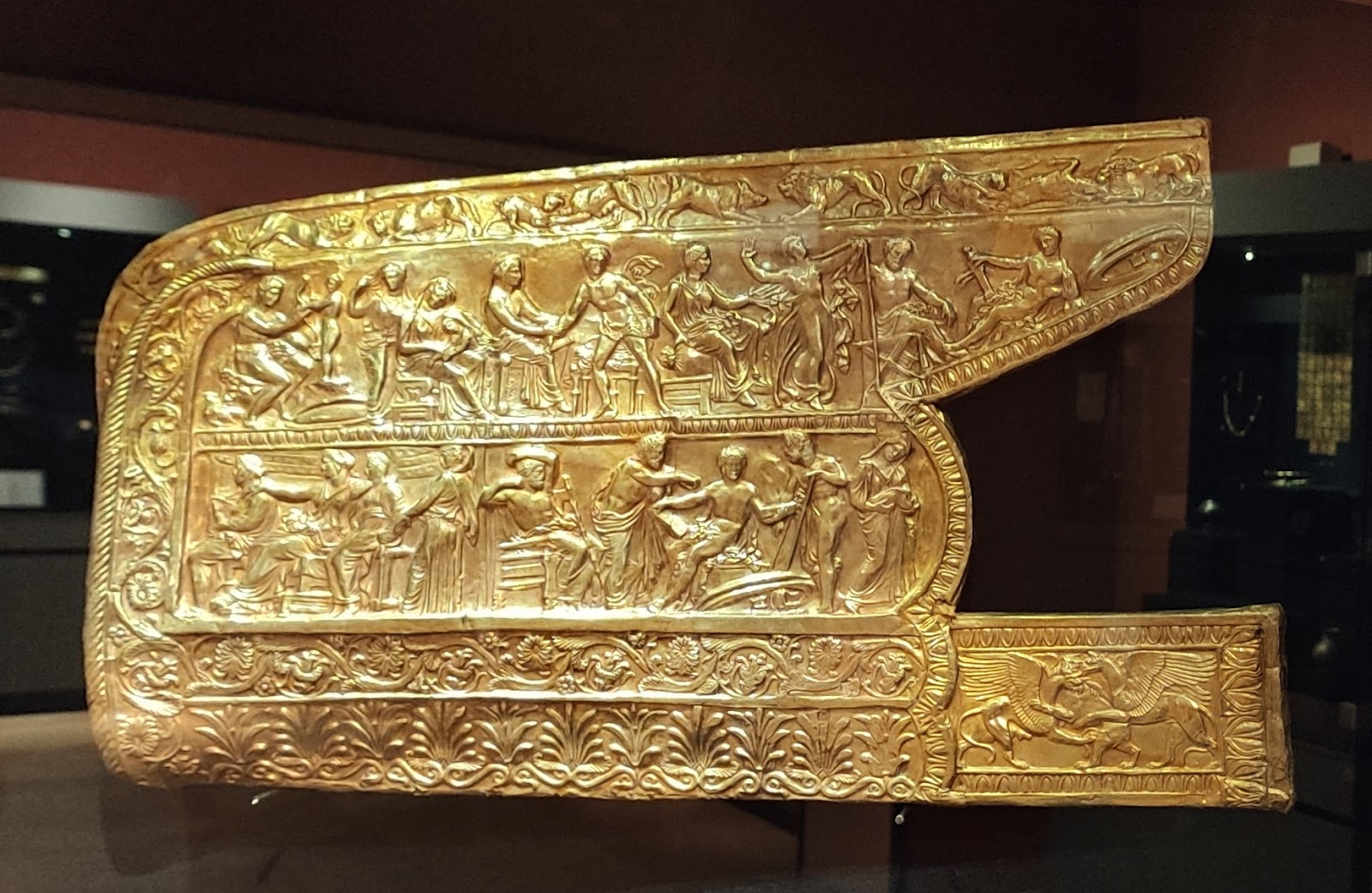
Recently, I watched a presentation on the History Channel*, about the gold quiver or goritos found in this tomb. Scholars agree that it is Scythian and not Macedonian, made between 900 and 200 BC. Next, the question arose whether it had belonged to Philip or to the woman. If it was the woman’s, who was she, and could she be a descendant of the fiercest Scythian female warriors, the mythical Amazons? 

The breakthrough occurred when the female bones and pelvis from the smaller room were analyzed. It is known that a woman’s pelvis changes during life, and it could be determined that this example was between 30 and 35 years old. 

Adea/Eurydice was only 20 years old when she had to take her life. She is not a candidate to be interred in Vergina. This conclusion automatically excludes earlier debates presenting Philip Arrhidaeus as the main occupant. 

The only remaining person obviously is Cynane, Alexander’s half-sister, who was 34 years old when she was murdered on the orders of General Perdiccas. 

It was also established that the two chambers of the Vergina Tomb were not built at the same time. Since Cynane died 13 years after her father, it is entirely plausible that her tomb was added next to her father’s at a later date. 

The program concluded with an extra note regarding the Scythian goritos (that was worn around the waist). After examining the DNA of the remains found in the Scythian kurgans, the scholars concluded that not all warriors were men, as 1/3 of the burial sites were built for women. 

Cynane must have been quite a character, raised as a warrior and a match to any man. No wonder the Macedonian troops were horrified when she was murdered in cold blood. It is quite remarkable that she lived one year longer than Alexander. Whoever arranged for her to be buried next to Philip was well aware of her courage and battle spirit. Maybe her father had been attracted to Audata for that same reason, who knows?

*2023 Strangest Things on History Channel
[Picture of Cynane's larnax and Facade of Philip's tomb are from Wikipedia; Goritos picture from this link Wikipedia]

Friday, April 14, 2023

Confusion about the name of Dardanus

As a general rule, the tribes living north of ancient Macedonia were known as Illyrians (see: A closer look at Illyria) and more to the east as Thracians (see: Thracian treasures at Alexander’s northern border). Some of those tribes are mentioned by name in Alexander’s conquest of Asia. 

I previously wrote about the Paeonians (see: About the Paeonians), and I want to concentrate on the Dardanians this time. 


[Damastion coin 380-360 BC - Picture from Military Wiki-Fandom]

King Bardylis I was the founder of the Dardanian Kingdom, which corresponds to modern Kosovo. In 393 BC, he dethroned King Amyntas III of Macedonia to place one of his henchmen in his place. Macedonia’s king Perdiccas III decided to take the Dardanian-occupied territory back, but he was defeated and killed. As the newly elected king, Philip II, his brother, married Bardylis’ granddaughter, Audata (see: Start of Philip's reign - Macedonia forged by Philip II). He killed old Bardylis on the battlefield in 358 BC. 

On his return home from the Danube campaign, Alexander faced the Illyrian revolt led by Bardylis’ son, Cleitus. The king defeated Cleitus at Pelium (see: Alexander’s psychological warfare), and the Dardanians were generally absorbed by the Illyrians and are no longer mentioned in history. 

However, a very different Dardanus is known as the son of Zeus. He was the mythical founder of Dardanus or Dardania on the Hellespont. Dardanus’ grandson Tros gave his name to the Trojans, and his son Ilus founded the city of Ilium, modern Troy. King Priam, the last king of Troy, would trace his lineage back to Dardanus. A pedigree worthy of any king!

Friday, March 25, 2022

Link to Philip’s presence in Bulgaria

Little is known about Philip’s conquest of the land of the Getae in his early campaigns to stabilize Macedonia after the death of his elder brother, King Perdiccas III, in 359 BC. 


Perdiccas was killed in a battle against the invading Illyrians, after which Macedonia faced several threats to the kingdom’s security. There was also the matter of succession to the throne since the dead king’s son, Amyntas, was still a youngster. The Athenians tried to interfere, pushing forward a certain Argaeus and the Thracians, Pausanias, who already marched towards the capital city of Pella. Given all these threats, the Macedonian Assembly unexpectedly proclaimed Philip as King, and the people swore their oath of allegiance to him. 

It was a lengthy and challenging assignment for the young Philip. The most urgent threat came from the Illyrians, who had just defeated his brother. He managed some treaties which may have included his marriage to Audata, King Bardylis granddaughter. 

He then turned towards the Paeonians, whom he corrupted with gifts and generous promises to reach a peace agreement. Athens with Argaeus was another serious problem, and Philip tricked them into believing he was giving up any claim on Amphipolis by withdrawing his Macedonian soldiers. The Athenians took the bait and eventually signed another peace treaty. 

Macedonia suffered from relentless attacks on all sides, but within a year, Philip managed to end the four major threats that had led to his accession to the throne. The lightning speed of his actions paid off. Although peace was never long-lived, Philip cleverly manipulated his opponents using diplomacy, deceit, bribery, and political marriages. 

In 342/341 BC (see: Macedonia forged by Philip II – part 11), Philip successfully dislodged the Thracians in the east, occupying the cities along the Hellespont - a very sensitive area as he needed to control this inland route. Later that year, he turned northwards against the people who lived between Thracia and the Danube Valley. Their King Cothelas was quick to surrender, giving his daughter, Meda, in marriage to Philip to become his sixth wife (see: The Many Wives of Philip II). 

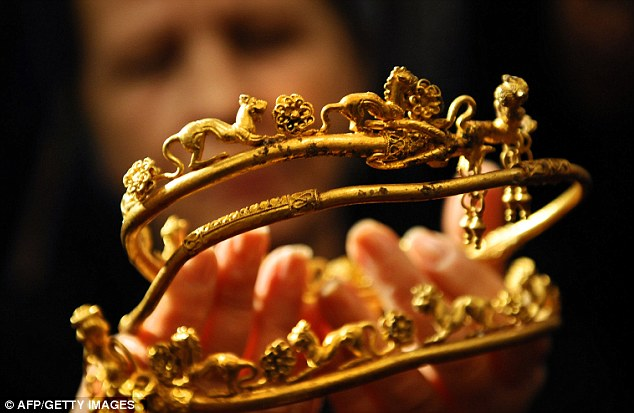
Recent excavations have located the tomb of Cothelas in northeastern Bulgaria, near the modern village of Sveshtari, roughly 400 km from the capital, Sofia. Although references to the Thracian king remain vague, the largest tomb in that burial complex may very well be his. Archaeologists have unearthed precious gold gifts, including 44 applications of female figures, 100 golden buttons, and a golden ring. The pièce de résistance is a tiara with animal motifs and a horse headpiece. Altogether, the site counts about 150 tombs all belonging to the Thracian tribe, the Getae. 

Let’s hope that further excavations will reveal more about these Thracians, of which much remains shrouded in mystery.

[Pictures from Daily Mail]

Thursday, February 2, 2017

Time to visit ancient Aiani in Upper Macedonia.

Few people have ever heard of Aiani, a lovely village close to modern Kozani, once surrounded by Kastoria, Florina, Pella, Imathia, Pieria, and Larissa in Upper Macedonia. Aiani was the capital of the kingdom of Elimeia.

The ruling king in Macedonia was Perdiccas III, who had been forced to give his younger brother Philip (the father of Alexander the Great) as a hostage to Thebes. At some time during his reign (368-359 BC), Philip returned to Macedonia, and Perdiccas gave him part of his kingdom, probably not to rule in his place but merely to rule on his behalf. According to speculations, he was entrusted with the territory of Amphaxitis, a strategic stretch of land between the Axios River and the Thermaic Gulf.

In 364 BC, Philip married his first wife, Phila, the daughter of King Derdas II of Elimeia, most probably a diplomatic alliance arranged by Perdiccas as was his right as king.

But Macedonia was faced with several threats to the kingdom’s security, and in 359 BC, the Illyrians, led by King Bardylis, envious of the fertile lands in Lower Macedonia, invaded Macedonia, killing Perdiccas and with him 4,000 brave Macedonian soldiers.  

Macedonia was on the brink of collapse and facing the problem of the king’s succession to the throne since his son, Amyntas, was still a youngster. The Athenians saw an opportunity to interfere, pushing forward a certain Argaeus and the Thracians, with a certain Pausanias already marching towards the capital city of Pella. Macedonia was in dire need of a strong leader, and given all these threats, the Macedonian Assembly proclaimed Philip as king, granting him full power, which he could not have received if functioning as regent for Amyntas. Philip, they knew, had acquired serious experience in the years he ruled part of the kingdom under the wing of his brother.

In 359 BC, Philip II was elected king, and the people of Macedonia swore their oath of allegiance. It is obvious that Upper Macedonia was at the core of Philip’s expansion, and this included Elimeia. One year into his kingship, Philip managed to unite Upper and Lower Macedonia, and he achieved it probably peacefully, consolidated no doubt by his success in crushing the Illyrians.

Presently, Aiani is in the news as the restoration of the entire city nears completion, and the site is now open to the public. The excavations have revealed a well-organized town that goes back to prehistoric times and flourished during the classical and Hellenistic eras.


Aiani was built on top of a high, imposing hill, meaning that all constructions were made upon successive stepped terraces. Archaeologists have exposed large portico structures belonging to public buildings, a water cistern, and several private houses spread over several levels because of the slope of the terrain. At the foot of the hill, extensive cemeteries and graves have been located, ranging from the late Bronze Age to the end of the 1st century BC. Besides the usual chamber tombs and cist graves, a heroon has also been found, confirming the presence of the highest social class. The wealth of the grave goods proves that Aiani maintained successful commercial and cultural relations with the rest of Greece. Contrary to what one thinks, Upper Macedonia certainly was not an isolated area.

The landscape, it must be said, is very different from what we find near Pella, Vergina, and Thessaloniki. This is a true high plateau swept by the wind, poor in agricultural land, and only fit for herding sheep and goats.

Until now, Aiani could only offer its precious Archaeological Museum to visit, which is a true treasure trove with, for instance, the oldest pieces of matt-painted pottery in black and white in the world. Some of the museum’s artifacts date back to the Mycenaean era, but most are from Greece’s archaic and Hellenistic times. This museum also holds some of the oldest samples of writing on archaic pottery, which confirms that the inhabitants wrote and spoke Greek well before the 5th century BC.

It will be interesting to see this site now that it has opened to the public!

Friday, October 10, 2014

The King is dead, long live the King!

Most histories about Alexander the Great simply start with his kingship and immediately jump to his conquest of Asia. This is where he spent the most important part of his life and where the great battles were fought. Still, he could not have even considered this campaign had he not first settled the unrest in Greece and the Macedonian northern borders – a fact that is often omitted, unfortunately.

In July 336 BC, just twenty years old, Alexander unexpectedly became the new King of Macedonia, and his life was to take a new turn. The most pressing matter was evidently to consolidate his place on the throne and to eliminate all those who could have been involved in the murder of his father. Next, he had to consider and evaluate all the pretenders to the throne that could be a threat - among them was Amyntas, the son of Philip's brother Perdiccas, now a grown man. Alexander, however, spared his simple-minded half-brother Arrhidaeus. And …. His final priority was his father's funeral, the construction of a vast pyre set afire in the presence of the entire Macedonian army, and the transfer of his remains to his last resting place inside the Royal Tomb outside the walls of Aegae. – a tomb that was found intact in 1977 by Manolis Andronicos.

No doubt, Alexander was itching to move on in his father's footsteps and set out for Asia as soon as possible, but more urgent matters kept him in Pella for a while. Athens had rejoiced at Philip's death, and many other cities still resented that Philip's Macedonia ruled the Greeks as Hegemon of the League of Corinth, a title that Alexander inherited, much to their discomfort and sorrow.

With the support of the army, Alexander marched south into Thessaly, where his route was blocked at the Tempe Pass. Instead of attacking the Thessalians head-on, he simply marched around the pass, settling the opponent's resistance once and for all. As he won the support of northern and central Greece, Athens could only do the same, and they sent their pledges of support to the new king. Leaving Athens for what it was, Alexander traveled to Corinth to ensure all the Greeks swore their oath of allegiance as they had done to his father before.

Now that Greece was secured, Alexander returned home for the winter, planning his spring campaign in Thrace to settle the unrest among the Triballi and the Illyrians living along Macedonia's northern border. This would be his first test with the army and asserting his authority as king before crossing to Asia.

In the spring of 335 BC, he left Amphipolis and was soon met by the Thracians, who held the pass over Mount Haemus. The enemy had hauled wagons up the pass to let them thunder down on the Macedonian army as soon as they were within reach. Alexander assessed the situation and ordered the phalanx to open up their ranks to let the wagons run through; where there was no space for the soldiers to step aside, they were instructed to lie down on the ground and lock their shields over their heads. As a result, the Thracian wagons hardly did any damage. It should be noted that the army followed Alexander's orders, showing that they trusted their commander – a matter of detail but a crucial point! It is said that 1,500 Thracians were killed, and their women and children were sent to Macedonia to be sold as slaves.

Alexander's next goal was the Triballi, who lived along the southern banks of the Danube River. Their strength was their many well-concealed defensive positions, and Alexander first had to dislocate them to attack them in open battle. One such encounter happened in their refuge on an island in the middle of Lyginus River, and Alexander sent out a small contingent of slingers and archers to lure them out of their hiding places. This stratagem worked as he intended, for soon, the Triballi rushed out in force only to be met by the whole Macedonian army. About 3,000 Triballi were killed, and those remaining sought refuge on the island of Peuces in the middle of the Danube, which had natural defenses because of its high banks, rocks, and the fast-flowing river. Since a front attack would be too costly, Alexander decided to wait and simply cut off the enemy's supply routes.

Unexpectedly, the Getae from the plains north of the Danube showed up with a force of 10,000 infantry and 4,000 cavalry, which could not be ignored because of their sheer number. Alexander decided to cross the Danube overnight with 4,000 men and 1,500 cavalry, using some small boats but mainly using floating devices made from the Macedonian leather tents filled with straw. When the Getae discovered them at daybreak, they fled. The fight was over before it began, and Alexander simply destroyed their crops. This meant that the Triballi on their island were entirely isolated, and all they could do was surrender. And so they did, together with the stray Thracians and Celts from the Balkans.

Behind Alexander's back, the Illyrians now revolted. Cleitus, the formidable king of the Dardani (from around Kosovo), had persuaded the Autariatae (from around Bosnia) to join forces and attack Alexander on his march to meet him. Even the Taulantii (from around Tirana) would march to join Cleitus. Alexander had to act fast so he would not be enclosed on all sides. He foiled Cleitus' plan and marched to Paeonia (Skopje), across the plains of Florina, to the heart of Illyria at Pelium, where Cleitus was holding a fortress. The Taulantians did not arrive in time to join forces with Cleitus; Alexander was there first. When he learned that the Taulantii had not posted sentries around their nearby camp, he immediately attacked them by night. Caught by surprise, they surrendered, leaving Alexander with one enemy less to face. On his way to attack Cleitus, a more pressing matter demanded his attention: Thebes had revolted and called the other Greeks to end Macedonian rule! This required a drastic change of plans. Luckily for Alexander, Cleitus escaped from the fortress but did not raise arms against him again; the Illyrians even sent troops to join Alexander's forces in Asia.

The attitude of Thebes was of the utmost importance. Thebes was endangering Alexander's hegemony of the League of Corinth and breaching the basic constitution of the Treaty. Thebes had signed the Common Peace and could not legally revolt unless it faced the armies of all the other League members. Alexander must have felt that Thebes' revolt was putting his authority in the balance and, on a personal level, that they were hampering his plans to attack Persia.

Alexander force-marched his army south from Illyria, covering 400 kilometers in 13 days over mountainous terrain, crossing Mount Grammus, Mount Pindus, and Mount Cambunia, allowing his men only one day's rest in Thessaly. This was so fast (more than 30km/day) that even the Thebans didn't believe it was Alexander standing before their city gates! Athens, who at first had taken side with Thebes, now withdrew (freaking out, no doubt), leaving Thebes to fight the battle on their own from the well-fortified Cadmea, where the Macedonian garrison was still surrounded by the Thebans. In the battle that ensued and despite their fortified position, the Thebans had to give way to the Macedonians led by Alexander personally. At least 6,000 Thebans died in the last stand, and 30,000 were taken prisoner to be enslaved. Unsurprisingly, Alexander wanted to set an example for the other members of the League of Corinth. At the same time, he diplomatically left the punishment of Thebes to the League, which urged the city's total destruction. At this stage, I believe Athens got scared and sent an embassy to congratulate Alexander for his victory over the Illyrians, and probably against their will, with his punishment of Thebes. To cut the matter short, Alexander demanded several of their politicians to be handed over to him, men like Demosthenes, Lycurgus, and Hyperides, but Demades, another Athenian orator, was able to convince Alexander to change his mind. Well, after all, now that Thebes was razed to the ground and cities like Corinth and Chalcis were in his hands, he could be generous towards Athens, which no longer had any support from other cities.

It was time for Alexander to return home, and nobody dared doubt his leadership. He spent nine days at Dion, the Macedonian sanctuary at the foothills of Mount Olympus, to feast in honor of the Muses and Zeus. He held several banquets in his royal tent that could fit one hundred couches, a true feast, Macedonian style. The vast plain at the foot of the old Greek theater is still there to kindle our imagination.

Back home, games were organized to honor the Olympian Zeus at Aegae. It was here that he issued the first coins bearing the image of Alexander; this was in 335 BC. He was now indeed King of Macedonia, feared and/or respected by all of Greece. He could now concentrate on the invasion of Asia. That is how he spent the winter, and in the early days of spring 334 BC, he set his army in motion, leaving Macedonia in the hands of his Regent, Antipater. Alexander would never see his homeland again.

Monday, March 3, 2014

A closer look at Illyria

So little is known about Illyria, and so little is mentioned in history that it hardly appears on a map. Yet, it was the northwestern neighbor of Macedonia that made life difficult for Alexander and, before that, for his father, Philip II. Today, most of the northern territory is occupied by Serbia, while the south is in the hands of Albania.

[Map from Wikipedia]

The Illyrians envied the good agricultural land and lush grasslands of the Macedonian floodplains and invaded that country on a more or less regular basis. It was during such an attack in 360/359 BC by the Illyrian King Bardylis that King Perdiccas III of Macedonia was killed and, with him, 4,000 brave Macedonian soldiers. 

This incursion left the door open for further invasions, for not only could the Illyrians push all the way down to the Thermaic Gulf, but neighboring tribes like the Paeonians (in the buffer zone between Illyria and Macedonia) and the Thracians from the east could also seize this opportunity. With the death of Perdiccas III, Macedonia was exposed to more attacks by its neighbors. Besides, there was also the matter of succession to the throne since the dead king’s son, Amyntas, was still a youngster. Given all these threats, the Macedonian Assembly unexpectedly proclaimed Philip II king in 359 BC, and the people swore their oath of allegiance to him. The most urgent enemies were evidently the Illyrians, who had just defeated his brother, and it seems that King Philip II managed to sign some treaty which may have included his marriage with Audata (his second wife), King Bardylis granddaughter. One year later, with a stronger army, Philip was confident enough to march into Illyria and bluntly refused to accept the old King Bardyliss terms. Consequently, both armies met near today’s Lake Ochrid, maybe close to Heraklea Lyncestis. Philip was victorious and demanded that the Illyrians pull out of Upper Macedonia all the way north to Lake Lychnitis, including the tribes of Orestis, which until then were controlled by the Molossian King of Epirus – no small achievement for a young king.

Illyria again comes into the news in 337 BC at King Philip’s wedding to Cleopatra, the niece of Attalus. Purposely or by accident, Attalus brings a toast to a lawful successor to the Macedonian throne, which implies that he looked at Alexander as a bastard. We know how insulted Alexander felt, more so when his father sided with AttalusAlexander then leaves the court, taking his mother Olympia with him, and after placing her in the hands of her brother, the King of Epirus, he himself retires to Illyria. It is not known what he did or didn’t do there, except for spending the winter. All that is being reported is that Alexander returns to his father’s palace thanks to the diplomatic intervention of Demaratus, a mutual friend and actor.

The news of Philip’s murder in October 336 BC runs fast, and practically all his new allies start revolting. The following summer, Alexander, who meanwhile succeeded his father as king of Macedonia, marched north towards the Danube and defeated the Illyrians on his way back to subdue Thebes. Obviously, no deep ties of friendship had been forged during his earlier stay.

This long introduction brings me to recent excavations carried out at Kale-Krševica in southeastern Serbia, exposing significant remains of what appears to be a city from the late 4th/early 3rd century BC built according to the Greek model in the days of Philip and Alexander! The settlement covers an area of about five hectares and was located on an important through-road from Greece to Central Europe. Archaeology in Serbia is still in its infancy, and only about 6% of this site has been investigated so far, raising more questions than providing answers. But based on the type of architecture, the shards of pottery and amphorae, the coins and jewelry, tools, and the overall organizational system of the area, clearly establish a Greek presence that might lead to locating the city of Damastion, which is still elusive, as well as its precious silver mines mentioned by Strabo. This would, of course, boost further research. So far, it has been established that most of the settlement was located on the slopes of the hill towards the Krševica River. Several remains were uncovered, like a rampart, a larger building, undefined walls, ovens, etc.

It is interesting, however, to mention that a wide range of coins has been found with the effigy of Philip, silver drachmae showing Alexander the Great, and bronze coins of Cassander, Uranopolis, and Demetrios Poliorcetes – all of them having close ties with Macedonia in any case. On top of these specimens, one tetradrachma of early Damastion was discovered (hence the possible theory that this settlement might be the very city), and one tetradrachma of Aduleon, King of Paeonia.

Yet one of the greatest discoveries so far is the arched vault used for water storage and supply, a highly sophisticated and modern installation for its time. It shows that because of the rising water level by the end of the 4th century BC, the entire appearance and function of the original structure had to be adapted, resulting in this 10-meter-long and 6-meter-wide cistern, built from large ashlars to a height of at least six meters. The fact is that it must have held enough water for a population of several thousand. A more intensive investigation had to be abandoned, however, as archaeologists were seriously hampered by the high water table, and the cistern has been buried again pending more advanced technologies.

Well, this is just a tiny corner of Illyria that has surfaced lately. Still, it would be extremely interesting to see these excavations and others bring proof of closer contact with Macedonia from the days of King Philip II and Alexander the Great.

[Last two pictures from Kale-Krševica]

Monday, December 19, 2011

Philip’s wives and marital conflicts - Macedonia forged by Philip II - 15

Philip’s wives and marital conflicts (337 BC)

We know or hear very little about the first five wives of Philip before Olympias. It is interesting to note that all four of them spoke Greek (Phila, Philinna, Nicesipolis, and Olympias) and two did not (Audata and Meda). How historians managed to find that out, I wonder. Nicesipolis died soon after childbirth, but all the others were apparently living at court in Pella (see: The Many Wives of Philip II.). Olympias had a special status because she was the mother of the heir, Alexander. The other ladies had given birth to a daughter, except the retarded Arrhidaeus. Since these marriages had happened rather early in his kingship and for political reasons, one may wonder how closely Philip kept in touch with them.

In 337 BC, at the age of 45, Philip announced his marriage to Cleopatra. She was an orphan and had been adopted by Attalus, one of Philip’s generals of noble origin, as his niece. Rumor had it that Philip fell in love with the girl, but speculations ran in a different and more serious direction. As Philip was getting ready to invade Asia, he needed one or more heirs to ensure his succession, for betting on Alexander alone did not offer enough security. This very idea will not have been well accepted by Olympias, fearing that a son of Cleopatra could displace Alexander in the longer term, of course.

[picture from Oliver Stone's movie Alexander]

The wedding took place, probably a typical Macedonian affair with an abundance of wine flowing between the men. I think that even to their own standards, they all got pretty drunk. Anyway, at a certain point, Attalus, now father-in-law of his king, proposed a toast to the bride and groom, wishing them a legitimate Macedonian heir. It is not difficult to picture Alexander’s reaction, who felt deeply hurt by the insinuation that Attalus (and who knows who else) considered him a bastard! A fiery argument broke out, and the king tried to intervene but had probably been drinking too much himself as he took sides with Attalus and demanded excuses from Alexander. As we can expect, Alexander refused. He left the room, picked up his mother, and took her to her brother in Epirus. He himself sought refuge in Illyria. 

Now, there is a theory by which Olympias tried to convince her brother to revolt against Philip, while Alexander might have worked the mind of the Illyrians in the same direction, but nothing is proven. Eventually, Philip hired an actor (as was customary to settle differences), Demaratus of Corinth, who managed to bring Alexander back to Pella. Yet this must have left quite a bitter aftertaste on both sides.

It is rather clear that Alexander was accepted as Philip’s heir at the age of fourteen when Aristotle became his tutor. There is no trace to include, for instance, Amyntas, the son of Perdiccas III and true heir to the throne that Philip now occupied, in Aristotle’s lessons, yet when Alexander became king, he had Amyntas executed. It is also a fact that Alexander took over the regency of Macedonia at sixteen while his father was campaigning, and at eighteen, Philip trusted him to lead the cavalry at Chaeronea. But despite all that, Philip was still father and king and did not tolerate anyone, even his own son, to act against his will. A clear example is that of the Pixodarus affair.

Pixodarus was the ruler of Caria (the area of Bodrum) who had kicked his sister Ada, the widow of the previous ruler, from the throne while remaining submissive to the Persian King. But Persia was in turmoil after eunuch Bagoas murdered Artaxerxes III and, in the ensuing confusion, Pixodarus thought it wise to seek support from Philip, an interesting consideration that fitted Philip’s plans to march east. Pixodarus offered his daughter, Ada, in marriage, and Philip, in exchange, presented the retarded Arrhidaeus. The pact was accepted. But Alexander felt his father had left him out and decided to act on his own, offering himself as a marital candidate to Pixodarus, who, of course, could not have asked for a better deal! When Philip got vent of this maneuver behind his back, we can imagine how infuriated he became. The entire agreement with Pixodarus was called off, and Philip seriously reprimanded his son by exiling several of his closest friends from Pella. That must have been quite a blow for Alexander!

These events clearly illustrate that all was not running smoothly between father and son, which may have led to the conclusions about the true murderers of Philip the next year.