Alexandria's founded by Alexander

Alexandria's founded by Alexander the Great (by year BC): 334 Alexandria in Troia (Turkey) - 333 Alexandria at Issus/Alexandrette (Iskenderun, Turkey) - 332 Alexandria of Caria/by the Latmos (Alinda, Turkey) - 331 Alexandria Mygdoniae - 331 Alexandria (Egypt) - 330 Alexandria Ariana (Herat, Afghanistan) - 330 Alexandria of the Prophthasia/in Dragiana/Phrada (Farah, Afghanistan) - 330 Alexandria in Arachosia (Kandahar, Afghanistan) - 330 Alexandria in the Caucasus (Begram, Afghanistan) - 329 Alexandria of the Paropanisades (Ghazni, Afghanistan) - 329 Alexandria Eschate or Ultima (Khodjend, Tajikistan) - 329 Alexandria on the Oxus (Termez, Afghanistan) - 328 Alexandria in Margiana (Merv, Turkmenistan) - 326 Alexandria Nicaea (on the Hydaspes, India) - 326 Alexandria Bucephala (on the Hydaspes, India) - 325 Alexandria Sogdia - 325 Alexandria Oreitide - 325 Alexandria in Opiene / Alexandria on the Indus (confluence of Indus & Acesines, India) - 325 Alexandria Rambacia (Bela, Pakistan) - 325 Alexandria Xylinepolis (Patala, India) - 325 Alexandria in Carminia (Gulashkird, Iran) - 324 Alexandria-on-the-Tigris/Antiochia-in-Susiana/Charax (Spasinou Charax on the Tigris, Iraq) - ?Alexandria of Carmahle? (Kahnu)
Showing posts with label Sirkap. Show all posts

Saturday, July 16, 2022

Presence of the Greek gods in Asia after Alexander

Just imagine doing some excavations in the middle of the Ganges Valley to find hundreds of seals carrying the image of Greek gods and goddesses such as Athena, Apollo, Nike, and Herakles! 

[Agate intaglio from Phu Khao Thong (right), impression (left). H. 16 mm.
Photos: Brigitte Borell and Prachak Pongspanich] 

The discovery of the figure of Herakles, in particular, is very striking and recognizable as he is resting on a club and holding a lion skin. He appeared from excavations in the 1940s at Rajghat, close to the Varuna and Ganges Rivers confluence. The site was a well-established trade center in antiquity, with connections reaching westward to Taxila. Considering that the distance from the Indus Valley, where Alexander halted his march eastwards, to the Ganges is almost 1500 km, shows how far his Greek influence traveled after his death. 

The surprise discovery does not stop in India as pictures of the god Herakles were found as far away as southern Thailand, at the archaeological site of Phu Khao Thongis – meaning Golden Hill - on the Isthmus of Kra. The hill owes its name to the many gold finds resulting from legal and illegal diggings. 

This coastal trading post was linked to the maritime networks of the Indian Ocean and served as a hub for land crossings to the peninsula's east coast and the South China Sea The unearthed artifacts originate from China and South East Asia to the Mediterranean in the West. They can be dated to the last centuries BC and early AD. Typical among the finds are, on the one hand, a fragment of a Roman cameo and a Roman intaglio from the West, and on the other hand, fragments of bronze mirrors from China’s Han period (25-220 AD) from the East. 

The Herakles from Thailand is remarkable because its design does not originate in the Mediterranean. The young beardless Herakles has big eyes and a large nose – hardly the delicate, true-to-nature rendition of the Greeks! It is, however, the work of an experienced local craftsman and appears to have been made for a finger-ring. This kind of beardless Herakles may be tied to the days of Alexander the Great, who used it on his coins. The Graeco-Bactrian King Demetrius I, who ruled from c. 200 until 190 BC, continued the tradition in his eastern empire. 

The main concern for scholars is to note the difference between local work and imports from the Mediterranean. This is far from clear-cut, as craftsmen may have settled deeper into Asia, or local craftsmen may have mastered the techniques from those same settlers. 

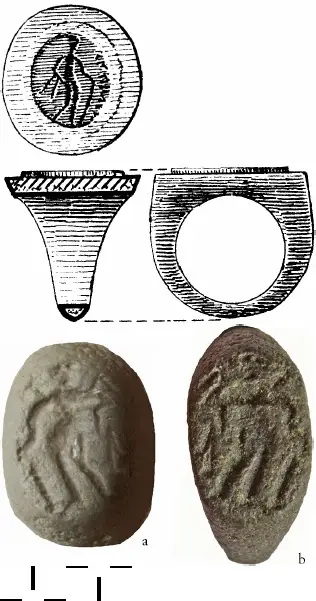
[TopGold ring with glass intaglio from Sirkap, Taxila. H. 22.1 mm
(from Marshall 1951: pl.197)
BottomBronze ring seal and impression (left) from Taxila H. 19 mm.
Taxila Museum, inv. 8797 (Photos: Courtesy of Aman ur Rahman)]

A good example is a ring found in a large hoard of jewelry at Sirkap near Taxila, buried there towards the end of the 1st century AD. Here, Herakles is presented as a slender and relatively thin figure – a far cry from the muscular male we would expect. However, it originated from a highly skilled school of gem-engraving.

The Herakles seal from Thailand resembles a garnet seal from the Northwest of the Indian subcontinent, possibly created there as well. It is now exhibited at the British Museum. It is noteworthy that it is closely related in type to two rings from Taxila. 

A similar meager Herakles appears on three other seals found in the Gandhara area in Afghanistan. Their style also suggests local production. 

These are only a few examples of the spreading of Hellenism and Hellenistic art further East, beyond Alexander's conquered lands. I like to believe that he would have been delighted with this outcome!

[Pictures are part of the article Herakles on an Intaglio Seal Found at Phu Khao Thong in the Upper Thai-Malay Peninsula by Brigitte Borell, published at Academia.edu]

Friday, April 2, 2021

The complex site of Taxila

Until now, I pictured Taxila as one big city, as it is in modern times. What threw me off was that ancient sources talked about the three ancient cities of Bhir, Sirkap, as well as Sirsukh instead of Taxila. Meanwhile, modern archaeology has established that Taxila is composed of 18 separate sites of great cultural value. This demanded a closer and more in-depth study of the matter. 

From the 6th century BC onward, the city of Taxila was known by the Persian Achaemenid kings, who turned it into an important hub on their Royal Road from Persepolis to Central Asia. For AlexanderTaxila was the first major city he encountered on this way into India. It was also the residence of King Taxiles, who came to meet him while he was still in Sogdiana. He had promised to join his forces to those of Alexander, but he died before they could meet. True to his father’s word, Omphis (also called Mophis or Ambhi) received Alexander in Taxila (see: Alexander crossing the Indus at Ohind). 

We will recall that Omphis had provided supplies to Hephaistion and the Macedonians as they were bridging the Indus River. When both kings met outside the city, Omphis handed his fifty-six elephants over to Alexander, together with an impressive herd of livestock, including 3,000 bulls dressed up for sacrifices. 

The site of Bhir is actually the place where this meeting took place in 326 BC since Omphis palace stood on top of a mound that carried that name. This same location was later occupied by Chandragupta Maurya (see: Was Chandragupta inspired by Alexander?) and his grandson, Asoka. As the latter introduced Buddhism in the Gandhara region, the first Buddhist monastery was erected at this very spot at some time in the 3rd century BC. By the 2nd century AD, this construction was replaced by the Dharmarajika Stupa, the remains of which are still visible. 

With Alexander, Greek knowledge and science reached Taxila. Here, philosophers and the like met and developed science, mathematics and astronomy. 

Sirkap emerged at a later date. After Alexander’s conquest, the eastern part of his empire was ruled by the Seleucid kings till about 250 BC. By then, power was taken over by the self-proclaimed King Diodotus I of Bactria, who laid the foundations of what became the Greco-Bactrian Empire. These Bactrian Greeks advanced into the Gandhara region and erected their well-planned city of Sirkap as part of Taxila. For the next five hundred years, Greek remained the lingua franca and the influence of Greek art and beliefs lived on (see: Unique Hellenistic heritage in Pakistan). 

This link is confirmed by the Greek philosopher Apollonius of Tyana (15-100 AD), who described Taxila as being rich with Greek-type of constructions. This happened in the 1st century AD, and it is generally accepted that he was talking about Sirkap.

As a result of the heavy traffic on the Silk Road that connected Central Asia to China, business flourished while the population mingled with the Scythians, the Parthians, and later the Kushans. Besides silk and other precious goods, Buddhism also spread steadily in the wake of Buddhist monks travelling to China, Korea, and Japan. It was under the Kushan emperors that a new form of art blossomed, blending classical Greek expression with local art forms. This became known as the Gandhara Art, which produced the most remarkable statues of Buddha and Bodhisattvas (see: Indo-Greek art or the influence of Hellenism on Buddhist art). 

One of the oldest Stupas is the so-called Round Stupa from the 1st century AD. The largest sanctuary is the Apsidal Temple, measuring 70x40 meters with a square nave and several rooms used by the Buddhist monks. It also presented a building in an apsidal shape – hence its name. It may have been decorated by a Greek artist, but the earthquake of 30 AD destroyed most of the building. 

Of particular interest is the Double-Headed Eagle Stupa, which displayed pilasters of Greek design with Corinthian columns. It has a strange combination of a Greek temple and a Hindu shrine. The ensemble is crowned with a double-headed eagle as originally found in Babylon. The theory is that the idea spread to Scythia and was introduced to the Punjab by the Saka rulers. 

The large Dharmarajika Stupa already mentioned in Bhir was situated not far from Sirkap. It was built with the sole purpose of housing relics of the Buddha and was surrounded by several monastic buildings. 

The most recent city is Sirsukh, which was founded by the Kushans after 80 AD. King Kanishka had decided to abandon Sirkap and to build his own new city in a typical Central Asian style. The city was surrounded by a strong fortification wall that was almost five kilometers long and more than six meters thick. Its particularity was that the face of these walls was covered with diaper or diamond-shaped masonry. Until now, the city proper could not be investigated properly because today it is buried deep underneath the low, richly irrigated land. Sirsukh was completely destroyed by the Huns, who invaded the Punjab around 500 AD.