Alexandria's founded by Alexander

Alexandria's founded by Alexander the Great (by year BC): 334 Alexandria in Troia (Turkey) - 333 Alexandria at Issus/Alexandrette (Iskenderun, Turkey) - 332 Alexandria of Caria/by the Latmos (Alinda, Turkey) - 331 Alexandria Mygdoniae - 331 Alexandria (Egypt) - 330 Alexandria Ariana (Herat, Afghanistan) - 330 Alexandria of the Prophthasia/in Dragiana/Phrada (Farah, Afghanistan) - 330 Alexandria in Arachosia (Kandahar, Afghanistan) - 330 Alexandria in the Caucasus (Begram, Afghanistan) - 329 Alexandria of the Paropanisades (Ghazni, Afghanistan) - 329 Alexandria Eschate or Ultima (Khodjend, Tajikistan) - 329 Alexandria on the Oxus (Termez, Afghanistan) - 328 Alexandria in Margiana (Merv, Turkmenistan) - 326 Alexandria Nicaea (on the Hydaspes, India) - 326 Alexandria Bucephala (on the Hydaspes, India) - 325 Alexandria Sogdia - 325 Alexandria Oreitide - 325 Alexandria in Opiene / Alexandria on the Indus (confluence of Indus & Acesines, India) - 325 Alexandria Rambacia (Bela, Pakistan) - 325 Alexandria Xylinepolis (Patala, India) - 325 Alexandria in Carminia (Gulashkird, Iran) - 324 Alexandria-on-the-Tigris/Antiochia-in-Susiana/Charax (Spasinou Charax on the Tigris, Iraq) - ?Alexandria of Carmahle? (Kahnu)
Showing posts with label Pliny. Show all posts

Wednesday, February 7, 2024

More of What Alexander did for us

Approximately ten years ago, I posted a blog about citrus fruit as introduced by Alexander’s Macedonians from India (see: What Alexander did for us). 

This certainly was not an isolated case if we look at the work of Theophrastus, a contemporary of Aristotle and Alexander (see: Theophrastus, philosopher and botanist). He studied plants that came from Persia, Afghanistan, and the Indus Valley. He introduced the Greeks to mangos, cardoons (or artichoke thistle), jujubes (also called Chinese dates), pistachios, and tamarind. Newly imported plants were cinnamon, banyan (a fig typically from India), as well as frankincense and myrrh. 

One day during his invasion of India in 327 BC, Alexander had bananas for dessert and he enjoyed the fruit so much that he wanted to share it. Eventually, bananas traveled to the Middle East, where they earned their Arabic name of banan, meaning finger. 

Arrian revealed that in 325 BC, Nearchus had found sugarcane. He described it as “a reed that brings forth honey without the help of bees”. In antiquity, sugarcane was basically used as a medicine by Greek and Roman physicians, as documented by Pliny the Elder in the 1st century AD. 

Rice was another food the king introduced into Macedonia after his campaign in Central Asia, and it appears that the well-known dish of Plov or Pilaf spread from Macedonia, throughout Greece and the Balkans (see: The origins of rice in ancient Macedonia). 

Alexander also introduced Europe to the cotton from India. It is said that the Macedonians started wearing cotton clothes which were more appropriate for the Indian climate. 

The colorful floor mosaic of a parakeet from Palace V in Pergamon now on display at the Museum of Pergamon in Berlin (see: The beauty of Alexandrine mosaics) is a rare example of the wide collection of animals and plants Alexander sent to Aristotle from the regions he conquered. The Alexandrine Parakeet was native to South Asia and Southeast Asia. 

As Alexander traveled to modern-day countries such as Turkey, Syria, Lebanon, Egypt, Iraq, Iran, Afghanistan, and India, he shared his serious interest in local cultures and habits with the rest of the world.

Saturday, February 11, 2023

Wearing silk is immoral in the Roman Empire

With his expansion far into eastern Asia, Alexander had opened a vast section of the Silk Road. In the following centuries, the Graeco-Bactrians, the Indo-Greeks, and the Sogdians played an important role as middlemen in this chain where goods were exchanged between East and West. 

The road between China and the eastern Mediterranean was nearly 6,500 kilometers long. Travel was dangerous, and robberies were frequent. The goods changed hands on the way. In this process, each intermediary increased the price to cover their own expenses and make a profit. 

To reduce the expenses, especially those for the silk from China, the Romans opened a sea route by the 1st century AD. It started near Hanoi in modern Vietnam, with stopovers in harbors on the coasts of India and Sri Lanka, all controlled by China. The shipments eventually reached Roman-controlled ports in Egypt and the northeastern coast of the Red Sea. From there, they could handily be distributed around the Mediterranean

Two centuries earlier, from the 1st century BC onward, silk had become the luxury fashion par excellence. In those days, the Romans still thought silk was obtained from tree leaves. Pliny the Elder tells us that the Seres (Chinese) used the woolen substance from the tree leaves, which they soaked in water and then combed off the white down from the leaves. 

Chinese silk was sold at exorbitant prices. It was far more expensive than gold, which caused a colossal outflow of this precious metal. In fact, the acquisition of silk hurt the Roman economy badly. 

In pure despair, the Roman Senate issued several edicts to prohibit wearing silk, more so since they had decided that silk clothes were decadent and immoral. Seneca (c.3 BC - 65 AD) goes as far as declaring: I can see clothes of silk, if materials that do not hide the body or even one's decency, can be called clothes ... Wretched flocks of maids labor so that the adulteress may be visible through her thin dress so that her husband has no more acquaintance than any outsider or foreigner with his wife's body. 

It is surprising to read that in the 1st century AD, women were still (or again) considered a man’s property, although men themselves didn’t shy away from wearing silk outfits!

Sunday, December 27, 2020

About ancient trade between India and Rome

On my earlier blog Link between Egypt and Gandhara under Ptolemy Philadephus, I received an interesting comment referring to the article which I am sharing hereafter.

Ancient trade between India and Rome    A Note on Muziris

A.Yesterday

1. Muziris, as the ancient Greeks called it, was an important port on the Malabar Coast in Southern India . It was frequented by the ancient Greeks, Egyptians and Romans.  Eudoxus of Cyzicus sailed into Muziris during his two voyages undertaken between 118 and 116 BC. Muzris,  is mentioned in the Periplous of the Erythraean Sea and in Ptolemy’s Geography and is prominent on the Peutinger Table. Pliny referred to it several times in his Naturalis Historia. Pliny called this port primum emporium Indiae. *

The Periplus of the Erythraean Sea, which was written by an anonymous Greek merchant in the second half of the first century AD, shows a great increase in Roman trade with India.

The author of the Periplus, who probably visited India personally, described in detail the Roman trade with the ports of the Malabar Coast.

The most important port of the Malabar Coast was Muziris (Cranganore near Cochin) in the kingdom of Cerobothra (Cheraputra), which ‘abounds in ships sent there with cargoes from Arabia and by the Greeks’.

According to the Periplus, numerous Greek seamen managed an intense trade with Muziris:[29]

“Muziris and Nelcynda, which are now of leading importance (…) Muziris, of the same kingdom, abounds in ships sent there with cargoes from Arabia, and by the Greeks; it is located on a river, distant from Tyndis by river and sea five hundred stadia, and up the river from the shore twenty stadia.” – Paul Halsall. The Periplus of the Erythraean Sea, 53-54

They send large ships to the market-towns on account of the great quantity and bulk of pepper and malabathrum [cinnamon]. There are imported here, in the first place, a great quantity of coin; topaz, thin clothing, not much; figured linens, antimony, coral, crude glass, copper, tin, lead, wine, not much, but as much as at Barygaza [Broach]; realgar and orpiment; and wheat enough for the sailors, for this is not dealt in by the merchants there. There is exported pepper, which is produced in quantity in only one region near these markets, a district called Cottonora [North Malabar?]. Besides this there are exported great quantities of fine pearls, ivory, silk cloth, spikenard from the Ganges, malabathrum from the places in the interior, transparent stones of all kinds, diamonds and sapphires, and tortoise shell; that from Chryse Island, and that taken among the islands along the coast of Damirica [Tamil Nadu]. They make the voyage to this place in favorable season that set out from Egypt about the month of July, which is Epiphi.

This provides evidence for a great volume of trade in both directions. The Periplus reported the influx of coins; and, the largest number of Roman gold hoards has been found in the hinterland of Muziris;   most from the period of the Roman emperors Augustus (r. 27 B.C.E.–14 C.E.) and Tiberius (r. 14–37 C.E.).

Black pepper was a major item of trade with the West along both the western and eastern coasts. This rich trade continued on the Malabar Coast through the medieval period. Other items traded were spices, semiprecious stones, ivory, and textiles. Western products coming into India included wine, olive oil, and Roman coins—and in later centuries horses.

A text of the Sangam era highlights this, too: ‘The beautifully built ships of the Yavanas came with gold and returned with pepper, and Muziris resounded with the noise’

There is no doubt Muziris was a major port in its time and was an Emporium, as Pliny called it.

[Strabo was more interested in northern India and in the ports between the mouth of the Indus and present Bombay and he reported next to nothing about South India, Sri Lanka and the east coast of India.]

When Ptolemy wrote his geography around AD 150 Roman knowledge of India had increased even more. He wrote about the east coast of India and also had a vague idea of Southeast Asia, especially about ‘Chryse’, the ‘Golden Country’ (Suvarna-bhumi) as the countries of Southeast Asia had been known to the Indians since the first centuries AD. However, recent research has shown that this so-called Roman trade was integrated into an already flourishing Asian network of coastal and maritime trade.

Pliny the Elder also commented on the qualities of Muziris, although in unfavorable terms:[30]

“If the wind, called Hippalus, happens to be blowing, it is possible to arrive in forty days at the nearest market of India, called Muziris. This, however, is not a particularly desirable place to disembark, on account of the pirates which frequent its vicinity, where they occupy a place called Nitrias; nor, in fact, is it very rich in products. Besides, the road-stead for shipping is a considerable distance from the shore, and the cargoes have to be conveyed in boats, either for loading or discharging.” – Pliny the Elder, Historia Naturae 6.26

Regarding Muziris , Maddy in his webpage  writes:

Muchiri pattanam, a location close to today’s Kodungallur, was not really a sea port as some believed. It was a city on the banks of the Periyar somewhat inland and accessed through the maze of canals. Roman Ships anchored out in the sea and transported their goods in small boats guided by local pilots through the canals to Pattanam. From centuries in the past until the 14th, the city was well known to the Arab and especially the Roman sailors who conducted trade with Malabar. Sometimes the ships went to Barygaza or Baruch, sometimes to Nelycinda (will be covered in a separate blog) other times, they landed up in Muziris. They came in with Western luxury goods and gold and took away spices and Eastern goods. Sometimes the ships went around the Cape Comorin and docked at Kaveri Poompattinam close to Pondicherry.

The Romans had expatriate settlements or colonies in both places as I mentioned before and much information about them can be found in Sangam Era writings like the Silappadhikaram and Manimekhalai. The Peutinger table shows Muziris on the Roman map and even alludes to an Agustus temple (later studies assume it was an Agasthya temple) in Muziris. Writers like Ptolemy, Pliny and so on had written much about the trade, so also the Tamil poets. So let us conclude that robust trade took place, until the floods of the Periyar wherein the riverbed got silted in the 13th Century. Since that event and due to other issues at the Roman and Arab areas, the trade petered off and veered off to other places like the Cochin and Calicut. But by then the Arab traders had a stronghold on the route and they staved off any competition until the next aggressive bunch – the Portuguese came in – followed by the Dutch and finally the English who eventually settled down and colonized the lands they came to trade with. But we will not talk about all the events that took place in the process, we will instead focus on the Muziris papyrus, something that you do not see often mentioned in mainstream media. And so we go to the rather active Roman Colony or river port called Pattanam well before the advent of Christ

Image taken from De Tabula Peutingeriana de kaart, Museumstukken II (edited by A.M. Gerhartl-Witteveen and P. Stuart) 1993 Museum Kam, Nijmegan, the Netherlands

2. In what is called a third century map (perhaps a copy of an earlier map) Muziris is shown  prominently by drawing a circle round it. (Taprobane , indicated at the bottom of the map refers to Sri Lanka ). Pliny in his Natural History(6.26) mentioned that if one followed the wind Hippalus , one would reach Muziris in about forty days ( he was referring to the South West monsoon) . He also mentioned that the roadstead for shipping was at a considerable distance from the shore and that the cargoes are to be conveyed in boats, for either loading or discharging. He was indicating that Muziris was not along the coast but situated inland , reachable by a creek or a river. This was confirmed by the later Roman sources according to which “Muziris is located on a river, distant from Tindis – by river and sea, 500 stadia; and by river from the shore, 20 stadia”. Incidentally , Pliny did not recommended alighting at Muziris, as it was infested by pirates .

3. Since the days of Eudoxus, the Greeks and Egyptians established a flourishing trade with Southern India by taking advantage of what they called the Hippalus wind , meaning the South West monsoon winds. (Please see my post” Other Ancient Greeks in India ” for further details).The commodities the Greeks/Egyptians and Romans imported from India were precious gems, aromatics , spices – specially the pepper , besides cotton.

roman trade

4. According to Prof AL Basham (The Wonder That Was India) :

The main requirements of the West were spices, perfumes,jewels and fine textiles, but lesser luxuries, such as sugar, rice and ghee were also exported, as well as ivory, both raw and worked. A finely carved ivory statuette of a goddess oryaksi has been found in the ruins of Herculancum . Indian iron was much esteemed for its purity and hardness, and dye stuffs such as lac and indigo were also in demand. Another requirement was live animals and birds; elephants, lions, tigers and buffaloes were exported from India in appreciable numbers for the wild beast shows of Roman emperors and provincial governors, though these larger beasts went mainly overland through the desert trading city of Palmyra; smaller animals and birds, such as monkeys, parrots and peacocks, found their way to Rome in even larger quantities as pets of wealthy Roman ladies. The Emperor Claudius even succeeded in obtaining from India a specimen of the fabulous phoenix, probably a golden pheasant, one of the loveliest of India’s birds.

In return for her exports India wanted little but gold. Pottery and glassware from the West found their way to India, and many shreds of Arretine and other wares, mass-produced in Western factories, have been found in the remains of a trading station at Arikamedu, near Pondicherry.

As regards the Gemstones , Muzris acted as the collecting and clearing point . The garnets and quartz came from Arikamedu region (on the East coast of south India), the pearls were from Gulf of Mannar , while lapis lazuli beads were from Kodumanal in the neighboring region. The other stones included diamonds, agate, beryls, citrines etc. Please check the following links that carry abundant details on the Gem trade:          http://www.thebeadsite.com/abm-rio.html

There was some demand for wine, and the Western traders also brought tin, lead, coral and slave-girls. But the balance of trade was very unfavorable to the West, and resulted in a serious drain of gold from the Roman Empire. This was recognized by Pliny, who, inveighing against the degenerate habits of his day, computed the annual drain to the East as  lOO million sesterces, “so dearly do we pay for our luxury and our women”.30 The drain of gold to the East was an important cause of the financial difficulties in the Roman Empire from the reign of Nero on wards. Not only gold, but coinage of all types was exported to India; Roman coinage has been found in such quantities in many parts of the Peninsula and Ceylon that it must have circulated there as a regular currency.

[Indian traders were active at both the Indian and the foreign ends of this maritime trade. Archaeological sites on the Red Sea have turned up potsherds with the names of Indians written in Tamil  and in Prakrit. In India, archaeologists have identied the port of Arikamedu  as the site of an ancient southeast Indian port mentioned in The Periplus of the Erythraean Sea.

Excavations there revealed Roman pottery, beads, and evidence of wines imported from southern Italy and Greece. Arikamedu seems to have traded with the eastern Mediterranean region from as early as the rst century B.C.E.]

There is good evidence that subjects of the Roman Empire, if not actual Romans, settled in India. There is mention of a temple of the Emperor Augustus at Muziris. Early Tamil literature contains several references to the Yavanas, who were employed as bodyguards by Tamil kings, or as engineers, valued for their knowledge of siege craft and the construction of war-engines. While the term Yavana was often used very vaguely, and, from its original meaning of “a Greek”, came to be applied to any Westerner, it is by no means impossible that the Yavanas of South India included fugitives from the Roman legions in their number.

Ptolemy's Geography

Ptolemy’s geography of Asia

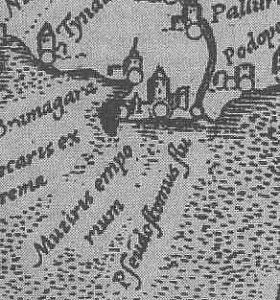
Ptolomy's Geographia. Muziris empo-rium

A section of the map of India drawn after Ptolomy’s Geographia, showing Muziris emporium

5. An indication of the importance of Muziris as a place for finalizing business deals by Roman traders was brought to light by L. Casson , a scholar, in his paper” New light on marine loans” .He mentioned about a papyrus (called P. Vindob. G 40822 -for identification purposes ), discovered during the year 1985 in  Vienna , which sets out the details of a maritime loan agreement between a ship owner – possibly of the Hermapollon mentioned on the verso of the papyrus – and a merchant using the ship as security. The document  suggests that the loan arrangement was agreed to while the parties were in Muziris (though possibly signed on arrival at the Red Sea), indicating a rather active Roman merchant colony on the Kerala coast

(http://www.uni-koeln.de/phil-fak/ifa/zpe/downloads/1990/084pdf/084195.pdf).

6. The heightened trade between Greece/Egypt and India came as a culmination of the trade relations that existed between India and the West even centuries earlier to Christian era.

7. Historians say Muziris, might be of significance in another way too. They say Christianity may have been introduced to the sub-continent through Muziris.

8. The successful run of the Greek/Egyptian trade with India suffered a temporary setback due to the rise of a new Parthian Empire that formed a sort of barrier between the Greeks and the Indians. However, when Rome  started to absorb the remnants of the Empire of Alexander, Egypt came under the control of Romans. Egypt became a Roman province in 30 B.C. Thereafter, Augustus settled down and took charge of Egypt , as his personal property.

Interestingly , According to Pliny , writing in about 51 AD , the use of monsoon winds to shorten the passage to /from India was made known to the Romans only in the days of Claudius .( Pliny, N. H., 8, 101, 86). This development, therefore, must have come around 51 AD.  There was, therefore, a long period of lull in the Egypt-India trade after 34BC.

9. The Roman trade with India, through Egypt, began in earnestness in the first century AD. Muziris then became an important Romans’ trading centre. The Rome/Egypt/India trade lasted famously until about sixth century.

10. Then suddenly and mysteriously, Muziris went off the radar. It was not mentioned again for a very long time. Dr  Roberta Tomber of British Museum said.

“What is interesting is that in the 6th Century, a Greek writer, writing about the Indian Ocean , wrote that the Malabar coast was still a thriving centre for the export of pepper – but he doesn’t mention Muziris”.

No one has  a clue how Muziris disappeared so completely.

[ Please read Indo-Roman trade by Ajoy Kumar Singh, Janaki Prakashan, 1988]

Roman coins

Regarding the trade in South India, Prof. Hermann Kulke and Prof. Dietmar Rothermund in their A History of India (Rutledge, London, Third Edition 1998-) write:

In the area around Coimbatore, through which the trade route from the Malabar Coast led into the interior of South India and on to the east coast, eleven rich hoards of gold and silver Roman coins of the first century AD were found. Perhaps they were the savings of pepper planters and merchants or the loot of highwaymen who may have made this important trade route their special target.

It also indicates that the South Indian ports served as entrepôts for silk from China, oil from the Gangetic plains which were brought by Indian traders all the way to the tip of South India, and also for precious stones from Southeast Asia. But, as far as the Eastern trade was concerned, the Coromandel Coast to the south of present Madras soon eclipsed the Malabar Coast. To the north of Cape Comorin (Kanya Kumari) there was the kingdom of the Pandyas where prisoners were made to dive for precious pearls in the ocean. Still further north there was a region called Argaru which was perhaps the early Chola kingdom with its capital, Uraiyur. The important ports of this coast were Kamara (Karikal), Poduka (Pondichery) and Sopatma (Supatama) (see Map 5). Many centuries later European trading factories were put up near these places: the Danes established Tranquebar near Karikal, the French Pondicherry, and the British opted for Madras which was close to Supatama

B.Today

1.BBC News in its edition of 11 June 2006 , reported an archaeological investigation by two archaeologists – KP Shajan and V Selvakumar – has placed the ancient port as having existed where the small town of Pattanam now stands, on India’s south-west Malabar coast. The team believes Pattanam as the place where Muziris once stood. Until recently, the best guesses for the location of Muziris centred on the mouth of the Periyar  River , at a place called Kodungallor – but now the evidence suggests that Pattanam is the real location of Muziris.

http://news.bbc.co.uk/2/hi/south_asia/4970452.stm


2. Pattanam is a small town some 12 km south of the Periyar river mouth (present day Kodungallur) , in Kerala state. The artefacts recovered from the excavation site include amphora (holding vessels) of Roman make and Yemenis, Mesopotamian, and West Asian ones too, indicating that Pattanam had trade not only with Rome but also with places in the Persian Gulf . The other artefacts recovered include pottery shards, beads, Roman copper coins and ancient wine bottles.

http://www.hindu.com/lf/2004/03/28/stories/2004032800080200.htm

3.There is no doubt that Pattanam was a major port and was important to the Indo-Roman trade But more collaborative evidence is needed to support the view that Pattanam was indeed Muziris.

http://www.hindu.com/2006/03/01/stories/2006030102540200.htm

4. The remote sensing data revealed that a river close to Pattanam had changed its course .The port may have been buried due to earthquakes or floods. This may perhaps explain the disappearance of the Muziris port. However, there are no definite answers yet.

http://news.bbc.co.uk/2/hi/south_asia/4970452.stm

5. Interestingly, while the excavations at Muziris are on, another set of archaeologists from UCLA and University of Delaware have excavated Berenike, a long-abandoned Egyptian port on the Red Sea near the border with Sudan . The team has uncovered the largest array of ancient Indian goods ever found along the Red Sea , including the largest single cache of black pepper from antiquity – 16 pounds – ever excavated in the former Roman Empire .

Dr. Willeke Wendrich, an archaeologist at the University of California at Los Angeles, said the research showed that themaritime trade route between India and Egypt in antiquity appeared to be even more productive and lasted longer than scholars had thought.

In addition, it was not an overwhelmingly Roman enterprise, as had been generally assumed. The researchers said artefacts at the site indicated that the ships might have been built in India and were probably crewed by Indians.

These again confirm the trade relations that existed between ancient Egypt and India

coins of Roman empire

http://mailman.geo.uu.nl/pipermail/maphist/2002-July/000840.html

http://historicalleys.blogspot.in/search?updated-max=2010-07-10T08:03:00-04:00&max-results=1&start=80&by-date=false

Monday, May 11, 2020

Travelling in the opposite direction of Alexander the Great

It is 330 BC when Alexander is marching through the heartland of Persia. That same year, a very little-known Greek merchant named Pytheas started an astonishing voyage of his own in the opposite direction. There was much more happening on planet Earth than Alexander’s campaign in the east.

This Pytheas made such a name and fame that contemporaries and authors ended up moving his story to the lands of myths and legends that were discussed in belief and unbelief for centuries.

Our merchant from Massilia (modern MarseilleFrance) was also known as a skilled navigator, mariner, and astronomer. His treatise On the Ocean, unfortunately, has not survived but has been quoted extensively throughout antiquity by people like Diodorus, Eratosthenes, Strabo, Polybiusand Pliny the Elder. Each one of them interpreted and judged Pytheas in his own way, often reaching contradictory conclusions. Truth and fantasy went hand in hand and were so intertwined that nobody will ever be able to get to the bottom of the fact, I’m afraid.

Pytheas’ book was a kind of maritime log loaded with astronomical, geographic, biological, oceanographic, and ethnological observations that still catch the attention of modern scholars. The log also contained practical information with descriptions of the coastal landmarks and even astronomical notes.

The travel account was written in Greek around 325 BC. At that time, Nearchus was sailing from the Indus to the Persian Gulf to be reunited with Alexander, who had survived his death march through the Gedrosian Desert.

Pytheas traveled through uncharted territory as well. Besides, we can only speculate about the route he took from his hometown, Massilia. After sailing through the Pillars of Hercules (modern Strait of Gibraltar), he then proceeded along the Atlantic coastline of Spain and France. He probably crossed the English Channel somewhere in French Brittany. Britain was a well-known source for tin, amber, and gold that was exported via Gaul to the Mediterranean world. 

Once in Britain, the intrepid navigator probably continued along the coast of Wales and onward to Scotland. Here, Pliny mentions Pytheas’ arrival at the Orcades Islands, north of Britain. These islands are generally recognized as the Orkney Islands.

More challenging was his route onward, which is thought to have taken him as far north as Iceland and the Arctic Ocean, where the giant Hyperboreans from Greek mythology lived. Modern scholars do not agree about Iceland, which Pytheas called Thule, as mentioned by Strabo, but believe that the merchant reached Norway instead. In any case, he experienced the nearly continuous daylight typical at this high latitude during the summer months. 

Just one day sailing out of Thule, he reached what he called the “Congealed Sea” – a way to tentatively describe the frozen Arctic OceanStrabo describes the place as a sea lung, where neither earth, water, nor air existed but where all things were suspended together.

On his way back, Pytheas may have traveled down the east coast of Britain, past “Kantion,” which may refer to the Kentish peninsula. There is evidence that he continued along the northern coastline of Europe, maybe meeting the Germanic people and perhaps venturing to Heligoland (Helgoland), a valuable source of amber. Some scholars argue that Pytheas sailed to the Baltic Sea as far as the Vistula River, now in Poland. It is not known when he arrived back in Massilia, but it is generally accepted that it was before 320 BC when his book was first cited by the writer Dicaearchus, a student of Aristotle.

It makes me wonder whether Alexander was aware of this travel expedition when he planned his own conquest of the western Mediterranean and the territories beyond. Julius Caesar likely used the book to acquire information about Britain and further northern areas. Copies of Pytheas’ work probably sat on the shelves of the great libraries of Alexandria and Pergamon, where it could and would be studied freely.

Whatever ancient and/or modern scholars may think of Pytheas, we cannot dismiss the fact that he went on a journey to explore the world by direct observation, not unlike the young British young men who went on the Grand Tour in the 18th century.

Thursday, November 21, 2019

The Alexander Mosaic

Needless to explain what I mean with “The Alexander Mosaic,” we are all familiar with the picture. The detailed images of Alexander facing Darius on the battlefield are common knowledge and widespread. However, to truly appreciate this mosaic, you have to see it for yourself.

Initially, this piece of art covered the floor of a Roman Villa in Pompeii, the city that was destroyed by the eruption of the Vesuvius in 79 AD. This villa is known today as the House of the Faun, where the lovely dancing and balancing bronze figure was found. This Faun stood in the atrium of the villa and has been replaced with a copy since the original is safely moved to the museum.

The “Alexander Mosaic,” created around 100 BC, is one of the largest ever found and most probably one of the finest also. It measures some 5m x 3m (the exact measurements vary according to the sources) and counts more than one million and a half tesserae made of stone and glass. This splendid piece of craftsmanship occupies a place of its own in the Archaeological Museum of Naples – very close to the Faun.

Scholars established that the composition is based on a wall painting created around 320 or 317 BC, most probably by Philoxenos of Eritrea, but Apelles, Alexander’s personal painter, is another candidate. 

Manolis Andronikos, who discovered and studied the Tomb of Philip in Vergina, made a rather convincing comparison between the hunting painting above the tomb’s entrance at Vergina and the original battle scene as later transposed onto the Alexander Mosaic. Both panels are about the same length, but the Vergina one is less than half in height. The composition of this hunting scene is very similar to that of the battle scene. Besides, both paintings have been executed in the typical style “of four colors” (yellow, red, black, and white), which was initiated by Apelles. Based on his study, Andronikos likes to attribute the painting that led to the mosaic to Philoxenus because he was a pupil of Nikomachos. This artist painted the fascinating Persephone that was discovered in the same Vergina tumulus. 

According to Pliny the Elderthe battle painting of Alexander and Darius was commissioned by Cassander, who was aspiring to become King of Macedonia at that time. It is a chilling thought that we owe such a masterpiece to Cassander, who had Alexander’s blood on his hands.  Hacking his way to the throne, he successively murdered Olympias, Alexander’s own mother, Roxane, his wife, Alexander IV, his son with Roxane, as well as Heracles, his son with his mistress Barsine. He used Alexander’s name and fame only as a means of propaganda to flatter his own ego. It makes you wonder which traits of Alexander he wanted to promote, considering his own brutality. It cannot have been too flattering, to say the least.

By 148 BC, however, Macedonia had been conquered by the Romans, who helped themselves to its many treasures. One of the key figures was Consul Quintus Caecilius Metellus Macedonicus, who plundered Pellas rich art collection and extensive Library. The original painting may well have been among his trophies to be used some fifty years later to create this mosaic. Many of Rome’s wealthy citizens, to escape the oppressing summer heat, could afford expensive seaside resorts in the Vesuvian area. Their villas were lavishly decorated with paintings, mosaics, and statues robbed or copied from the newly conquered Greek provinces.  

There have been some discussions as to which battle this mosaic is supposed to represent. But lately, scholars have agreed that we are looking at the Battle of Issus rather than the Battle of Gaugamela. The main argument leading to that conclusion is the dead tree behind Alexander. Marco Polo, on his trek with the caravans of Central Asia, learned that late Arabian sources knew the Battle of Issus as The Battle of the Dead Tree.

The dead tree, in fact, opens a whole new discussion as we find two similar dead trees in the Vergina painting. A few years ago, Frank Holt wrote an extensive article on the meaning of these strange lone trees (published by academia.edu under the title Alexander the Great, Lightning, and the Lone Dead Tree), but in the end, no theory was really conclusive. 

The entire setting is theatrical, with the central position of Darius’ turning chariot and horses. The dismounting figure just below Darius has been identified as his brother, Oxyathres. He is standing over his wounded horse (notice the front leg that has been chopped off above the hoof) as Alexander’s sarissa hits him. In reality, no mounted soldier ever carried a sarissa simply because it was too long and too heavy and needed both hands to handle. The cavalry, and in this case, Alexander on horseback, used spears. Well, we can explain this as artistic liberty, I suppose.

Each person and each animal is on the move, nothing is static, and the faces and bodies show an excellent understanding of the human form and anatomy. Connoisseurs speak of the outstanding use of foreshortening – an artistic way to reduce or distort objects and figures to produce a 3-D effect. How on earth did we lose that knowledge and technique in the dark Middle Ages! Stepping back for a moment, I am looking straight at the behind of a horse galloping away from me. Only a master artist is capable of creating such a realistic and daring composition!

It is quite exciting to study this monumental mosaic in all its minute details – of which there are very many. For a start, there is the layout of the tesserae themselves. The scientific name is opus vermiculatum, also known as “worm work,” because the tiny stones are set in a pattern resembling the slow motion of a worm. Studying the legs of the horses at my eye level, I realize that I can almost “feel” the texture of the horse’s robe.

Unbelievable! I also notice the detailed patterns on the pants of the Persians in the foreground, the harnesses of the horses, including the little bell on top of their head, the figures of ducks and lions applied on the bridles, and the thick tassel on their breast. Oxyathres’ pants are particularly elaborate, and I love the comfort of his low leather boots with the flaps. And then there is the gorgeous gold torque worn by the Persian next to Darius, holding his headwear as he is staring at Alexander.

Darius’ chariot is another subject worth to be scrutinized. The rims of its panels show motives of winged animals (dragons and aurochs) reminiscent of Babylons walls. I am amazed to see how the front wheel, with its border of beads, throws a shadow onto the body of the chariot. Darius’ large cloak is flung to the side by the sudden turn of his chariot, and I am surprised to find it trimmed with a Greek meander motif. Looking more closely, I even notice that the end of the horse’s tail is tied in an elegant knot. There is much determination in the face of the driver whipping the span he is leading in the turn. There even is a dialogue between two of the Persians in the back who raise their arms as if they are signaling to each other. Their eyes are meeting. There is fear on the face of the fallen Persian at the bottom right, looking up as he is on the point of being trampled by the horses around him. The Persian in the foreground watches his reflection in the Macedonian shield that he is pushing away to avoid being crushed underneath. The scene makes me think about what effect the reflection of hundreds of such shiny shields would have on a battlefield? It must be terrifying!

The Macedonian side of the mosaic is damaged to the point that there is close to nothing to tell about the army and their outfit. Luckily, the image of Alexander the Great has been spared. He has his wide eyes fixed on Darius. He is supposed to ride his black Bucephalus, but this horse is brown. Did that color look better in the picture? Who knows? On the other hand, Alexander’s outfit is correctly rendered with his off-white linen corselet and the lively Medusa head on his chest to avert the evil and the thunderbolts on his shoulder straps. His sword is still sheathed. The one officer behind Alexander is wearing a Thessalian helmet. Otherwise, the tesserae are gone. It makes me wonder if the visitors to the villa had eyes for Alexander only. After all, these were the days when those who could afford it went to Egypt to visit Alexander’s tomb – men like Caesar, Marc Antony, Augustus, Caligula, etc.

The space below the raging battle is filled technically with lost arms: a bow, a sword, a scabbard, and a javelin that still has the Ankyle, leather strip wrapped around its end (meant to increase the throwing distance). 

The commotion and the disarray of the battlefield are very palpable! The Persian spears in the background not only fill the space from an artistic point of view but also provide a line of focus toward Alexander. What a masterly composition!

It is unknown what led the owner of this villa to use this battle theme for his main floor, the one which every visitor would cross upon arrival. There are several theories. One is that the owner was a mercenary in Roman service during the war against King Perseus of Macedonia. Another is that one of his ancestors was involved in the fight against King Alexander of Epirus in Italy. Well, in both cases, they refer to close ties with Macedonia.

Whatever the speculations, this mosaic certainly is a rare piece of art that survived in close memory of Alexander. We still cannot imagine the immense wealth that the Romans hauled away from Macedonia - a wealth we owe to Alexander!