Recently, archaeologists
have located a row of 7-8 shops in the commercial area next to the Arch of Mettius Modestus, which fascinated me
during my first visit. So far, one shop and the adjacent Stoa have been cleared, revealing some marble panels and coins.
The city gate was
actually constructed around 100 AD to honor the first governor-general of Lycia and Pamphylia,
administrator of Patara, C. Trebonius Proculus Mettius Modestus.
With its three arches, it is rather unique
as the top of the construction holds a section of the aqueduct that brought
water to Patarafrom a source some 22 kilometers away. The Roman architects were
very imaginative indeed.
Illegal digs are
inevitable and Turkey
with its countless antique sites is no exception. A beautiful bronze head of an
unknown young man displayed at the Getty Villa has recently been identified as
stolen or illegally excavated, and it is heartwarming to hear that it will be
returned to Turkey.
The GettyMuseum in Malibu, California, acquired the head in 1971 and it could be established that it belonged to a now-lost life-size figure. It is marked with the letter alpha (the Greek A) at the
bottom of the neck. The inlaid eyes, which always add so much character to a
face, are missing.
Dated to the
period between 100 BC and 100 AD, the statue's provenance was not
documented, although scholars now link it to the archaeological site of Bubon
in ancient Lycia.
Since the late 1960s, several bronzes have been smuggled out of Turkey from that area. Most
depicted Roman emperors and their families but the head at Getty has yet to be identified.
In October 2023,
the New York Times published an article on these bronzes from illegal
digs that have been scattered around the world to various private homes and
museums.
By 1967 the
looting became apparent and slowly stopped as the Turkish police found a
headless bronze torso hidden in the woods near Bubon. This site turned out to be
the main source for this unique collection and authorities are determined to
track the looters down.
Bubon has not
been systematically excavated and all that remains are a small theater and
stadium, as well as an Acropolis. The main building may have been a shrine or
Sebasteion, where several bronze statues stood around a U-shaped courtyard that
was probably roofed. The Sebasteion may have been started by Neroand his wife
Poppea Sabina. His example was followed by eleven emperors and three empresses,
the last being Gallienus, who ruled till 268 AD. In the following decades, Bubon
suffered from repeated earthquakes which buried and saved the Sebasteion.
Scholars and
experts aim to restitute the group of statues, which represented an important binding
factor between the citizens to the power of faraway Rome.
In the end, the
villagers themselves, now in their 60s and 70s, provided the most precious
information. They described the statues and their posture and remembered how
they were sold. Their plinths with the names of the emperors in Greek are still in situ.
Lucius Verus apparently
stood next to Marcus Aurelius, his
adoptive brother and co-ruler. His headless statue may be at The Cleveland
Museum of Art and hisBubonorigin is now under
investigation.
Septimius Severus was
accompanied by his wife and sons, Caracalla
and Geta. His headless statue was
on loan at the Metropolitan Museum of Art in New York
and has been turned over to the authorities for repatriation. Some experts
believe the missing head is kept at the Carlsberg Glyptotek in Copenhagen,
Denmark. The
head of Caracallahas been seized
from the Met and his torso is probably in the hands of a Greek collector.Emperor Valerian stood
nearby and his torso is now exhibited at the Museum
of Burdur,
Turkey.
Commodusalso had a plinth of his
own.
In due time, more
emperors will be reconciled with their names on the pedestals and more effigies
or body parts will be returned to their rightful
spot in Turkey.
[Top picture from Getty Museum. Lucius Verus is mine taken at the MANN]
The city
of Leptis Magna covered
far more ground than the official buildings I just visited tend to imply. Two
major constructions are still waiting for me, the Amphitheater and the
Hippodrome.
The Amphitheater
lies approximately one kilometer from the center of Leptis Magna, close to the sea. It has been
excavated in the natural rocky depression or possibly an ancient quarry.
Thanks to an
inscription, we know that it was inaugurated by the ruling governor, Marcus
Pompeius Silvanus Staberius Flavinus, in his third year in office.
He and his deputy dedicated the monument to Emperor Nero,
meaning it was finished in 56 AD.
The Amphitheater
measured 57 x 47 meters
and would accommodate as many as 16,000 people. Compared to the 50,000 seats in
Rome’s
Coliseum, it may seem small, but looking at it from the higher ground, it
appears more impressive. The elite of Leptis Magna would elect to sit on the
southeastern side of the Amphitheater, where they could enjoy a gentle breeze.
The games were
an all-day event. Typically, the early morning starts with animals
fighting each other. Around noon, the criminals would be executed, i.e., thrown
to the wild beasts. The afternoon was reserved for gladiators of different
kinds and named after their equipment.
In the southeastern corner of this monument stood a temple from
the time of Hadriandedicated to the goddess Artemis. Excavations early in the 20th century yielded
a statue similar to the one in Ephesus,
which is now exhibited at the Museum in Tripoli.
Closer to the
sea are the remains of the Hippodrome or Circus built under Trajanin 112 AD. It roughly runs
parallel to the coastline and is 450 meters long and 100 meters wide. Two
tall vaulted passageways connected the Amphitheater to the Hippodrome. From my
vantage point above, I can clearly see the spina, the central spine of the
Hippodrome. Since it is not entirely excavated, the only visible rows of seats
are at the far end, seemingly resting on the side of the dunes facing inland.
It is estimated it could seat 23,000 spectators.
Exceptionally, I
would like to underscore the beauties of the Archaeological Museum of Tripolibecause so many of the most exquisite statues and artifacts from Leptis Magna (and other antique
cities on Libya’s
coastline) are exhibited there.
Leptis Magna has a
small museum of its own, which collects artifacts whose quality does not rise
to the standards of Tripoli.
In front of the building stands a beautiful bronze statue of Septimius Severus, created by the Italians in 1940.
At the entrance
of this museum stands a welcoming marble African elephant who lost his trunk. A
place of honor is reserved for the original Arch of Septimius Severus reliefs. Otherwise, there are many statues from the Theater and Hadrian’s
Baths. In the corner, a group of headless figures in a toga gathers, generally
larger than life-size, retrieved from the Old Forum and the Forum Novum
Severianum. Rather striking and very lifelike is the face of Isis
with inlaid glass eyes. The glassware and other vessels in various shapes and
sizes, as well as the small frescos, merit attention.
We mentally have
to put the artwork from this museum and the one in Tripoliback into
place. Still, we hardly catch a fraction of the magnificence and wealth Leptis Magna displayed in its time of glory. Picturing the wealth and opulence of Rome
is clearly beyond reach!
It is evident that life in Libya has changed since my last visit. I expressed my concern in an earlier blog: Still hope, though scant, for Libya’s
cultural heritage, but that was almost ten years ago. Nothing much has transpired since, and it seems the country's cultural heritage is not a priority, yet. I sincerely hope for the best!
When talking about Macedonian shields, our thoughts
automatically turn to those carrying a 16-rayed star like the one on the lid of King Philip's golden larnax displayed at the Museum of Vergina.
What should be simple and straightforward, in reality,
isn't.
The first king to use the Macedonian sun emblem may be Archelaus(413-399 BC), i.e., well before Philip II came to power. In Alexander's
days, the number of sun rays varied from eight to twelve or sixteen. Alternatively,
the center of the shield could be a disc that remained blank or was filled with
a Gorgon's head, the face of Heracles, etc. Such a disc was usually surrounded
by a varying number of crescents. Other shields may seem unadorned, but it has
been documented that many were painted only. That would make sense when looking
at the row of armor and shields lining the street in Dion.
The monument was commissioned by Alexander
after his victory at the Granicus.
As I have come across many examples of shield decorations,
either on paintings, reliefs, coins, or other works of art, it might be
interesting to highlight some examples.
For a start, today's flag of the Republic of Macedonia
shows a sun with 16 rays, the so-called "Vergina-Sun."
The excavations in Albania have so far yielded several
examples of shields they call Illyrian but look very Macedonian at first
glance. I was told that the difference with a Macedonian shield was the
curving. Whether that is true or not, I don't know (see: Looking for Illyrian remains in Albania).
At the small Museum
of Apollonia, Albania, I saw my first
Illyrian shield from the 4th century BC that looked very much like the
Macedonian one. A series of triple crescents surrounds the central Medusa head
with shiny eyes.
The SkanderbergMuseum proudly exhibits
an Illyrian shield with similar half-crescents but with a six-rayed star at its
center.
Two Illyrian shields are embossed on a leather belt
buckle at the Archaeological Museum of Tirana. In this case,
we see a central disc surrounded by respectively four and five larger double
crescents.
From the same period, a striking limestone mold for a
leather shield cover was found in Egypt. It was made for the soldiers of Ptolemy in
330 BC. It has typical Macedonian features with a central Medusa head
surrounded by triple concentric circles holding a small eight-rayed Macedonian
star (see: Alexander's
Legacy. Allard Pierson Museum in Amsterdam).
The Tomb of Agios Athanasios from
the era of Alexander
has been attributed to a Macedonian nobleman. Although looted in
antiquity, the narrow frieze above the entrance holds precious information
about Macedonian daily life and its army in blazing colors. The lively scenes
have been photographed in detail and digitally restored for all to examine at
the Archaeological Museum of Thessaloniki(see: The Macedonian Tomb of Agios Athanasios in
Thessaloniki). Of particular interest are the three
shields, two of which show an eight-rayed star surrounded by a broad-colored
rim. These shields are painted, as are other examples on the
walls of grave monuments. It remains an intriguing question whether shields
used in combat were painted as well. Color coding may have contributed to
bringing soldiers of the same unit together. Still, I fail to see how Alexander's
Macedonians would have carried paint to maintain the distinctive coding during
the many skirmishes and battles.
A unique set of shields can be admired inside the Tomb of
Lyson and Kallikles in Lefkadia,
Greece (see: Alexander'sschooling
at Mieza). The one painted in the north lunette has a
blue eight-rayed star at its center and is edged with a crown of leaves. The
shield in the south lunette is defined as the 'familiar Macedonian' shield with
an empty disc at its center and surrounded by eight crescents. The tomb is
dated to c.250 BC.
Another specimen is a bronze shield from the collection
of the GettyMuseum in Malibu,
California. It definitely has a
Macedonian look because of the central six-rayed star (see: A magnificent Greek shield).
The inscription reveals that it was made in Pontuson the Black Sea for KingPharnaces
I. Since we do not know when exactly Pharnaces died, we
can only assume it was made between 160 and 154 BC, when his brother Mithridates IV
succeeded him to the throne.
From the cities that disappeared under the ashes of Mount Vesuvius after the eruption of 79 AD, I like the
fresco from Boscoreale,
now at the Archaeological Museum of Naples (see: Fresco of a Macedonian at Boscoreale).
The painting, based on a mid-3rd century BC original, was retrieved from the
Villa of P. Fannius Synistor and shows a scene in which the principal figure
sits next to an eight-rayed Macedonian shield resting at his feet. According to
some sources, it would depict Antigonus II Gonatas (the son of Demetrios I of Macedonia) with his mother, Phila,
or simply be the personification of Macedonia and Asia/Persia.
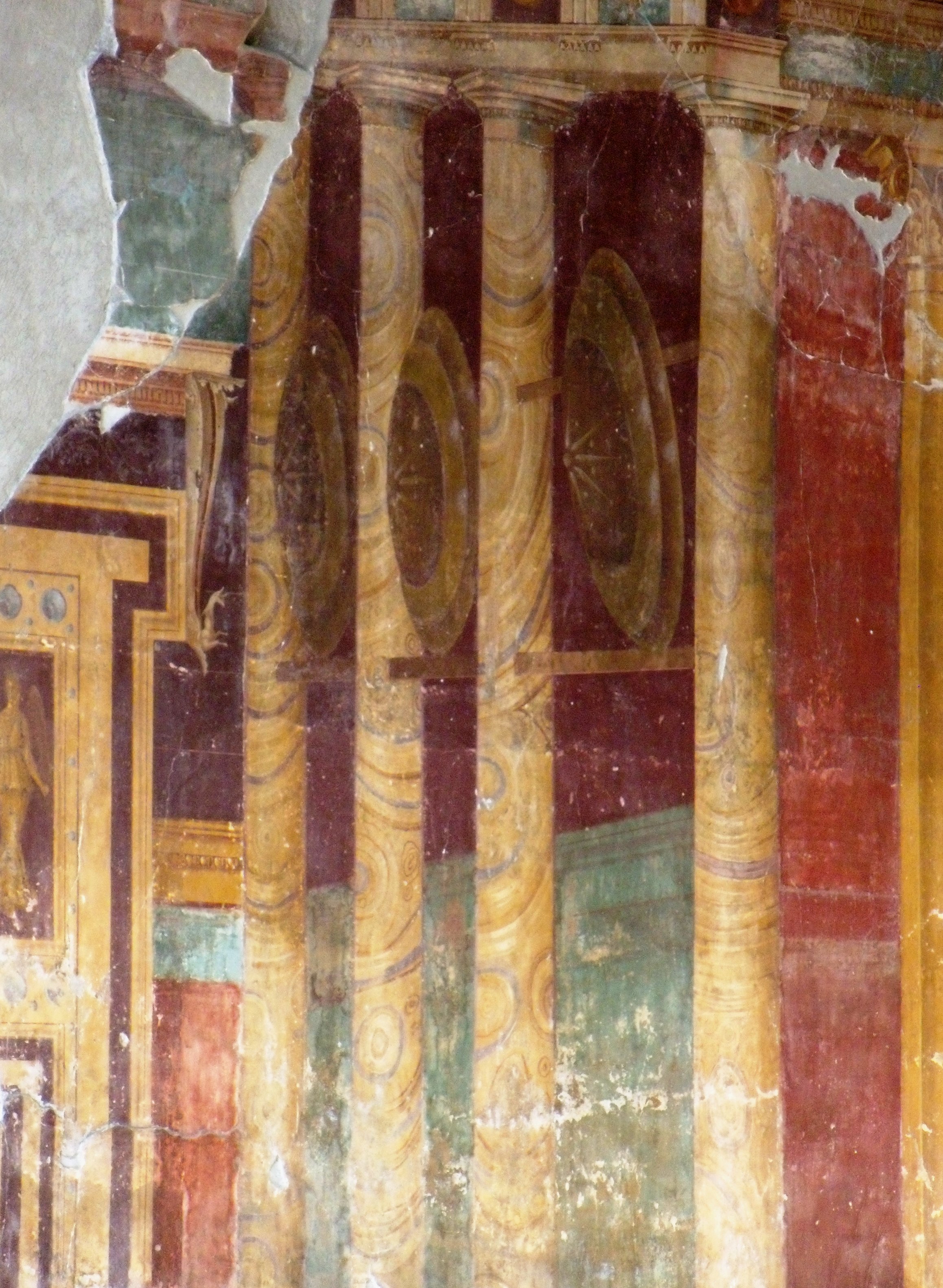
Another magnificent fresco is still in situ
at the Villa of Poppea,
Nero's
wife, in nearby Oplontis. A life-size view of the Temple of Apollo with eight-rayed Macedonian
shields painted between the columns covers a wall in the large sitting room.
Wow!
Later rulers and countries held Alexander and Macedonia in great esteem, and the Romans' admiration is an obvious example!
Aizanoi, regretfully, doesn’t make
headline news - yet. Several years ago, I watched a program on TRT TV that
showed many imposing monuments from Roman times at this site which was
otherwise unknown to me. After that, I haven’t heard anything about further excavations or remarkable finds until today. The massive entrance to the Temple of Zeus
has been re-erected, which rightfully makes it one of the best-preserved
temples in Anatolia.
As always, I like to put things in context. Looking at the map, Aizanoilies roughly 200 km south of Bursa, in the heart of ancient Phrygia.
The city occupies both sides of the KocaçayRiver (Penkalas). The
first settlements date back to 3000 BC, but what we see today are
roughly the remains of the Roman city from the 2nd century BC.
The Temple
of Zeus indeed commanded
the view, as it still does today, standing on its podium on top of a low hill. It
measured 33x37 meters, counted 15 x 8 columns, and was commissioned by Emperor Hadrian. Thanks to an
inscription on the architrave, the temple could be dated to the second quarter
of the 2nd century BC. The inscription also mentions M.
Apuleius as a benefactor of
the city.
The base of the podium of this temple is covered with vaults – an
unusual and unique occurrence in Roman Anatolia. Archaeologists concluded that
this was a double temple, with the one dedicated to Zeus beckoning us, and a
vaulted underground space where the cult of Cybele was practiced. This goddess
was worshipped under the name Metre Steunene in Aizanoi. However, more recent in-depth research has
revealed that this temple could not be devoted to both Zeus and Cybele. Consequently,
the underground space is thought to be a prophecy center or a mere storage
room. Whatever its purpose, it is an odd construction.
Opposite the temple are the remains of a small Bouleuterion, but its
history remains unknown. The same problem applies to the Heroon and the Agora
and surrounding Stoa because the remains were either reused on other structures
or disappeared under the modern houses.
Aizanoi counts remains of many monuments, among which a rare combined
theater-stadium complex linked together by a large stage building. Its
construction started shortly after 160 AD and was completed halfway through
the 3rd century AD. Several inscriptions have been found in the stadium and the
theater, and they confirm that the same M. Apuleius contributed substantially to building this complex.
The excavations done between 1970 and 2011 have exposed two public
Baths, a Gymnasium, a Macellum, five bridges, an ancient dam, a colonnaded
street, and a large necropolis.
One of the Baths stood between the theatre-stadium complex and the Temple of Zeus and included a Palaestra or
Gymnasium. With its recognizable frigidarium and caldarium, the Bath has been dated to
the end of the 2nd century AD. In the largest side room, a marble statue of
Hygeia was found. Also, the water and heating pipes are still in
situ. Despite its rich
marble décor, it has been recognized as a precursor of the Turkish-style Bath. The Palaestra is located at the northeast end of the Baths.
The second Turkish-style Bath
built a century later was found northeast of the city center. Here a beautiful
mosaic floor representing a satyr and a maenad has been exposed.
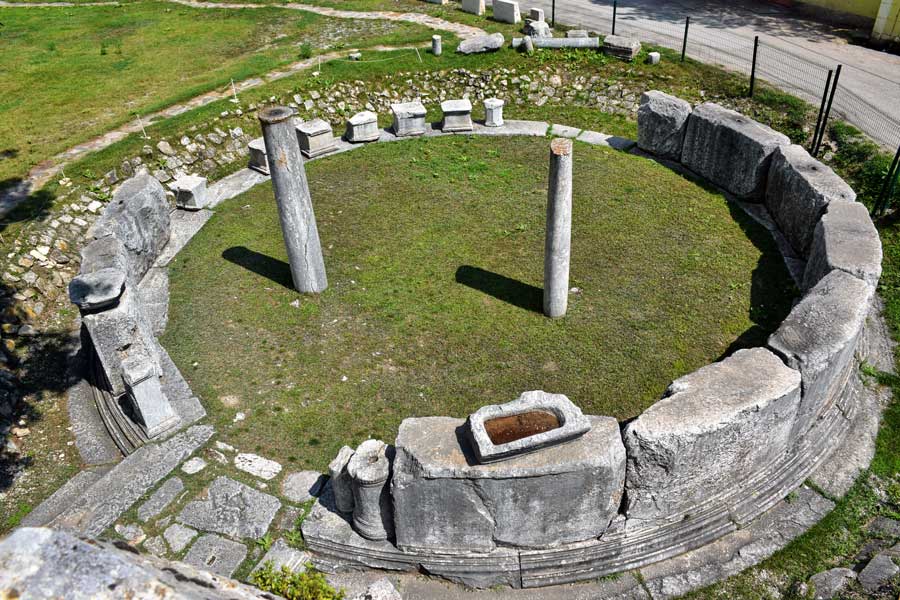
The circular Macellum of Aizanoiwas built simultaneously with the
first Bath and
was used as a food market. Here, a copy of the Price Edict of Diocletianfrom 301 AD
was found. The edict aimed to limit the severe inflation that followed the
debasement of the coinage initiated by Emperor Nero.
During recent excavations, remains of a colonnaded street have been
uncovered over a length of 450
meters. This street had its own Stoa, which could be
dated to ca. 400 AD. A pedestal carried a marble statue of a satyr dressed with
panther skin stands at the very end of the Stoa.
The Roman city of Aizanoioccupied both sides of the KocaçayRiver and was protected against the rise
of the water level by walls or dams made of large cut stones. Two of the five
bridges are still used today. They both have five arches, and one of them still
supports modern-day traffic. In between these two examples, we can recognize
the remains of a bridge with three arches that fell in disuse. Further north, a
low wooden bridge was used as a pedestrian crossing.
The main bridge displays an inscription on the pedestal of the railing
and tells us it was opened in September 157 AD. An illustrating relief shows
the sea voyage undertaken by M. Apuleius as he paid for the bridge’s construction. It may be
essential to mention that M. Apuleius represented Aizanoiin the Panhellion Union held in Athens from 153 to 157 AD. The new railing was installed
in 1990.
The large necropolis of Aizanoireflects the size of the city. It includes a wide
array of tombs, including door-shaped Phrygian tombs from the 2nd century AD. The
typical tomb doors, which often bore the name of the deceased or donor,
symbolized the passage to the other world. These tombstones usually showed
bulls, lions, or eagles for the men and baskets of wool or a mirror for the
women.
In one of the tombs, archaeologists made a remarkable discovery. They
found a “lykion,” a typical jar made to contain a precious salve to
treat eye dryness which frequently occurred to soldiers traversing large
stretches of dry lands or deserts (see: Eye cream from antiquity).
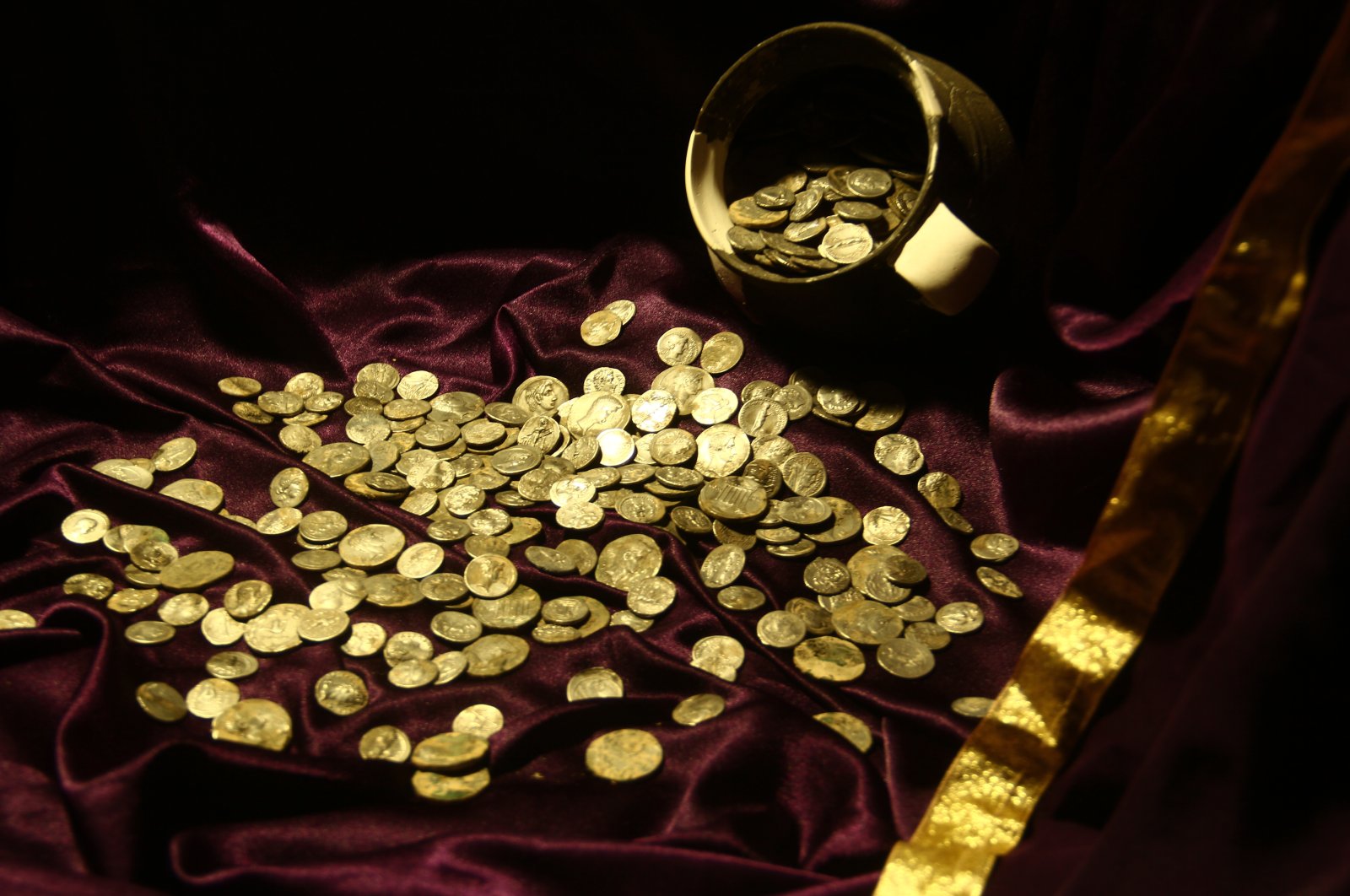
More recently, they unearthed a jug containing an exceptional hoard
of 651 silver coins from the days of Emperor Augustus. Remarkably, 439 coins were standard Roman silver
denarii, but 212 were cistophoruscoins typically from Pergamon. This is not surprising considering that Aizanoiwas ruled by Pergamon until the kingdom was bequeathed to the Romans
in 133 BC.
Aizanoistarted minting its first coins in the second and first
centuries BC. During the days of the Roman Empire,
the city grew wealthy thanks to the production of grain, wine, and wool. Aizanoifell into decline in Late Antiquity.
It seems that at last, the plans to restore the unique lighthouse of Patara are going to be materialized. The remains of this lighthouse that was built under Emperor Nero in 64 AD were exposed a few years ago, and the inscription to that purpose reads “I am Emperor Nero. I built this lighthouse to greet sailors”. It was said to be written in bronze, but the more recent article published by The Archaeology News Network mentions that the letters were made of gold.
Standing at the mouth of the XanthosRiver, the tower proper was approximately 26.5 meters tall with a diameter of six meters; it rested on a square podium. Inside the tower, two interlocking cylindrical structures were connected by a spiral-shaped ladder. As mentioned in an earlier blog (see: The oldest lighthouse in the world at Patara), this lighthouse is the oldest in the world ever recovered.
The plans are to actually rebuild the lighthouse to its original height and guide modern sailors with its light.
We’ll remember that Patarasurrendered to Alexander the Great in 333 BC, and we may wonder what kind of beacon guided the ships up the river in his days.
Antiochus III captured Patara in 196 BC, and the city was annexed by the Roman Empire in 43 AD. Since Patara and its harbor were an important hub on the ancient trade routes, they kept their importance till far into the Byzantine times.
The possibilities of modern technology are truly without limits! The latest invention is a digital project allowing a “fly-over” of ancient cities and sites. It sounds like a very exciting way to travel back into time.
The first destination that has been made available is a virtual trip to Rome as it was in the year 320 AD. This specific date has been chosen because so much is known about the city at that time. Several of the key buildings built by the successive emperors were visible at that time.
The program called Rome Reborn allows us to explore the Roman Forum, the Basilica of Maxentius and Constantine, Nero’s Palace Domus Aurea, and the Baths of Caracalla. In the next two or three years, other key sites like the Colosseum and the Pantheon will be added. All in all, it will possible to zoom in on about 7,000 buildings and monuments.
Visitors to the above mentioned link can actually “fly-over” the ancient city and stop at chosen locations.
When Philip was proclaimed leader of all the Greeks at Corinth, he was clever enough to insert a clause in the treaty-making his title hereditary. Each state had individually sworn not to harm any other member of the Common Peace and not to interfere in their internal affairs. They also had sworn not to become allies with any foreign power that could damage any member of the Treaty. No member could undertake any operation that might endanger the peace or overthrow its constitution. The then assembled council or synedrion at Corinth was the final authority to settle any dispute between individuals or between member states. They had to help each other if one of the members was attacked but were not allowed to accept support from foreign powers.
This means that after the assassination of Philip in 336 BC, it was one of Alexander’s priorities to be accepted and confirmed as Hegemon of this League of Corinth.
Walking around the impressive remains of Corinth, crowned by the Temple of Apollo, which Alexander saw in all its glory, makes you wonder where these meetings took place. The most obvious location would be the theatre rebuilt early 4th century BC on the foundations of an older one from the 5th century BC. This theater could seat around 15,000 spectators, but there is very little left of this building. There is also a Bouleuterion behind the Agora to consider, but this turns out to be a Roman construction that didn’t exist in Philip’s days.
The Lechaion Street, which connected the center of Corinth to the western harbor of the same name, is one of the highlights of the city. In recent years, expert divers have been exploring the very harbor of Lechaion to expose the infrastructure of this important port city, locating two monumental piers built of ashlar blocks next to a smaller dock. They also found a canal entrance leading into Lechaion’s three inner harbors, as well as a breakwater.
Lechaion was only one of Corinth’s harbors, as the city strategically straddles the isthmus between mainland Greece and the Peloponnesus (less than 6 kilometers wide), which means that it needed both an eastern and a western harbor. Lechaion, on the Gulf of Corinth, served the western sea routes to Italy, Sicily, and beyond to Spain. The harbor of Kenchreai gave access to the Saronic Gulf from where the ships sailed to and from the Aegean, Asia Minor, Cyprus, Syria, and Egypt. Goods could be transported overland from one port to the other as lightweight ships were hauled using a platform along the road connecting LechaiontoKenchreai. This was before Nero planned to dig a canal meant to link both sides, a plan that eventually materialized two thousand years later. The remains of Kenchreai Street are not as impressive as Lechaion Street, which is tucked away behind the shops of the Agora, but both were familiar to Alexander.
The Temple of Apollo certainly is the main landmark. It is built in Doric order, counting 6x15 columns, seven of which are still standing and define the skyline of Corinth. Rather unique is the fact that the columns are monolithic and stand more than seven meters tall. It is here that the slight convex floor to support the temple’s columns has been implemented for the first time, antedating the much-praised concept for the Parthenon in Athens! There is no trace of the bronze statue of Apollo that once stood inside the temple, as mentioned by Pausanias.
Another unmistakable feature in Corinth is the Fountain of Peirene, built in the late 6th century BC and enhanced many times, especially by the Romans in the 2nd century AD. Much older, and probably built together with the Temple of Apollo, is the adjacent Fountain of Glauke, an inelegant cube of about 7.5 meters. Inside is a succession of reservoirs with a total capacity of approximately 527 m3. Water management in antiquity was far more sophisticated than generally admitted.
Since its early beginning, Corinth was a booming trading hub in the eastern Mediterranean and has a lot to tell. For more than one thousand years, roughly from the 6th century BC till the 6th century AD, the city was at the center of all trade carried out by its mixed population of Greeks, Romans, and Jews, and later by early Christians as well. The importance of this city cannot be stressed enough, and few people know about the many colonies Corinth founded all over the Mediterranean. As early as 733 BC, the first such colonies were established at Corcyra (Corfu) and Syracuse (Sicily). Less than a century later, many more settlements followed, like Epidamnus (Dϋrres) and Apollonia (Fier), both in Illyria, modern Albania, as well as Potidaeain Chalcidice, Greece. Corinth was also one of the co-founders of Naucratis in ancient Egypt. These facts alone prove the overall importance of the city, which rivaled Athensand Thebes.
It is not difficult to imaginethe hustle and bustle of people inAlexander’s days, merchants talking feverishly with buyers and sellers, while seafarers were seeking the distractions common to every port - temples, taverns, and brothels are the same all over the world. Sacrifices to the local and foreign gods were being made to thank them for their safe arrival and to pray for a safe journey onward. Corinth certainly was no exception.
If the story is true, it was here that Alexander met Diogenes(see: Alexander meeting Diogenes in Corinth). This Cynic philosopher originated from the Black Sea and died in Corinth the same year as Alexander, in 323 BC. Diogenes’ own writings have not survived, but were known by his disciple Onesicritus, who accompanied Alexander on his Asian campaigns. It may be thanks to him and Ptolemy that his philosophy slipped into the later AlexanderRomance.
Speaking of
megalomania, I believe the Roman emperors of the first century AD excel in that
domain with Caligula and Nero in prominent places.
The opulence
that was common good to them goes beyond our most daring imagination and one
such example is the two ceremonial ships which Caligula built for his eccentric pleasure on Lake Nemi, some 30 kilometers south of Rome. These ships were not meant for
sailing as they were simply too big to maneuver for the size of the lake. But
then, the lake was sacred to the Romans as confirmed by the presence of the goddess
Diana Nemorensis and the god Virbius which were venerated in the towns on the surrounding
shore.
Much speculation
is shrouding these ships in mystery but it is thought that the largest vessel (73 meters long and 24 meters wide) served
essentially as a floating palace with rooms whose floors and walls were covered
with colored marble and lively mosaics. This residence had its own baths and
pool equipped with the appropriate comforts of plumbing and heating. The other
vessel was not much smaller with its 70 x 20 meters and seems to
have been a floating temple for Diana. Both ships were built from cedar wood
and carried sails made of purple silk. History further tells us that they were
adorned with gold and precious stones as well as bronze reliefs. Somehow they
even “grew” a number of fruit trees and vines on board. The example set by the
Ptolemies in Egypt and the
Hellenistic rulers in Syracuse
certainly was not lost on Caligula!
It is known that
Romans could make ball bearings out of lead and the story goes that this
invention was used on the Nemi ships to move the windlasses and even to rotate
the statues of the gods! Top notch technology was implemented like several hand
operated bilge pumps that worked very much like modern bucket dredges. Piston
pumps, in turn, supplied the hot water for the baths and the cold water for
fountains and drinking water. It is hard to believe that this knowledge of
piston pumps was lost in time until it finally was “rediscovered” in the Middle
Ages.
Caligula’s pleasure
vessels were short lived as he was assassinated about a year after they were
launched and opposition parties soon stripped them of their precious content
and intentionally sunk them. They remained at the bottom of LakeNemi
for almost 2,000 years during which time fishermen and treasure hunters regularly
retrieved small treasures from the wrecks.
This is probably
the origin of a square piece of inlaid marble which features a geometric
pattern using green and purple porphyry, serpentine and molded glass that
recently made headlines on the antique markets. The owners who acquired the
piece in the early 1970s framed it and turned it into a small coffee table. The
details of that story can be found in the New
York Times of 19 October 2017.
The life of the
two Nemi ships did, however, not end at the bottom of the lake. In 1927, Benito
Mussolini (another megalomaniac) ordered to drain the lake in order to expose
and retrieve the ships. The first ship was recovered in 1931 and the second one
in 1932, and in 1936 he built a museum to host both vessels. Unfortunately, in
1944 fire destroyed the museum and its precious contents after several bombings.
To this day, it is not clear whether the Germans started the fire or the allies
caused it by their intense bombing. Today, a new museum can be visited on the
site sheltering scale models of the ships and those rare artifacts that have
survived. Let us hope that this “coffee table” will soon be visible at that
museum also.
LakeNemi, once hosting scenes of orgies, cruelty, music and sport is once
again a place where the people of Rome
can enjoy the clean air and cooler temperatures in the summer months. The lucky
visitor may still witness the magical reflection of the Moon in the center of
the lake during summer nights – a phenomenon the ancient Romans called Speculum Dianae, in other words, Diana’s
Mirror.