Cynane was Alexander’s half-sister, born around 357
BC. Her mother was Audata from
Illyria (see: The many wives of Philip II of Macedonia), whom King Philip had married to secure his expanding kingdom.
Philip gave Cynane in marriage to Amyntas, who was the
legal successor to the throne of Macedonia after his father, King Perdiccas III of Macedonia, died in combat in 359 BC. As Amyntas was only a child, Philip, Perdiccas' younger brother, became his
tutor and regent. Later that year, Philip was elected king instead.
After Philip's murder in 336 BC, Amyntas could have taken his chances, but he did not, for whatever reason. The newly
elected King Alexander, however, did
not hesitate and had Amyntas killed.
He could have suspected that Cynane would manipulate her husband to gain power. Cynane was left a widow, raising her daughter Adea alone. Not for long, though.
Cynane stayed in Macedonia as Alexander
left for Asia. Having been raised by her
mother in the Illyrian tradition as a warrior, equal to any man, she now
instilled the same values in her daughter.
Upon Alexander’s death, Cynane saw her chances, not for herself but for Adea. She mobilized her troops and led
her daughter and her army to Babylon
to secure their future by arranging the marriage of Adea with Alexander’s
successor.
As the daughter of Philip II and Alexander’s half-sister, Cynane enjoyed the loyalty of the Macedonian army, despite General Perdiccas’ disagreement. The general tried to stop her in every
possible way and sent Alcetus, who
killed Cynane before she could speak.
This assassination did not sit well with the Macedonian army, who revolted and
demanded that Adea, Alexander’s niece, marry Alexander’s half-brother, the simple-minded
Arrhidaeus. Arrhidaeus, who was the only available bloodline, would rule as King Philip III, and Adea would become Queen Eurydice II. She was the power behind Philip III, which was not to the liking of Queen Olympias. She had Philip III killed
in 317 BC and Eurydice II imprisoned
and forced her to commit suicide.
This long
introduction brings me to the tomb of Philip II and the adjacent tomb of a woman in Vergina. Since its
discovery in 1977 when Manolis
Andronicos attributed the tomb to Philip II and the remains in the smaller room to his seventh and last wife, Cleopatra, many arguments have erupted, presenting different theories.
Recently, I
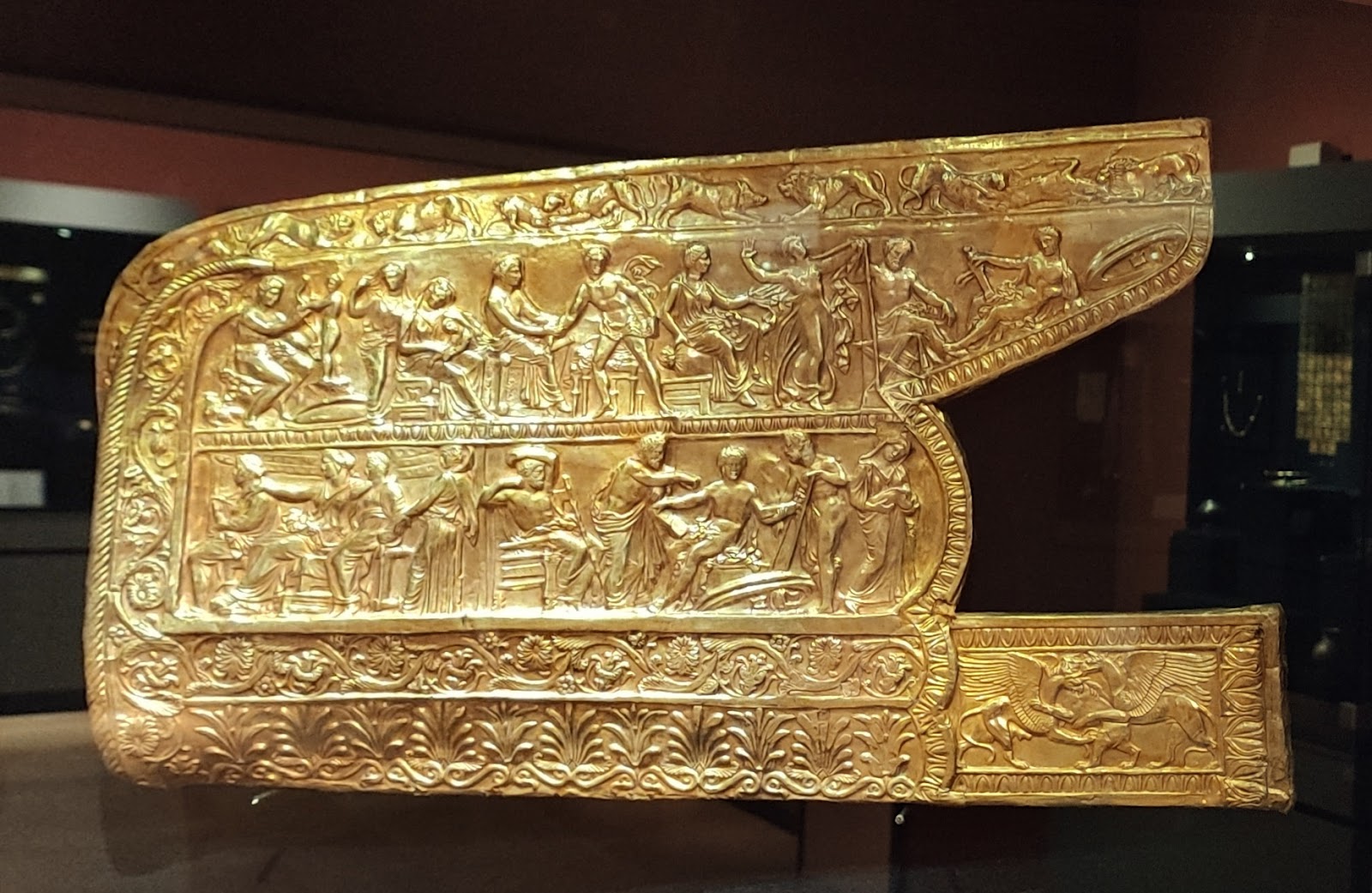
watched a presentation on the History Channel*, about the gold quiver or goritos found in this tomb. Scholars
agree that it is Scythian and not Macedonian, made between 900 and 200 BC.
Next, the question arose whether it had belonged to Philip or to the woman. If it was
the woman’s, who was she, and could she be a descendant of the fiercest
Scythian female warriors, the mythical Amazons?
The breakthrough
occurred when the female bones and pelvis from the smaller room were analyzed.
It is known that a woman’s pelvis changes during life, and it could be
determined that this example was between 30 and 35 years old.
Adea/Eurydice was only 20
years old when she had to take her life. She is not a candidate to be interred in Vergina.
This conclusion automatically excludes earlier debates presenting Philip Arrhidaeus as the main occupant.
The only
remaining person obviously is Cynane,
Alexander’s half-sister, who was 34
years old when she was murdered on the orders of General Perdiccas.
It was also
established that the two chambers of the Vergina Tomb were not built at the
same time. Since Cynane died 13 years
after her father, it is entirely plausible that her tomb was added next to her
father’s at a later date.
The program
concluded with an extra note regarding the Scythian goritos (that was worn around the waist). After examining the DNA
of the remains found in the Scythian kurgans, the scholars concluded that not
all warriors were men, as 1/3 of the burial sites were built for women.
Cynane must have been
quite a character, raised as a warrior and a match to any man. No wonder the
Macedonian troops were horrified when she was murdered in cold blood. It is quite remarkable that she lived one year longer than Alexander. Whoever
arranged for her to be buried next to Philip was well aware of her courage and battle spirit. Maybe her father had been
attracted to Audata for that same
reason, who knows?
*2023 Strangest Things on History
Channel[Picture of Cynane's larnax and Facade of Philip's tomb are from Wikipedia; Goritos picture from this link Wikipedia]