Alexandria's founded by Alexander

Alexandria's founded by Alexander the Great (by year BC): 334 Alexandria in Troia (Turkey) - 333 Alexandria at Issus/Alexandrette (Iskenderun, Turkey) - 332 Alexandria of Caria/by the Latmos (Alinda, Turkey) - 331 Alexandria Mygdoniae - 331 Alexandria (Egypt) - 330 Alexandria Ariana (Herat, Afghanistan) - 330 Alexandria of the Prophthasia/in Dragiana/Phrada (Farah, Afghanistan) - 330 Alexandria in Arachosia (Kandahar, Afghanistan) - 330 Alexandria in the Caucasus (Begram, Afghanistan) - 329 Alexandria of the Paropanisades (Ghazni, Afghanistan) - 329 Alexandria Eschate or Ultima (Khodjend, Tajikistan) - 329 Alexandria on the Oxus (Termez, Afghanistan) - 328 Alexandria in Margiana (Merv, Turkmenistan) - 326 Alexandria Nicaea (on the Hydaspes, India) - 326 Alexandria Bucephala (on the Hydaspes, India) - 325 Alexandria Sogdia - 325 Alexandria Oreitide - 325 Alexandria in Opiene / Alexandria on the Indus (confluence of Indus & Acesines, India) - 325 Alexandria Rambacia (Bela, Pakistan) - 325 Alexandria Xylinepolis (Patala, India) - 325 Alexandria in Carminia (Gulashkird, Iran) - 324 Alexandria-on-the-Tigris/Antiochia-in-Susiana/Charax (Spasinou Charax on the Tigris, Iraq) - ?Alexandria of Carmahle? (Kahnu)
Showing posts with label Olympias. Show all posts

Monday, July 28, 2025

Cynane buried next to her father, Philip II

Cynane was Alexander’s half-sister, born around 357 BC. Her mother was Audata from Illyria (see: The many wives of Philip II of Macedonia), whom King Philip had married to secure his expanding kingdom. 

Philip gave Cynane in marriage to Amyntas, who was the legal successor to the throne of Macedonia after his father, King Perdiccas III of Macedonia, died in combat in 359 BC. As Amyntas was only a child, Philip, Perdiccas' younger brother, became his tutor and regent. Later that year, Philip was elected king instead.

After Philip's murder in 336 BC, Amyntas could have taken his chances, but he did not, for whatever reason. The newly elected King Alexander, however, did not hesitate and had Amyntas killed. He could have suspected that Cynane would manipulate her husband to gain power. Cynane was left a widow, raising her daughter Adea alone. Not for long, though.

When Alexander made his way to Pelium in 335 BC, he faced a threatening revolt of the Illyrians, and Langaros, King of the Agrianes, came to his rescue. In recognition of his assistance, Alexander invited Langaros to Pella, offering his half-sister Cynane in marriage. Before this wedding could materialize, Langaros fell ill and died (see: The short-lived appearance of King Langaros).  

Cynane stayed in Macedonia as Alexander left for Asia. Having been raised by her mother in the Illyrian tradition as a warrior, equal to any man, she now instilled the same values in her daughter. 

Upon Alexander’s death, Cynane saw her chances, not for herself but for Adea. She mobilized her troops and led her daughter and her army to Babylon to secure their future by arranging the marriage of Adea with Alexander’s successor. 

As the daughter of Philip II and Alexander’s half-sister, Cynane enjoyed the loyalty of the Macedonian army, despite General Perdiccas disagreement. The general tried to stop her in every possible way and sent Alcetus, who killed Cynane before she could speak. This assassination did not sit well with the Macedonian army, who revolted and demanded that Adea, Alexander’s niece, marry Alexander’s half-brother, the simple-minded ArrhidaeusArrhidaeus, who was the only available bloodline, would rule as King Philip III, and Adea would become Queen Eurydice II. She was the power behind Philip III, which was not to the liking of Queen Olympias. She had Philip III killed in 317 BC and Eurydice II imprisoned and forced her to commit suicide. 

This long introduction brings me to the tomb of Philip II and the adjacent tomb of a woman in Vergina. Since its discovery in 1977 when Manolis Andronicos attributed the tomb to Philip II and the remains in the smaller room to his seventh and last wife, Cleopatra, many arguments have erupted, presenting different theories. 

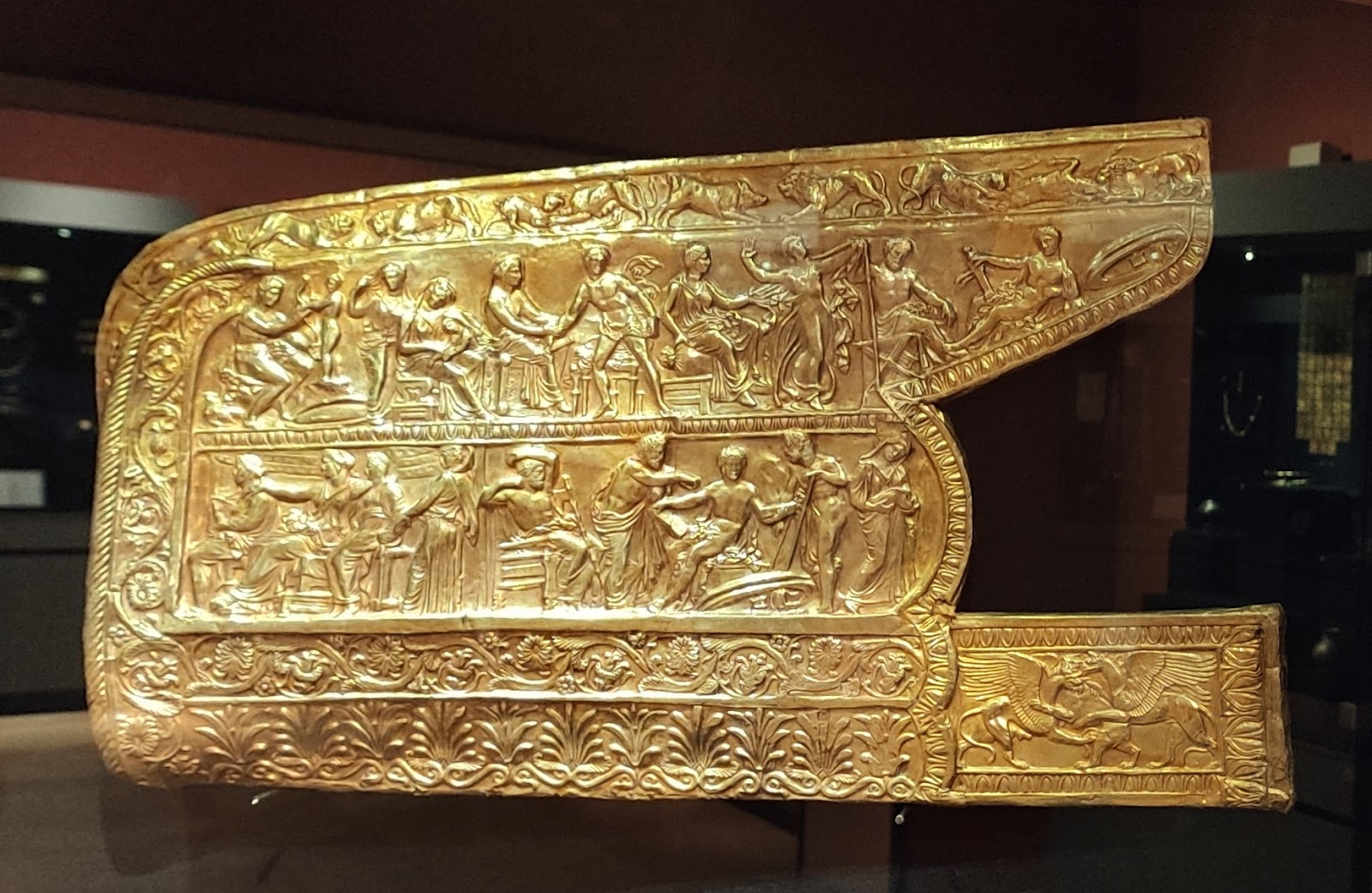
Recently, I watched a presentation on the History Channel*, about the gold quiver or goritos found in this tomb. Scholars agree that it is Scythian and not Macedonian, made between 900 and 200 BC. Next, the question arose whether it had belonged to Philip or to the woman. If it was the woman’s, who was she, and could she be a descendant of the fiercest Scythian female warriors, the mythical Amazons? 

The breakthrough occurred when the female bones and pelvis from the smaller room were analyzed. It is known that a woman’s pelvis changes during life, and it could be determined that this example was between 30 and 35 years old. 

Adea/Eurydice was only 20 years old when she had to take her life. She is not a candidate to be interred in Vergina. This conclusion automatically excludes earlier debates presenting Philip Arrhidaeus as the main occupant. 

The only remaining person obviously is Cynane, Alexander’s half-sister, who was 34 years old when she was murdered on the orders of General Perdiccas. 

It was also established that the two chambers of the Vergina Tomb were not built at the same time. Since Cynane died 13 years after her father, it is entirely plausible that her tomb was added next to her father’s at a later date. 

The program concluded with an extra note regarding the Scythian goritos (that was worn around the waist). After examining the DNA of the remains found in the Scythian kurgans, the scholars concluded that not all warriors were men, as 1/3 of the burial sites were built for women. 

Cynane must have been quite a character, raised as a warrior and a match to any man. No wonder the Macedonian troops were horrified when she was murdered in cold blood. It is quite remarkable that she lived one year longer than Alexander. Whoever arranged for her to be buried next to Philip was well aware of her courage and battle spirit. Maybe her father had been attracted to Audata for that same reason, who knows?

*2023 Strangest Things on History Channel
[Picture of Cynane's larnax and Facade of Philip's tomb are from Wikipedia; Goritos picture from this link Wikipedia]

Monday, June 30, 2025

The case of Alexander of Lyncestis

The name Alexander is already very popular in the days of Alexander the Great and may lead to confusion. 

For a start, there was King Alexander of Epirus, Olympias brother and Alexander’s uncle. I usually refer to him as Alexandros to make the difference. He is the one who married Alexander’s sister Cleopatra in 336 BC, the day King Philip of Macedonia was assassinated. 

Then there is Alexander of Lyncestis, in Upper Macedonia, son of Aeropus and son-in-law of the general and later regent Antipater. He had two brothers, Heromenes and Arrhabaeus, who were soon accused of plotting the murder of Philip II and put to death. Brother Alexander is said to have been the first to proclaim Alexander of Macedonia as king and thus avoided punishment, for now at least. 

In Alexander’s campaign, the Lyncestian was soon appointed to command the Thracian detachment and later the Thessalian cavalry. However, two years later, Parmenion, who was spending the winter near Gordion, caught a messenger carrying a secret letter from the Persian King Darius for Alexander of Lyncestis. It revealed that Darius promised to pay him a thousand talents of gold to kill Alexander and would proclaim him King of Macedonia instead! Parmenion sent the messenger with a trusted escort to Alexander, where the man repeated the same story. 

This was an extremely serious matter that Alexander put before his assembled Companions in order to make the appropriate decision. It was agreed to send a trusted man, a brother of Craterus, to Parmenion. He would travel incognito, dressed as a local and accompanied by guides from Perge, and deliver his message verbally, as it was thought better not to write down anything on a matter of this importance. Alexander’s envoy reached Parmenion without being detected and reported the instructions he was carrying. Alexander of Lyncestis was arrested and put in chains. He was tried for plotting against his king and put in prison. Being the son-in-law of Antipater, acting as the king’s Regent in Macedonia, was an important factor in his favor. 

The Lyncestian was dragged around for about three years, when in 330 BC, in the wake of Philotas trial and execution for a similar plot, the Macedonians demanded that he should be tried and punished accordingly as well. When he was brought in from confinement to plead his case, he was faltering and nervous, and found no words to reply and defend himself. This was perceived as a guilty conscience, and the bystanders ran him through with their spears. 

It should be noted that Queen Eurydice I, Alexander’s paternal grandmother, was born in Lyncestis. She married King Amynthas III of Macedonia, the father of Philip II, in 390 BC to consolidate the relations between the two countries.

Friday, June 13, 2025

Saving documents and books in antiquity

Nowadays, saving our documents and information on our computers is very obvious. Before the digital era, we relied on typewriters and printers to distribute our pamphlets, advertisements, letters, and books. 

It is hard to imagine that in antiquity nothing of the kind existed, but then the needs were entirely different. Public information, laws, decrees, and other important notices were inscribed on stone slabs or posted on walls in conspicuous places throughout the city, and eventually shared with other cities.  

Exchanging documents and letters over longer distances, as during Alexander’s campaigns, required writing on papyrus, a lightweight material that could be easily transported. His correspondence with Antipater, Olympias, Aristotle, Sisygambis, governors, and generals all over his ever-growing empire required an active exchange of news and information.

Eumenes and Callisthenes, serving as Alexander’s secretaries, must have been very busy and very organized. We tend to forget that they also kept copies of Alexander’s correspondence, official documents, and perhaps private letters as well. This becomes apparent when Eumenes tent went up in flames after a conflict that arose as Nearchus was preparing the fleet to sail the Southern Sea. 

Alexander had exhausted his own treasury and had to borrow money from his friends, including Eumenes, to finance Nearchus expedition. His secretary was to contribute 300 talents, but being stingy, he gave only 100 talents. Alexander did not accept Eumenes excuse that it was not without difficulty and decided to set his friend’s tent on fire. He expected Eumenes to rush his money out, and thus admit he had been lying. The plan went wrong, and the tent burned down entirely, leaving a clump of smelted gold and silver worth one thousand talents. In the process, Alexander’s archives were reduced to ashes. It is Plutarch who tells us that Alexander asked several governors and generals to send Eumenes copies of the papers that had been destroyed. This proves that Alexander did indeed keep a record of his correspondence! 

We so often read of papers and books that have only partially survived or are only known second-hand or not at all, except for the title. This situation is inherent to the mindset of the time and to the degradation of the natural support used (papyrus). 

Papyrus is a vegetal product and a very practical writing support, but it is also fragile. It has been calculated that papyrus documents had a lifespan of a maximum of one hundred years. This may have suited the needs at the time, but the chances of having them still around two thousand years later are very slim. 

Chances of survival were greater if there were many copies of a text, like, for instance, for theater plays. Yet, professional writers were expensive, and the costs were borne by the author. In Roman times, wealthy citizens could afford to have certain scrolls copied for their own use, but they would hardly survive after the Fall of the Roman Empire. 

Under exceptional conditions, some scrolls or bits of papyrus, however, reached us. The most telling example is the scrolls that survived the fire in Herculaneum after the volcanic eruption of Mount Vesuvius in 79 AD. Only recently have we been able to decipher their content without having to unroll the brittle carbonized scrolls (see: Reading the papyrus scrolls from Herculaneum). 

Another situation developed in Egypt. The garbage dump in Oxyrhynchus that served as fuel to the local population in the 19th century appeared to contain a huge amount of hitherto unknown papyrus texts ranging from the Ptolemaic era to the Muslim conquests in the 7th century AD. The papyri consist of private letters and public documents, such as a variety of official correspondence, theater plays, records, sales, wills, and inventories. The deciphering of the papyri is ongoing, as only a handful of scholars are capable of recognizing where the bit of papyrus text belongs. 

When parchment was introduced in the 2nd century BC, documents stood a better chance of survival, although even animal skins had their limits. However, parchment was extremely expensive to make. 

With the passage of time, interest and taste evolved and changed. Treatises, studies, analyses, and even books and poems went out of fashion and vanished altogether. 

As the writing supports were decaying, it is not surprising that documenting Alexander’s life is a nearly impossible task, despite the second-hand recordings by Arrian, Diodorus, Curtius, and Plutarch, who could still access some original documents (see: Eyewitness accounts of Alexander’s life).

[Top picture Derveni papyrus 340 BC, Thessaloniki Museum.
Bottom picture from Archaeology News, Digs & Discoveries

Wednesday, August 30, 2023

The Tabula Chigi quoting Alexander

“Kings have knelt before my spear, and their peoples too,
how many are the embraces of the Ocean around the earth.
I am the son of Philip, by Heracles a descendant of Zeus,
and of my mother Olympias, of the race of the Aeacids.”

This inscription is in Greek as it appears on the Tabula Chigi, in which Alexander speaks in the first person. 

This Tabula Chigi is a tablet made of antique yellow marble, 15.5 x 9 cm and 1.5 cm thick, from between the 1st century BC and the 1st century AD. It belongs to a series of “tabula iliaca” named after the Iliad because most of the scenes tell episodes from Homer’s book. 

[Picture from Rai Cultura, Arte]

We don’t know for whom or why these panels were created. They may have served to decorate some libraries or to disseminate a story, or they simply had a votive function. The latest opinion is that they were a kind of conversation piece for the ‘nouveaux riches’ who had no access or the skills to read literary texts. 

Another study has suggested that the Chigi iliaca were meant to be read and understood by a selected group of connoisseurs of Greek calligrams (sets of words arranged in such a way that they form a thematically related image). So far, we know twenty-two tabulae iliacae existed. Italy has the largest collection with seven tablets spread among the Capitoline Museums, the Villa Albani, the Vatican Museums in Rome, and the National Archaeological Museum of Naples. 

The Tabula Chigi was discovered in 1777 in a quarry belonging to the Chigi family. Over the years, the tablet disappeared and was known only from 19th-century illustrations. In 1928, the last member of this powerful family gave the tablet to his American wife. It was officially called lost in 2012. However, it resurfaced recently in New York and was handed over to the Italian State in the name of the last daughter of the Chigi family. It ended up in the National Roman Museum,Palazzo Massimo, in Rome.   

The tablet shows two female figures facing each other, Europa and Asia as mentioned in the inscriptions. Between them stands an altar with a relief of a cithara player, probably Apollo, flanked by two dancers, Muses or Graces. With one hand, they hold up a tondo (round relief) with various figures; and with the other hand, they hold a dish for libations and offerings. A Greek inscription fills the space between the roundel and the altar, Europa and Asia, and this is the text mentioned above. The Tabula Chigi has survived in excellent condition. 

This unique tablet has been on display during the exhibition “The instant and eternity. Between us and the ancients” together with 300 exceptional artifacts from Greek, Roman, Etruscan, Italic, medieval, modern, and contemporary civilizations. For the occasion, a section of the Baths of Diocletian, part of the National Roman Museum in Rome reopened after decades of closure. 

Saturday, August 27, 2022

Welcome to the Royal Palace of Pella

After repeated attempts and postponements (see: More restorations at the Royal Palace in Pella), the remains of the Royal Palace of Pella are finally made accessible to the public.

Several reconstructions have circulated since its first excavations in 1957, even though archaeologists initially ignored that they had found the Palace! 

As I mentioned previously (see: The Royal Palace of Pella will open to the public in 2021), the Palace covers an area of 28 ha, spreading over different levels. Unlike the Royal Palace in Aegae, the residence in Pella was also a seat of government requiring space for the vast administration of Macedonia and Alexander’s Empire. 

It took several years until the Palace in Pella was entirely mapped. Authorities are now focusing on the digital tour they plan to show in a visitor center to be built for that purpose by 2023. 

In antiquity, the visitor reached the Palace after crossing the city to the north. They accessed the construction through a monumental Propylon flanked by a Stoa with Doric colonnades. The front was 160 meters long, and the columns were 15 meters high - most certainly meant to impress. 

The most explicit mapping of the Palace I have found so far is on this site of The Kingdom of Macedon – The Palace of Pella. 

On the first terrace behind the Propylon entrance, the buildings on either side have been attributed to Macedonia's political and social life. They were built between 350 and 330 BC during the reign of Philip, Alexander’s father. Following Alexander's death and roughly between the years 320 and 250 BC, the Palace underwent drastic expansions. 

The Royal quarters, poorly preserved, were located on a higher terrace further north, after some unidentified rooms and close to the fortification wall. To the left or west of these quarters, archaeologists have unearthed a pool and a gymnasium with a large central courtyard surrounded by Stoas. They identified the adjacent building as the Residence for the Royal Pages and other officers who lived in the Palace. The two buildings to the south have been attributed to living quarters, baths, stables, workshops, kitchens, and storage space. 

I’m still wondering where Philip’s wives, besides Olympias, stayed, or the many ambassadors and envoys who came to see the King. There also must have been a room reserved for official receptions or banquets and a library. Hopefully, further excavations will follow to shed light on the missing pieces. 

Alexander had amassed great wealth, which, in part, was used effectively to display the Macedonian power and grandeur. Sadly, we will never know what treasures were kept inside the Royal Palace of Pella as the Romans thoroughly looted the premises in 168 BC. They took the prized possessions to Rome, where they ended up in the quarters and villas of high-ranked officials (see: Massive plundering of art in the early years of the Roman Empire).

[updated 16 Feb 2026]

Sunday, November 14, 2021

Antipater and Alexander

Antipater first emerges from history at the side of Philip, when he became King of Macedonia after his brother Perdiccas died fighting the Illyrians. 

From what could be established, Antipater was a Macedonian nobleman, born circa 399 BC. In his younger years, he must have accompanied King Philip (see: Macedonia Forged by Philip) during his campaigns to impose and improve the power of Macedonia. We actively see him from 346 BC onwards, aged 57. 

When Philip ended the successive Sacred Wars in 346 BC (see: Philip’s campaigns east and the Fourth Sacred War – Macedonia forged by Philip II - 11), a delegation from Athens arrived in Pella to negotiate the peace terms. After the usual diplomacy, they reached an agreement. Philip, however, didn’t trust the Athenians and sent Antipater, Parmenion, and Eurylochus to Athens to repeat his terms of peace. This is where Antipater is mentioned by Arrian for the very first time. 

During the Battle of Chaironea in 338 BC, when Alexander commanded the left flank with his cavalry, facing the Sacred Band, he was probably assisted by both generals Parmenion and Antipater. To seal the ensuing Common Peace, i.e., the League of Corinth (see: High stakes at Corinth), with the Athenians, Philip sent an official embassy led by nobody less than Alexander in the company of Antipater and Alcimachus. They carried the ashes of those Athenians who had fallen during the battle. 

The above clearly shows how much Philip trusted Antipater. It is known that the king formed a clique with Parmenion, Antipater, and Attalus, who were also bound by several intermarriages. 

Antipater’s private life is little known except that he produced an impressive number of children. His recorded sons were Iollas, Cassander, Pleistarchus, Philip, Nicanor, Alexarchus, and Triparadeisus. His daughters Phila, Eurydice, and Nicaea all married generals in Alexander’s army. 

After Philip’s assassination in 336 BC, Antipater and Parmenion, still devoted to their king, supported Alexander to be elected as his heir. However, the neighboring Thracians and the Greek states in the south had doubts about accepting the rule of this young king and revolted. Alexander had no choice but to confirm his kingship from the onset and attacked the troublemakers both north and south. 

As soon as he had established Macedonian control, he turned his attention to his Asian campaign and left Pella in 334 BC. He made sure to leave half of his troops in the capable hands of his regent Antipater, who became Hegemon. Besides this heavy responsibility, which included handling the finances of the military and the navy, he was headmaster of the School of Pages. 

On top of his own army, Antipater had the power to summon the militia of the Greek city-states. He must have managed the situation with excellence because he gathered a large number of infantry and cavalry, despite Alexander’s constant demand for reinforcements. Antipater’s troops were needed when he had to face Sparta’s revolt in the Peloponnese. 

The first group of reinforcements was already mentioned in 332 BC while Alexander was in Memphis, and some 500 mercenaries and 500 Thracian cavalry joined his lines. From Arrian, we know Alexander sent the funds needed to enlist or hire such recruits. When the king was in Susa, he sent a certain Menes back to become the new governor of Syria, Phoenicia, and Cilicia. Menes received 3,000 talents in silver with instructions to transfer as much money as Antipater needed to cover his war expenses against Sparta. The general made good use of it because he emerged victorious in the decisive battle at Megalopolis, just north of Sparta. 

Antipater was, unfortunately, seriously criticized by Olympias, who liked to interfere in all matters. After several years, it must have become challenging for Alexander to make sense of either version of the facts. A mother’s love is mighty, and the image of the once-trusted commander was eventually blemished. Even if Alexander wanted to dismiss Antipater, he had nobody to replace him – not until a year before his death. Alexander decided to send Craterus to replace Antipater as the new regent in Macedonia. The regent-to-be was sent back home at the head of those veterans no longer fit for service. 

Alexander called (or summoned) Antipater to come to Babylon, but the old general ignored the order and sent his son Cassander instead. That is a bizarre decision because Cassander was not his favorite. Whether Cassander forced his father to accept to let him go or if it was by mutual agreement in case of the poison complot is true, we’ll never know. We will remember that Antipater’s son, Iollas, was Alexander’s cupbearer then. 

Alexander left no heir or successor when he died in 323 BC. As a result, each of his generals claimed a part of this empire. As a matter of fact, Antipater took control of Macedonia. This, however, did not mean peace as Antipater got involved in the Lamian War. The Aetolians, a tribe south of Thessaly, decided to help the Athenian general Leosthenes defeat Antipater. Leosthenes managed to corner Antipater, but luckily Craterus came to the old general's aid, and the Siege of Lamia was thus broken. The war proper ended a year later, in 322 BC, during the Battle of Crannon, when Leosthenes was killed. 

Antipater died in 319 BC at the blessed age of eighty. Upon his deathbed, he left his realm to Polyperchon and not Cassander. The arrogant Cassander deeply resented this, and Macedonia was the scene of bitter fights between Polyperchon and Cassander for the next decade. But that is another story altogether. 

It is quite astonishing to note how much Antipater accomplished in his later years. From the time of the Sacred Wars that ended in 346 BC until he died in 319 BC, he lived through some twenty-five turbulent years. In our modern world, this is the time for retirement. Amazing!

Sunday, August 22, 2021

The tomb of Olympias found?

Last month, the Greek City Times published an article with the resonating title “Professor Bidas: Tomb of Alexander the Great’s mother was found in Korinos.” The news is worth making headlines, and I’m puzzled because it didn’t. 

It is all about one of the tombs of Korinos, some 13 kilometers south of Pydna. These tombs were discovered back in 1860 by the French archaeologists L Heuzey and H Domet, who named them A and B. Both tombs had been plundered in antiquity, and the artifacts left behind were recuperated by Heuzey to be sent to the Louvre in Paris. The tombs, which were covered by a tumulus, are dated to the 4th century BC. 

[Entrance to the tomb by Daumet 1855. Picture from Greek City Times]

In 1991, the Greek archaeologist, M Besios, restarted the excavations and concentrated on the largest tomb. The burial complex is 22 meters long compared to the 9.5 meters of King Philip’s tomb in Aegae. The size alone is enough to raise the question of the possible occupant of such a large gravesite. 

As he uncovered a rare construction of three consecutive burial chambers, M Besios concluded that the grave was intended for an important person. He found a marble case in the burial chamber that once held the vessel with the cremated remains on the east side. This result indicates that the remains belonged to a woman since women were buried with their heads facing east. 

The logical conclusion was that this tomb must have belonged to Queen Olympias. She had been assassinated by Cassander in 316 BC at the issue of the siege of Pydna and buried outside the city. 

At the tomb's entrance are the building remains of what seems to refer to a temple in honor of the deceased. Three epitaphs were found in the area. They mention the Aiakides, who were relatives of Olympias living in the outskirts of Pydna. A good reason for choosing this location for the burial. Remarkably, one of the epitaphs refers to a memorial dedicated to Neoptolemus I that stood opposite the tomb attributed to his daughter Olympias, the spouse of Philip II of Macedon. A wide road separated both constructions. 

In light of the above, Emeritus Professor Athanasios Bidas claimed to have located the tomb of Queen Olympias here in Korinos (see also: Is the Mother of Alexander the Great in the Tomb at Kasta Hill near Amphipolis?) The announcement was made public in December 2019, but competent authorities in Greece remain reticent to accept his argumentation. 

This lack of reaction is as surprising as the one that followed the discovery of the (doubtful) grave of Alexander the Great in Siwah in 1995. At that time, archaeologist Liana Souvaltzi substantiated her finds, but her digging permit was blocked by the Greek government as soon as she did. They sent an advisor of the Greek Embassy to the Egyptian government to withdraw her excavation permit and prevent her further excavations of the tomb. Twenty-five years later, Liana Souvaltzi still fights to return to Siwah and resume her excavations. 

It makes one wonder if nobody in the world wants to know the truth about what happened to the remains of Alexander the Great, his mother Olympias, his wife Roxane and their son Alexander IV, as well as those of Heracles and his mother, Barsine. Until now, it remains unsure whether the tomb of the young prince discovered next to the grave of Philip in Aegae belongs to Alexander IV.

Tuesday, July 20, 2021

Birthday wishes

Dear Alexander, 

Wouldn’t it be great if this year you received a gold medallion for your birthday like those made by Roman admirers some five hundred years after your death? The “Alexander cult” was still very much alive at that time when able craftsmen created such marvelous works of art. 

This gem was part of the Abukir Medallions made in Roman times between 215 and 243 AD. The obverse shows your familiar effigy with ram’s horns looking slightly upwards. The reverse displays this splendid Nike in full action as she holds the reins of the quadriga in one hand and a palm branch and a headband in the other. For the unbelievers, there is an inscription that reads ΒΑCΙΛ-ΕωC /ΑΛΕΞΑΝΔΡΟΥ – in other words, Basileus Alexandrou. With a diameter of 5.4 cm, it weighs nearly 113 grams. Isn’t this medallion genuinely worthy of you and your accomplishments? 

How many more medallions and remembrance coins must have been issued by you to underscore the merit of your men! How many must have been distributed by your successors and by famous and less famous admirers! Sadly, so many have been lost in time. 

With gratitude for the immense heritage you left us,

Argyraspid and the crowd of Philalexandros from all over the world.

This Abukir Medallion was part of a stash of 20 medallions, 600 gold coins, and about 20 stamped gold ingots discovered by chance in Egypt in 1902. Shortly after their discovery, they were presented to the Bibliothèque Nationale de France in Paris and the British Museum in London. It is hard to believe that both institutions refused to buy the medallions. Their excuse was that they doubted their provenance and authenticity. 

In the end, the medallions were offered to the Staatliche Museen (Berlin State Museum) in Berlin, which purchased five of them after being able to establish that they were genuine. The remainder was sold to private collectors around the world. In 1949, the Calouste Gulbenkian Museum in Lisbon acquired three medallions from James Loeb and another eight from the Pierpont Morgan Library and Museum in New York. Alexander is represented on seven of these gold pieces, and his mother, Olympias, on another two. One medallion depicted Emperor Caracalla, a great admirer of Alexander who tried to emulate him (as if he could!)

Tuesday, May 4, 2021

Hidden treasures of Epirus

Northern Greece and Epirus, in particular, are not top destinations for the common tourist – unfortunately so. 

Epirus is wedged in the northwestern corner of Greece, and this rugged mountainous landscape shares borders with Albania. It is also the homeland of Queen Olympias, Alexander’s mother. 

The best-known site is the sanctuary of Dodona, which King Pyrrhus of Epirus promoted as the religious capital in 290 AD. It features a remarkable theater and is seen as the oldest Hellenic oracle. Other notable places are Gitana (3rd century BC), Amvracia (founded in the 7th century BC. It was given to Pyrrhus by the son of Cassander in 294 BC); Cassope (founded in the 4th century BC), and Nicopolis (founded in 28 BC by Octavian after his victory at Actium). 

At present, a project has been conceived to link the theaters of these towns together and to create a brand new tourist trail. The idea behind this plan is that from antiquity onward, theaters are places where people met and interacted on different levels. 

These five archaeological sites are stringed along a circuit of 344 kilometers which the intrepid traveler can discover. Although the theater shares a common link, it is obvious that the sites have much more to offer when it comes to archaeology, history, culture, art, and modern daily life. 

The article from the Archaeology News Network puts the accent on developing tourism in the region. Still, the underlying historical value of the antique cities is not in the least described. Without their appropriate background, it is difficult to truly appreciate the theaters as their focal points.

Saturday, January 30, 2021

Writing a letter home and the logistics implied

It sounds like the most obvious thing to do for a soldier, writing a letter home. But I find it quite remarkable that the Macedonian troops travelling with Alexander wrote letters to their family in their homeland because it implies that the average soldier could actually read and write! Maybe they didn’t all carry pen and ink in their backpack but papyrus or some kind of parchment – even though that seems to have been implemented only in the days of Cleopatra – was easy to take along.

The letters home are rarely mentioned in our literature but they become subject to close scrutiny when the Macedonians are divided after the plot and the execution of Philotas in 330 BC. Many were distressed by the murder of Parmenion, Philotas father. The army no longer stood unanimously behind the king’s decisions and policies. Alexander, however, could not let this group of discontent troops sow havoc in his ranks. He had to make sure to find the traitors and those who dared to criticize him. This was a serious matter and he decided to open and censor the army’s letters home. This was the only way for Alexander to locate the unruly elements. He removed the culprits from their own units and transferred them to a separate body, the ataktoi, a disciplinary unit that was specially created for the occasion. These men were sent on particularly dangerous or suicidal missions where they could and would redeem themselves – if they were not killed that is.

The courier service between the troops on the march and their homeland must have involved an incessant flow of riders and seafarers – not only for the common soldiers but also for official business that must have followed another channel.

The most frequent mail exchanges were undoubtedly Alexander’s official correspondences with his Regent, Antipater, and with foreign ambassadors and representatives. It was the task of his secretaries Eumenes of Cardia, who occupied that position previously under his father, and of Callisthenes of Olynthus, the nephew of Aristotle. There must have been an entire “office” of scribes of all kinds, including people who were familiar with the does of don’ts at foreign courts and a number of qualified translators and copyists to keep track of the documents.

Alexander certainly wrote his private letters to his mother Olympias personally for I doubt he would have entrusted these to anyone else. He may have employed a number of private and trustworthy couriers because the content of those documents was highly sensitive.

We are also aware of Hephaistion’s correspondence with Aristotle but it seems evident that he maintained a vivid correspondence with many scholars and high ranking officials spread all over the conquered territories and even beyond.

Also, the incoming mail had to be checked, sorted and distributed. The royal mail had priority and was opened, checked and sorted by the scribes in Alexander’s tent supervised, I assume by Eumenes who had to decide what had to be prioritized and what not.

The matter of correspondence, on whatever level, implies a huge logistic machinery of its own. It has been suggested that initially Parmenion was responsible for the army’s logistics, which may have included the mail services. However, once he was assigned as keeper of the immense Persian treasury in Ecbatana, we don’t know who replaced him to become the trusted brain behind those operations.