Alexandria's founded by Alexander

Alexandria's founded by Alexander the Great (by year BC): 334 Alexandria in Troia (Turkey) - 333 Alexandria at Issus/Alexandrette (Iskenderun, Turkey) - 332 Alexandria of Caria/by the Latmos (Alinda, Turkey) - 331 Alexandria Mygdoniae - 331 Alexandria (Egypt) - 330 Alexandria Ariana (Herat, Afghanistan) - 330 Alexandria of the Prophthasia/in Dragiana/Phrada (Farah, Afghanistan) - 330 Alexandria in Arachosia (Kandahar, Afghanistan) - 330 Alexandria in the Caucasus (Begram, Afghanistan) - 329 Alexandria of the Paropanisades (Ghazni, Afghanistan) - 329 Alexandria Eschate or Ultima (Khodjend, Tajikistan) - 329 Alexandria on the Oxus (Termez, Afghanistan) - 328 Alexandria in Margiana (Merv, Turkmenistan) - 326 Alexandria Nicaea (on the Hydaspes, India) - 326 Alexandria Bucephala (on the Hydaspes, India) - 325 Alexandria Sogdia - 325 Alexandria Oreitide - 325 Alexandria in Opiene / Alexandria on the Indus (confluence of Indus & Acesines, India) - 325 Alexandria Rambacia (Bela, Pakistan) - 325 Alexandria Xylinepolis (Patala, India) - 325 Alexandria in Carminia (Gulashkird, Iran) - 324 Alexandria-on-the-Tigris/Antiochia-in-Susiana/Charax (Spasinou Charax on the Tigris, Iraq) - ?Alexandria of Carmahle? (Kahnu)
Showing posts with label Eurydice-wife of Arrhidaeus. Show all posts

Monday, July 28, 2025

Cynane buried next to her father, Philip II

Cynane was Alexander’s half-sister, born around 357 BC. Her mother was Audata from Illyria (see: The many wives of Philip II of Macedonia), whom King Philip had married to secure his expanding kingdom. 

Philip gave Cynane in marriage to Amyntas, who was the legal successor to the throne of Macedonia after his father, King Perdiccas III of Macedonia, died in combat in 359 BC. As Amyntas was only a child, Philip, Perdiccas' younger brother, became his tutor and regent. Later that year, Philip was elected king instead.

After Philip's murder in 336 BC, Amyntas could have taken his chances, but he did not, for whatever reason. The newly elected King Alexander, however, did not hesitate and had Amyntas killed. He could have suspected that Cynane would manipulate her husband to gain power. Cynane was left a widow, raising her daughter Adea alone. Not for long, though.

When Alexander made his way to Pelium in 335 BC, he faced a threatening revolt of the Illyrians, and Langaros, King of the Agrianes, came to his rescue. In recognition of his assistance, Alexander invited Langaros to Pella, offering his half-sister Cynane in marriage. Before this wedding could materialize, Langaros fell ill and died (see: The short-lived appearance of King Langaros).  

Cynane stayed in Macedonia as Alexander left for Asia. Having been raised by her mother in the Illyrian tradition as a warrior, equal to any man, she now instilled the same values in her daughter. 

Upon Alexander’s death, Cynane saw her chances, not for herself but for Adea. She mobilized her troops and led her daughter and her army to Babylon to secure their future by arranging the marriage of Adea with Alexander’s successor. 

As the daughter of Philip II and Alexander’s half-sister, Cynane enjoyed the loyalty of the Macedonian army, despite General Perdiccas’ disagreement. The general tried to stop her in every possible way and sent Alcetus, who killed Cynane before she could speak. This assassination did not sit well with the Macedonian army, who revolted and demanded that Adea, Alexander’s niece, marry Alexander’s half-brother, the simple-minded Arrhidaeus. Arrhidaeus, who was the only available bloodline, would rule as King Philip III, and Adea would become Queen Eurydice II. She was the power behind Philip III, which was not to the liking of Queen Olympias. She had Philip III killed in 317 BC and Eurydice II imprisoned and forced her to commit suicide. 

This long introduction brings me to the tomb of Philip II and the adjacent tomb of a woman in Vergina. Since its discovery in 1977 when Manolis Andronicos attributed the tomb to Philip II and the remains in the smaller room to his seventh and last wife, Cleopatra, many arguments have erupted, presenting different theories. 
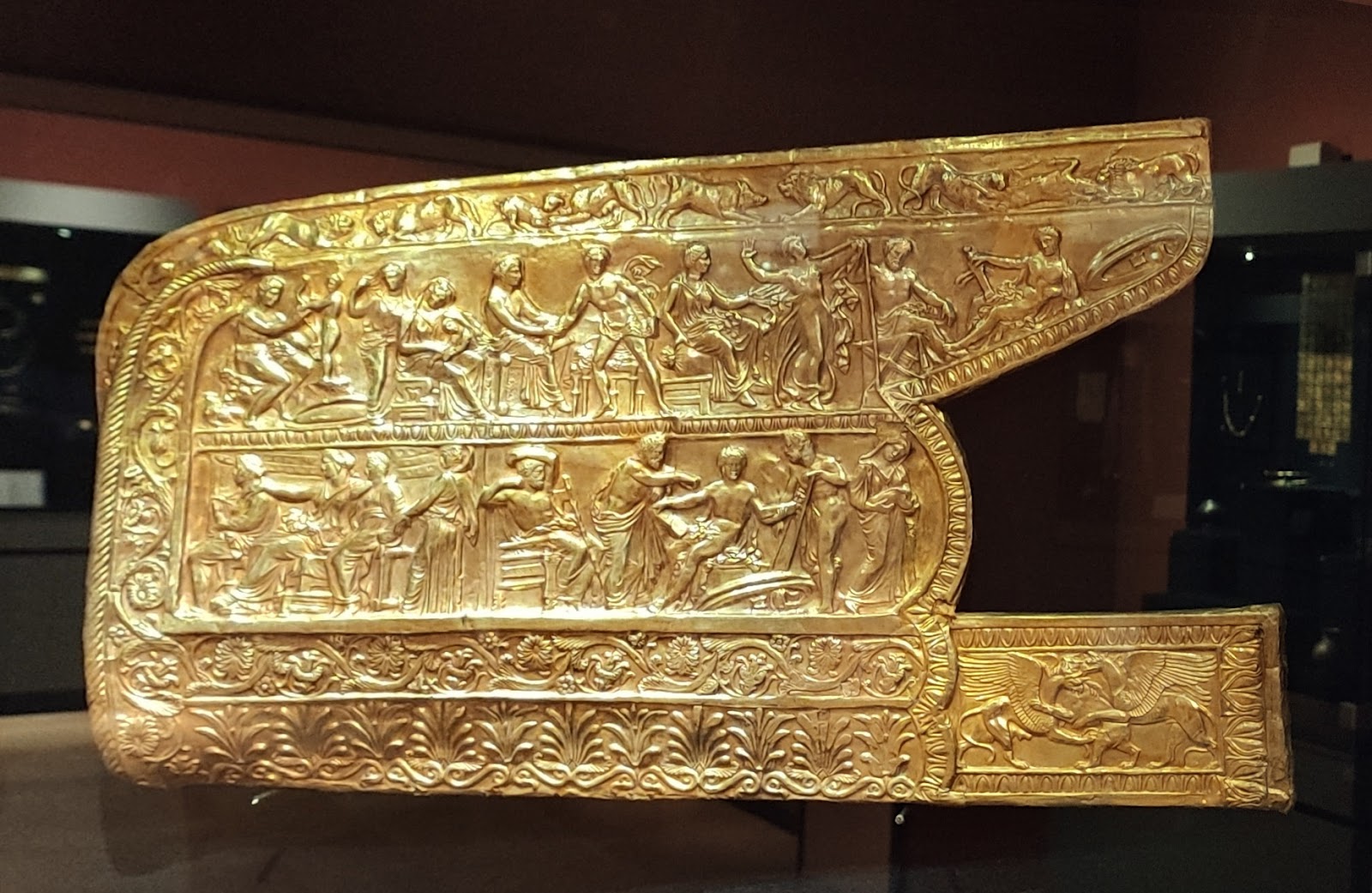
Recently, I watched a presentation on the History Channel*, about the gold quiver or goritos found in this tomb. Scholars agree that it is Scythian and not Macedonian, made between 900 and 200 BC. Next, the question arose whether it had belonged to Philip or to the woman. If it was the woman’s, who was she, and could she be a descendant of the fiercest Scythian female warriors, the mythical Amazons? 

The breakthrough occurred when the female bones and pelvis from the smaller room were analyzed. It is known that a woman’s pelvis changes during life, and it could be determined that this example was between 30 and 35 years old. 

Adea/Eurydice was only 20 years old when she had to take her life. She is not a candidate to be interred in Vergina. This conclusion automatically excludes earlier debates presenting Philip Arrhidaeus as the main occupant. 

The only remaining person obviously is Cynane, Alexander’s half-sister, who was 34 years old when she was murdered on the orders of General Perdiccas. 

It was also established that the two chambers of the Vergina Tomb were not built at the same time. Since Cynane died 13 years after her father, it is entirely plausible that her tomb was added next to her father’s at a later date. 

The program concluded with an extra note regarding the Scythian goritos (that was worn around the waist). After examining the DNA of the remains found in the Scythian kurgans, the scholars concluded that not all warriors were men, as 1/3 of the burial sites were built for women. 

Cynane must have been quite a character, raised as a warrior and a match to any man. No wonder the Macedonian troops were horrified when she was murdered in cold blood. It is quite remarkable that she lived one year longer than Alexander. Whoever arranged for her to be buried next to Philip was well aware of her courage and battle spirit. Maybe her father had been attracted to Audata for that same reason, who knows?

*2023 Strangest Things on History Channel
[Picture of Cynane's larnax and Facade of Philip's tomb are from Wikipedia; Goritos picture from this link Wikipedia]

Saturday, September 27, 2014

Amphipolis/Kasta Hill … here we go again!

A strange statement was made yesterday by Mrs. Katerina Peristeri “in about a month we finish”. Did she mean that excavations at Amphipolis would be stopped for the season or does she expect to round up the excavations in a month?


Once again speculations about the possible occupants are listed in this article by Newsbomb.gr. Why are they rubbing in all these theories time and again, I don’t understand. Anyway, just to be complete, here follows the list of the possible names:

  1. Megas Alexandros himself
  2. Roxane
  3. Alexander IV, the son of Alexander the Great
  4. Olympias, the mother of Alexander the Great
  5. Cleopatra, the sister of Alexander the Great
  6. Cassander, son of Antipater, who murdered Olympias, Roxane, and Alexander IV
  7. Nearchus or Laomedon or Androstenes, all generals of Alexander the Great
  8. Antigonus Monophthalmus, general of Alexander the Great and one of the Diadochi
  9. Hephaistion, a childhood friend and general of Alexander the Great who died in Ecbatana
  10. Heracles, the illegitimate son of Alexander the Great, and Barsine, his mistress
  11. Polyandrion
  12. Polyperchon, general of Alexander the Great
  13. Philip-Arrhidaeus, half-brother of Alexander the Great
  14. Philip II, Alexander’s father as many still doubt that he was buried in the tumulus of Aegae
I am not going to comment on any of these suggestions – that have been amply discussed in earlier articles. For those who still want to read more on this argumentation, please click on this link for Newsbomb.gr.

The least I can say is that they covered every possible candidate, except maybe Queen Eurydice who married Philip-Arrhidaeus. Why has she been left out?

[Picture from Newsbomb.gr]

Wednesday, August 4, 2010

Funeral Games by Mary Renault


Funeral Games (ISBN 0-375-71419-7) is the third novel Mary Renault wrote, after Fire from Heaven and The Persian Boy – the first about Alexander’s boyhood and the second about his Asian conquests till his untimely death in 323 B.C.

As is generally the case in any trilogy, this book is the least appealing, not only because the hero, Alexander, is no longer the red thread running through the pages, but mainly because it does not add anything to the character of Alexander. What he left to posterity right after his death was only a void that nobody knew how to fill. Alexander’s legacy in the long term is enormous. It is the kind of ripple mark effect that has not yet come to a standstill. We owe Hellenism to him and our entire Western culture to Hellenism and, thus, to Alexander.

The story starts right after Alexander died in Babylon, and the disbelief and bickering of his generals. Nobody knows what to do; each general pretends to know best but is utterly incapable of taking full charge. Ultimately, they agree to give the kingship to Alexander’s simple-minded half-brother Arrhidaeus, pending the outcome of Roxane’s pregnancy, not knowing whether it will be a boy. But even when the boy is born and is appropriately given the name of Alexander IV, the leadership of Alexander’s empire continues to fall apart.

The leading figure in the Wars of the Diadochi events around the succession is played in Mary’s novel by Eurydice, who was betrothed to Arrhidaeus, who took the title of King Philip III. Eurydice was the daughter of Amyntas, son of King Perdiccas III, and the elder brother of Philip II. Since Amyntas was only an infant when Perdiccas died, the throne went to Philip, Perdiccas’ younger brother. If the person of Eurydice really existed as painted by Mary is a possibility, not a historical fact. It makes for good reading and navigates us through the plots and envy that ruled the forty years after Alexander’s death.

I find this a sad story, not only because Alexander is no longer in the picture but because of the intrigues between the great men surrounding him and the disintegration of all he stood for. In her comments, Mary remarks that Macedonia returned to the feudal way of life from before King Philip’s time, i.e., the only way it knew how to survive. I think she pointed to the sore spot there. It took the world eons to recover, and in my eyes, Macedonia sadly never recovered.

Anyway, one should read this book to make the story complete, but I find it much less than Mary’s two previous novels, which are absolutely superb.

Also available as an e-Book.