Alexandria's founded by Alexander

Alexandria's founded by Alexander the Great (by year BC): 334 Alexandria in Troia (Turkey) - 333 Alexandria at Issus/Alexandrette (Iskenderun, Turkey) - 332 Alexandria of Caria/by the Latmos (Alinda, Turkey) - 331 Alexandria Mygdoniae - 331 Alexandria (Egypt) - 330 Alexandria Ariana (Herat, Afghanistan) - 330 Alexandria of the Prophthasia/in Dragiana/Phrada (Farah, Afghanistan) - 330 Alexandria in Arachosia (Kandahar, Afghanistan) - 330 Alexandria in the Caucasus (Begram, Afghanistan) - 329 Alexandria of the Paropanisades (Ghazni, Afghanistan) - 329 Alexandria Eschate or Ultima (Khodjend, Tajikistan) - 329 Alexandria on the Oxus (Termez, Afghanistan) - 328 Alexandria in Margiana (Merv, Turkmenistan) - 326 Alexandria Nicaea (on the Hydaspes, India) - 326 Alexandria Bucephala (on the Hydaspes, India) - 325 Alexandria Sogdia - 325 Alexandria Oreitide - 325 Alexandria in Opiene / Alexandria on the Indus (confluence of Indus & Acesines, India) - 325 Alexandria Rambacia (Bela, Pakistan) - 325 Alexandria Xylinepolis (Patala, India) - 325 Alexandria in Carminia (Gulashkird, Iran) - 324 Alexandria-on-the-Tigris/Antiochia-in-Susiana/Charax (Spasinou Charax on the Tigris, Iraq) - ?Alexandria of Carmahle? (Kahnu)
Showing posts with label Cyrene. Show all posts

Tuesday, February 24, 2026

The Trojan War in the absence of Helen

Hector seated
The Trojan War, as recounted by Homer, is a beautiful love story of Paris and Helen set against the cruelty of war when Achilles dragged the dead body of Hector behind his chariot around the city. It is the kind of subject we can still recognize today. 

Recently, I had echoes of another version in which Helen never made it to Troy but stayed in Egypt instead. One of the sources was Herodotus’ book "Histories". 

At first, I dismissed the information, mostly because Homer’s account was so familiar. When Heinrich Schliemann discovered the walls of Troy and Priam’s gold treasury in the late 19th century, the history of Troy and the Trojan War came back alive. 

Herodotus, a native of Halicarnassus, is described as ‘The Father of History’. He was an intrepid traveler, very inquisitive about foreign lands and customs. He journeyed widely around the Mediterranean, as far south as Elephantine on the first cataract of the River Nile and as far north as the Black Sea. He visited southern Italy and eventually settled in Thurii on the Gulf of Taranto. He may well have spent time in Cyrene and even in Babylon. 

Herodotus

This Greek historian lived in the 5th century BC (he died in 425 BC), roughly three hundred years after Homer. Both men relied on the world around them and on the sources that were available to them.

During his stay in EgyptHerodotus spoke to the priests of the Temple of the “Foreign Aphrodite”, meaning Astarte. They said that Helen arrived in Egypt with Paris after a severe storm had blown their ship off course. The couple was brought before the pharaoh in Memphis, who condemned Paris for taking Helen away from her husband, whether by force or not, and seizing treasures from Sparta. He granted Paris three days to leave the country to return to Troy,  but he kept Helen in Memphis. 

Questioning the priests further, Herodotus was informed about the Trojan War as told to them directly by Helen's husband, Menelaus. 

What happened was that after the abduction of Helen, the Greeks sent their forces to support Menelaus. The Spartan king and his delegation were received at Troy’s Palace, where they demanded the return of Helen and the stolen treasures. The Trojans responded that neither Helen nor the treasure was in their possession, but was held in Egypt instead. Obviously, the Greeks refused to believe them and laid siege to Troy. They fought each other for ten years, and all that while Helen waited in Egypt. 

When Troy fell, and there was still no trace of HelenMenelaus sailed to Memphis. After giving the pharaoh a true account of what had happened, he was reunited with Helen, 'having suffered no evil’, and the stolen treasure was restored. 

This looks like a happy ending, but it was not. Menelaus got cross because contrary winds pinned him down in Egypt for a long time. As an offering to the gods, he took two Egyptian children, whom he offered in sacrifice. This act of disrespect turned the friendship of the Egyptians into hatred. Menelaus was pursued but managed to escape to Libya with Helen and his ships. What happened afterwards, the priests did not know. 

Herodotus was not the only one to suggest that Helen never went to Troy but stayed in Egypt during the Trojan War. 

Euripides
There was Euripides, who in 412 BC wrote his play "Helen", in which Helen is taken to Egypt by the gods. The Helen who accompanied Paris to Troy was an eidolon, a spirit-image or likeness, cursed for her infidelity by the Greeks and Trojans alike. Meanwhile, the real Helen spent the ten-year siege of Troy in Egypt! 

It is noteworthy that Euripides was born ca. 480 BC, meaning that he was 55 years old when Herodotus died in 425 BC. He definitely must have known Herodotus’ travel history and the details of his encounters. Euripides may well have given his own twist to Herodotus’ tale of Troy. 

A similar eidolon image is introduced in Stesichorus' account. This lyric poet, who lived from around 630 to 555 BC, antedates both Herodotus and Euripides. The story goes that Stesichorus was blinded because he slandered Helen, but recovered his eyesight after writing her praise. 

Helen’s eidolon image may have been introduced by Homer or Hesiod, who reached his peak in popularity around 700 BC. 

In his "Histories"Herodotus believes that Homer knew of this eidolon version keeping the real Helen in Egypt, but that he decided not to use it, preferring the more epic poetry. 

Troy walls

Interpreting this ‘eidolon’ in today’s world is very difficult. We may think that Paris believed in ghosts since, according to this story, nobody in Troy had ‘seen’ Helen. It is clear that, in antiquity, the gods played an important role in daily life. Before the outbreak of the Trojan WarParis had built a reputation for making fair decisions, away from outside influences. For that reason, he had been appointed by Zeus to choose which of the three goddesses was the most beautiful: Athena, Aphrodite, or Hera. He elected Aphrodite, the goddess of love. In return, Aphrodite brought Helen, the most beautiful mortal, into the life of Paris, and they fell in love. The fact that Helen was already married to Menelaus, king of Sparta, and had a daughter, Hermione, did not bother Aphrodite. To alleviate the pain of Paris being separated from his beloved Helen, the goddess introduced Helen's eidolon. 

That leaves me with Alexander cherishing the Iliad to the point of keeping it at his bedside. His copy had annotations made by Aristotle, which indicates that the Iliad was well studied and discussed by both men. It is unthinkable that Aristotle was not aware of  Helen’s eidolon substitute in Troy, and this goes for Alexander as well. However, I assume that Alexander’s fascination with the Iliad was mainly because of Achillesheroics. 

Wednesday, January 29, 2025

Alexander’s missed voyage to conquer the West

Alexander always planned ahead, far ahead even. He was a true genius juggling many problems, projects, and strategies (see: Eyewitness accounts of Alexander's life). 

His most significant projects, or at least their outlines, were put on paper, as we may conclude from the to-do list the king left upon his death, as mentioned by Diodorus. We have no reason to believe Alexander’s ambition was a utopian dream. After all, conquering the then-known world in less than ten years is a superhuman achievement. Nobody before or after Alexander succeeded. Nothing could stop Alexander – except his own death. 

It has been generally accepted that Alexander aimed to conquer the western Mediterranean, and the idea is consistent with his character. However, Diodorus text may be a list of ideas rather than real plans, as we all would imagine. 

Besides his plan to build colossal temples and a mausoleum for his father, there was the project to build a thousand warships, larger than triremes, in Phoenicia, Syria, Cilicia, and Cyprus. This construction had already started while Alexander was in Babylon and alive. He planned to conquer Carthage. On the way, along the coast of Libya, he would create a string of safe havens and shipyards. Eventually, this strategy would lead him to Iberia and Magna Graecia, including Sicily, where many Greek colonists had established themselves centuries earlier. 

In the end, the Romans attacked the Carthaginians in Sicily in the First Punic War, 60 years after Alexander’s death. A second war shifted their terrain to Iberia, which was largely occupied by the Carthaginians (see: Carthage Antique, des origines jusqu’à l’invasion Vandale). We can only guess how Alexander would have handled the confrontation, especially since the power of Carthage was different in his days. 

On his way to Carthage, Alexander would need to secure the hinterland to protect his newly built harbors along the North African coast. To this effect, he conceived the construction of a road as far as the Pillars of Heracles (Gibraltar). The project materialized 2,500 years later when Mussolini built a 2,000 km-long highway, the Litoranea, running from Tunisia all the way to the Egyptian border (see: Cyrene, founded by the Greeks). We may wonder whether this was Alexander’s megalomania or far-sightedness. 

Greek immigrants searching for fertile lands and a better life had already colonized a significant part of the western Mediterranean. Around 600 BC, the Phocaeans (from modern Foça), who fled Asia Minor after a siege by the Persians, established themselves in southern France, where they founded the city of Massalia, modern Marseille. By 575 BC, these settlers founded regional colonies in Agde (Agathe Tyche), Antibes, Nice (Niké), and Monaco. 

With time, these colonists went further inland and spread all over Provence. The city of Arelate, modern Arles, occupied a strategic position where goods traveled up and down the River Rhone after they had been transhipped from Massalia. Most of those settlements are best known by their Roman names: Orange, Vaison-la-Romaine, and Glanum, although their origin was much older. 

A photographer friend of mine, Andrew Squires, explored Provence. His vision was to create images of the region, including Glanum, that translate the remains into what it once was. He published a splendid work of art as an iBook (with Apple) under the name Provence Mysterious. 

The Phoceans from Massalia, about the same time as they expanded in Provence, created circa 550 BC the trading post of Emporion, Roman Ampurias, and Rhoda, modern Rossas in Spain. Both cities, connected by a long sandy beach, served as stopover ports in the Greek expansion in the western Mediterranean. Geographically speaking, Emporion occupies the southwestern end of the Golfe de Lion, opposite Massalia. 

The first colonization of Magna Graecia happened earlier than elsewhere in that part of the Mediterranean. It started in Cumae, founded around 740 BC by emigrants from Chalcis and Kyme. Spartans emigrated to Taras, later named Tarentum. It was soon followed by new colonies established by the Achaeans in Metapontum, Sybaris, and Croton. In 733 BC, Greek settlers from Corinth arrived on the small island of Ortygia and founded Syracuse.

In the 6th century BC, Athenian settlers founded Thurii. Around 580 BC, colonists from Gela (Sicily), Crete, and Rhodes founded Akragas (Agrigento). 

Many of these initially Greek colonies became influential cities in their own right, creating their own towns. A good example is Sicily, where the new colonies fought the Carthaginians, the Romans, and each other, seeking their own ideals (see: Syracuse rivaled Athens to be the most powerful city). 

In 535 BC, Phocaean refugees established the colony of Elea, home of the Eleatic School created by the philosopher Parmenides (see: Magna Graecia, the forgotten Greek legacy). In 433 BC, the colony of Tarentum founded Herakleia, and the Achaeans founded Poseidonia, Roman Paestum. 

These relentless fluxes of Greek emigrants were no secret to Alexander and his contemporaries, meaning he was well aware and informed about the western Mediterranean – something we tend to forget! 

An excellent example of the high skills and wealth in the western Mediterranean is the so-called Riace bronzes retrieved off the coast of Calabria ( see: More about Magna Graecia: a testimony from Calabria). Archaeologists disagree on whether they represent warriors, athletes, or gods. Consequently, they are called “Riace A,” created between 460 and 450 BC, and “Riace B,” between 430 and 420 BC. Let’s keep in mind that these statues are the kind of artwork that existed a century before Alexander. 

Although extensive, the above-mentioned list of Greek colonists in the western Mediterranean is far from complete but long enough to prove their impressive presence. They often were caught in the expansionist attacks of the Carthaginians and, alternatively, of the Romans. Alexander would have to face both sooner or later. With his seasoned Macedonians, he would have created a Greek/Hellenistic world instead of the Latin one that Rome imposed on Western Europe. How different our world would have been!

Friday, October 25, 2024

About decrees and multilingual inscriptions

In antiquity, news was carried by word of mouth, but legal matters and other important information were cut in stone and placed in a conspicuous spot for everyone to see. 

The majority of inscriptions are Decrees of which I can only mention a selection. 


At the Acropolis Museum, there is a stele with decrees for the construction of the temple and altar of Nike by Kallikrates, for the reorganization of the cult, and for the salary of the priestess of the goddess dated 427-424 BC (side A) and 424-423 BC (side B).


Also a stele with a series of Decrees by which the Athenians bestowed economic, commercial, and military privileges on their ally Methone in Pieria

It shows the goddess Athena shaking hands with perhaps Artemis, dated 430-423 BC.


Very broken but still readable is the Athenian Decree honoring Neapolis (modern Kavala) for its support in the war against Thasos and its constant commitment to her. 

In the upper right corner, we recognize the goddess Athena extending her hand towards another figure, probably the goddess Parthenos of Neapolis, dated from 410-409 BC.


A very elegant stele with a horse and an olive wreath carries an inscription in which the Athenians honored King Alcetas of Epirus for his help during their military expedition to Corcyra (modern Corfu) in 373-372 BC.


And finally, still at the Acropolis Museum, there is the long Decree of Chalkis on the island of Euboia in which the islanders were forced to swear loyalty to Athens after failing in their revolt of 446-445 BC. 

The people of Chalkis could punish their own citizens, except in cases that involved death, exile, or the loss of their rights as citizens, where the power of Athens prevailed.

The National Archaeological Museum in Athens has its own rich collection of Decrees. A good example is the honorary inscription from Piraeus dating from 347-346 BC. 

The stele honors the three sons of Leukon (depicted), king of the Cimmerian Bosporus, thanking them for services rendered to the people of Athens and allowing them to import grain free of duty.


A particular stele from 355-354BC was found near the Monument of Lysicrates in Athens

It honors Philiskos, son of Lykos of Sestos in the Thracian Hellespont as a public guest and benefactor of Athens. In 356 BC, Philiskos had warned the Athenians of the hostile presence of the fleet of Byzantium that threatened the city’s grain supply.


The Eleusis Museum, in turn, exhibits a decree providing for the construction of a footbridge across Lake Rheitoi on the Sacred Way from Athens to Eleusis, dated 421 BC.


Two fragments from an unidentified monument carry a Royal Decree of Alexander, which defines the limits of ‘land’, meaning the agricultural area that Philippi supervised. 
The (partial) inscription dates from 336-334 BC, just before Alexander started his campaign East. It is kept at the Museum of Philippi.


On a different level, there is a Decree sanctioning the people and city of Iasos for conspiring against King Mausolos of Caria

It is kept at the Louvre in Paris and dates to 370-350 BC. 


The Foundation Decree of Cyrene in North Africa is a covenant between the citizens of Cyrene in ca. 322 BC and those of their mother-state of Thera
The exact purpose is uncertain, but it is thought that the citizens of Thera, including the early settlers of 631 BC, were granted the same rights and freedoms as the Cyreneans, even though Cyrene was wealthier than Thera at the time.


Of another level is, for instance, the trilingual stele from Letoon in the Xanthos Valley found near the Temple of Apollo. It holds a public Decree authorizing the cult of the deities and establishing the provisions for its officers.
The Decree is written in Lycian, Greek, and Aramaic, which are not verbatim translations of each other. Each version contains information that is not translated into the two other tongues. The Aramaic text with 27 lines is the shortest, followed by Greek with 35 lines, and Lycian with 51 lines. Useless to point out that this stele helped to decipher the peculiar Lycian language. This unique document can be seen at the Fethiye Museum.

The story of this stele reminds us of the Rosetta Stone, which helped to decipher the Egyptian hieroglyphs and Demotic script using the Greek version carved on the same stone. The text is a Decree issued by King Ptolemy V of Egypt in 196 BC and was key to deciphering the hitherto unknown hieroglyphic signs. 

Trilingual inscriptions are not isolated cases. In ancient Persia, it was a common practice to leave inscriptions in three languages to make sure everyone in the vast empire would be notified: Elamite, Old Persian, and Babylonian. The best-known lines are carved on the cliff wall of Bisutun, where Darius I celebrates his victory over Gaumata and eight more pretenders to the throne in 518 BC, as represented above.

The trilingual inscriptions on the Palace walls of Pasargadae and Persepolis are mainly continuous reminders of the power of the King of Kings who ruled by the grace of Ahuramazda, repeating their title of Great King. These were defined in full by Cyrus the Great: Great King, King of Persia, King of Anshan, King of Media, King of Babylon, King of Sumer and Akkad, and King of the Four Corners of the World.

Perhaps the most remarkable panels are set in the spectacular landscape close to the fast-running mountain river and lovely waterfalls of Ganj Nameh, some five kilometers southwest of Hamadan. As is customary, each text starts by praising Ahuramazda and continues describing the lineage and deeds of Darius I on the left panel and his son Xerxes on the right. It reads: "The Great God [is] Ahuramazda, greatest of all the gods, who created the earth and the sky and the people; who made Xerxes king, and outstanding king as outstanding ruler among innumerable rulers; I [am] the great king Xerxes, king of kings, king of lands with numerous inhabitants, king of this vast kingdom with far-away territories, son of the Achaemenid monarch Darius." (see: The Bisutun relief of King Darius I).

I’d like to close with the impressive Monument of Opramoas in Rhodiapolis. He was a great benefactor who contributed lavishly to the reconstruction of most Lycian cities after the devastating earthquake of 141 AD. He must have been terribly wealthy, for it seems that every single Lycian city mentioned his name in thanks. The construction blocks of the Monument listing his good deeds were strewn over a wide area until, in 2016, archaeologists managed to sort them out and reconstruct the walls of his Monument (see: The Monument in honor of Opramoas of Rhodiapolis is taking shape).

Its text, the longest ever found in Lycia or perhaps even in all of Anatolia, contains 12 letters Opramoas exchanged with the Roman Emperors and Antoninus Pius in particular, 19 letters to the Roman Procurator, and 33 various documents related to the Lycian League. 

The reasons for leaving an inscription widely vary, and the list is endless. I stopped at a few of the most telling examples that caught my attention.

Wednesday, May 22, 2024

Plato, more than a philosopher

Plato is a highly fascinating figure. Not only was he a student of Socrates, but he also taught Aristotle, who, in turn, passed his knowledge on to young Alexander. 

Plato, born in 427 BC, received the best education of his time. Although we know him mainly as a philosopher, he was educated in martial arts and horse riding, besides mathematics and music, painting, and drawing. 

When about the age of twenty, he encountered Socrates teaching on the Agora of Athens, and he realized that philosophy was a more worthy goal to pursue. 

Socrates hardly wrote anything down. We know him from Plato and Xenophon, who are not always in agreement. Socrates preferred talking, or rather asking questions, to the point of embarrassing and irritating his audience. 

Plato followed his master until the Athenians executed him on the charge of impiety in 399 BC. He then left Athens and traveled to other philosophical centers, such as Megara and Syracuse in Sicily, and later to Egypt and Cyrene. He became a student of Pythagoras, Euclid, and Heraclitus, and concentrated on the religion and metaphysics of Egypt. 

Before the Museum of Alexandria was founded, the center of knowledge was in Heliopolis, where priests studied philosophy, astronomy, and theology. Many Greeks, like HomerPythagoras, Plato, and Solonconsulted the Library that contained the history of Egypt going back thousands of years. For us, Egypt's ancient history is lost in the mists of time… How much was (still) available in Plato’s days? Probably far more than we can imagine. 

In the 380s BC, Plato returned to Athens, where he started the Academy. The philosopher educated his followers in a shrine of olive groves, sacred to the Greek hero Academos, and called it, therefore, Academia. Plato’s school would continue to thrive till the early 6th century AD when it was shut down by Emperor Justinian. This Byzantine emperor was determined to erase paganism for good and impose Christianity instead to regain control over the Western Roman Empire. 

Plato is best known for his Dialogues and his Letters. He contributed hugely to our Western culture and religion, although few people realize his impact on monotheistic religions like Christianity, Judaism, and Islam. He was the first philosopher to mention and underscore the soul's immortality. For that reason, his work was not destroyed but accepted by the Christian religious leaders. Plato also stressed the importance of ‘objective truth’ in order to live well. 

As a result of the recent advanced imaging diagnostic techniques to read the carbonized papyri from Herculaneum (see: Reading the papyrus scrolls from Herculaneum), scholars have discovered more details about Plato’s life, of which very little is otherwise known. By virtually realigning the bits of burnt papyrus, they were able to restore the continuity of the text and obtain more information. 

The scroll revealed that Plato was sold into slavery on the island of Aegina, south of Athens, either in 404 BC when Sparta conquered the island, or in 399 BC upon the death of Socrates. It was previously and erroneously accepted that this event took place while he resided at the court of Dionysios of Syracuse in 387 BC. 

We also learned more about the final hours of Plato. While battling a fever, he listened to flute music played by a Thracian slave girl. He was still very lucid as he had the strength to criticize the girl’s lack of rhythm. A perfectionist to the end? 

Plato died in 348/347 BC, and it is now understood that he was buried in the garden of his Academia of Athens. This is very telling since the Academy is considered the world’s first university, which he founded next to the Mouseion. 

Deciphering the papyrus scrolls is a lengthy process that may well require many more years. Who knows what more we will learn?

Wednesday, March 6, 2024

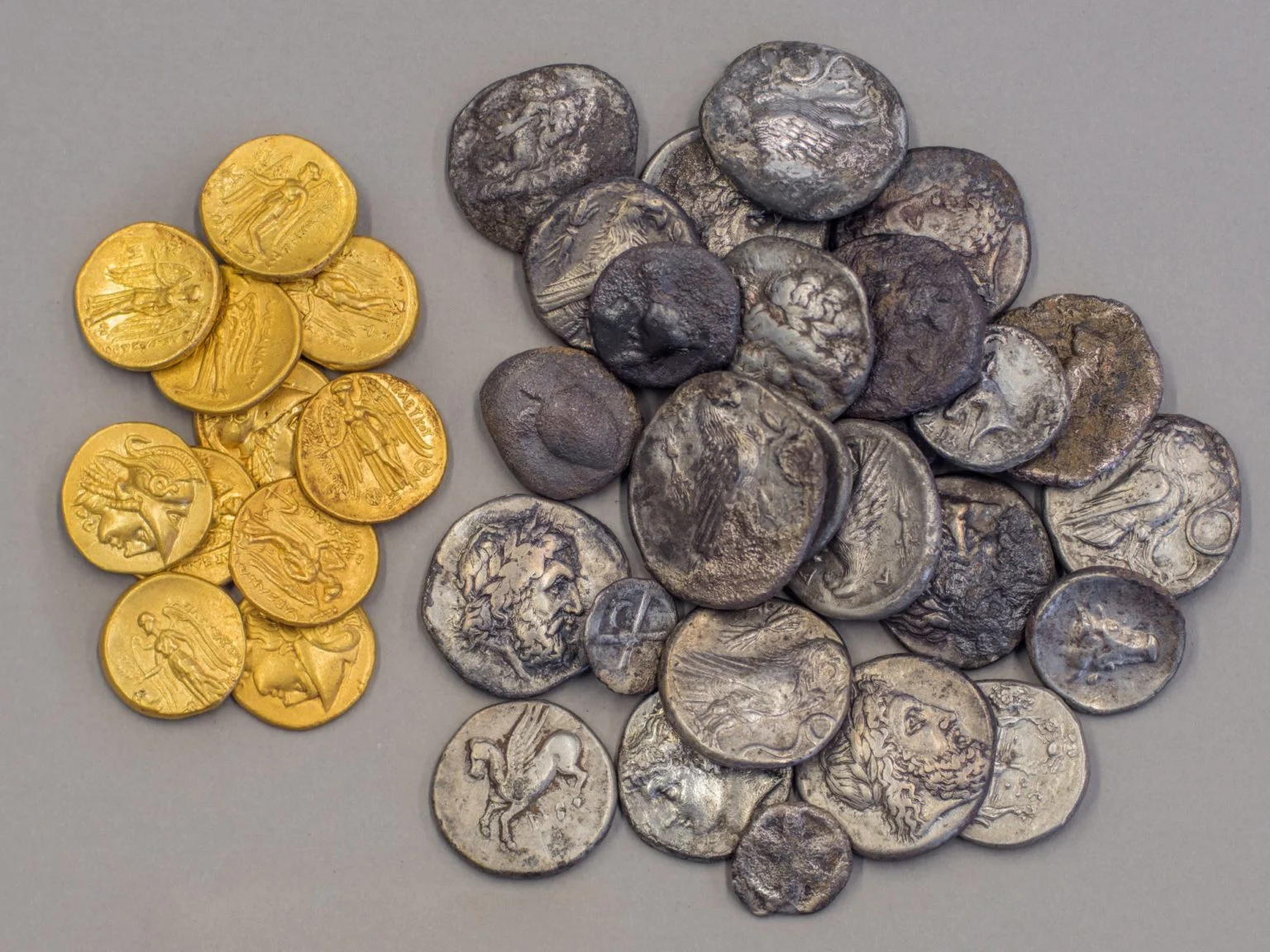
A handful of Alexander coins from Chania

Chania on Crete’s northwestern coast is best known for its beaches and hotels that attract today’s tourists. Its history, however, goes back to the 14th century BC and is centered on the ongoing excavations of the Minoan Palace of Kydonia which was destroyed by an earthquake one century later. 

The Old Town of Chania proper has yielded a cache of 37 rare coins, including eleven gold staters of Alexander. The hoard together with two coins of Kydonia, was hidden in a space behind the wall of the acropolis of Kydonia probably by a mercenary between 300 and 280 BC. That is quite a find considering one gold stater equaled a mercenary month's salary. 

It has been established that the coins were mostly minted after Alexander’s death in the name of Philip Arrhidaeus, Seleucos or Lysimachos in different locations such as Amphipolis, Abydos, Lampsacus, etc. 

[Picture of the two-drachms of Cyrene, Greek Reporter,

The hoard also included 15 silver staters minted in Olympia during the Olympic Games at some time in the 4th century BC. Also one Corinthian stater of the Palace of Acarnania, a colony on the Ionian Sea; and one stater of Praisos (on the peninsula of Sitia at the eastern end of Crete). Further one two-drachms of Cyrene (North Africa), two drachms of Phaistos (62 km south of Heracleion), one drachma of Hyrtakina (in the northwest of Crete), and two pseudo-hemi-drachms of the Aegina type found in Kydonia. Last but not least, there are two early versions from Aegina showing the sea and land turtles.