Alexandria's founded by Alexander

Alexandria's founded by Alexander the Great (by year BC): 334 Alexandria in Troia (Turkey) - 333 Alexandria at Issus/Alexandrette (Iskenderun, Turkey) - 332 Alexandria of Caria/by the Latmos (Alinda, Turkey) - 331 Alexandria Mygdoniae - 331 Alexandria (Egypt) - 330 Alexandria Ariana (Herat, Afghanistan) - 330 Alexandria of the Prophthasia/in Dragiana/Phrada (Farah, Afghanistan) - 330 Alexandria in Arachosia (Kandahar, Afghanistan) - 330 Alexandria in the Caucasus (Begram, Afghanistan) - 329 Alexandria of the Paropanisades (Ghazni, Afghanistan) - 329 Alexandria Eschate or Ultima (Khodjend, Tajikistan) - 329 Alexandria on the Oxus (Termez, Afghanistan) - 328 Alexandria in Margiana (Merv, Turkmenistan) - 326 Alexandria Nicaea (on the Hydaspes, India) - 326 Alexandria Bucephala (on the Hydaspes, India) - 325 Alexandria Sogdia - 325 Alexandria Oreitide - 325 Alexandria in Opiene / Alexandria on the Indus (confluence of Indus & Acesines, India) - 325 Alexandria Rambacia (Bela, Pakistan) - 325 Alexandria Xylinepolis (Patala, India) - 325 Alexandria in Carminia (Gulashkird, Iran) - 324 Alexandria-on-the-Tigris/Antiochia-in-Susiana/Charax (Spasinou Charax on the Tigris, Iraq) - ?Alexandria of Carmahle? (Kahnu)
Showing posts with label Pompey. Show all posts

Monday, September 30, 2024

Hoard of Roman coins found in Pantelleria

The small island of Pantelleria lies about one hundred kilometers southwest of Sicily, off the Tunisian coast, which is visible on a clear day. 

During recent excavations, archaeologists discovered 27 silver coins that had been deliberately hidden. They surfaced after severe rains had flooded the area. These silver denarii were minted between 94 and 74 BC. In those days, the island belonged to the Roman Republic and served as an important trading center in the Mediterranean. 

[Picture from All that's Interesting]

It is noteworthy that in the 1st century BC, the eastern Mediterranean, in particular, was plagued by repeated attacks from pirates. They even dared to kidnap young Julius Caesar in 78 BC and hold him for ransom. The story goes on to say that Caesar felt insulted because the pirates demanded only 20 talents for his liberation. He personally insisted they should raise the amount to 50 talents! Caesar was released after 38 days. The pirates swarmed as locusts over the towns and farms, plundering and burning them on the go. In 42 BC, in a large-scale operation, Pompey finally managed to abolish piracy. 

During these uncertain times, people buried their valuables and money, hoping to retrieve their possessions after the pirates left. It was not to be in the present case; the treasures were recovered only two thousand years later. 

A trove of over 100 coins was found during previous excavations, as well as marble busts of Caesar, Agrippina, and Emperor Titus.

Wednesday, August 23, 2023

Roman soldiers in China

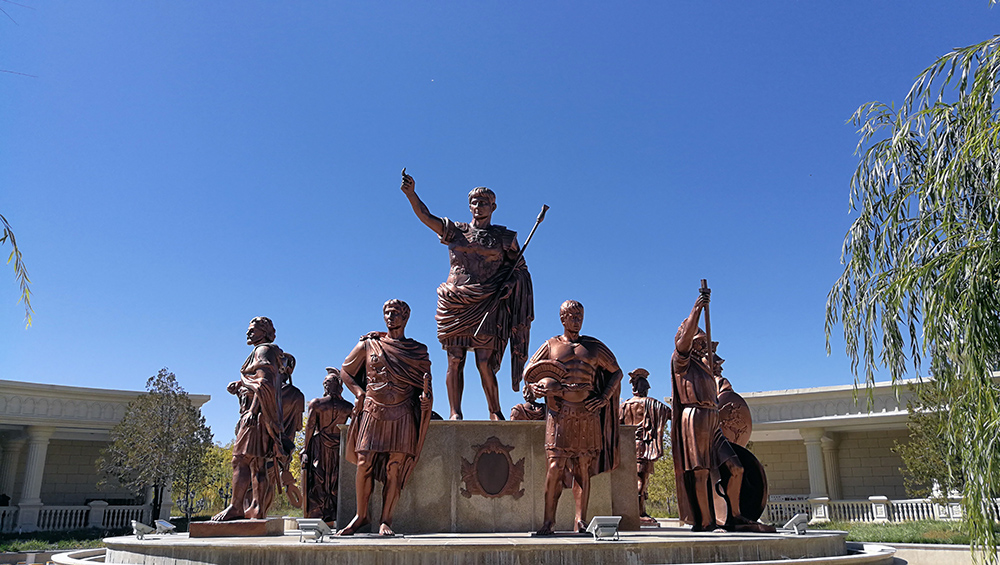
Entering China from the depression of Mongolia, the modern visitor is in for a remarkable surprise. High on top of a Corinthian column stand two bronze figures, a Chinese and a Roman soldier, greeting each other. Behind it, two rows of white columns line up in sharp contrast with the cloudless blue sky. 

A short distance away, a group of eleven, life-size Roman legionaries is immortalized in bronze. Behind it is the entrance gate to a Roman world in the style of Disneyland. The monument is a mixture of a Buddhist and a Roman temple with Ionic columns holding a pediment. A unique way to attract tourists to the Chinese frontier! What happened here? What triggered this staging? What is the truth behind this story? 

We must go back to 60 BC when Rome’s First Triumvirate was formed between Caesar, Pompey, and CrassusPompey is envious of Caesar’s successes in Gaul and recent friendship with CrassusThey were three very different men who came together to achieve their own goals. Once they agreed to their role in this new form of government, Caesar returned to Gaul, Pompey stayed in Rome, and Crassus went east.

Crassus was the richest man in Romebut he was not a military man. Still, he sought glory on the battlefield similar to that of his co-rulers and decided to attack Asia Minor. His army was defeated by the Parthians and Crassus was killed at the Battle of Carrhae in 53 BC (see: Harran, better known under its Roman name Carrhae). Some 20,000 soldiers died on the battlefield and 4,000 returned to Syria. 

Yet 10,000 of his troops were taken prisoner by the Parthians (see: Who were the Parthians?) and sent to Margiana to man the frontier. In 36 BC, the Parthians forced the Roman prisoners to participate in the Battle of Zhizhi, Kazakhstan, against the Chinese. The victorious Chinese of the Western Han Dynasty were so impressed by the fighting skills of their opponents that they took them to the city of Liqian or Li-chien – maybe a transliteration of Alexandria or the Roman word Legion - in the region of Gansu in western China. 

A number of inscriptions discovered in the Kara-Kamar caves on the border between eastern Uzbekistan and Turkmenistan were written in Bactrian, Greek, Arabic, and Latin. The latter one was composed of three lines and was left by the Roman soldiers of the Pannonian Legio XV Apollinaris around the 2nd century AD (see: First contacts with China). A proof that the Romans had been there? 

It is a fact that about 50% of the population of Liqian has green and blue eyes and a Roman aquiline nose. This may be wishfully attributed to the Roman presence some 2,000 years ago. Another theory circulates that the Chinese mingled with people from Siberia. As so often, it is unclear where history and legend start or end.

[top and bottom pictures from That's Mags]

Wednesday, March 22, 2017

Pella and Gadara, two more settlements for Alexander’s veterans

When Alexander returned from Egypt in 331 BC, he marched along the coast of the eastern Mediterranean. How close to the coast may be subject to debate, but the fact remains that he had to send foraging parties into the hinterland. Alexander must have depleted much of the local provisions when he marched his troops through the region the year before, as did the fleet that supported him and his troops on their way to Egypt, especially when crossing the Sinai. This being said, it is very plausible that his foraging parties had to move further inland when he returned. To that purpose, they must have exploited the lands east of the Dead Sea, Jordan River, and the Sea of Galilee, and that is exactly where we find cities like Gerasa, Pella, and Gadara, which are said to be founded by Alexander.

The founding of Gerasa has been treated in an earlier blog (see:  Alexander founder of Gerasa). Some 45 kilometers north of that city lies the town of Pella (previously Pihilum) known to be named in honor of the city where Alexander was born. Pella flourished in Hellenistic times as it became a regional power in the maze of trade routes running through the city. It has been established that Pella was largely populated in Hellenistic times as it was a hub for merchants crossing the region (see: Apamea, heritage of Alexander). Under the rule of Seleucos, the city was renamed Apamea after his wife Apame.

After the death of Alexander, Gerasa and the neighboring territories were annexed by the Ptolemies in 301 BC. At some time during the third and second centuries BC, the Seleucids took hold of the area and undertook a thorough Hellenization till by 64-63 BC, it became a Roman province. The Romans, to properly govern Judea and Syria, created a Decapolis (see: Alexander, founder of Gerasa), a group of ten cities that shared the same language, commercial relations, and political status. Each city enjoyed a certain degree of autonomy with its own Semitic, Nabataean, Aramean, and Jewish culture. The members were according to PlinyDamascus (in Syria), Philadelphia (modern Amman in Jordan), Gerasa (now Jerash in Jordan), Scythopolis (now Beisan in the Jordan Valley, North Israel), Gadara (modern Umm Qays in Jordan) and once the capital of this Decapolis, Hippos (on the banks of Lake Tiberias in Israel), Dion (probably near Irbid in Jordan, but not yet discovered), Pella (in the Jordan Valley, northwest of Amman in Jordan), Canatha (now Qanawat in Syria) and Raphana (probably north of Umm Qays in Jordan, but not yet discovered either). As part of the Decapolis, these cities shared the common political, cultural, and commercial interests of the other members and enjoyed their Golden Age that lasted for about 150 years.

The Romans left their usual buildings, like theaters and temples, along familiar colonnaded streets in Apamea. It is hard to imagine in today’s desert-like landscape that these cities were blessed with fertile soil and plenty of water, making them favorite stops on the busy trade routes between Europe and Asia. Let us not forget that besides goods and agricultural skills, Greek culture and language widely spread.

Another 30 kilometers onward, we find the town of Gadara, today’s Umm Qays, near the northern border of Jordan with Israel and Syria in the hills above the Jordan Valley. Since Gadara emerged in the wake of Alexander the Great, as well as Pella and Gerasa, it shares most of its history. It became part of the kingdom of the Seleucids, and we know from Polybius that Antiochus III ruled here in 218 BC and that Gadara was coveted by both the Ptolemies and the Seleucids, who captured and recaptured it time and again, confirming the role it played on the trade routes with the east. The Seleucid kings renamed the city Antiochia or Antiochia Semiramis and even another Seleucia, as they turned the city into a center of Greek culture.

Gadara boomed under the Romans after Pompey conquered it in 63 BC. At that time, the reputation of the local poet Meleagros (131-61 BC) had already spread far and wide. He was a much-admired Hellenistic author who wrote an anthology of other poets – a true statement of the city’s high cultural level. Gadara certainly deserved its surname of “Athens of the East” when in the 2nd and 3rd centuries AD it became a center for philosophy, literature, and theater.

The ruins of Gadara are far less impressive than those of Gerasa, mainly since most of the city still lies underneath the old Ottoman village from the 18th-19th century that has been vacated in recent decades. The spooky streets and buildings are hiding the Roman living quarters. This settlement leans closely to the crumbling walls and has inherited its medieval name of Umm Qays

The very top of the hill has been carefully excavated and exposes many of the official buildings. It is always a delight to enter an ancient city over the Cardo, which here is paved with large blocks of black basalt. The Roman Theater on the right almost immediately calls for attention. It is entirely built of black basalt as well and offers seating for 3,000 people. This is generally called the West Theater, as there are remains of another theater on the north side of town, which has largely been dismantled by the locals and recycled for their own contemporary constructions, leaving an overgrown field. Unlike the usual eastern-oriented theaters, this theater is looking to the west so that the theater-goers would be sheltered from the strong eastern wind! The remains date generally from the first and second centuries AD and are overall in good condition. From the top tiers, one has a most wonderful view over this biblical land on the eastern bank of the Jordan River, where the Golan Heights and the Sea of Galilee shimmer on the horizon.

Back on the Cardo, one notices several vaulted spaces underneath the skene where once shops were set up. Even in antiquity, theater-goers could be tempted by food and drinks or other entertainment commodities!

Then the Cardo reaches the Decumanus, which has been well cleared and runs on for at least two kilometers to the west. Its black basalt pavement stands in sharp contrast with the white Corinthian limestone columns that separate the road from the sidewalk lined with shops of all kinds. The deep ruts in the pavement testify to the heavy traffic of carts with goods that were transported along the edge of this high plateau to nearby cities like Pella. In its heyday, this road ran all the way to the Mediterranean coast. Halfway there is an unknown sanctuary and a Nymphaeum next to still overgrown public baths from the 4th century.

Turning back, one encounters another large and very impressive Nymphaeum set in the same black-and-white stone combination as found on the Decumanus. To the right is an area called the Terrace Church, dating from the 6th century. This is a strange mixture of all kinds of Roman remains from the 2nd century, enhanced with columns from Byzantine and early Islamic times. It is not easy to figure out the pattern and discover a central square framing an octagonal space. Each corner of this octagon is marked by a black basalt column, and it is believed to have been an unusual inner sanctum. On the west side, there is a large entrance hall, and on the north side, another open space that looks like an atrium. This may have been a pilgrimage site for some important martyr, although no hard proof has been found so far. Like so many buildings in Gadara, this church was destroyed by the severe earthquake of 747 AD, after which the city was abandoned.

The Decumanus loses itself further east past well-preserved city walls embracing the skeleton remains of the Ottoman houses and their crumbling walls. There must be a hippodrome and a stadium out there somewhere, as well as an aqueduct, but apparently, not much has been exposed.

It is nearly impossible to look at Gadara or Gerasa beyond the Roman influence, for these cities originally did not have any Greek roots. Since they were founded by Alexander, they should be seen as a pure Macedonian concept. It is here that the first seeds of later Hellenism were planted, and this makes me wonder how much of the Macedonian influence went into the Alexandrias founded later on during Alexander’s campaigns.

Tuesday, November 10, 2015

Astrology and Astronomy, one and the same in antiquity

The subtitle could be: What a coin could tell us, for this is about a Greek coin minted around 120 BC showing King Antiochus VIII of Syria on one side but on the reverse we find the unusual picture of Zeus with a crescent of the moon above his head while his right arm is reaching out to a star (maybe the planet Jupiter?) hovering above the palm of his hand. It is a one-of-a-kind iconography, meaning that is was worth investigating further.

Antiochus VIII was king of the Seleucid Empire, which in his days had its capital in Antioch-on-the-Orontes at the border of modern Turkey and Syria. His empire was threatened by the expansionism of the Parthians in the east and that of the Romans in the west. He started his kingship at the side of his mother, Cleopatra Thea, a very domineering woman who had gone so far as to kill her oldest son so Antiochus could be the ruler of her choice. This did not reassure Antiochus who decided to put his mother to death in 121 BC.

The abovementioned coin is indeed out of common; maybe there is a meaning beyond the simple picture of Zeus. Dr Robert Weir, a classic professor with an interest in astronomy and ancient coins started to make some calculations to see what the sky of Antioch-on-the-Orontes would have looked like in Antiochus’ days. He found that on January 17, 121 BC, the planet Jupiter was blocked out by the moon, a phenomenon that today is called an “occultation”. When this occultation happened, the moon was in the constellation of Cancer, a very significant constellation. This was explained as a sign that a great king was coming, or would be born in Syria since the Cancer constellation governs that part of the world according to the ancient astrologers. 

Yet, there was more happening in the night sky at that time. Dr Weir discovered that another occultation of Jupiter happened within the year and just one week after the first one, there also was an occultation of Venus, considered to be a very good omen too. This was especially well received by King Antiochus ruling over his ever shrinking Seleucid empire barely delivered from his murderous mother.

But appearances are deceptive and the following years did not favour the king. His half-brother and cousin, Antiochus IX, claimed the throne and in the end what was left of the once proud Seleucid Kingdom was split between the two of them. Over the next few years several bad luck eclipses of Mars and Saturn lit the night skies. The final blow came in 114 BC, shortly before the coin was stopped being minted: the Moon eclipsed Mars and Saturn at the very same time. Such an eclipse happens only once in 2,000 years and is recorded as being about the worst omen one can get.

The death of Antiochus VIII was all but glorious; he was killed by one of his ministers in 96 BC. The Seleucid Empire was doomed. In 64 BC Pompey conquered Syria that became part of the Roman Empire.

Wednesday, August 5, 2015

A two-month project to excavate the city of Soli (near Mersin, Turkey)

The news was announced in mid-July 2015. For years, all one could see here were two rows of columns running on each side of what seemed to be the main street of the Roman city. Tourists had no access to the site and I hope this will change after the said excavations have been carried out.

This year’s team will work on the restoration of the columns, most of which still have their Corinthian capitals, and investigate the continuation of the street as well as the Roman shops established alongside. Last year, they unearthed a very active harbor, including part of the wall dating from the period between the first century BC and the first century AD.

Soli has my interest because it is one of those Cilician cities where Alexander installed a garrison in 333 BC after having demanded a fine of 200 talents of silver for supporting the Persians against him. This fine is a considerable sum if one considers, for instance, that the yearly income of Athens in 431 BC was estimated at 1,000 talents. From Soli, Alexander marched against the Cilicians holding the hills behind the city. Some were driven off, others surrendered, and within a week, he was back in Soli – a short incursion, it seems.

It is here that Alexander received the long-awaited news that Halicarnassus had finally fallen! Ptolemy and Asander had stayed behind in 334 BC to besiege the city and to evict the Persian commander Orontobates. With the fall of Halicarnassus, the towns of Myndos, Caunos, Thera, and Callipolis came into Macedonian hands, together with Cos and Triopium (Cape Crio in southwestern Turkey). This victory called for a celebration, and Alexander is said to have offered sacrifices to Asclepius – no doubt to thank the god for his recovery from the fever he caught in Tarsus. He also held a ceremonial parade of his troops, followed by a torch race and games with music and poetic contests as well as athletics.

Whatever the situation, Soli was allowed to retain its own popular government. After the Battle of Issus in November 333 BC, Arrian tells us that Alexander cancelled the debt of fifty talents, Soli still owed and returned their hostages. This kindness was reciprocated to Alexander when he was laying siege on Tyre a year later, and three ships from Soli joined the reinforcement fleet of eighty Phoenician vessels and several others.

I doubt there will be much, if anything, left to testify from Alexander’s day since reference is generally made to the Roman and Byzantine occupation, with a faint hint towards the Seleucids who were Alexander’s successors in Cilicia.

The first to colonize the area were the Greeks from Rhodes in about 700 BC, and they named the city Soli, which eventually flourished, especially when the Persians ruled Asia Minor. After AlexanderSoli gradually lost its importance with the decline of the Seleucids in the first and second centuries BC, but gained again in prosperity with the arrival of the Roman general Pompey. He took advantage of Soli’s naval base while campaigning against the pirates who pillaged the cities of the eastern Mediterranean. From those days onward, the city was renamed Pompeiopolis in honor of their leader and liberator. New defensive walls and several public buildings and roads were built, and after Hadrian’s visit and sponsorship in 130 AD, the harbor was expanded. Pompeiopolis/Soli successfully withstood the Persian attack of 260 AD and the city’s importance kept on growing, even through the Byzantine period when it became a bishopric. However, the powerful earthquake that hit the region in 525 AD completely devastated the city, which was abandoned.

Saturday, April 11, 2015

The surprise of Butrint, ancient Buthrotum in Epirus

Under Roman rule, the Via Egnatia strategically connected Byzantium via Thessaloniki to Rome thanks to the crossing of the Adriatic Sea between Dyrrhachium and Brundisium. But there was another lesser road that led south to the city of Buthrotum, modern Butrint, right across from Saranda, one of the newest bay resorts in Albania.


Yet Buthrotum was not born with the Romans but like most towns in the area, it was founded by colonists from Corinth and Corfu at some time during the 7th or 6th century BC – although according to the legend its founder was a son of King Priam of Troy, which is a more noble ancestry, of course. To me, this is Epirus, the homeland of Queen Olympias, Alexander’s mother and it is not surprising that in her days the city was important enough to have a sanctuary dedicated to Asclepius with its own theatre and agora; besides, it was protected by a city-wall with five entrance gates.

For some reason, I always thought that all of Epirus was part of modern Greece, but it seems that this ancient country has been split up between Greece to the south and Albania to the north. All I knew about it was the oracle of Dodona, so it is a surprise to hear that Buthrotum was important before the arrival of the Romans. The main attraction may well have been the sanctuary of Asclepius, which was built on a series of terraces rising from a paved area in front of the theatre. The reconstruction as shown on the billboard at the entrance of the site is very clear, but it is much harder to find pre-Roman evidence on the site itself. The sanctuary included a temple, a stoa, and a treasury, all modified by the 3rd century BC to include a theatre and a building that may have served as a hotel for the pilgrims.

As early as 228 BC, Buthrotum became a Roman protectorate, and its influence spread steadily till the city was included in the province of Macedonia. Julius Caesar thought it was an appropriate place to settle his veterans after fighting Pompey in 44 BC, but a wealthy local landlord, Titus Pomponius Atticus, objected to these plans and went so far as to plead his case at the Roman Senate through his friend, the orator Cicero. He was successful, and only a small number of settlers were relocated to Buthrotum. They blended in pretty easily with the locals, and their presence left a definite Roman stamp on the city.


It seems appropriate to take a closer look at Titus Pomponius Atticus, one of the richest men of his time. He lived in Athens for almost twenty years (hence the name Atticus) and showed great interest in Greek culture and philosophy. He bought an estate near Buthrotum and probably acquired more land in neighboring Epirus and Corfu. Although his villa is explicitly mentioned in his correspondence with Cicero, it has not yet been found, but it is generally accepted so far that it was situated in the river valley, where cool breezes soften the heat of summer. Atticus’ wealth, which he acquired as a financier and by managing his land properties, gave him great influence in politics as we have seen above. He was a gifted politician who managed to remain on good terms with both parties involved, the Romans and the locals. He died in 32 BC, aged 78, shortly before the Battle of Actium. Five years earlier, he gave his daughter Caecilia in marriage to Agrippa, Augustus friend and general. Consequently, Atticus’ influence continued after his death through his son-in-law.

In 31 BC, Emperor Augustus conceived plans similar to those of Caesar for after his victory over Marc Anthony and Cleopatra at Actium (some 200 km south of Butrint), he considered Buthrotum to settle his veterans. Once again, the new arrivals, though limited in number, blended in well, and the city expanded rapidly, doubling in size even. At this stage, Buthrotum required a major building plan, which was funded by Augustus in person as well as by his family or private parties. The main projects were the construction of a new aqueduct to feed the many fountains and bathhouses, and a bridge across the Vivari Channel. At this stage, the city appears as Colonia Augusta Buthrotum. Most of what we see today at Butrint may date from Augustus reign since statues of the emperor and of his wife Livia have been found – a sure sign of the city’s loyalty and support.

As in any excavation site, the theatre is what we see first. Although the earliest construction goes back to the 4th century BC, when it was part of the Sanctuary of Asclepius, it was clearly rebuilt and enlarged during the 2nd century AD to become the Roman centerpiece of the city. Today, the lower part of the theater, mainly the stage, is flooded by groundwater, adding a romantic touch with its reflection in the pool. Unique are the many manumission inscriptions that have survived on the outside walls of the theater, dating from shortly after 232 BC. The freeing of slaves, which seems to have lasted for sixty years, was accomplished in the name of a god, generally Asclepius, hence the close link between the theater and its inscribed walls with the treasury of which close to nothing remains.

Behind the cavea of the theater are the remains of the Roman Baths, which are also flooded. Part of the hypocaust is being preserved, exposing some of the fire-resistant bricks used in the floor heating – always an exciting element, I’d say.

The Forum is located next to the theater and the Baths, and originally was located at the heart of the Hellenistic city. In those early days, i.e., late 2nd/1st century BC, it measured a modest 4.5 x 25 meters. Towards the 2nd century AD, the area was enlarged to the size we see today, 52 x 20 meters, but most of it still remains buried.

Further down the island, around the corner of the abovementioned buildings, are the remains of a rather imposing Nymphaeum that must have lined up with the Roman aqueduct that ran across the Vivari Channel and the valley floor to the hills from where the water was transported. Thanks to one of the billboards, I am able to locate the header tank of this aqueduct on the other side of this channel. The spring itself has not been located with certainty, but it seems to be found near Çuka e Aitoit (Eagle Mountain), a rough 12 km away. This fountain, once enhanced with statues of Dionysus and Apollo, appears to lean against the city wall, basically built in the 6th century AD but mixed with remains of earlier Roman constructions. The access to the Vivari Channel, however, was preserved as there are several entrance gates in this wall, still easily recognizable. Today, it is a very peaceful water channel where time seems to have come to a standstill. It is not certain, but this aqueduct may well have served as the first bridge across the channel, and as such, adding to Buthrotum’s status since the city was now connected with the wider Roman world. Aqueducts were very costly enterprises, and only rich cities or those sponsored by private patronage could afford them. Great cities like Athens or Corinth, for instance, didn’t have any aqueducts till the rule of Emperor Hadrian! That definitely proves how wealthy and how important Buthrotum was in its heyday!

This is also the area once occupied by the Gymnasium, but which in Byzantine times was filled by the Great Basilica and its dependencies. It is here that we find a Baptistery from the 6th century AD with an exquisite mosaic floor, covered for its own protection, which is unfortunate for us visitors. It consists of seven circular bands around the baptismal font, thus creating the figure eight, the Christian number for salvation and eternity, I am told (although I have not encountered this explanation before). The mosaics show animals (representing land), birds (representing air), and fish (representing water), in accordance once again with early Christian symbols of salvation. The entrance is flanked by two mosaics of large peacocks (symbolizing paradise and immortality) with a vine growing out of a vase (symbol for the blood of Christ).  Apparently, the roof of this Baptistery was supported by two circular rows of columns, of which only the bases remain. It is worthwhile to mention that this is the second-largest Baptistery in the Eastern Roman Empire after the Aya Sophia in Istanbul.


From the 3rd century onward, Buthrotum started to decline, and a severe earthquake destroyed large parts of the city. It shrank, and a new, smaller city wall was needed. The relief of the so-called Lion Gate on the road to Epirus, which was added in the 5th century to reduce the size of the gate, is a clear illustration. Even an untrained eye can see how this wall has been altered time and again, with steps leading nowhere and dead-end tunnels. When Buthrotum became the seat of a bishop in the 6th century, the Baptistery and Basilicas mentioned above were built, and at the same time, the city walls were reinforced.

But like its neighbors, it was attacked and sacked by the Huns. Over the following centuries, Butrint was occupied in turn by several foreign forces till it turned into a malaria-infested swamp.

The very top of today’s Butrint is crowned by a castle that was reconstructed over the ancient acropolis and now serves as a museum that badly needs some improvement or modernization, unfortunately. It houses finds from Butrint itself but also from other nearby sites, showing some pieces from the Hellenistic occupation but mostly from the prosperous Roman period.

Today, a flat barge ferries men and cars across the Channel to the Vrina plain on the other side. In Roman times, that was the location of a thriving suburb of Buthrotum where the rich and famous had their vast residences. It is here that archaeologists are looking for the remains of Titus Pomponius Atticus’ estate. Work in progress …

Thursday, March 5, 2015

Along the Via Egnatia: Dyrrhachion in Illyria

Except for the significant remains in Apollonia, which I discussed earlier (see: Along the Via Egnatia: Apollonia in Illyria), the other cities along the Via Egnatia have little remains to offer, merely indications of where to find its course. As poor as those remains are, I am trying to gather as much information as possible in this corner of Illyria (today’s Albania), stopping this time at Dyrrhachion.

As mentioned before, the Via Egnatia (see: Via Egnatia, a road to remember) was built by the Romans in the 2nd century AD and was the main road between Byzantium and Rome. As far as Illyria, the road came from Ohrid (Republic of Northern Macedonia) in the east and then ran through Elbasan, from where one arm connected directly to Dyrrhachion (Dürres). Another one diverged to Apollonia and Antipatrea (Berat) to end also in Dyrrhachion on the Adriatic coast where ships ferried people and goods to Brundisium (Brindisi) on the Italian side.

This time, I’m stopping at the most western end of the Via Egnatia on the Illyrian side of the Adriatic Sea, i.e., at the city of Dyrrhachion situated at the narrow in the Adriatic Sea right across from Brindisi, some 200 km to the west. The only significant testimony from antiquity that is left for us to see is the Roman amphitheater from the first half of the 2nd century AD, and even this is incomplete since there are still modern houses sitting on top of it. Yet it is rather interesting to wander through the vaulted corridors, discovering even a small Byzantine chapel. The oval amphitheater reached its longest diameter of 120 meters and stood originally 20 meters high. It offered seating for 15,000-18,000 spectators who watched gladiator fights, animal combats, or other artistic shows. It is sad, though, to see that all the seating material has been removed – most probably reused somewhere else. Yet in spite of its bareness and partial excavation, it is a most impressive construction.

As early as 627 BC, the first colonists from Corinth and Corfu founded the city of Epidamnos, named after the Illyrian King Epidamnos, its co-founder. The king’s daughter had a son who received the name Dyrrhachion, and it was this name that stuck. Dyrrhachion was the ideal location for a city, built around a natural harbor with high cliffs and protected on the land side by swamps.

Obviously, the envious Romans had their mind set on this prosperous city and after a fierce fight with the Illyrians in 229 BC, they took possession of the city, which they renamed Dyrrhachium, modern Dürres.

Dyrrhachium was the site of a battle during Caesar’s Civil War on 10 July 48 BC. He faced Pompey, who came out victorious, although not for long. The decisive battle of the Civil War was fought at Pharsalus in Central Greece on 9 August of that same year. This battle eventually led to Pompey's assassination on 3 September 48 BC. Another waste of lives in history …

Emperor Augustus turned the city into a colony for his veterans after the Battle of Actium, proclaiming it to be a free town. By the 4th century, Dyrrhachium became the capital of the Roman Province of Epirus Nova, but it was soon hit by a severe earthquake that destroyed the city’s defense walls. They were almost immediately rebuilt to a height of 12 meters and were wide enough for four horsemen to ride abreast on them. The remaining portions of the wall from the fifth century are still in place but have lost most of their strength and were first reshaped by the Byzantine Emperor Anastasios I after the catastrophic earthquake of 345 AD. He defended the city with three rows of walls guarded by consecutive fortification towers every 60-65 meters. During later occupations, the walls were modified several times. Dyrrhachium did not escape the repeated attacks by the Huns, but in Byzantine times, the city gained importance as a major link with Western Europe once again. 

There are no traces of the Via Egnatia in Dürres, but I am pointed towards a tall apartment building near the beach that supposedly stands on top of it. The nearby lonely Venetian tower from the 15th century is said to be built over an earlier Byzantine construction while reusing its stones. It stands nine meters tall with a diameter of 16 meters and is surrounded by intriguing modern pebble mosaics with birds and fish moving around in a black-and-white pattern.

[Click here to see all my images of Dürres]

Wednesday, February 18, 2015

Along the Via Egnatia: Apollonia in Illyria

The Via Egnatia, as mentioned earlier (see: Via Egnatia, a road to remember), was built by the Romans in the 2nd century AD and served as a major connection between Byzantium and Rome. As far as the Illyrian part is concerned, the road came from Ohrid (Republic of Macedonia), then ran through Elbasan, where it split in two, one arm connecting directly to Dyrrhachion (Dürres) and another one crossing Apollonia and Antipatrea (Berat) to end also in Dyrrhachion on the Adriatic coast where ships ferried people and goods to Brundisium (Brindisi) on the Italian side. 

To name a city after the sun god Apollo seems to have been very popular in Greek history as we find several cities by the name of Apollonia in Turkey (Lycia, Mysia, Pisidia, etc.); in Sicily, Italy; in Greece itself (Thessaloniki, Chalcidice, Kavalla, etc.) and in Crete; in Libya, where it was the harbor of wealthy Cyrene; and finally here in Illyria, modern Albania.

This time, I’ll be concentrating on Apollonia in Albania, located about 7 kilometers from Fier (see: Alexander’s psychological warfare in Pelium, Illyria). The city is well documented during Roman times, and the remains are obviously very Roman too. For Alexander, this was deep into the Illyrian country, just beyond the northern border of Epirus.

The original name was Gylakeia, after its founder Gylax, who belonged to the Illyrian tribe of the Taulantii. It was the Greek colonists migrating from Corinth and Corfu in 588 BC who changed the name to Apollonia. They were the ones who controlled the city and ruled over the Illyrians. Money was made from the slave trade and agriculture, but maybe mostly through the supply of asphalt, which was a valuable material for the caulking of ships in antiquity. Located on a branch of the Via Egnatia, it is obvious that it was an important harbor along the Illyrian coastline to link up with Brindisi on the other side of the Adriatic Sea and a transit port for all kinds of goods traveling between Byzantium and Rome.

This is the area where King Pyrrhus (a great-nephew of Olympias and cousin of Alexander the Great) ruled roughly from 306 to 272 BC while mingling in Macedonian affairs in the wake of the Diadochi Wars. He tried to keep the Romans out of Illyria, but by 229 BC, they firmly established themselves. I find it rather strange that Apollonia, like so many other Illyrian cities, was so loyal to the Romans. Maybe that is because the city was rewarded with the booty taken from their defeated King Gentius of Illyria – not very patriotic, I would say. By 148 BC, Apollonia became part of the Roman province of Macedonia, Epirus Nova. About a century later, the city supported Julius Caesar in his war against Pompey but fell into the hands of Brutus in 48 BC. Apollonia could also claim to have contributed to the education of Emperor Augustus, who studied at its famous school of philosophy in 44 BC, where Athenodorus of Tarsus was his teacher. Together with other cities in the area, Apollonia flourished and was even mentioned by Cicero as “magna urbs et gravis”, meaning “a great and important city”. Strabo also mentions the city in his Geographica as “an exceedingly well-governed city”. Decline set in during the third century AD when its harbor started silting up after being hit by a severe earthquake, which changed the course of the Aoos River. The inland turned into an ever-growing malaria-ridden swamp, and the inhabitants moved out to resettle at nearby Avlona (modern Vlore).  Only a small Christian community that moved in during the very early days of Christianity remained; they may have built the first church of Saint Mary. Today’s church dates from the 14th century and houses the local museum.

The visitor’s attention is immediately drawn toward a colonnaded façade that could be part of a temple. Still, it turns out to be the entrance to the Bouleuterion from the second century AD – quite unusual since generally, the tiers of such a city council survive but not the portal. The columns are definitely Corinthian, and in the architrave above them, we can still read the Greek dedication: “To the memory and in honor of Valentinus Villius Furius Proculus from his brother Quintus Villius Crispinus Furius Proculus, prefect of a cohort in Syria, tribune of the Legion Gemina in Pannonia, and president of the sacred games. A fight of 25 gladiators was held for the inauguration.” This Bouleuterion is surrounded on three sides by rooms, some kind of annexes to the Ionic Temple next to it. What is left are mainly low walls, and archaeologists suppose that these rooms were used for administration or for the priests’ duties. The outlines of the temple itself are easily located with a few columns sticking out from the grass.

Across from the Bouleuterion are two big stumps of stone indicating the site of a triumphal arch at the end of the street leading into Apollonia and dating from the 3rd century AD. To the right, but difficult to make out, are the remains of a Library from the 2nd-3rd century AD, proof of the city’s importance – if needed. On the other side of the street lies an Odeon that has been carefully restored and could hold as many as 650 spectators. Adjacent is a small Sacellum, an open sanctuary dedicated to an imperial cult. The niche was most probably flanked by two Ionic columns, and we still can see the rosettes and lion paws of their base.

It is followed by a portico, 78 meters long, punctuated by 17 niches that once held marble statues. This portico seems to date from the 4th century BC and was divided lengthwise into two by a row of Doric columns, whereas the outside columns were of Ionic style. I am told that this kind of structure is unique for Apollonia.

The portico ends at the Sacred Road, where we find a temple right around the corner, dating from the second half of the 2nd century BC but probably renovated four centuries later and possibly dedicated to Jupiter, Juno, and Minerva. The Sacred Road continues further uphill to the Acropolis, where little or no excavations have been done. With a width of nine meters, it is the widest street so far in Apollonia, paved with river pebbles laid directly on the clay surface.

On the other side of this Sacred Road are three vaulted shops, almost square in shape (3.45x3.40m), whose entrance could be closed by heavy double doors. The walls were very thick to keep out the moisture and guarantee a nearly constant temperature in order to preserve the goods stocked inside. They seem to have been built during the second half of the second century AD. Against these shops, another construction deserves our attention, for this is a water cistern that was used from the 4th century BC all the way to the 2nd century BC and has still kept its impermeable inside coating.

Opposite this Sacred Road are the remains of a large villa, in fact, no more than a succession of mosaic floors. The house was divided into four parts: an entrance portico of 14x5.8 m right opposite the Sacred Road; the main room measuring 12x11.8m with a center of white mosaics surrounded on all four sides by a corridor 2.9 m wide paved with little brick squares of 5x5 cm; the back room overlooking the sea. It is thought that this house was used as a gathering place for the believers before starting their procession over the Sacred Road. The most precious mosaics have been covered, of course, but the remaining ones are quite interesting. The attentive visitor will also notice the clearly Roman sewage system running parallel to this building.

Like every single Greek city, the location of Apollonia was chosen with the greatest care, overlooking the Aoos River and its fertile valley with the Adriatic Sea at the far horizon.

My greatest surprise, however, was the local museum, housed in the 14th-century monastery attached to the church of St Mary, by itself worth a visit. Under the watchful eyes of the soaring Pantocrator, it is easy to discover all sorts of antique fragments: Corinthian capitals placed upside-down to serve as a base for some Christian relic or flowers; the marble wall of a well with deep gutters left by the ropes that pulled the water-buckets over the centuries and now on dry land; small lidless sarcophagi turned into mini-gardens; and other spolia spotted in the outside walls. In the upstairs portico leading to the very entrance of the museum, several grave steles and smaller altars have found refuge.

Since I have been walking through Roman Apollonia, I expect this museum to reflect that image. Well, not entirely so, for originally, the city was founded by Greeks who imported the art from their hometowns or created their own imitation. I walk among Attic vases and hydras from the 5th century BC, Apollonian bottles and pots, but also some Italic imports. The Hellenistic period is also very present with several marble steles, reliefs, busts, and statues, but the eye-catcher is this wonderful shield that I immediately recognize as Macedonian. But wait a moment … according to the label it seems to be Illyrian! How on earth is that possible? I take a closer look at this splendid piece with three concentric circles in its center, around the frightening head of a Gorgon in Classical Greek style, sticking out its tongue and staring at me with shiny inlaid eyes. The border of the shield also counts three concentric rows of circles framing six half-circles around the edge. I fail to see what makes it Illyrian and inquire with the museum director, who tells me that the difference lies in the curving. Well, I suppose he knows, but I am not entirely convinced till I see other examples of Illyrian shields later on in Tirana and at the Skanderberg Museum. I’m totally baffled by this revelation! Ironically, the Illyrian shield in Apollonia is presented next to a splendid Macedonian helmet that has been dated to 314-312 BC, a rather narrow timeline.

So, all in all, Apollonia was definitely worth a visit, including the local museum. Some artifacts, however, have been moved to the national museum at Tirana, where I discovered a hoard of silver drachmae from the 1st century BC, as well as a head of Demosthenes (1st century AD) – of all people, what is he doing here?

I’m not too far away from Alexander, after all!