Alexandria's founded by Alexander

Alexandria's founded by Alexander the Great (by year BC): 334 Alexandria in Troia (Turkey) - 333 Alexandria at Issus/Alexandrette (Iskenderun, Turkey) - 332 Alexandria of Caria/by the Latmos (Alinda, Turkey) - 331 Alexandria Mygdoniae - 331 Alexandria (Egypt) - 330 Alexandria Ariana (Herat, Afghanistan) - 330 Alexandria of the Prophthasia/in Dragiana/Phrada (Farah, Afghanistan) - 330 Alexandria in Arachosia (Kandahar, Afghanistan) - 330 Alexandria in the Caucasus (Begram, Afghanistan) - 329 Alexandria of the Paropanisades (Ghazni, Afghanistan) - 329 Alexandria Eschate or Ultima (Khodjend, Tajikistan) - 329 Alexandria on the Oxus (Termez, Afghanistan) - 328 Alexandria in Margiana (Merv, Turkmenistan) - 326 Alexandria Nicaea (on the Hydaspes, India) - 326 Alexandria Bucephala (on the Hydaspes, India) - 325 Alexandria Sogdia - 325 Alexandria Oreitide - 325 Alexandria in Opiene / Alexandria on the Indus (confluence of Indus & Acesines, India) - 325 Alexandria Rambacia (Bela, Pakistan) - 325 Alexandria Xylinepolis (Patala, India) - 325 Alexandria in Carminia (Gulashkird, Iran) - 324 Alexandria-on-the-Tigris/Antiochia-in-Susiana/Charax (Spasinou Charax on the Tigris, Iraq) - ?Alexandria of Carmahle? (Kahnu)
Showing posts with label Herakleia-Pontus. Show all posts

Tuesday, January 23, 2024

The Periplus of the Euxine Sea by Arrian – Part 2

The second part of the Periplus covers the section From the Thracian Bosporus to Trapezus. 

As mentioned earlier in About Arrian’s Periplus of the Euxine Sea, it could not be established whether this chapter reflects Arrian's personal experience or not. One theory is that he wrote it upon arrival in Trapezus after Hadrian appointed him governor of Cappadocia in 131 AD. 

We should also keep in mind that Arrian was a native of Bithynia, which bordered the south shores of the Black Sea over approximately one-third of its total length. Consequently, he knew the people and the geography of that area very well. As an admirer of Xenophon, he was familiar with the route followed by the Ten Thousand as they marched from Trapezus to Byzantium following the seashore.

[Bust of Xenophon, Carole Raddato (CC BY-NC-SA)]

Whatever the case, this section of the Periplus includes an impressive list of the harbors and rivers on the southern shore of the Black Sea among which are the cities of Herakleia-Pontus founded by the Megarians and the Boeotians at the mouth of the Lycus River; Tios, at the mouth of the Billaeus River and a colony of MiletusAmastris (modern Amasra) that had a harbor 17 kilometers from the River Parthenius; Sinope, another colony of Miletus and home of Diogenes; Amisus, an Athenian colony between the Halys and the Iris River deltas; and, finally, Cotyora, a colony of Sinope. 

Ever since the days of the Hittite Empire, which reached its height in the 14th century BC, the Halys River was the border between several kingdoms; first between Lydia and the Persian Empire, then between the Pontic Kingdom and the Kingdom of Cappadocia. By the 6th century BC, it separated Lydia from Media until King Croesus crossed the river to attack Cyrus the Great and was defeated. 

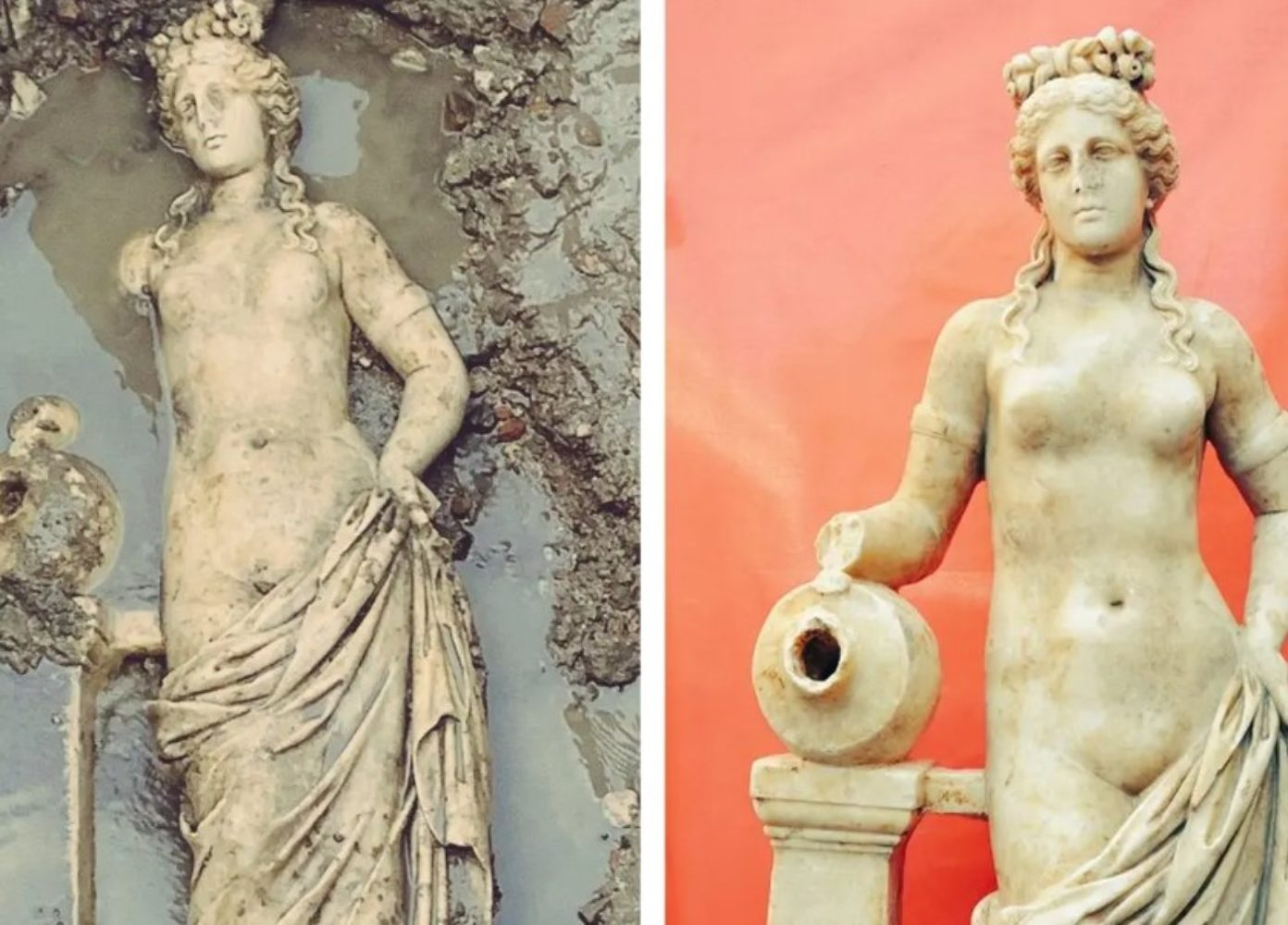
[From the Greek Reporter]

It is worth mentioning that a 1.50-meter-tall statue of Aphrodite has been discovered recently in ancient Amastris. It could be established that it is a Roman copy from between 180 and 200 AD that was inspired by Praxiteles school in the 4th century BC. The ancient city was named after Amastris, the niece of King Darius III, who married Dionysos, the tyrant of Herakleia-Pontus.

The map included in my post About Arrian’s Periplus of the Euxine Sea is most useful for locating all the cities, harbors, and rivers mentioned above. 

It should be said that while inspecting the Cappadocian frontier harbors in 123 AD, Emperor Hadrian had already visited part of the southern Euxine Sea, including Trapezus. With this in mind, Arrian now informed the emperor that Trapezus was building a new harbor, replacing the mooring where ships could only anchor in summer. 

It is quite amazing to see so much geography and history being exchanged. We tend to forget the many lines of communication that existed in antiquity, with traders, merchants, scholars, philosophers, astronomers, kings, and emperors traveling far and wide, by land and by sea.

[to be continued in Part 3]

Monday, October 23, 2023

Alexander head found near the Black Sea

As strange as it may seem, a head of Alexander was found in Konuralp, close to the Black Sea. In antiquity, the city was named Kieros and was part of Herakleia Pontus. 

[Picture from Duzce Municipality]

The historian Memnon of Herakleia (1st century AD) tells us that King Prusias I of Bithynia captured the city end 3rd/beginning 2nd century BC and renamed it Prusias. It was strategically situated on the road between Nicomedia (modern Izmit) and the Pontus region. 

The Romans, who conquered Bithynia around 74 AD, changed the name again to Prusias ad Hypium. The city was important enough to be visited by the emperors Hadrian, Caracallaand Elagabalus. 

Although most of the ancient city is still buried under modern Konuralp, recent archaeological excavations have exposed remains of the city walls and a gate, a theater, an aqueduct, and a Roman bridge. Inscriptions mention the presence of a gymnasium and an agora. However, there is not enough information to establish the layout of Prusias ad Hypium, and crucially there is nothing to indicate the reason for Alexander’s presence at this location. 

The marble head attributed to Alexander was discovered at the top of the theater. It is 23 cm tall and has been dated to the 2nd century AD. This is not much information to go by but hopefully, more news will follow.

Previous excavations also exposed a head of Apollo and Medusa.

Monday, June 27, 2022

Lysimachos in the wake of Alexander – Part II

 [continued from Lysimachos in the wake of Alexander - Part I]

Skipping the many details and intertwined relationships, let us pick up the story when Seleucos added his forces to those of Lysimachos and his allies to fight the elderly Antigonus Monophthalmus and his son Demetrios Poliorcetes. The battle took place in 301 BC at Ipsus and ended with Antigonus’ defeat and death. The victors subsequently divided his territory among them. Lysimachos acquired a significant share with Lydia, Ionia, and Phrygia, including the entire north coast of Asia Minor. Seleucos received Syria, and Cassander was now secure in Macedonia and Greece. 

Until then, Antigonus Monophthalmus had been the most successful among the generals in recreating Alexander’s empire. His son Demetrios attempted to follow in his father’s footsteps, but he lacked a broader view. 

Around that time, Nicaea died, and Lysimachos honored her by naming a city in Asia Minor after her, modern Iznik in Turkey. 

As Seleucos was growing ever more powerful, Lysimachos thought it wise to seek the support of Ptolemy. Around 300 BC, he elected to marry Arsinoe, the daughter of Ptolemy, and his mistress Berenice. Amastris, as said above, stepped back and divorced herself from Lysimachos, moving back to Herakleia Pontus. 

Although this marriage of Lysimachos was not a happy one, Arsinoe stayed with her husband till his death. She bore him three sons: Ptolemy I Epigonos, Lysimachos, and Philip. Her jealousy, however, incited her to convince her husband to kill his oldest son and heir, Agathocles (from his marriage to Nicaea), based on treason. The murder happened in 284 BC despite the young man successfully leading his father’s army in combat. Although he was only in his early thirties, his men loved him much. 

Meanwhile, Cassander died in 297 BC. His sons were more interested in fighting each other for power than ruling the country. Macedonia eventually fell into the hands of Demetrios. So, in 287 BC, Lysimachos agreed to fight alongside Pyrrhus to drive Demetrios out of Macedonia. They successfully ruled the country jointly until Lysimachos broke up with Pyrrhus and seized Macedonia for himself. 

Lysimachosgreed and thirst for power equaled that of the other generals, now kings in their realms. The fighting was not over yet. 

Seleucos, in 282 BC, broke his alliance with Lysimachos as he attempted to take his territory in Asia Minor. The final clash happened in Lydia at Corupedium in 281 BC. It ended with the death of Lysimachos. By then, the King of Thracia must have been in his late 70s. He had lived a life of almost continuous and repeated battles, inspired by the greatest conqueror of all times, Alexander the Great. 

Like the other new self-proclaimed kings, Lysimachos had minted his own coins. However, he did not follow them by stamping his personal image on these coins but kept using the effigy of Alexander instead. Could that be seen as a late posthumous homage and tribute to his boyhood friend? 

Lysimachos is also being honored as a friend and benefactor of Samothrace. He received the title of Lysimachos Euergetes as inscribed on the altar erected in his honor and used during annual festivals. A stele found on the island reads a dedication of King Lysimachos from between 288 and 281 BC. Based on the surviving first fifteen lines, Lysimachos was honored for restoring sacred lands on the mainland initially granted to Samothrace by either Philip II or Alexander the Great or by Philip Arrhidaeus III and Alexander IV. There were boundary stones for said sacred land near Alexandroupolis in Greece. 

Money was never an issue throughout all those years of bickering, conniving, and fighting. Lysimachos, like all the other generals, had cashed his share of Alexander’s fortune. In his case, it was a mere 9,000 talents in silver and gold, roughly worth several billion in today’s value. The money was safely kept on the Acropolis of Pergamon. However, when Attalus III gave the city to Rome in 133 BC, the entire treasure (not limited to Lysimachos share) fell into Roman hands. This fortune contributed largely to the rise of the Roman Empire – but that is another story.

Friday, June 10, 2022

Lysimachos in the wake of Alexander – Part I

Lysimachos was in Babylon at the time of Alexander’s death in 323 BC. Almost immediately, anarchy erupted as the king had no successor. Every single one of his generals felt entitled to succeed Alexander pending the coming of age of his yet unborn son. 

The War of the Diadochi had begun and would last for the next forty years or so. The generals took sides, changed sides, and made peace treaties but coveted each other’s possessions soon after. Their lust for power led them to conquer ever more land. They eliminated each other systematically until around 280 BC; four contenders remained: Ptolemy in Egypt, Seleucos in Asia, Antipater / Cassander in Macedonia/Greece, and Lysimachos in Thrace. 

Lysimachos’ origin is obscure, and the best guess is that he was born around 361 BC to Thessalian parents living in Pella. He was educated at the court of Philip and was probably one of his Bodyguards. He was only a few years older than Alexander, and we can safely assume that he joined the young prince in Mieza to attend Aristotle’s teaching with the other selected young men. 

Historians hardly mention Lysimachos in Alexander’s early campaigns, although he was present throughout the king’s conquests of Persia as one of his trusted Bodyguards. This lack of information does not imply that Lysimachos was not a valued element in Alexander’s organization. Many positions beyond that of a general were of the utmost importance. Take, for instance, the logistics of the entire enterprise, or the scouting parties to locate otherwise hidden enemies or find the appropriate location for the following camping site, or escorting Queen Sisygambis and her retinue till their arrival at Susa, and many other tasks. 

Lysimachos joined the ranks of the Companion Cavalry, maybe after several of Alexander’s masterly reshuffling of the army according to his needs. 

Except for him being mauled by a lion in Syria, he was not documented until 328 BC, when Alexander crossed the Hydaspes River. There is no further information. 

Lysimachos participated in the siege of Sangala (see: The siege of Sangala). Alexander lost less than one hundred men in this fierce fight, but an excessive number of 1200 soldiers were wounded, including Lysimachos. 

He was evidently present at the Susa Wedding in 324 BC, but we don’t know the name of his bride. Since she is not mentioned when he moves to Thracia, we may conclude that he left her behind after Alexander’s death, at which time he became ruler of Thracia. 

The position of Thracia was strategically crucial as the land extended to the Black Sea and the Hellespont, both major links with Asia. Upon arrival, Lysimachos faced the rebellious Thracian tribes fighting each other. Their most powerful dynasty was the Seuthes. However, Lysimachos was quickly able to establish his authority. 

As the War of Alexander’s Successors raged on with the other generals fighting among themselves, Lysimachos managed to stay away from their intrigues. 

In 321 BC, to stabilize his position further, he decided to marry Nicaea, Antipater’s daughter, after Perdiccas had refused her hand. This alliance secured his position vis-à-vis both Antipater and Cassander. The couple would have three children: one son, Agathocles, and two daughters. 

In 315 BC, a revolt broke out among the cities on the Black Sea. Antigonus Monophthalmus, who reigned over most of Asia Minor, saw an opportunity to annex Thrace to his own territory and stirred up the local tribes against their king. Once again, Lysimachos managed to suppress the revolt and consolidate his power. Peace was reached in 311 BC. 

This revolt drew him into the Succession Wars, and he sided with Cassander, Ptolemy, and Seleucos against Antigonus Monophthalmus. In 309 BC, to secure the Hellespont, he built a new city, Lysimachia, in a commanding location on the Chersonese peninsula. 

By 305 BC, all the contestants in the Wars of the Diadochi adopted the title of king and Lysimachos followed suit by assuming the royal title as well. He was now an equal player in the succession game of the thrones. 

In 302 BC, Lysimachos again joined forces with Cassander to conquer Asia Minor from Antigonus Monophthalmus. As winter approached, he set up camp in Herakleia Pontus, where he met Amastris, granddaughter of Queen Sisygambis, who had been given as wife to Craterus at the Susa Wedding. She left her husband after he took Arsinoe of Egypt as his wife, who became the widowed Queen of Herakleia. So, Lysimachos married Amastris, but this marriage didn’t last long, for soon afterward, he decided to take as spouse Arsinoe, daughter of Ptolemy. Consequently, Amastris left Lysimachos and returned to Herakleia Pontus (see: Time to reconnect with Princess Amastris). 

In fact, with his marriages, Lysimachos was in line with the other Successors or contenders who still aimed at re-establishing Alexander’s empire. Marriage was much cheaper than war to conquer more land.

 [continued in Part II]

Saturday, January 22, 2022

Heraklea Sintica in southwestern Bulgaria

There are a great number of towns going by the name Heraclea or Herakleia throughout Turkey and Greece. Wikipedia provides an enticing list of places. 

In previous blogs, I developed Herakleia Pontus, a kingdom in Bithynia (see: Time to reconnect with Princess Amastris), Herakleia by Latmos to be found on the banks of Lake Bafa in Western Turkey, Herakleia Lyncestis in Illyria (see: King Philip, one year later – Macedonia forged by Philip II), and Heracleion-Thonis (see: Heracleion, ancient Greek port in Egypt).

This time, I’m focusing on Heraclea Sintica in southwestern Bulgaria. The additive Sintica refers to the Sintians, a Thracian tribe that lived in the Valley of the Struma, the Greek Strymon River that runs past Amphipolis. The Sintian occupation goes back to 1300-1200 BC. Although many sources claim that the city had been founded by Cassander around 300 BC, others state that it was Philip, Alexander’s father who conquered Sintica and added Heraclea to remind the Thracians and the Macedonians that his ancestor was Heracles. The city’s layout appears to be similar to that of Philippi or Philippopolis. 

Heraclea Sintica was a major hub on the North-South traffic and connected the Aegean coast to Macedonia, Thrace, and the Balkan hinterland. In its heyday, its population may have reached 40-50,000 inhabitants! 

The city existed at least until the 6th century AD since it was mentioned in the Byzantine tax records of Emperor Justinian the Great. 

Although the city's name was known, it took some investigation to find its location. A Latin inscription left by Emperor Galerius revealed that in response to their plea to restore their lost civil rights in 308 AD, he addressed the local citizens as those of Heraclea Sintica. 

Serious and steady excavations in Heraclea Sintica are pretty recent and seem to have started in 2007. 

By 2016, an imposing Basilica was unearthed, measuring 22 x 16 meters with walls rising five meters tall, next to other sanctuaries and shops. An older Basilica from the 4th century BC was discovered a year earlier. A striking find happened in 2017 when a Roman gold necklace came to light. It has been dated to the 4th century AD and may have been made by craftsmen in Rome. 

In 2018, a headless Roman statue from ca. 100 AD was found underneath the stairs of the Forum. The statue represents a magistrate and was apparently carefully buried four meters deep. More recently, a female head was discovered in the eastern corner of the Forum. This head carries traces of ocher paint, indicating that the woman was blond. In ancient times, blond hair symbolized sin. This beautiful marble seems to date to the same time as the headless man. It is too early to draw any conclusion about the reason for these careful burial rites, as the site has not been entirely investigated yet. Intriguingly, both discoveries were made underneath buildings of later periods. Archaeologists suppose that these respectful funerals could have had a ritual meaning in antiquity – and may have been meant as protection from calamities or barbarian attacks. 

More questions remain unsolved, like the bone needle whose end was wrapped in a thin gold sheet. It must have belonged to a woman of some importance who lived in Heraclea Sintica in the 2nd century AD. 

Undoubtedly, many more buildings and artifacts are still hidden from view, awaiting to be uncovered.

Sunday, November 17, 2019

Time to reconnect with Princess Amastris

Amastris is much less known than her cousins, Barsine/Stateira and Drypetis, although she too was the granddaughter of Queen Mother Sisygambis.

She was born as the daughter of Oxyathres, a younger brother of Darius, the later King Darius III. At the Susa Wedding in 324 BC, Alexander married her to Craterus. She was of true royal descent, and as an infant, she had already been promised in marriage to the ruling King Artaxerxes III, who died shortly afterward.

[Picture from Archaeology News Network]

As Craterus’ wife, she could look forward to a powerful life since the general had been appointed by Alexander to replace the old Antipater as Regent of Greece. We’ll remember that Craterus had not yet arrived in Pella when Alexander died, and Antipater may well have seized the opportunity to convince the general to consider their king’s plan voided by his death. Under the influence of Antipater, who wanted to have closer control over Craterus, he agreed to marry one of his daughters, Phila. Amastris had her pride, and she refused to be pushed aside as a mere Persian concubine.

We don’t know exactly which strings she pulled, but Amastris married King Dionysios of Herakleia Pontus in 322 BC. Dionysios reportedly was a friend of Alexander’s sister Cleopatra who had pleaded for the king’s protection with her brother. After Dionysios’ death seventeen years later, Amastris ruled with excellence over the kingdom in Bithynia as a widowed queen.

With the War of Alexander’s Successors still raging, Lysimachos, by now king of Thracia, proposed to Amastris in 302 BC and she accepted. Not for long though. When Lysimachos decided to marry Arsinoe, daughter of Ptolemy Soter (or Ptolemy Philadelphus), Amastris left her husband and returned to Herakleia Pontus. It was at this time that she founded the city of Amastris on the coast of the Black Sea. The town was created through the fusion of four Ionian colonies, Sesamus, Cromma, Cytorus, and Tium (which detached itself from Amastris again later on). By 300 BC or so, she minted her own coins – no small matter for a woman!

This city of Amastris has been in the news recently when archaeologists discovered some columns and pillars that may have belonged to the queen’s sanctuary. Pending in-depth excavations, it has been established so far that the sanctuary was about five to six meters high. It will be quite interesting to see what treasures the archaeologists will uncover at this site of which so little is known but where great history was written.

Queen Amastris was killed by her own sons Dionysios, Clearchus, and Oxyathres, who coveted their mother’s power. They arranged for her to be drowned around 284 BC. It must be said, however, that Lysimachos avenged his former wife by killing the matricides, if not out of love or admiration for her, then to add Herakleia Pontus to his own adjacent realm.

Friday, June 1, 2018

The many colonies of Miletus

The colonization by the Greeks, either from mainland Greece or from Asia Minor remains a fascinating subject. I touched on the topic before when discussing Magna Graecia (see: Magna Graecia, the forgotten Greek legacy) and this time I will concentrate on the shores of the Black Sea, the Pontus Euxinus of antiquity.

The first settlers arrived in the second half of the 7th century BC mainly from Ionia but by far the most prominent group came from Miletus. Ancient authors go as far as claiming that the city possessed between 75 and 90 colonies but this number does not immediately refer to cities founded and populated by Miletus since they did not have enough manpower to occupy so many settlements. In fact, Miletus acted as their organizer and the initial true number of colonies was about 25.

The reason for people from Asia Minor to emigrate is complex but one of the main causes to relocate was the westward expansion of the Persian Empire which even attacked Greece itself. The Ionians were facing a simple choice to either submit to the Persians with the risk of being killed or enslaved or to leave their homeland for new horizons.

The Actual Archaeology Magazine of May 2011 published a very interesting article, “Greek Colonisation of the Black Sea” written by Gosha R. Tsetskhladze about the origins of a great number of settlements on the shores of the Back Sea including both sides of the Cimmerian Bosporus.

Among the first settlements, we find Berezan (modern Borysthenites) founded in the third quarter of the 7th century BC, and Tangarog (on the Sea of Azov) in the last third of the 7th century BC (completely destroyed by the sea). Other colonies were located on the western shore of the Black Sea like Histria (at the mouth of the Danube) in ca. 630 BC, Apollonia Pontica (modern Sozopol in Bulgaria) in ca. 610 BC, and Tomis (modern Constanta in Romania) at the end of the first quarter of the 6th century BC. On the southern shoreline, we find Sinope (modern Sinop in Turkey) from the late 7th century BC and Amisos (modern Samsun in Turkey) from ca. 564 BC. Olbia (in modern Ukraine) was settled on the northern side of the Black Sea by the end of the first quarter of the 6th century BC.

Between 580 and 560 BC, Miletus colonized new territories on the Kerch peninsula (the western side of the Cimmerian Bosporus) and the Taman peninsula (the eastern side of the Cimmerian Bosporus). On the European side of the straight, we find cities like Panticapaeum, Nymphaeum, Theodosia, Myrmekion, and Tyritake (all on the Crimean peninsula); and on the Asian side, we name Kepoi, Patraeus, Corocondame (destroyed by the sea) and Hermonassa (joined colony of Miletus and Mytilene).

In the wake of Cyrus westwards conquests during which he took the stronghold of Sardes in 546 BC, the Black Sea area was once again flooded by a new wave of Ionians – this time by people not exclusively from Miletus. The Megarians and the Boeotians founded Heraklea in 554 BC on the south shores, and Miletus founded Odessos (modern Varna in Bulgaria) on the western shore. In turn, those colonies that had settled around the Black Sea created many small settlements of their own.

Around that same time, new cities like Tyras and Nikonian appeared together with some fifty rural settlements under their control. Non-Milesians founded Gorgippia (modern Anapa in Russia), Toricos (near modern Gelendzhik in Russia), Akra (in Russia, destroyed by the sea), Porthmeus (in Russia), and several other colonies on the Cimmerian Bosporus, and around 542 BC the Teians established the colony of Phanagoria on the Taman Peninsula (as well as the city of Abdera in Thracia).

Ionians settled even further north along the Black Sea coast, and by 422/1 BC, Herakleia Pontus founded a small town that would become the later Chersonesus (near modern Sevastopol in Crimea). The Milesians, once again, founded Colchis (modern western Georgia), who in turn established the cities of Phasis, Gyenos, and Dioscuria, and two more settlements, Pichvnari and Tsikhisdziri. The last wave arrived when the Ionians were defeated in their revolt against Persia. Mesambria (modern Nessebar in Bulgaria) was founded on the western shore of the Black Sea by the Chalkedonians and Byzantines, and in western Crimea, the Ionians established Kerkinitis and Kalos Limen, which later became part of Chersonesus.

In the days of Alexander and even during the reign of his father Philip, we read about ships bringing corn from the Black Sea to Athens. This leads us to believe that this traffic existed already in earlier centuries. It has been established, however, that the earliest ships loaded with corn circulated at the end of the 5th/beginning of the 4th century BC, and that they were not meant for Athens but for the island of Aegina and the Peloponnese instead. Except in case of emergency, it appears – according to the abovementioned article - Athens was perfectly capable of feeding its citizens.

With so many sites spread over so many countries around the Black Sea (from Turkey to Bulgaria, Romania, Ukraine, Russia, and Georgia), one can wonder how much of these colonies still exist or have been excavated and, if so, to what extent. Yet the fact remains that this geographical knowledge was part of Alexander’s baggage and his Companions. The ancient world was much and much larger than what we like to believe!

The heavy colonization shows that emigration is not a modern phenomenon but existed in eons past. Famine may have been a major reason for people to leave hearth and home, but generally, it was and is a war that triggers the displacement of entire populations. In any case, it is quite amazing to see how many peoples were on the move between the 7th and the 5th century BC. In my opinion, these three centuries of constant emigration explain - at least in part – the general Greek resentment against the Persians. Their occupation of Greece and the burning of the Acropolis is, of course, another valid reason for their grudge.