Alexandria's founded by Alexander

Alexandria's founded by Alexander the Great (by year BC): 334 Alexandria in Troia (Turkey) - 333 Alexandria at Issus/Alexandrette (Iskenderun, Turkey) - 332 Alexandria of Caria/by the Latmos (Alinda, Turkey) - 331 Alexandria Mygdoniae - 331 Alexandria (Egypt) - 330 Alexandria Ariana (Herat, Afghanistan) - 330 Alexandria of the Prophthasia/in Dragiana/Phrada (Farah, Afghanistan) - 330 Alexandria in Arachosia (Kandahar, Afghanistan) - 330 Alexandria in the Caucasus (Begram, Afghanistan) - 329 Alexandria of the Paropanisades (Ghazni, Afghanistan) - 329 Alexandria Eschate or Ultima (Khodjend, Tajikistan) - 329 Alexandria on the Oxus (Termez, Afghanistan) - 328 Alexandria in Margiana (Merv, Turkmenistan) - 326 Alexandria Nicaea (on the Hydaspes, India) - 326 Alexandria Bucephala (on the Hydaspes, India) - 325 Alexandria Sogdia - 325 Alexandria Oreitide - 325 Alexandria in Opiene / Alexandria on the Indus (confluence of Indus & Acesines, India) - 325 Alexandria Rambacia (Bela, Pakistan) - 325 Alexandria Xylinepolis (Patala, India) - 325 Alexandria in Carminia (Gulashkird, Iran) - 324 Alexandria-on-the-Tigris/Antiochia-in-Susiana/Charax (Spasinou Charax on the Tigris, Iraq) - ?Alexandria of Carmahle? (Kahnu)
Showing posts with label Alexandria-Margiana. Show all posts

Wednesday, August 23, 2023

Roman soldiers in China

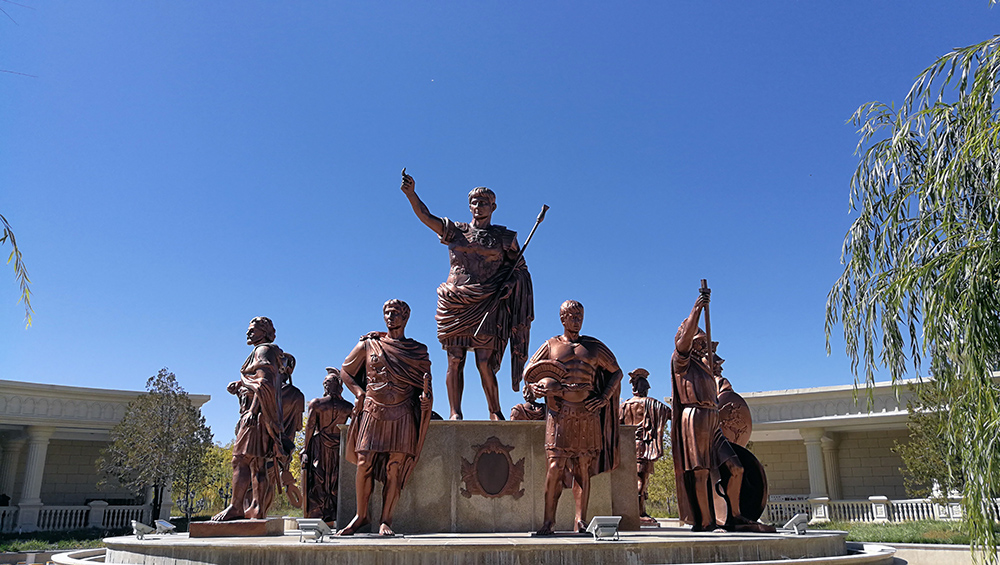
Entering China from the depression of Mongolia, the modern visitor is in for a remarkable surprise. High on top of a Corinthian column stand two bronze figures, a Chinese and a Roman soldier, greeting each other. Behind it, two rows of white columns line up in sharp contrast with the cloudless blue sky. 

A short distance away, a group of eleven, life-size Roman legionaries is immortalized in bronze. Behind it is the entrance gate to a Roman world in the style of Disneyland. The monument is a mixture of a Buddhist and a Roman temple with Ionic columns holding a pediment. A unique way to attract tourists to the Chinese frontier! What happened here? What triggered this staging? What is the truth behind this story? 

We must go back to 60 BC when Rome’s First Triumvirate was formed between Caesar, Pompey, and CrassusPompey is envious of Caesar’s successes in Gaul and recent friendship with CrassusThey were three very different men who came together to achieve their own goals. Once they agreed to their role in this new form of government, Caesar returned to Gaul, Pompey stayed in Rome, and Crassus went east.

Crassus was the richest man in Romebut he was not a military man. Still, he sought glory on the battlefield similar to that of his co-rulers and decided to attack Asia Minor. His army was defeated by the Parthians and Crassus was killed at the Battle of Carrhae in 53 BC (see: Harran, better known under its Roman name Carrhae). Some 20,000 soldiers died on the battlefield and 4,000 returned to Syria. 

Yet 10,000 of his troops were taken prisoner by the Parthians (see: Who were the Parthians?) and sent to Margiana to man the frontier. In 36 BC, the Parthians forced the Roman prisoners to participate in the Battle of Zhizhi, Kazakhstan, against the Chinese. The victorious Chinese of the Western Han Dynasty were so impressed by the fighting skills of their opponents that they took them to the city of Liqian or Li-chien – maybe a transliteration of Alexandria or the Roman word Legion - in the region of Gansu in western China. 

A number of inscriptions discovered in the Kara-Kamar caves on the border between eastern Uzbekistan and Turkmenistan were written in Bactrian, Greek, Arabic, and Latin. The latter one was composed of three lines and was left by the Roman soldiers of the Pannonian Legio XV Apollinaris around the 2nd century AD (see: First contacts with China). A proof that the Romans had been there? 

It is a fact that about 50% of the population of Liqian has green and blue eyes and a Roman aquiline nose. This may be wishfully attributed to the Roman presence some 2,000 years ago. Another theory circulates that the Chinese mingled with people from Siberia. As so often, it is unclear where history and legend start or end.

[top and bottom pictures from That's Mags]

Saturday, August 6, 2022

Hidden treasures of Central Asia

In a recent article, The Greek Reporter focused on the achievements of the prominent archaeologist Viktor Sarianidi (which they misspelled as Victor Sarigiannidis). 

His name is closely tied to the excavations at Tillya Tepe in Afghanistan, which had to be interrupted when the USSR invaded the country. The treasures from that tomb were safely transferred to the Museum of Kabul for safekeeping. When the Taliban rose to power in 2001, they decided to destroy the 2,500 statues and reliefs kept at the Museum. The Afghans managed to move and hide the precious artifacts from the tomb. In 2004, the government of Afghanistan decided the situation was safe enough to bring the gold treasures out in the open again. As the Museum in Kabul could no longer shelter this precious collection, they agreed with the Musée Guimet in Paris to send these rich finds on a traveling tour (see: Bactrian Gold, the Hidden Treasures from the Museum of Kabul). The Greek Reporter mentions that the artifacts have instead disappeared!

[Picture from The Telegraph, CREDIT: ©Thierry Ollivier / Musée Guimet]

Viktor Sarianidi lived an interesting life, to say the least. He was born in Tashkent, then USSR, and now Uzbekistan, to Greek parents. His archaeological career took off in 1949, and he excavated actively in Central Asia and Afghanistan. At this time, he exposed the necropolis of Tillya Tepe. It is noteworthy that Sarianidi proved the intercultural influences of the findings with links to Greece, Iran, India, Egypt, China, and even Siberia! The most striking example is the cute little Greek goddess Aphrodite, complemented with wings conforming to local winged deities and the dot on the forehead that shows influence from India

Sarianidi spent the last 30 years of his life excavating in the Desert of the Karakum in Turkmenistan, where he discovered the hitherto unknown Margian Kingdom (end of the 3rd millennium BC). This discovery earned him the Honorary citizenship of Turkmenistan in 2000. Three years earlier, he had received Greek citizenship. These rewards have led to widespread confusion about his nationality, and he is quoted alternatively as Russian, Greek, or Turkmen. 

[Kyzylkum Desert and Oxus River]

With such a background, he promoted the Greek presence in the greater Black Sea area and identified Greek roots in modern Afghanistan, Turkmenistan, and Uzbekistan. Sarianidi also developed a theory that Hellenism (I believe he means Greek) influences reached Central Asia some 1600 years before Alexander the Great arrived on the scene. This means that the culture of the Oxus River could be associated with the Minoan-Mycenaean culture. He was a prolific writer, and his books have been translated into English and Greek. 

The Greek Reporter further insists that Sarianidi discovered “the city” of Bactria! This is very confusing because Bactria was a region in Central Asia, and its capital was named Bactra, modern Balkh. Linking Bactra and the vast necropolis of Gonur Tepe apparently confirms Sarianidi’s theory that Greek influences (not Hellenism) were present many centuries before Alexander conquered Central Asia.
Monday, June 1, 2020

Traces of Alexander in Afghanistan

Alexander keeps popping up from the most unexpected corners, even from the occasional encounters on our travels.

As I was once again flipping through Robert Byron’s book The Road to Oxiana, I came across his journal entry of 20  May 1933. Byron had arrived in Bala Murghab six days after he left Herat and headed north over the Paropamisus Mountains. The modern traveler is expected to cover the distance of some 270 km in about four hours.


Bala Murghab takes its name from the Murghab River, which is the modern name for the Margiana River. It rises in the Hindu Kush and eventually peters out in the desert around Merv

Byron describes how the river seemingly runs towards a mountain wall which, upon closer look, turns out to be a pair of rocky gates crowned by a watch-tower. A strategic point that was recognized already in antiquity. After the river has passed these sentinels, Byron finds a dilapidated bridge to cross the turbulent waters of the Murghab. Initially, the construction had been propped up by two stone arches, one of which had been washed away over time and replaced by a wooden suspension.

The interesting part of the story is when he says that, according to the Russians, this bridge, as well as the watch-tower, was built by Alexander. If this is true, it may be a confirmation that the king did indeed detour to Margiana (Merv). In that case, naming the city Alexandria Margiana is entirely justified as discussed in my previous blog Merv, Alexandria Margiana.

[About the picture copied from Flickr: HERAT, Afghanistan--The view from a CH-47 Chinook helicopter during an International Security Assistance Force (ISAF)mission, Nov. 30. ISAF is assisting the Afghan government in extending and exercising its authority and influence across the country, creating the conditions for stabilization and reconstruction. (ISAF Photo by TSgt Laura K. Smith)(released)]

Friday, February 7, 2020

Merv, Alexandria Margiana

The origins of Merv seem to go back to Cyrus the Great, who founded the city in the 6th century BC. As Margu, it is mentioned in the Bisutun inscription (see: The Bisutun relief of King Darius I), meaning that it was one of the many satrapies ruled by the Achaemenids.

It is still uncertain whether Alexander took Merv in today’s Turkmenistan, although the area of Margiana became part of his empire. When he was in Central Asia, he may or may not have conquered the city. According to some theories, it was Craterus who founded the town. If this were the case, Alexandria Margiana would be the first and only “Alexandria” founded in Alexander’s absence. A questionable assumption. If Alexander went to Merv, the only plausible time would be while he was in Bactra, in modern Afghanistan. Pending confirmation and further excavations, this question remains unanswered (see: Alexander in Bukhara).

In any case, after the king’s death, Alexandria Margiana became the capital of the Seleucid Empire. It was his son, Antiochus I Soter, who expanded the site and built the fortress of Gyaur Gala. He named it after himself, Antiochia Margiana.

The rulers of the later Graeco-Bactrian Empire, the Parthians, the Kushans, and the Sassanids all recognized the importance of its strategic location. Before the arrival of Islam, Merv was renowned for its Buddhist monasteries and stupas.

Its defensive walls were almost eight kilometers long, fortified by sturdy towers. Through one of the four entrance gates, traders and other visitors would access the clean streets divided into quarters among the branches of the Murghab River and its canals. The principal buildings were mosques and madrasas, libraries, and bathhouses. The marketplace was centrally located and well-organized. Under the Seljuk sultans, Merv was enhanced with a palace and several administrative buildings.

As a significant stopover on the prosperous Silk RoadMerv was a welcome oasis full of gardens and orchards surrounded by richly cultivated lands amidst the barren Karakum Desert. Some sources tell us that around 1150 AD, Merv was the largest city in the world. Merchants from as far as India, Iraq, and China would have crowded the narrow streets and spent the night in one of the many caravanserais. Besides the trade of silk, Merv was also famous for the high-quality cotton that was grown in the nearby fields.

Unfortunately, Genghis Khan razed the city to the ground, killing all its 700,000 inhabitants. The many dams and dykes that supported an efficient network of canals and reservoirs were forever destroyed. Genghis Khan and his Mongols annihilated this lifeblood so thoroughly that Merv never truly recovered, in spite of the numerous attempts to rebuild and resettle the city over the centuries.

By 1888, Merv was entirely abandoned. George Curzon, who was the Viceroy of India from 1899 to 1905, visited the remains at that time. He describes the city as “Very decrepit and sorrowful looked those wasting walls of sun-dried clay, these broken arches and tottering towers; but there is magnificence in their very extent and a voice in the sorrowful squalor of their ruin.”

Merv today exposes, in fact, four separate walled cities. The oldest settlement from the Achaemenid times is Erkgala, whereas the Hellenistic and Sassanid capital Gyaur Gala is built around the Erkgala fort. The Abbasid/Seljuk city is Soltangala, and the largest as it sits on the edge of Gyaur Gala. Just south lies the smallest town, Abdyllahangala, which was founded by the descendants of Tamerlane. 

The archaeologists are clearly facing a daunting task. A joint team from Turkmenistan and the UK worked here from 1992 to 2000. A year later, a new collaboration was started between the Turkmen authorities and the University College London. It will be fascinating to learn if they ever retrieve some relics of Alexander’s short passage in the area.

[Pictures from The Guardian]

Thursday, May 31, 2012

Alexander in Bukhara (Central Asia 10)

[9 - Alexander probably went as far as Bukhara and even Merv in today’s Turkmenistan where he founded his Alexandria-Margiana (it seems no “Alexandria” was ever founded without the king being present)].

After spending the night in Khiva, I once again have to cross the Oxus River but this time over a solid bridge to reach the main road to Bukhara and Samarkand. The view of the river is about the same as before, only from higher up, but still as impressive! No wonder Arrian stated that this is the widest river in Asia after the Indus.

This road is absolutely awful, more like a track in the heart of Africa than the main road. An entirely new road is under construction but the new sections have not been opened to traffic. I have all the time in the world to inspect the red desert sands stretching out in low rolling hills as far as the eye can see. The only greens are meager tiny bushes kept short by the everlasting wind that swept the arid land for eons. My thoughts drift away to Alexander, of course, who had to cross this kind of empty space time and again like he did on his way from Bactra to Termez on the south side of the Oxus River or on his way to the Jaxartes River and the Scythians further to the northeast.

Bukhara, although hardly mentioned in Alexander’s campaigns, certainly must have played an important role. Some say the city was founded by Alexander, but it already existed 4,000 years ago and was used throughout the ages as a crossroad for trade between east and west. We know more of Bukhara as being a meeting point on the famous Silk Road, but that Silk Road only followed older trading routes, which under Persian rule were already heavily used. Other major cities along that trade route included Bactra (Balkh), Alexandria-Ariana (Herat), Alexandria-Margiana (Merv), Maracanda (Samarkand), Termez, Nasaf (Karshi), and Khorezm (Khiva), amazingly enough, all of them within the borders of Bactria and Sogdiana. It is not hard to imagine the caravans with traders, envoys, and travelers treading over these sandy roads. They definitely were adventurous, brave, and strong men. It is quite evident that Alexander used these same roads whenever possible, and he definitely would have appreciated them to their rightful value as economic and military assets.

As to the city of Bukhara proper, I assume that Alexander reinforced the city walls, turning it into a stronghold, as its strategic value would not have been lost on him. Even after his death, this region knew golden times when Seleucos, one of Alexander’s generals and successors, laid the basis for the later Graeco-Bactrian Empire, which in turn led to the Kushan Kingdom. Trade was, throughout the centuries, a most rewarding lifeline in this region.

I don’t expect to find traces of Alexander’s presence in Bukhara, and I don’t. The only location that I can connect to him is the Citadel, whose foundations go back to the 4th century BC. But as houses were built on top of other houses over the centuries, the citadel now stands about twenty meters high, sheltering the city remains of Tamerlane’s time.

But all is not lost, for I find quite unexpectedly my own private Alexander. Walking through the main street of old Bukhara with all the handicraft shops, I stop at a table where an artist is painting what I see as Persian miniatures. Such delicate work, fine drawings, strong colors with bold touches of gold, I engage a conversation with the young man. He explains that these are Uzbek miniatures and not Persian ones, pointing to the typical headdress and decoration of the men’s robes. Well, yes, now I see the difference. In the exhibition rack next to him, my eyes suddenly stop at a familiar picture … Iskander and Roxane, I ask? The artist’s face brightens up, yes, it is indeed! How do you know? I don’t remember where I saw it, in which book or exhibition. In any case, this is the piece. How appropriate to find it here, in the heart of Central Asia, in Roxane’s homeland! Of all places! It is beautiful work, painted on old silk paper, and I’m afraid to ask the price. I can’t resist, of course, and I go home with my precious miniature, and for a moment I’m in the very presence of Alexander and his beautiful bride!


According to Frank Holt (Alexander the Great and Bactria), it is most probable that Alexander went to Merv to found his Alexandria-Margiana, but sources are unclear about when and how. Robin Lane Fox is sending Craterus to Merv instead with a detachment of the army in the spring of 328 BC. David Engels mentions that Alexander founded the city. The problem is that the ancient writers focused on Alexander exclusively, but at times couldn’t single out Alexander’s personal expedition in his complex campaign through Bactria and Sogdiana. Since Ptolemy actively participated in nearly all the skirmishes, pursuits and sieges, and both Arrian and Curtius generally based their story on Ptolemy’s account, they seem to be the most trustworthy historians to follow, although modern writers have tried in vain to straighten out history. Pierre Briant is his recent book Alexander the Great and his Empire, situates Margiana a few miles east of the Derbent’s Iron Gates, but the confusion may still be greater than expected since Leonid Sverchkov (Ancient Civilizations from Scythia to Siberia) is looking for two distinct cities, Margania as named by Curtius and Margiana as referred to by Pliny. Good luck!

After Bukhara, I’m once again on the main road to Samarkand, i.e., the old Silk Road. It is common knowledge that this road was dotted with stopping places where merchants and travelers could spend the night, finding forage for the animals and accommodations for themselves. Every 30-40 kilometers or so, there was a caravanserai offering the weary traveler a place to spend the night, to trade his goods, or maybe to enjoy the comforts of a hamam. In fact, it is a system copied from the glory days of the Persian Empire, and I am convinced that whenever possible or available, Alexander followed these same roads, making use of the same facilities. So, when I stop at the 11th-century caravanserai of Baboti Malik, I have no difficulty picturing what such a station must have looked like in his days.

The place is rather isolated, more in the middle of nowhere than alongside a major route. This caravanserai is in a pretty poor state; only the façade has been re-erected, while all the other outer and inner walls are only reconstructed to approximately one meter high. Still, it gives a good overview of the layout, although I have in mind the well-preserved building of Kervansaray in central Turkey, especially because of the central octagonal base of what once was the top lantern, which impressed me immensely. But here it is the location rather than the caravanserai itself that strikes me, for it is easy to imagine what a safe-haven such a place must have been to the traveler through these hostile lands.

On the other side of the road is the ever-needed water reservoir, the Sardova from the 14th century – an impressive vaulted construction that shelters the water from dust and pollution while offering a clean spot to drink and to water the animals. To me, it is obvious that this entire construction stands over an old well that has been used over the centuries by local sheep and cattle herders, as well as by the merchants on this busy east-west road. It gives a clear image of the welcome stops Alexander may have encountered during his many desert crossings.