Alexandria's founded by Alexander

Alexandria's founded by Alexander the Great (by year BC): 334 Alexandria in Troia (Turkey) - 333 Alexandria at Issus/Alexandrette (Iskenderun, Turkey) - 332 Alexandria of Caria/by the Latmos (Alinda, Turkey) - 331 Alexandria Mygdoniae - 331 Alexandria (Egypt) - 330 Alexandria Ariana (Herat, Afghanistan) - 330 Alexandria of the Prophthasia/in Dragiana/Phrada (Farah, Afghanistan) - 330 Alexandria in Arachosia (Kandahar, Afghanistan) - 330 Alexandria in the Caucasus (Begram, Afghanistan) - 329 Alexandria of the Paropanisades (Ghazni, Afghanistan) - 329 Alexandria Eschate or Ultima (Khodjend, Tajikistan) - 329 Alexandria on the Oxus (Termez, Afghanistan) - 328 Alexandria in Margiana (Merv, Turkmenistan) - 326 Alexandria Nicaea (on the Hydaspes, India) - 326 Alexandria Bucephala (on the Hydaspes, India) - 325 Alexandria Sogdia - 325 Alexandria Oreitide - 325 Alexandria in Opiene / Alexandria on the Indus (confluence of Indus & Acesines, India) - 325 Alexandria Rambacia (Bela, Pakistan) - 325 Alexandria Xylinepolis (Patala, India) - 325 Alexandria in Carminia (Gulashkird, Iran) - 324 Alexandria-on-the-Tigris/Antiochia-in-Susiana/Charax (Spasinou Charax on the Tigris, Iraq) - ?Alexandria of Carmahle? (Kahnu)
Showing posts with label Assos. Show all posts

Saturday, February 12, 2022

Ancient harbor city discovered near Dikili, Turkey

Some excavations are carried out on sites known from antiquity, other digs get started after an accidental discovery. This is the case for the city of Atarneus situated on Turkey’s west coast. A 39-year-old diver noticed columns and column drums as he was diving off the coast of Dikili, some 120 km north of Izmir. 
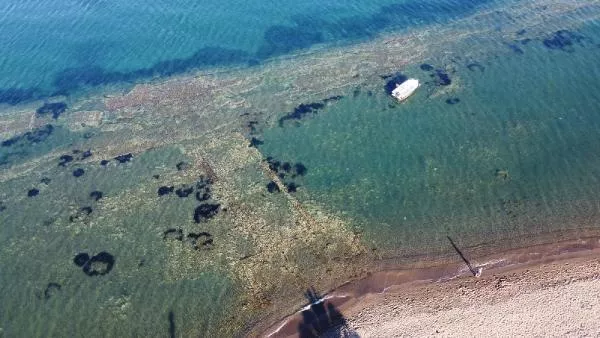
Archaeologists examining the site concluded that said columns belonged to the ancient city of Atarneus founded by the Akalis, of whom close to nothing is known. 

Atarneus is, however, linked to Aristotle as Proxenus of Atarneus cared for the young Aristotle after his father died. While working at the Academy of AthensAristotle befriended a certain Hermias, who became the king of Atarneus. When the philosopher left Athens at the death of Plato, he stayed with Hermias and eventually married his daughter or niece, Pythia. 

The city reached its peak in the 4th century BC under Hermias ruling over the area spreading from Atarneus to Assos further north. It ceased to exist in the 1st century BC, apparently following the outbreak of some unspecified epidemic although tectonic movements cannot be excluded. 

Hopefully, further excavations will be started to learn more about the city’s existence and destruction. After all, it blossomed in the days of Alexander the Great meaning that he must have known the existence of this city!

Tuesday, June 18, 2019

The new Archaeological Museum of Troy

Despite the many centuries of excavations in Troy, the time has come (at last!) to build its own museum on the site. It is located some 800 meters outside the ancient city, and from the pictures, it looks very promising.


Beyond Troy, about 40,000 artifacts have been transferred from the Archaeology Museum in Istanbul, the Museum of Anatolian Civilizations in Ankara, and the Archaeological Museum of Çanakkale. It is nice to have the finds concentrated in one single building.

Besides Troy, artifacts from the greater area are being exhibited here also. Those archaeological remains include finds from cities like Assos, Tenedos, Parium, Alexandria Troas, Smintheion, Lampsacus, Thymbra, Tavolia, and Imbros.

It is a wonderful idea to have this collection together in one place, more so since that corner of Northwestern Turkey is often overlooked by tourists.

Friday, February 1, 2019

Exploring Troy and surroundings

What a lovely idea to actually walk the newly created Troy Culture Route between Çanakkale and Assos in northwestern Turkey. The route is 120 km long and the cherry on the cake will be a stop at Troy itself.

Like other trails in Turkey, this is a unique way for trekkers and bikers to enjoy the landscape but also community life of the villagers on the way. The first leg will actually start in Troy and end in Assos offering a wide array of archaeological, historical, cultural and natural assets.

The trail will be signposted but a route map complemented with a guide book will be useful tools for those who do not want to handle GPS or internet applications.

Interestingly, Çanakkale is an excellent ferry arrival harbor from across the Dardanelles, the ancient Hellespont and not far away from the point where Alexander made the crossing. The itinerary will pass the villages of Tavaklı, Babadere, Kösedere, Tuzla, Gülpınar, Kocaköy, Bademli, Koyunevi, Balabanlı, Bektaş, Kuruoba, Korubaşı, Behramkale and the ancient harbor of Assos (an excellent opportunity to enjoy the archaeological site).


It is evident that Turkey is trying to attract more tourists, especially the adventurous ones. It may be a tempting idea for our next holiday destination taking the opportunity to pay a well-deserved tribute to Achilles at his burial mound with Alexander in mind?

Friday, March 7, 2014

Bouleuterion of Assos

Assos, on the north-western coast of Turkey, is one of those places still on my list of things to see, were it only because Aristotle lived here for a while during the fourth century BC and because Plato built a second Academy here – the first being the one in Athens of course. The very idea of a Bouleuterion or Council House was born with the democracy in Athens at some point during the 5th and 6th century BC when the citizens gathered to discuss administration, politics, and business. But Assos was the first city in history to be managed by philosophers, quite noteworthy.

[Picture from Archaeology News Network]

The fact is that Aristotle, after leaving Plato’s Academy, went to Assos in 348 BC where he opened an Academy of his own. He was welcomed by King Hermias, whose adopted daughter or niece Pythias he married. Soon Aristotle was leading a group of philosophers before he moved to Lesbos three years later. When the Persians invaded Assos, torturing and killing Hermias, Aristotle sought refuge in Macedonia with his friend King Philip II. This exile eventually led to his appointment as a tutor for the king’s son, young Alexander. In 334 BC Alexander drove out the Persians from Anatolia and after his death, Assos was ruled by the kings of Pergamon till the Romans took over in 133 BC.

Based on an inscription from the end of the fourth century BC, the Bouleuterion of Assos was built by Ladomos and his wife, a leading family no doubt. Unlike other council halls which are generally entirely made of stone, the seats here in Assos were made of wood. Apparently, it was built in the wake of Alexander’s invasion of Asia Minor as the people of Assos put the doctrines of Plato into practice – making it the first Bouleuterion in Anatolia.