Alexandria's founded by Alexander

Alexandria's founded by Alexander the Great (by year BC): 334 Alexandria in Troia (Turkey) - 333 Alexandria at Issus/Alexandrette (Iskenderun, Turkey) - 332 Alexandria of Caria/by the Latmos (Alinda, Turkey) - 331 Alexandria Mygdoniae - 331 Alexandria (Egypt) - 330 Alexandria Ariana (Herat, Afghanistan) - 330 Alexandria of the Prophthasia/in Dragiana/Phrada (Farah, Afghanistan) - 330 Alexandria in Arachosia (Kandahar, Afghanistan) - 330 Alexandria in the Caucasus (Begram, Afghanistan) - 329 Alexandria of the Paropanisades (Ghazni, Afghanistan) - 329 Alexandria Eschate or Ultima (Khodjend, Tajikistan) - 329 Alexandria on the Oxus (Termez, Afghanistan) - 328 Alexandria in Margiana (Merv, Turkmenistan) - 326 Alexandria Nicaea (on the Hydaspes, India) - 326 Alexandria Bucephala (on the Hydaspes, India) - 325 Alexandria Sogdia - 325 Alexandria Oreitide - 325 Alexandria in Opiene / Alexandria on the Indus (confluence of Indus & Acesines, India) - 325 Alexandria Rambacia (Bela, Pakistan) - 325 Alexandria Xylinepolis (Patala, India) - 325 Alexandria in Carminia (Gulashkird, Iran) - 324 Alexandria-on-the-Tigris/Antiochia-in-Susiana/Charax (Spasinou Charax on the Tigris, Iraq) - ?Alexandria of Carmahle? (Kahnu)
Showing posts with label Tralles. Show all posts

Thursday, October 2, 2025

Restoring the Bath/Gymnasium of Tralles

A lot can happen in ten years since I last visited Tralles (see: A tentative visit to Tralles). 

Excavations in this ancient city have been carried out around its Baths/Gymnasium, the iconic three vaulted arches, which the locals call “the three eyes,” that caught my attention back in 2015. 

[Picture from Anatolian Archaeology]

After being closed to the public, Tralles finally reopened to the public in August 2025. For me, the place is hardly recognizable as all the trees and shrubs around the arches have been cleared, exposing a comprehensive layout of the Baths. The terracotta water or sewage pipes I noticed before are no longer visible, probably reburied appropriately under the floor. 

This is one of the largest Roman bath complexes in Anatolia, matching the importance Tralles had acquired at that time. 

This large complex is said to cover 40,000 square meters, i.e., having sides of 60 meters or something along those lines. The pool could accommodate up to 200 people. Archaeologists expect that after restoration, it will be refilled with water and thus recreate a mesmerizing picture of the premises. 

Romans would often visit the Baths on a daily basis, not only to refresh themselves during the hot summer months, but mostly to socialize and exercise. 

Monday, March 2, 2015

A tentative visit of Tralles

Today’s name for Tralles is Tralleis, near Aydin, where signposts point me in the right direction. Tralles seems to have reached the level of Ephesus or Pergamon, but so far, only basic excavations have been undertaken. This makes the visit more challenging for I have no idea what to expect.

My road ends at a T-crossing, where mini signs point left towards the city walls and the Roman necropolis, or right to the Gymnasium. I make a right turn, and after some turns and twists, I’m driving along some ruins carrying a sign “Roman theatre” and another one “no photographs”. I don’t understand either inscription, and the many big stones don’t make sense since I cannot make out the contours of a theatre in the landscape; only a short vaulted passageway next to the road gives me a hint. The view from here over the rolling hills where olives, figs, and cotton are grown is, however, superb. In the distance, I can see a quarry of red marble in the green landscape. Far below me lay an imposing ruin with vaults that reminded me of an aqueduct. As I drive closer in the opposite direction, I discover this is the Gymnasium from the 4th century BC, and I realize Tralles must have been huge. There is some parking space, and not a single soul is in sight. Never mind, I love this!


A large billboard welcomes me, showing the rough layout of mainly Roman Tralles, with the theatre and the adjacent Stadium, and further on the Gymnasium. Then come some houses, and much further west, the Acropolis. This Acropolis may go back to Hellenistic times. Tralles was founded by the Hittites in 2500 BC and obviously occupied a strategic position. In later centuries, the city was ruled by the Phrygians, the Lydians, the Persians, the Greeks, and the Romans till it was totally destroyed by the severe earthquake of 26 BC. Emperor Augustus rebuilt the city, blessing it with his imperial name, Caesarea. When the Byzantines arrived, they re-baptized it again to Tralles. Then followed the Seljuks and the days of the Ottoman Empire, till in 1922, the city burnt down to the ground. A new town was built nearby, today’s Aydin, now famously reputed for its fine figs.

There is no indication of any scale or size, probably to discourage illegal digging in this remote countryside.

The three vaulted arches with thick walls, which the locals call “the three eyes”, are clear evidence that this is where the Roman Baths once stood. It seems that excavations are in progress, exposing a literal maze of water conduits running more or less parallel to each other but on different levels. This must have been quite a construction! Between the olive trees further down, I distinguish some low walls and, more to the right, a wide straight passage that could refer to a road. What a place to let my imagination run freely!

I can only guess how far Tralles spreads out in this landscape, but I am certain that Alexander must have been very happy with its surrender (see: Alexander’s presence in Ephesus).


Overall, very little is known about Tralles, except maybe the renowned Anthemius of Tralles, an architect who worked together with Isidorus of Miletus to build the Hagia Sophia in Constantinople. Anthemius also worked there as a professor of geometry, and his brother, Dioscorus, took over his father’s career as a physician in Constantinople, while another brother, Alexander, practiced in Rome to become one of the most celebrated medical men. He wrote a major work on pathology and therapy entitled Twelve Books on Medicine, which was known for many centuries in Latin, Greek, and Arabic. As to works of art, the only testimony I came across so far is the head of Aphrodite of Tralles at the Louvre, a free copy of Praxiteles’ famous Aphrodite of Cnidos from the 5th-4th century BC (see: What did Alexander the Great know of Cnidos?). It was taken by Kaufmann in 1885, who also seemed to have found her upper thigh and pelvis, now at the Staatliche Museen in Berlin.

Sunday, December 21, 2014

Alexander’s presence in Ephesos

Picturing Alexander walking through the streets of Ephesos is relatively easy. When he arrived, most cities of Asia Minor were occupied by armed forces and notables loyal to the Great King. The population generally was known to have amicable relations with Macedonia. In Ephesos, they even erected a statue in honor of King Philip II, Alexander’s father.

Three days after leaving Sardes, Alexander arrived in Ephesos and was received with open arms. He immediately expelled the pro-Persian oligarchy and installed a democratic government. Now that the people felt liberated from their political masters, they didn’t waste time putting the collaborators to death. Some victims had sought refuge inside the temples and were now being dragged outside and stoned to death. Alexander reacted immediately, realizing that if he didn’t stop this rage immediately, the vengeance offensive would run out of control, and innocent citizens would be killed. He halted this revolt with a firm hand. The people of Ephesos listened, and Alexander’s popularity never stood higher than after his intervention.

The city probably became a member of the League of Corinth, which meant that it was subject to Macedonian rule and had to pay the tribute previously granted to Persia. In reality, this tribute went to the reconstruction of the famous Temple of Artemis, which was burnt down the night Alexander was born, set afire by a certain Herostratus who wanted his name to be remembered for eternity. A new temple was now under construction, and Alexander initially suggested it should be dedicated to him, but the Ephesians refused. The Artemis cult was old, going back to the worship of Cybele, and probably reached the first Greek settlers around 1000 BC. Artemis was the virgin goddess of nature who assisted women in delivering their babies. She was represented with many breasts (linked to the fertility cult) and a miniature temple on her head as a crown. The three stories of the crown indicated that she protected the cities, while the sickle on her forehead referred to the moon goddess. She also wore the symbol of the bee, i.e., the emblem of Ephesos, indicating that she originated from Anatolia.

The first Temple of Artemis goes back to the 7th century BC, and after its destruction, it was rebuilt on an unheard-of scale. The new temple rested on a plinth of 13 steps, and the sanctuary itself, measuring 115x55 meters, was surrounded by a double row of 18-meter-high Ionic columns, 127 in total. The 36 columns on the front side are said to have been decorated with reliefs by Skopas, while nobody less than Praxiteles built the altar. After its reconstruction, it became one of the Seven Wonders of the Ancient World.

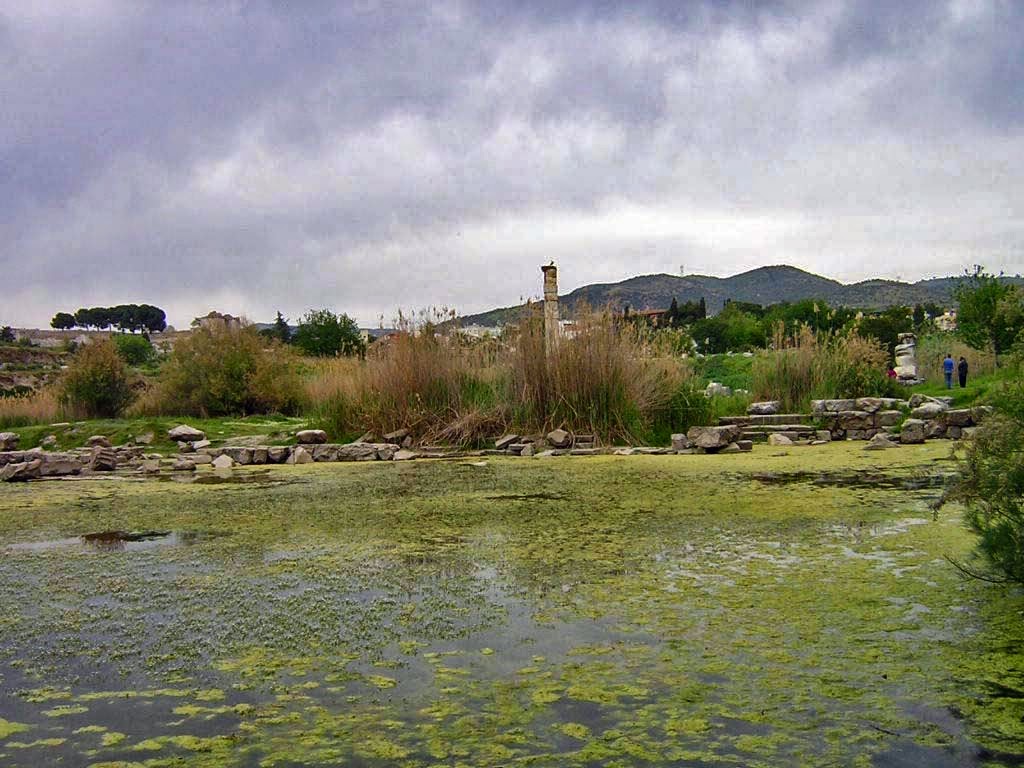
Unfortunately, all that is left today are some flooded foundations and a single not-too-well-reassembled column. The scattered remains go back to the time of Lysimachos, one of the generals and successors of Alexander the Great in the 4th century BC. In Alexander’s days, the city was centered on the Artemision. Lysimachos chose the location for the new town, which he surrounded with defensive walls. The place looks wild and overgrown, an eerie picture accentuated by the cackling chickens and screaming geese on the adjacent farm. At one time, even the gods made sure I heard them. The sky had turned pitch dark, and soon enough, the thunder rumbled while lightning flashes tore the clouds apart. A sign from Zeus, no doubt, but not from Artemis. Strangely enough, I was not surprised by the god’s manifestation.

After twenty years of rest, new excavations started again in 2014 because this year’s drought made the ruins far more accessible. Archaeologists hope to find remains from the Roman era, which may answer whether this famous temple was converted into a Christian church. In its present condition, it is not drawing much interest from tourists, but this may change when enough of the layout is exposed. After all, the sanctuary occupies the size of a football field, something worth considering, right?

Pausing at the edge of the poorly excavated parcel, I wonder about the traders, tourists, craftsmen, and kings who visited this temple over the centuries when it was a market and a religious center. They all came to honor Artemis and to share their profits with her. Excavations have shown that many people came to offer their gifts: gold and ivory statues of Artemis, but also earrings, bracelets, and necklaces from faraway countries like Persia and even India. An excellent collection of these gifts can be seen at the local Museum of Selçuk.

The temple may not have been finished when, in 268 AD, the Goths raided the city, destroying or partly destroying it. In 614, Ephesos was hit by an earthquake, severely damaging the buildings. The town lost its importance as a commercial center, aggravated by the silting up of the Cayster River that constituted its harbor.

While he was in Ephesos, Alexander received representatives from the towns of Magnesia and Tralles offering their submission. Parmenion was dispatched with a force of 5,000 foot soldiers and 200 Companion cavalry to ensure recognition by all Aeolian and Ionian towns in the area. At the same time, Alcimachus, son of Agathocles, set out with an equal force. They established a popular government replacing the existing Persian rule, ensuring that all would keep their own laws and customs and pay their taxes to Alexander instead of to the Persians.

Alexander, meanwhile, stayed in Ephesos and offered sacrifices to Artemis. It is probably at this time that he frequently visited the studio of Apelles, who became the only painter allowed to paint pictures of Alexander. We know of at least one painting made especially for the Temple of Artemis, in which Alexander was represented holding a thunderbolt. Apelles depicted the King using only four colors to create a more wondrous work. Alexander also organized a ceremonial parade of his troops in battle order, wearing their best outfit. He definitely knew how to put up a show!

Leaving the temple area, I drive up the nearby hill where it is said that the Virgin Mary spent her last days. From here, I have an eagle’s view of Roman Ephesos. In 190 BC, the city was included in the Kingdom of Pergamon, which, in turn, was incorporated into the Roman Empire in 133 BC and the later Byzantine Empire. In the early days of Christianity, Ephesos was still significant, if only because Apostle Paul lived here, as well as Apostle John, who is said to have taken care of Mary, who is buried here.

Of course, the Romans turned Ephesos into the largest seaport of the Aegean, which prospered till the harbor silted up, leaving the grand city about 6 miles inland from the coast. The most remarkable monument from those times is the Temple of Hadrian with the Baths behind it, the Fountain of Trajan, the Library of Celsus, and the magnificent villas (see: Ephesos and its terrace houses and The Grandeur of Ephesos).

Friday, September 26, 2014

Additional scrutiny of the Caryatids of Amphipolis (Kasta Hill) by Andrew Chugg

Yes, Andrew Chugg,  as can be expected, has written a second analysis just after the Caryatids were discovered. He decided to explain the meaning of the presence of these ladies. (For his first comment, see: A wonderful analysis of Amphipolis by Andrew Chugg).

Although the best-known caryatids are those of the Erechtheion on the Acropolis of Athens, they are a very common feature in Greek and Roman architecture. The caryatids guarding the entrance door of the Kast Hill tomb are slightly out of the norm because of their posture, facing each other in a mirror effect with an upraised arm in the center and the outside arm holding up their dress.

Andrew Chugg shows us that the Amphipolis caryatids closely resemble the one found at Tralles (modern Aydin, Turkey), dating from the first century BC. He adds, however, that little has changed in the general representation of the caryatids, either for those from the Classical or the Hellenistic periods.

More interesting, I think, is his comparison with the miniature caryatids found on the throne of Eurydice, Alexander’s grandmother (Philip’s mother), who stood in her tomb at Aegae. These caryatids, separated from each other by columns, also hold the ceiling with one arm while the other picks up their dresses, but they show more dynamism in their movement. These caryatids, in combination with the now-lost sphinxes, draw a clear parallel with Amphipolis and tend to point towards the burial site of a Macedonian queen of the fourth century BC. A detail, but a rather important one, is that women and adolescent girls only served Macedonian queens and not their kings, meaning that they only appear in female burial sites. Andrew Chugg here quotes Plutarch and goes as far as to link the baskets in which Queen Olympias kept her snakes (λίκνων) to the baskets carried on the heads of Amphipolis’ caryatids. This makes Olympias a favorite occupant of the Amphipolis tomb.


He also mentions Diodorus, who wrote that Cassander left Olympias behind, where she fell after being murdered, but no source speaks of her burial. Yet it is unthinkable that Olympias’ relatives or supporters, or the Macedonians in general, would not have provided a fitting burial to the mother of Alexander the Great.

So far, we have generally accepted the idea that Olympias was buried at Pydna, but this assumption seems to be solely based on a fragmentary inscription found in the area. The reconstruction of the text, i.e., filling in the blanks, is purely speculative and is subject to lots of interpretations. According to Andrew Chugg, it is improbable that Olympias died at Pydna, as her death occurred weeks after she surrendered to Cassander, who had his hands full with the revolt in Amphipolis. It makes no sense for Cassander to stay in Pydna pending Olympias’ execution while he was so badly needed to defend his position in Amphipolis.

Of course, this still doesn’t prove that Olympias is actually buried at Amphipolis, even though she may be the main candidate. As stated earlier, second in line could be Roxane, for which I have my personal doubts since I cannot believe that the Macedonians treated her with enough reverence to build such a lavish burial site, even though she was the wife of their Alexander.

Monday, September 3, 2012

Turkey beyond the Maeander by George Bean

"Turkey beyond the Maeander" (ISBN 0719547652) is simply the best and most complete book one can find about southwestern Turkey, in spite of the fact that information about accessibility and the state of the excavations may be outdated since George Bean died in 1977.

George Bean is a legend in this country where everybody seems to know him, has met him, or their parents, relatives, or neighbors have. He was a broad-shouldered man of almost six feet tall, and that alone was enough to impress whoever saw him. But apparently he had a most pleasant character, and unlike today’s hurried archaeologists, he would simply make his way to the local coffee-house for a chat with the villagers about their daily business, the harvest, and their way of living. Slowly winning their confidence, he then would bring up his interest in archaeology with surprising results.

He definitely loved this country and his deep interest in its past transpires through every line. It is surprising to discover how much history, facts, and figures he manages to cram into the story of each town he describes, while at the same time, he keeps things simple enough to make it passionate reading. Clear drawings, often just a few lines, illustrate his vivid tales, and the book is further enhanced with a handful of black-and-white pictures. No bombastic language that only an initiate can decipher, but plain words and sentences we can all understand.

In this book, George Bean mainly covers Caria in southwestern Turkey, where King Mausolos and his dynasty were leading figures and the main cities were Mylasa (today’s Mylas) and Halicarnassus (today’s Bodrum). Yet George Bean mentions nearly every single city and town. As a bonus, he has even extended his story as far as Aphrodisias, Hierapolis, and Tralles, which are in fact situated beyond the northern border of Caria.

Besides his “Turkey beyond the Maeander”, George Bean wrote another three books, “Aegean Turkey”, “Lycian Turkey”, and “Turkey’s Southern Shore”. You may have a hard time finding any of them, though; the best chance is a secondhand acquisition. Each and every one of these books is a precious tool and an unequaled jewel very much worth the effort of looking for.