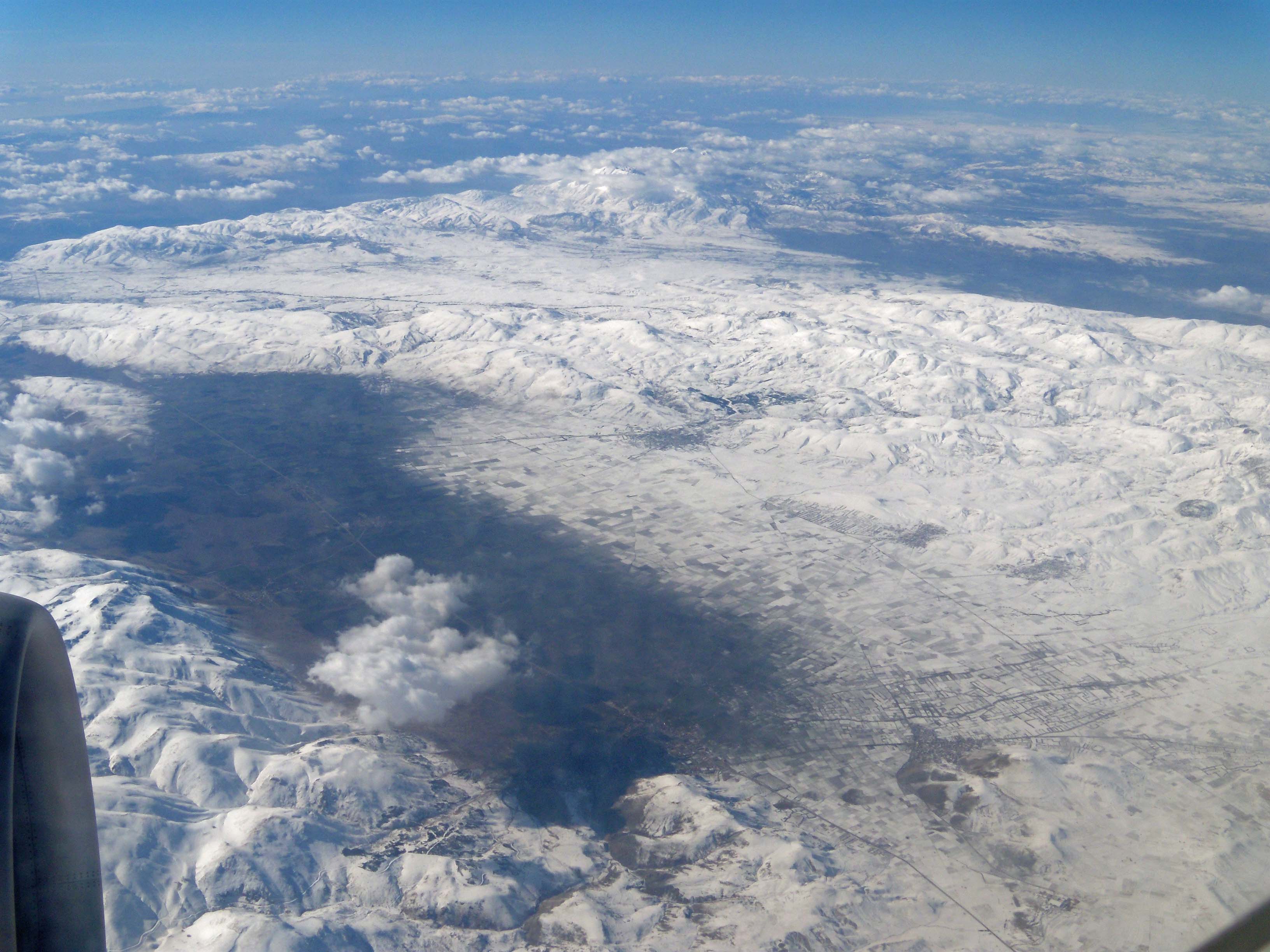
Alexandria's founded by Alexander

Alexandria's founded by Alexander the Great (by year BC): 334 Alexandria in Troia (Turkey) - 333 Alexandria at Issus/Alexandrette (Iskenderun, Turkey) - 332 Alexandria of Caria/by the Latmos (Alinda, Turkey) - 331 Alexandria Mygdoniae - 331 Alexandria (Egypt) - 330 Alexandria Ariana (Herat, Afghanistan) - 330 Alexandria of the Prophthasia/in Dragiana/Phrada (Farah, Afghanistan) - 330 Alexandria in Arachosia (Kandahar, Afghanistan) - 330 Alexandria in the Caucasus (Begram, Afghanistan) - 329 Alexandria of the Paropanisades (Ghazni, Afghanistan) - 329 Alexandria Eschate or Ultima (Khodjend, Tajikistan) - 329 Alexandria on the Oxus (Termez, Afghanistan) - 328 Alexandria in Margiana (Merv, Turkmenistan) - 326 Alexandria Nicaea (on the Hydaspes, India) - 326 Alexandria Bucephala (on the Hydaspes, India) - 325 Alexandria Sogdia - 325 Alexandria Oreitide - 325 Alexandria in Opiene / Alexandria on the Indus (confluence of Indus & Acesines, India) - 325 Alexandria Rambacia (Bela, Pakistan) - 325 Alexandria Xylinepolis (Patala, India) - 325 Alexandria in Carminia (Gulashkird, Iran) - 324 Alexandria-on-the-Tigris/Antiochia-in-Susiana/Charax (Spasinou Charax on the Tigris, Iraq) - ?Alexandria of Carmahle? (Kahnu)
Showing posts with label Bamyan. Show all posts

Saturday, February 4, 2023

Afghanistan, where history keeps repeating itself

The war in Afghanistan is no longer making headline news since the U.S. withdrew its troops in a sudden and short-term operation. What’s new, we might ask. The answer is nothing. 

Alexander spent three years of his life in Central Asia fighting an ever-elusive enemy of tribes that no longer fought each other but joined forces against the invader. In the 5th century, the Huns wreaked havoc; Genghis Khan, at the head of the Mongols, rampaged the region in the 13th century; Tamerlane repeated the operation a century later; and the Mughal dynasty followed suit in the 16th century. Even Islam spreading brotherhood among men could not achieve any result. The more recent invasions by Britain in 1839-1842 and 1870-1880, the Soviet Union in 1979-1989, and the United States in 2001-2021 only repeated their predecessors’ fatal outcomes.  

Who are we to call Alexander’s campaign in Central Asia a failure when later invaders with far more sophisticated means did not fare any better? Alexander was a military genius, and no one has been able to surpass him – certainly not here in Afghanistan. 

Those looking for a complete analysis on the situation in Afghanistan will find useful information in Frank Holt’s book Into the Land of Bones, Alexander the Great in Afghanistan. The author draws an excellent comparison of Alexander’s achievements with those of later invaders. He asserts that the only way to rule the country should imply that the conqueror subdues every warlord because one single exception would erase all previous successes. Isn’t that precisely what Alexander tried to achieve? 

The French archaeologists who worked in Afghanistan early last century upon the invitation of King Mohammed Zahir were confronted with the double face of the local population. During the day, they gathered around to look and give a helping hand, while at night, they would destroy the statues and steal the precious artifacts. Tribal elderly, generally strong Islamic believers, destroyed many human statues as soon as they were unearthed. Altogether, many unique artifacts were destroyed overnight or disappeared on their way to the Museum in Kabul (see: Le trésor perdu des rois d’Afghanistan by Philippe Flandrin). Typically for Afghanistan, not even the king could overrule the tribe elderly! 

Under these circumstances, it is impressive that the gold treasure from Tillya Tepe, a tomb hill in the northwest corner of Afghanistan, has survived. The content of these six tombs was barely rescued when the Soviet Union entered Afghanistan in 1979 and safely transferred to the Museum in Kabul (see: Bactrian Gold, the Hidden Treasures from the Museum of Kabul). The Museum suffered greatly from the ensuing civil wars and was repeatedly plundered, and artifacts were stolen. The worst, however, was still to come when in 2001, the Taliban decided not only to destroy the huge Buddha statues at Bamyan but also to annihilate the 2,500 statues and reliefs of the Museum. However, a handful of brave Afghans rescued the Tillya Tepe treasure and locked it away in the vaults of the Presidential Palace. They managed to keep the place a secret. By 2004 the government of Afghanistan decided that the situation was safe enough to bring the gold artifacts out in the open again, but the Museum in Kabul was no longer fit to shelter this precious collection. Based on their earlier collaboration, they contacted the Musée Guimet in Paris and, together, they agreed to send these rich finds on a traveling tour around the world. 

Today, with the ruling Taliban, the country is still dominated by its warlords, who consistently cling to their traditions and mistrust all foreign intrusion.

Thursday, May 19, 2022

Weather conditions during Alexander’s march East

As I so often stated, the weather conditions are not important for historians. We find only a few examples in Alexander's campaigns, like the Monsoon in India and the flash flood in the Gedrosian Desert. Still, in reality, the weather did play a vital role in his campaign East.

Throughout their march from Greece to India, the Macedonians must have been plagued by recurrent earthquakes that disturbed their advance or campsite. Alexander could sacrifice to the gods, but he could not prevent or control these natural disasters. 

Speaking to one of the locals in Turkey, I remember him pointing out that he preferred to be “in the open” rather than inside any building when an earthquake occurred. Being outside, he would witness boulders rolling downhill and trees being shaken, but none of the rattlings would be as frightening as when sitting inside a house or shack.

It is easy to imagine how, in Alexander’s campsites, the army tents would collapse, banging up the occupants. Frightened horses and pack animals would try to run if they were not adequately secured by their attendants. When an earthquake hit the troops on the march, they could immediately react accordingly.

Another natural threat is the wind, which may not sound so dangerous, but the situation could be life-threatening when it creates a storm.

This idea occurred to me during my trip to Iran when I skirted the Zagros Mountains. In the winter of 330 BC, Alexander marched south using approximately the same route I was following a little later in the year, i.e., in April (see: The Zagros Mountains and the Persian Gates in Alexander’s footsteps).

I was plagued by a severe sandstorm that blew relentlessly during my three-day journey. Visibility was very low as the sands from the Mesopotamian Valley in modern Iraq were carried through the air. My clothes flapped around me as if they were to be torn away any moment while the sand was stinging my face and hurting my body. The wind whistled through the lunch place and the sand battered against the windows.

Inevitably my mind drifted back to Alexander as he must have known days like this. Traveling in the comfort of my air-conditioned vehicle was hard enough. However, when I stepped outside of this protective shell, I had a taste of what he experienced – if not here, certainly in other locations.

Curtius seems to be the only one to write about Alexander’s expeditions into the interior of Persia some time in Spring 330 BC, where he was troubled by heavy rain and “almost intolerable weather.” He even was stopped by heavy snow that had frozen solid; not for long, though, as he immediately started making his way, breaking the ice with a mattock, an example that his men promptly followed (see: Alexander amidst the pomp and circumstance of Persepolis).

While we take bad weather as a mere inconvenience, we cannot underestimate its far-reaching impact. That became clear after reading The Road to Oxiana by Robert Byron. Byron traveled to Iran and Afghanistan in 1933, using whatever means of transportation available. The weather conditions commanded his advance to a degree I did not expect. The Macedonian army must have faced similar conditions that hampered their progress to the same extent.

Byron is hit by what he calls a burning dust-storm, a good one hundred miles east of Hamadan, ancient Ecbatana. Near Bisutun, he witnessed great spirals of dust, “dancing like demons over the desert,” stopping his car and choking the passengers. 

Wind, rain, and ice are Byron’s main challenges. He attempted to drive south from Tehran to Isfahan in early February but was stopped some ten miles out. The road turned into a sheet of ice that partly thawed and had frozen again. The scene must have been spectacular, for he writes, “At this moment the sun rose, a twinkle of fire lit the snowy plain, the white range of the Elbruz was suffused with blue and gold,” A beautiful picture but a horrible travel condition.

A few days later, it rained for twenty-four hours. Byron was still stopped in Tehran by a “deluge of rain” in the last days of April. As he traveled further East via Damghan to Mashed, a route that approximately matches Alexander’s, “the rain fell like a bath-waste. For miles at a time the road was a river, the desert a flood, and every mountain a cataract.” The roads turned into fast-flowing rivers.

In Spring, Byron eventually reached Herat and continued due East to Kunduz. On his road to Balkh, where Alexander made camp and wintered in 328 BC (see: A view of the Karakum and Kyzylkum Deserts and Afrasiab, ancient Samarkand), Byron describes how “the rain came down in sheets. … every angle of the mountains was occupied by a cataract. … along that narrow ledge whence the red pinnacles rose into the clouds above, and whole ranges could be seen emerging from the clouds below…” A little further, he continues by saying that “the color of the landscape changed from lead to aluminum… The clumps of green trees, the fountain-shaped tufts of coarse cutting grass, stood out almost black against this mortal tint”.

Mazar-i-Sharif fared much better in his last days of May. He described how the clouds gathered on the mountains each afternoon, although summer should have set in six weeks before. People said they had never witnessed such conditions. The weather one hundred years ago was as unpredictable as today. The rain that fell before Byron’s arrival in the city was enough to close the road to Kabul for a whole month! An entire village had fallen down in a nearby gorge. Just picture Alexander having to cope with such extremes!

After Kunduz, Byron turned West, following the river of the same name to the plain of Bamyan, crossing the stream nine or ten times over wooden bridges. I doubt these bridges existed in Alexander’s days when the army had to find a way through the water. In June, Byron heard that a landslide blocked the other side of the Shibar Pass. In fact, “heaps of liquid mud and pebbles concealing large rocks.” The travel conditions became increasingly drastic. “The crops below the road, already half destroyed by the rivers of mud, were now menaced by a further spate.”

Alexander probably took this same road in the fall of 327 BC when he left Bactria for India by the Shibar Pass (see: Alexander crosses the Hindu Kush a second time). Nobody mentions any landslides occurring, but they were undoubtedly recurrent because further down Byron’s road to Kabul, another dozen landslides prevented him from reaching the city. Was Alexander just lucky and under the protection of the gods, one wonders?

The crossings of the Hindu Kush, in turn, have been pictured very well by Steven Pressfield in his book The Afghan Campaign. He describes the pure horror and misery the army endured in their daily lives of survival (see: From Afghanistan into Bactria across the Hindu Kush). Arrian, of course, gives us the facts but Pressfield, with his skills as a military writer, adds the human experience to the expedition.

Picking up Byron again, we read how on the road from Kabul to Ghazni – which Alexander traveled in the opposite direction to cross the Hindu Kush into Bactria – “two lorries were completely wrecked by the stream … the Kunduz ferry has overturned and sunk, drowning five women.”

Reading our history books, we are far from realizing that traveling or leading an army was a dangerous enterprise. Not only because of the enemies that had to be subdued but also because of the terrain and the weather conditions, which, as I said above, were seldom mentioned or recorded.

Wednesday, April 3, 2019

Saving Afghanistan's Incredible Heritage

As it is utterly impossible to summarize this wonderful article written by CNRS News, giving a thorough insight in the problems archaeology is facing in Afghanistan, I'll limit myself to the following short introduction. For further reading, I gladly refer to the link that I attach at the end.

For nearly a century, the French Archaeological Delegation in Afghanistan (DAFA) has been drawing up an inventory of the archaeological heritage of one of the world’s most unstable countries. Some 5000 sites have already been discovered, both on the ground and from the air. They reveal Afghanistan's remarkable archaeological wealth, including protohistoric, Greek, Buddhist and Islamic remains, as archaeologist Julio Bendezu-Sarmiento explains.


For the last thirty years, Afghanistan has been associated with images of war, of the Soviet occupation, civil strife, and the Taliban—to the point of concealing the extent to which the country once fired the imagination of archaeologists and adventurers of every sort. It was there that Alexander the Great, who had set out to conquer Asia, is said to have met and married the beautiful Roxana around 330 BC. Buddhism found fertile ground there too, yielding some of its most beautiful works of art, such as the tragically renowned Buddhas carved into the cliffs of the Bamiyan valley, and destroyed by the Taliban in 2001. It was also through Afghanistan that goods, such as tea, spices, precious stones and silk, travelled for centuries along the Silk Road. Located at the crossroads between central Asia, the Persian world and the cultures of the Indian sub-continent (Pakistan and India), Afghanistan has always been a source of envy, and with good reason: it is one of the countries that boasts the greatest number of mines of copper, gold, silver and even of lapis lazuli, a semi-precious stone found in the Mesopotamian tombs of Ur and in the jewelry of the Egyptian Pharaohs.

Julio Bendezu-Sarmiento, a CNRS researcher and French-Peruvian archaeologist, has headed the French Archaeological Delegation in Afghanistan (DAFA) since 2013.1 He explains why it is urgent to list Afghanistan's archaeological heritage, as a growing number of economic development projects are underway, such as the gas pipeline planned to cross the south of the country, and looting has never been so widespread. 

The French Archaeological Delegation in Afghanistan (DAFA) is the only foreign archaeological team with a permanent presence in Afghanistan. Why?

Julio Bendezu-Sarmiento: Our offices are located in Kabul, in an old building that houses a research center, a library containing 20,000 books, a restoration and a photo laboratory and storerooms. Today, we are quite simply the only foreign archaeologists still working in the country: since the bomb attack that killed 90 civilians in Kabul's diplomatic quarter in spring 2017, every other international scientific team has left. This has to do with our very close ties to Afghanistan. The DAFA was set up in 1922 at the request of King Amanullah, when the country was just beginning to open up to the outside world: in fact, the archaeologists got here before the French diplomats!

For the entire article, please click here.

Friday, October 20, 2017

Damned dams!

After Allianoi (see: My Heart in bleeding for Allianoi), after Zeugma (see: Zeugma, border town along the Euphrates), and after many unchartered dams destroying our historical heritage, it is the turn to the town of Hasankeyf on the Tigris to be flooded and blasted to pieces because of the construction of yet another dam.

[Picture from Archaeology News Network]

The location of the dam on the Tigris River is a very unhappy one for Hasankeyf is one of the oldest continuously inhabited settlements in the world. From Neolithic caves to the Roman fortress and later Ottoman landmarks, all are soon to disappear forever as crews have already started blasting the surrounding cliffs in preparation for the construction of this dam.

As before in Allianoi and in Zeugma, the Turkish government does not listen to the pleas formulated by local and international communities to preserve the site. Internationally, it does not ring loud bells like when the giant Buddhas were blown to pieces in Bamyan, Afghanistan, or the more recent dynamiting of the Temple of Bell in Palmyra, Syria, but this heritage is nonetheless very important from the historical point of view.

Of course, officials have their own arguments and as usual they underscore the fact that this dam will enable the irrigation of the surrounding land and generate a substantial amount of energy. They even expect tourists to come for scuba diving in the new reservoir in search of the submerged monuments (as if the average tourist walks around with his diving gear in his backpack!). The price tag for this operation is, however, that nearly 200 settlements will be submerged and some 15,000 people will be resettled in the newly built city of New Hasankeyf on higher grounds.

It is comforting to hear that Ridvan Ayhan, who is a member of the Save Hansakeyf Initiative, confirms my earlier worries about the lifespan of a dam which is only 80 years on average. Nobody is asking the obvious question: and then, what? As I explained earlier when talking about Allianoi, water is of vital importance to our life but dams are not the one and only solution and they are not eternal as governments all over the world want us to believe. What will happen in 80 or 100 years from now when this barrage and so many others give way? No water then, no crops, no dams, nobody to take responsibility for, and sadly no historical city to be revived from underneath the sediments. How can we explain this to our children and our children’s children?

In December 2016, the HuffPost published a cry for help with large-sized photos of the area but as usual, officials turned a blind eye to this kind of plea.

Saturday, October 7, 2017

World Heritage Sites in Danger

The war in the Middle-East, especially in Syria, Iraq and Afghanistan is a terribly destructive one ( see: The War in Syria, what will happen to its heritage?; Loss of our Cultural Heritage in the Middle-Eastern Conflicts). Millions of people have been displaced and the number of habitations that have been shot down and blown to pieces can no longer be counted. Among the damaged constructions are – inevitably – irreplaceable ancient sites that belong to human heritage. They are pages of our history that are torn and lost forever.

In Syria and Iraq alone, UNESCO lists ten World Heritage Sites and of those ten, they say, nine are presently in danger. ISIS, although not the only destructive factor is definitely the main culprit.

The majority of the sites are located in Syria:


The well-preserved remains of Bosra on Syria’s southern border are less known but contained a great number of ancient buildings. Most famous is probably its Roman theater from the 2nd century AD when Bosra was the capital of the Province of Arabia. Yet there also are many testimonies from the days when the city was ruled by the Nabataeans, the Byzantine Empire, and the Umayyads. Bosra, however, was one of the first cities under siege and suffering from repeated shelling and bombing by ISIS (the theater was a  choice location for the snipers).

Another sore spot is the ancient city of Aleppo, which like Palmyra was situated on antique trading routes (see: Tracking Alexander from Tyre to the Euphrates) and remained a major city in Syria. Since 2012, it has been divided alternately between rebels and government troops. Among the destroyed and damaged buildings is the Mosque of Aleppo and its Minaret from the 11th century AD (see: Desperation of the Archaeologists).

Less known but certainly as important are the so-called Dead Cities with their precious villages and churches that flourished between the 1st and the 7th centuries ranging from antiquity to the end of the Byzantine era. Fighters and refugees alike sought shelter among these ruins, trying to accommodate the fragile remains to their needs.

From another time-frame are the many Crusader Castles, the most renown being the Crac-des-Chevaliers. They are unique because of their mixed architecture of European and Eastern influences. Here too, the Syrian army and the rebels occupied the premises in turn without any respect or consideration for the patrimony.

Last but not least, there is the damage done in Damascus, one of the most ancient cities in the world. Damascus already was a problem child because of a population decrease and people moving from older building to newer housing facilities. This left big gaps in some of the city’s neighborhoods. The fighting inside the Old City started as early as 2012 and caused more damage. UNESCO has counted as many as 125 protected monuments in Damascus, among which the famous Umayyad Mosque, one of the largest mosques in the world.

UNESCO also lists a number of precious buildings in Iraq. Unfortunately, these are less known by the general public simply because traveling into Iraq was and is problematic.

The city of Hatra was one of the best surviving examples of a Parthian city founded in the 3rd or 2nd century BC. Most of its city walls and towers, as well as the sacred temenos of the Temple of Mrn, were still standing when ISIS arrived. As they did in nearby Nimrud a few days before, they hacked down the magnificent figures that decorated the arches and vaulted passages. The Great Temple was a rare example of combined Greek, Roman, Persian and Arabian architectural styles.

The Assyrian city of Assur on the western bank of the River Tigris is another precious site as it was the first capital of the Assyrian Empire. Assur existed for nearly four thousand years and was finally destroyed by the great Tamerlane. However, the stately Parthian Palace and Temple have survived into our 21st century until they fell under threat of ISIS. The fate of Assur remains uncertain for if the city is not destroyed by terrorists it may become victim to the dam project on the Tigris which will flood whatever walls that are still standing.

Finally, there is the old Abbasid capital of Samarra which is the only surviving Islamic capital to show its original layout, architecture, and decorations (including mosaics and carvings). It is home to the Great Shiite Mosque that was in danger when the city was taken by ISIS and was caught up in the war between Shiites and Sunnites. It seems that the Iraqi government was able to push the invaders back.

Not very uplifting altogether. As to Afghanistan where the situation is far more complicated, there is the Valley of Bamiyan where the giant Buddha’s were blown up in 2001 and the Minaret of Jam (see: The Minaret of Djam, an Excursion in Afghanistan by Freya Stark). Meanwhile, UNESCO has put the cities of Herat, the city founded by Alexander as Alexandria Ariana and Balkh or, as it was called in antiquity Bactra or Zariaspa (see: Alexander’s Prison?) on a tentative list.

[Picture of the Bamyan Valley is from Ancient Origins]

Although this is only a corner of our planet, there is more than enough to worry about!

Wednesday, August 16, 2017

Alexander crosses the Hindu Kush a second time

After two years of intense guerilla fights throughout Sogdiana, Alexander had finally caught Bessus, eliminated Spitamenes and restored a relative peace in Bactria by marrying Roxane. The time had come for him to head for India.

Until now, I was convinced that Alexander returned from Bactria via the Khyber Pass but when I tried to trace where the idea came from, I was in for a surprise. There is no excuse, I should have taken a closer look at the map to realize that the Khyber Pass lies in fact on the way from Kabul to Peshawar and not between Bactria and Afghanistan.

With that question solved, I needed to find out which pass Alexander had used leaving Bactria. The antique authors are disappointingly scant in reporting this part of his campaign. Plutarch, Justin, and Diodorus do not mention the crossing of the Hindu Kush – a formidable barrier under all circumstances - on Alexander’s return and Curtius simply states that Alexander set out for India in order not to foster idleness. Arrian seems to be the only one to be more specific telling us that by the end of spring Alexander began his march for India, that he crossed the Indian Caucasus, and ten days later reached Alexandria(-in-the-Caucasus), the city he had founded during his first expedition into Bactria. Strabo merely tells us that Alexander crossed the Hindu Kush and settled his veterans and mercenaries together with natives at Alexandria-in-the Caucasus.

This meant that I had to rely on modern historians and their research on the matter. Unfortunately, they do not agree among themselves about Alexander’s route and it seems that they all have a theory of their own.

Frank Holt (Into the Land of Bones) has come to the conclusion that Alexander marched his army over the Shibar Pass. With the winter snows gone, the trek went smoothly and without great logistical problems.

Robin Lane Fox (Alexander the Great) says that Alexander used the same pass as earlier, meaning the Khawak Pass (see: From Afghanistan into Bactria across the Hindu Kush). This time in June, the march was at a leisurely pace and took only ten days. The snows had melted and Alexander could rely on food stored in the Sogdian fortresses on the way and on the high grazing grounds for the animals. The army spent a pleasant summer at Alexandria-in-the-Caucasus (Begram) thus avoiding an invasion of India in appalling heat.

A.B. Bosworth (Conquest and Empire) simply mentions that Alexander crossed the passes of the Hindu Kush into the Paropamisadae in ten days and reinforced the city of Alexandria-in-the-Caucasus.

Michael Wood has concluded that Alexander crossed the Hindu Kush via Bamyan, which implies that he took the Shibar Pass.

Donald Engels (Alexander the Great and the Logistics of the Macedonian Army) in turn sticks to the Salang Pass since this pass is shorter and has often been used by armies in a hurry. Engels states that the army re-crossed the Hindu Kush in late spring but could not forage for grain along the route because harvest at these high altitudes does not occur until July or August. They had to rely on supplies collected by Hephaistion throughout Bactra before departing.

In a footnote, the author refers to the optional Kushan Pass, just east of the Salang Pass, that has been put forward by other historians, but then this Kushan is seldom used because it is precipitous and treacherous – not exactly recommendable for an army. The Salang Pass, on the other hand, although as fast as the Kushan is much safer. He rules out the Shibar Pass which is longer than the Khawak. Given the ten days it took Alexander to cross the Hindu Kush, Engels’ choice is narrowed down to either the Salang Pass or the Kushan Pass.

All these theories take me back to the map of Afghanistan and of the Hindu Kush in particular. Based on the above, it comes down to choosing between the 3,878 meter-high Salang Pass and the Kushan Pass rising at 4,370 meters located due west of the Salang Pass. Interestingly, this pass is less than one kilometer away from the modern Salang Tunnel built in 1964 with the financial and technological support of the Soviet Union. This meant that traveling time is cut down drastically although repeated avalanches tend to trap the vehicles inside the tunnel, making the voyage still a dangerous one.

Glancing at Google maps provides another quite impressive image of the landscape the Macedonian army crossed. Even with enough food and fodder, we have to admire these sturdy men trudging over narrow paths, through deep ravines, across icy rivers and over rocks of all sizes and shapes. Nobody, not even Hannibal comes close to Alexander’s exploits in the Hindu Kush. In the end, I have to agree with David Engels and agree on the Salang Pass.

We should remember that Alexander’s Asian campaign is much and much more than a series of battles and sieges. Marching often through forbidding landscapes, coping with extreme heat, thunderstorms, crosswinds, dust, rain, sleet and ice, the Macedonians have seen it all but the king set the example by leading his troops over each and every obstacle. The Hindu Kush is just one of these obstacles, although a major one that cannot be stressed enough.

[First picture shows the Shibar Pass by František Řiháček -original prints, CC BY-SA 3.0, - The two other pictures show the Salang Pass by Scott L.Sorensen - My Personal Picture, CC BY 3.0 and by Spc. Michael Vanpool (U.S. Armed Forces) respectively.]

Tuesday, October 28, 2014

Great news from Pergamon

The unique site of Pergamon has just been added to the World Heritage List of the UNESCO.


So many sites are still pending acceptance, others are being accepted and Pergamon certainly deserves its place. As told in my previous article Pergamon is simply huge, the city was the capital of the Hellenistic Attalids and the capital of the Roman province of Asia. It was a key city in the ancient world and the proud owner of an Asclepion where sick people were treated in what we can label as modern ways.

It is very unfortunate that cities on UNESCO’s World Heritage List cannot be better protected during conflicts or in wartime. It saddens me deeply when scrolling down this list (click here) that so many sites are in danger (the red dots) in countries like Afghanistan (the Minaret of Djam and the Bamiyan Valley), Georgia, Iraq (Ashur on the Tigris and the Samarra site), Israel with the old city walls of Jerusalem, Serbia (medieval Kosovo), and maybe most of all Syria including old Damascus, old Bosra, the beautiful city of Palmyra, old Aleppo, the Crac des Chevaliers, and the so-called Dead Cities.

Monday, June 30, 2014

Bactrian Gold, the Hidden Treasures from the Museum of Kabul

Bactria, to me, is Alexander-country, the lands of Central Asia where he spent two years of his life in 228 and 227 BC. The exceptional exhibition Afghanistan, hidden treasures from the National Museum, Kabul” covers this period and is presently traveling worldwide. It centers on four excavation sites covering roughly 2,500 years, i.e., from two thousand BC to the third century AD.


[Map from National Geographic showing Alexander's Route]

I knew French and Russian archaeologists had been working in the area for years, entrusting their treasures to the National Museum in Kabul. That is till 1979 when the troops of the USSR invaded Afghanistan. Archaeological diggings by Frenchman Paul Bernard at Ai-Khanoum, for instance, had to be interrupted abruptly, and when he returned to the site recently, it was thoroughly plundered and destroyed. Most damages were, however, done a few years later when the Taliban considered it their duty to obliterate every image of people wherever they found it: on frescoes, mosaics, paintings, reliefs, or statues. We all have witnessed what happened to the giant Buddha statues in Bamyan. Still, not many people know that the Museum of Kabul was one heap of rubble after the Taliban had thoroughly ravaged it – a frightening experience! A precious heritage that survived for centuries is being totally destroyed with just one single blow!


To use the old name, Bactria is located in Central Asia right on the crossroads of old caravan routes, later the Silk Road, the meeting point of all trade routes between East and West. It is not surprising that Alexander the Great put so much time and effort into the conquest of this area, for it meant not only a way to secure his back while heading for India but also an economic asset precisely because of the geographic location of Bactria. His marriage with Roxana, the local chief's daughter, was, after all, a high political move rather than real or impulsive love, as some suggest. Who knows?

The first objects I encounter as I enter the exhibition are three statues from the Musée Guimet in Paris, dating from Buddhist times but showing a definite Hellenistic influence. You can’t miss them; the way they are presented in the floodlights against a black background instantly gives you a taste of what to expect. This tremendous high relief of a Genius with Flowers from the 4th-5th century AD was found in the Buddhist monastery of Hadda in remote northern Afghanistan, yet still magnificently Hellenistic.

At a right angle, right in front of me, stands a showcase filled with one hundred Buddhist heads, sorted by size, i.e., the smaller ones on the lower steps and the bigger ones at the top. It is a fascinating group, for all the heads are different, and as I take a closer look at each and every one of them, either at eye level or from the side, I see how they stare back at me or ignore me, looking away in an absent glance. I take my time to inspect and admire each face, some more Hellenistic than others, with a more elongated or rounder face, longer ears, closed eyelids, or just peeping at us visitors. All in all, an amazing group!

From here, the way leads to the movie theater, where this French documentary is shown about their exploration and excavations in the magnificent Afghan landscape. It is well documented with clear maps and a captivating view behind the scenes – absolutely worth watching. 

The oldest finds (2,000 BC) come from Tepe Fullol. There are only a handful of gold bowls and beakers made of thinly beaten gold that somehow reminds me of old Mycenae and the death mask of Agamemnon. Archaeologists disagree about the origins of this form of art, and the link to other cultures remains obscure. To complicate things, most of the treasures had disappeared, first because the gold was split up between the local tribal chiefs of Northern Afghanistan when it was discovered, and secondly, because the entire collection at the Museum of Kabul fell apart. These pieces are a little out of the way. That is unfortunate, for they deserve better after being hidden for four thousand years, don’t they?

The section about Ai-Khanoum is the most important one, at least in my eyes, for it is the reason for my visit, as this city was built in the wake of Alexander the Great’s conquest of the area in 328-327 BC. I am very much impressed by the idea of discovering this Hellenistic city at the banks of the Amu Daria River (modern Oxus River), complete with a Gymnasium, Citadel, Theater, and temples. It is not as evident as it would seem! The Greeks even built a Palace here. It is unlike anything else, for they never had a king to build it for. This one is based on the Persian model but decorated in Greek style with monumental Corinthian capitals on top of the columns and flat roofs with the so-called antefix decorations at the edge. A capital and several antefixes are on display here, together with objects like a water jet in the shape of a theatrical mask, a couple of sundials (which I didn’t expect to find here at all), a Hellenistic Hermes pillar of high quality from the Gymnasium; a face of either a man or a woman; bronze decorative elements; etc.

Eye-catcher is the Disk of Cybele from the 3rd century BC made of gilded silver picturing the goddess Cybele on a chariot in Greek style mixed with several eastern influences featuring the fire altar and Helios.


What excites me is the stone pedestal bearing the Delphic precepts. This wisdom comes from 5th century Delphi and teaches us something along the lines of “As a child, learn good manners. As a young man, learn to control your passions. In middle age, be just. In old age, give good advice. When you die, do so without regret.” Can you imagine the impact of this old text, this old wisdom that traveled from Greece to resurface unexpectedly 2,500 years later at the very edge of the desert steppes? That leaves me utterly speechless for a while!


Next comes the collection from Begram, a small town north of Kabul. In the years before WWII, two sealed chambers were uncovered, still containing their treasures of ivory furniture from India, plaster medallions, and, most strikingly, an extensive collection of glasswork of Hellenistic origin. Here too, each archaeologist seems to have their own theory of whether these chambers were set up as storage areas (since all the ivory was put together, and so was all the bronze and all the glass), as religious offerings, or maybe this is a hidden treasure. 


In any case, the glasswork alone is absolutely fabulous and unique in shape, color, and decoration. There are, for instance, these three goblets (they look more like vases to me, so tall). The countless pieces have been glued back together, but just by looking at the colors of these fishing and hunting scenes, you would swear they were painted only yesterday – so vivid and lively! Now try to imagine the impact of such a find, for these drinking beakers were produced in Alexandria in the first century AD and traveled all the way from Egypt to Kabul.


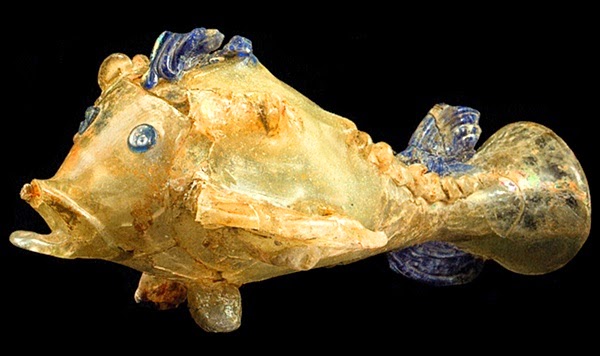
You have to admit that you are looking at something very exceptional. We all know there was an active exchange of goods in antiquity, and it comes to us like a simple statement from a history book, but here you are faced with the very product of such trade! I keep staring at this glasswork with wide-open eyes. Wow! Next to these painted glasses are a couple of glass drinking goblets or vases in the shape of fish, blue and off-white, with shiny eyes and sharp fins. I’ve never seen anything like this. There are glass-blown vases with honeycomb motives or wrapped in a net of glass lace; an elegant black glass vase with a high handle next to a translucent one covered with designs applied with gold leaf; for me, an unprecedented variety of delicate, colored, and painted glass that makes the cut-crystal bowl look rather primitive and dull. Amazing!

In another showcase, all the ivory artifacts have been brought together.

These objects from the first century AD originally all come from India but again are drenched in a Hellenistic sauce. Unique is the ivory River Goddesses approximately 45 cm high, clearly from a Buddhist background, among the exquisite openwork ivory panels showing Indian ladies in exotic gardens with fountains and temple-like buildings, a few monster figures, etc. Strange is the odd-shaped earthenware jar with blue-green glaze representing a bird-woman, for I cannot tie this style or shape to anything I have seen before.

The bronze artifacts somehow don’t add anything new. I only remember the cute figurine of Amor carrying a lamp and the young rider who seems to refer to Alexander the Great because of the way he is sitting on the horse that is lost from underneath him.

I stop to admire the row of plaster medallions, each about 15 cm in diameter, also dating from the first century AD. They look like oversized molds for the production of coins but were used to create the bottom motives for silver plates and goblets as the silver was poured and hammered around these molds. There are a few striking designs, like the Winged Amor or the high relief of a youth. Just imagine these portraits staring back at you from the bottom of your silver goblet filled with water or wine. I certainly would love to give this a try, wouldn’t you?

Finally, there is the gold treasure from Tillya Tepe, a tomb hill just outside the Greek Bactrian city of Emshi-Tepe in the oasis of Sherberghan. The content of these six tombs was barely rescued when the Soviet Union entered Afghanistan in 1979, and it was safely transferred to the Museum in Kabul. There was a seventh tomb on that hill at the Turkmenistan border, but Viktor Sarianidi, the Russian archaeologist who had led these excavations together with his Afghan colleagues, ran out of time, and when he recently returned, the tomb had been thoroughly plundered. Such a shame! Luckily for us, Sarianidi managed to travel to the Museum of Kabul in the 1980s in order to take pictures of all 20,000 excavated objects, and he published an impressive book. So at least we know exactly what was found at Tillya Tepe.

What followed were uncertain times for the art world, and we owe it to a handful of brave Afghans that this treasure was rescued, safely locked away in the vaults of the Presidential Palace. They managed to keep the place a secret. The Museum itself has suffered a great deal from the civil wars as it was repeatedly plundered and artifacts were stolen, and in 1994 it was hit by a rocket setting it on fire. How dreadful! The worst, however, was still to come when in 2001, the Taliban decided not only to destroy the huge Buddha statues at Bamyan but also to annihilate the 2,500 statues and reliefs of the Museum. We had to wait till 2004 when the government of Afghanistan decided that the situation was safe enough to bring the gold treasures out in the open again, but as the Museum in Kabul could not shelter this precious collection yet, they contacted the Musée Guimet in Paris. Together they agreed to send these rich finds on a traveling tour. After Paris and Turin (Italy), the collection can presently be seen in Amsterdam, moved on to the United States, and is now touring Australia.


The tombs are beautifully presented in high rectangular boxes covered with a glass plate showing the contours of the deceased with underneath each piece of jewelry in its original place. They unearthed one warrior and five women, the man lying at the top of the hill between the two most beautifully dressed women, the other three women being found on the hillside, which should have looked like a kurgan according to the nomads’ rituals.

This part of the exhibition clearly states that Northern Afghanistan was the melting pot of different cultures where the influence of China and Greece are interwoven with the lifestyle of the steppe people. Each tomb is an exploration by itself, where all kinds of artifacts of different origins keep each other company in breathtaking harmony.

Of course, they all have gold bracelets and anklets inlaid or not with semi-precious stones, but I notice how some women hold a Chinese mirror, from the Han Dynasty apparently; gold pins with on top a gold flower with open petals and vibrant pistils; hairpins as I know them from Japanese geishas but executed in thin flaky gold and tiny pearls; a ring engraved with an Athena figure and Greek inscription, and rings inlaid with precious stones; ornaments for the neck of the robe laid out as a necklace made of gold, turquoise, garnet, carnelian, and pyrite; gold earrings preferably inlaid with turquoise; pendants like those of the Dragon Master with turquoise, garnet, lapis-lazuli, carnelian and pearls in a rare symbiosis of Greek, Indian and Chinese elements; a set of gold clasps showing Amor riding a dolphin with turquoise and mother of pearl; even gold foot soles! 

The warrior, supposedly a prince, carries an iron dagger with gold covered handle depicting animals and inlaid with turquoise. His belt made of braided goldthread-strings connecting nine gold medallions showing a warrior riding a lion is an exceptional masterpiece. His head rested on a phial, a plate used for offerings, made of pure gold and measuring nothing less than 23 cm in diameter!

The list seems endless, for besides the most striking objects, the collection contains numerous coins, pendants, and various decoration items. As the most recent coin found in these tombs is that of Emperor Tiberius (who ruled from 14 to 37 AD), they could be dated with certainty to the first century AD. We see a true amalgamation of art from the steppes (I would personally call this Scythian art), Greek, Indian, and Chinese art.

I am terribly excited to finally catch up with the Aphrodite of Bactria, a five centimeters high gold appliqué inlaid with turquoise. I know the piece from pictures and references, but here she is. I go down on my knees to look closer; for an instant, she is mine alone. The piece de resistance, however, seems to be the gold crown with gold spangles and flowers. It is, in fact, a travel crown that can be taken apart as it consists of five separate pieces mounted around a tiny stem holding flattened branches that fit into the band of the crown itself. The spangles gently shake as people walk by, so imagine this crown in the open steppe where the wind can play freely with every tiny detail! A true gem!

It is still unclear to which nomad tribes the tombs of Tillya Tepe belong and how far this melting pot of civilizations reached out. Generally, these steppe people came from northwestern China or Parthia (now part of Iran and Turkmenistan), but who knows? Further investigations will tell us. For now, we have to accept that this territory is vast, for we have jade from China, garnets from India, turquoise from eastern Iran, and lapis lazuli from the mines of Badakhshan (today’s Afghanistan), all found together in this area. And yet we have not mentioned the traders and artists who were constantly moving between China, India, and the Roman Empire to produce these beautiful artifacts. It’s a small world – or is it not so small after all?


Anyway, I am convinced that this wide exchange of art and knowledge would not have been possible without Alexander the Great conquering these territories and organizing his Empire as he did.


[Pictures from The Australian by Ollivier Thierry]