Alexandria's founded by Alexander

Alexandria's founded by Alexander the Great (by year BC): 334 Alexandria in Troia (Turkey) - 333 Alexandria at Issus/Alexandrette (Iskenderun, Turkey) - 332 Alexandria of Caria/by the Latmos (Alinda, Turkey) - 331 Alexandria Mygdoniae - 331 Alexandria (Egypt) - 330 Alexandria Ariana (Herat, Afghanistan) - 330 Alexandria of the Prophthasia/in Dragiana/Phrada (Farah, Afghanistan) - 330 Alexandria in Arachosia (Kandahar, Afghanistan) - 330 Alexandria in the Caucasus (Begram, Afghanistan) - 329 Alexandria of the Paropanisades (Ghazni, Afghanistan) - 329 Alexandria Eschate or Ultima (Khodjend, Tajikistan) - 329 Alexandria on the Oxus (Termez, Afghanistan) - 328 Alexandria in Margiana (Merv, Turkmenistan) - 326 Alexandria Nicaea (on the Hydaspes, India) - 326 Alexandria Bucephala (on the Hydaspes, India) - 325 Alexandria Sogdia - 325 Alexandria Oreitide - 325 Alexandria in Opiene / Alexandria on the Indus (confluence of Indus & Acesines, India) - 325 Alexandria Rambacia (Bela, Pakistan) - 325 Alexandria Xylinepolis (Patala, India) - 325 Alexandria in Carminia (Gulashkird, Iran) - 324 Alexandria-on-the-Tigris/Antiochia-in-Susiana/Charax (Spasinou Charax on the Tigris, Iraq) - ?Alexandria of Carmahle? (Kahnu)
Showing posts with label Issus. Show all posts

Friday, April 10, 2026

The story around Alexander’s copy of the Iliad

Throughout history, it transpires that Alexander liked to present himself as the new Achilles. His Companions jokingly said it was because he slept with Homer's Iliad under his pillow. 

Page from the Iliad found in Egypt, 
APM Amsterdam

This statement may be far-fetched, but Plutarch confirms that Alexander kept his copy of the Iliad in a jeweled casket. It was the king’s proud possession since the precious scrolls were given to him by his earlier teacher, Aristotle, who had commented on the script. 

Ironically, the luxurious box may have belonged to the Persian King Darius. After the Macedonians were victorious at the Battle of Issus, it fell into Alexander's hands, who considered it worthy to hold the scrolls of his beloved Iliad

What history does not provide is a detailed description of the box and what King Darius kept inside. 

It is everyone’s guess if the casket was made of wood and inlaid with precious stones, or perhaps made of gold with intricate decorations. 

As to its contents, it may well have held the translation of the ancient Persian Avesta, the sacred text of Zoroastrian belief written originally in Avestan, an old eastern Iranian language that dates back to 1400 BC. Zoroaster was the first to teach humanity the doctrines of Heaven and Hell, the Resurrection of the body, the Last Judgment, and Eternal Life. These principles spread among mankind to be picked up eventually by Judaism, Christianity, and Islam. The Avesta must have been key to Darius ideology, and these ancient texts were his most prized possession. 

Zoroastrian Temple of Fire, Yazd, Iran

Nothing more is heard about Darius Avesta. I find it hard to believe that Alexander would have discarded these texts. The wrath of the gods was something to reckon with. Besides, he always respected people’s beliefs, and there is no reason to simply dispose of the Avesta. There were enough men in his entourage who understood and spoke Persian to recognize the content. Our history mentions Leonnatus by name when he visits the Persian Queen Mother in Issus to reassure her that her son, King Darius, was still alive, although not victorious. Alexander may well have given the Avesta texts to Queen Sisygambis, why not? 

However, some tales take a life of their own. In the first centuries of the Abbasid Empire in Persia (750-1258), it was believed that Alexander had stolen all the Persian books, which had to be translated back from Greek into Arabic to make them available to the Persians once again, who by now had adopted the Arabic script.

While in the West, the ancient world collapsed with the Fall of Rome in 476 AD, the knowledge of antiquity survived in the Eastern Roman Empire. The Abbasid Caliphs largely contributed to preserving the knowledge of the ancient Greeks.  Their work, except poetry and history, was translated initially into Syriac and later into Arabic as spoken at their court. As a result, the well-known works on geometry, arithmetic, astronomy, and most of Aristotle’s oeuvre were saved.  Without the arduous efforts of their skilled translators, not even the Renaissance could have saved our Greek heritage. 

The Abbasid and Persian angle of perception of the facts was obviously different from ours, and led them to believe that Alexander had simply stolen the Persian books. Other sources argued that they were burned in Persepolis when Alexander set the Palace ablaze.

Monday, December 29, 2025

Kastabala, Hellenistic Hierapolis

It happens quite frequently that two or more cities go by the same name. That can be very tricky if we don’t pay attention. 

I actually stopped in my tracks when I saw a picture of the ancient city of Hierapolis built at the foot of a 35-meter-high hill crowned with a medieval tower. Hierapolis, as I know it, stands next to the famous Pamukkale hot springs, roughly 140 kilometers east of Aydin. Clearly, these are two different sites. 

In my earlier blog, Hierapolis, stepchild of Pamukkale, I developed the fascinating remains of Hierapolis/Pamukkale. The other city was known originally as Kastabala and changed its name to Hierapolis or Hieropolis in Hellenistic times. It lies much further to the East in Cilicia, on the Ceyhan River, halfway between Adana and Gaziantep. Alexander crossed the Ceyhan River after his illness in Tarsus on his way to Issus. 

As a matter of convenience, I’ll call this eastern city Hieropolis to avoid confusion. It was famous for its sanctuary of Artemis Perasia, where priestesses allegedly walked barefoot over hot coals during their rituals. The origins of Kastabala, however, go back some 2,700 years, and thus must have existed in Alexander’s time. 

Archaeological excavations in Hieropolis started in 2009 and so far have exposed mainly Roman remains of city walls, a 200-meter-long and 11-meter-wide colonnaded street, an Agora, public baths, temples, and a theater. This theater has been dated to the 1st century AD and could seat 5,000 people. As so often, it would be the place for citizens’ debate and intellectual exchange. The Acropolis of Greek Kastabala is probably hidden underneath the medieval castle. 

[Picture from ZME Science]

This year, 2025, five fine theatrical masks were unearthed, among which one represents an elderly philosopher. In all, 36 masks have been retrieved. They typically blend Eastern and Western elements and will eventually contribute to restoring the theater stage to its former glory. 

Given the cultural heritage of the site, it makes sense that the reliefs — some depicting tragic heroes, others comic performers — embody a place where Greek drama, Roman architecture, and Anatolian myth intertwined. 

Tuesday, March 11, 2025

Equality of women and men in ancient Persia

The thought alone causes most people to frown their eyebrows and stare at me in utter disbelief. Who says this? 

Well, obviously not our Greek and later Roman historians for whom the Persians were the enemy. Persian sources, however, describe their women as enterprising, independent, and resolute. This has been widely researched by Robbert Bosschart in his book All Alexander’s Women on which I commented repeatedly (see: Persia’s historical memory of Alexander). An updated version, his 5th edition is now available on Amazon. 

His study, based on the in-depth research published by such experts as professors Amélie Kuhrt, Maria Brosius, Jozef Wiesehöfer, Wouter Henkelman, and others is concentrated on the clay tablets found at Persepolis (see: Fire over Persepolis) and saved by the fire as mentioned in his chapter Biographical/Geographical Notes: 

“An unintended consequence of these fires was the preservation of clay archive tablets, cooked and hardened. About a hundred Treasury Archive texts from Persepolis, recording royal payments in silver in 492-458 BC were made available between 1948 and 1965. Other texts, published in 1970, were written in Aramaic. This coincided with the biggest windfall: the discovery of over 8,000 texts, dated between 509 and 493 BC and found on tablets in the Persepolis Fortification Archive. They deal with the royal administration of food commodities. About 7,000 are written in the Elamite language of Susa, with some incrustations of Old Persian. Another thousand were written in Aramaic, but there is also one in Greek, one in Frygian, and a few in Neo-Babylonian.” 

He further underscores how and where women are mentioned performing tasks we would expect were those of men:

 … “the archive tablets routinely register travel rations of wine, beer and grain issued to royal women for extensive journeys throughout the empire on their own behalf. And … to commoner women ... For example, one tablet (… dated to 493 BC), registers a journey by a woman employee from Susa, Mizapirzaka, who has to carry a letter to Persepolis. The text adds that she carries a personal seal (…) that authorizes her to claim provisions at the waystations.” 

Until recently, the ruling opinion was that the Greeks doubted how women “could obtain and exercise power in the Achaemenid monarchy.  How could an empire be ‘well ruled’ if women were influential and even exercised power over the king himself?”

.. “with the publication, around 1970, of numerous tablet texts from the Persepolis Fortification site … Dr Maria Brosius identifies a particular category of women officials who carry the title of Arashara.  … specifically mentions four Arasharas by name: Dakma, Harbakka, Matmaba and Sadukka. Meat rations are rare, so the issuing of 4 complete sheep to each of these women supervisors confirms their important payment level. …

At least ten more tablets refer to the salary of Arasharas, showing that these highly qualified women were better paid than male personnel of lower professional rank. …

[Achaemenid, maybe Arashara statuette from Bosschart's book]
[Achaemenid, maybe Arashara statuette
from Bosschart's book]

750 measures of wine among 65 employees; three Arasharas receive 30 measures each, whereas a male scribe at the same workplace gets only 20. On another tablet we even see an Arashara being issued 50 measures. The sliding scale of payment in order of professional qualification (and not by gender distinction) … distributes wine rations: two men who are called ‘manual workers’ get 10 measures each; two other men who are “doorkeepers” by profession, get 20 measures each; and the Arashara is allotted 30 measures. The highest payment (in grain) of all the tablets in the archive also goes to an Arashara75 quarts per month…

… an exceptionally high number of Arasharas worked at the service of queen-mother Irdabama. The circa 7,000 archive texts that have been translated so far mention some 150 places in the region of Persepolis (and in a few cases, beyond) where royal ladies had storehouses or workshops. Usually the personnel working there was overseen by Arasharas.”

...

"The tablets show women in a wide range of occupations in Persepolis: woodworkers and stoneworkers, artisans, winemakers, furniture makers, treasury clerks, storekeepers, carriers, grain handlers. A tablet dated to 502 BC refers to ‘Indukka, mother of Tuku’, stating that she is “the chief of the merchants”. It registers the amount of tax she has paid -in silver- on “the business deal that she has managed”.


… “Irdabama regularly orders greater amounts of foodstuffs to be delivered at the palace from her own … storehouses … Irdabama has more personnel working at her various factories. On top, she can direct the royal treasury to make payments in silver” …

As Alexander traveled in the company of Queen-mother Sisygambis from Issus to Susa the equality of royals and commoners must have become apparent. His close company with Barsine undoubtedly confirmed and enhanced the role of women. Dr. Maria Brosius further writes:

“Persian queens were much more than consorts, or than queen-mothers supposedly ruling a palace harem. They had a huge influence in decisions about whom to promote, whom to punish, whom to execute, or whose life to spare. Sisygambis, queen-mother of Darius III, also wielded such power, even after her son had been replaced on the throne by Alexander the Great. He pointedly upheld her status as the most prominent woman in the empire, and treated her as if she were his own mother.” 

There is little doubt about the real meaning behind the mass-wedding in Susa as arranged by Alexander in 324 BC (see: Susa with its unique glazed brick walls). Lacking time and knowledge, he could not personally choose the brides-to-be for his Companions and close friends but Sisygambis could and did. The brides, many of them princesses in their own right, were selected with care, and probably well-prepared by Sisygambis for their new role as wife of one of Alexander’s marshals. Their independence would inevitably trickle down to their children and children’s children. What an ambitious vision! 

Alexander always led by example. His wedding with Stateira, the eldest daughter of King Darius III, and Parysatis, the youngest daughter of King Artaxerxes III was celebrated at the same time as that of 90 court members. Each of the newlywed couples received a dowry from the king and on this happy occasion, Alexander granted a gratuity to his Macedonians who had taken Asian wives during his campaigns. He paid out of his own pocket for the proper education of their children. 

The Susa celebration was Alexander’s first step towards uniting West and East, not limited to Greece and Persia but encompassing the entire then-known world. He laid the basis for one single world in which everybody was equal, East or West, man or woman. What we call today an emancipated woman existed for 2,500 years, not as a dream but a reality! So much time has been lost on the subject! 

Alexander was a visionary, but none of his generals or friends understood his vision. The one exception was Hephaistion, but he died shortly after the wedding, poisoned no doubt. As a result, Alexander’s plans were muffled and erased from history. 

When the king died one year later, his world died with him. Had Alexander lived long enough, we would all speak Greek. What’s more, for 2,500 years our world would have been one where men and women lived on the same foot, with the same rights and the same status. 

Wednesday, July 12, 2023

Does age matter?

Writing about Alexander over the years, I have been handling chronological dates for his whereabouts in the correct time frame. There is, however, another approach to consider and that is Alexander’s age. 

We know he became king at the age of twenty and started his invasion of Asia at the age of twenty-two. He died a month short of his 33rd birthday. All his marches, sieges, battles, and fighting are condensed within this last period of roughly ten years. 

A comparison with any modern monarchy is impossible because there are hardly any kings left and they no longer go to war at the head of their army. To compare Alexander with young men his age today is out of the question also simply because life and the circumstances of living are too far apart. 

Alexander has been taught by Aristotle but again this kind of education cannot be identified with the teaching of a young man in our modern world. I believe that even Philip, although he intended to do what was best for his son, underestimated the vastness of Aristotle’s knowledge. Alexander was meant to rise above Philip because he understood how to draw from Aristotle’s vast database (to use modern terminology) and merge it expertly with his innate infallible instinct - his genius. 

However, Philip may well have realized the potential of his 16-year-old son when he entrusted him with the seal of Macedonia while campaigning against Byzantium. The young prince honored his assignment as Regent by successfully putting down the Maedi revolt on the country’s northern border. 

Two years later, Philip put his son in command of his cavalry at the Battle of Chaironeia. Alexander did more than his share and annihilated the entire Theban Band, all three hundred of them! 

We don’t know how much time the young prince spent among the soldiers growing up in Pella, but I think it is safe to assume it was a lot. Leading the small contingent against the Maedi and the cavalry in Chaironeia speaks volumes. An army has that instinctive flair to recognize a true leader, one they can and will trust. 

This trust would only grow when Alexander became king after his father was murdered. In the next two years, he successfully led his troops against the Illyrians and the Thracians to secure his northern borders, sacked the city of Thebes in retribution for its betrayal, and confirmed his position as Hegemon of Greece as per the Treaty of Corinth. Alexander could never have contemplated his campaign in Asia without the full trust and commitment of his army. 

He crossed the Hellespont shortly before his 22nd birthday and fought the Persian army for the first time at the Granicus River. Later that summer, he marched to Sardes and took Ephesos, Priene, Miletus, Didyma, and Halicarnassus. Alexander spent the following winter in Lycia, after which he conquered Phaselis and Perge. 

When he was 23 years old, he headed north to Sagalassos and from there to Gordion, where he cut the knot. Crossing Cappadocia, he returned to the shores of the Mediterranean. At Tarsus, he fell sick with a fever, which incapacitated him for several weeks. By the end of the year, he was engaged in the Battle of Issus, his first personal confrontation with King Darius. 


In two years, Alexander fought two major battles (see: The Battle of the Granicus and The Battle of Issus, where Alexander and Darius faced each other for the first time), besieged two cities, Miletus and Halicarnassus, and occupied all the major ports in Asia Minor. In our modern world, this means that he crossed all of Turkey. 

At the age of 24, he laid siege to two more cities, Tyre (building a mole in the process) and Gaza. His reception in Egypt was that of a liberator, and he was soon acclaimed as their new Pharaoh - a title that automatically made him a god in the eyes of the Egyptians. At the western end of the Nile Delta, he founded his first Alexandria, a city that still exists and prospers today! 

Many more sieges and battles were to follow in Central Asia and India. We almost take them for granted, despite that every siege and every battle came with its own technicalities and challenges. Alexander faced many hardships as he traveled through deserts, waded through countless rivers, and crossed mountains as high as those of the Hindu Kush! 

The three years Alexander spent in Sogdiana and Bactria, from his 27th to his 30th birthday, were an uninterrupted succession of skirmishes and fights in guerrilla wars he was totally unfamiliar with. The events culminated with his victory at the Battle of the Hydaspes against the Indian King Porus. By then, he and his men had covered some 28,000 kilometers, creating many new Alexandrias in the process. 

Although Alexander is usually depicted sitting on his horse, we have to keep in mind that he moved at the pace of his foot soldiers. Riding bareback was not comfortable, not for the rider and not for the horse (see: No saddles and no stirrups for Alexander’s cavalry). 

It is impossible to imagine anyone covering such a distance on foot. It would imply walking an average of 2,800 kilometers a year, ten years in a row! Let us keep in mind that many of his troops were veterans of his father’s days, men in their fifties, sixties, and even seventies! Not a leisurely trip for the fainthearted. 

Speaking of walking: how many pairs of shoes, boots, and sandals would the Macedonians have worn out? Providing new ones for some 40,000 men or more would have implied production on an industrial scale! Maybe we should believe the sources suggesting that the soldiers fought and walked sections of the route barefoot?

Sadly, Alexander died far too young, and so did Hephaistion, but men like Ptolemy and Seleucos lived to the ages of 84 and 77, respectively. Age clearly is not everything!

Monday, July 4, 2022

Let's play chess and relive the Battle of Issus

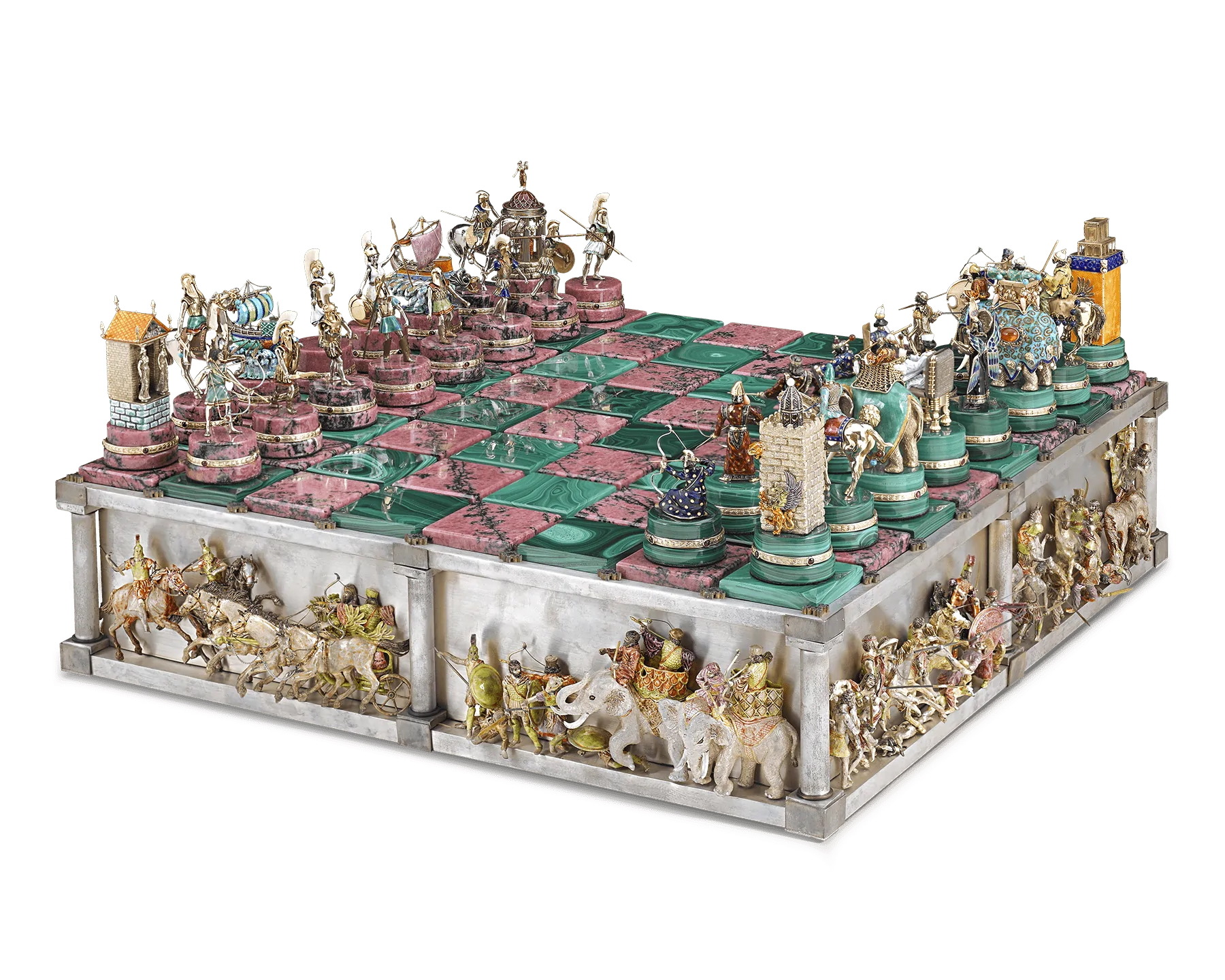
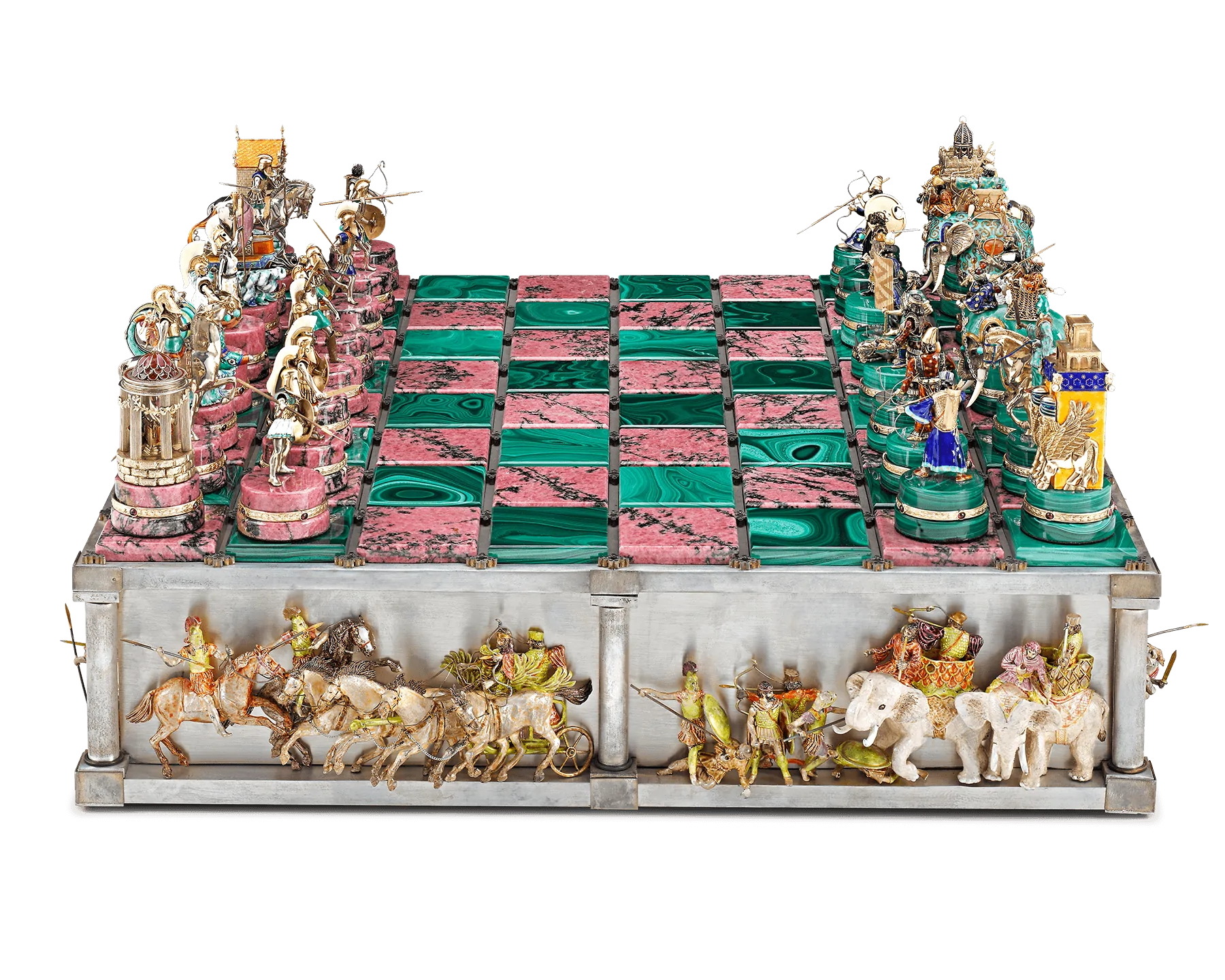
If I were a rich man, ... surely I would buy this chess game. It is a pure pleasure for the eye and handling each and every piece of the game would bring me closer to Alexander at his Battle of Issus!

*

*          *


The Battle of Issus Chess Set

Photo by M.S. Rau

It's a unique piece and is wonderful, it would be a dream to have it... even less valuable workmanship and material to make it more affordable to many but is wonderful!

Lavishly decorated and large in size, this extraordinary chess set is the only one of its kind and is perhaps the best ever made. Crafted by the hand of a master jeweler, the exquisite quality of its manufacture is showcased in each and every detail. Every 14k gold game piece is different, encrusted with semiprecious stones and brightly hued enamel, and each is endowed with mechanical movement. This ancient game of war truly comes to life on the breathtaking board, which is itself a spectacular sight to behold.

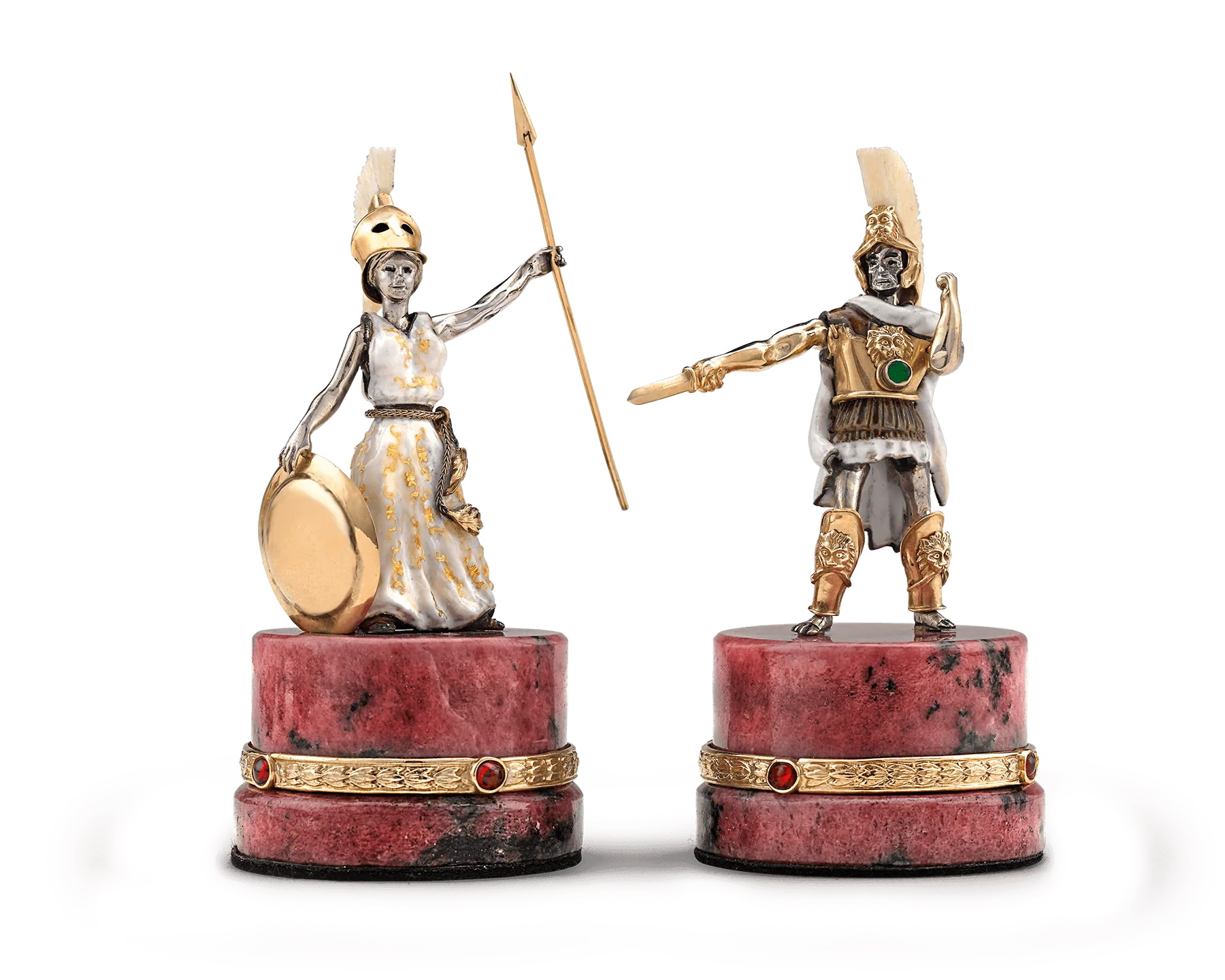
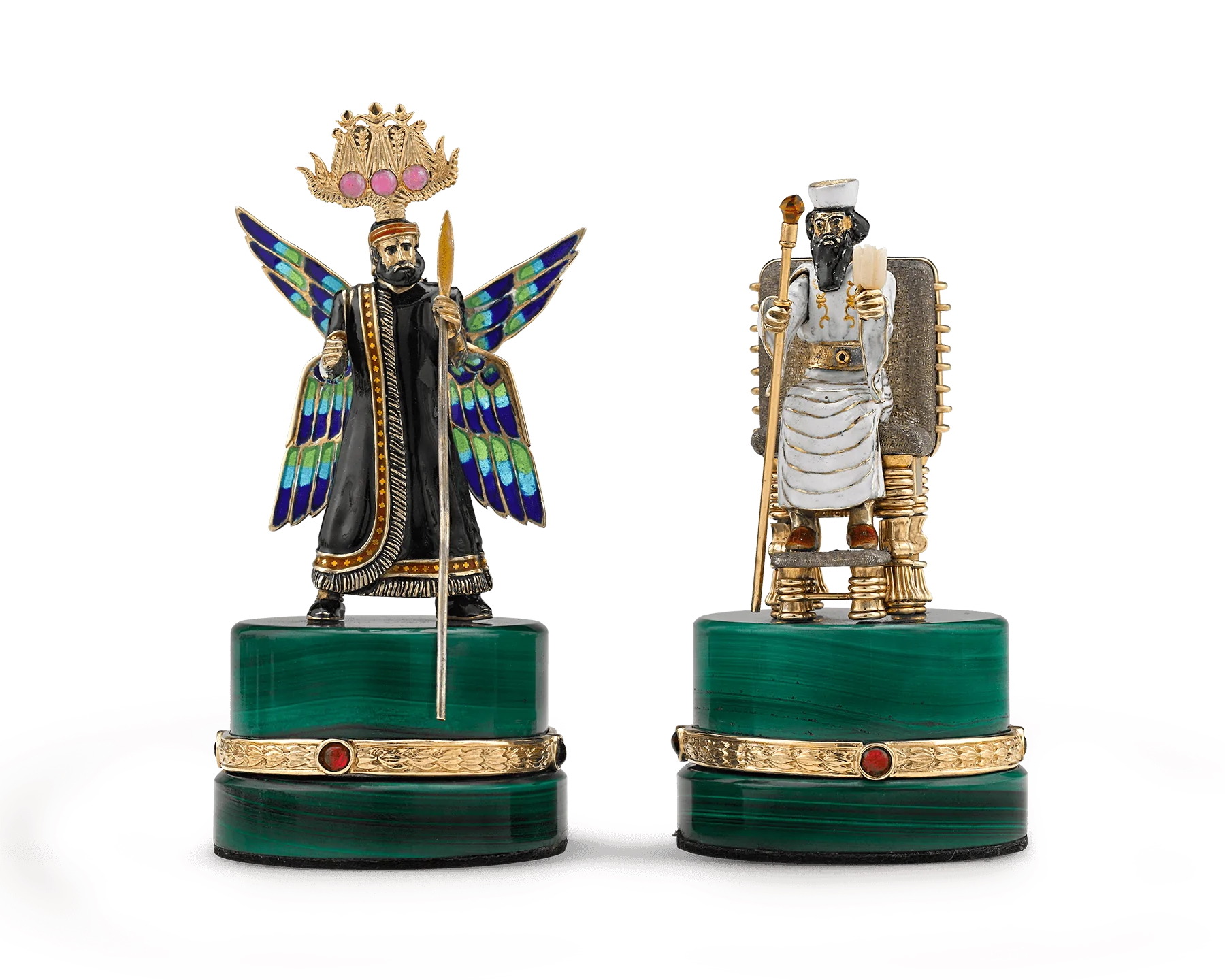
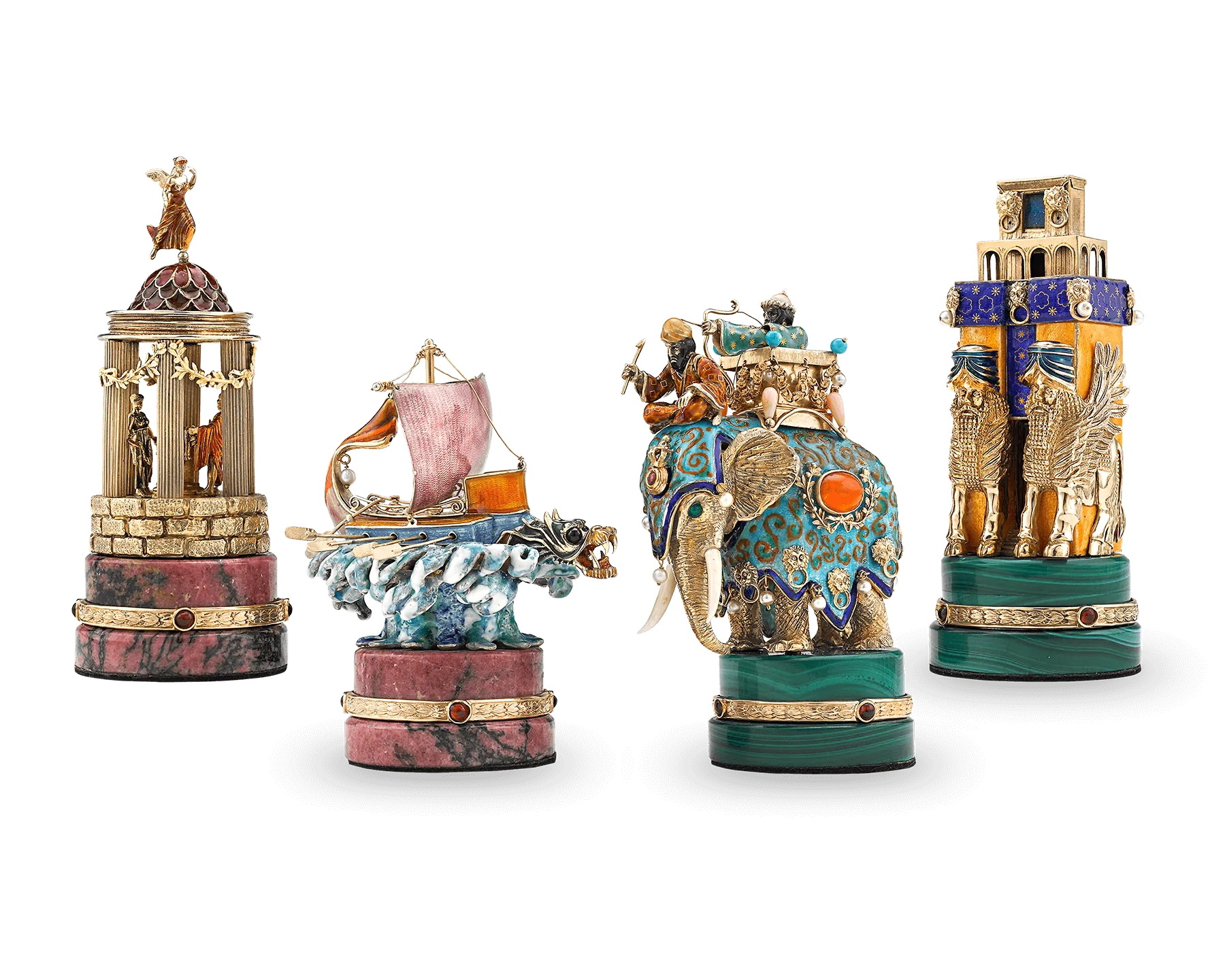
The ancient Battle of Issus is the subject of the set and an apt reference to the military-like strategy of the game. What was one of the most important battles of the ancient world is beautifully retold here through pieces representing gods and goddesses, ancient structures, and creatures of both Greek and Persian origin. Alexander the Great and King Darius III take their places on the board as kings. At Alexander's side is Queen Athena, the Greek goddess of war and wisdom, while the winged Persian god of war stands as Darius' queen piece. Warships sailing over waves and massive elephants covered in elaborate trappings take the place of bishops, while the castles have been transformed into the columned temples of ancient Greece and the impressive Persepolis. Horsemen and footmen face off as well, each with their own sword, javelin or bow.

Photo by M.S. Rau
Photo by M.S. Rau
Photo by M.S. Rau

Not a single detail has been overlooked, from the laces of the soldiers' boots to the tiny feathered arrows in their quivers. Yet, even the spectacular aesthetic design of the pieces is surpassed by their mechanical complexity. Each figure stands on a solid pink rhodonite or green malachite base that, when twisted, triggers a different movement in each individual piece. Through this simple movement, the ships row their oars, Alexander lowers his sword, archers tense their bows and horses shake their manes — the extraordinary pieces, so rich in appearance, truly come alive.

Photo by M.S. Rau

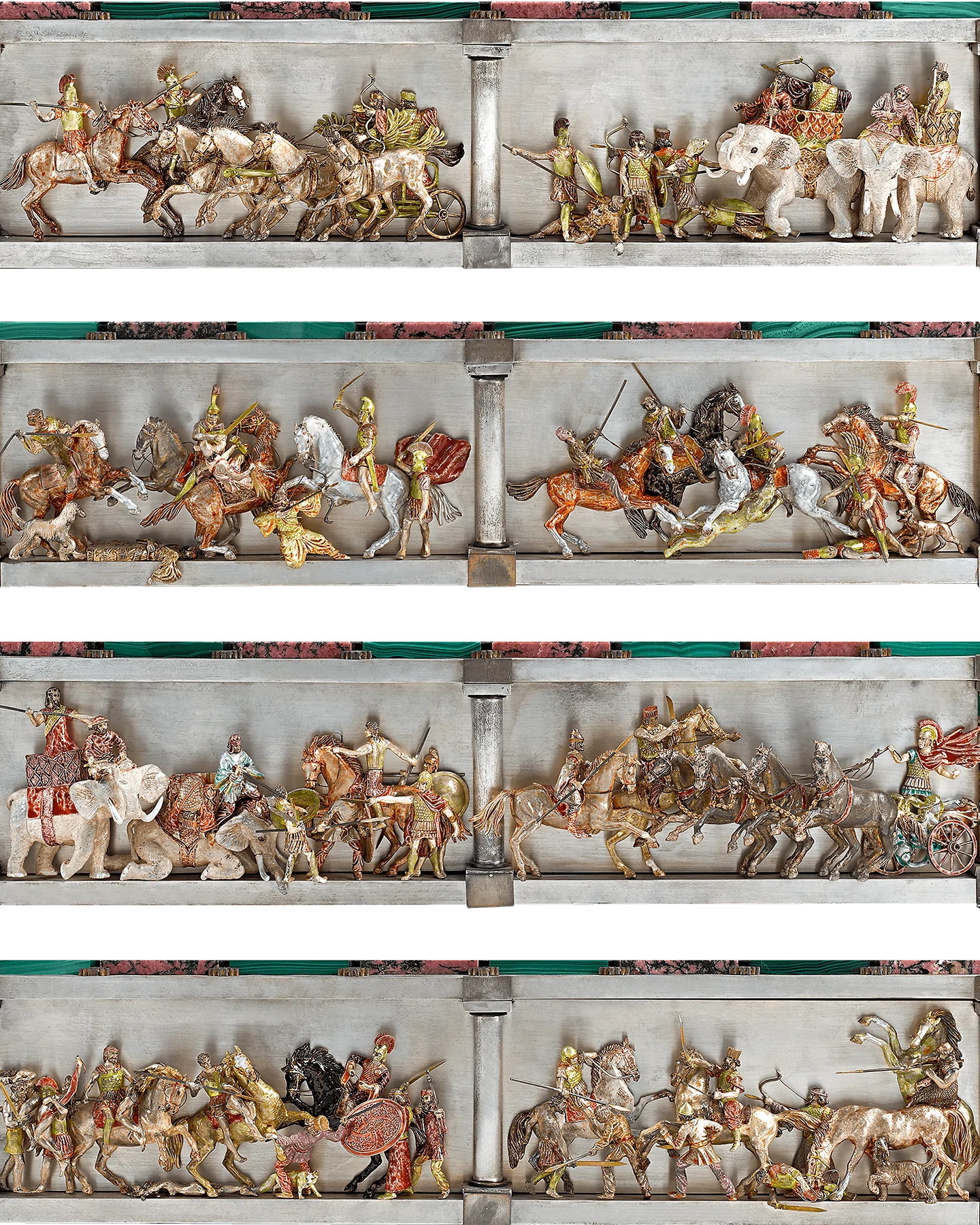
The chess table is as remarkable as the chess pieces. The squares of the board are crafted of pink rhodonite and green malachite to match the bases of each piece and can be removed for storage when not in use. The sides of the board are formed from pure silver, sculpted in high relief to depict battle scenes that mimic the motifs in the game pieces. Archers, horsemen, chariots and elephants all engage in endless combat that heightens the drama of the game board.

Photo by M.S. Rau

A product of over 14,000 man-hours over the course of a decade, this sensational chess set is perhaps the most complex and extravagant ever created. In terms of both mechanics and aesthetics, it is one-of-a-kind in every aspect and a true masterpiece of design.

Photo by M.S. Rau

BUY WITH CONFIDENCE: At M.S. Rau, we are so confident that our antiques are some of the finest in the world, that we back each piece we sell with a 125% guarantee.               $1,985,000 – Item No. 31-1086

Thursday, April 14, 2022

How important was Barsine?

The question is actually double: How important was Barsine for Alexander? And how important was Barsine in the geopolitical world of her time? 

Authors from antiquity have not spent much ink on her, and she is only mentioned when she comes to the foreground, which isn’t often.  

Barsine was the daughter of Artabazus II, satrap of Hellespontine Phrygia in northwestern Turkey. Artabazus’ first wife was from Rhodes and was the sister of two capable generals, Mentor and Memnon. 

Artabazus revolted against the newly appointed Persian king, Artaxerxes III Ochus. Artaxerxes had ordered the dismantling of his mercenary army, which the satrap did not accept. Artabazus and his family (including Memnon) went into exile and found refuge at the court of Philip II in PellaBarsine, who was fluent in Greek, must have met the younger Alexander during their stay. We don’t know the nature of their encounters or conversations, but we may safely assume that Alexander inquired about life and customs in Persia. After all, he impressed the Persian envoys at a young age as he questioned them pending his father’s return to the Palace. 

Three years later, Artabazus reconciled with the Persian king, and he returned to Persia, taking Barsine and his family with him. That happened in 343 BC, about one year after Aristotle arrived on the scene to teach Prince Alexander. Over the years, the entire company probably met the philosopher along with other distinguished visitors to the Macedonian court. 

Barsine married her uncle Mentor, a Greek mercenary general in Persian service, while she still was young. Mentor died soon afterward, leaving her with a daughter. In those circumstances, Memnon took her as his wife that same year, 338 BC. He already had several sons from a previous marriage. We can safely assume that Barsine’s opinion in these matters didn’t count. What’s more, she became a second mother to her husband's (teenage?) sons. Just as MentorMemnon led an army of mercenaries for the Great King. Having a lovely wife familiar with the Greek language and culture, no doubt, added to his prestige. 

In 334 BC, when Alexander, now king of Macedonia, faced the Persian army at the Granicus RiverMemnon fought on the enemy’s side. Although the battle was lost, the general’s capabilities were recognized by Darius, and he was appointed as commander of the Persian fleet in the Aegean. This honor may be a questionable trust because, in exchange, Barsine had to stay at King Darius’ court with her father, Artabazus. 

A year later, during the siege of Lesbos Memnon fell ill and died. Barsine was widowed for a second time. 

Around that time, Alexander had reached Issus where he defeated Darius in November 333 BC. When Parmenion rode to Damascus to take hold of the Persian treasury, the baggage train, and the women of the aristocrats, he met Barsine and brought her to Alexander. 

Her relationship with Alexander lasted five or six years. I wonder whether she traveled with Darius’ mother, wife, and children, who had been taken in Issus. Alexander was constantly on the move, conquering the eastern Mediterranean and Egypt and marching to Babylon and Susa, where he finally installed the Persian Royal Family. Barsine stayed at Alexander’s side, and we can only guess which quarters she occupied when the army was on the road. 

During that time, Artabazus remained faithful to Darius until the Great King was murdered by Bessus, who then proclaimed himself the new king of PersiaArtabazus refused to submit to Bessus and left, taking his mercenaries with him. He joined Alexander, who rewarded him with the satrapy of Bactria. Here he was reunited with Barsine. 

She is mentioned again by ancient historians about 327 BC at the end of Alexander’s campaign in Sogdia. However, it is unclear in which order the events unfolded precisely. 

The fact is that Barsine became pregnant and gave birth to Heracles. Alexander never recognized his son, his first-born, although he must have loved him, giving him the name of his ancestors. Is it possible that Alexander resented Barsine for having Heracles without his consent? She and little Heracles stood in his way for his bigger plans, meaning to marry Princess Stateira as – probably – agreed with SisygambisBarsine must have known of those plans, so she had no excuse. 

It is, in any case, a strange coincidence that Alexander almost immediately married Roxane, the daughter of a local chieftain. This was not love at first sight, as most authors claim. It was a purely political move to end the three-year wars through Bactria and Sogdia. 

Artabazus requested to be relieved of his duties in Bactria because of his old age. Alexander accepted his resignation and Artabazus left for Pergamon taking Barsine and the little boy with him. Artabazus seems to have produced an elegant way to retire, and, at the same time, he created the best solution for Barsine since there was no longer a place for her at Alexander’s court. She had to say goodbye to the snow-topped mountains of the Hindu Kush after sharing so many miles with the Macedonian troops and her great love.

Barsine met Alexander again in 324 BC when she attended the mass wedding at Susa. Her daughter from Mentor married Nearchus. Two of her sisters were also given in marriage to Alexander’s companions, but the sources (Plutarch and Arrian) are at odds with each other about the names. 

Hardly a year later, Alexander died in Babylon. I wonder whether Barsine was still in nearby Susa, close enough to say her goodbyes to the man she once loved? If she returned to Pergamon after the wedding, she could never make it to Babylon in time. 

She and Heracles quietly spent the next decade in PergamonIn 310 BC, Cassander as king of Macedonia, summoned Alexander IV, Alexander’s 14-year-old legitimate son with Roxane, to Pella to be poisoned. 

The news traveled fast and eventually reached Pergamon, as poor Heracles was now at the center stage in the drama of the Succession War. Initially, general Polyperchon had been defending the cause of the now 17-year-old Heracles, but in 309 BC, he fell into Cassander’s vicious trap. Cassander made many great promises of money and power in exchange for eliminating Heracles. For one hundred talents, Polyperchon tricked Heracles into accepting an invitation for dinner and poisoned him. Barsine, who had traveled with her son, was murdered shortly afterward, although some sources pretend she was murdered simultaneously. Sadly, Heracles didn’t even receive a proper burial in the cemetery of his ancestors, and neither did Barsine. 

Now about my questions formulated at the beginning of my post. How important was Barsine for Alexander? Well, she was important enough to keep her at his side for about six years. All this time, she managed not to get pregnant. Barsine knew that Alexander dearly wanted and needed an heir during those years of intimacy. She also knew that his plan was to marry a Persian princess. Barsine spoiled this by wanting a child of her own. Alexander had his principles and stuck to them. Nobody, not even sweet and gentle Barsine, was allowed to interfere. His sudden marriage to Roxane may be seen as a statement toward Barsine. Historians say Alexander fell in love with Roxane because of her beauty. In my mind, her beauty may be a nice bonus, but it was not the main reason. 


How important was Barsine in the geopolitical world of her time? Barsine was a beneficial source of information about the Persian court, Persian habits, and culture. After all, she had lived at least three years at the court of King Darius. Speaking Greek was an important asset to avoid misunderstandings. Alexander was an excellent judge of character, and having met Artabazus at Pella, he knew that he was a man of his word and could be trusted. Artabazus was loyal to Alexander. Having his daughter at the king’s side was a warranty that worked both ways. Barsine and her father contributed to Alexander’s larger plan. The birth of Heracles disturbed this goal – something Alexander never could or would accept. Barsine no longer fit his purpose in the new world he was building.