Alexandria's founded by Alexander

Alexandria's founded by Alexander the Great (by year BC): 334 Alexandria in Troia (Turkey) - 333 Alexandria at Issus/Alexandrette (Iskenderun, Turkey) - 332 Alexandria of Caria/by the Latmos (Alinda, Turkey) - 331 Alexandria Mygdoniae - 331 Alexandria (Egypt) - 330 Alexandria Ariana (Herat, Afghanistan) - 330 Alexandria of the Prophthasia/in Dragiana/Phrada (Farah, Afghanistan) - 330 Alexandria in Arachosia (Kandahar, Afghanistan) - 330 Alexandria in the Caucasus (Begram, Afghanistan) - 329 Alexandria of the Paropanisades (Ghazni, Afghanistan) - 329 Alexandria Eschate or Ultima (Khodjend, Tajikistan) - 329 Alexandria on the Oxus (Termez, Afghanistan) - 328 Alexandria in Margiana (Merv, Turkmenistan) - 326 Alexandria Nicaea (on the Hydaspes, India) - 326 Alexandria Bucephala (on the Hydaspes, India) - 325 Alexandria Sogdia - 325 Alexandria Oreitide - 325 Alexandria in Opiene / Alexandria on the Indus (confluence of Indus & Acesines, India) - 325 Alexandria Rambacia (Bela, Pakistan) - 325 Alexandria Xylinepolis (Patala, India) - 325 Alexandria in Carminia (Gulashkird, Iran) - 324 Alexandria-on-the-Tigris/Antiochia-in-Susiana/Charax (Spasinou Charax on the Tigris, Iraq) - ?Alexandria of Carmahle? (Kahnu)
Showing posts with label Carrhae. Show all posts

Wednesday, August 23, 2023

Roman soldiers in China

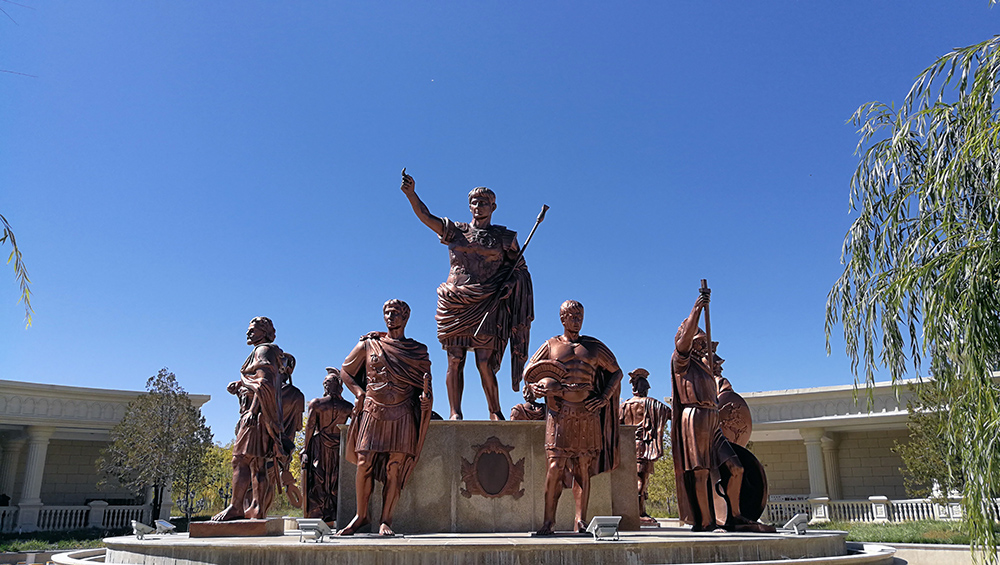
Entering China from the depression of Mongolia, the modern visitor is in for a remarkable surprise. High on top of a Corinthian column stand two bronze figures, a Chinese and a Roman soldier, greeting each other. Behind it, two rows of white columns line up in sharp contrast with the cloudless blue sky. 

A short distance away, a group of eleven, life-size Roman legionaries is immortalized in bronze. Behind it is the entrance gate to a Roman world in the style of Disneyland. The monument is a mixture of a Buddhist and a Roman temple with Ionic columns holding a pediment. A unique way to attract tourists to the Chinese frontier! What happened here? What triggered this staging? What is the truth behind this story? 

We must go back to 60 BC when Rome’s First Triumvirate was formed between Caesar, Pompey, and Crassus. Pompey is envious of Caesar’s successes in Gaul and recent friendship with Crassus. They were three very different men who came together to achieve their own goals. Once they agreed to their role in this new form of government, Caesar returned to Gaul, Pompey stayed in Rome, and Crassus went east.

Crassus was the richest man in Rome, but he was not a military man. Still, he sought glory on the battlefield similar to that of his co-rulers and decided to attack Asia Minor. His army was defeated by the Parthians and Crassus was killed at the Battle of Carrhae in 53 BC (see: Harran, better known under its Roman name Carrhae). Some 20,000 soldiers died on the battlefield and 4,000 returned to Syria. 

Yet 10,000 of his troops were taken prisoner by the Parthians (see: Who were the Parthians?) and sent to Margiana to man the frontier. In 36 BC, the Parthians forced the Roman prisoners to participate in the Battle of Zhizhi, Kazakhstan, against the Chinese. The victorious Chinese of the Western Han Dynasty were so impressed by the fighting skills of their opponents that they took them to the city of Liqian or Li-chien – maybe a transliteration of Alexandria or the Roman word Legion - in the region of Gansu in western China. 

A number of inscriptions discovered in the Kara-Kamar caves on the border between eastern Uzbekistan and Turkmenistan were written in Bactrian, Greek, Arabic, and Latin. The latter one was composed of three lines and was left by the Roman soldiers of the Pannonian Legio XV Apollinaris around the 2nd century AD (see: First contacts with China). A proof that the Romans had been there? 

It is a fact that about 50% of the population of Liqian has green and blue eyes and a Roman aquiline nose. This may be wishfully attributed to the Roman presence some 2,000 years ago. Another theory circulates that the Chinese mingled with people from Siberia. As so often, it is unclear where history and legend start or end.

[top and bottom pictures from That's Mags]

Wednesday, October 5, 2022

Who were the Parthians?

The name of the Parthians often raises questions, and their territory is hard to define. Scholars have established that the tribe of the Parthians may be closely linked to the Scythians who lived southeast of the Caspian Sea. 

The Parthians appeared in history after the death of Alexander the Great, when Seleucos inherited the largest portion of the lands he had conquered in the east, from the eastern Mediterranean to Bactria and India. Seleucos kept the existing Persian governing system of satraps in place, and at an early stage, Parthia became one of its satrapies. 

Seleucos founded the Seleucid Empire and soon discovered that ruling such a vast territory was a nearly impossible task. As the empire weakened, the Parthians revolted and established their independence. 

The first king of Parthia was Arsaces, who came to power in 247 BC. Not for long, as the Seleucid King Antiochus III managed to reconquer Parthia in 209 BC from Arsaces’ son, the new king Arsaces II. For some unknown reason, Antiochus did not want to kill his enemy and established him instead as satrap. This did not sit well with the Parthian nobility, and as soon as Antiochus left for Syria, they deposed Arsaces II and proclaimed Phriapatius as their new king in 191 BC. 

Meanwhile, the Romans subdued Antiochus III according to the Treaty of Apamea, signed in 188 BC. Now that the Seleucid King was no longer a threat, Phriapatius’ son, Phraates, took heart and conquered the territories between Hyrcania in the east and Media in the southwest. He created a solid base for his brother Mithridates, who succeeded him on the throne in 171 BC. 

At this point, Parthia started a new era. Mithridates conquered the Bactrian kingdom in 168 BC and then turned west. He took Media from Phraates in 151 BC and then focused on Mesopotamia. He captured the capital city of Seleucia, followed by Babylon in 141 BC, and Susa three years later. 

Phraates II, Mithridates’ son, continued the fight for power. A worthy successor to his father, but his power was short-lived as he soon died in an attempt to stop a Scythian mutiny. From then onward, Parthia would be torn by successive uprisings and battles. After the death of Phraates II, Parthia was ruled by his uncle, Artabanus I, who crushed several revolts in his short life. 

His son, Mithridates II, in turn, would become Parthia’s greatest ruler (124-91 BC). He strengthened his position in Bactria, Mesopotamia, Characene (on the Iran-Iraq border where Alexander had founded Alexandria-on-the-Tigris, modern Charax Spasinou), and the realm of Babylon. He also annexed the lands of Albania and Armenia, together with the vital Syrian city of Dura-Europos on the Euphrates. Roughly, the Parthian Empire now stretched from the Mediterranean all the way to China! 

No wonder Parthia was very much coveted by the rising Roman Empire and lost several territories, including Armenia. The tables were turned in 53 BC when Crassus invaded Parthia near Carrhae (see: Harran, better known under its Roman name Carrhae) and lost. Rome suffered a severe psychological blow. The situation worsened when Marc Antony was defeated in 32 BC in an effort to keep hold of Armenia. After decades of constant fighting, Emperor Augustus secured a peace agreement with King Phraates IV in 20 BC. Instead of fighting each other, both rulers agreed to unite their efforts against enemies outside their borders. 

No treaty lasted forever, and after several skirmishes back and forth, Emperor Trajan invaded Mesopotamia in 115 AD, looting the capital cities of Seleucia and Ctesiphon. At about the same time, Parthia was invaded on its eastern border by the Kushans, who established their empire in Bactria. 

However, two years later, Parthia, now ruled by Vologases IV, was invaded by Hadrian, Trajan’s successor. Lucius Verus, the adopted son of Marcus Aurelius, followed suit and sacked Seleucia and Ctesiphon once again. The Parthians managed somehow to expel the Romans, but like a Jack-in-the-Box, they returned in 198 AD. 

This time, Emperor Septimius Severus invaded Mesopotamia and marched down to take the Parthian-held cities of Seleucia, Babylon, and Ctesiphon. It makes one wonder how often cities are destroyed and rebuilt over the centuries. 

I now better understand the significance of the Severan bridge I crossed many years ago on my way to Mount Nemrud. At that time, I wondered what could have been so important in this god-forsaken, steaming hot land to need a bridge! It crossed the Cedere River, a tributary of the Euphrates. It is possibly the second-largest still-existing Roman bridge, with a length of 120 meters and a span of 34 meters. Two Corinthian columns of 9-10 meters guard either side of the bridge. One set is erected in honor of Septimius Severus and his wife Julia Domna, and the other for their two sons, Caracalla and Geta.

 
The weakened Parthian Empire finally collapsed when it was overthrown by King Ardashir, the founder of the Sassanid Empire, in 224 AD. That is another story altogether (see: Sassanid reliefs tell a story of their own in Persia).

Thursday, April 29, 2021

First contacts with China

It is generally not mentioned that in the wake of Alexander's expansion, an opening towards China, or Seres as Strabo called the country, was created to the east of Central Asia. After all, in 329 BC, the king founded the city of Alexandria Eschate (very appropriately being Alexandria the Furthest), the later Khojend in modern Tajikistan, where he stopped his march eastwards. 

His Greek settlers in Central Asia were there to stay for the next three hundred years as Seleucos established his Empire, which later became the Graeco-Bactrian kingdom. Over time, their kings steadily expanded their power further to the east, and the main force appeared to be King Euthydemus (230-200 BC). This Euthydemus was born in Magnesia, Asia Minor as the son of the Greek general Apollodotus. By 209 BC, as Graeco-Bactria king, he withstood the three-year-long siege of Bactra led by the Seleucid ruler Antiochus III. In the end, Antiochus offered one of his daughters in marriage to Demetrius, son of Euthydemus, in exchange for which he received several Indian war elephants. 

Once well settled, Euthydemus went to the lands beyond Alexandria Eschate. As reported by Strabo, he even reached Kashgar in the region of Xinjiang. This may date the first Western and China exchanges to around 200 BC. 

How China looked at the West is a much lesser-known story. Not unlike the Greeks, the Chinese held that they were the center of world civilization and that all other countries were tributaries of China. This implies that the campaign of Euthydemus may have been a significant turning point (see also: Alexander's influence reached all the way to China?)

Around 130 BC, embassies of the Han Dynasty traveled to Central Asia as the Chinese emperor Wudi was interested in the sophisticated civilizations of Ferghana, Bactria, and Parthia, respectively known to the Chinese as Dayuan, Daxia, and Anxi. Since then, numerous embassies left every year to these countries, where they found people living in fixed homes and interested in the rich produce of China. Chinese records reveal that more than ten such missions were dispatched into Parthia, Seleucid Syria (known as Lijian), Chaldea (Tiaozhi), and north-western India (Tianzhu). Allegedly, they even visited Emperor Augustus (27 BC – 14 AD), and it seems hard to imagine Chinese envoys walking in the streets of Rome! 

Roman soldiers also made their way east, although not out of their free will. It has been documented that soldiers captured by the Parthians were dispatched to defend their eastern borders. In 54 BC, Pliny mentioned that after the battle of Carrhae in 53 BC (see: Harran, better known under its Roman name Carrhae), the Parthians sent some 10,000 prisoners to Margiana to man the frontier. Chinese sources report that these soldiers had blond hair and blue eyes. Eventually, these troops were captured by the Chinese to founding the city of Liqian or Li-Chien – a transliteration of Alexandria - it seems, in the region of Gansu in western China. Several inscriptions discovered in the Kara-Kamar caves on the border between eastern Uzbekistan and Turkmenistan were written in Bactrian, Greek, Arabic, and Latin. The latter was composed of three lines and was left by the Roman soldiers of the Pannonian Legio XV Apollinaris around the 2nd century AD. Notably, this cave complex showed remarkable similarities with temples dedicated to the god Mithras, who was featured in killing the bull. This secret male cult started about the 1st century AD and soon spread with the legionnaires over the entire Roman Empire. 

By the first century BC, Rome started showing serious interest in the precious silk it received through trade with the Parthians. Wearing silk soon exploded, but it was not met with overall approval. Seneca (3 BC-65 AD) complained that silk did not hide the body, not "even one's decency." This led the Senate to issue an edict prohibiting silk-wearing, which the wealthy Roman elite liked to ignore. Besides the moral ground, this edict also had an economic reason, as importing silk caused a massive outflow of gold. 

Yet, business is business, and the trade prospered. Over land, using the Silk Road was a tedious and expensive operation, which was soon to be supplanted by a newly found maritime route. The ships would sail from China, stopping at ports in modern Vietnam, India, and Sri Lanka controlled by the Chinese emperors. The western end of this business route, with stopovers in Egypt and the Nabataean territories, was controlled by Rome. Their merchants traveled on Roman, Indian, and even Chinese ships. 

Best known from this period is the campaign led by the Chinese general Ban Chao, who in 97 AD crossed the Pamir Mountains with an army of 70,000 men to fight the Xiongnu, generally the people living in Central Asia. He even reached the Caspian Sea and the lands occupied by the Parthians. From here, the general sent an envoy to Dagin (Rome). Ultimately, this was Gan Ying, who stopped in Mesopotamia although he intended to sail to Rome via the Black Sea. The Parthian merchants wishing to safeguard their profitable position as the middleman between Rome and China, told Gan Ying that his planned trip would take him two years. In reality, this was two months. This is why the envoy decided to abandon his mission and return home. His merit, to a certain extent at least, was his account of Rome and Emperor Nerva, which he obviously based on second-hand information. However, he correctly reported that Rome was the leading economic power at the western end of Eurasia. The Chinese army settled for an alliance with the Parthians. 

The earliest documented Roman embassy to arrive in China dates to 166 AD. Chinese sources mention that it came from Antun (Antoninus Pius), king of Dagin (Rome). This information must be clarified since Antoninus Pius died five years before, in 161 AD. It is suggested that they meant Marcus Aurelius, who added the name of his predecessor to his own; he came to power in 166 AD. 

This Roman delegation probably arrived by sea and carried presents of rhinoceros horns, ivory, and tortoise shells originating from Southern Asia. More important, however, is that the Chinese acquired a treatise on astronomy. Roman cartographers knew of the existence of China since the country was mentioned on the map by Claudius Ptolemy in about 150 AD. The booming trade across the Indian Ocean in the 2nd century AD enabled the identification of Roman outposts in India and Sri Lanka. 

After a lacuna about further exchanges, the next documented account emerged in the 3rd century AD when the Roman Emperor (possibly Alexander Severus) sent presents of colored glass to Emperor Taitsu of the Kingdom of Wei (reigned 227-239 AD) in Northern China. The last record about an embassy from Rome dates from 284 AD when the envoys of presumably Emperor Carus (282-283 AD) brought "tribute" to the Chinese Empire. 

To summarize, contact between our western world and China lasted at least six hundred years after Alexander opened access to Central Asia. In all its aspects, the Silk Road sank into oblivion until Marco Polo revived this part of history in the 13th century, i.e., one thousand years later!
Friday, June 5, 2020

Harran, better known under its Roman name Carrhae

Harran is the modern name for Roman Carrhae, where Crassus was crushed by the Parthians in 53 BC. Exploring these ruins, I wonder how much of old Carrhae was left after the Parthians killed 20,000 soldiers and took 10,000 more as prisoners.

Today’s Carrhae is in a dilapidated state where I quickly spot the Forum, some bathhouses, and temples. At the edge of the Forum rises a high square tower from the days of Prophet Mohamed. This is said to be the oldest minaret in Turkey and belonged to the Ulu Cami, i.e., the Congregation Mosque, the oldest university.

I did not expect to find any such remains in Harran as I was heading to see the unique and peculiar adobe constructions with a conical roof topped by a square vent made of the same material. The concept seems 3,000 years old, making me believe that Alexander saw these or similar constructions. These beehives, which were used till the 1980s, date from the 11th-12th century. Today, they are placed on the UNESCO World Heritage List. After building dams on the Euphrates, the villagers could now irrigate their fields and raise abundant crops of cotton, tomatoes, and aubergines. Before this irrigation project materialized, they had been constrained to herding goats and sheep. The beehive constructions are, however, maintained as a tourist attraction.

Following eastern hospitality, I am invited to take place on low V-shaped stools in the courtyard's shade. Tea is served by the men, who then withdraw to a corner of the yard. Meanwhile, children are running around, but I see no womenfolk.

I can freely roam in and around the rooms, in fact, one under each dome. As expected, they are cool and probably warm in winter, like Cappadocia's troglodyte caverns. My eyes have to adjust to the dim light since the only daylight is coming through one single window and the vent in the conical roof. The interior is made cozy, with carpets covering the floor and the walls. Low benches set against the walls display colorful cushions, and a few round and square tables fill the center of the room. In the sleeping quarters, I find beds standing high above the ground. The protective parapet has an opening to access the bed. I had noticed a similar contraption, but much higher above ground in the corner of the courtyard. Apparently, they are used during hot summer nights. The only modern touch is electric lighting and flushing toilets which look very much out of place.

The hill on the other side of the adobe settlement of Harran is crowned with a fort. This is where the Temple of Sin, the moon god, stood. But the stones and foundations have been reused for the construction of this fort. From my vantage spot, I have a great view over Harran where women with dark eyes and dark skin move in colorful dresses. Beyond the city, I spot green cotton fields separated by broad meandering waterways, some tributaries of the Euphrates, no doubt. It looks very peaceful as if time had no hold on the place, but the street boys tell me that only yesterday, a formation of warplanes from Iraq flew over. I find this an odd and awkward combination of past and present where there is no room for the present.


When Alexander marched east for his confrontation with Darius at Gaugamela, he passed through Harran. It is here that his scouts reported that the massive Persian army was marching north from Babylon. After giving his troops a few days rest, the king ordered a forced march to the Tigris as he meant to cross the river before his enemy could stop him.

I am hopeful that future excavations will expose much more of this unique city and maybe tell something about Alexander?