Alexandria's founded by Alexander

Alexandria's founded by Alexander the Great (by year BC): 334 Alexandria in Troia (Turkey) - 333 Alexandria at Issus/Alexandrette (Iskenderun, Turkey) - 332 Alexandria of Caria/by the Latmos (Alinda, Turkey) - 331 Alexandria Mygdoniae - 331 Alexandria (Egypt) - 330 Alexandria Ariana (Herat, Afghanistan) - 330 Alexandria of the Prophthasia/in Dragiana/Phrada (Farah, Afghanistan) - 330 Alexandria in Arachosia (Kandahar, Afghanistan) - 330 Alexandria in the Caucasus (Begram, Afghanistan) - 329 Alexandria of the Paropanisades (Ghazni, Afghanistan) - 329 Alexandria Eschate or Ultima (Khodjend, Tajikistan) - 329 Alexandria on the Oxus (Termez, Afghanistan) - 328 Alexandria in Margiana (Merv, Turkmenistan) - 326 Alexandria Nicaea (on the Hydaspes, India) - 326 Alexandria Bucephala (on the Hydaspes, India) - 325 Alexandria Sogdia - 325 Alexandria Oreitide - 325 Alexandria in Opiene / Alexandria on the Indus (confluence of Indus & Acesines, India) - 325 Alexandria Rambacia (Bela, Pakistan) - 325 Alexandria Xylinepolis (Patala, India) - 325 Alexandria in Carminia (Gulashkird, Iran) - 324 Alexandria-on-the-Tigris/Antiochia-in-Susiana/Charax (Spasinou Charax on the Tigris, Iraq) - ?Alexandria of Carmahle? (Kahnu)
Showing posts with label Crenides. Show all posts

Saturday, June 5, 2021

Amphipolis beyond the Kasta Hill

Much ink has been spilled on the promising excavations of Kasta Hill at a short distance from the town of Amphipolis proper. For that reason, the importance of this city harbor has been seriously neglected. 

Amphipolis was an Athenian colony founded in the 5th century BC. It was surrounded by a 7.5-kilometer-long wall, probably dating from the Classical Period, but the date has not been confirmed yet. It would be interesting though, to know whether Philip II had attacked it in 356 BC when he ousted the Athenians in power. Amphipolis was key to the king’s conquest because it sat on the mouth of the Strymon River which gave him access to the mines of Crenides (later renamed Philippi) and opened up the trading route with Thracia (see: Macedonia’s gold and silver mines today). 

[Picture from Structurae.net]

When Alexander set out from Pella towards Asia in 334 BC, he crossed the bridge of Amphipolis (see: Bridge of Amphipolis used by Alexander), which was constructed at some time between 600 and 550 BC and was first mentioned in history during the Peloponnese War of 422 BC. 

The city has a lot to tell us, as the occasional photographic and on-site research reveals. However, the archaeologists seek financial support to establish what Amphipolis looked like in the days of Alexander and how it changed by the time Philip V died here in 179 BC. So far, it has been recorded that the city possessed a well-preserved Gymnasium and the remains of a Hellenistic house with frescoed walls. 

At present, special attention is given to the Acropolis of Amphipolis located within sight of Kasta Hill. Scholars tell us that it becomes easy to understand the city's importance as this location gave its citizens full control over the Strymon River, the gateway to the sea and Crenides, and the overland route into Thracia.

In the past two years, archaeologists have concentrated on the Acropolis, whose inner walls were exposed in the 1960s and 1970s. Otherwise, there is a lot of architectural debris lying around. At the same time, other parts have been reused by the Romans to rebuild the city’s fortifications. The same applied to the Christians when they built their monuments. These public buildings stand on top of older layers, and the current five-year plan (2019-2023) will concentrate on the pre-Christian Acropolis. 

[Picture from Archaeology News Network. Aerial view of the Basilica C with the Hellenistic building below it. [Credit: Kathimerini]

The bottom line is that we still need more patience before establishing a solid link with Alexander in the early days of his kingship.

Thursday, June 6, 2019

Air pollution in antiquity

We are inclined to believe that air pollution is a modern phenomenon that started with the Industrial Revolution in the 1800s, but recent research has shown that the problem existed already in Greek and Roman antiquity.

The first mining of metals started in the 6th millennium BC but mass production was a Roman invention as they intensively used lead for the production of water pipes, household items, and to mint their silver coins. The smelting of lead releases toxic heavy metals into the air.


It has never been established, for instance, to what extend King Philip’s mines in Crenides, Stratonici, Skouries, and Olympiade on the east side of the Chalcidice peninsula, and Potidaea contributed to the air pollution (see: Macedonia's gold and silver mines today) .

Until now, scientists relied on the traces of metal trapped in Greenland’s ice but that is far away from the actual mine sites. At present, the concentrations have been measured in the deepest layers of ice on the Mont Blanc, which is geographically much closer to the source.

The study of alpine ice has revealed that lead emissions in antiquity increased the natural level by a factor of 10. By comparison, the use of leaded gasoline in Europe matched up to a factor of 50 to 100. The impact may not seem so important were it not that the Roman pollution spread over many centuries, while our leaded gasoline damaged our air quality for "only" 30 years or so.

Although the Roman smelting and mining activities went on for almost 500 years, it appears that they knew two peaks in atmospheric lead pollution, i.e., during the 2nd century BC and again during the 2nd century AD. The Romans mined lead all over Europe, from Iberia to Great Britain, and the production eventually declined gradually after the fall of the Empire in the 5th century.

We look at the Roman Empire with its grand monuments and great works of art but never consider that all that wealth came at a very high price.

Today we aim to bring our air pollution back to standards from before the Industrial Revolution, but it is clear that it existed for a long time. To take the values from before the Industrial Revolution as a “clean” standard does no longer stand either. There were many ups and downs, like noted in the Middle Ages when mining activities almost became nil, particularly when the Black Death pandemic hit this part of the world in the mid-14th century.

Beside the lead pollution, quantities of antimony were also released into the atmosphere. It is important to know that lead ores also contain elements like arsenic, copper, silver, and gold.

Friday, August 10, 2018

The Mud Baths of Crenides

As people lived much closer to nature, thermal baths in antiquity belonged to everyday life rather than to plush spa resorts as we know them today. Such spots are mentioned throughout history as a matter of fact and are often overlooked.

This is the case of Crenides, the city that was conquered by Philip of Macedonia who renamed it Philippi. Inevitably all attention goes to the latter and the hot springs are ignored although they were known to Aristotle and Xenophon.


However, today, Crenides (or Krinides) is a thermal city that attracts tourists to enjoy its curative waters and therapeutic clay. The spring water has a pleasant temperature of 29 degrees Celsius and is used in hydrotherapy for ailments of the musculoskeletal system and as mineral drinking water to treat gastrointestinal and urinary problems.

What is more, the city also boasts of its clay therapy that is adequately housed in a late Byzantine building used as a Turkish Bath. The mud therapy results from a balanced mix of argil, a local plant, and hot mineral water. It is especially indicated in cases of autoimmune diseases, skin problems, and rheumatism.

It is tempting to imagine King Philip soaking in this hot clay to relieve the pain in his gammy leg and the sore scars of war he suffered although he strongly believed that bathing was only done in cold water. Maybe even Alexander and his companions in spite of this stoic Macedonian rule about cold water enjoyed a pleasant halt at the springs when heading for Thracia or on the way back, who knows…

Thursday, November 22, 2012

Philippi, Macedonia’s gold and silver mines

Philippi is one of the milestones in the life of King Philip II, but maybe even more so in shaping the history of Macedonia. An exciting place to visit in order to visualize its importance.


Today, Philippi lies within easy reach of Thessaloniki thanks to the freeway Thessaloniki-Amphipolis-Kavala, roughly 160 km. From there, the road North to Drama and Serres leads you straight to Philippi after less than 15 km. It is a lovely drive, in spite of being on a freeway, for the road offers impressive views over Lake Koroneia and Lake Volvi, along which King Philip II of Macedonia, as well as his son Alexander the Great, must have marched eastwards. Between Stavros and Amphipolis, the road runs close to the sea as it crosses the delta of the River Strymon, which, before Philip’s reign, was the eastern frontier of Macedonia. From Amphipolis to Kavala, the road runs a little more inland but right around the foothill of the Pangaeon Mountains, rich in gold and silver mines. And that is what Philippi was all about.

The antique city of Philippi was situated at the top of a hill, overlooking extensive marshlands that ran all the way to the seashore. On the east, we find the gorges of the Sapaeans and Corpileans, while in the west, we discover the beautiful, fertile plains that border the River Strymon. There is another nearby hill called the Hill of Dionysus, rich in gold. The remains we see today are mostly from the Roman city located at the foot of the ancient citadel, but that is a different chapter in history. 

Let us start with King Philip, who was the one to put the place on the map, starting in the early years of his kingship. At that time, the place was called Crenides because of the many springs bubbling up around the hill, and it was a colony of the island of Thasos. Towards 357 BC, the king of eastern Thracia besieged the strategic and precious city of Crenides, just above the port of Neapolis (today’s Kavala), a valuable naval base in the region. Philip immediately marched in and defeated the Thracian forces. He was determined to stay, and in order to put his stamp on this place, he changed the name to Philippi. He fortified the city walls and towers of this strategic location from where he could control the entire Strymon Valley and beyond that all the way to the Danube hinterland. Besides that, he had access and control over the port of Neapolis.
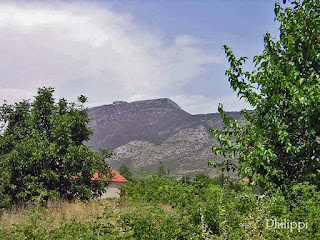
These newly acquired mines provided Philip with a reliable and steady inflow of money, Crenides being the largest and most profitable mine. To improve the situation further, he had the marshy plain drained and cultivated, adding another boost to the local economy. 

The city prospered in Hellenic times thanks to the Via Egnatia, which passed through Philippi in the 1st century BC, making it even more important. Philippi turned out to be a major center, connected through this Via Egnatia with Amphipolis, Thessaloniki, and the ports of the Adriatic Sea in the west, and to Neapolis and Byzantium in the east.

Things changed dramatically when the plains of Philippi became the theater of an important battle in 42 BC. Two Roman armies approached each other: Brutus and Cassius, the assassins of Julius Caesar and defenders of the Roman Republic, arrived from the east, and a bit later, the triumvirs Marc Antony and Octavian moved in from the west, wishing to avenge the murder of Caesar. This was not just a battle between rival factions; the future of Rome depended on it. Because Brutus and Cassius had occupied the best positions on two hills approximately four kilometers from Philippi, Marc Antony tried to circumvent Philippi by building a causeway through the wetlands to the south of the city, but Cassius discovered the plan and built a transverse dam. But then, Marc Antony unexpectedly stormed Cassius' camp. This was a great maneuver for it made Cassius believe that all was lost, and he committed suicide. That was a far too hasty decision, for at the same time Brutus had defeated Octavian and captured his camp and that of Marc Antony. In other words, both sides had won a victory and suffered a defeat.

A second clash occurred a few days later. This time, Marc Antony and Octavian were able to lure Brutus into a battle he should not have accepted and the triumvirs ended up victorious. As we know, eleven years later Octavian defeated Marc Antony at the Battle of Actium and took on the surname Augustus. Veterans of these battles were settled in Philippi, which became a Roman colony (Colonia Augusta Julia Philippensis). The city expanded and became an economic, administrative, and artistic center, the result of which we can still see in today’s remains.

An important visitor to Philippi was Apostle Paul, who spent time here in 49 or 50 AD establishing the first Christian Church of Europe, making Philippi a metropolis of Christianity.

The city was slowly abandoned in the early 7th century AD due to repeated earthquakes and the invasion of the Slavs. However, it survived the Byzantine era as a fort on top of the Acropolis but was entirely deserted after the Ottoman conquests of the 14th century.

All the road signs are in place, and ancient Philippi welcomes the visitor with a spacious parking space and an even more spacious park where school children seem to have gathered today for a special outing. I hope they are not screaming like this around the site!

They are not; I even seem to have the excavation site all to myself, except for a bus or two with Chinese tourists who move with a discipline of their own.

• The very first building I encountered was inevitably the theatre. It was probably built by King Philip II around the middle of the 4th century BC and was improved in the 2nd/3rd century when the Romans made rearrangements and additions to meet the needs of that time.

The walls and the Acropolis. The line of the walls begins at the top of the hill, and it surrounds the foot of the hill and part of the valley below. The structure has two architectural phases: the first was built by Philip II and the second by Justinian I in A.D. 527-565. Inside the Acropolis, there is a tower dated to the Late Byzantine period.

The Agora (Forum). The Agora, built during the reign of Marcus Aurelius, was the administrative center of Philippi. The public buildings are arranged around a central open square (100x50m). It is bordered on the north side by the Via Egnatia, and on the other sides by steps and porticoes leading to the main municipal buildings. Parallel with the Via Egnatia were fountains, a rostrum, and commemorative monuments. The west side is bordered by traces of a temple and administrative buildings. In the southwest corner stands an unusual upturned marble table, the cavities of which are thought to have been used for measuring, and holes in the ground for playing marbles.

The Palaestra. The largest part of the monument is now covered by Basilica B. The Palaestra comprised a peristyle central court, rooms, and a small amphitheater.

The prison of Apostle Paul. The structure is actually a Roman water cistern, which was later converted into a cult place.

Basilica A. Large, three-aisled basilica (130x50 m) with a transept aisle on the east side, a square atrium, and a gallery over the aisles and the narthex. Fragments of the luxurious pavement and part of the ambo are preserved in the middle aisle. Particularly impressive are the frescos that imitate orthostats (dados) on the porch of a chapel. Dated to the end of the 5th century A.D.

Basilica B. Three-aisled basilica dated to ca. 550 A.D. It has a narthex and annexes to the north and south (phiale, vestry). The almost square central aisle was covered with a vault supported by huge pillars composed of ancient drums. A second vault roofed the sacred Bèma. Its sculptural decoration is under the influence of Constantinople.

Basilica C. An impressive three-aisled basilica with narthex and transept, and a double ambo. It had luxurious marble inlaid floors and rich sculptural and architectural decoration. Dates from the 6th century AD.

Octagonal church. The building's layout is square as seen from the outside and octagonal inside. The nucleus of the whole structure is the vaulted tomb-heroon of the Late Hellenistic period. The octagonal church was built in ca. 400 A.D. and replaced the first small church dedicated to Apostle Paul.

• In the area between the Via Egnatia and the cult buildings of the Octagon, we find one of the Baths of Philippi. The complex also includes the phiale, a baptistery, and a monumental gateway towards the Via Egnatia.

Tuesday, December 6, 2011

Philip’s hegemony and his plans for Asia - Macedonia forged by Philip II - 14

Philip’s hegemony and his plans to cross over to Asia (337 BC)
Although at first sight, the Greeks could make their own decisions within the frame of the synedrion, it was definitely Philip as hegemon who was pulling the strings – he was the one who had all the power.


This was clearly illustrated at Olympia, where Philip commissioned the building of a splendid Philippeon, a large circular tholos counting 18 Ionic columns on the outside and nine Doric ones on the inside. A statue of Philip, slightly larger than life-size, would stand in the center, surrounded by his parents (Eurydice and Amyntas), his wife Olympias, and his son Alexander. The architect was Leochares of Athens, who had worked on the famous Mausoleum of Halicarnassus. This Philippeon was located in the sacred area and must have caught the eye of all the visitors by its sheer shape (the only round building in the sanctuary of Olympia) if not size. It may have looked like a thank-you to Zeus for his recent victory at Chaeronea, but it most certainly showed off Philip’s power and that of Macedonia.

A second meeting of the Synedrion was held that same spring in Corinth to officially elect Philip as hegemon. This is when he announced his plans to invade Asia as part of a pan-Hellenic plan to liberate the Greeks of Asia Minor from Persian rule and to punish the Persians for sacking Athens some one hundred and fifty years before. This is what he proclaimed, while we may wonder whether it was his dire need for money that instigated this decision. We know he made huge profits from his several gold and silver mines (more than 1,000 talents a year from Crenides alone), but vast amounts went into his army. His court in Pella cannot have come cheap, either with all the women and guest-friends. And then there were all the bribes he paid to influential statesmen and the many awards he lavishly granted for building temples, fortifications, etc. It’s interesting to read a comment made by Diodorus that “Philip used gold more than arms to enlarge his kingdom”, which tells a lot. We all remember that Alexander when he set out to Asia had no more than 70 talents in his treasury and that he had to borrow 600 talents on top of that – clear proof that Philip’s money was not there for the taking, although he somehow always had managed to use the income from one campaign to finance the next one.

Now, the reason why Philip went to Asia is another interesting question. There are several theories, as always, but the most likely is that Philip wanted to win the cities of Asia Minor over to Greece as the country needed agrarian land (it might even be a place where the Greeks could dispose of their unwanted or disreputable elements!). On the other hand, he had a golden opportunity to expand his own empire and acquire more wealth.

Wednesday, August 3, 2011

A moment of glory - Macedonia forged by Philip II - 4

A moment of glory in 356 BC

Three years into his kingship, in 356 BC Philip must have looked back at his achievements with some degree of satisfaction. He now had secured most of Macedonia’s borders and built up a nearly invincible army, money was flowing in from the recently acquired mines of Philippi (more than 1,000 talents a year), his race-horse had won at the Olympic games, and most important of all Olympias bore him a son, Alexander.


Towards the end of 355 BC, Philip decided to besiege Methone in order to complete his control of the entire coastline towards Thessaly. Besides, Methone was located on a strategic communication route to Dion, Macedonia’s major religious sanctuary. He generously gave the people a chance to surrender but when they refused, he besieged the city. Methone had huge walls and in spite of Philip’s equipment and repeated efforts, it took him several months to succeed. But while he was inspecting his own siege craft, an arrow from an enemy catapult hit him in the eye. It seems that an eye injury is a bloody affair and one can easily imagine the commotion among his men. The siege may have been brought to a halt for a while, waiting for the outcome of the king’s wounds. The city was eventually taken in the early summer of 354 BC. Methone’s walls and buildings were razed to the ground so that even today it is difficult to locate.

The result of these moves meant that Macedonia’s coastline was now free of Greek cities, that Chalcidice was bound to Macedonia by a thorough treaty, and that the country reaped large revenues from the Crenides mines – more than enough to cover his military expenses and provide regular pay to his soldiers. Athens, by contrast, had exhausted its finances and was lucky enough to be saved by its archon Eubulus who created a special fund to stimulate the city’s economy.


Tuesday, July 26, 2011

King Philip, one year later - Macedonia forged by Philip II - 3

King Philip, one year later (358 BC)

But, returning to 358 BC after one full year of kingship, Philip had to secure his border with the Paeonians again and trounced them. As a result, Paeonia became a sort of buffer zone between Macedonia and the tribes of the Danube to the north, which was the trade route up the Axios Valley and beyond. Philip’s army now numbered 10,000 infantry and 600 cavalry, no small achievement if you consider that only a year or two earlier, the Illyrians had defeated nearly the entire Macedonian army. He was confident about marching into Illyria and bluntly refused to accept old King Bardylis terms. Both armies met near today’s Lake Ochrid, maybe close to the town of Heraklea Lyncestis, and by the end of the day, the Macedonians had killed 7,000 Illyrian soldiers.


Philip seemed to have it all planned. He demanded that the Illyrians pull out of Upper Macedonia north to Lake Lychnitis, including the tribes of Orestis, which until now were controlled by the Molossian King of Epirus. This way, he had an open route into Epirus to the south and Orestis in the east. A surprising fact is that Parmenion, one of the Paeonian chieftains, was made a general soon after coming over to Philip’s side – an interesting background for this man who served both Philip and Alexander for many years. At this stage, Philip started training recruits from these newly conquered territories, the non-nobles as infantrymen and the nobles as cavalry. This practice stayed in place far into our 20th century!

This latest victory also meant that Macedonia virtually doubled in size, that the size of Philip’s army increased substantially in only one year, and that Upper and Lower Macedonia were united as never before. Philip, still married to the Illyrian princess Audata, found it wise to change her name to Eurydice to mask her origin. Their daughter Cynane later married Amyntas, the original heir to the Macedonian throne.

Let us switch our attention to the southern borders with Thessaly and two of its cities in particular, Pherae, with its harbor, Pagasae, controlling the coastal states, and Larissa, which controls the inland states. Strangely enough, both cities were bitter enemies. It so happened that Larissa turned to the king for an alliance against Pherae. Philip agreed, be it for his own reasons, i.e., to incorporate the expert Thessalian cavalry into his new army (estimated to be 3-6,000) and to consolidate Macedonia’s southern borders. This alliance was cemented by Philip’s (third) marriage to Philinna from Larissa. She was to bear him a son, Arrhidaeus, the following year.

After these events in 358-357 BC, Philip planned to include Epirus to consolidate his borders. Three large tribes dominated that country: the Thesprotians, the Chaonians, and the Molossians, who spoke a kind of Greek dialect and were the most powerful and prosperous. Since Epirus had also suffered from the Illyrians, a treaty with Philip was relatively easy, and it was sealed by his marriage to Princess Olympias, Philip’s fourth wife. So in 357 BC, Philip’s borders were mainly secure, but there were still two significant enemies to deal with: Athens and the Chalcidian League, who, luckily, were not on friendly terms with each other!

The Chalcidian League had a powerful army, counting 10,000 infantrymen and no less than 1,000 cavalry. We should remember that the Chalcidice owed its economic importance to the mines of the Crenides. The Athenians, meanwhile, had established settlements at Potidaea (on the neck of the Kassandra peninsula), close to Olynthus, and had captured Torone at the tip of the middle finger of the Chalcidice. And, of course, they still had an eye on Amphipolis, a most important crossing on the trading route with Thrace, including the rich mines of Crenides, the waterway to the Strymon River, and the Danube beyond. To send help to Amphipolis, Athens needed a nearby base for their fleet, and it eventually found one on the island of Thasos.

Philip’s attack on Amphipolis was quickly settled, and the city capitulated in the late summer of 357 BC. He also attacked Athens’ ally Pydna, which promptly fell to him. As a reminder, we should not forget that Philip was only 26 years old then.

Tensions between Philip and Athens ran high at this point, and both parties sought an alliance with Olynthus because of the forces it could muster. Olynthus apparently was blinded by Philip’s promises, and a treaty was made in the winter of 357-356 BC. Copies were set up in Delphi, at the Temple of Zeus in Olympia, in Dion, and at the Temple of Artemis in Olynthus. As a consequence, Philip besieged Potidaea and occupied the city.


He had no time to take a break, for now, the king of eastern Thracia besieged the strategic and precious city of Crenides. It was only about 40 miles east of Amphipolis, right above the port of Neapolis (today’s Kavala), a valuable naval base in the region. Philip immediately marched in and defeated the Thracian forces despite their sudden coalition with Illyria and Paeonia. Philip was determined to stay and to put his stamp on this place; he changed its name to Philippi. He fortified the city walls and towers and increased the output of silver coinage. The marshy plain was drained and cultivated, meaning another boost for the local economy.