Alexandria's founded by Alexander

Alexandria's founded by Alexander the Great (by year BC): 334 Alexandria in Troia (Turkey) - 333 Alexandria at Issus/Alexandrette (Iskenderun, Turkey) - 332 Alexandria of Caria/by the Latmos (Alinda, Turkey) - 331 Alexandria Mygdoniae - 331 Alexandria (Egypt) - 330 Alexandria Ariana (Herat, Afghanistan) - 330 Alexandria of the Prophthasia/in Dragiana/Phrada (Farah, Afghanistan) - 330 Alexandria in Arachosia (Kandahar, Afghanistan) - 330 Alexandria in the Caucasus (Begram, Afghanistan) - 329 Alexandria of the Paropanisades (Ghazni, Afghanistan) - 329 Alexandria Eschate or Ultima (Khodjend, Tajikistan) - 329 Alexandria on the Oxus (Termez, Afghanistan) - 328 Alexandria in Margiana (Merv, Turkmenistan) - 326 Alexandria Nicaea (on the Hydaspes, India) - 326 Alexandria Bucephala (on the Hydaspes, India) - 325 Alexandria Sogdia - 325 Alexandria Oreitide - 325 Alexandria in Opiene / Alexandria on the Indus (confluence of Indus & Acesines, India) - 325 Alexandria Rambacia (Bela, Pakistan) - 325 Alexandria Xylinepolis (Patala, India) - 325 Alexandria in Carminia (Gulashkird, Iran) - 324 Alexandria-on-the-Tigris/Antiochia-in-Susiana/Charax (Spasinou Charax on the Tigris, Iraq) - ?Alexandria of Carmahle? (Kahnu)
Showing posts with label Cyrus. Show all posts

Friday, October 25, 2024

About decrees and multilingual inscriptions

In antiquity, news was carried by word of mouth, but legal matters and other important information were cut in stone and placed in a conspicuous spot for everyone to see. 

The majority of inscriptions are Decrees of which I can only mention a selection. 


At the Acropolis Museum, there is a stele with decrees for the construction of the temple and altar of Nike by Kallikrates, for the reorganization of the cult, and for the salary of the priestess of the goddess dated 427-424 BC (side A) and 424-423 BC (side B).


Also a stele with a series of Decrees by which the Athenians bestowed economic, commercial, and military privileges on their ally Methone in Pieria. 

It shows the goddess Athena shaking hands with perhaps Artemis, dated 430-423 BC.


Very broken but still readable is the Athenian Decree honoring Neapolis (modern Kavala) for its support in the war against Thasos and its constant commitment to her. 

In the upper right corner, we recognize the goddess Athena extending her hand towards another figure, probably the goddess Parthenos of Neapolis, dated from 410-409 BC.


A very elegant stele with a horse and an olive wreath carries an inscription in which the Athenians honored King Alcetas of Epirus for his help during their military expedition to Corcyra (modern Corfu) in 373-372 BC.


And finally, still at the Acropolis Museum, there is the long Decree of Chalkis on the island of Euboia in which the islanders were forced to swear loyalty to Athens after failing in their revolt of 446-445 BC. 

The people of Chalkis could punish their own citizens, except in cases that involved death, exile, or the loss of their rights as citizens, where the power of Athens prevailed.

The National Archaeological Museum in Athens has its own rich collection of Decrees. A good example is the honorary inscription from Piraeus dating from 347-346 BC. 

The stele honors the three sons of Leukon (depicted), king of the Cimmerian Bosporus, thanking them for services rendered to the people of Athens and allowing them to import grain free of duty.


A particular stele from 355-354BC was found near the Monument of Lysicrates in Athens. 

It honors Philiskos, son of Lykos of Sestos in the Thracian Hellespont as a public guest and benefactor of Athens. In 356 BC, Philiskos had warned the Athenians of the hostile presence of the fleet of Byzantium that threatened the city’s grain supply.


The Eleusis Museum, in turn, exhibits a decree providing for the construction of a footbridge across Lake Rheitoi on the Sacred Way from Athens to Eleusis, dated 421 BC.


Two fragments from an unidentified monument carry a Royal Decree of Alexander, which defines the limits of ‘land’, meaning the agricultural area that Philippi supervised. 
The (partial) inscription dates from 336-334 BC, just before Alexander started his campaign East. It is kept at the Museum of Philippi.


On a different level, there is a Decree sanctioning the people and city of Iasos for conspiring against King Mausolos of Caria. 

It is kept at the Louvre in Paris and dates to 370-350 BC. 


The Foundation Decree of Cyrene in North Africa is a covenant between the citizens of Cyrene in ca. 322 BC and those of their mother-state of Thera. 
The exact purpose is uncertain, but it is thought that the citizens of Thera, including the early settlers of 631 BC, were granted the same rights and freedoms as the Cyreneans, even though Cyrene was wealthier than Thera at the time.


Of another level is, for instance, the trilingual stele from Letoon in the Xanthos Valley found near the Temple of Apollo. It holds a public Decree authorizing the cult of the deities and establishing the provisions for its officers.
The Decree is written in Lycian, Greek, and Aramaic, which are not verbatim translations of each other. Each version contains information that is not translated into the two other tongues. The Aramaic text with 27 lines is the shortest, followed by Greek with 35 lines, and Lycian with 51 lines. Useless to point out that this stele helped to decipher the peculiar Lycian language. This unique document can be seen at the Fethiye Museum.

The story of this stele reminds us of the Rosetta Stone, which helped to decipher the Egyptian hieroglyphs and Demotic script using the Greek version carved on the same stone. The text is a Decree issued by King Ptolemy V of Egypt in 196 BC and was key to deciphering the hitherto unknown hieroglyphic signs. 

Trilingual inscriptions are not isolated cases. In ancient Persia, it was a common practice to leave inscriptions in three languages to make sure everyone in the vast empire would be notified: Elamite, Old Persian, and Babylonian. The best-known lines are carved on the cliff wall of Bisutun, where Darius I celebrates his victory over Gaumata and eight more pretenders to the throne in 518 BC, as represented above.

The trilingual inscriptions on the Palace walls of Pasargadae and Persepolis are mainly continuous reminders of the power of the King of Kings who ruled by the grace of Ahuramazda, repeating their title of Great King. These were defined in full by Cyrus the Great: Great King, King of Persia, King of Anshan, King of Media, King of Babylon, King of Sumer and Akkad, and King of the Four Corners of the World.

Perhaps the most remarkable panels are set in the spectacular landscape close to the fast-running mountain river and lovely waterfalls of Ganj Nameh, some five kilometers southwest of Hamadan. As is customary, each text starts by praising Ahuramazda and continues describing the lineage and deeds of Darius I on the left panel and his son Xerxes on the right. It reads: "The Great God [is] Ahuramazda, greatest of all the gods, who created the earth and the sky and the people; who made Xerxes king, and outstanding king as outstanding ruler among innumerable rulers; I [am] the great king Xerxes, king of kings, king of lands with numerous inhabitants, king of this vast kingdom with far-away territories, son of the Achaemenid monarch Darius." (see: The Bisutun relief of King Darius I).

I’d like to close with the impressive Monument of Opramoas in Rhodiapolis. He was a great benefactor who contributed lavishly to the reconstruction of most Lycian cities after the devastating earthquake of 141 AD. He must have been terribly wealthy, for it seems that every single Lycian city mentioned his name in thanks. The construction blocks of the Monument listing his good deeds were strewn over a wide area until, in 2016, archaeologists managed to sort them out and reconstruct the walls of his Monument (see: The Monument in honor of Opramoas of Rhodiapolis is taking shape).

Its text, the longest ever found in Lycia or perhaps even in all of Anatolia, contains 12 letters Opramoas exchanged with the Roman Emperors and Antoninus Pius in particular, 19 letters to the Roman Procurator, and 33 various documents related to the Lycian League. 

The reasons for leaving an inscription widely vary, and the list is endless. I stopped at a few of the most telling examples that caught my attention.

Sunday, July 7, 2024

Alexander’s Oriental Afterlife

This is the title of one of the many intriguing chapters in Robbert Bosschart’s book “All Alexander’s Women”. Beyond the widespread descriptions of Alexander’s life in our Western literature, the author hunted for Eastern sources. There are two key figures to consider, Ferdowsi and Nizami (see: Timeline of Main Arabic/ Persian Sources writing about Alexander). 

Ferdowsi is a Persian poet from the 10th century who is still very much revered in Iran today, famous for his Shah-Nama, one of the longest epic poems in the world. It tells the (partially mythical) history of the Persian Empire from its creation until the end of the Sassanid rule in the 7th century. 

The other prominent figure is Nizami, known as the greatest romantic poet in Persian literature. He lived in the 12th century and described Alexander as a philosopher king and sage. 

It is not surprising that the Persians looked at Alexander from a very different angle as highlighted by R. Bosschart. Here are a few such examples, excerpts from his book: 

The vast popularity attained by the Alexander Romance over the centuries means that thousands of local storytellers have entertained millions of listeners in countless places with a marvelous or terrifying Alexander, made to measure for the taste of the audience.

But their tales were based on a very limited number of source texts. That is, whatever version of the Life and Deeds they might have heard or read, plus some (snippets of) local literature. For example, the 170 fake Alexander letters that circulated in Egypt from Ptolemaic times; or, in Persia, one of the contradictory Alexanders described in Ferdowsi’s Shah-Nama.

By the time this oral folklore became fixed in writing (a process that took obscure propaganda hacks and famous poets quite some centuries), an astonishing variety of Alexanders were living a fascinating afterlife. Most of them, just as an entertaining or educational sample of literary fantasy; but at least in two cases, with a profound social-political significance.

I am referring to the way in which the storytellers of Egypt and Persia appeased the bad conscience of their patriotic audience over the fact that their nation, with its ages-old, proud civilization, had submitted so meekly or even zealously to that young barbarian Alexander. Their solution was simple: they converted him to a ‘hidden’ son of a respectively Egyptian or Persian monarch, so that he could be welcomed back in ‘his true homeland’ as a liberator with full birthright to the throne.

…

The marriage of the daughter of Persia’s previous king to Alexander is a historical fact. During their negotiations after his first defeat, Darius III tells Alexander he can marry «one of my daughters». Years later, Alexander moreover receives the public approval of queen-mother Sisygambis to marry her granddaughter, the princess Barsine/Stateira.

But in his literary afterlife, the bride always is another princess: the insignificant Roxane, in the multiple versions based on the pseudo-Kallisthenes; or the magnificent, ‘divine’ Buran-dokht in a Persian tradition. However, in all these fantasied romances without exception, the reason why he marries her is the plea of the routed king Darius, who, with his dying breath, asks him to do so.

Only in the Persian version, Darius/Darab adds another petition to his deathbed plea. In Ferdowsi’s Shah-Nama, the routed king whispers in Alexander’s ear: «…Ask for my daughter’s hand in marriage; look after my children, my family, and my veiled wise women».

Who or what these wise women would be —so important that the High King in his last words before his death desperately wants to make sure they will be respected by the future ruler—, Ferdowsi sees no need to explain: he is sure that the (Persian) audience will understand.

This signifies two things. One: that wise women in the age of the Achaemenid empire were highly considered, and their rights were deemed worthy of the maximum protection. And two: as this oral tradition has been created to justify, to the eyes of a Persian audience, events in Alexander’s deeds which they recognized but needed to get explained, it follows that they knew that Alexander had wise Persian women at his side, and respected women’s rights. After all, such national sagas like the Shah-Nama and the Darab-Nama were intended as a reminder so that the Persians would not forget their glorious past.

… we are presented with an Oriental legend. Or rather, an embroidered version of a historic fact known to every Persian in the Achaemenid empire — and to many Jews, who revered Cyrus the Great because he had freed them from slavery in Babylon and sent them home to rebuild their temple in Jerusalem.

The fact is that in 530 BC Cyrus went to war against queen Tomyris of the Massagetai — and lost.

…

Tomyris sends a herald to Cyrus with her message: «Stop this war effort, because you cannot know if in the end it will do you any good. Be content to rule in peace over your own kingdom, and let me reign in mine. But of course, you will refuse my advice».

Cyrus indeed refuses to listen to her wise words, attacks – and dies on the battlefield. Now, it is a well-known theme that Alexander always tries to (and succeeds in) surpassing the feats of Cyrus. So here the Jews —who maintained good relations with Alexander throughout his reign, acting as loyal subjects— award him another victory: Alexander comes out a winner where Cyrus failed.

This is the beginning of a literary tradition – later represented so brilliantly by Nizami’s Iqbal-Nama— that describes Alexander as a philosopher king, Seeker of Knowledge, a sage whose only real aim is to learn wisdom.

...

Persia’s historical memory, as explained by the saga “Darab-Nama”, also remembers Alexander’s decision to promote mass-marriages for the better integration of conquerors and conquered into one realm. This is how the story in this popular saga was told to audiences all over Persia: 

Alexander and his army happen upon an island of women, and thousands of these invade the camp «searching for men». Alexander first suspects that they may be hostile, but soon understands they only want to make love —and then fears that his own men will “go berserk”, causing even worse problems. So he allows his wise chancellor –whose name is given as Plato— to apply a miracle-working solution.

Alexander and his wise chancellor Plato receive queen Sabaterah.
She reigns over an island where only women live, who all want
sex with men. Plato will ensure that they become legal spouses.
(Miniature from a 1720 AD manuscript of the Darab-Nama)
[Graciously shared by Robbert Bosschart]

Plato calls upon the women and asks them: «By the will of God, and so be all the Angels your witnesses, will you give yourselves in legal union to the men that will enter your city?» They agree. The storyteller concludes: «When the women were trying to seduce the men, it was the work of the Devil; but as soon as they were conveniently and legally married, it became God’s work, and Alexander could no longer be held responsible for any problems arising of their arrival».

Clearly, this is a remembrance of the mass-marriages (in reality, the legalization of de facto marriages) that Alexander organised in parallel with his double wedding at Susa in 324 BC. Out of his own purse, as Arrian reports in VII, 4, 8, he paid dowries for the Persian and other Oriental women who had taken up with his officers and soldiers, so they could be legally married. The list totalled some 10,000 dowries, and the classical sources say that Alexander disbursed over 10,000 talents of silver for them; an amount equivalent to 150 million dollars of today. It is understandable that these marriages, converting thousands of concubines into legal wives, left an indelible memory among the Persians.

Just as important was Alexander’s pledge that he would care for their offspring. Arrian notes in passing that he promised his veterans that their children from Oriental partners “will be educated as Macedonians”. But Diodoros tells more: he registers (in his Book XVII, 110, 3) that Alexander has set up a specific fund and appointed the necessary teachers to ensure that the 10,000 children his men have had with “women who were taken in war” will be educated “as is the right of free men”.

In Book XVIII, Diodoros adds that Alexander had decided to apply his integration policy on a much broader scale: «…he intended to establish cities and to transplant populations from Asia to Europe and in the opposite direction from Europe to Asia, in order to bring the largest continents to common unity and to friendly kinship by means of intermarriages and family ties».

Alexander’s intermarriage policy found lasting approval in Persia, as shown by the positive comment in the Darab-Nama on the “miraculous solution” devised by Plato.

For over a thousand years, Persian audiences have been listening again and again to this story in theaters, bazaars, harems and taverns. They must have agreed: after all, no storyteller makes a living by irritating his public.

Friday, March 22, 2024

The Bharhut Yavana

Yavana means as much as Greek or could even refer to a foreigner in ancient Indian literature. The word may have a Persian origin and traveled with Cyrus the Great to the Northwestern provinces of India. After the eastern conquests of Alexander the Great, the name Yavana was used more specifically for the Indo-Greeks after approximately 175 BC. 

The Bharhut Yavana refers to the relief of a Greek warrior on a Vedika pillar, discovered near the Stupa of Bharhut in Central India. His role was to guard the entrance to a temple. It is made of reddish-brown sandstone and dated to c. 100-80 BC.

The characteristics of the Yavana warrior are his short curly hair and hairband (the Indians wore a turban), his tunic, and boots. His hair band is well-known from coins minted for King Menander. The sheath of his broadsword is decorated with symbols of Buddhism, such as a srivasta, also known in Hinduism, and a nandipada, the symbol of a bull’s hoof. The inscription at the top of the panel is in Brahmi script and says "Pillar-gift of the lay brother Mahila." Who this Mahila is remains a mystery.

Some sources claim that the Bharhut warrior could represent King Menander of Bactria, who expanded his kingdom to the Punjab as far as Pataliputra. As a great Indo-Greek King, he ruled from 155 to 130 BC.

The Bharhut Yavana is not unique. The Stupa of Sanchi, commissioned by Asoka the Great in the 3rd century BC, displays another 18 of these Greek worshipers. They wear very recognizable Greek tunics, capes, and sandals. Also, they play Greek musical instruments like the aulos (double flute) and the carnyx (a Roman brass horn shaped as a capital G). Here too, the men have short curly hair and many wear a hairband as mentioned above. 

Even in his wildest dreams, Alexander could not have expected this evolution and presence of Greek art for centuries after his death at the other end of his empire.

Tuesday, January 23, 2024

The Periplus of the Euxine Sea by Arrian – Part 2

The second part of the Periplus covers the section From the Thracian Bosporus to Trapezus. 

As mentioned earlier in About Arrian’s Periplus of the Euxine Sea, it could not be established whether this chapter reflects Arrian's personal experience or not. One theory is that he wrote it upon arrival in Trapezus after Hadrian appointed him governor of Cappadocia in 131 AD. 

We should also keep in mind that Arrian was a native of Bithynia, which bordered the south shores of the Black Sea over approximately one-third of its total length. Consequently, he knew the people and the geography of that area very well. As an admirer of Xenophon, he was familiar with the route followed by the Ten Thousand as they marched from Trapezus to Byzantium following the seashore.

[Bust of Xenophon, Carole Raddato (CC BY-NC-SA)]

Whatever the case, this section of the Periplus includes an impressive list of the harbors and rivers on the southern shore of the Black Sea among which are the cities of Herakleia-Pontus founded by the Megarians and the Boeotians at the mouth of the Lycus River; Tios, at the mouth of the Billaeus River and a colony of Miletus; Amastris (modern Amasra) that had a harbor 17 kilometers from the River Parthenius; Sinope, another colony of Miletus and home of Diogenes; Amisus, an Athenian colony between the Halys and the Iris River deltas; and, finally, Cotyora, a colony of Sinope. 

Ever since the days of the Hittite Empire, which reached its height in the 14th century BC, the Halys River was the border between several kingdoms; first between Lydia and the Persian Empire, then between the Pontic Kingdom and the Kingdom of Cappadocia. By the 6th century BC, it separated Lydia from Media until King Croesus crossed the river to attack Cyrus the Great and was defeated. 

[From the Greek Reporter]

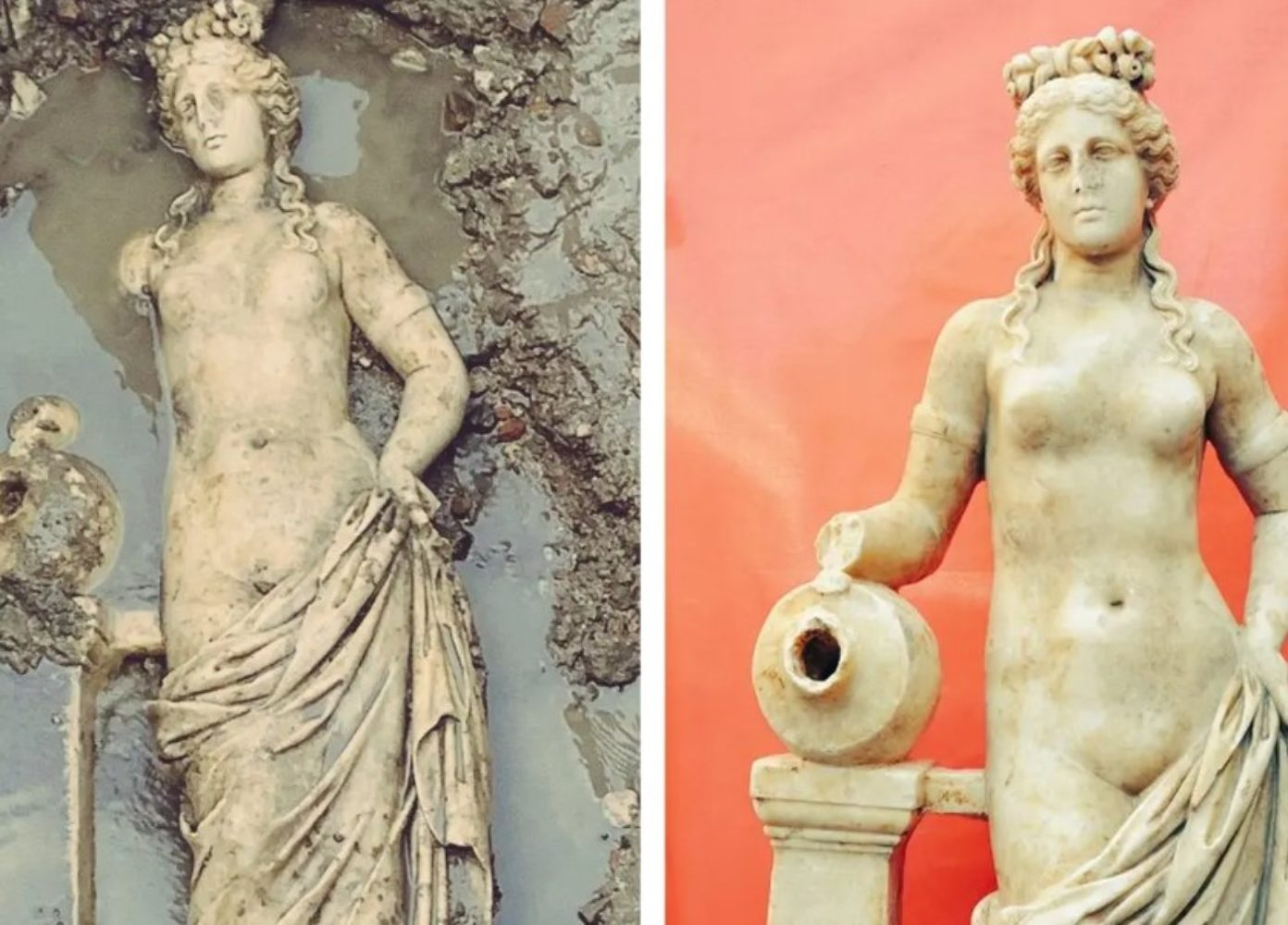
It is worth mentioning that a 1.50-meter-tall statue of Aphrodite has been discovered recently in ancient Amastris. It could be established that it is a Roman copy from between 180 and 200 AD that was inspired by Praxiteles’ school in the 4th century BC. The ancient city was named after Amastris, the niece of King Darius III, who married Dionysos, the tyrant of Herakleia-Pontus.

The map included in my post About Arrian’s Periplus of the Euxine Sea is most useful for locating all the cities, harbors, and rivers mentioned above. 

It should be said that while inspecting the Cappadocian frontier harbors in 123 AD, Emperor Hadrian had already visited part of the southern Euxine Sea, including Trapezus. With this in mind, Arrian now informed the emperor that Trapezus was building a new harbor, replacing the mooring where ships could only anchor in summer. 

It is quite amazing to see so much geography and history being exchanged. We tend to forget the many lines of communication that existed in antiquity, with traders, merchants, scholars, philosophers, astronomers, kings, and emperors traveling far and wide, by land and by sea.

[to be continued in Part 3]

Wednesday, May 31, 2023

Aristobulus, more than a biographer

Aristobulus of Cassandreia has been listed among the many biographers of Alexander the Great (see: Eyewitness accounts of Alexander’s life), but he was far more than that. He did not hold any military function in Alexander’s army. Consequently, not being involved allowed him to approach the events as an onlooker. 

He must have been a tough guy since he survived the hardships of Alexander’s campaigns, including the march through the Gedrosian Desert. He seems to have lived to be over ninety years old. 

When he was 83, he began writing his book about the exploits of Alexander from the early days of his kinship to his death. He was blessed with an excellent memory, being able to recall so many events, novelties, and details! Apparently, his book was finished at about the same time as Ptolemy and Cleitarchus published theirs, 285-283 BC. Unfortunately, most of his work is lost. We only have a few scraps together with his observations recorded and used later by Arrian and Strabo. 

We may assume that Aristobulus’ accounts were exact and reliable. He had a wide field of interest and investigated the land, the animals, the many peoples he encountered, the public buildings, and other construction works. Alexander’s military campaign was not his priority. 

He is best known as the engineer/ architect in charge of restoring Cyrus’ Tomb in Pasargadae, a serious responsibility that clearly shows how much Alexander trusted his capabilities. 

Aristobulus, however, was mainly a geographer. He spent much time analyzing and describing the fauna and flora he encountered, the rainfall and the Indian monsoon (whose arrival he recorded in Taxila), the rivers, and the different climates. He drew an in-depth comparison between India and Egypt, including their environment. He analyzed the river courses, placing them in a broader context as trade routes throughout Central Asia and Punjab. 

The Oxus (see: Crossing the Oxus River), for instance, was the longest river, he said, that was navigable and used to transport goods from India to the Caspian Sea. Another river that caught his attention was the Polytimetus (see: Alexander's march to Maracanda) in Sogdiana, which did not flow into another river or a sea, but petered out in the desert. 

On the other hand, fragments of Aristobulus’ text on plants have been preserved. He tells us how rice was cultivated in beds in the backwaters and that the plants were 1.75 meters tall. He said that since each plant had several ears, the harvests were plentiful, adding that the grains had to be hulled. 

The geographer also spent ink on the importance of Alexander’s visit to Siwah. Unlike fellow biographers of the king, Aristobulus detailed Alexander’s route. Ptolemy stated that Alexander headed directly for Memphis. Aristobulus, instead, wrote that the king left from Paraetonium and followed the Mediterranean for about 290 kilometers before turning south to Siwah. On the way back, Alexander founded the city of Alexandria. This implies that he returned over the same route as the one used on his outward journey. Again, this is the version of events as copied by Arrian.

We know very little about Aristobulus’ fascinating personality, but he is one of the rare authors who draws an overwhelmingly positive picture of Alexander. He depicts him as a righteous king, concerned about justice and not making hasty decisions. Another of his remarkable declarations is that Alexander was not a heavy drinker but liked to spend time with his companions, toying with his drink. That is a far cry from the many statements or hearsay statements depicting Alexander as a heavy drinker and even that the wine led to his premature death in Babylon! 

Aristobulus rightfully declares that Alexander was under the protection of the gods. Nowadays, we would say that he was born under a lucky star. Why not?

Saturday, March 25, 2023

Persia's Historical Memory of Alexander

Robbert Bosschart has published an Updated Version 2025 to his book All Alexander’s Women, which deserves special attention.

Of particular interest is this newly reworked Chapter, Persia's Historical Memory of Alexander, where the author focuses on the Persian side of history. The Achaemenids did not have a counterpart for the Greek writers and chroniclers and relied instead on the verbal transmission of Alexander’s life and deeds by way of mouth by their storytellers.

This new information is too good to be kept hidden in the dust of time, and I am very happy to share hereafter the most important information together with some of the magnificent illustrations. 


Persia's Historical Memory of Alexander

For Persia’s own first-hand memories of Alexander perforce we have to rely on oral history: all the published testimonies available today originated from texts of local storytellers, later written down and ‘enriched’ by scribes, poets or translators.

...

Early Persian/Arab authors who included history themes in their writings, based their texts both on oral history accounts and on written documents. From Umara in the 7th century AD up to Masudí in the 10th century they used all sorts of sources, including the first Arabic translations of the pseudo-Kallisthenes’ Alexander Romance.
As times went by, the most popular versions of Alexander’s exploits became more and more sensational and sexy, big adventure tales usually known as the Iskandar-Nama, the Book of Alexander. As a result, their reports about Alexander’s reign are quite entertaining literature, but in historical accuracy ‘few and far between’.

Therefore it is interesting to find that the only text with specifically Persian memories of Alexander’s life and deeds is, again, that of a simple storyteller. Or not exactly ‘simple’, for Abu Taher al-Tarsusí describes himself as «a compiler of histories and narrator of mysterious facts». The saga that Tartusi published under the title of Darab-Nama (‘Tale of Darius’) was a written version of an ancient folk story. From the 12th century AD on it became very popular.
The oldest manuscript we have is dated to 1580 AD, in an edition illuminated with precious miniatures made in India for the Mughal emperor Akbar. Painstaking research on this and other, later versions finally yielded in 1965 the definitive edition of the Darab-Nama. In his introduction, Professor Zabiholla Safa underlined that the text is based on oral source material that is much older than the Arabic translations of the Alexander Romance. In other words, the Darab-Nama reflects Persia’s own historical memory. 
Its title is rather misleading, because only 386 of the 1159 known pages concern Persia’s glory years under the revered figures of Darius the Elder and his successor. But the bulk of the text, 773 pages long, displays an elaborate tale of how his fictional granddaughter, princess ‘Buran-dokht’, first opposes, but finally permits Alexander’s conquest of Persia. 
A unique characteristic of the Darab-Nama is that here, Alexander does not get the brilliant leading role. That privilege is reserved solely for the purely Persian personage Buran-dokht. As long as the story takes place in Persia, Alexander is even portrayed as a hotheaded, at times stupid or cowardly, and always vulnerable young man, with no special military talents. More than once, Buran-dokht has to come and save him. Only after the story has moved to foreign lands, Alexander is allowed to become a brilliant warrior and wise statesman.


The Iskandar-Nama became a popular (and often hilarious) 
adventure tale with lots of action and sex

Of course, like many other works of oral literature, the Darab-Nama has been compiled over the centuries by successive storytellers. This makes it even more impressive that in Tarsusí’s final version, the text still manages to retain Persia’s popular memory of three historical facts concerning Alexander. 
The most extensive of the three is the (re)appearance of a goddess from a legendary past, Anahita. Time and again she intervenes to promote and protect Alexander’s kingship. To begin with, as Nahid, Alexander’s secret mother, who succeeds in placing him on the throne of the Western empire called “Rum“. Then she pops up briefly as queen Aban-dokht, who becomes his lover, and presents him with the capital of Persia, Estakhr. Finally she shines forth on hundreds of pages as the divine Buran-dokht, who ends up marrying him and setting him on the throne of the empire. Which means that even in islamic Iran, popular folklore still remembered –from 1500 years back!– the goddess Anahita, her role as Giver of Kingship, and her blessing for Alexander.

The second historical fact reported about Alexander in the Darab-Nama refers to his double Persian marriage «according to core royal usage»; that is, the multiple political marriages practised by Cyrus the Great and Darius the Great in the 6th century BC. This is told as follows:
«Buran-dokht took Alexander by the hand, made him sit on the throne and saluted him as King of Iran. Then they sent messengers and letters from Estakhr to all the provinces to announce that Buran-Dokht and Alexander had married. 
The gates of the treasuries were opened, gold was distributed profusely, and with both of them installed on their thrones on equal footing, they had seven months of celebrations. In accordance with the core royal usage, Alexander was also given in marriage the daughter of King Shahush».

So here Alexander marries a daughter of king Darab and a daughter of a king called Shahush. History tells us that in Susa, in 324 BC, Alexander married princess Barsine/Stateira, daughter of Darius III, and the princess Parysatis, last daughter of a king we know as Artaxerxes III Ochus, but who was called ‘Vahush’ in Old Persian. So the «daughter of King Shahush» in the Darab-Nama evidently is the daughter of Shah Vahush, as Artaxerxes III was known to his court.

The Persian warrior-queen Buran-dokht repeatedly 
saves Alexander from his enemies. 
Here she defeats the Indian king Poros, when she grabs 
his war elephant by the trunk and overturns him.
(Miniature illustrating a Darab Nama manuscript of 1720 AD, 
now in the Statsbibliothek of Berlin)

The third popular memory of a historical fact embedded in this saga recounts Alexander’s decision to promote mass-marriages for the better integration of conquerors and conquered into one realm; a theme that takes up some 20 pages in the Darab-Nama. This is how the story goes:
Alexander and his army happen upon an island of women, and thousands of these invade the camp «searching for men». Alexander suspects that in reality they may be hostile, but soon understands they only want to make love —and then fears that his own men will “go berserk”, causing even worse problems. So he allows his wise chancellor –whose name is given as Plato— to apply a miracle-working solution.
Plato calls upon the women and asks them: «By the will of God, and so be all the Angels your witnesses, will you give yourselves in legal union to the men that will enter your city?» They agree. The storyteller concludes: «When the women were trying to seduce the men, it was the work of the Devil; but as soon as they were conveniently and legally married, it became God’s work, and Alexander could no longer be held responsible for any problems arising of their arrival».

Clearly, this is a remembrance of the mass-marriages (in reality, the legalization of de facto marriages) that Alexander organised in parallel with his double wedding at Susa in 324 BC. Out of his own purse, as Arrian reports in VII, 4, 8, he paid dowries for the Persian and other Oriental women who had taken up with his officers and soldiers, so they could be legally married.
The list totalled some 10,000 dowries, and the classical sources say that Alexander disbursed over 10,000 talents of silver for them; an amount equivalent to 150 million dollars of today. It is understandable that these marriages, converting thousands of concubines into legal wives, left an indelible memory among the Persians. 

Just as important was Alexander’s pledge that he would care for their offspring. Arrian notes in passing that he promised his veterans that their children from Oriental partners “will be educated as Makedonians”. But Diodoros tells more: he registers (in his Book XVII, 110, 3) that Alexander has set up a specific fund and appointed the necessary teachers to ensure that the 10,000 children his men have had with “women who were taken in war” will be educated “as is the right of free men”.

Alexander and his wise chancellor Plato receive Queen Sabaterah, 
who reigns over an island where only women live, 
and they all want sex with men. 
Plato will ensure that they become legal spouses.
(Miniature from the 1720 AD manuscript of the Darab-Nama)

In Book XVIII, Diodoros adds that Alexander had decided to apply his integration policy on a much broader scale:
«…he intended to establish cities and to transplant populations from Asia to Europe and in the opposite direction from Europe to Asia, in order to bring the largest continents to common unity and to friendly kinship by means of intermarriages and family ties».
Alexander’s intermarriage policy found lasting approval in Persia, as shown by the positive comment of the storyteller in the Darab-Nama on the “miraculous solution” devised by Plato. In fact, all three of Tarsusí’s historical storylines, repeated again and again in the saga, must have met with notable approval of his Persian audience. After all, no storyteller makes a living by irritating his public.

Around the year 1000 AD, the prominent court poet Farrukhi Sistaní affirmed: “The story of Alexander’s exploits and his travels has found listeners everywhere, and everybody knows those tales by heart”. So Tarsusí and the storytellers before him had to take into account that among their public, there always would be people who remembered some previous version of the Alexander Romance.
As a case in point, their public in Ghazna could perfectly well remember an Eskandar-Nama compiled around 1015 AD out of stock tales of Persian storytellers that simply copied episodes from the pseudo-Kallisthenes Romance, with some fancy (and errors) added. In that text, Alexander is the undisputed hero of the saga. But to entertain the audience, this Eskandar-nama turns him into a comical figure who not only conquers kingdoms, but also women galore. He seduces princesses, amazons, warrior beauties, servant girls, widow queens, noble dames and even fairy queens (!) far and wide. With the result that this Alexander suffers all the problems of a bumbling man with too many wives and/or concubines.
When Alexander is listening to the deathbed pleas of king Darab, who begs him to treat his family well, Roxana makes her appearance in this Eskandar-Nama. “She is still young, you could marry her,” suggests Darab. (Here, Roxana is said to be not a daughter, but one of the wives of the Persian king.) Alexander answers hastily that this is a petition he will not agree to:
“God forbid that I should desire your wife, for I already have four wives, all free women, plus 40 concubines from here and from Greece.”
Roxana is an unavoidable heroine in all the Oriental translations of Romance episodes. So she also has to appear in the Darab-Nama. Well, more or less. When introducing his top star the princess Buran-dokht, Tarsusí takes the precaution of telling his public that «elsewhere she was also called Roshanak».
In other words, despite the fact that the following 773 pages prove without a shadow of doubt that his majestic Buran-dokht has nothing in common with the insignificant Roxana, Tarsusí still thought it wise to bow –if only once– to the Alexander Romance.

For my comments on Robbert Bosschart’s Third Edition, please refer to my earlier blog post: All Alexander's Women.