Alexandria's founded by Alexander

Alexandria's founded by Alexander the Great (by year BC): 334 Alexandria in Troia (Turkey) - 333 Alexandria at Issus/Alexandrette (Iskenderun, Turkey) - 332 Alexandria of Caria/by the Latmos (Alinda, Turkey) - 331 Alexandria Mygdoniae - 331 Alexandria (Egypt) - 330 Alexandria Ariana (Herat, Afghanistan) - 330 Alexandria of the Prophthasia/in Dragiana/Phrada (Farah, Afghanistan) - 330 Alexandria in Arachosia (Kandahar, Afghanistan) - 330 Alexandria in the Caucasus (Begram, Afghanistan) - 329 Alexandria of the Paropanisades (Ghazni, Afghanistan) - 329 Alexandria Eschate or Ultima (Khodjend, Tajikistan) - 329 Alexandria on the Oxus (Termez, Afghanistan) - 328 Alexandria in Margiana (Merv, Turkmenistan) - 326 Alexandria Nicaea (on the Hydaspes, India) - 326 Alexandria Bucephala (on the Hydaspes, India) - 325 Alexandria Sogdia - 325 Alexandria Oreitide - 325 Alexandria in Opiene / Alexandria on the Indus (confluence of Indus & Acesines, India) - 325 Alexandria Rambacia (Bela, Pakistan) - 325 Alexandria Xylinepolis (Patala, India) - 325 Alexandria in Carminia (Gulashkird, Iran) - 324 Alexandria-on-the-Tigris/Antiochia-in-Susiana/Charax (Spasinou Charax on the Tigris, Iraq) - ?Alexandria of Carmahle? (Kahnu)
Showing posts with label Constantinople. Show all posts

Wednesday, May 6, 2026

How the Arabs saved our knowledge from antiquity

In my post, The story around Alexander’s copy of the Iliad, I briefly mentioned how the Abbasid Caliphs in Persia largely contributed to preserving the knowledge of the ancient Greeks. 

A few years ago, my attention was drawn to the glory days of Baghdad around 1000 AD, a city built inside a circle surrounding the central Abbasid Palace, a symbol of power and unity. More amazing than its shape was the fact that its Caliphs invested in hiring scholars to translate ancient Greek documents into Arabic. 

Baghdad was built along the Tigris River in 762 AD, as the residence of Caliph Al-Mansur, the founder of the Abbasid Caliphate. The Abbasid Dynasty was named after the uncle of Prophet Muhammad. A Caliph was the title of the civil and religious leader of a Muslim state, seen as representing Allah on earth. 

Al-Mansur was the first Caliph to honor astrologers. The most famous astrologer was Mash’allah from Basra, who served the Caliphs from 762 to 809 AD. Al-Mansur was convinced that it was written in the stars that the Abbasids were the legitimate successors of the Persian Sassanid Empire. They had been in power from 224 until 651 AD, when they were conquered by the Muslims. Since astrology did not exist in Arabic, Al-Mansur needed to revert to Persian and Greek astrological texts. As a result, he needed these ancient texts to be translated into Arabic.

By 786 AD, Caliph Harun al-Rashid established the House of Wisdom in Baghdad, which originally may have been a Library, where scholars from across the Muslim world would organize their translations. The idea caught on, and other centers flourished a few centuries later in Cordoba and Granada in Spain, as well as in Cairo, Egypt. 

In the western Roman world, we saw our ancient knowledge and know-how disappear into the dark Middle Ages soon after the Fall of Rome in 476 AD. In the Eastern Roman or Byzantine Empire, however, the science of Antiquity survived despite the rise of Christianity. Constantine the Great had made it the official religion, renaming its capital Byzantium after himself, Constantinople.

When Islam entered the stage in the 7th century AD, the Abbasid Caliphate, established in Damascus, was a serious competitor to Constantinople. In about 750 AD, the Caliphate was transferred from Damascus to Baghdad, meaning that the center of power moved east from a Greek-speaking region to a non-Greek-speaking area. Followed a series of wars between the Caliphate and the Byzantine Empire that lasted until the 11th century. 

All that time, the knowledge from Antiquity flowed into Baghdad, where a vast translation project was set up, and top translators were highly rewarded in gold. They concentrated on matters like astronomy, geometry, arithmetic, and even music theory. Aristotle was still held in high esteem, his works as well as his comments. Later translations included Claudius Ptolemy's Almagest, a mathematical and astronomical treatise on the motions of the stars and planets; Euclid's book on geometry; the medical works of Hippocrates and Galen; and Plato’s Republic and Laws. Many other ancient books were translated from Greek, Pahlavi, Neo-Persian, and Syriac into Arabic. 

Simultaneously with this translation movement, Islamic science developed, involving philosophers and scientists alike. A name that stands out is that of Ibn Sina, better known as Avicenna (980-1037), the Father of Early Medicine, whose work was standard in Europe for centuries. Another figure was Al-Khwarizmi (780-860), the Father of Algebra, who introduced the algorithms.

By the mid-11th century, the ideas of antiquity reached Europe in Arabic, traveling to Sicily and Muslim Spain. Over time, they had been enriched with the knowledge that the Caliphs in the Middle East had acquired and developed. We owe it to the Abbasids that the knowledge from classical antiquity reached Europe, where it was generally translated into Latin. 

The Abbasid Caliphate ended in 1258 when Baghdad was sacked by the Mongols. The city was looted and thoroughly destroyed. The invaders burned piles of books, including those that were held in the House of Wisdom. 

Without Baghdad and its western expansion, we would have remained stuck in the dark Middle Ages, and there would not have been a Renaissance. 

Sunday, February 9, 2025

The importance of Perinthus

In antiquity, Perinthus was of strategic importance as it controlled Athens grain route from the Black Sea through the Bosporus. Each spring Athenian ships loaded with wheat from the Danube and Maritza basins sailed down via Byzantium, the Hellespont, and further across the Aegean to Athens. 

Perinthus, near the modern city of Tekirdağ, had two harbors in the East and the West side of the peninsula both used for commercial and military purposes. So far, the remains of a shipwreck have been located at a depth of 60 meters, and the finding is under investigation. More of the city’s buildings are being exposed, including an Acropolis with large temples and a theater. Besides the many small artifacts such as bits of jewelry and statuettes, there also is a necropolis.

[Picture from Sozcu.com.tr]

In late 352 BC, King Philip of Macedonia was asked to assist a coalition of Central Thracia, consisting of Byzantium, and Perinthus in besieging the nearby fortress town of Heraion Teichos that threatened Perinthus (see: Philip is bouncing back). He marched his army east, took the town, and returned it to Perinthus, presumably its original owner. 

Philip’s presence in the area was a threat to the Athenians but also to the Persians aiming to control Perinthus. In 340 BC, the Persians ordered Pixodarus of Caria, their ally in Halicarnassus, to help Perinthus revolt against Philip. The operation was not successful. 

Pixodarus then changed his mind as Persia was in turmoil after the murder of King Artaxerxes III. He thought it wise to seek Philip’s support instead. He offered his daughter, Ada, in marriage to Philip’s retarded son Arrhidaeus. The pact was accepted. 

However, Alexander felt left out and decided to act on his own, offering himself as a marital candidate. When Philip got vent of this maneuver behind his back, the agreement with Pixodarus was called off. Philip seriously reprimanded his son by exiling several of his closest friends from Pella (see: Pella, the birthplace of Alexander). 

By 188 BC, Perinthus fell under the rule of Pergamon until the Romans took over in 129 BC. By the end of the 2nd century AD, they used the port as a main hub to ship their troops between the Euphrates and the Danube fronts. On the other hand, Perinthus had an important connection with the Via Militaris that ran west to Philippopolis, Serdica, and Viminacium. From here, the Via Egnatia led to Thessaloniki, Dyrrhachion, and Brundisium. 

Based on inscriptions from the late 2nd century AD, it has been established that the provincial governors of Thracia had a residence in Perinthus. 

[Map from Stilus.nl]

In 286 AD, Emperor Diocletian renamed the city Heracleia to become a state capital. He may well have built a palace here as the outline of the ruins indicates a similarity with his palace in Nicomedia.

Under Constantine in 330 AD, Heracleia was supplanted by Byzantium which was renamed Constantinople. 

In the end, Perinthus lived a long and prosperous history thanks to its strategic location with ideal access to the Black Sea, the Aegean, and the Mediterranean, as well as inland Anatolia, and Egypt. Inevitably, it became a multicultural center populated by different peoples all speaking their own language. That sounds very close to today’s praise of Istanbul joining Europe and Asia. 

Thursday, August 8, 2024

Alexander’s presence in Venice – Part 3, the Pala d’Oro

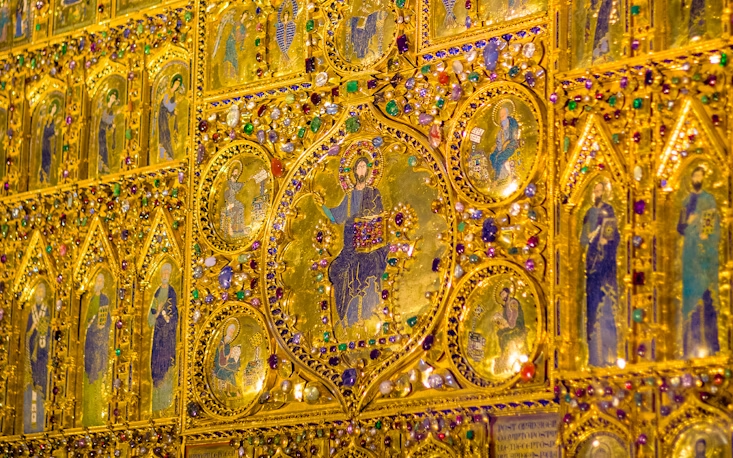
Finding Alexander on the Pala d’Oro, the high altar of the Basilica San Marco in Venice is extremely difficult. 

[Pala d'Oro from Saint Mark's Basilica]

The golden altarpiece is a unique work of Byzantine enamel thought to be commissioned in 976. It acquired its present shape and size (three meters wide and two meters high) in 1345. It is made of gold and silver and counts 187 enamel plaques alternating with nearly 2,000 gemstones. 

The enamels in the top part of the Pala d’Oro are a group of six images representing the Life of Christ arranged around Archangel Michael. The bottom section tells the life of St Mark. A central picture of Christ Pantocrator is surrounded by the Four Evangelists and flanked by twelve Apostles, six on either side. 

Hardly noticeable in this opulence of precious metal and colorful stones are the small roundels and busts of Saints in the surrounding cornice. 

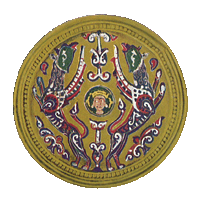
Of particular interest are the six enamel Byzantine plaques of 4.4 cm in diameter at the very bottom dated to the 11th century. 

They depict three scenes of falconers on horseback (as in Eastern iconography): 

The stylized image of Alexander the Great elevatus ad aerem (lifted into the skies) as seen in the relief on the north façade of the Basilica San Marco in Venice:

The Tree of Life, a representation of the world, is seen as a paradisiacal garden. In the center is a tree surrounded by two serpents, but also the rivers that circumscribe the emerged lands. It is the world that, in the ancient and medieval versions of the Romance, Alexander sees from above, in the cosmic vision that concludes his mystical flight. 

And a bust of Emperor Constantine of which I have no picture. 

There is nothing to link these themes together except perhaps that the enamels were gifts from the Imperial Court of Constantinople to the Doge of Venice. They were interpreted as divine inspiration through the centuries from the days of Alexander the Great to the Roman Emperor Constantine, the Byzantine emperors, and finally to the Venetian Republic. 

The six roundels, in fact, summarize the vision of Doge Dandolo to make the Venetian Republic the true and rightful heir of the Roman Empire. It is not surprising that he turned the Pala d’Oro into a most splendid centerpiece of the Basilica

It is remarkable to find Alexander still present as Kosmokrator (Ruler of the World) some 1700 years after his untimely death. Even today, we greatly underestimate his wide contribution to mankind, which is way beyond his military and political achievements.

[Pictures of the enamel roundels are from Engramma]
[Continue reading Alexander's presence in Venice - Part 4, the Doge's Palace]

Wednesday, August 7, 2024

Alexander’s presence in Venice – Part 2, from Constantinople

Alexander is also featured on the north façade of the Basilica di San Marco in Venice. Here is a relief taken from Constantinople after the sack and looting by the Crusaders in 1204 together with the bronze horses that found a prominent place above the entrance to the Basilica. 

[Alexander lifted into the skies – from Engramma]

Looking at the photograph in the article published by Engramma, my thoughts immediately go back to a similar picture of Alexander in the Cathedral of Otranto in southern Italy where he is part of a huge mosaic floor created between 1163 and 1165 (see: Alexander’s presence in Magna Graecia). 

In the Venetian relief, Alexander is seated on a chariot, which is not clearly visible in Otranto's mosaic, pulled by winged griffins who lift him up into the skies. The motif is said to be very common in the 12th-13th century. 

Initially, the relief was not a decorative piece but a precious trophy like the famous bronze quadriga and other artifacts used to represent the transfer of the symbolic continuity from Constantinople to Venice. The ambition of the Venetian Doge was boundless as he strived to move in Alexander’s footsteps as ruler of the world. Nothing less …!

[Continue reading Alexander's presence in Venice - Part 3, the Pala d'Oro]

Thursday, April 20, 2023

An introduction to Leptis Magna in Libya

Alexander's presence in North Africa has been limited to Egypt, which in his days included Cyrene in modern Libya (see: Cyrene, founded by the Greeks). The king knew of the Phoenician colonies and Carthage further west, but they were not part of his plan then. 

My visit to Libya happened later, too, because the impressive ruins of Leptis Magna are far too Roman to fit into my Alexander picture. 

However, the opportunity to travel to Libya arose just before the outbreak of the Arab Spring. With hindsight, I've never been so lucky! Not only because of the timing of my visit but also because it was here at Leptis Magna that I really understood what the grandeur of Rome meant. It is an impression that the ruins of Rome itself cannot give us. 

Leptis Magna or Lepcis Magna is located on the coast of the Mediterranean, 120 km east of Tripoli. It was founded by the Carthaginians around the 7th century BC at the mouth of the Wadi Lebda and at the end of the caravan route from the Sahara. Grain and olive oil were the primary export product, but wild animals from the hinterland were also traded and shipped. 

Carthage was involved in successive fights over the fertile lands of Sicily, facing the locals and the growing power of RomeCarthage and Rome fought each other during the three Punic Wars, which ended with the total destruction of Carthage by the Romans in 146 BC.   

Thanks to the generosity of the local merchants, Leptis Magna already had numerous public buildings from the time of Augustus and Tiberius (first century AD).  

By the end of the second century, many Africans held high positions in Rome, and it is said that 15% of the Roman senators came from North Africa. Emperor Septimius Severus, who ruled from 193 to 211 AD, was born in Leptis Magna, and he wanted to build a city of imperial allure, a second Rome. 

He was an avid traveler and had visited every corner of his realm, casually crushing a rebellion here and conquering more land there. He spent the winter of 202-203 here in Leptis Magna. Septimius Severus had become wealthy from the goods he had confiscated from his enemies and could afford to undertake major construction projects. The best architects and sculptors of the time were brought here to build a new forum and a huge temple dedicated to the gods protecting the city. The harbor was expanded, the water supply was improved, and a richly decorated Triumphal Arch put Leptis Magna on the map. He brought peace and prosperity; the city counted at least 60 to 80,000 inhabitants in his heyday. Septimius Severus could afford some eccentricity because the population was on his side since he had granted them the ius italicum, an exemption from local taxes.

Despite all the prestige, Leptis Magna's days were numbered. The opulence of its people did not sit well with the Roman aristocracy and created a lot of envy. As a result,  most of the African property was confiscated, and soon decline set in. 

The city was seriously damaged by the earthquake of 262 AD. Emperor Diocletian ( see: Price list established by Emperor Diocletian) tried to restore order in the 3rd century by promoting Leptis Magna to the capital of the Province of Tripolitania. Yet, another devastating earthquake ravaged the city in 306 AD. 

With the Fall of the Roman Empire, Tripolitania remained part of the Western Roman Empire, i.e., under Rome's control, while the Cyrenaica was added to the Eastern Empire, i.e., Constantinople. By that time, the harbor of Leptis Magna silted up, and the Vandals moved from Rome to settle in the area. This definitely sealed the fate of the city. 

The Byzantine Empire took over and constructed the city wall, and many large buildings were converted into churches. After the Arab invasion in the 7th/8th century, Leptis Magna was still inhabited. Sadly, the grand city never reached its heyday from the 2nd and 3rd century AD. After the 11th century, Leptis Magna was abandoned and gradually disappeared into the sand. 

However, the magic lived on, and from the 17th century onward, columns from Leptis Magna found their way to Europe. Versailles was a destination, together with the church of St-Germain-des-Prés in Paris. The Temple of the Gods, built in Windsor Great Park in 1826, has nine columns from Leptis Magna. 

In the 1920s and 1930s, Italian archaeologists excavated the site extensively, and the most beautiful artifacts were transferred to the Museum in Tripoli. Sadly, more recent diggings are at a standstill because of the political instability in Libya.

[Continue reading Leptis Magna or what Rome must have looked like - Part I]

Monday, June 21, 2021

The rich history of olive oil

Most of us believe that the olive tree originated in Greece from where it spread over the entire MediterraneanIt thus may come as a surprise to learn that the oldest ones were found in ancient Israel around 5,000 BC. The olive oil was exported to Greece and Egypt until Crete and Cyprus started to produce their own, and eventually the production reached mainland Greece. The Greek and Phoenician colonists, in turn, introduced the olive tree to Italy, Iberia, and North Africa. In the wake of Alexander’s conquests and the subsequent Roman occupations, the olive tree became familiar in those lands, boosting warm summers and little rainfall. 

Olive trees obviously were most famous for their oil. The Greeks believed that the earlier they pressed the olives, the finer the quality of the oil was as they were still green. However, if they let them ripen longer till they were black, they would produce more oil. Then and now, the best quality oil came from the first pressing. 

Generally, the olives were crushed underfoot – a process that survived till far into the 20th century. Several examples of these “presses” have survived, such as those found at Mesembria in Eastern Greece. A large slab or a terracotta lid on an earthen pot was perforated with holes, and the crusher would press the fruit by trampling the olives with his feet. The pulp was collected in a basin or jar underneath the lid and was then filtered. 

The earliest presses consisted of a large round millstone, usually pulled by a donkey. Those stones would roll over the olives poured into a circular container. The resulting pulp was then filtered through stacked baskets and pressed with a heavy rock placed on top. A good example has been found in Olynthus. Although the process may sound rather primitive, the end result was pretty satisfactory. 

It is not rare to find olive trees amongst fruit trees, and the field owners would let some sheep graze the groves to keep them free of grass and weeds. Moreover, the residue of the oil pressing process could be used as feed for the pigs. 

The demand for olive oil grew with the Roman Empire's expansion, and eventually, Constantinople became one of the leading importers.  Also, vineyards and olive farms arose in Syria and Cilicia, and they reached the peak of their capacity in the 3rd-5th century AD. In any case, the principal producers were located in the regions of Attica in Greece, Italy, Baetica in Spain, Cyrenaica in Libya, Venafrum in Italy, and the island of Samos. To meet the high demand for oil, the Romans developed screw presses which were more performing to crush the olives. In those days, it is believed that oil production reached such a high level that we had to wait till the 19th century to see it improved. 

Olive oil was and remains an essential ingredient in Mediterranean cuisine. However, many other implementations were known, such as fuel for the lamps or a component to make perfumes. Another application was to cleanse the body of the Greek and Roman athletes from dirt and sweat using a strigil. 

The most popular way to store and transport the oil was the common amphora, which came in all shapes and forms depending on their country of origin, the manufacturer and the merchant. 

Beyond the success story of the olive oil, the tree acquired a sacred significance when the olive branch became a sign of peace and a crown for the winners at the ancient Olympic Games. 

The olive branch was very favorite in Classical Athens, where the tree was considered a gift from Athena. The sacred tree stood on the Acropolis close to the Erechtheion and has been replaced with a new version in modern times. Pilgrims also carried olive branches on their way to the oracle at the Temple of Apollo in Delphi. 

This all means that the importance of the olive tree reached far beyond oil extraction and usage.

Thursday, June 17, 2021

The birth of Egyptology under Napoleon

Napoleon was fascinated by Alexander the Great, and for that reason, he deserves some attention as France celebrated the bicentenary of Napoleon’s death on 5 May 2021. 

The young general launched his Egyptian campaign in 1798 in order to cut off the British route to India. At the same time, he intended to free Egypt from the Mameluk warriors. With his fleet, he landed in Alexandria and fought his way inland to Cairo and the Pyramids. Unfortunately for him, the British Royal Navy, under the command of Lord Nelson, sunk the French fleet on the Nile, and Napoleon was forced to return to France, leaving his troops behind – something Alexander would never have done! 

However, Napoleon somehow managed to turn his disastrous campaign into a cultural and scientific victory. Egypt, in those days, had little or no interest in the legacy of the great pharaohs from antiquity, which they dismissed as pagan. 

Inspired by Alexander, Napoleon added a large number of scientists, engineers, artists, cartographers, botanists, mathematicians, and art connoisseurs to his army. History does not remember most of their names, but it is worth mentioning, for instance, Mathieu de Lesseps, whose son Ferdinand built the Suez Canal half a century later (see also: The canal of the pharaohs, the Suez Canal of antiquity). Napoleon founded the Institute of Egypt with four distinctive sections: Mathematics, Physics, Political Economy, and Literature and Arts. 

Napoleon’s scientific expedition made extensive studies of the pyramids and temples of Egypt, and in particular of the statues of Pharaohs like the head of Amenhotep III, which can still be admired in the Louvre today. At that time, a slab of black basalt was discovered at Rosetta, some 35 miles from Alexandria, displaying a trilingual inscription in Greek, Demotic, and Egyptian hieroglyphs. 

After the Battle of the Nile in 1798, Napoleon lost most of the excavated objects to the British, including the Stone of Rosetta and the Sarcophagus of Nectanebo II, which, among other items, ended up in the British Museum. 

Importantly, the French Egyptologist Jean-Francois Champollion deciphered the hieroglyphs using the Greek text on the Stone of Rosetta to guide him. This was a huge step forward in discovering and studying the culture of ancient Egypt. Interestingly, the inscription on the stone honors Ptolemy V, who lived from 210-180 BC. 

During his extensive campaigns, Napoleon didn’t shy away from acquiring whatever artifact pleased him or was of some value. Most of his collection ended up at the Louvre and included, for instance, the Horses of San Marco in Venice (which originally stood in the Hippodrome of Constantinople) and one splendid frieze from the Parthenon in Athens.

Tuesday, August 14, 2018

Istanbul, The Imperial City by John Freely

Istanbul, The Imperial City by John Freely (ISBN 978-0140244618) is by far the most complete historical guide you can find. It is a lightweight, handy format that easily fits into your backpack.

Every first-time visitor will inevitably be overwhelmed by the many remnants of this capital, famed successively as Byzantium, Constantinople, and Istanbul, which has had a far-reaching role on the world map for over three thousand years.

For obvious reasons, the book is divided into three parts.

The first and shortest covers the city's birth on the Bosporus and the first Greek colonization to become the Roman Byzantium, with all the wealth that could be displayed. This was the city besieged by Philip II of Macedonia in preparation for his invasion of Asia. The Romans, in turn, linked the city to Italy through the Via Egnatia, and the Golden Milestone known as The Million marked the distance to the towns stringed along the road. The Great Palace and the Hippodrome date from that era.

The second part starts with the advent of Emperor Constantine in 330 AD, who renamed the city after himself, Constantinople. As such, it became the seat of the Eastern Roman Empire. Under great emperors like Theodosius, Justinian, and the dynasty of the Comneni, the city expanded again. Constantinople was besieged repeatedly from the 7th to the 10th century by the Sassanids from Persia, the Arabs from the Umayyad caliphate, and the Crusaders, who thoroughly sacked the city.

The last and no less important part treats the birth of Istanbul as the capital of the rising Ottoman Empire that started in 1453. Sultans like Suleiman the Magnificent wrote history, and many of today's great buildings were built in those days. To name just a few, there is the Grand Bazaar, Topkapi Palace, and the many mosques, especially those made by Sinan, to rival the Hagia Sofia from the 6th century.

Instead of a dry and dull account, John Freely takes us by the hand and leads us from one place to the next, often unfolding the many superposed layers of Istanbul's rich history. A handy additional chapter is dedicated to Notes on Monuments and Museums, which the author referred to in previous pages. As another helpful tool in the complicated and long succession of rulers, there is also a complete list of all the Byzantine emperors and Ottoman sultans ending when Turkey as such was born and Atatürk became its leader.

As always, John Freely makes history look simple, and it is a great pleasure to travel through the ancient world in his footsteps. Another excellent book by the same author is Aladdin's Lamp: How Greek Science Came to Europe Through the Islamic World – a treasure trove of knowledge!

Saturday, March 14, 2015

Apollonia in Cyrenaica (eastern Libya) after Alexander

In 322 BC, the year after Alexander’s death, Ptolemy I, who had established himself as ruler of Egypt, conquered five Libyan cities. They are collectively known as the Pentapolis and include, besides Cyrene, the cities of Apollonia, Ptolemais or Barca, Arsinoe or Taucheira (modern Tocra), and Euesperides or Berenice (near modern Benghazi). In those days, Cyrenaica was part of greater Egypt and often simply assimilated into Egypt itself. The region was very fertile and produced wheat and barley, as well as olive oil and wine; the orchards in turn were filled with fig and apple-trees; sheep and cattle roamed widely; and above all, this was the only place in the world where silphium grew, a natural medicine, a contraceptive and aphrodisiac.

In an earlier post, I already wrote about Cyrene (see: Cyrene, founded by the Greeks), so this time I’ll concentrate on Apollonia, now renamed Susa in today’s eastern Libya, the most obvious choice since it was the harbor for majestic Cyrene, only some twenty kilometers further inland.

Apollonia was founded by Greek colonists as early as the 7th century BC, and during the fourth century BC, the harbor facilities were widely improved, sheltering the berths against the strong northern winds. On the west side, a new inland port was constructed, protected by two towers, while on the most eastern island, a lighthouse was installed. It was only in the first century BC that Apollonia became a city in its own right. Not for long, however, since upon Ptolemy III’s death in 96 BC the entire Pentapolis, including Cyrene and Apollonia, was bequeathed to the Romans, who just moved a step closer to Egypt itself …

Today’s visitor to Apollonia will only find half of the antique city as the other half lies underwater. Northern Africa has suffered badly from a devastating earthquake that occurred in 365 AD, causing the entire coastline to drop by four meters. The phenomenon is clearly visible here in Apollonia, where the old harbor is entirely drowned, and the three offshore islands are all that remains of the northern pier. This explains why the city doesn’t have the appeal of a harbor, and certainly not one to serve a city as important as Cyrene. Apparently, shipwrecks from the fourth century BC have been located in the antique harbor where French archaeologists were diving during my visit in 2010. I hate to think about what has happened since.

Anyway, Apollonia’s remains are mainly Byzantine, with three Basilicas: the western Basilica with three naves; the central Basilica with five naves; and to the far end, the eastern Basilica, the largest, from the 6th century, with an exceptional Baptistery because it has six steps instead of the normal three. My local guide tells me that in the Byzantine era, the purpose of this Baptistery was not to baptize people in order to convert them but to receive forgiveness for their sins. One submersion would cleanse the believer from small sins, but for more serious offenses, five or six submersions would be required. I never heard of this theory, but it may be a logical explanation for the great number of baptisteries in these churches.

Next to the central Basilica are the remains of a Roman Bath, whose layout, except for the entrance gate, is rather confusing. That is no surprise when you think of how the Byzantines liked to remodel Roman buildings or re-use their stones elsewhere.

Alongside the Byzantine city wall and approximately across from the Roman Baths, lies the Palace of the Dux, the Byzantine governor Hekobolius from the 6th century, i.e., the time when Apollonia was the capital of the Pentapolis. The palace itself does not offer much, but the story that goes with it is rather interesting. For nearly six years, this Hekobolius kept an extremely good-looking mistress called Theodora. One day, she happened to be dancing in Constantinople for Emperor Justinian, who fell in love head over heels and married her soon after. This is how Empress Theodora arrived at the imperial court, where she lived happily ever after … Well, this marriage lasted about twenty years, and Theodora died before Justinian, on 28 June 548.

More remains of Apollonia have not yet been excavated, including the Acropolis at the far end of the site. Outside the city wall lies the inevitable Roman theater (although built on an earlier Greek one) that now lies near the shoreline. According to an inscription found near the podium, it was built in 92 AD during the reign of Emperor Domitian. This is the best-preserved theater of the Cyrenaica despite being used as a quarry by the Byzantines.

A last glance over Apollonia makes me realize that the restored columns of the different Basilicas are the most notable features, but that is primarily because of their texture. All these columns are made of cipolin marble, imported from the island of Euboea, off the coast of eastern Greece. Cipolin is the Italian name for onions and is used to describe this kind of marble, which, like onion skins, appears in green-grayish streaks – a very appropriate name, I must say.

Walking back along the coastline, my attention is drawn towards four large round pits carved in the rock. These pits were used to marinate fish in order to make the famous garum or fish paste, a delicacy for the Romans. How interesting!