Alexandria's founded by Alexander

Alexandria's founded by Alexander the Great (by year BC): 334 Alexandria in Troia (Turkey) - 333 Alexandria at Issus/Alexandrette (Iskenderun, Turkey) - 332 Alexandria of Caria/by the Latmos (Alinda, Turkey) - 331 Alexandria Mygdoniae - 331 Alexandria (Egypt) - 330 Alexandria Ariana (Herat, Afghanistan) - 330 Alexandria of the Prophthasia/in Dragiana/Phrada (Farah, Afghanistan) - 330 Alexandria in Arachosia (Kandahar, Afghanistan) - 330 Alexandria in the Caucasus (Begram, Afghanistan) - 329 Alexandria of the Paropanisades (Ghazni, Afghanistan) - 329 Alexandria Eschate or Ultima (Khodjend, Tajikistan) - 329 Alexandria on the Oxus (Termez, Afghanistan) - 328 Alexandria in Margiana (Merv, Turkmenistan) - 326 Alexandria Nicaea (on the Hydaspes, India) - 326 Alexandria Bucephala (on the Hydaspes, India) - 325 Alexandria Sogdia - 325 Alexandria Oreitide - 325 Alexandria in Opiene / Alexandria on the Indus (confluence of Indus & Acesines, India) - 325 Alexandria Rambacia (Bela, Pakistan) - 325 Alexandria Xylinepolis (Patala, India) - 325 Alexandria in Carminia (Gulashkird, Iran) - 324 Alexandria-on-the-Tigris/Antiochia-in-Susiana/Charax (Spasinou Charax on the Tigris, Iraq) - ?Alexandria of Carmahle? (Kahnu)
Showing posts with label Metellus. Show all posts

Friday, July 16, 2021

There is more to Aegae than the Royal Palace and the Great Tumulus

Driving from modern Vergina towards the Royal Palace of Aegae, we take little notice of the open fields to our left, where the necropolis of ancient Aegae is waiting to be fully excavated. The very area is uninspiring as it consists of a succession of more or less conic bumps in the landscape. These are, in fact, mounds covering the tombs dating as far back as 1000 BC. The cemetery remained in use until the 2nd century BC. 

Proceeding further south, we encounter the Rhomaios Tomb and the Tomb of Eurydice, Alexander’s grandmother, a few meters onward. Further north lies an undefined Public Building and the so-called Hellenistic House and the Sanctuary of the Mother of the Gods to the west

With its 8.50 meters, the Rhomaios Tomb is one of the longest tombs. It consists of two rooms, an antechamber, and the chamber proper. The antechamber measures 4.50 x 2.50 m and is 2.20 m high. A narrow band runs around the walls and is painted with flowers. The colors alternate on the deep blue background using combinations of red-blue, white-blue, yellow-blue successively, and again red-blue, etc. A marble door separates the antechamber from the main vaulted chamber, which is square (4.50x4.50 m) and 4.45 m high. Here too, a dark blue band decorates the walls, but it is plain blue this time. An impressive marble throne stands in the back of the tomb with a footstand and a kind of bed. The throne is remarkable because of its large size. It is decorated with small painted friezes in the lower part, and its armrests display sculpted sphinxes. 

This tomb has been totally robbed in antiquity, making dating very difficult. However, comparing its features and style to those of the nearby Palace, it has been possible to date it to the first half of the 3rd century BC. Last, but not least, it is essential to note that this tomb was never covered by a tumulus and that its location so close to the village is puzzling.
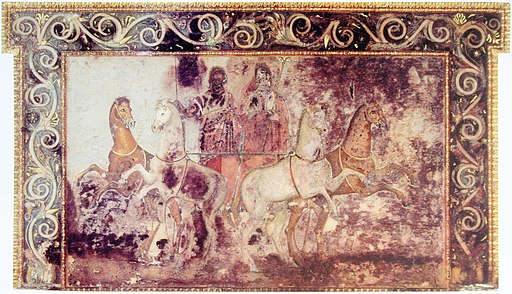
Hades and Persephone, Vergina
Unknown author, Public domain, via Wikimedia Commons

The Tomb of Eurydice is another large burial monument, which appears to be the earliest known Macedonian tomb. As expected, this gravesite has been plundered in antiquity. However, based on the shards left behind, it could be dated to around 340 BC. The dating, the wealth of the tomb, and the dedications found in the nearby  Temple of Eukleia led us to believe that this grave belonged to Queen Eurydicethe mother of Alexander’s father. The monument is 10.60 m long and nearly 8m wide. It is divided into an antechamber and the chamber proper, which measures 5.50x4.40 m with a 5.80-meter-high vault. The chamber's back wall displays an elegant but straightforward Ionic façade of a Macedonian tomb whose stucco and architectural details have been well-preserved. The trompe-l’oeil painting reveals a central door flanked by two stucco windows separated by two pairs of Ionic half-columns. The frieze of flowers and the cornice of the entablature are painted in vivid blue, red, and green. Like in the Rhomaios Tomb, we find a richly decorated throne two meters high. The back of the seat surprises with a superbly painted panel showing the Underworld, with the gods Pluto and Persephone, standing in full majesty on a quadriga drawn by two white and two brown horses. The throne itself is decorated with reliefs, gilded flowers and animals, and even with statuettes of korai. 

Other remarkable tombs in the area are the Tomb of the Bella Farm (first half of the 3rd century BC) with its delicate facade paintings, the tomb on the Bloukas field (c. 200 BC), and the cist grave of Palatitsa (c. 350 BC) – none of which are open to the public. 

The Temple of Eukleia is situated some 80 meters north of Aegae’s theater and close to the road leading to the Palace. Not much of this sanctuary survived, but it could be established that it had a small pronaos of 4x2.5 m and a square naos of 4x4 m. Archaeologists assume that the pronaos was an open space because the bases for statues were found in the two corners of the naos and possibly flanking a sacrificial table. It is striking that the temple faced north. Along the west side of the temple, three bases for statues were found at regular intervals. On the face of the southernmost base, a valuable inscription was found, reading ΕΥΡΙΔΙΚΑ ΣΙΡΡΑ ΕΥΛΛΕΙΑ, in other words, ”Eurydice, daughter of Sirra (erected this statue) to Eukleia.” The finesse of the letter curving has helped to date the inscription to the second half of the 4th century BC. These elements indicate that Queen Eurydice dedicated her statue to the goddess Eukleia, worshiped in this temple. It is assumed that the other bases carried similar offerings by members of the royal family. 

Roughly 400 meters east of the Temple of Eukleia are the remains of the Sanctuary of the Mother of the Gods. This archaic deity had a close relationship with the cult of Dionysus. By the early 6th century BC, the Mother of the Gods was linked with her Asian counterpart, Cybele. The goddess was worshiped with orgiastic dances and music. On votive reliefs and terracotta statuettes, she is depicted holding a large libation bowl in one hand and a large drum for the orgiastic dances in the other. Her head is crowned with a kind of fortress, referring to her role as goddess of cities and fortification walls.

Together with the information left by ancient writers, the remains of this Sanctuary reveal the importance of the cult. A large square building of 32x32 m has been unearthed in recent years. It contained separate rooms playing an essential role during initiation and worship. Various terracotta figures of the goddess, incense burners, vases, coins, loom weights, and all kinds of architectural relics from the earlier building from the 4th century BC have been found. The excavation showed that this sanctuary, destroyed by a severe fire around 150 BC, dates from Hellenistic times. 

A recent article in the Archaeology News Network mentions new studies of a large building complex close to the northwest gate of Aegae and the “queen’s burial cluster.” However, it is not clear whether this is close to the tombs mentioned above or the sanctuaries, but I suppose it is the case. 

The building complex from the 4th century BC has been associated with the worship of the royal family. It was built with stone from the nearby Mount Vermion and set up in successive square and rectangular rooms reaching 100 square meters. They are organized around a large courtyard. The space on the east side resembles a temple with a very large antechamber and two Doric columns on the courtyard side.

More exciting are the stamps carrying the Macedonian shield, which were also used on the coins by the Macedonian kings in Hellenistic times. Importantly, roof panels bearing the inscriptions AMYNTOΥ. This may refer to King Amyntas III, the husband of Eurydice and grandfather of AlexanderIn any case, it testifies of a close relationship with the Macedonian royal family. Other tiles are imprinted with ΠΕΛΛΗΣ, indicating that this particular sacred building must have belonged to Amyntas, who was given the status of hero. A similar cult is known to have existed in Pydna. Moreover, the presence of Eurydice in her nearby temple cannot be a coincidence. 

Despite the thorough looting by the Roman general Metellus in 148 BC, extensive renovations occurred under Philip V during the late 3rd/early 2nd century BC. For instance, the walls are covered with painted plaster. The favorite color was purple, with touches of green and ochre, and the scenes are divided with reliefs, not unlike those known from  Pompeii. The floors are inlaid with marble, as seen in the Palace of AegaeHowever, it could be established that the cracks and irregularities in the floor levels were due to catastrophic landslides in the 1st century AD. After a period of decline, the city of Aegae disappeared under the debris.

 It is clear that the cult of Alexander was kept alive and that the building complex was a way to confirm and legitimize his power and that of his successors.

Sunday, January 26, 2020

Alexander’s battle outfit

Except for the famous mosaic from the House of the Faun in Pompeii, now on display at the Archaeological Museum of Naples (see: The Alexander mosaic), we have no picture of Alexander’s outfit. Although this mosaic gives only a partial view and is made two centuries after his death, it is the closest we can get to visualizing the details.

True, there are a few equestrian bronzes of Alexander that were copied from one and the same original that once stood in the sanctuary of Dion. The Alexander figure belonged to a group of at least 25 Companion cavalry who died during the Battle of the Granicus in 334 BC. This memorial in honor of the dead was erected upon the king’s instruction and occupied a place of honor for some four hundred years. In 148 BC, when Macedonia was reduced to a mere Roman province, Consul Quintus Caecilius Metellus moved the group to Rome. It has been argued that the monument was part of Alexander’s propaganda campaign and was recognized as such by the Romans.

Plutarch is the only author from antiquity to give us a detailed description of Alexander’s outfit. He speaks of the king wearing a coat of Sicilian make. Over that coat, he wore a tight girth and a corselet of thickly quilted linen. In the mosaic, Alexander seems to wear a long-sleeved garment underneath his breastplate, but the image is too garbled to make it out. David Karunanithy (see: The Macedonian War Machine) states that the tunic, which now appears as faded purple-grey, was once deep purple. This is very credible since the king reportedly wore purple for everyday use. By extension, a purple tunic does not look out of place.

The mosaic also shows Alexander wearing a cloak that is held in place by a round gold fibula. This cloak has been recognized as a long antique epiporpoma.  It was made by a certain Helicon and given to him by the citizens of Rhodes as a mark of their respect. The belt Alexander wore in all engagements was from the same origin. It showed much richer craftsmanship than the rest of his outfit and was probably adorned with precious stones.

[Picture from the movie Alexander by Oliver Stone]

The linen corselet apparently was taken as war booty after the Battle of Issus, but Plutarch does not tell us who the original owner was. This linothorax carries strong Greek features, meaning that it may have belonged to someone fighting with the Allied Greek army, or it may have been taken from one of the Greek mercenaries in Persian service. The face of the Gorgon as depicted on Alexander’s corselet on the mosaic is rather cute and animated. He seems to take part in the attack with his eyes turned towards the action.

Alexander’s helmet, which is totally absent from the mosaic, was another eye-catcher. His entire army, as well as his enemies, knew exactly where he was because of his ostentatious headgear. It is very probable that the king had more than one conspicuous helmet, but in all cases, Alexander had to be seen from afar. At least one of his helmets was created by Theophilus, clearly an expert maker otherwise unknown. It was made of iron so thoroughly polished that it looked like silver. It was fitted to a gorget made of the same material, set with precious stones.

On the battlefield, Alexander was recognizable by this characteristic helmet that had large plumes of white feathers attached to either side of the crest. We’ll remember how during the Battle of the Granicus, Spithridates hit the king’s helmet with his battle-axe, cutting off the crest and one of the plumes. The blow barely missed his scalp. It is obvious that under these circumstances, Alexander needed another helmet. It had to be consistent with the image he had projected so far. The two distinctive white plumes that set him apart from other commanders and generals in the field were a must.

In the mosaic, Alexander is handling a spear, and his sword is still sheathed. Plutarch described the sword as exceptionally light and well-tempered. It was a masterpiece given to him by the King of Citium on the island of Cyprus. By the 4th century BC, Cyprus had a long-established history of talented armorers.

The Macedonians basically used two forms of swords. The straight sword with a double-edged blade was the most popular. On average, it was about 60-70 cm long and had a cruciform hilt, usually made of bone or wood. Some fine specimens had ivory handles enhanced with gold or silver decorations. The blade was exceptionally efficient because of the swelling toward the sword’s tip. It added weight and momentum to each blow. It was particularly indicated to hit the enemy with downward strokes, causing more severe injuries. Another advantage of the straight sword was that it could be used by cavalry and infantry alike, as it functioned as well for hacking and stabbing.

The kopis, or saber-shaped sword with the crooked hilt, was less common. The blade was 40-60 cm long, and only the curved inside had a cutting edge. Xenophon tells us that the kopis was more effective for fights on horseback since the rider could deliver a heavy blow from above.

During his lifetime, Alexander added several foreign or Asian features to his outfit and battledresses as he moved further east.

Over the centuries, artists and movie-makers have fitted Alexander according to their inspiration, influenced by the fashion of their own time. Modern archaeology, especially from grave finds, has revealed many pictures of Macedonian soldiers and commanders. Nowadays, it is easier to recreate a more faithful image of Alexander’s outfit, although the entire picture will always elude us.

Thursday, November 21, 2019

The Alexander Mosaic

Needless to explain what I mean with “The Alexander Mosaic,” we are all familiar with the picture. The detailed images of Alexander facing Darius on the battlefield are common knowledge and widespread. However, to truly appreciate this mosaic, you have to see it for yourself.

Initially, this piece of art covered the floor of a Roman Villa in Pompeii, the city that was destroyed by the eruption of the Vesuvius in 79 AD. This villa is known today as the House of the Faun, where the lovely dancing and balancing bronze figure was found. This Faun stood in the atrium of the villa and has been replaced with a copy since the original is safely moved to the museum.

The “Alexander Mosaic,” created around 100 BC, is one of the largest ever found and most probably one of the finest also. It measures some 5m x 3m (the exact measurements vary according to the sources) and counts more than one million and a half tesserae made of stone and glass. This splendid piece of craftsmanship occupies a place of its own in the Archaeological Museum of Naples – very close to the Faun.

Scholars established that the composition is based on a wall painting created around 320 or 317 BC, most probably by Philoxenos of Eritrea, but Apelles, Alexander’s personal painter, is another candidate. 

Manolis Andronikos, who discovered and studied the Tomb of Philip in Vergina, made a rather convincing comparison between the hunting painting above the tomb’s entrance at Vergina and the original battle scene as later transposed onto the Alexander Mosaic. Both panels are about the same length, but the Vergina one is less than half in height. The composition of this hunting scene is very similar to that of the battle scene. Besides, both paintings have been executed in the typical style “of four colors” (yellow, red, black, and white), which was initiated by Apelles. Based on his study, Andronikos likes to attribute the painting that led to the mosaic to Philoxenus because he was a pupil of Nikomachos. This artist painted the fascinating Persephone that was discovered in the same Vergina tumulus. 

According to Pliny the Elderthe battle painting of Alexander and Darius was commissioned by Cassander, who was aspiring to become King of Macedonia at that time. It is a chilling thought that we owe such a masterpiece to Cassander, who had Alexander’s blood on his hands.  Hacking his way to the throne, he successively murdered Olympias, Alexander’s own mother, Roxane, his wife, Alexander IV, his son with Roxane, as well as Heracles, his son with his mistress Barsine. He used Alexander’s name and fame only as a means of propaganda to flatter his own ego. It makes you wonder which traits of Alexander he wanted to promote, considering his own brutality. It cannot have been too flattering, to say the least.

By 148 BC, however, Macedonia had been conquered by the Romans, who helped themselves to its many treasures. One of the key figures was Consul Quintus Caecilius Metellus Macedonicus, who plundered Pellas rich art collection and extensive Library. The original painting may well have been among his trophies to be used some fifty years later to create this mosaic. Many of Rome’s wealthy citizens, to escape the oppressing summer heat, could afford expensive seaside resorts in the Vesuvian area. Their villas were lavishly decorated with paintings, mosaics, and statues robbed or copied from the newly conquered Greek provinces.  

There have been some discussions as to which battle this mosaic is supposed to represent. But lately, scholars have agreed that we are looking at the Battle of Issus rather than the Battle of Gaugamela. The main argument leading to that conclusion is the dead tree behind Alexander. Marco Polo, on his trek with the caravans of Central Asia, learned that late Arabian sources knew the Battle of Issus as The Battle of the Dead Tree.

The dead tree, in fact, opens a whole new discussion as we find two similar dead trees in the Vergina painting. A few years ago, Frank Holt wrote an extensive article on the meaning of these strange lone trees (published by academia.edu under the title Alexander the Great, Lightning, and the Lone Dead Tree), but in the end, no theory was really conclusive. 

The entire setting is theatrical, with the central position of Darius’ turning chariot and horses. The dismounting figure just below Darius has been identified as his brother, Oxyathres. He is standing over his wounded horse (notice the front leg that has been chopped off above the hoof) as Alexander’s sarissa hits him. In reality, no mounted soldier ever carried a sarissa simply because it was too long and too heavy and needed both hands to handle. The cavalry, and in this case, Alexander on horseback, used spears. Well, we can explain this as artistic liberty, I suppose.

Each person and each animal is on the move, nothing is static, and the faces and bodies show an excellent understanding of the human form and anatomy. Connoisseurs speak of the outstanding use of foreshortening – an artistic way to reduce or distort objects and figures to produce a 3-D effect. How on earth did we lose that knowledge and technique in the dark Middle Ages! Stepping back for a moment, I am looking straight at the behind of a horse galloping away from me. Only a master artist is capable of creating such a realistic and daring composition!

It is quite exciting to study this monumental mosaic in all its minute details – of which there are very many. For a start, there is the layout of the tesserae themselves. The scientific name is opus vermiculatum, also known as “worm work,” because the tiny stones are set in a pattern resembling the slow motion of a worm. Studying the legs of the horses at my eye level, I realize that I can almost “feel” the texture of the horse’s robe.

Unbelievable! I also notice the detailed patterns on the pants of the Persians in the foreground, the harnesses of the horses, including the little bell on top of their head, the figures of ducks and lions applied on the bridles, and the thick tassel on their breast. Oxyathres’ pants are particularly elaborate, and I love the comfort of his low leather boots with the flaps. And then there is the gorgeous gold torque worn by the Persian next to Darius, holding his headwear as he is staring at Alexander.

Darius’ chariot is another subject worth to be scrutinized. The rims of its panels show motives of winged animals (dragons and aurochs) reminiscent of Babylons walls. I am amazed to see how the front wheel, with its border of beads, throws a shadow onto the body of the chariot. Darius’ large cloak is flung to the side by the sudden turn of his chariot, and I am surprised to find it trimmed with a Greek meander motif. Looking more closely, I even notice that the end of the horse’s tail is tied in an elegant knot. There is much determination in the face of the driver whipping the span he is leading in the turn. There even is a dialogue between two of the Persians in the back who raise their arms as if they are signaling to each other. Their eyes are meeting. There is fear on the face of the fallen Persian at the bottom right, looking up as he is on the point of being trampled by the horses around him. The Persian in the foreground watches his reflection in the Macedonian shield that he is pushing away to avoid being crushed underneath. The scene makes me think about what effect the reflection of hundreds of such shiny shields would have on a battlefield? It must be terrifying!

The Macedonian side of the mosaic is damaged to the point that there is close to nothing to tell about the army and their outfit. Luckily, the image of Alexander the Great has been spared. He has his wide eyes fixed on Darius. He is supposed to ride his black Bucephalus, but this horse is brown. Did that color look better in the picture? Who knows? On the other hand, Alexander’s outfit is correctly rendered with his off-white linen corselet and the lively Medusa head on his chest to avert the evil and the thunderbolts on his shoulder straps. His sword is still sheathed. The one officer behind Alexander is wearing a Thessalian helmet. Otherwise, the tesserae are gone. It makes me wonder if the visitors to the villa had eyes for Alexander only. After all, these were the days when those who could afford it went to Egypt to visit Alexander’s tomb – men like Caesar, Marc Antony, Augustus, Caligula, etc.

The space below the raging battle is filled technically with lost arms: a bow, a sword, a scabbard, and a javelin that still has the Ankyle, leather strip wrapped around its end (meant to increase the throwing distance). 

The commotion and the disarray of the battlefield are very palpable! The Persian spears in the background not only fill the space from an artistic point of view but also provide a line of focus toward Alexander. What a masterly composition!

It is unknown what led the owner of this villa to use this battle theme for his main floor, the one which every visitor would cross upon arrival. There are several theories. One is that the owner was a mercenary in Roman service during the war against King Perseus of Macedonia. Another is that one of his ancestors was involved in the fight against King Alexander of Epirus in Italy. Well, in both cases, they refer to close ties with Macedonia.

Whatever the speculations, this mosaic certainly is a rare piece of art that survived in close memory of Alexander. We still cannot imagine the immense wealth that the Romans hauled away from Macedonia - a wealth we owe to Alexander! 

Wednesday, November 5, 2014

The Battle of the Granicus

Strangely enough, the Persian army had made no effort to stop Alexander and his army when crossing the Hellespont, which was a missed opportunity, no doubt. Still, they now awaited the Macedonian king near the Granicus River in Hellespontine Phrygia, a satrapy that stood under the control of Persia.

With my traveling companions from Peter Sommer's In the Footsteps of Alexander the Great, we head in that direction. The landscape is monotonous and uninspiring. After parking the minivan, we walk a short distance over a local asphalted road to the wooden railing of a bridge. Here, I lay eyes on the Granicus River for the first time, a river like so many, a good 25 meters wide and probably not deeper than one meter. I find it hard to believe such a decisive battle was fought on this lazy rivulet. I am itching to go down to the water's edge with an urge to get as close as possible to the thick of the fight.

Meanwhile, locals have stopped by to investigate what we are doing here. I wonder where they all come from so suddenly out of nowhere. They disagree about the location of the fight [proof that even today Alexander is still remembered!] and point us further upstream near the remains of a Roman bridge. Still, Peter has done his research and proven his right based on ancient descriptions of the terrain. At the horizon, I can see the wedge in the mountain range through which the Persians had marched to their position.

Alexander arrived at the Granicus late in the spring afternoon of 334 BC. Still, it is unclear whether he attacked the Persians immediately or waited till the following day as Parmenion cautioned him. Alexander's reply that he would not be stopped by this trickle of water after crossing the Hellespont does not explain either decision. I personally like to think that Alexander attacked immediately as the afternoon sun would shine in the faces of the Persians and might hamper their perception of the enemy – but that is only a personal opinion, of course.

[YouTube with thanks to Jim Cleary]

Both riverbanks are very steep, and we scramble down about four meters to the water level. The grass stands high and is very slippery. It's easier to slide down that to get a good foothold, and I wonder how the hypaspists managed with their leather sandals or boots to keep on their feet, let alone in formation! To actually stand here, however, is absolutely thrilling! Peter opens Arrian's Campaigns of Alexander and starts reading how the fight evolved out loud. It's a story we all know, but hearing it here on the very spot where both armies clashed is quite unique. Many frogs are jumping around the river's edge, and for some reason, they all join in as a loud croaking audience. More frogs have heard the signal and move in, drowning Peter's voice. The louder he speaks, the louder the croaking. When he stops, they stop. It is great fun but has a very unusual deafening chorus. Spirits from the past, I wonder?

Anyway, here I am, facing the entire Persian army lined up along the opposite river bank, and it takes my breath away. They are about 20,000 cavalry, having taken a position on a vast front. At the same time, the infantry (probably not as many as 20,000 as reported by Arrian) behind them – a strange and incomprehensible strategy for the cavalry had no space to charge, and the infantry didn't have the opportunity to fight until it was too late. Peter's reading is so lively that I can almost feel the Persian presence. With Alexander and most of the Companion cavalry, I am standing at the head of the right-wing alongside the phalanx that is flanked on the left by the Thessalian and Thracian cavalry under Parmenion's command.

Arrian writes that there was "a profound hush as both armies stood for a while motionless on the brink of the river." Everybody's adrenaline must have risen to an unbearable level! Who was going to shout the battle cry first? Right, the Macedonians, of course, and hell broke loose! Alexander first sent a small battalion across a new stratagem known as the pawn sacrifice, whereby a small detachment was used as a pawn to split up the enemy ranks. This distraction maneuver kept the Persians occupied while Alexander and the right wing set out to cross the river. I look up and down the bank where I am standing. Surely not here? It is too steep! But Alexander's front spread out over one mile, meaning that he was positioned further upstream where the slope of the riverbank was gentler. The crossing was done diagonally, expanding the Macedonian frontline and enabling them to ride up the opposite riverbank in a continuous formation once again. Parmenion, at the other end, had moved in much the same way. The Persians defended their precious position, and in a hand-to-hand struggle, Alexander's troops ferociously forced their way out of the water while the Persians did all they could to prevent them from getting there. It is impossible to put this clash in a time frame. Still, once Alexander himself was on the Persian bank, he was immediately taken in the thick of the fight and charged straight for the spot where the Persian commanders stood surrounded by serried ranks of their cavalry.

Meanwhile, the Macedonian infantry was making steady progress, and company after company made their way across the river. A fierce fight developed, man against man, horse against horse, each side determined to take the upper hand. Alexander's men had been well trained by his father, and most had years of experience. Armed with their long sarissas, they had a clear advantage over the light lances of the Persians.

In the heat of the fight, Alexander's spear broke, and he called one of his grooms for another, but the groom had only a stub of his own spear left, which he showed to Alexander. He then had to call for one of his bodyguards, who, luckily, could help out his king. At the same time, Alexander caught a glance of Mithridates, Darius' son-in-law riding ahead of a squadron of horses in his direction. He did not hesitate and instantly galloped forward, hitting his opponent in the face with his freshly acquired spear. At this point, Rhoesaces (satrap of Ionia) rode up to revenge Mithridates and hit Alexander on the head with his scimitar, seriously damaging his helmet; but that did not stop Alexander from killing him. Then Spithridates (satrap of Lydia) rode up to him with a raised scimitar but was intercepted by Cleitus (the Black), who chopped off his arm with scimitar and all. Nearly all the troops had come across and were fighting fiercely by now. The Persians were pinned down between the push of the Macedonians and their own infantry that was mingling among their horses. Their rout was complete.

The foreign mercenaries fighting for the Persians under the command of Memnon of Rhodes had been kept aside. They were still holding their original position, apparently struck by the suddenness of the Macedonian attack. Instead of pursuing the fleeing Persian army, Alexander focused on these mercenaries instead, ordering a combined attack of cavalry and infantry to butcher them all. He deeply resented that men from Greece were chosen to side with the Persian king and against him!

Persian losses evidently were high. As for the Macedonians, Arrian mentions that no more than 25 Companion cavalry were killed during the first assault, for which Lysippos was ordered to make bronze statues. The group stood in Dion (Greece), the Macedonian religious center at the foothills of Mount Olympus, until it was moved to Rome in 148 BC by Metellus Macedonicus, having made Macedonia a Roman Province. All in all, about sixty cavalry and thirty infantry are said to have fallen at the Granicus. These figures are subject to debate as logically, they must have been much higher, but the dead were buried in style with their arms and equipment, and their direct family was exempted from taxes. No records of the wounded were kept; I guess that they must have run in the thousands. It is, however, recorded that Alexander visited them all, talking to them about their fight and their injuries and even examining their wounds.

Alexander then made an offering to Athena and, to let the Greeks participate in the honors of his victory, he sent 300 full suits of Persian armor to Athens. The inscription accompanying his gift read as follows: Alexander, son of Philip, and the Greeks (except the Lacedaemonians) dedicate these spoils, taken from the Persians who dwell in Asia. The other spoils, including purple garments, were sent as a present to his mother, except for a few items he kept for himself.

This was Alexander's first victory over the Persians, but he must have realized that although he had won the battle, he had yet to defeat the King of Persia. Another confrontation with Darius was inevitable, but the gods only knew when or where. For now, he had to take advantage of his momentary supremacy and move on to deliver the Ionian cities from their Persian oppressors.