Alexandria's founded by Alexander

Alexandria's founded by Alexander the Great (by year BC): 334 Alexandria in Troia (Turkey) - 333 Alexandria at Issus/Alexandrette (Iskenderun, Turkey) - 332 Alexandria of Caria/by the Latmos (Alinda, Turkey) - 331 Alexandria Mygdoniae - 331 Alexandria (Egypt) - 330 Alexandria Ariana (Herat, Afghanistan) - 330 Alexandria of the Prophthasia/in Dragiana/Phrada (Farah, Afghanistan) - 330 Alexandria in Arachosia (Kandahar, Afghanistan) - 330 Alexandria in the Caucasus (Begram, Afghanistan) - 329 Alexandria of the Paropanisades (Ghazni, Afghanistan) - 329 Alexandria Eschate or Ultima (Khodjend, Tajikistan) - 329 Alexandria on the Oxus (Termez, Afghanistan) - 328 Alexandria in Margiana (Merv, Turkmenistan) - 326 Alexandria Nicaea (on the Hydaspes, India) - 326 Alexandria Bucephala (on the Hydaspes, India) - 325 Alexandria Sogdia - 325 Alexandria Oreitide - 325 Alexandria in Opiene / Alexandria on the Indus (confluence of Indus & Acesines, India) - 325 Alexandria Rambacia (Bela, Pakistan) - 325 Alexandria Xylinepolis (Patala, India) - 325 Alexandria in Carminia (Gulashkird, Iran) - 324 Alexandria-on-the-Tigris/Antiochia-in-Susiana/Charax (Spasinou Charax on the Tigris, Iraq) - ?Alexandria of Carmahle? (Kahnu)
Showing posts with label Mieza. Show all posts

Monday, August 11, 2025

Another Macedonian tomb

The large number of tombs that dot ancient Macedonia never ceases to amaze me. They do not immediately stand out, but driving around on local roads in the wider area of Pella and Vergina (ancient Aegae), they appear as solitary structures or ruins. Occasionally, their names are announced on promising road signs pointing you to mysterious sites. 

Most visitors flock to the Great Tumulus housing the Tomb of Philip II in Vergina, along with the Tomb of Persephone (based on her frescoed depiction on the wall), and the Tomb of the Prince, attributed to Alexander IV. 

[Picture of the Abduction of Persephone from The Maritime Explorer]

The large necropolis to the east of the city and the many tombs outside the ancient city walls are generally ignored. In this area, it is nearly impossible to miss other beautiful examples like the Rhomaios Tomb, the Tomb of Eurydice (Alexander’s grandmother), the Macedonian Tomb on the Bloukas Farm, or a series of tombs on the Bella Farm (see: There is more to Aegae than the Royal Palace and the Great Tumulus). These tombs are rarely open to the public.  

Excavations are still ongoing, and more than one thousand tombs have been uncovered at Pella alone since 2000. They often carry the names of Macedonian families, and many monuments still display their vivid original colors. 

Closer to Náousa  (some 50 kilometers east of Pella), the Tomb of the Judgment, the Tomb of the Palmettos, the Tomb of Lyson and Kallikles, and the neglected Tomb of Kinch are worth visiting if the opportunity arises (see: Alexander's schooling at Mieza. Visit of the surrounding area). These tombs are not always open to the public.


Earlier this year (2025), the Tomb of the Philosophers, situated in the eastern necropolis of Pella, made headlines. The burial chamber measures 4.40x1.95 meters and is three meters high. It dates from around 300 BC and shows frescoes of six unnamed philosophers that document the richness of Pella’s intellectual development and cultural life at the time, when philosophy and sciences were a common good. 

The frescoed figures, who gave their name to the burial site, call for our attention. The most intriguing picture is that of a man wearing a red himation (kind of mantle), holding a wooden rod, pointing at a celestial globe, indicating that he might be a philosopher interested in astronomy. The theme is likely influenced by Aristotle’s teachings and other works written by philosophers and poets living at the Macedonian Court of Antigonus II Gonatas in the 3rd century BC. 

On the wall to his right, a bearded man is studying a papyrus scroll. The left wall depicts another wreathed, bearded ‘philosopher’. Above them are scenes of horsemen and grave steles inspired by Homeric funeral games. 

Excavations have revealed that the grave was probably built for a family. It contained the remains of three individuals: a man in his forties, a woman in her thirties, and an infant. The presence of this elaborate decoration with symbolic elements indicates that the family belonged to the higher social elite of Pella. The man could well have been a scholar or an astronomer who cared for his family after their death. 

The tomb’s frescoes are of high quality, giving a telling insight into the personal identity and the cultural values of the deceased. What’s more, the elements testify to the vibrant intellectual and artistic level that was reached in Pella some one hundred years after the death of Alexander

[Pictures of the Philosopher's Tomb from the Teacher Curator]

Saturday, March 11, 2023

How Macedonian is a Macedonian shield?

When talking about Macedonian shields, our thoughts automatically turn to those carrying a 16-rayed star like the one on the lid of King Philip's golden larnax displayed at the Museum of Vergina. 

What should be simple and straightforward, in reality, isn't. 

The first king to use the Macedonian sun emblem may be Archelaus (413-399 BC), i.e., well before Philip II came to power. In Alexander's days, the number of sun rays varied from eight to twelve or sixteen. Alternatively, the center of the shield could be a disc that remained blank or was filled with a Gorgon's head, the face of Heracles, etc. Such a disc was usually surrounded by a varying number of crescents. Other shields may seem unadorned, but it has been documented that many were painted only. That would make sense when looking at the row of armor and shields lining the street in Dion. The monument was commissioned by Alexander after his victory at the Granicus. 

As I have come across many examples of shield decorations, either on paintings, reliefs, coins, or other works of art, it might be interesting to highlight some examples. 

For a start, today's flag of the Republic of Macedonia shows a sun with 16 rays, the so-called "Vergina-Sun." 

A bucranium found in Apollonia Pontica, modern Sozopol, Bulgaria, shows an eight-rayed star, which leads that country to claim that the origin of the "Vergina-Sun" is theirs (see: The Origin of the Macedonian star was Thracian?)

The excavations in Albania have so far yielded several examples of shields they call Illyrian but look very Macedonian at first glance. I was told that the difference with a Macedonian shield was the curving. Whether that is true or not, I don't know (see: Looking for Illyrian remains in Albania).

At the small Museum of Apollonia, Albania, I saw my first Illyrian shield from the 4th century BC that looked very much like the Macedonian one. A series of triple crescents surrounds the central Medusa head with shiny eyes.

The Skanderberg Museum proudly exhibits an Illyrian shield with similar half-crescents but with a six-rayed star at its center.

Two Illyrian shields are embossed on a leather belt buckle at the Archaeological Museum of Tirana. In this case, we see a central disc surrounded by respectively four and five larger double crescents. 

From the same period, a striking limestone mold for a leather shield cover was found in Egypt. It was made for the soldiers of Ptolemy in 330 BC. It has typical Macedonian features with a central Medusa head surrounded by triple concentric circles holding a small eight-rayed Macedonian star (see: Alexander's Legacy. Allard Pierson Museum in Amsterdam). 

The Tomb of Agios Athanasios from the era of Alexander has been attributed to a Macedonian nobleman. Although looted in antiquity, the narrow frieze above the entrance holds precious information about Macedonian daily life and its army in blazing colors. The lively scenes have been photographed in detail and digitally restored for all to examine at the Archaeological Museum of Thessaloniki (see: The Macedonian Tomb of Agios Athanasios in Thessaloniki). Of particular interest are the three shields, two of which show an eight-rayed star surrounded by a broad-colored rim. These shields are painted, as are other examples on the walls of grave monuments. It remains an intriguing question whether shields used in combat were painted as well. Color coding may have contributed to bringing soldiers of the same unit together. Still, I fail to see how Alexander's Macedonians would have carried paint to maintain the distinctive coding during the many skirmishes and battles.

A unique set of shields can be admired inside the Tomb of Lyson and Kallikles in Lefkadia, Greece (see: Alexander's schooling at Mieza). The one painted in the north lunette has a blue eight-rayed star at its center and is edged with a crown of leaves. The shield in the south lunette is defined as the 'familiar Macedonian' shield with an empty disc at its center and surrounded by eight crescents. The tomb is dated to c.250 BC. 

Another specimen is a bronze shield from the collection of the Getty Museum in Malibu, California. It definitely has a Macedonian look because of the central six-rayed star (see: A magnificent Greek shield). The inscription reveals that it was made in Pontus on the Black Sea for King Pharnaces I. Since we do not know when exactly Pharnaces died, we can only assume it was made between 160 and 154 BC, when his brother Mithridates IV succeeded him to the throne. 

From the cities that disappeared under the ashes of Mount Vesuvius after the eruption of 79 AD, I like the fresco from Boscoreale, now at the Archaeological Museum of Naples (see: Fresco of a Macedonian at Boscoreale). The painting, based on a mid-3rd century BC original, was retrieved from the Villa of P. Fannius Synistor and shows a scene in which the principal figure sits next to an eight-rayed Macedonian shield resting at his feet. According to some sources, it would depict Antigonus II Gonatas (the son of Demetrios I of Macedonia) with his mother, Phila, or simply be the personification of Macedonia and Asia/Persia.

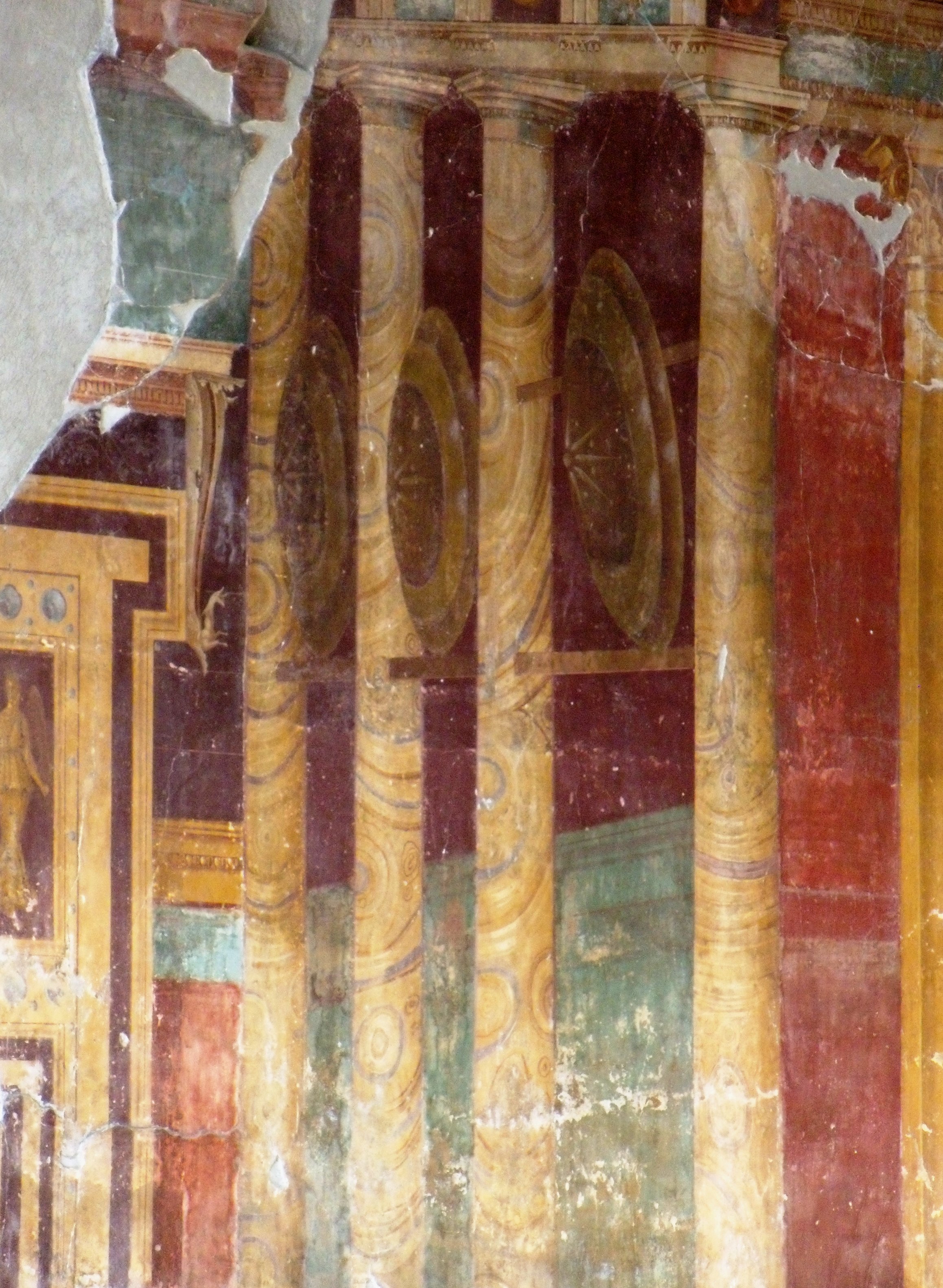
Another magnificent fresco is still in situ at the Villa of Poppea, Nero's wife, in nearby Oplontis. A life-size view of the Temple of Apollo with eight-rayed Macedonian shields painted between the columns covers a wall in the large sitting room. Wow! 

Later rulers and countries held Alexander and Macedonia in great esteem, and the Romans' admiration is an obvious example!

Tuesday, September 10, 2019

Dancing with the Lion: Becoming by Dr. Jeanne Reames

Dancing with the Lion: Becoming by Dr. Jeanne Reames (ISBN: 978-1-62649-896-9) is a historical fiction book about the youth of Alexander the Great.

It is not fair - yet inevitable - to compare this novel to Mary Renault’s Fire from Heaven since they both handle Alexander’s coming of age where close to no resources from antiquity are available. It is interesting – and, as a matter of fact reassuring - to find that the main characters of Alexander, Hephaistion, and Philip match in both versions.

But there are many differences as well. For a start, fifty years have passed since Fire from Heaven and archaeology, especially in northern Greece and Macedonia have revealed a substantial amount of information. On that base, Jeanne Reames could set the story in a context that is much closer to the truth. There is, for instance, the more detailed description of the palaces of Pella and Aegae, the sanctuary of Dion, and the location of Mieza.

On the other hand, however, the characters in Dancing with the Lion go by their Greek/Macedonian names, and although this may tie them straightforwardly to antiquity, I find it annoying – as if reading history in a foreign language wondering about who is who. The use of Greek words, translated or not, is not really a plus either.

All in all, the book is a good read, but I could have done without the last chapter about the initiation ceremony. I agree that it is a great effort to put something like this together, but I fail to see what it is adding - if anything - to the story or to the images of Alexander or Hephaistion. This ends the book in a rather abrupt way.

I understand there is a sequel in the making, Dancing with the Lion: Rise, which I suppose is a continuation, but there is nothing to indicate this is the case. Besides, I do not understand the title. Is Alexander the lion or Hephaistion and, if so, why? Or is there a hidden meaning that will be revealed only at the end of the second book?

It is sad to come to these conclusions for the dialogues are well constructed, and as I said, the story is well-placed in its Macedonian context.

Wednesday, August 22, 2018

Harpalos’ mismanagement or is it Alexander’s?

It is common knowledge that Alexander valued friendship above all. His first core group of friends took shape at an early age when they joined him in Mieza for Aristotle’s tutoring and these friendships lasted till the end of his life. Harpalos was one of them, and he was among those who were exiled by Philip for siding with and supporting his son in the Pixodarus affair. Once he became king, Alexander called them back and promoted them to high positions in his army. Harpalos, however, being physically unfit for military duty, was assigned as Treasurer.

In Alexander’s eyes, his friends could do no wrong, and a few such examples have transpired. There is Philotas’ first conspiracy in Egypt that was reported by his mistress Antigone and confirmed by Coenus, who was married to Philotas’ sister Antigone – strong evidence that Alexander refused to believe. That was in 332 BC, and Philotas survived another two years before being put to death in Alexandria in Drangiana for failing to report or for participating in another conspiracy to take Alexander’s life. It is pretty significant that the king left most of the judging and sentencing to his Companions and the Macedonian army.

The case of Harpalos is another matter and by far the most enigmatic example. Just before Alexander engaged in the Battle of Issus, and for some obscure reason, Harpalos fled to Megarid in Greece. He may have cowardly chickened out, not believing in his king’s victory against Darius, and seeking a safe haven elsewhere. Or, he may have been under the bad influence of a certain Tauriscus, who escaped at the same time to find refuge in Italy. In any case, this indicates that both men had serious reasons to fear Alexander’s wrath for whatever wrongdoing or embezzlement they had committed.

Two years later, however, Alexander inexplicably called Harpalos back and reinstated him with the resounding title of Guardian of the Babylonia Treasury and the Revenues Accruing Thereto and put him in charge of the enormous treasures he had so far collected in Asia Minor and in Egypt. Alexander reassured Harpalos that he would not be punished for whatever happened before. Why he made this decision or what triggered it is everyone’s guess. One would think he had enough capable and responsible officers in his army, he could trust with this highly sensitive position besides Harpalos. Maybe the fact that the aunt of his friend, Phila, was one of his father’s wives played a role, since this relationship also made him a family member. In any case, there is no rational explanation for Alexander’s decision. The fact remains that Harpalos occupied the most powerful position compared to Alexander’s other friends and this was in spite of the fact that he had betrayed his king’s trust.

After seizing the intact treasuries of Babylon, Persepolis, and Pasargadae, Alexander put the largest wealth ever accumulated in history into Harpalos' hands, installing him in Ecbatana with 6,000 troops to guard the booty.

As Alexander headed further east into the heart of Central Asia, his treasurer moved to Babylon where he lavishly spent the amounts of money for his own pleasures with prostitutes and hetaerae, setting up a court only equaled by Nero a few centuries later. He picked a courtesan from Athens named Pythionice, who was covered with gifts worthy of a queen. This extravagant love affair did not last, for she soon died and was interred in a stunning memorial for the baffling price of 200 talents paid for by the treasury. Yet Harpalos’ megalomania did not stop there since he also built a temple in Babylon where she would be worshiped as Aphrodite Pythionic and another expensive monument on the Sacred Road in Athens. This last epitaph was witnessed by our traveling reporter Pausanias several centuries later, who considered it unworthy of the 30 talents it had cost.

After this extravaganza, Harpalos sent for another Athenian hetaera, Glycera. Like her predecessor, she lived like a queen and even received divine honors. Her beauty was trumpeted forth in Syria with a statue dedicated to her beauty and at Tarsus, where a luxurious palace was constructed for her pleasure. Harpalos showed no respect for Alexander and certainly did not reciprocate his friendship. Like on the eve of the Battle of Issus, he probably expected his king to be the underdog in one of the many fights, battles, skirmishes, and confrontations with the barbarians in the east. Alexander would evidently be killed and never return to the court Harpalos had cut out for himself at Babylon.

But Alexander did return from India and soon discovered how many satraps had taken advantage of their privileged position to fill their own pockets. His response was immediate, and he promptly executed the culprits there and then. Obviously, Harpalos had every reason to expect his king’s anger, and he feared for his life. He packed up as much money as he could possibly carry, and with 5,000 talents [that is the equivalent of three billion dollars] and 6,000 mercenaries, he set sail for Athens.

It is known that Alexander sent three different embassies to demand Harpalos’ extradition, but they all returned empty-handed. Thanks to lavish bribes paid by Harpalos to the Athenian politicians – led by the ever-sour Demosthenes - who still resented Alexander’s successes and the Macedonian power, he was able to escape. Eventually, Harpalos was captured in Crete and assassinated by his own men, one year before the king’s own death.

How is it possible that Alexander, the conqueror of the world, was unable to catch and judge Harpalos wherever he was? Many men were killed for stealing less than Harpalos’ extravagant expenditure and the 5,000 talents (equaling 142 tons of silver and 14 tons of gold) he took with him to Athens. Alexander must have been aware of this corruptible behavior but turned a blind eye to it? Neither stupidity nor ignorance can be the reason for Alexander’s action – or non-action - and the most obvious explanation would be mismanagement.

This is an extremely serious accusation, and it is hard to believe that a bright mind like Alexander’s could be capable of such a misjudgment and such a miscalculation. As strange as it may be, it seems that Alexander was not truly interested in money but rather in conquering new territories and expanding his power, since there are other examples of embezzlement that were left unpunished or which he somehow accepted.

There is the case of Cleomenes, whom Alexander had appointed in Egypt to collect taxes and manage his finances, including the building of Alexandria. This man had set up a shady trade business selling wheat to Athens, extorted money from the priests on a broad scale, and cheated the soldiers in his service. An official complaint was filed and sent to Alexander, and guess what? The king not only pardoned Cleomenes for said crimes, ordering him to build a temple in honor of Hephaistion, but he also forgave him all future violations! Unbelievable! Ptolemy was much smarter, and as soon as he became king of Egypt, he executed Cleomenes. Chop-chop!

In between Harpalos’ two appointments as treasurer, there were the cases of Coeranus and Philoxenus, who got away with exorbitant amounts of money. The final replacement for Harpalos, Antimenes of Rhodes, made a reputation for oppression by imposing outrageous taxes, setting up a swindle business with slave owners and travelers on the royal roads. All these financial officers somehow escaped disciplinary actions, or at least none are being documented besides the cases of Harpalos and Cleomenes.

Maybe it is true that Alexander was not much interested in money, at least not beyond the strict necessity to finance his next campaign or war, which would automatically generate a new inflow of money. He loved to give and he gave in style, not only to his close friends but also to new allies (e.g. Porus), to his soldiers as a prize for merit and bravery in combat, and to his veterans sent back to Macedonia, including travel expenses, bonuses, and stipends for the wives they left behind in Asia. He entirely financed the huge Susa wedding, i.e., his own but also that of his one hundred Companions, and he offered wedding gifts for his 10,000 Macedonians who had taken Asian brides on the road. When he heard that his army was in deep debt, he paid them some 20,000 talents out of his own pocket (evidently from his treasury), requiring 280 tons of coins.

Being the richest man in the world with wealth acquired in a short decade, Alexander could not call on anyone with enough experience and skills to manage such huge sums. Even he, although a brilliant general and military leader, had no training in managing such enormous amounts of gold and silver. Even his shrewd father had always spent his money before even having it in his hands, but in his case, the consequences were limited because the amounts were less, and the world in which he moved was much smaller.

To Alexander’s credit, it should be noted that he leaned heavily on the existing Persian administrative system created by Cyrus the Great, but its true implementation would have taken more time since his Macedonian commanders and officers did not (yet) share Alexander’s broad vision of this new world he had created. In the end, they never did, for within one year their king was dead and they now had to manage the empire on their own. This, they could not do either, and they fought each other in fierce competition for the next forty years.

Sunday, November 12, 2017

About the Death of Alexander the Great

Alexander's death is shrouded in mystery. From antiquity until today, scores of historians, admirers, archaeologists, authors, and philosophers have written about it, and each and every one has developed their own theory and their own point of view.

It is useless to retell the story – or the many versions of the story – as I certainly cannot add anything sensible to that. Like everybody else, I have, however, my own thoughts and own reflections on the matter.

Alexander's death most certainly was first recorded in his Royal Diaries, but is the account that reached us truly reflecting what was written down at that time, or has the original report been manipulated to suit his courtiers and successors? That is hard to tell, certainly 2,500 years onwards.

We have a very detailed, day-by-day account of Alexander's whereabouts and health during the last days of his life. I find this rather strange, as it sounds more like a justification than an actual report of the events. Alexander's life has been in the balance before, but not so many details were reported, or at least have not survived. The first time the troops feared for the king's life was at Tarsus after he plunged into the cold waters of the Cydnus River, and the remedy of his doctor, Philip, was being questioned by Parmenion, in those days his trusted general. We have no day-to-day account of Alexander's condition at that time, although it must have been quite critical nonetheless, as it kept him pinned down for several weeks.

Another life-threatening experience was during his attack on the Malian town in India when Alexander was hit by a poisonous arrow while scaling the city wall. The soldiers had been slow to follow their king, exposing him to the full force of the enemy's attack. Alexander had to be carried away, and for three days, he fought between life and death. At the cost of enormous superhuman efforts, he eventually showed himself to his troops and even hoisted his battered body on the back of a horse to prove to them he was still alive. No day-to-day account of his eating and drinking patterns has been recorded, and none of the worries and treatments by his doctor have been documented. All we know is that he floated down the Indus in full view of his men. He needed much rest to help the healing process, but the march to the mouth of the Indus went on as planned.

So, why this detailed list of activities in Babylon? If Alexander had been straightforwardly sick, there was no need to document his eating, drinking, or sleeping patterns during the days preceding his death.

The question that arises more often than not is, was Alexander poisoned? Attempts to take his life had occurred before. The first one mentioned in our sources is Philotas' attempt to at least cover up the plot to kill Alexander in 330 BC. In Central Asia, the king survived the Pages' conspiracy, said to be planned by Callisthenes. There may have been more attempts to take his life that are not necessarily recorded, and the next occasion may have arisen here in Babylon.

If Alexander was indeed poisoned, which I doubt, then Hephaistion would have died of poisoning also. Had his dear friend still been alive, the murderer(s) would have had less chance and could expect the full wrath of Hephaistion? He was not only Alexander's most intimate and dearest friend but also the second-in-command, the only one ever to be promoted to the title Chiliarch and, as such, the obvious person to replace and take over from Alexander. Many people must have envied his privileged position.

With Hephaistion no longer in the way, the main question is, however, who would or could benefit from eliminating the king? It is not only about killing Alexander but also about providing a good and approved replacement. So, who would be eligible? Not Ptolemy, since he withdrew soon enough to his beloved Egypt and didn't interfere much in succession. Not Nearchus, who was happy to keep his admiralship of the navy. Not Peucestas, who made an effort to learn the Persian language and must have been quite happy in his role as satrap. Not Seleucos, who had married the daughter of Spitamenes – the only marriage that survived the big Susa wedding. Not Eumenes, who faithfully served King Philip and Alexander as secretary and archivist for years. Not Craterus, who was halfway to Macedonia with strict orders to replace Antipater. According to some sources, Antipater has been named as a possible beneficiary, as he sent his son Cassander to Babylon in his place, carrying a very potent poison. If so, the poison was not very potent since it took Alexander almost ten days to die. Besides, Antipater did not hold Cassander in high esteem, for he did not allow him to recline with his guests during the Symposia but had to sit like a little boy on a chair at the end of his father's couch. When Antipater died, Polyperchon was appointed as his successor and not his own flesh and blood. That tells enough. Perdiccas may be a suspect as he helped Roxane poison Alexander's Persian wives after the king's death, but that may be simply because he was still a Macedonian in heart and soul. Besides, in my honest opinion, I think he was far too loyal to Alexander to harm him in any way.

Cassander, however, may have acted on his own, seizing the opportunity of being delegated to Babylon. Not impossible. Although he had shared the early years at Mieza with Alexander and his Companions, he stayed behind when Alexander went east, probably as persona non grata. He must have resented this denial. Fueled by his father's attitude, he developed a deep grudge against Alexander and his clique. Life at the Babylonian court was totally alien to Cassander. He cannot have operated without inside help, possibly that of his younger brother Iollas, one of the king's Pages. All this is based on speculations, although eight years later, Olympias accuses Cassander of murdering her son – perhaps not entirely unfounded.

At the time of Alexander's death, all of Alexander's Bodyguards and other powerful men like Aristonous, Leonnatus, Lysimachos, Meleager, Pytho, Stasanor, Asander, Olcias, Philip the physician, and Peithon were present in Babylon. Still, none of them really stood out to replace Alexander. If we follow Pseudo-Callisthenes, only Ptolemy, Perdiccas, Peucestas, Lysimachos, Asander, and Olcias are beyond suspicion. Whatever the plan, either it was ill-conceived, or whoever was supposed to gain from it was facing unexpected opposition from the other contenders. After all, the Succession War lasted almost forty years, and even the rising star of Antigonus Monophthalmus only made waves many years later.

Suppose Alexander had indeed been killed with poison without involving his Bodyguards and his other faithful generals (I cannot imagine they were not). Why don't we hear anything about an investigation to find the culprit? This was certainly the case when Philotas' plot was discovered and after the Pages' conspiracy. These were, of course, led or instigated by Alexander. Still, in his absence, the army certainly expected that much from their commanders, and there was no way anyone could avoid the Macedonian legal machine.

Another possible cause of Alexander's death could be his excessive drinking, which would immediately make any investigation superfluous. The heavy drinking is at least what the Royal Diaries, in all their elaborate details, want us to believe. However, some twenty-five years after the facts, Aristobulus casually remarks that Alexander sat for hours over his wine for conversation. The drinking theory, however, has been widely developed in the Alexander Romance. On one such occasion, Alexander is spending a drinking night with twenty other guests, toasting to their health in turn with unmixed wine, creating the ideal circumstances for the poisoning theory. But as we know, the Alexander Romance must be taken with a large pinch of salt, maybe a shovel full.

Less often highlighted but genuine are the prophecies made by the Chaldean diviners who advised Alexander not to enter Babylon. Their warning was recorded on cuneiform tablets and predicted Alexander's death in these words "When in the month Ajaru, during the evening watch, the moon eclipses, the king will die. The sons of the king will vie for the throne of their father, but will not sit on it" (see: Alexander the Great and the Magi). Alexander is not mentioned by name, just as "king." We no longer believe in prophecies in our modern world, but maybe we should. After all, facts and figures do not explain everything.

Alexander dying of exhaustion and the consequences of his near-fatal wound in India is not a heroic way to end his life, which evolved between myths and reality from the beginning. But why did he not name his successors if he was suffering from his chest wound? Was he hoping and waiting for Roxane to give birth to a boy? His Persian wife, Stateira, is also said to be pregnant, meaning that it was not beyond reason for Alexander to want to live long enough to see his heir(s). Another possibility is that he was in denial and did not take his declining health seriously, which is very much unlike Alexander. His succession, I think, was a problem even for him. He was surrounded by capable men and generals, but none had the vision of his greater world. The only one who ever shared that insight with him was Hephaistion, and he was dead.

When Alexander gave his signet ring on his deathbed to "the strongest," he may have meant just that: the man who would be strong enough to keep his empire together, but they had to work it out for themselves. A poor legacy, one may say, but under the circumstances, this was the best he could do, for even had he indeed named Perdiccas, as some sources pretend, he probably lacked the capabilities and vision to pursue Alexander's goals. Well, time has given us the answer, and Alexander was right one last time.

Saturday, January 3, 2015

News from Mieza

Mieza is known through Homer as one of the cities of lovely Emathia, but to me, it is the place where Alexander the Great received his education from none other than Aristotle himself.

Finally, the ancient theatre of Mieza has undergone thorough works of restoration and conservation to present it in its original form to the visitor. New blocks of travertine marble have been added to blend in the remaining parts that have been cleaned, and the contours of the seating area and the scene have clearly been defined.

It is now ready to receive visitors. A new parking space with a visitor’s entrance has been created since the theater will be used for small venues. The private land on which this theater stood has been expropriated by the State, and the area has been fenced.

So next time you visit Aristotle’s “school”, don’t forget to stop at this wonderful theater, which unfortunately did not exist in Alexander’s day, for it was built in pure Hellenistic style during the second century BC. Its capacity is estimated to be 1,500-2,000 people in antiquity, and I wonder how many could be seated there today.

Wednesday, June 25, 2014

Pella, the birthplace of Alexander the Great

Pella became the capital of Macedonia in the early 4th century BC. The choice for the location is, as always, made with great care. Situated at the mouth of the Axios River, the city had direct access to the sea, although the harbor has not yet been located. That is not surprising, for today’s Pella lies 25 km inland, as over the past two thousand years, the river has silted up and has covered the remains of the settlement. The land was fertile, however, sloping up gently towards the mountains, which are now part of the Republic of Macedonia. Standing here, it is not difficult to mentally erase the houses and roads and imagine what it may have looked like in Alexander’s days with fields of barley, wheat, and oats, or rows of olive trees followed by fruit trees, mainly peaches and pomegranates – a garden of Eden.

Any first-time visitor to Pella will be struck by the American layout of the street plan, all house blocks of the same size, and all streets crossing each other at a right angle. The east-west roads were nine meters wide, while the north-south streets were a mere six meters. A wider ornamental road, 15 meters wide, ran through the city center to the Agora. Pella knew an excellent water supply, and a close look would reveal the underlying functional system, with at the crossroad a special earthen urn that collected the dirt and could easily be removed for cleaning. The city counted many wells and fountains, combined with an efficient drainage system.

Excavations are ongoing, with the ups and downs that typically go hand in hand with finances. When I was here the first time in 1973, there were only a few pebble mosaic floors amidst a handful of slender Ionic columns; the most precious mosaics leaned against a shack covered with a piece of roofing. Since then, the excavated surface has expanded steadily, and a first small museum housed the earlier exposed mosaics together with marble and terracotta statues, among which a head of Alexander as a young prince and a statue representing him as Pan. Most recently, a new museum has been built where many more artifacts have joined the collection, now exhibited in chronological order.

The true eye-catchers at the Archaeological Museum of Pella are, of course, the pebble mosaics: a Lion Hunt featuring Alexander and Craterus; Dionysus Seated on a Panther and Carrying the Thyrsus Staff; a Griffon Attacking a Deer; and a couple of centaurs. As always, I’m entirely taken by the Tanagra statuettes, among which are those of two ladies playing the lyre, a couple of playful cupids, and several heads with ladies showing all sorts of hairdos. From the potters’ quarters, there is a wide selection of pots, vases, and other vessels, very representative of their period in time. Striking are the ivory and bone elements from now perished wooden kline or couches that have partially been reconstructed. Further, several golden crowns, a wide choice of silver and gold coins, remains of a frescoed wall from the second century BC, a small marble horseman, although decapitated, still carrying a proud posture; a marble inlaid round table, etc.

The mosaics of Pella are quite unique since they are mainly made with pebbles of different sizes, ranging from white to grey to bluish-grey, collected from the nearby beach and arranged in patterns. Here and there, a touch of yellow or red is added to enhance the picture, and the contours are accentuated using bronze strips. The large mosaic of the Rape of Helena has remained in situ under a protective roof. Such dynamics with the horses in full gallop and the dashing dresses; the edges of the panel are trimmed with palmetto and acanthus motives. The next room is paved with a mosaic showing a Deer Hunt, also in full action. This house alone covers a surface of 3,000 m2. The private houses varied in size, and the rooms were arranged around a central courtyard, generally framed by colonnades. Many mosaics have been covered up with sand to protect them, an understandable precaution, but very sad to find them hidden from view.

The Agora, covering 700 m2 in the heart of Pella, underwent thorough restoration, making the layout easier to understand with the six-meter-wide surrounding Stoas that gave access to a wide array of workshops and shops selling food, pottery, jewelry, and more. On the north side, official buildings have been identified, like the Temple of Aphrodite and others supposedly serving the city’s administration. The southwestern side may have housed the archives since many seals used to secure the papyri have been retrieved. More houses were uncovered on the south side of the old main road, which now runs right through the middle of ancient Pella. It is here that the intriguing round Sanctuary of Darron has been identified, whose striking mosaic floor has been transferred to the Museum. 

The Royal Palace of Pella, where Prince Alexander grew up, is located further uphill to the north - still within reach of the city. The Palace alone covers an area of 6 ha and was divided into seven separate complexes, including, beside the living quarters, the necessary storage rooms, rooms reserved for entertainment, service rooms, and even a swimming pool and a palestra. These complexes were, of course, interconnected by corridors and staircases. The royal family must have occupied the most central part, with four large buildings around a large open courtyard. It would be interesting to figure out how close Philip’s wives lived to each other, how much space was occupied by the official administration and military management, where the many visiting delegations were lodged, which rooms the King used to receive his guests, etc. 


The Palace was supposed to open to the public in 2011, but at the last moment, it was decided to restart more archaeological work on the premises. I was not allowed inside, but I could at least walk all the way around it, taking in the view over the city of Pella and the sea beyond. Behind me, the Macedonian landscape was covered with bright spring flowers from the white chamomile and pink hollyhock to the deep red puppies and purple wild onions – an explosion of colors over the rolling hills. It felt like a homecoming, in an intoxicating excitement. The land is pleasantly green, cut through by refreshing, clear streams tumbling down from higher elevations under the blue sky filled with fleets of puffy clouds. This is truly the place where Alexander spent his youth!

Like other boys and young men his age, Alexander would have been hunting boar, foxes, and lions (who have long since gone), probably in the hills to the north. We have the abovementioned mosaic of the Lion Hunt with Craterus to illustrate the hunting parties and also the fresco above the Tomb of Philip at Aegae (modern Vergina). Hunting was a way to train for war and to develop physical and mental skills. Without his friends, Alexander would have had a rather lonely youth since his father was constantly fighting the neighboring tribes and cities in order to extend and stabilize Macedonia. The young prince grew up with the stories of his father’s campaigns that must have fueled his imagination; based on the legends of Troy, he treasured them all his life. Around age twelve, Philip invited Aristotle to teach the young prince and even found an appropriate location at the temple of the Nymphs in Mieza.  These probably were the years when Alexander learned the most in many fields, like literature, topography, biology, zoology, botany, ethics, and even meteorology – a knowledge he shared with his boyhood friends such as Hephaistion, Ptolemy, and Nearchus [see: Mieza, Alexander's schooling]. Alexander’s interest in medicine must have come from these days with Aristotle, a skill he used throughout his life to treat his sick friends.

Macedonia was not an isolated “Barbarian” country as so often stated, but the court had long been a center for culture where envoys, refugees, artists, actors, and delegates from all around the Mediterranean spent time. Alexander’s knowledge of the world extended thus far beyond his homeland, and he and his immediate neighbors must have had quite a broad insight into what was going on in other parts of the ancient world. Theopompus of Chios, who later on wrote a History of Philip, was one of the visitors. Envoys from Sparta, Thebes, Thessaly, and Phocis found their way to Pella. Athens sent several ambassadors to the capital to end the successive Sacred Wars, and we know that negotiators like Demosthenes, Aeschines, Philocrates, and Nausicles participated in these missions. More significant was the presence of Artabazus II, satrap of Hellespontine Phrygia, who revolted against Persian rule and found refuge at Philip’s court. He spent several years there with his wives and children, among which his eldest daughter Barsine. She was about seven years older than Alexander, and we know how they met again many years later when she became his mistress and even bore him a son, Heracles

When Philip appointed his 16-year-old son as Regent while he went fighting in the east, Alexander must have realized how much his father trusted him, and at the same time, he recognized him as the official heir to the throne. These feelings were stressed again two years later during the Battle of Chaironeia, where Alexander not only proved his leadership and capability in military matters at the head of the cavalry, but he also crushed the Sacred Band of Thebes, which was known to be invincible; this must have boosted his ego to an even higher level. Alexander must have felt ready to take command, not only of the army but maybe also of the kingdom. Realizing, however, that his father was “only” in his mid-forties and that he would have to wait a very long time to take over his tasks must have been hard to accept. He would have to live in the shadow of his powerful father for another twenty years at least.

Shortly afterward, some worrying situations developed. Philip married for the seventh time, this time with Cleopatra, the niece of one of his leading generals, Attalus, who, during the wedding feast, proclaimed that Macedonia would at last have a legitimate heir to the throne! Alexander’s mother was from Epirus, meaning Alexander was only half Macedonian. Alexander was enraged by Attalus’ remark and asked his father to reprimand his general. He did not, and Alexander promptly left the Macedonian court with his mother. He entrusted her to her brother’s care, Alexandros of Epirus, when he joined the Illyrians, making Philip worry about his earlier peace treaty with them. When the King sobered up, he realized that he had to recall his son, which he did through the intervention of Demaratus of Corinth, a common friend. He also had to make up with his brother-in-law to avoid a possible revolt in the neighboring Epirus. To this purpose, he offered his own daughter in marriage to his wife’s brother, meaning that Alexander’s sister was to marry her uncle. It was during this wedding feast that King Philip II of Macedonia was murdered. 

By the time Alexander celebrated his twentieth birthday, another drama unfolded at the Macedonian court. Philip was approached by Pixodarus of Caria for a marriage alliance. Philip put his eldest (half-witted) son Arrhidaeus forward to marry Ada, the younger daughter of Pixodarus. When Alexander heard the news, he felt overlooked and secretly sent the tragic actor Thettalus to renegotiate the deal, presenting himself instead of Arrhidaeus. When Philip got wind of this plot behind his back, it was his turn to be furious, for he was still King and ruler of Macedonia, not his son. As a punishment, he exiled a group of Alexander’s closest friends – among them Nearchus, Ptolemy, Harpalus, and Erigyius – and warned his son not to interfere in his plans ever again. It is known that Alexander rewarded his friends later on for their loyalty to high positions in his army. 

A few months later, the wedding of Cleopatra and Alexandros of Epirus was to be celebrated at Aegae in great pomp. This is when King Philip II was murdered. Alexander became the new king of Macedonia. This story will be tackled next under the title, Aegae, where Alexander's world changed forever.