Alexandria's founded by Alexander

Alexandria's founded by Alexander the Great (by year BC): 334 Alexandria in Troia (Turkey) - 333 Alexandria at Issus/Alexandrette (Iskenderun, Turkey) - 332 Alexandria of Caria/by the Latmos (Alinda, Turkey) - 331 Alexandria Mygdoniae - 331 Alexandria (Egypt) - 330 Alexandria Ariana (Herat, Afghanistan) - 330 Alexandria of the Prophthasia/in Dragiana/Phrada (Farah, Afghanistan) - 330 Alexandria in Arachosia (Kandahar, Afghanistan) - 330 Alexandria in the Caucasus (Begram, Afghanistan) - 329 Alexandria of the Paropanisades (Ghazni, Afghanistan) - 329 Alexandria Eschate or Ultima (Khodjend, Tajikistan) - 329 Alexandria on the Oxus (Termez, Afghanistan) - 328 Alexandria in Margiana (Merv, Turkmenistan) - 326 Alexandria Nicaea (on the Hydaspes, India) - 326 Alexandria Bucephala (on the Hydaspes, India) - 325 Alexandria Sogdia - 325 Alexandria Oreitide - 325 Alexandria in Opiene / Alexandria on the Indus (confluence of Indus & Acesines, India) - 325 Alexandria Rambacia (Bela, Pakistan) - 325 Alexandria Xylinepolis (Patala, India) - 325 Alexandria in Carminia (Gulashkird, Iran) - 324 Alexandria-on-the-Tigris/Antiochia-in-Susiana/Charax (Spasinou Charax on the Tigris, Iraq) - ?Alexandria of Carmahle? (Kahnu)
Showing posts with label Apollonia-Pontica (BU). Show all posts

Wednesday, February 14, 2024

The Periplus of the Euxine Sea by Arrian – Part 3

In this last part of the PeriplusArrian takes us from Dioscuras/Sebastopolis to Byzantium. 

He starts his story where he left off at the conclusion of part 1, i.e., in Sebastopolis (see: Tour of Colchis: From Trapezus to Sebastopolis). This section, the Cimmerian Bosporus, was not controlled directly by Rome but by a so-called client king. In Hadrian’s day, that was Cotys II, in full Tiberius Julius Cotys, who ruled from 123/4 AD until he died in 131/2 AD. His appointment was made for life, and his successor needed to be officially recognized by Rome. 

At the news of his death, Arrian decided that Hadrian would be interested in having the latest information about the Bosporan Kingdom since it supplied a great deal of wheat, clothing, wine, and slaves. His territory was also an important buffer zone with the warlike Alans living to the north. 

Arrian sailed along the mountainous coastline below the Caucasus to Pityus, some 65 kilometers away. These lands were occupied by the Zilchi, ruled by a certain Stachemphax, also recognized as a king by Hadrian. Follows a list of cities, harbors, and rivers, including the distances between them, from Crimea to the mouth of the Danube River. More familiar are the Greek cities on the south coast of Crimea, such as Panticapaeum (Kerch), Theodosia, Cercinitis, and Chersonesus (Kherson). Panticapaeum, which lies only 11 kilometers from the Tanais River (modern Don River) and flows into Maeotis Lake (Sea of Azov) was seen as the place where Europe ended and Asia started. 

Sailing further west, Arrian stops at the Greek city of Olbia at the mouth of today’s Dnieper River. Next, he heads for the harbor of Odessos, a trading post founded by the Greeks from Istria. From here, he continues to the wide delta of the Ister River (Danube), where he reaches the Island of Achilles or Leuke (possibly Snake Island in Ukraine). Legend has it that Thetis gave it to her son. The island was known for its Temple of Achilles, which held a wooden statue of the hero, as well as Greek and Latin inscriptions in honor of Achilles and his dear PatroclusArrian speaks of many offerings that were made, including sacrifices of animals. Those who sail by the island may “see” Achilles in their dreams or hallucinations. 

Proceeding further down the coast of the Black SeaArrian arrives at Tomis, a colony founded by the Greeks, where Emperor Augustus banished the poet Ovid. The next port was Callatis, established by the Carians, followed by Odessos (another harbor by that name), where he entered Thracia. 

Passing the eastern end of the Haemus Mountains (in central Bulgaria), Arrian reaches Miletus colony of Apollonia, which once held a colossal statue of the god Apollo. From here, he sailed to the not-so-good harbor of Salmydessus (roughly 150 km east of Hadrianopolis, modern Edirne), where Xenophon helped Seuthes II to become King of Thracia. 

By now, Arrian has landed on the Thracian side of the Bosporus. This area is reputed for the Cyanean Islands or Symplegades (also Clashing Rocks), a pair of rocks that clash together when a ship sails through. In Greek mythology, the rocks were defeated by Jason on his way to Colchis on board his ship, the Argo. 

Byzantium is Arrian’s final destination. He concludes by mentioning the local Temple of Zeus Ourios (who grants favorable winds), where Jason and the Argonauts erected an altar to the Twelve Olympian Gods on their return from Colchis. 

In our modern days of traveling by plane and high-speed trains, it is hard to imagine the pace in antiquity when people and armies moved on foot. Ships and barges were a comfortable alternative, although winds and currents were not always reliable. Travelers could never predict the duration of a trip or the time of arrival, but in those days, time was not so much of the essence as it is today. 

Though Arrian wrote his Periplus 130-131 AD, we don’t know how many months or weeks he actually spent at sea. Considering that the circumference of the Black Sea is over 4,000 kilometers, it may be safe to speculate that he spent most of those two years “on the road”. Quite an achievement!

[For the locations, please consult this map]

Saturday, March 11, 2023

How Macedonian is a Macedonian shield?

When talking about Macedonian shields, our thoughts automatically turn to those carrying a 16-rayed star like the one on the lid of King Philip's golden larnax displayed at the Museum of Vergina. 

What should be simple and straightforward, in reality, isn't. 

The first king to use the Macedonian sun emblem may be Archelaus (413-399 BC), i.e., well before Philip II came to power. In Alexander's days, the number of sun rays varied from eight to twelve or sixteen. Alternatively, the center of the shield could be a disc that remained blank or was filled with a Gorgon's head, the face of Heracles, etc. Such a disc was usually surrounded by a varying number of crescents. Other shields may seem unadorned, but it has been documented that many were painted only. That would make sense when looking at the row of armor and shields lining the street in Dion. The monument was commissioned by Alexander after his victory at the Granicus. 

As I have come across many examples of shield decorations, either on paintings, reliefs, coins, or other works of art, it might be interesting to highlight some examples. 

For a start, today's flag of the Republic of Macedonia shows a sun with 16 rays, the so-called "Vergina-Sun." 

A bucranium found in Apollonia Pontica, modern Sozopol, Bulgaria, shows an eight-rayed star, which leads that country to claim that the origin of the "Vergina-Sun" is theirs (see: The Origin of the Macedonian star was Thracian?)

The excavations in Albania have so far yielded several examples of shields they call Illyrian but look very Macedonian at first glance. I was told that the difference with a Macedonian shield was the curving. Whether that is true or not, I don't know (see: Looking for Illyrian remains in Albania).

At the small Museum of Apollonia, Albania, I saw my first Illyrian shield from the 4th century BC that looked very much like the Macedonian one. A series of triple crescents surrounds the central Medusa head with shiny eyes.

The Skanderberg Museum proudly exhibits an Illyrian shield with similar half-crescents but with a six-rayed star at its center.

Two Illyrian shields are embossed on a leather belt buckle at the Archaeological Museum of Tirana. In this case, we see a central disc surrounded by respectively four and five larger double crescents. 

From the same period, a striking limestone mold for a leather shield cover was found in Egypt. It was made for the soldiers of Ptolemy in 330 BC. It has typical Macedonian features with a central Medusa head surrounded by triple concentric circles holding a small eight-rayed Macedonian star (see: Alexander's Legacy. Allard Pierson Museum in Amsterdam). 

The Tomb of Agios Athanasios from the era of Alexander has been attributed to a Macedonian nobleman. Although looted in antiquity, the narrow frieze above the entrance holds precious information about Macedonian daily life and its army in blazing colors. The lively scenes have been photographed in detail and digitally restored for all to examine at the Archaeological Museum of Thessaloniki (see: The Macedonian Tomb of Agios Athanasios in Thessaloniki). Of particular interest are the three shields, two of which show an eight-rayed star surrounded by a broad-colored rim. These shields are painted, as are other examples on the walls of grave monuments. It remains an intriguing question whether shields used in combat were painted as well. Color coding may have contributed to bringing soldiers of the same unit together. Still, I fail to see how Alexander's Macedonians would have carried paint to maintain the distinctive coding during the many skirmishes and battles.

A unique set of shields can be admired inside the Tomb of Lyson and Kallikles in Lefkadia, Greece (see: Alexander's schooling at Mieza). The one painted in the north lunette has a blue eight-rayed star at its center and is edged with a crown of leaves. The shield in the south lunette is defined as the 'familiar Macedonian' shield with an empty disc at its center and surrounded by eight crescents. The tomb is dated to c.250 BC. 

Another specimen is a bronze shield from the collection of the Getty Museum in Malibu, California. It definitely has a Macedonian look because of the central six-rayed star (see: A magnificent Greek shield). The inscription reveals that it was made in Pontus on the Black Sea for King Pharnaces I. Since we do not know when exactly Pharnaces died, we can only assume it was made between 160 and 154 BC, when his brother Mithridates IV succeeded him to the throne. 

From the cities that disappeared under the ashes of Mount Vesuvius after the eruption of 79 AD, I like the fresco from Boscoreale, now at the Archaeological Museum of Naples (see: Fresco of a Macedonian at Boscoreale). The painting, based on a mid-3rd century BC original, was retrieved from the Villa of P. Fannius Synistor and shows a scene in which the principal figure sits next to an eight-rayed Macedonian shield resting at his feet. According to some sources, it would depict Antigonus II Gonatas (the son of Demetrios I of Macedonia) with his mother, Phila, or simply be the personification of Macedonia and Asia/Persia.

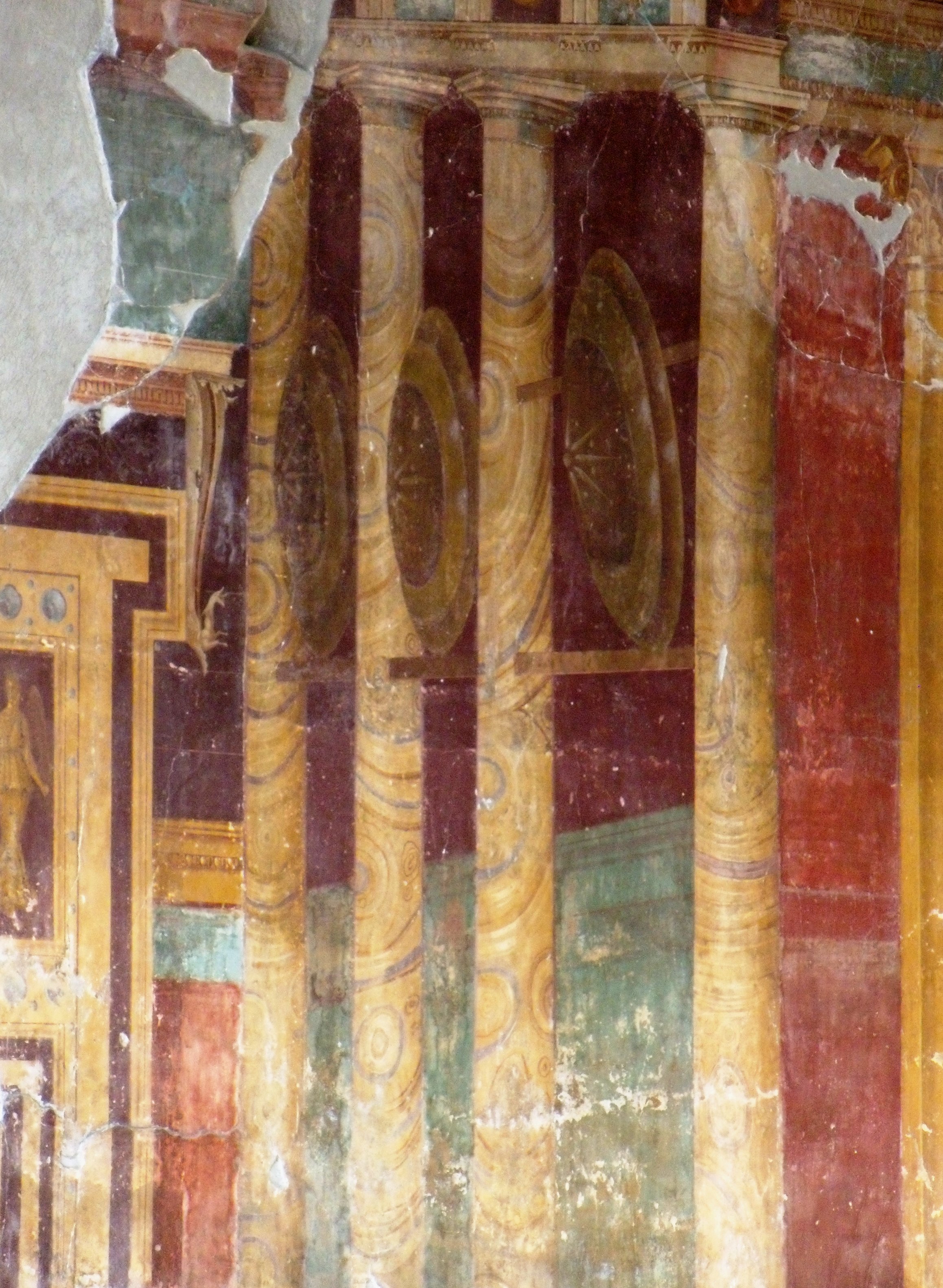
Another magnificent fresco is still in situ at the Villa of Poppea, Nero's wife, in nearby Oplontis. A life-size view of the Temple of Apollo with eight-rayed Macedonian shields painted between the columns covers a wall in the large sitting room. Wow! 

Later rulers and countries held Alexander and Macedonia in great esteem, and the Romans' admiration is an obvious example!

Tuesday, March 26, 2019

Imagine Bucephalus dressed up in his finest attire

Among the many colonies founded by Miletus on the western shore of the Black Sea is Apollonia Pontica (modern Sozopol in Bulgaria) in ca. 610 BC (see: The many colonies of Miletus). Its original name was Antheia, which soon became one of the largest naval bases and richest trade centers in the area.

By the 5th century BC, the Odrysian Kingdom was founded that lasted for six centuries. This kingdom was nothing more than a union of more than forty tribes which turned Thracia into a powerful state to be reckoned with. Both Philip and Alexander repeatedly invaded Thracia, but the city of Apollonia Pontica managed to keep its independence.

This does not alter the fact that Hellenism left its marks in the area, and recent archaeological finds immediately to the south of Apollonia Pontica in particular revealed precious goods that once belonged to the Thracian aristocracy.

In a nearby tomb, archaeologists found forty decorative gold appliqués for a horse harness. Of course, the tomb is Thracian but the Hellenistic influence is obvious. Based on a clay lamp that was buried together with these precious items, the elements could be dated between 333 and 250 BC.

The date and the finding place make a connection with Alexander very plausible and I can’t help imagining his Bucephalus wearing very similar trimmings.

The reconstruction of the horse’s headdress speaks for itself. The casted centerpiece is an eagle’s head that weighed some 23 grams. Since the eagle stands for power, this find may indicate that the owner was a member of one of the leading dynasties. Most of the gold pieces were round, and scholars were able to establish that they were meant to decorate the bridle.  The smaller gold appliqués may have been fixed onto narrow strips sewn over the main strip, or the elements may have served to decorate the bridle during certain religious parades only. Two elaborated, elongated pieces were probably part of the bit.

The Thracians were famous for their horses and it does not come as a surprise to find such fine and artistic trimming for these noble animals. 

I am amazed, however, to hear that horsemen in Thracia already used spurs. If so, it is strange that Alexander and his Macedonians did not fancy them. It seems very improbable that he would not have known this - if, once again, the theory about the spurs is correct.


[Pictures from Horse Talk, New-Zealand, by G. Balabanov, Primorsko Municipality, and Petar Balabanov, respectively]

Monday, October 19, 2015

Thracian treasures from Bulgaria

Information about archaeological finds in Bulgaria filters through only piecemeal, and it is hard to stay up-to-date. Not many details are provided either, but at least there is some progress.


The news is that some massive ancient stone anchors have been found in the Black Sea near Sozopol, suggesting by their shape that they were used by Mycenaean, Phoenician, or Carian ships during the 15th-12th centuries BC, i.e. much earlier than generally accepted. Also in the Sozopol area, a temple dedicated to Demeter and her daughter Persephone has been located. It is near a monastery complex from the 14th century known as St. Apostles and 20,000 Martyrs. In the same city, the long-sought East Gate of Apollonia Pontica has finally been found. Scientists hope eventually to recover the entire fortification system of the ancient city.

In Odrysia, one of the most powerful Thracian settlements in the fertile plain of the Hebrus River, excavations have revealed the residence of the rulers evidencing the sacking by King Philip II of Macedonia. A 13-meter wall has been preserved to a height of two meters.

Near the town of Opaka in north-eastern Bulgaria, a Thracian tomb has been discovered and seems to be one of the latest burials in ancient Thracia. Among the treasures, archaeologists have found six gold leaves that once were part of a golden wreath, as well as other gold and bronze decorations, and some glass and bronze vessels.

And in the Bulgarian capital city of Sofia, new sections of the Roman Decumanus have been exposed as well as a unique mosaic floor of 30m2 together with a stylized laurel wreath from the 4th century AD. The excavations are ongoing and go hand in hand with the construction of Sofia’s subway.

Monday, September 28, 2015

The Origin of the Macedonian star was Thracian?

Recent excavations at Apollonia Pontica, modern Sozopol (Bulgaria) on the Black Sea, have revealed a leaden bucranium with an eight-ray star, which possibly served as a model for the well-known Macedonian star.

[Picture from Novinite, National Historical Museum]

A bucranium is a special kind of amulet in the shape of an ox-skull known as early as the 5th century BC in Greece, and the above-mentioned amulet-bucranium entirely fits the picture. Yet the sun symbol with its eight rays placed on the forehead of the ox is peculiar simply because it is so terribly close to the star used on the coat of arms and on the flag of Macedonia.

It seems that the sun symbol was used in Greek art long before the Macedonians adopted it. Pictures exist of hoplites bearing 16- and 8-pointed sun symbols on their shields and armor as early as the 6th century BC; coins from Corfu, for instance, bore a sun with the same number of rays in the 5th century BC. Both variants were also frequently represented under Macedonian rule in the 4th century BC as we know from the tomb of Philip II of Macedonia at Vergina, where it is enhancing the lid of the larnax. Yet other examples of suns with 12 rays have been found also. And recently, the fragment of a shield carrying the inscription “King Demetrios” (apparently referring to Demetrios Poliorcetes (300-285 BC) was put up for sale by Christies’; this shield features 24 sunrays in its center, quite an unusual number.

The so-called "Vergina-Sun" and the modern flag of the Republic of Macedonia (FYROM) show a sun with 16 rays.


Is the number of sun rays really important? Maybe not but the fact that this bucranium with its starry sun has been found in Bulgaria seems to kindle a fight over its legitimacy and from what I read in the article published by Novinite, the present Director of the National Historical Museum, wants the municipality of Sozopol to sue FYROM (meanwhile renamed the Republic of Northern Macedonia) for using the star that should be Bulgarian property. What will they come up with next!