Alexandria's founded by Alexander

Alexandria's founded by Alexander the Great (by year BC): 334 Alexandria in Troia (Turkey) - 333 Alexandria at Issus/Alexandrette (Iskenderun, Turkey) - 332 Alexandria of Caria/by the Latmos (Alinda, Turkey) - 331 Alexandria Mygdoniae - 331 Alexandria (Egypt) - 330 Alexandria Ariana (Herat, Afghanistan) - 330 Alexandria of the Prophthasia/in Dragiana/Phrada (Farah, Afghanistan) - 330 Alexandria in Arachosia (Kandahar, Afghanistan) - 330 Alexandria in the Caucasus (Begram, Afghanistan) - 329 Alexandria of the Paropanisades (Ghazni, Afghanistan) - 329 Alexandria Eschate or Ultima (Khodjend, Tajikistan) - 329 Alexandria on the Oxus (Termez, Afghanistan) - 328 Alexandria in Margiana (Merv, Turkmenistan) - 326 Alexandria Nicaea (on the Hydaspes, India) - 326 Alexandria Bucephala (on the Hydaspes, India) - 325 Alexandria Sogdia - 325 Alexandria Oreitide - 325 Alexandria in Opiene / Alexandria on the Indus (confluence of Indus & Acesines, India) - 325 Alexandria Rambacia (Bela, Pakistan) - 325 Alexandria Xylinepolis (Patala, India) - 325 Alexandria in Carminia (Gulashkird, Iran) - 324 Alexandria-on-the-Tigris/Antiochia-in-Susiana/Charax (Spasinou Charax on the Tigris, Iraq) - ?Alexandria of Carmahle? (Kahnu)
Showing posts with label Drypetis. Show all posts

Sunday, November 17, 2019

Time to reconnect with Princess Amastris

Amastris is much less known than her cousins, Barsine/Stateira and Drypetis, although she too was the granddaughter of Queen Mother Sisygambis.

She was born as the daughter of Oxyathres, a younger brother of Darius, the later King Darius III. At the Susa Wedding in 324 BC, Alexander married her to Craterus. She was of true royal descent, and as an infant, she had already been promised in marriage to the ruling King Artaxerxes III, who died shortly afterward.

[Picture from Archaeology News Network]

As Craterus’ wife, she could look forward to a powerful life since the general had been appointed by Alexander to replace the old Antipater as Regent of Greece. We’ll remember that Craterus had not yet arrived in Pella when Alexander died, and Antipater may well have seized the opportunity to convince the general to consider their king’s plan voided by his death. Under the influence of Antipater, who wanted to have closer control over Craterus, he agreed to marry one of his daughters, Phila. Amastris had her pride, and she refused to be pushed aside as a mere Persian concubine.

We don’t know exactly which strings she pulled, but Amastris married King Dionysios of Herakleia Pontus in 322 BC. Dionysios reportedly was a friend of Alexander’s sister Cleopatra who had pleaded for the king’s protection with her brother. After Dionysios’ death seventeen years later, Amastris ruled with excellence over the kingdom in Bithynia as a widowed queen.

With the War of Alexander’s Successors still raging, Lysimachos, by now king of Thracia, proposed to Amastris in 302 BC and she accepted. Not for long though. When Lysimachos decided to marry Arsinoe, daughter of Ptolemy Soter (or Ptolemy Philadelphus), Amastris left her husband and returned to Herakleia Pontus. It was at this time that she founded the city of Amastris on the coast of the Black Sea. The town was created through the fusion of four Ionian colonies, Sesamus, Cromma, Cytorus, and Tium (which detached itself from Amastris again later on). By 300 BC or so, she minted her own coins – no small matter for a woman!

This city of Amastris has been in the news recently when archaeologists discovered some columns and pillars that may have belonged to the queen’s sanctuary. Pending in-depth excavations, it has been established so far that the sanctuary was about five to six meters high. It will be quite interesting to see what treasures the archaeologists will uncover at this site of which so little is known but where great history was written.

Queen Amastris was killed by her own sons Dionysios, Clearchus, and Oxyathres, who coveted their mother’s power. They arranged for her to be drowned around 284 BC. It must be said, however, that Lysimachos avenged his former wife by killing the matricides, if not out of love or admiration for her, then to add Herakleia Pontus to his own adjacent realm.

Friday, June 12, 2015

Susa with its unique glazed brick walls

If you look at the map, Susa is situated almost on the same line as Babylon but away from the Mesopotamian valley, in the foothills of the Zagros Mountains. More importantly, Susa was no more than three kilometers away from the Pasitigris River (modern Karun), which flowed into the Tigris further south and was navigable all the way – a priceless connection to the Persian Gulf.


It had taken Alexander twenty days of a leisurely march to cover the 365 km that separated Babylon from Susa in late November of 331 BC. Here, he installed Sisygambis, Darius’ mother, as well as her grandchildren, who had traveled with him since the aftermath of the Battle of Issus in 333 BC. Curtius and Diodorus mention that Alexander provided teachers for them to learn the Greek language. Nobody ever tells us whether, over the years, the Macedonian king learned the Persian language, but he must certainly have picked up some of it, being as smart as he was.

Immediately after his victory at Gaugamela in early October 331 BC, Alexander sent his trusted officer, Philoxenus, to Susa to make sure that the city would surrender with its legendary treasures. Apparently, the mission was successful, for upon reaching the banks of the Pasitigris River, Alexander was met by the satrap of Susa, Abulites, who brought him splendid gifts, including camels and elephants, and escorted him personally to the winter capital of the Achaemenid Empire. Here, the Treasury of Susa was handed over, intact. This meant a bullion of 40,000 talents of gold and silver and 9,000 talents in gold darics, the largest amount Alexander ever collected in one take.


I have no idea what is left of the city of Susa itself, if anything at all. What I find is a scorching hot plateau with neatly reconstructed mud-brick walls up to one meter high, belonging to the palace with at its heart the Apadana. Like its namesake at Persepolis, this Apadana is filled with stubs of columns only. Bits and pieces of columns and their capitals have been piled up together on the side, except for one lonely double-headed bull capital placed under a protective roof. I remember the capital, now at the Louvre Museum, in almost perfect condition. My heart aches to look over the remains of this once so grand a palace – hard to imagine what it must have looked like. Interestingly, the very stone on which the king’s throne once stood is still in situ.

There are some more remains southwest of the Apadana, and it seems that recently one of the entrance gates has been restored, evidently in mud bricks, but without a proper plan, I cannot really figure this out. French archaeologists excavated the site in the 1890s, and the agreement at that time was that they should leave everything gold and silver in Iran, but that they could take everything else with them. They obviously did. To make things worse (at least in our concept of the 21st century), all the leftover mud bricks and debris were used by the French archaeologists to build their living quarters and storage areas. This building, which looks like a castle, has been converted into a local museum.
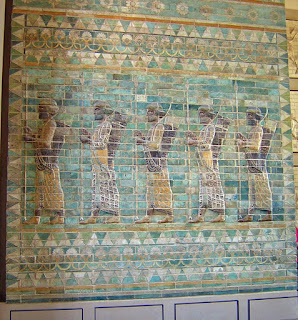
Knowing the superb glazed-brick reliefs that are housed at the Louvre, I find it even more difficult to imagine the splendor and grandeur of this palace in Alexander’s and Sisygambis’ days. After all, it was the setting for the Susa mass wedding that took place here in 324 BC after Alexander returned from India.

Seven years after he had left the Persian Royal princesses in Susa, Alexander arranged not only his own wedding but that of about ninety members of his court as well. The stage was set for an elaborate, colossal, and most expensive marriage ceremony. Standing here on the Susa plateau, I wonder where the famous ceremonial tent was set up, most likely somewhere at the foot of this plateau, for how else could the ninety-two bridal suites be fitted in, more so since the whole hall was almost half a mile in circumference. In any case, it has been recorded that the hall contained a hundred bedrooms, each furnished with a lavishly decorated bed with linen sheets, and each worth half a talent of silver. Alexander’s bed, of course, had legs of gold – nothing less. The hall was framed and trimmed with sumptuous draperies woven with animal figures and gold thread, hanging down from gilt and silver rods; purple carpets embroidered with gold were spread out. The huge tent was held up by thirty-foot-high columns that were gilded and silvered and set with precious stones.

Alexander sat at the very center, surrounded by the other bridegrooms, and all his personal friends sat opposite. He took two princesses as his wives, Barsine (renamed Stateira), the eldest daughter of Darius, and Parysatis, the youngest daughter of Artaxerxes III. His close friend Hephaistion married Drypetis, another daughter of Darius. The idea behind this marriage was that Alexander wanted their children to be nephews and nieces. The wedding was performed in Persian style; the grooms would have a drink (I suppose a kind of toast) after which the brides were led inside to take place next to their respective husband-to-be. The bridegroom would then take his lady by the hand and kiss her, Alexander being obviously the first to do so. That sealed the marriage.

The ceremonies lasted five days, and the banquets were announced by the sound of trumpets. Many entertainers from Greece and Asia performed for Alexander and his noble guests. There was music, songs, and recitations, theatre performances with tragedies and comedies in which the greatest artists of those days appeared.

Each of the newlywed couples received a dowry from the king, and on this happy occasion, Alexander even had a special thought for all his Macedonians who had taken Asian wives during his campaigns and granted them a gratuity.


These are the thoughts that rush through my brain as I stand among these scant sun-bleached ruins. There is no sound rising from the city below, no bird, not even a fly to give this site a sense of reality. It seems even the spirits have abandoned the place.

Monday, January 26, 2015

What if … Hephaistion had still been alive at the time of Alexander’s death in Babylon?

We can state beyond doubt that Hephaistion was Alexander’s closest friend; he was his confidant and probably his lover. He undoubtedly occupied an exceptional place in Alexander’s life. One example is when, after the Battle of Issus, King Darius’ family falls into Macedonian hands. Together with Hephaistion, Alexander visits Queen Sisygambis, the Queen Mother, and she did obeisance before Hephaistion since he was the tallest and most handsome of the two. Alexander comes to her rescue by saying, “he too is Alexander” – a statement he would not have made about anyone else. Another example can be found during the famous Susa wedding when Alexander gives princess Drypetis, the sister of his new bride Stateira, to Hephaistion since he wanted their mutual children to grow up as they had. A last example is that Alexander wanted his dead friend to be worshipped as a god so that they could meet again in heaven, for which he asked permission from the oracle of Siwah, who granted him the status of hero instead.

Hephaistion was one of Alexander’s Seven Bodyguards from the early days onward, with Aristonous, Leonnatus, Lysimachus, Peithon, Perdiccas, and Ptolemy, but appears as “Commander of the Bodyguards” at the actual Battle of Gaugamela. In light of his more intimate relationship with Alexander, he would protect Alexander more fiercely and convincingly than anyone else. This same attitude may percolate through the trial of Philotas, who was accused of conspiracy several years later, and where we see Hephaistion as a most determined defender of Alexander’s security and safety.

Besides his role as Bodyguard and commander of the troops entrusted to him, it is clear that Hephaistion had many other tasks and responsibilities that do not jump out immediately but transpire through the accounts of Arrian and Plutarch. The historian Hieronymos affirms that Alexander reinstated the Persian post of Chiliarch (Prime Minister) solely for Hephaistion. His unique position is further disclosed and discussed by Andrew Chugg in his book “Alexander’s Lovers.”

I think we should see Hephaistion as a great diplomat functioning as a buffer between all the personages whirling around the royal tent, from the simple pages to the highest general and Alexander himself. As early as Tyre, he was assigned to find a leader/king for the newly conquered city. Another crucial moment was the orchestration of the Proskynesis, a general practice at the Persian court that the Greeks and the Macedonians considered abhorrent, but where Hephaistion set the example. The attempt to put Persians and Greeks on the same line did not work out as Alexander wished because his vision was larger than his army's – yet he certainly had Hephaistion’s support.

There is a theory that Alexander has been poisoned or maybe unknowingly poisoned himself by taking too high a dose of the hellebore plant, a common remedy in antiquity for many ailments. I am convinced that Hephaistion would have looked closely after his dearest friend and could have avoided the poisoning orchestrated by an outsider, or could have talked sense into Alexander’s mind about a more prudent dosage of his remedy (provided Alexander died of poisoning, that is)


Had Hephaistion still been alive in Babylon in his function of Chiliarch, he probably would have had precedence over all the other commanders despite his earlier quarrel with Craterus. This happened when Alexander invaded India - a conflict in which the king settled true to Salomon by stating that Craterus loved the king (philobasileus) and Hephaistion loved Alexander (philalexandros). This is evidence that they both had a seniority position over the other commanders. We may safely assume they would respect their mutual position and unconditional devotion to Alexander.

Yet, in the current theory, Craterus was underway to bring the veterans back home and take over regency from Antipater (assuming, however, that he would agree to give up his important position even upon Alexander’s order, which he had ignored before when the king summoned him to Babylon), leaving Hephaistion in charge of the east. It is evident that Hephaistion would have spoken in Craterus’  name and acted with his approval.

It may have been possible for Hephaistion to “rule” over the other commanders pending the birth of Roxane’s child, who came into this world as Alexander IV. This child needed a regent pending his coming of age. I seriously doubt that the other generals would have tolerated Hephaistion’s leadership till that time (at least 18 years), but he may have avoided the kingship of Arrhideus/Philip III. 

Each of the commanders was a wealthy man by now, some keeping a court of their own, and they were powerful figures in the eyes of their troops, who only wanted more fights and more booty. Alexander’s empire had to be divided one way or another. Maybe most of the violence and continuous Wars of the Successors could have been avoided, but not all. As pointed out above, in 323 BC, we must reckon with twelve powerful men, i.e., the Bodyguards and Seleucos, Nearchus, and Eumenes – in the absence of Craterus and Antipater. In fact, they were simply too many to make a decent and peaceful split. Hephaistion probably would have had the time and the opportunity to organize and streamline the management of the many satrapies with some form of agreement with Craterus in Macedonia. The succession of Alexander would not have dragged on for forty years, when each general could have been assigned a part of the empire to rule pending the takeover by Alexander IV. In the end, the Romans may have had a more challenging time conquering Asia, and those eastern provinces would have been annexed only many centuries later than what happened now.

On the other hand, Hephaistion would undoubtedly have protected Roxane and young Alexander with his life, for in his eyes, they were part of Alexander in many ways. There would have been no case for Roxane to poison the Persian princesses were it only because Hephaistion would have watched over all of them as his family.

[Picture of Alexander and Hephaistion is from Oliver Stone's movie "Alexander"]

Monday, August 26, 2013

About Greek theater plays

Whoever travels to Greece or Turkey cannot miss the ever-present remains of antique theaters, all in relatively good condition.  

The origin of theater tragedies goes back to the 6th century BC, thanks to the feasts that were held in honor of Dionysos, the Dionysia. For the first time in 534 BC, they are considered a permanent program element. Theaters are no longer exclusively used for religious performances but have become the place where the lives of heroes and half-gods are related. The tragic poet is the most essential element. He not only writes the tragedy but also expresses his songs as an actor, accompanied by 12-15 singers and dancers.

Aeschylus (525-456 BC) is the first author to break traditions by introducing a second actor to create a dialogue between two people. Although the choir is still essential, it is now pushed to the background. In those days, we discovered a difference between light comedy and tragedy, which treated the conflicts between men and the gods.

A third actor is introduced by Sophocles (405-406 BC), enabling the creation of intrigue between the other two persons. The choir at this stage serves only to support the action. When in 460 BC, Sophocles stops performing, an actual separation between writing theater plays and acting occurred.

The third playwriter was Euripides (ca. 480-405 BC), who spent several years at the Macedonian court in the days of King Archelaus, where he died. He must have written more than ninety plays, of which at least 20% have come to us more or less complete. His fame is because he actually wrote dialogues that sounded like spontaneous conversations instead of carrying the ritual contexts from older plays. In his lifetime, most of his public did not appreciate this "modern" style. Only after his death did he become the favorite of Athenian theaters.

It is evident that Alexander grew up with theater plays, as his father before him, as well as his ancestors, who all loved to watch a good play. From 449 BC onward, the Greek States chose plays with three main actors: the principal role was performed by the Protagonist, who in turn hired the supporting actors, i.e., the second actor, the Deuteragonist, and the third actor, the Tritagonist. The choir was not composed of professional actors but of civilians appointed by the city. The principal actors, however, were also allowed to compete for prizes in special competitions. The peak of acting was reached in the fourth century BC, and actors even became more important than playwriters. The most famous players went so far as to adapt parts of the play to match their egos or ambitions. In the heyday, actors were exonerated from taxes and military service. Thanks to their popularity, they enjoyed the admiration and protection of kings and the social elite. In return, the kings and the nobility entrusted them with significant political and diplomatic missions, by which the actors could make history away from the theater.

We will remember the Pixodarus affair when Alexander asked the tragic actor Thettalus to plead in his favor with the Carian satrap for his daughter's hand. By this maneuver, Alexander hoped to thwart his father's plan, who had offered his retarded son, Arrhidaeus, Alexander's half-brother, in marriage to the infant daughter of Pixodarus of Caria. Because of their political immunity, actors were often asked to act as mediators with rulers or politicians, and Alexander knew how to exploit that possibility. This time, however, Alexander had to pay a high price for interfering with his father's plans, as King Philip banished all Alexander's friends from Macedonia except Hephaistion.

In the summer of 331 BC, when Alexander installed himself temporarily at Tyre after leaving Egypt, he organized a grand celebration in honor of Melqart-Heracles. The kings of Salamis and Soli, who sponsored the event, hired the most celebrated actors of the day, including evidently Thettalus, who by now had become a personal friend of the king. Unfortunately for Alexander, Thettalus did not win the contest.

The same actor was again invited by Alexander in 324 BC when he organized the mass wedding in Susa, where he married the Persian princess Stateira (or Barsine). Her sister, Drypetis, was given to Hephaistion. Alexander's close companions were all married to girls from high Persian nobility. Eighty other couples shared the feast in a wonderfully idealistic dream to bring East and West closer together.