Alexandria's founded by Alexander

Alexandria's founded by Alexander the Great (by year BC): 334 Alexandria in Troia (Turkey) - 333 Alexandria at Issus/Alexandrette (Iskenderun, Turkey) - 332 Alexandria of Caria/by the Latmos (Alinda, Turkey) - 331 Alexandria Mygdoniae - 331 Alexandria (Egypt) - 330 Alexandria Ariana (Herat, Afghanistan) - 330 Alexandria of the Prophthasia/in Dragiana/Phrada (Farah, Afghanistan) - 330 Alexandria in Arachosia (Kandahar, Afghanistan) - 330 Alexandria in the Caucasus (Begram, Afghanistan) - 329 Alexandria of the Paropanisades (Ghazni, Afghanistan) - 329 Alexandria Eschate or Ultima (Khodjend, Tajikistan) - 329 Alexandria on the Oxus (Termez, Afghanistan) - 328 Alexandria in Margiana (Merv, Turkmenistan) - 326 Alexandria Nicaea (on the Hydaspes, India) - 326 Alexandria Bucephala (on the Hydaspes, India) - 325 Alexandria Sogdia - 325 Alexandria Oreitide - 325 Alexandria in Opiene / Alexandria on the Indus (confluence of Indus & Acesines, India) - 325 Alexandria Rambacia (Bela, Pakistan) - 325 Alexandria Xylinepolis (Patala, India) - 325 Alexandria in Carminia (Gulashkird, Iran) - 324 Alexandria-on-the-Tigris/Antiochia-in-Susiana/Charax (Spasinou Charax on the Tigris, Iraq) - ?Alexandria of Carmahle? (Kahnu)
Showing posts with label Seleucos-I. Show all posts

Thursday, May 22, 2025

Mysterious relief statues near Seleucia, modern Silifke

On the southern slopes of the Taurus Mountains lies Silifke or ancient Seleucia, one of the many cities founded by Seleucos I (see: Excavations at the ancient city of Olba). 

In its vicinity, a mysterious group of reliefs in the rock wall has intrigued archaeologists. It must be said that they stand out as gold figures against the dark canyon wall, attracting the attention of illegal treasure hunters who truly believed they could find gold inside them and damaged the statues as recently as 2015. 

There are 19 figures in all, 11 men, 4 women, 2 children, plus a mountain goat and an eagle. It is thought that they represent kings and queens from ancient Olba. 

The reliefs are presented in different compositions to commemorate the dead, such as in the ritual scene, the farewell of a soldier, or a feast scene for the dead. Of a different kind is the scene where a man holds grapes in one hand and the horns of a goat with the other. One figure is pouring what could be a libation from a jug into the bowl in his other hand. 

Sadly, the inscriptions under the reliefs do not help to identify the figures. The names may refer to the artist who created them or some important personality who wanted to be remembered. 


Scholars could, however, determine that the reliefs were carved over a period of 250 years, with the latest having been completed in the 2nd century AD. 

These figures are a far cry from the well-known temple tombs dug out of the cliffs in Caria and Lycia, for instance, and seem to be quite unique.

[Pictures are from Arkeonews]

Saturday, August 31, 2024

“To the strongest”

“To the strongest” are the last words Alexander pronounced on his deathbed in Babylon when pressed to name his successor. 

His Companions and generals were obviously panicking at the thought of being left behind so many miles away from Macedonia without their king to guide them. They desperately needed him. 

Ever since he became king in 336 BC Alexander had shown his commanders the way and led his men by example. He certainly did not expect to die at the age of 33 and not in his bed. How could he have foreseen to be incapacitated and unable to be his own self? 

The only person who had always been at his side and enjoyed his full confidence had died the previous year. Hephaistion had been officially appointed as his Chiliarch, his second in command. The sudden death of his dearest friend left him in total disarray and maddened by grief. He was truly alone at a time when he had to make the hardest decision of his life and elect a successor. “Who, Alexander? Tell us who!” are the words Oliver Stone put in the mouth of Ptolemy. How appropriate! 

“To the strongest” has often been understood as a weak and evasive statement, although, in reality, Alexander’s last words are one final proof of his genius! Had he not been so much afflicted by his illness and impaired by the high fever, he would have found the strength to elaborate a solution to the Succession with his close Companions. He would likely have appointed Perdiccas. Even so, Alexander’s decision may have lost its power two years onward, and the commanders would have taken the matter into their own hands anyway.

Of course, everyone around the king’s deathbed still hoped to be appointed and hear his name called out. However, matters were not as straightforward as one might think. On the one hand, he had to name an heir since, as King, he needed a successor, and on the other hand, as commander in chief of his army, he had to appoint a capable military leader. 

At this point, his most experienced generals were Craterus and Perdiccas. Yet, Craterus was in Cilicia taking 10,000 veterans back to Macedonia with Alexander’s instructions to replace Antipater as Regent in Pella. Perdiccas was in Babylon and took the king’s succession into his hands. 

Roxane was pregnant, but the child had not been born yet, and there was no guarantee it would be a boy. Alexander had never recognized Heracles, his son by Barsine. In any case, Roxane’s son and Heracles were too young to rule, and the generals would have to choose a Regent pending their coming of age. The next best option was to push Arrhideus forward. He was Alexander’s simple-minded half-brother and not capable of becoming the de facto ruler. As a result, Perdiccas was elected Regent at the Partition of Babylon. 

This implied, however, that he would rule over Alexander’s Companions and generals. Perdiccas’ success was short-lived, though, and in 321 BC he was sidelined at Triparadeisus as the commanders decided to divide the kingdom among themselves. When Perdiccas escorted Alexander’s remains to be buried in Macedonia, Ptolemy hijacked the mummified body and took it to Egypt. In a desperate attempt to recover his king’s remains, Perdiccas failed totally to march his men across the Nile. His losses were so excessive that his soldiers revolted and killed him. 

These were uncertain times for all the parties involved in the Succession Wars. They all had the ambition to rule over Alexander’s Empire and felt equally qualified to do so, but none shared Alexander’s vision. Ultimately, they eliminated each other until the empire was divided between Ptolemy, Seleucos, Antigonus, and Cassander (see: Dividing the Spoils. The War for Alexander’s Empire by Robin Waterfield).

None of the great men who fought alongside Alexander for almost twelve years emerged as the strongest. They all had learned a lot, but none could come close to Alexander’s charisma and exceptional genius.

Friday, June 21, 2024

The roaring times of the Antigonid dynasty

The Wars of the Diadochi broke out after Alexander’s death in 323 BC and his huge Empire went to “the strongest” as he may have intended to say on his deathbed in Babylon. However, it did not go to one single ruler as none of his generals had his vision or charisma. 

After endless battles, intermarriages, and lots of intrigues, Alexander’s generals eliminated each other and, in the end, started four distinct dynasties. Ptolemy initiated the Ptolemaic dynasty in Egypt, and Seleucos the Seleucid dynasty in Asia. Cassander, the son of Antipater, founded the Antipatrid dynasty (the ancient Kingdom of Macedonia). In 306 BC, Antigonus Monophthalmus (the One-Eyed) declared himself and his son Demetrios kings. By doing so, the Antigonid dynasty replaced the Antipatrid dynasty. 

Antigonus may well have served under Philip II and lost an eye during the Siege of Perinthus in 340 BC. He later joined Alexander on his Persian campaign and was promoted to satrap of Phrygia in 334 BC. His main duty was to maintain Alexander’s line of communication and supply. As a result of the Partition of Babylon following Alexander’s death, he also received Pamphylia and Lycia. 

During the Wars of the Diadochi, Antigonus picked up momentum and managed to rule over all of Asia Minor, Greece, Syria, Phoenicia, and northern Mesopotamia. Fearing his increasing power, Seleucos, Ptolemy, Lysimachos, and Cassander joined forces against him. Antigonus was defeated and killed at the Battle of Ipsus in 301 BC after which his realm was split between Lysimachos and Seleucos. 

However, Antigonus’ son Demetrios Poliorcetes, by now having earned his stripes as Besieger survived said battle and took control of Macedonia in 294 BC. Cassander died in 297 BC without a successor as his sons had eliminated each other, paving the way for Demetrios to become King of Macedonia. Not for long because in 288 BC he was driven out by Pyrrhus and Lysimachos, and died as a prisoner of Seleucos. 

It was not until 277 BC that Demetrios’ son, Antigonus II Gonatas, regained the title of King of Macedonia. He ruled till about 239 BC, to be succeeded by Demetrios II Aetolicus, followed by Antigonus III Doson ten years later. 

Meanwhile, Rome became the rising power in the eastern Mediterranean, and soon the first conflicts with Antigonid Macedonia led by King Philip V (221-179 BC) erupted. His successor, Perseus, put up a fierce resistance against the expanding Roman Empire that coveted Macedonia’s wealth. The Romans conquered Antigonid Macedonia in 168 BC at the Battle of Pydna, turning Alexander’s homeland into a mere Roman Province. 

Although very eventful, the Antigonid dynasty was short-lived and lasted less than 150 years. 

Macedonia’s grand palaces of Aegae, Pella, Bylazora, and Dimitrias were thoroughly looted, and the houses of the wealthy Macedonians were plundered. Statues, paintings, jewelry, and other wonderful, precious artifacts from Greece and Asia were up for grabs. Roman generals and common soldiers alike took as much as they could carry. Only the gods know what happened to the collection of Macedonia’s precious libraries.

Wednesday, March 6, 2024

A handful of Alexander coins from Chania

Chania on Crete’s northwestern coast is best known for its beaches and hotels that attract today’s tourists. Its history, however, goes back to the 14th century BC and is centered on the ongoing excavations of the Minoan Palace of Kydonia which was destroyed by an earthquake one century later. 

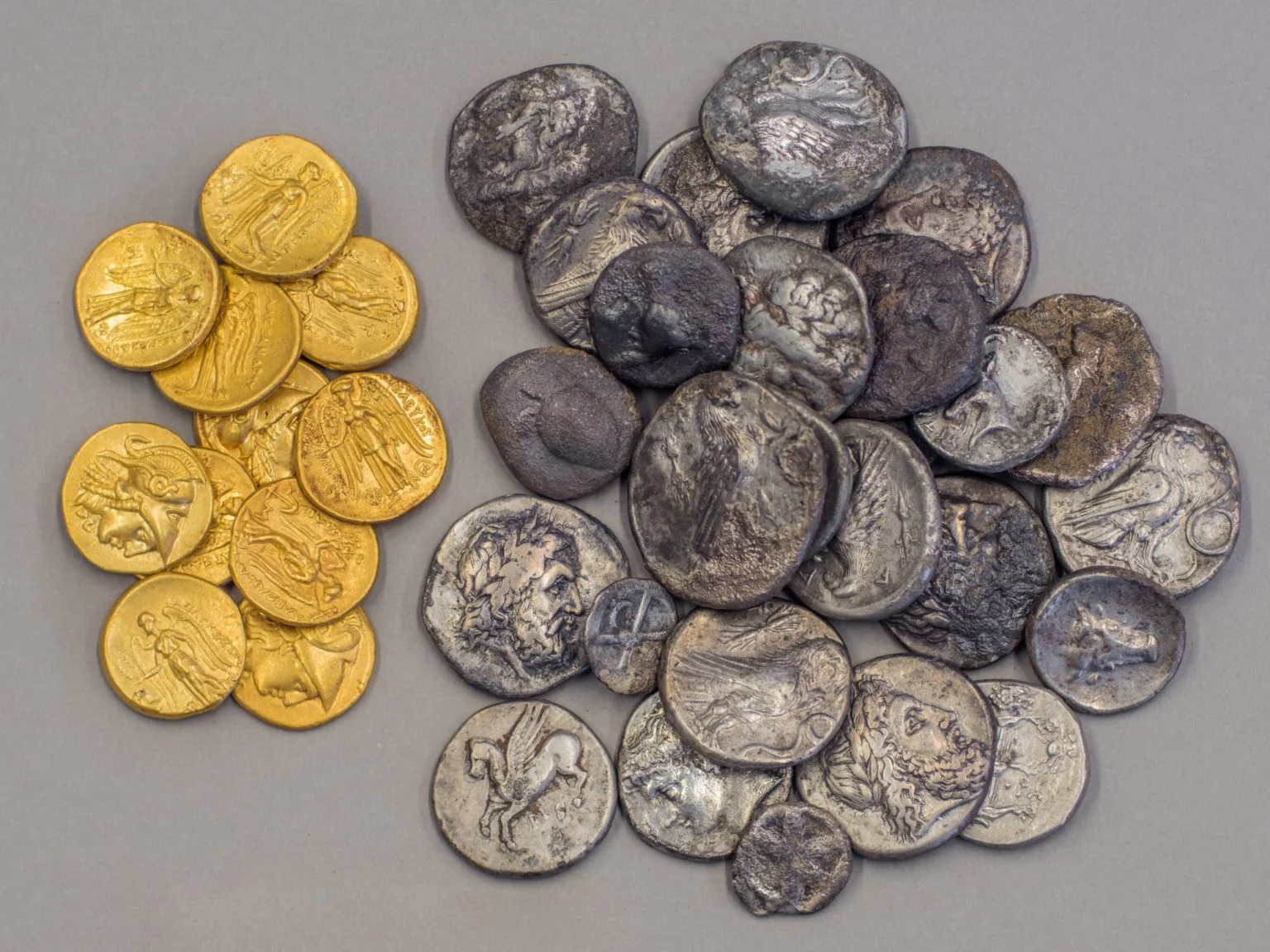
The Old Town of Chania proper has yielded a cache of 37 rare coins, including eleven gold staters of Alexander. The hoard together with two coins of Kydonia, was hidden in a space behind the wall of the acropolis of Kydonia probably by a mercenary between 300 and 280 BC. That is quite a find considering one gold stater equaled a mercenary month's salary. 

It has been established that the coins were mostly minted after Alexander’s death in the name of Philip Arrhidaeus, Seleucos or Lysimachos in different locations such as Amphipolis, Abydos, Lampsacus, etc. 

[Picture of the two-drachms of Cyrene, Greek Reporter,

The hoard also included 15 silver staters minted in Olympia during the Olympic Games at some time in the 4th century BC. Also one Corinthian stater of the Palace of Acarnania, a colony on the Ionian Sea; and one stater of Praisos (on the peninsula of Sitia at the eastern end of Crete). Further one two-drachms of Cyrene (North Africa), two drachms of Phaistos (62 km south of Heracleion), one drachma of Hyrtakina (in the northwest of Crete), and two pseudo-hemi-drachms of the Aegina type found in Kydonia. Last but not least, there are two early versions from Aegina showing the sea and land turtles.

Monday, October 2, 2023

The Attalids, rulers of Pergamon

The Attalid Dynasty of Pergamon started with Philetairos in 282 BC, roughly fifty years after the death of Alexander. 

It remains difficult to imagine the wealth Alexander had accumulated from his conquest of Asia.  The rise of the Ptolemaic and Seleucid dynasties can hardly be compared to that of Lysimachos, who did not draw the best cards. The War of the Diadochi was a very intricate and complex bickering and conniving from which all parties did not profit equally. However, Lysimachos put his share of the booty to good use and his trusted treasury keeper, Philetairos, did the same giving Pergamon the jump start it needed.

The starting date of the Pergamon Dynasty is much later than for the empires of  Seleucos in 312 BC, and Ptolemy in 305 BC founded at the end of the War of the Diadochy. 

Philetairos was a eunuch who had served under Antigonus Monophtalmos. In 302 BC he deserted him to join Lysimachos, the king of Northwest Asia Minor. At the death of Antigonus, Lysimachos rewarded Philetairos for his loyalty by putting him in charge of his treasury (inherited from Alexander) in Pergamon. 

But when Lysimachos, upon the instigation of his wife, murdered his only son, Agathocles, Philetairos joined Seleucos I. Soon afterwards, Seleucos’ forces murdered Lysimachos leaving Philetairos to rule Pergamon until 263 BC. Seleucos granted him great autonomy, which enabled him to expand his territory. Unable to have children of his own, Philetairos had adopted his nephew, the future Eumenes I, who would succeed him in 263 BC. 

One year into his kingship, Eumenes defeated the Seleucid King Antiochus near Sardes, which enabled him to create an independent city-state of Pergamon. Eumenes did not have children either and the throne went to his nephew and cousin, Attalus, who went down into history as Attalus I Soter. Attalus ruled from 241 to 197 BC and many historians still consider him as the founder of the Attalid Dynasty, with Pergamon as its capital. 

The reign of Attalus I was all but peaceful. The Seleucids had lost power over Lysimachos' territories of Pergamon, Bithynia, Nicomedia, and Cappadocia, which gained their independence. Attalus expanded his territory but lost much of it to Seleucos II later on. However, he managed to save Pergamon from the attacks of the Galatians on his northern border and to establish friendly relations with the Romans. That’s how he got involved in the Second Macedonian War (200-197 BC), which opposed the weakening kingdom of Macedonia to Rome, as an ally of Pergamon. Attalus suffered a stroke during peace negotiations in Thebes and was brought back to Pergamon, where he died in 197 BC. 

Eumenes II took over where his father left off but mingling in the affairs of the Seleucids in Syria did not sit well with the Senate of Rome. No reason for Eumenes to be distracted from carrying out his own large expansion program in Pergamon, where he built the unique Great Altar and the massive Library, second only to that of Alexandria. The Romans resented the power and independence Eumenes displayed, which in their eyes reduced their own sphere of influence in Asia Minor. Sadly, although still in his early sixties, Eumenes’ health began to deteriorate, and he appointed his brother Attalus II as a co-ruler. One year later, in 159 BC, Eumenes died. His own son was still an infant, and consequently, Attalus II, who conveniently married his widow, became the new king. He also adopted his brother’s young son, who was to become the future Attalus III. 

Attalus II continued Eumenes’ building projects in Pergamon, this time including the Palace. He also funded the construction of a new temple to Hera Basileia between the lower Agora and the Gymnasium. 

He was familiar with the political situation he inherited. He had no real enemies and was careful to recognize the authority of Rome. Instead of going to war, Attalus II expanded his influence by spending lavish amounts of money on prestige projects. For instance, he contributed to the construction of a splendid Stoa in the Agora of Athens, at the foot of the Acropolis. This is the Stoa of Attalus II, which was restored/ reconstructed by the American School of Classical Studies in the early 1950s. Another Stoa carrying his name was built in Termessos next to the Corinthian temple.

As always, all kinds of taxes were raised to pay for these grand expenses, but Attalus equally improved trade in his kingdom, building markets and safe harbors. He certainly needed reliable access to a harbor, and Attalus attempted to subdue Side. In the wake of this failed attempt, he added part of Pamphylia to his kingdom, where he founded an entirely new port. He named it Attaleia, after himself, i.e., modern Antalya. Attalus II died at the blessed age of 81 or 82 in 138 BC. 

His successor was his nephew and adopted son, Attalus III. However, the new king was not interested in his kingship or in Pergamon. No wonder that he was rather unpopular among his citizens. When he died five years later of disease, he bequeathed Pergamon to Rome, which made it the capital of their Provincia Asia.

Although there may have been one last pretender to the throne, a supposed illegitimate son of Eumenes II, the Attalid Dynasty came to an abrupt end in 133 BC. 

In hardly 150 years, the Attalids had built one of the greatest Hellenistic centers for culture and art, mainly under the reigns of Eumenes II and Attalus II, which still intrigues us.

The end of Pergamon was all but glorious. After being hit by a severe earthquake in 262 AD, its decline was set in motion. The Muslims sacked what remained standing during their raid of 663 AD. More setbacks followed after the conquests by the Byzantine Empire and around 1300 AD by the Ottoman Empire. Slowly, the majestic site deteriorated to the point it was abandoned and forgotten until the first explorers of the 18th and 19th centuries rediscovered Pergamon.

Monday, February 27, 2023

About daily life after Alexander the Great

How exciting to read about daily life as it was after the conquests of Alexander! It sounds like a fiction story, but the truth may be closer than we think! 

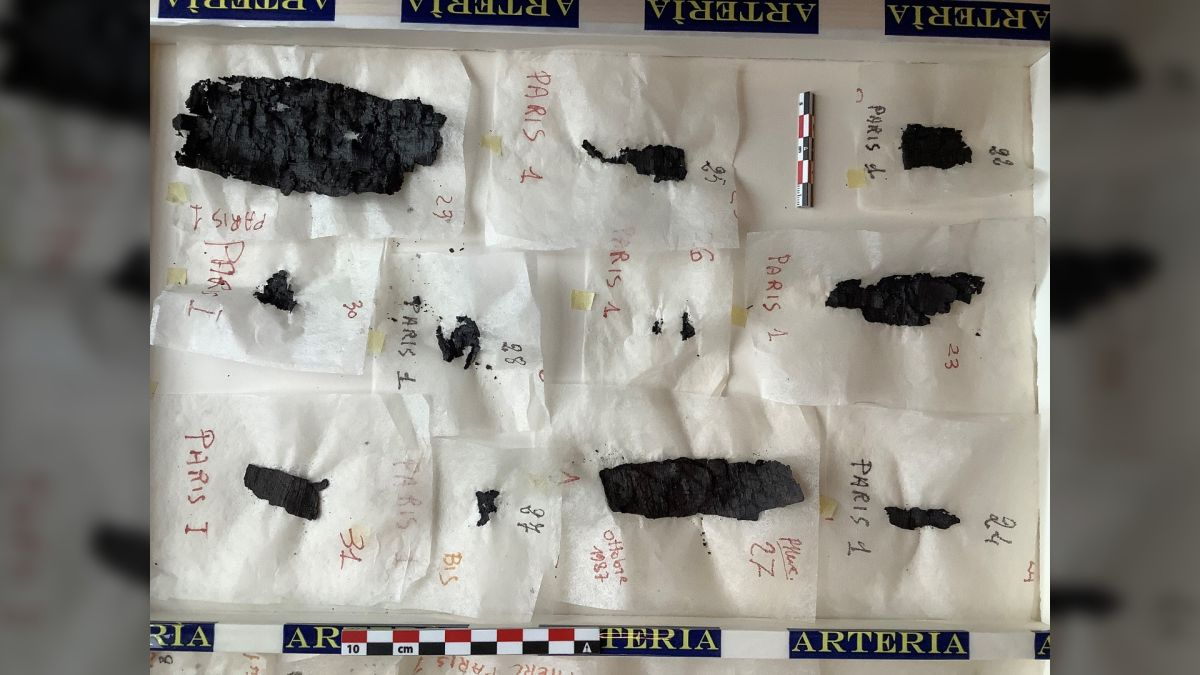
Artificial Intelligence, AI, in short, is a relatively new digital means that offers endless possibilities with unexpected results. Machine learning is a branch of AI researchers use to read faint traces of ink on still rolled-up papyrus scrolls. If successful, this technology opens exciting possibilities to decipher Herculaneum's thousands of carbonized scrolls. 

These latest results have been published in Live Science. The study concentrates on an otherwise “lost book” that supposedly discusses the dynasties that succeeded Alexander. 

Although till now only small fragments can be read, hopes are high to learn more about the Macedonian leaders that followed in the wake of Alexander. So far, the names of Seleucos and Cassander have been recognized together with “several mentions of Alexander himself!” 

[Picture from Live Science, credit Michèle Hannoosh]

The “lost book” is one of the many works discovered at the Villa dei Papiri in Herculaneum. Other books contain writings by Philodemus of Gadara, an Epicurean philosopher who lived from c. 110 until 30 BC and resided in the city. 

The fragile carbonized scrolls ended up at the Institut de France in Paris. Over the years, several attempts were made to unroll the scrolls, but they failed. The papyri crumbled into bits and pieces or volatilized into pure dust. 

Clearly, AI gives us new hope to unravel more about our past.

Wednesday, October 5, 2022

Who were the Parthians?

The name of the Parthians often raises questions, and their territory is hard to define. Scholars have established that the tribe of the Parthians may be closely linked to the Scythians who lived southeast of the Caspian Sea. 

The Parthians appeared in history after the death of Alexander the Great, when Seleucos inherited the largest portion of the lands he had conquered in the east, from the eastern Mediterranean to Bactria and India. Seleucos kept the existing Persian governing system of satraps in place, and at an early stage, Parthia became one of its satrapies. 

Seleucos founded the Seleucid Empire and soon discovered that ruling such a vast territory was a nearly impossible task. As the empire weakened, the Parthians revolted and established their independence. 

The first king of Parthia was Arsaces, who came to power in 247 BC. Not for long, as the Seleucid King Antiochus III managed to reconquer Parthia in 209 BC from Arsaces’ son, the new king Arsaces II. For some unknown reason, Antiochus did not want to kill his enemy and established him instead as satrap. This did not sit well with the Parthian nobility, and as soon as Antiochus left for Syria, they deposed Arsaces II and proclaimed Phriapatius as their new king in 191 BC. 

Meanwhile, the Romans subdued Antiochus III according to the Treaty of Apamea, signed in 188 BC. Now that the Seleucid King was no longer a threat, Phriapatius’ son, Phraates, took heart and conquered the territories between Hyrcania in the east and Media in the southwest. He created a solid base for his brother Mithridates, who succeeded him on the throne in 171 BC. 

At this point, Parthia started a new era. Mithridates conquered the Bactrian kingdom in 168 BC and then turned west. He took Media from Phraates in 151 BC and then focused on Mesopotamia. He captured the capital city of Seleucia, followed by Babylon in 141 BC, and Susa three years later. 

Phraates II, Mithridates’ son, continued the fight for power. A worthy successor to his father, but his power was short-lived as he soon died in an attempt to stop a Scythian mutiny. From then onward, Parthia would be torn by successive uprisings and battles. After the death of Phraates II, Parthia was ruled by his uncle, Artabanus I, who crushed several revolts in his short life. 

His son, Mithridates II, in turn, would become Parthia’s greatest ruler (124-91 BC). He strengthened his position in Bactria, Mesopotamia, Characene (on the Iran-Iraq border where Alexander had founded Alexandria-on-the-Tigris, modern Charax Spasinou), and the realm of Babylon. He also annexed the lands of Albania and Armenia, together with the vital Syrian city of Dura-Europos on the Euphrates. Roughly, the Parthian Empire now stretched from the Mediterranean all the way to China! 

No wonder Parthia was very much coveted by the rising Roman Empire and lost several territories, including Armenia. The tables were turned in 53 BC when Crassus invaded Parthia near Carrhae (see: Harran, better known under its Roman name Carrhae) and lost. Rome suffered a severe psychological blow. The situation worsened when Marc Antony was defeated in 32 BC in an effort to keep hold of Armenia. After decades of constant fighting, Emperor Augustus secured a peace agreement with King Phraates IV in 20 BC. Instead of fighting each other, both rulers agreed to unite their efforts against enemies outside their borders. 

No treaty lasted forever, and after several skirmishes back and forth, Emperor Trajan invaded Mesopotamia in 115 AD, looting the capital cities of Seleucia and Ctesiphon. At about the same time, Parthia was invaded on its eastern border by the Kushans, who established their empire in Bactria. 

However, two years later, Parthia, now ruled by Vologases IV, was invaded by Hadrian, Trajan’s successor. Lucius Verus, the adopted son of Marcus Aurelius, followed suit and sacked Seleucia and Ctesiphon once again. The Parthians managed somehow to expel the Romans, but like a Jack-in-the-Box, they returned in 198 AD. 

This time, Emperor Septimius Severus invaded Mesopotamia and marched down to take the Parthian-held cities of Seleucia, Babylon, and Ctesiphon. It makes one wonder how often cities are destroyed and rebuilt over the centuries. 

I now better understand the significance of the Severan bridge I crossed many years ago on my way to Mount Nemrud. At that time, I wondered what could have been so important in this god-forsaken, steaming hot land to need a bridge! It crossed the Cedere River, a tributary of the Euphrates. It is possibly the second-largest still-existing Roman bridge, with a length of 120 meters and a span of 34 meters. Two Corinthian columns of 9-10 meters guard either side of the bridge. One set is erected in honor of Septimius Severus and his wife Julia Domna, and the other for their two sons, Caracalla and Geta.

 
The weakened Parthian Empire finally collapsed when it was overthrown by King Ardashir, the founder of the Sassanid Empire, in 224 AD. That is another story altogether (see: Sassanid reliefs tell a story of their own in Persia).

Monday, June 27, 2022

Lysimachos in the wake of Alexander – Part II

 [continued from Lysimachos in the wake of Alexander - Part I]

Skipping the many details and intertwined relationships, let us pick up the story when Seleucos added his forces to those of Lysimachos and his allies to fight the elderly Antigonus Monophthalmus and his son Demetrios Poliorcetes. The battle took place in 301 BC at Ipsus and ended with Antigonus’ defeat and death. The victors subsequently divided his territory among them. Lysimachos acquired a significant share with Lydia, Ionia, and Phrygia, including the entire north coast of Asia Minor. Seleucos received Syria, and Cassander was now secure in Macedonia and Greece. 

Until then, Antigonus Monophthalmus had been the most successful among the generals in recreating Alexander’s empire. His son Demetrios attempted to follow in his father’s footsteps, but he lacked a broader view. 

Around that time, Nicaea died, and Lysimachos honored her by naming a city in Asia Minor after her, modern Iznik in Turkey. 

As Seleucos was growing ever more powerful, Lysimachos thought it wise to seek the support of Ptolemy. Around 300 BC, he elected to marry Arsinoe, the daughter of Ptolemy, and his mistress Berenice. Amastris, as said above, stepped back and divorced herself from Lysimachos, moving back to Herakleia Pontus. 

Although this marriage of Lysimachos was not a happy one, Arsinoe stayed with her husband till his death. She bore him three sons: Ptolemy I Epigonos, Lysimachos, and Philip. Her jealousy, however, incited her to convince her husband to kill his oldest son and heir, Agathocles (from his marriage to Nicaea), based on treason. The murder happened in 284 BC despite the young man successfully leading his father’s army in combat. Although he was only in his early thirties, his men loved him much. 

Meanwhile, Cassander died in 297 BC. His sons were more interested in fighting each other for power than ruling the country. Macedonia eventually fell into the hands of Demetrios. So, in 287 BC, Lysimachos agreed to fight alongside Pyrrhus to drive Demetrios out of Macedonia. They successfully ruled the country jointly until Lysimachos broke up with Pyrrhus and seized Macedonia for himself. 

Lysimachos’ greed and thirst for power equaled that of the other generals, now kings in their realms. The fighting was not over yet. 

Seleucos, in 282 BC, broke his alliance with Lysimachos as he attempted to take his territory in Asia Minor. The final clash happened in Lydia at Corupedium in 281 BC. It ended with the death of Lysimachos. By then, the King of Thracia must have been in his late 70s. He had lived a life of almost continuous and repeated battles, inspired by the greatest conqueror of all times, Alexander the Great. 

Like the other new self-proclaimed kings, Lysimachos had minted his own coins. However, he did not follow them by stamping his personal image on these coins but kept using the effigy of Alexander instead. Could that be seen as a late posthumous homage and tribute to his boyhood friend? 

Lysimachos is also being honored as a friend and benefactor of Samothrace. He received the title of Lysimachos Euergetes as inscribed on the altar erected in his honor and used during annual festivals. A stele found on the island reads a dedication of King Lysimachos from between 288 and 281 BC. Based on the surviving first fifteen lines, Lysimachos was honored for restoring sacred lands on the mainland initially granted to Samothrace by either Philip II or Alexander the Great or by Philip Arrhidaeus III and Alexander IV. There were boundary stones for said sacred land near Alexandroupolis in Greece. 

Money was never an issue throughout all those years of bickering, conniving, and fighting. Lysimachos, like all the other generals, had cashed his share of Alexander’s fortune. In his case, it was a mere 9,000 talents in silver and gold, roughly worth several billion in today’s value. The money was safely kept on the Acropolis of Pergamon. However, when Attalus III gave the city to Rome in 133 BC, the entire treasure (not limited to Lysimachos’ share) fell into Roman hands. This fortune contributed largely to the rise of the Roman Empire – but that is another story.