Alexandria's founded by Alexander

Alexandria's founded by Alexander the Great (by year BC): 334 Alexandria in Troia (Turkey) - 333 Alexandria at Issus/Alexandrette (Iskenderun, Turkey) - 332 Alexandria of Caria/by the Latmos (Alinda, Turkey) - 331 Alexandria Mygdoniae - 331 Alexandria (Egypt) - 330 Alexandria Ariana (Herat, Afghanistan) - 330 Alexandria of the Prophthasia/in Dragiana/Phrada (Farah, Afghanistan) - 330 Alexandria in Arachosia (Kandahar, Afghanistan) - 330 Alexandria in the Caucasus (Begram, Afghanistan) - 329 Alexandria of the Paropanisades (Ghazni, Afghanistan) - 329 Alexandria Eschate or Ultima (Khodjend, Tajikistan) - 329 Alexandria on the Oxus (Termez, Afghanistan) - 328 Alexandria in Margiana (Merv, Turkmenistan) - 326 Alexandria Nicaea (on the Hydaspes, India) - 326 Alexandria Bucephala (on the Hydaspes, India) - 325 Alexandria Sogdia - 325 Alexandria Oreitide - 325 Alexandria in Opiene / Alexandria on the Indus (confluence of Indus & Acesines, India) - 325 Alexandria Rambacia (Bela, Pakistan) - 325 Alexandria Xylinepolis (Patala, India) - 325 Alexandria in Carminia (Gulashkird, Iran) - 324 Alexandria-on-the-Tigris/Antiochia-in-Susiana/Charax (Spasinou Charax on the Tigris, Iraq) - ?Alexandria of Carmahle? (Kahnu)
Showing posts with label Arrian. Show all posts

Friday, June 13, 2025

Saving documents and books in antiquity

Nowadays, saving our documents and information on our computers is very obvious. Before the digital era, we relied on typewriters and printers to distribute our pamphlets, advertisements, letters, and books. 

It is hard to imagine that in antiquity nothing of the kind existed, but then the needs were entirely different. Public information, laws, decrees, and other important notices were inscribed on stone slabs or posted on walls in conspicuous places throughout the city, and eventually shared with other cities.  

Exchanging documents and letters over longer distances, as during Alexander’s campaigns, required writing on papyrus, a lightweight material that could be easily transported. His correspondence with Antipater, Olympias, Aristotle, Sisygambis, governors, and generals all over his ever-growing empire required an active exchange of news and information.

Eumenes and Callisthenes, serving as Alexander’s secretaries, must have been very busy and very organized. We tend to forget that they also kept copies of Alexander’s correspondence, official documents, and perhaps private letters as well. This becomes apparent when Eumenes’ tent went up in flames after a conflict that arose as Nearchus was preparing the fleet to sail the Southern Sea. 

Alexander had exhausted his own treasury and had to borrow money from his friends, including Eumenes, to finance Nearchus’ expedition. His secretary was to contribute 300 talents, but being stingy, he gave only 100 talents. Alexander did not accept Eumenes’ excuse that it was not without difficulty and decided to set his friend’s tent on fire. He expected Eumenes to rush his money out, and thus admit he had been lying. The plan went wrong, and the tent burned down entirely, leaving a clump of smelted gold and silver worth one thousand talents. In the process, Alexander’s archives were reduced to ashes. It is Plutarch who tells us that Alexander asked several governors and generals to send Eumenes copies of the papers that had been destroyed. This proves that Alexander did indeed keep a record of his correspondence! 

We so often read of papers and books that have only partially survived or are only known second-hand or not at all, except for the title. This situation is inherent to the mindset of the time and to the degradation of the natural support used (papyrus). 

Papyrus is a vegetal product and a very practical writing support, but it is also fragile. It has been calculated that papyrus documents had a lifespan of a maximum of one hundred years. This may have suited the needs at the time, but the chances of having them still around two thousand years later are very slim. 

Chances of survival were greater if there were many copies of a text, like, for instance, for theater plays. Yet, professional writers were expensive, and the costs were borne by the author. In Roman times, wealthy citizens could afford to have certain scrolls copied for their own use, but they would hardly survive after the Fall of the Roman Empire. 

Under exceptional conditions, some scrolls or bits of papyrus, however, reached us. The most telling example is the scrolls that survived the fire in Herculaneum after the volcanic eruption of Mount Vesuvius in 79 AD. Only recently have we been able to decipher their content without having to unroll the brittle carbonized scrolls (see: Reading the papyrus scrolls from Herculaneum). 

Another situation developed in Egypt. The garbage dump in Oxyrhynchus that served as fuel to the local population in the 19th century appeared to contain a huge amount of hitherto unknown papyrus texts ranging from the Ptolemaic era to the Muslim conquests in the 7th century AD. The papyri consist of private letters and public documents, such as a variety of official correspondence, theater plays, records, sales, wills, and inventories. The deciphering of the papyri is ongoing, as only a handful of scholars are capable of recognizing where the bit of papyrus text belongs. 

When parchment was introduced in the 2nd century BC, documents stood a better chance of survival, although even animal skins had their limits. However, parchment was extremely expensive to make. 

With the passage of time, interest and taste evolved and changed. Treatises, studies, analyses, and even books and poems went out of fashion and vanished altogether. 

As the writing supports were decaying, it is not surprising that documenting Alexander’s life is a nearly impossible task, despite the second-hand recordings by Arrian, Diodorus, Curtius, and Plutarch, who could still access some original documents (see: Eyewitness accounts of Alexander’s life).

[Top picture Derveni papyrus 340 BC, Thessaloniki Museum.
Bottom picture from Archaeology News, Digs & Discoveries] 

Monday, January 6, 2025

Updating the location of the Granicus Battlefield

We like to believe that archaeologists merely scratch the soil to expose some remains of times past and ideally discover some gold and silver treasure. That is a very idealistic picture, far from the truth. 

Many people forget that excavations can take up to a lifetime to yield some results. Famous examples are men like Heinrich Schliemann in Troy, Arthur Evans in Crete, and more recently Prof. Marc Waelkens in Sagalassos and Manolis Andronicos in Vergina. However, the historical picture they created has been revised since. Schliemann erroneously dated the layers of Troy, Evans partially fabricated Crete by wishful thinking, and the occupant of Vergina’s Tomb is still disputed. 

[Picture from Arkeonews]

The Granicus Battlefield is no exception. Based on excavations and observations since the 19th century, the site of the battle had been identified north of the village of Çınarköprü on the River Biga, which in antiquity was known as the Granicus. That was the site I visited in 2007 (see: The Battle of the Granicus). It lies about 100 kilometers east of Çanakkale on the river that empties into the Propontis, modern Sea of Marmara. 

For the past 20 years or so, Prof. Reyhan Korpe, historian from Çanakkale Onsekiz Mart University (ÇOMÜ), led the team that shed new light on the location of the battlefield. It is obvious that I have to revise my standpoint. 

His recent excavations using modern techniques, including geomorphological surveys, exposed new evidence. For instance, the city of Hermaion, which Arrian calls Hermoton, was located on Alexander’s route to the Granicus. It could also be determined that the hitherto assumed site of the battle was a marsh in antiquity, making it unsuitable for an army to move, and that the course of the Granicus River had not changed much in the past two thousand years. Further investigation led to a hill to the east of the battlefield that has now been established near Gümüşçay, i.e., further south than previously reported. Said hill matches the spot where Greek mercenaries in Persian service were positioned, as documented in ancient sources. 

Now, 18 years after my last visit to the Granicus, the area of the battlefield has shifted further south. In my eyes, this new enlarged location makes more sense since there is more space on the wide plain for both armies to maneuver. I hope the river banks are not as steep as near Çınarköprü, where I wondered how the phalanx was able to stay in formation during the crossing. I may well have to return to the Granicus soon! 

                                                  [Picture from Arkeolojikhaber]

It is interesting to read Prof. Reyhan Korpe’s analysis of this part of the Troad region, where he has identified nine ancient cities. We tend to forget that this area was one of the richest in the Persian Empire – hence the numerous tumuli that dot the landscape. No wonder the Persians meant to stop Alexander’s advance immediately after he landed in Asia Minor.

It is worth mentioning that the overall landscape of the Granicus Battlefield has retained much of the appearance it would have had in Alexander’s days, as the agricultural activities have not led to any substantial destruction. 

Thursday, April 11, 2024

The short-lived appearance of King Langaros

Alexander’s campaign into the Balkans before marching east to conquer the Persian Empire is often neglected and even forgotten in literature. 

Only occasionally do we find a name. This is the case for Langaros, King of the Agrianes, who had openly chosen to side with Alexander as he had done with Philip before him. 

When Alexander made his way to Pelium in 335 BC, he faced a threatening revolt of the Illyrians led by Cleitus, king of the Dardanians. Cleitus had persuaded the Autariatae and the Taulantians to join forces (see: Alexander's psychological warfare in Pelium, Illyria). The situation looked bleak for Alexander, who needed to know more about the strength of these Autariatae. 

Langaros, faithful to Alexander, attended him with his bodyguard, the finest and best-equipped troops, and told his friend that he would take care of this warlike tribe. He actually did so, and with Alexander’s consent, he invaded and occupied the Autariatae territory, causing severe losses to their common enemy. 

Alexander showered Langaros with every mark of honor and gifted him with many high-valued presents as proper at the Macedonian court. He also promised Langaros that if he visited him at Pella, he would give him his half-sister Cynane in marriage. Cynane was the daughter of Philip II and his Illyrian wife Audata (see: The many wives of Philip II of Macedonia). It was not to be, as Langaros, after returning home, fell ill and died. 

Our only source for this story is Arrian, who kindly remembered him. 

Recent archaeological digs near the city of Kumanova in North Macedonia have revealed remains of an important yet unknown town from the 4th century BC. Besides a pool with a plastered floor, some plastered walls, capitals and bases of columns, and appliqués have been found. They are consistent with similar details from Aegae and Pella. 

It is far too early to draw any conclusions right now and to link the ruins to King Langaros’ capital. The pictures of the site are not adding much to the story yet. As we know, excavations in that part of the world are slow to materialize. 

This King Langaros is not to be confounded with the Illyrian King Longarus, who ruled over the Dardanians from 231 to 206 BC. 

Longarus, however, played an important role in the life of Philip V of Macedonia, who regularly attacked the Dardanians. Taking advantage of Philip’s campaign in the Peloponnesus in 219 BC, Longarus occupied Bylazora, the capital of Paeonia. His success was short-lived, though, as two years later, in 217 BC, Philip V captured Bylazora, blocking the Dardanian access road to Macedonia.

Wednesday, February 14, 2024

The Periplus of the Euxine Sea by Arrian – Part 3

In this last part of the Periplus, Arrian takes us from Dioscuras/Sebastopolis to Byzantium. 

He starts his story where he left off at the conclusion of part 1, i.e., in Sebastopolis (see: Tour of Colchis: From Trapezus to Sebastopolis). This section, the Cimmerian Bosporus, was not controlled directly by Rome but by a so-called client king. In Hadrian’s day, that was Cotys II, in full Tiberius Julius Cotys, who ruled from 123/4 AD until he died in 131/2 AD. His appointment was made for life, and his successor needed to be officially recognized by Rome. 

At the news of his death, Arrian decided that Hadrian would be interested in having the latest information about the Bosporan Kingdom since it supplied a great deal of wheat, clothing, wine, and slaves. His territory was also an important buffer zone with the warlike Alans living to the north. 

Arrian sailed along the mountainous coastline below the Caucasus to Pityus, some 65 kilometers away. These lands were occupied by the Zilchi, ruled by a certain Stachemphax, also recognized as a king by Hadrian. Follows a list of cities, harbors, and rivers, including the distances between them, from Crimea to the mouth of the Danube River. More familiar are the Greek cities on the south coast of Crimea, such as Panticapaeum (Kerch), Theodosia, Cercinitis, and Chersonesus (Kherson). Panticapaeum, which lies only 11 kilometers from the Tanais River (modern Don River) and flows into Maeotis Lake (Sea of Azov) was seen as the place where Europe ended and Asia started. 

Sailing further west, Arrian stops at the Greek city of Olbia at the mouth of today’s Dnieper River. Next, he heads for the harbor of Odessos, a trading post founded by the Greeks from Istria. From here, he continues to the wide delta of the Ister River (Danube), where he reaches the Island of Achilles or Leuke (possibly Snake Island in Ukraine). Legend has it that Thetis gave it to her son. The island was known for its Temple of Achilles, which held a wooden statue of the hero, as well as Greek and Latin inscriptions in honor of Achilles and his dear Patroclus. Arrian speaks of many offerings that were made, including sacrifices of animals. Those who sail by the island may “see” Achilles in their dreams or hallucinations. 

Proceeding further down the coast of the Black Sea, Arrian arrives at Tomis, a colony founded by the Greeks, where Emperor Augustus banished the poet Ovid. The next port was Callatis, established by the Carians, followed by Odessos (another harbor by that name), where he entered Thracia. 

Passing the eastern end of the Haemus Mountains (in central Bulgaria), Arrian reaches Miletus’ colony of Apollonia, which once held a colossal statue of the god Apollo. From here, he sailed to the not-so-good harbor of Salmydessus (roughly 150 km east of Hadrianopolis, modern Edirne), where Xenophon helped Seuthes II to become King of Thracia. 

By now, Arrian has landed on the Thracian side of the Bosporus. This area is reputed for the Cyanean Islands or Symplegades (also Clashing Rocks), a pair of rocks that clash together when a ship sails through. In Greek mythology, the rocks were defeated by Jason on his way to Colchis on board his ship, the Argo. 

Byzantium is Arrian’s final destination. He concludes by mentioning the local Temple of Zeus Ourios (who grants favorable winds), where Jason and the Argonauts erected an altar to the Twelve Olympian Gods on their return from Colchis. 

In our modern days of traveling by plane and high-speed trains, it is hard to imagine the pace in antiquity when people and armies moved on foot. Ships and barges were a comfortable alternative, although winds and currents were not always reliable. Travelers could never predict the duration of a trip or the time of arrival, but in those days, time was not so much of the essence as it is today. 

Though Arrian wrote his Periplus 130-131 AD, we don’t know how many months or weeks he actually spent at sea. Considering that the circumference of the Black Sea is over 4,000 kilometers, it may be safe to speculate that he spent most of those two years “on the road”. Quite an achievement!

[For the locations, please consult this map]

Wednesday, February 7, 2024

More of What Alexander did for us

Approximately ten years ago, I posted a blog about citrus fruit as introduced by Alexander’s Macedonians from India (see: What Alexander did for us). 

This certainly was not an isolated case if we look at the work of Theophrastus, a contemporary of Aristotle and Alexander (see: Theophrastus, philosopher and botanist). He studied plants that came from Persia, Afghanistan, and the Indus Valley. He introduced the Greeks to mangos, cardoons (or artichoke thistle), jujubes (also called Chinese dates), pistachios, and tamarind. Newly imported plants were cinnamon, banyan (a fig typically from India), as well as frankincense and myrrh. 

One day during his invasion of India in 327 BC, Alexander had bananas for dessert and he enjoyed the fruit so much that he wanted to share it. Eventually, bananas traveled to the Middle East, where they earned their Arabic name of banan, meaning finger. 

Arrian revealed that in 325 BC, Nearchus had found sugarcane. He described it as “a reed that brings forth honey without the help of bees”. In antiquity, sugarcane was basically used as a medicine by Greek and Roman physicians, as documented by Pliny the Elder in the 1st century AD. 

Rice was another food the king introduced into Macedonia after his campaign in Central Asia, and it appears that the well-known dish of Plov or Pilaf spread from Macedonia, throughout Greece and the Balkans (see: The origins of rice in ancient Macedonia). 

Alexander also introduced Europe to the cotton from India. It is said that the Macedonians started wearing cotton clothes which were more appropriate for the Indian climate. 

The colorful floor mosaic of a parakeet from Palace V in Pergamon now on display at the Museum of Pergamon in Berlin (see: The beauty of Alexandrine mosaics) is a rare example of the wide collection of animals and plants Alexander sent to Aristotle from the regions he conquered. The Alexandrine Parakeet was native to South Asia and Southeast Asia. 

As Alexander traveled to modern-day countries such as Turkey, Syria, Lebanon, Egypt, Iraq, Iran, Afghanistan, and India, he shared his serious interest in local cultures and habits with the rest of the world.

Tuesday, January 23, 2024

The Periplus of the Euxine Sea by Arrian – Part 2

The second part of the Periplus covers the section From the Thracian Bosporus to Trapezus. 

As mentioned earlier in About Arrian’s Periplus of the Euxine Sea, it could not be established whether this chapter reflects Arrian's personal experience or not. One theory is that he wrote it upon arrival in Trapezus after Hadrian appointed him governor of Cappadocia in 131 AD. 

We should also keep in mind that Arrian was a native of Bithynia, which bordered the south shores of the Black Sea over approximately one-third of its total length. Consequently, he knew the people and the geography of that area very well. As an admirer of Xenophon, he was familiar with the route followed by the Ten Thousand as they marched from Trapezus to Byzantium following the seashore.

[Bust of Xenophon, Carole Raddato (CC BY-NC-SA)]

Whatever the case, this section of the Periplus includes an impressive list of the harbors and rivers on the southern shore of the Black Sea among which are the cities of Herakleia-Pontus founded by the Megarians and the Boeotians at the mouth of the Lycus River; Tios, at the mouth of the Billaeus River and a colony of Miletus; Amastris (modern Amasra) that had a harbor 17 kilometers from the River Parthenius; Sinope, another colony of Miletus and home of Diogenes; Amisus, an Athenian colony between the Halys and the Iris River deltas; and, finally, Cotyora, a colony of Sinope. 

Ever since the days of the Hittite Empire, which reached its height in the 14th century BC, the Halys River was the border between several kingdoms; first between Lydia and the Persian Empire, then between the Pontic Kingdom and the Kingdom of Cappadocia. By the 6th century BC, it separated Lydia from Media until King Croesus crossed the river to attack Cyrus the Great and was defeated. 

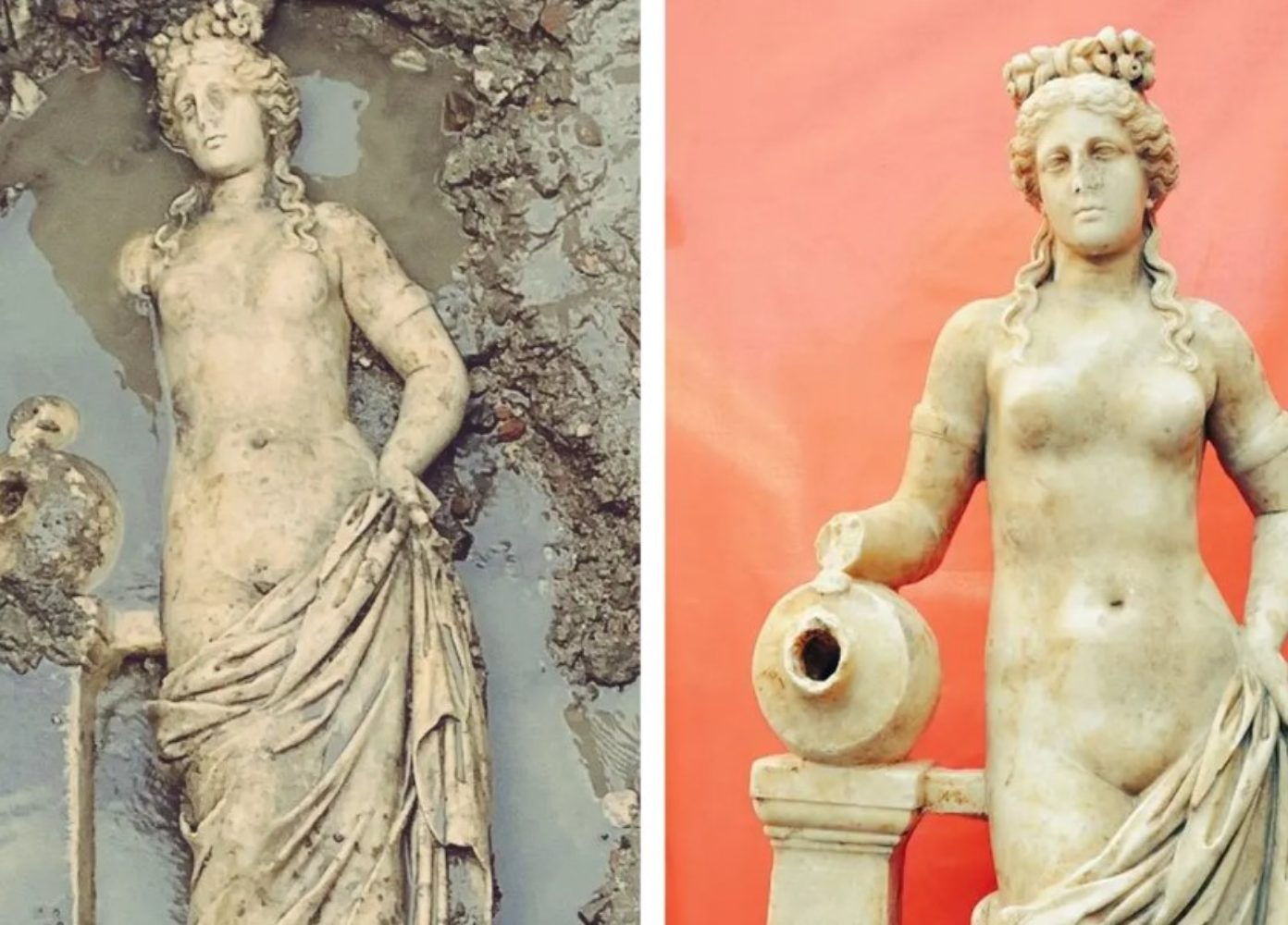
[From the Greek Reporter]

It is worth mentioning that a 1.50-meter-tall statue of Aphrodite has been discovered recently in ancient Amastris. It could be established that it is a Roman copy from between 180 and 200 AD that was inspired by Praxiteles’ school in the 4th century BC. The ancient city was named after Amastris, the niece of King Darius III, who married Dionysos, the tyrant of Herakleia-Pontus.

The map included in my post About Arrian’s Periplus of the Euxine Sea is most useful for locating all the cities, harbors, and rivers mentioned above. 

It should be said that while inspecting the Cappadocian frontier harbors in 123 AD, Emperor Hadrian had already visited part of the southern Euxine Sea, including Trapezus. With this in mind, Arrian now informed the emperor that Trapezus was building a new harbor, replacing the mooring where ships could only anchor in summer. 

It is quite amazing to see so much geography and history being exchanged. We tend to forget the many lines of communication that existed in antiquity, with traders, merchants, scholars, philosophers, astronomers, kings, and emperors traveling far and wide, by land and by sea.

[to be continued in Part 3]

Wednesday, January 17, 2024

The Periplus of the Euxine Sea by Arrian – Part 1

Arrian, to the Emperor Caesar Trajan Hadrian  Augustus, greetings. We came to Trapezus, a Greek city, as Xenophon says, founded on the sea, a colony of the Sinopeans; and gladly we looked down on the Euxine Sea from the very same spot as both Xenophon and you.

With these words, Arrian starts his letter to Hadrian, introducing the first part of his report, Tour of Colchis: From Trapezus to Sebastopolis. 

As mentioned in my previous blog, About Arrian’s Periplus of the Euxine Sea, Arrian started his journey in Trapezus. Here, he visited the sanctuary of Hermes, which was also devoted to Emperor Hadrian. Arrian tells the emperor that his statue needs to be replaced with a better resemblance to the original. He also shared his critiques on the rough stone altars and the “incorrectly written” inscriptions. 

From Trapezus, Arrian sailed east to inspect the garrison of Hyssus. Here, he organized a display of javelin throwing and reminded the soldiers of Hadrian’s observations and address made in 128 AD at Lambaesis, Numidia (modern Algeria), which survived on a column found northwest of its parade ground. 

His next stop was at the temple of Athena in Athenae, where he was marooned for two days due to a violent storm of thunder and lightning, during which he lost one of his triremes. Arrian’s fleet consisted of liburnas, small galleys suitable for raiding and patrols, and large triremes. 

When it was safe to travel onwards, he anchored at the fortress of Apsarus (Gonio in modern Georgia). He inspected the weapons and provisions of the five cohorts and paid the 2,500 soldiers. Remains of this impressive Roman fortress are still standing on the left bank of the River Chorokhi, where it controlled the access to the hinterland. In 135 AD, Arrian established his headquarters in Apsarus when he led the Cappadocian legions against the invading Alans.

[Remains of the Apsarus Roman Fort, Carole Raddato (CC BY-NC-SA)]

At this point in his letters, Arrian provides a list of all the rivers between Trapezus and Phasis that flow into the Euxine Sea, adding the distances between them. 

These details are helpful to follow the governor as he moved on to Phasis (see: The many colonies of Miletus), some 67 kilometers further north at the mouth of the Phasis River. This was the most important river in Colchis. It arose in the Caucasus, and its water was unusually soft and sweet with a changeable light color. In Phasis, he dug a ditch to protect the harbor and the settlement that had developed around the stronghold. 

Arrian’s interest and respect for the history of Jason is tickled when the locals show him an iron anchor claiming it belonged to Jason’s ship, the Argo. However, he was skeptical as it looked too recent. It seems that even in ancient times, people liked to spread tales and myths! 

The last leg of this trip took Arrian to Dioscurias, another colony of Miletus, known to him as Sebastopolis. He is said to have visited the sick, which raises the question about their ailments. He also checked the city walls and the ditch to be sure they would resist any attack from the native Colchian tribes on the eastern coast. He provided a list of their rulers subject to Rome as established by Hadrian. They were Malassas of the Lazi, Rhezmegas of the Abasci, and Spadagas of the Sanigs. 

He further inspected Sebastopolis, including the grain supply vital to the army’s survival. He paid the soldiers and watched the cavalry in their exercises, leaping upon horses. 

From that harbor, the governor could see the highest peak of the Caucasus, the Strobilus, where, according to myth, Prometheus was bound and an eagle ate his liver that grew back overnight. The mountain was Mount Elbrus. 

This completed Arrian’s mission, and he returned to the naval base of Trapezus, 422 kilometers away.

[To be continued in Part 2]

Wednesday, January 3, 2024

About Arrian’s Periplus of the Euxine Sea

Beyond doubt, Arrian is best known for his Campaigns of Alexander the Great but as I mentioned in my earlier post, What do we know about Arrian of Nicomedia, he was a prolific writer. However, most of his works have now been lost. 

Such was the case for his Periplus of the Euxine Sea, the Circumnavigation of the Black Sea, an official military report Arrian wrote in Latin to Emperor Hadrian, who had inspected the area before him. Additionally, he composed a series of informal letters to Hadrian using Greek.

Although Arrian was a member of the Roman imperial administration, he also belonged to the Greek literary elite. As a native of still very Greek Bithynia in Asia Minor, Arrian grew up with this dual identity making him a true Graeco-Roman. Addressing his Greek account to the Philhellenic emperor underscores his friendly and personal relationship with Hadrian.

Arrian was very much inspired by Xenophon, a philosopher, and historian from the 4th century BC – hence his nickname of “Second Xenophon.” In fact, Arrian picked up Xenophon’s tracks on the Black Sea at Trapezus as he led his Ten Thousand according to his Anabasis.

Arrian’s Greek version of the Periplus with its valuable information about the Black Sea region luckily survived. It dates from 131 AD, one year after he had been appointed governor of Cappadocia.

In his days, Cappadocia was a Roman frontier with forts along the coast of the Black Sea. Arrian’s duty was to protect that line of defense and the routes into the hinterland up to the Parthian Empire further east. He was also responsible for the Pontic Fleet based in Trapezus (modern Trabzon) and for protecting the grain supply from Crimea. Besides those matters about his military and diplomatic mission, Arrian outlined the navigation routes and ports of the Black Sea and concentrated on economic activities and resources.

His Periplus covers a counter-clockwise voyage around the Black Sea, made in three separate trips. During his first journey, he sailed from Trapezus to Sebastopolis. His letters to Hadrian are bundled in chapters 1 to 11 and constitute the longest and most interesting part of his Greek Periplus.

His second expedition contained in chapters 12 to 17 took him from the Bosporus to Trapezus, and the third one is covered in chapters 18 to 25 traveling from Sebastopolis to Byzantium. These two voyages may well have been undertaken by different people as the narration is less personal and less fluent.

Much of the writing focuses on the rivers, landmarks, harbors, and cities, including the distances and other relevant information for sailors and travelers alike. It also includes information regarding the local population and the safe havens. True to himself, Arrian likes to insert local stories from Greek mythology such as Jason and the Argonauts and Prometheus, and often quotes Homer.

In short, a complete traveler’s guide that may still be helpful today!

[Continue reading in Part 1]

Monday, July 31, 2023

Another aspect of Alexander’s personality?

Life is full of surprises and Alexander’s life is no exception. Our best sources are extant books by Arrian, Diodorus, Curtius, Plutarch, and Justin, but contemporary documents are far more difficult to find (see: Eyewitness accounts of Alexander's life). Alexander’s Royal Journals carefully kept by Callisthenes and Eumenes have not survived, except for some rare fragments whose origins cannot be verified with certainty.

Browsing through Robinson’s book, The History of Alexander the Great and the Ephemerides of Alexander’s Expedition, I was intrigued by the few lines that survived Ephippus’ writing. 

Ephippus of Olynthus was a historian and contemporary of Alexander. It is unclear whether this man is the same as Ephippus of Chalcis, mentioned by Arrian as one of the superintendents Alexander installed in Egypt. The reason to link both names is that the city of Olynthus is part of Chalcis. Otherwise, our Ephippus may well have lived at the king’s court or shortly after his death. 

He is known as the author of a lost pamphlet “On the death (or funeral) of Alexander and Hephaistion,” as mentioned by Athenaeus of Naucratis, who lived about the end of the 2nd/beginning of the 3rd century AD. The document held an account of the burial of Hephaistion and Alexander as well as of the king’s death. 

Robinson is quoting Athenaeus in several separate issues, shedding a different light on Alexander than what other, usually Greek, sources tell us. 

According to Ephippus, Alexander spent one hundred minas on a dinner with his friends, i.e., sixty or seventy of them. It seems the author is reacting to some critics about Alexander’s expenses compared to those of the Persian king, who spent four hundred talents for his 15,000 invites. Converting the currencies, however, both expenditures come to the same amount per capita.


Another observation made by Ephippus is that the Macedonians never understood how to drink in moderation, but drank a lot of wine at the beginning of a feast. The case of Proteas of Macedonia, who was a sturdy guy, is highlighted because he drank a great deal all his life. Alexander, Ephippus said, once ordered a six-quart cup of wine, and after a drink, toasted Proteas, thereby extending a challenge to him. Proteas took the cup, sang praises to his king, and drank the rest of the wine under the wide applause of those present. A little later, Proteas ordered another such cup, toasted the king, and took a drink. Alexander then (accepting the challenge) took it but could not hold it, falling back on his cushion and dropping the cup from his hands. The king fell ill and died. 

This scene inspired Oliver Stone in his Alexander movie during a scene played in India. However, this is not how the king died, and the text puts serious question marks behind the assumption that Ephippus lived at Alexander's court at the time of his death. The truth about Alexander’s death, for me, lies elsewhere as I discussed on previous occasions (see: A personal approach to the cause of death for Alexander).

Regarding the luxury of Alexander, Ephippus tells us that the king had a golden throne, and couches with silver feet “on which he used to sit and transact business with his companions”. These couches are known from the Susa wedding party, but the link is not made in this text. 

Ephippus continues by stating that Alexander also wore “sacred vestments”, such as the purple robe, cloven sandals, and horns of Ammon as if he were a god. At times, he would imitate Artemis, wearing her dress while driving his chariot. Alexander also had a Persian robe and displayed the bow and javelin of the goddess above his shoulder. Sometimes, he dressed as Hermes, and sitting with his friends, he wore the god’s sandals and the petasus, holding the caduceus in his hand. In everyday use, he would appear wearing a purple riding cloak and a purple tunic with white stripes, and the Macedonian causia holding the royal diadem. Referring to Heracles, Alexander would wear a lion’s skin and carry the god’s club. 

To my own astonishment, Ephippus also says that Alexander used to have the floor sprinkled with perfumes and fragrant wine, while incense and myrrh were burnt in his presence. If this is true, I presume it would happen only while the king resided in one of the Persian palaces? The bystanders are said to remain silent out of fear of his violence, “with no regard for human life.” 

Athenaeus further quotes Ephippus, saying that Alexander arranged a festival for Dionysus at Ecbatana. He does not tell us when this sacrifice occurred but I would assume it was in 324 BC, maybe around the death of Hephaistion. 

The local satrap Satrabates had invited all the troops (just try to picture the scene!) for his lavish feast, and many speeches of praise and flattery were made to impress Alexander. As in Samarkand, some of these praises turned into insolence. However, with the king’s complicity one of his armorers totally went overboard by having the herald announce that he, Gorgus, would shower the son of Ammon with 3,000 gold coins; and whenever Alexander would besiege Athens, he would add 10,000 full suits of armor and as many catapults and other missiles needed for the war. 

Such words clearly illustrate how preposterous and absurd these flatteries of Alexander were! Freedom of speech? 

Shifting through Ephippus' lines, it is difficult and even impossible to determine what is correct and what is not. As always, opinions are divided. Ephippus’ version of the facts is examined in detail by Antony Spawforth in his article The Pamphleteer Ephippus, King Alexander and the Persian Royal Hunt.