Alexandria's founded by Alexander

Alexandria's founded by Alexander the Great (by year BC): 334 Alexandria in Troia (Turkey) - 333 Alexandria at Issus/Alexandrette (Iskenderun, Turkey) - 332 Alexandria of Caria/by the Latmos (Alinda, Turkey) - 331 Alexandria Mygdoniae - 331 Alexandria (Egypt) - 330 Alexandria Ariana (Herat, Afghanistan) - 330 Alexandria of the Prophthasia/in Dragiana/Phrada (Farah, Afghanistan) - 330 Alexandria in Arachosia (Kandahar, Afghanistan) - 330 Alexandria in the Caucasus (Begram, Afghanistan) - 329 Alexandria of the Paropanisades (Ghazni, Afghanistan) - 329 Alexandria Eschate or Ultima (Khodjend, Tajikistan) - 329 Alexandria on the Oxus (Termez, Afghanistan) - 328 Alexandria in Margiana (Merv, Turkmenistan) - 326 Alexandria Nicaea (on the Hydaspes, India) - 326 Alexandria Bucephala (on the Hydaspes, India) - 325 Alexandria Sogdia - 325 Alexandria Oreitide - 325 Alexandria in Opiene / Alexandria on the Indus (confluence of Indus & Acesines, India) - 325 Alexandria Rambacia (Bela, Pakistan) - 325 Alexandria Xylinepolis (Patala, India) - 325 Alexandria in Carminia (Gulashkird, Iran) - 324 Alexandria-on-the-Tigris/Antiochia-in-Susiana/Charax (Spasinou Charax on the Tigris, Iraq) - ?Alexandria of Carmahle? (Kahnu)
Showing posts with label Faustina. Show all posts

Friday, August 11, 2023

Museum of Tripoli, Libya

There are several reasons to write about the Archaeological Museum of Tripoli. It is one of those ‘must-see’ places that sadly are off the beaten track for the average tourist, especially since Gaddafi has been eliminated and the country has not regained its stability. 

I was privileged to visit this wonderful collection just before the outbreak of the Arab Spring, unaware of the quantity and high quality of artwork that awaited me. It must be said that I discovered these treasures on my first day in Libya, and, as always, I should have returned after my tour of the archaeological sites as well. 

Anyway, I took in as much as I could, fully aware that the best pieces from any excavation made their way to the museum in the country’s capital. Tripoli was no exception. 

The bulk of the collection comes from Leptis Magna, second to Rome (see: An introduction to Leptis Magna in Libya). 

The first statues I see are two magnificent Roman copies of Praxiteles’ originals from the 4th century BC. One is the Diadumenos, a young athlete who is tying the ribbon of victory around his head. The other is Apollo-Antinous, hinting at Dionysus, combining the body of Apollo with the head of Antinous, the lover of Emperor Hadrian. Both life-size marbles were recovered from the Baths of Hadrian in Leptis Magna. The arched vaults of these baths from the 2nd century AD have simply collapsed, burying and saving their precious statues in the process. 

Stealing the show is the marble Apollo playing the lyre. He is a little taller than life-size and as true to life as imaginable. Apollo’s delicate hands and fingers seem to strike the strings as he holds his instrument with his left hand and the plectrum in his right. The lyre is intact, except for the strings, and it is a unique opportunity to have a close-up look. His eyes, whose traces of paint make them alive, stare melancholically into the distance. They are a vivid reminder of all the painted statues in antiquity. Apollo’s body is truly worthy of a god. 

The elegant Muse Calliope is sitting nearby, listening carefully to his tune. More remarkable statues gather around Apollo. An unspecified sea goddess is looking up to him, and Mars is standing in a niche behind him. The slender Isis is wearing a diadem, and Venus is very similar to other copies of the famous Aphrodite of Cnidos (see: Was Alexander the Great aware of Cnidos?). Hadrian definitely had an outspoken taste for beauty! 

Another large group of statues and busts is brought together from the theater of Leptis Magna, consisting mainly of Roman emperors: Augustus, Tiberius, Claudius, Marcus Aurelius, Lucius Verus, etc. Even Augustus' wife, Livia and granddaughter, Agrippina the Elder, are present. Upstairs, in the Mezzanine, there is a statue of Faustina, the wife of Marcus Aurelius. 

Inside the theater of Leptis Magna stood a small temple dedicated to Ceres-Augusta, goddess of the harvest – our word for cereal derives from the name Ceres. A seated statue of this goddess also found its way to the museum. 

The goddess Cybele, with the many breasts (or whatever they represent) as worshiped in Ephesos, was unearthed in the sanctuary of the amphitheater. A Roman copy of a Greek original Diana/ Artemis, as displayed at the Louvre in Paris and the Archaeological Museum of Antalya, is also exhibited. 

The Ancient Forum of Leptis Magna yielded a rather damaged Dionysus with satyr and panther, and a headless Lady Fortuna wearing a beautifully draped tunic. 

The museum’s impressive main hall also displays four delicate mosaics from a private villa in Leptis Magna. It dates from the 2nd century AD and depicts scenes of daily life in and around the Nile – hence its name, Villa of the Nile. 

Upstairs, a special room holds the original reliefs of the Arch of Septimius Severus (see: A solid gold bust of Septimius Severus), proof of the political loyalty of the inhabitants of Leptis Magna in the 3rd century. The relief of Septimius Severus standing between his two sons, Caracalla and Geta, was meant to express the good harmony inside the imperial family. Here is also a statue of Caracalla as a child. 

The Cyrene Room has a wooden scale model of the Agora, which, unfortunately, is meaningless unless one has visited the site. Nearby are faceless goddesses believed to represent Persephone from the necropolis of Cyrene. Also, a rare Minerva wearing the Aegis tied to her waist as opposed to her Greek version, Athena, who wears it around her shoulders. She also holds her owl and carries the spear and shield. The statue is carefully carved in pure Greek tradition. 

The Archaeological Museum of Tripoli has a rich collection of mosaics from the 2nd century AD. Many villas were built along the Mediterranean coast by wealthy landowners who loved to show off. One such example is the Roman Villa of Zliten, some 200 km east of Tripoli. It yielded a large floor mosaic executed in a wonderful combination of opus sectile and clearly outlined opus vermiculatum. The central panel is filled with different sorts of fish, and the border with less peaceful scenes of gladiator fights. From the same villa comes the floor mosaic representing the Four Seasons. Tajura is located closer to Tripoli, where another Roman villa from the 2nd century AD has been spotted. A large mosaic with geometric figures and the head of the sea god, Amfitritus, in its center has been removed from the Villa of the Nereids. 

Unfortunately, I did not visit any of these villas since they were usually closed to preserve them. Under the present chaotic regime, I wonder how many of these precious villas have survived the revolt and looting in the wake of Gaddafi’s execution. 

From Ghirza, a Roman fortress near Misrata, an entire Mausoleum from the 4th century AD has been moved to the entrance hall of the museum. It has a strange mixture of different styles that can hardly be defined. 


It is, of course, preferable to leave such constructions and the precious statues and mosaics in situ, but in case of political unrest and war, the artifacts are generally better protected inside the walls of a museum. It so happens that the Archaeological Museum of Tripoli is housed inside the so-called Red Castle of Tripoli. In 2011, following the outbreak of the Libyan Civil War, the museum was closed, but rebels managed to break into the museum and steal a few of Gaddafi’s belongings that were kept in a special room. Previously, the most valuable artifacts had been moved to a safer location. As of 2020, the museum is still closed.

Saturday, March 26, 2016

Phaselis and its three harbors

Phaselis was colonized by the Greeks of Rhodes, and that was not without reason, for here, their navy could find a safe shelter in one of its three natural harbors to load the wood they needed from the Lycian hinterland to build their ships. When the Persians took Anatolia in 546 BC, they automatically became masters of Phaselis till Alexander the Great changed that in 333 BC. Ambassadors had met him already on his way from Xanthos, and as soon as he arrived in Phaselis, he was welcomed with a golden crown and other gifts as a gesture of friendship. His march through the rough country of Lycia, of which very little is known, must have been pretty heavy, and it is not surprising that Alexander decided to spend the winter of 334-333 BC in Phaselis to rest his troops. He received envoys from Pamphylia, which he planned to cross in the early spring before meeting up with Parmenion near Gordion with the other half of his army.

Meanwhile, the citizens of Phaselis tried to take advantage of their good understanding with Alexander to solve their own deep conflict with Marmara, whose people destroyed their crops regularly and even kidnapped their women. When it came to friendship, Alexander knew no half-measures, and the people of Marmara were well aware of that. The night before the battle, the men decided to send their women, children, and elderly to seek protection in the neighboring woods. The men defended Marmara to the last, and when the end was near, they set the entire city afire and perished themselves. A story for a book, no doubt.

After Alexander’s death, Phaselis remained in the hands of the Ptolemies until 197 BC when the city, like all of Lycia, came under the rule of Rhodes. After 160 BC, the Lycian League collapsed, and with so many other regions around the Mediterranean, the city fell under the control of Rome. Then danger arose from an entirely different angle, piracy. Just like Olympos, Phaselis was under repeated attacks, and in the first century BC, both cities chose to join Zeniketes, the most powerful pirate of his time. Yet in 42 BC, the Romans took Phaselis back as they managed to abolish piracy. This peace didn’t last very long either, for the pirates were back in the third century. In the meantime, the entire region was struck by a series of powerful earthquakes, such as those that occurred in 141 and on the 5th of August, 240, causing widespread damage. When the Roman Empire was divided between East and West, Phaselis’ decline set in. Exporting timber from the hinterland was halted, which meant a significant blow to the city’s economy. The harbor slowly silted up, creating marshy lowlands where mosquitoes thrived and, in turn, caused health problems. Ports like Antalya, Side, and Alanya were on the rise, and by the 11th century, Phaselis was totally impoverished and had virtually disappeared. We had to wait till the 1970s when the first explorers could locate the site.

Today’s Phaselis is not the most exciting place to visit, but its location is quite idyllic. An advantageous approach is from the sheltered Southern Harbor, which is generally used by today’s tourists. The Northern Harbor, on the other hand, is privileged because it was and is accessible under all circumstances, either by southwesterly or northeasterly winds. The two islets near the harbor entrance are all that remains of the pier connected to the mainland with a lighthouse on its far end. It is difficult to imagine that this peaceful cobblestone beach was once a busy harbor, with its Naval Harbor, exceptionally well protected, now a field of waving reeds populated by loud croaking frogs.

Further inland, we find the remains of a Roman aqueduct that brought water from the 70-meter-high plateau down to the city.

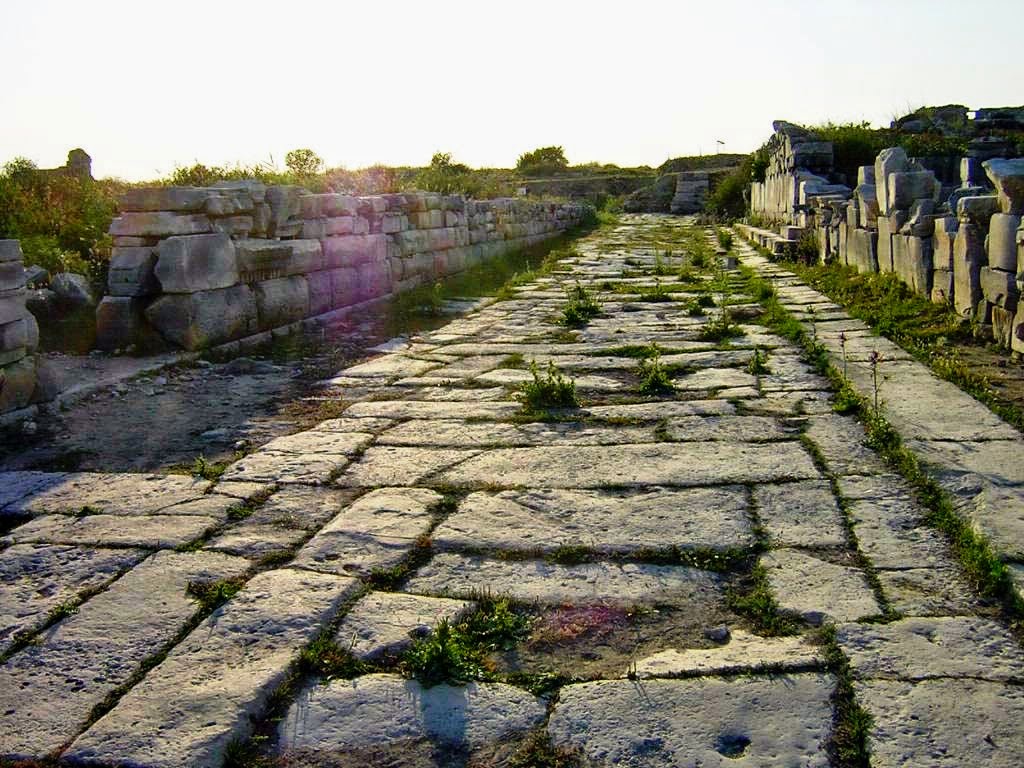
From here, it is easy to find the 24-meter-wide Harbor Street, which was entirely paved. On either side runs a sidewalk that can be reached via three steps. Cevdet Bayburtluoğu (see: Lycia) has speculated that there might have been an extra wooden step since the first one is pretty high. Statues of important citizens lined up the street, duly resting on a pedestal engraved with their names or the reason for their presence. The pedestals were put back into place after the Byzantines had removed them to build the pier. Cevdet Bayburtluoğu recovered them from the harbor's depth and put them back in place. This is the reason why some of these stones look so much worn. Notably, this avenue is reserved for pedestrians as the three-step staircase on either end makes cart access impossible.

To the left are the latrines, after a small bath establishment, the Bath of the Theatre, probably built after the earthquake of 240, since recuperation material from earlier periods has been used. The sewage of both complexes went straight into the Naval Harbor, where traces of this system can still be seen. After these small baths, which functioned at least until the 8th century, one reaches the theater, the inevitable eye-catcher in any city. The old staircase to the entrance is still there, but is not very recommendable. Instead, a relatively comfortable wooden construction has been put in place. The theater is typically Hellenistic, although the skene is a pure Roman addition. The walls of the skene have been badly damaged, not so much because of age but because of a severe fire that caused many lintels made of porous stone to collapse. Such a shame for a building that withstood centuries. A theater always touches a soft spot in my soul, for this is a place where people gathered some 2,000 years ago, walked through its corridors, and climbed its steps, with echoes of voices and sounds from times past under the watchful eyes of the snow-capped Tahtali mountain.

The central square or Agora is somewhat puzzling because it is a shapeless space situated halfway the Harbor Street, which continues further along the Agora of Domitian to the Southern Harbor. This Agora is neatly paved, and opposite the theater are the remains of a Nymphaeum – another of those monuments that a trained eye recognizes immediately. There are two more such Nymphaeums on either side of the passageway to the Agora of Hadrian. The left and oldest one (mid-3rd century AD) is rather difficult to make out, as opposed to the one on the right, dating from the end of the 3rd and beginning of the 4th century. In the prolongation of Harbor Street, the stretch between the Agora and the Southern Harbor that also ends with three steps, we find the Gate of Domitian, the entrance to the Agora by the same name. For some obscure reason, the name of Domitian was erased from all official buildings after his death.

We find most of the shops in this part of the city, but since the streets were only accessible to pedestrians, the supplies had to be brought in from the parallel back streets.

At the end of this paved road, next to the steps leading to the harbor, several marble blocks indicate where the large Triumphal Arch for Hadrian once stood. It was built in all its splendor after his second visit to Phaselis in 131 AD, when the city reached its climax. It consisted of one large vault resting on two square pillars decorated with lion paws. The busts of Faustina and Sabina have since long disappeared from the niches, and we can only find blocks with reliefs of fancy vines and drinking vessels.

It is nice to meet my friend Opramoas of Rhodiapolis again, in stone, that is. As mentioned earlier, he is the benefactor who contributed to the reconstruction of Phaselis after the terrible earthquake of 141 AD. In thankful remembrance, the citizens erected a monument in his honor not too far from the Agora of Hadrian. A small part of the accompanying inscription is still visible on the lintel above the gate.

The Southern Harbor, where today’s tourists anchor their boats, is a pleasant green oasis along the dark blue waters crowned by the snow-capped Tahtali Mountain in the background – a picture-perfect setting! According to Cevdet Bayburtluoğu, this is where we should look for the Greek city. No serious excavations were ever carried out in these parts, and the fencing is pretty random. Turkey has too many ruins and areas that require thorough research, making it extremely difficult to set priorities. If this is indeed the site of the original Greek city, which will have to be confirmed by future excavations, we may have a chance to recover the remains of the Temple of Athena, where Achilles’ lance was kept.

This being said, these parts of Phaselis have been recently (2008) threatened by a building project. The owner of the Rixos Hotels intended to build a new hotel, “Dream of Phaselis,” right on top of the ancient city. It was a hard fight, but environmentalists and archaeologists, for once, did win this battle, and in 2015, the project was abandoned!

Walking back, it is worth investigating the remains of the Large Baths and the Gymnasium along Harbor Street, both from the 2nd century AD. A few mosaic floors from Byzantine times are still there, as well as the piles of fireproof bricks that once supported the floors of the Caldarium and the Tepidarium. On the opposite side, several temples stood next to each other, but the remains were vague, and the thickets covered most of the walls from view. This is, however, the place to look for the Temple of Zeus with the inscription Dios Boulaios from the days of Nero and Antoninus Pius, and a little further, one should be able to find the two temples dedicated to Leto’s children, the twins Artemis and Apollo who were highly revered by the Lycians.

The intrepid visitor may still find the energy to scramble uphill to the necropolis, nothing more than broken and crumbled sarcophagi, some of them submerged downhill. About three-quarters of the necropolis seems to lie outside the fenced area and has yet to be excavated. There are imposing remains of a large mausoleum which at first was labeled as a temple because of the stumps of columns, but it is more likely that this was the tomb of a wealthy family from Phaselis.

Once again, it will be interesting to return here at some point in the future and see what new excavations will reveal and what additional information will become available.

Wednesday, January 6, 2016

In search of the Forum at Serdica (modern Sofia)

As mentioned in an earlier blog (see: Ulpia Serdica, the Roman name for Sofia), today’s capital of Bulgaria is sitting right on top of old Serdica, whose history goes back to 5000 BC. It seems that the Thracians were the first to settle in this valley, where they built the first city, which they named Serdica. During the fourth century BC, it was conquered by Philip II during his expansion of Macedonia’s frontiers. Around 29 BC, the Romans took possession of the city and renamed it Ulpia Serdica. Emperor Trajan established his administrative center here and started an extensive building project. Serdica is said to be the favorite residence of Constantine the Great, who qualified the city as “my Rome.” Unfortunately, the city was destroyed by the Huns in 447 AD. However, it was apparently rebuilt by the Byzantine Emperor Justinian, who protected it with sturdy fortress walls that are still visible today. It was in the 14th century that the city changed its name to Sofia as a homage to the St Sofia Basilica.

Excavations seem to be carried out at a more or less steady pace, although spread randomly over different locations around Sofia. The most recent digs occurred on the parking lot of the Sofia Hotel Balkan and under the square next to the Holy Sunday Church (St Nedelya), a favorite of the Bulgarians. This is where archaeologists hoped to uncover the Roman agora of Serdica. Instead, they found a building from the 3rd century AD with exceptionally thick foundation walls of more than 1.5 meters thick. As this is three times the average wall thickness, it leads one to believe that it had to support the extra weight, maybe two-floor levels. The house stands along a stretch of the old Decumanus that is particularly wide at this point, measuring about six meters.

In a way, it is disappointing that the Roman Forum has not been found, but on the other hand, not all cities had one, although there must have been some kind of meeting space to centralize public and religious life. So far, of all the cities excavated in the Roman Province of Thracia, only Philippopolis (modern Plovdiv) had a Forum. Archaeologists are not giving up their quest at Serdica as the next possible location may be the underpass of the St Petka Church. Next year’s excavations may shed new light on this theory.

Meanwhile, extensive restoration works have been carried out here as well as at previously uncovered sites, and once they are completed, the remains will be covered with glass to allow the passer-by to have an intimate look at the city’s history. The different locations will be connected in order to create a large open-air museum.

Besides remains of buildings and streets, a hoard of silver coins was discovered at St Nedelya Square in September 2015, hidden in a ceramic pot. The 13 kg treasure counts 2,976 Roman coins from the 1st and 2nd century AD and was the prized possession of a certain Silvius Calistus, who carved his name on the pot. This is the largest collection ever found in Serdica and was gathered over a period of one hundred years as the earliest coins were minted under Emperor Vespasian (69-79 AD) and the last under Emperor Commodus (180-192 AD). So far, the coins were identified with the effigies of the Roman Emperors Nerva, Trajan, Hadrian, and Antonius Pius, but also of some Empresses or rather wives of Emperors like Vibia Sabina (wife of Hadrian), Faustina the Elder (wife of Antoninus Pius), Faustina the Younger (wife of Marcus Aurelius), and Bruttia Crispina (wife of Commodus).

Archaeology in Bulgaria (click on the link) has published a number of photographs showing the excavation sites of Sofia as discovered in 2010, together with a picture of the same spots in 2015 after cleaning and restoration works were carried out.

[Pictures were taken from Archaeology in Bulgaria]

Thursday, February 12, 2015

Miletus, Alexander’s first siege in Asia

While Alexander was still in Ephesos, the Persian governor of Miletus, Hegisistratus, made his appearance at the court. He came in peace, offering the surrender of the city. At that time, Miletus was the largest Greek city on the eastern shore of the Aegean Sea.

Its origins go back to Mycenaean times in the 11th century BC. In 670 BC, Miletus started colonizing the coast of the Black Sea, the Mediterranean, and the Sea of Marmara. Just like Priene and the other cities belonging to the Ionic League, Miletus suffered from repeated Persian invasions and occupations, the most memorable of which happened when Cyrus defeated Croesus of Lydia, causing the fall of Miletus. In 499 BC, however, this city led the Ionian Revolt against the Persians, punishing Miletus and destroying the mighty city, but it soon recovered.

So, by the time Alexander arrived in 334 BC, Miletus was in Persia's hands only because its excellent harbor was their main base, ideally situated to control the other cities of Asia Minor or launch a counter-attack on mainland Greece. Miletus was surrounded on three sides by the sea and had strong fortifications on the landward side. It is not surprising that Alexander welcomed Hegisistratus’ offer.

In this context, Alexander marched towards Miletus with only a small number of troops in his entourage. Yet, at the same time, news reached Hegisistratus that a 400-warship strong fleet of the Persians was only three days away. This gave the governor new hope and a good reason to resist the Macedonian king, who found the city gates closed upon arrival.

Meanwhile, Alexander’s own fleet of 160 ships commanded by Nicanor (brother of Parmenion) had anchored on the island of Lade, just off Miletus. The island was fortified with 4,000 men 4,000-man-strong garrison ready to make it difficult for the Persians to use the harbor for their operations. Consequently, the Persian fleet was forced to land off Mycale, some 15 km south of Miletus. The situation at sea seemed locked for the time being. Alexander decided to begin besieging Miletus from the land side, confident that the Persians were in no position to help or reinforce the city from the sea.

For the time being, Alexander made himself comfortable in nearby Priene and directed the siege operations from there. Here, he was approached by an unexpected embassy led by Glaucippus, a well-respected citizen of Miletus. His proposal was that Miletus would become a free city, meaning that both Persians and Macedonians could use its harbor at will. If he had accepted, Alexander would have allowed the vital port of Miletus to be open to the Persians, who had access to the entire coast of Asia Minor.

Early next morning, Alexander moved his siege engines forward, probably including his stone-throwing catapults. Artillery was used to chase the defenders from the walls, after which the battering rams and scaling ladders were brought in. The wall crumbled soon enough, and the city was quickly taken. The Greek fleet, which had positioned itself as a ring around the city, successfully prevented the Persians from giving Miletus any assistance.

Panic broke out among the citizens of Miletus, who immediately offered to surrender to Alexander. Alexander probably accepted their plea, but he slaughtered nearly all the Greek mercenaries who had defended the city from the Persians. Only about 300 of these mercenaries escaped, using their shields as makeshift rafts to paddle to safety on one of the many rocky islets off Miletus. Of course, Alexander was not going to leave it at that and mounted scaling ladders to the front of his triremes to be used by his men to land on the islet. On the other hand, the mercenaries did not ask for mercy but were prepared to fight to the death. At this point, Alexander showed clemency, and in the end, they were included in his army.

With Miletus taken, Alexander could now concentrate on eliminating the threat of the Persian fleet. He did not want to get involved in a naval battle because his fleet was much smaller, and the men on board were not trained in maritime warfare. Instead, he sent Philotas by land to Mycale, preventing the Persians from landing and getting new provisions and fresh water from the River Maeander. The fleet withdrew, seeking protection on the island of Samos instead. Eventually, the Persian fleet moved south to the safety of Halicarnassus, which was still in Persian hands.

This being settled, Alexander elected a democratic leader, canceled all taxes, and boosted commerce – in short, he started a new period of prosperity for Miletus. This prosperity ended with the arrival of the Romans in 133 BC, who imposed high taxes now that the city was part of their Provincia Asia. By the third century AD, Miletus’ decline set in as its harbors silted up and marshes were formed.

Today, the antique city is to be found 10 km inland, and in springtime, the once so busy port is covered by extensive marshlands filled with reed and blooming irises. In a way, this helps to imagine what this vast harbor must have looked like. The old rotunda was part of the Harbor Monument built in honor of Pompey in 31 BC, still surrounded by water. This Monument must have been at least 7.5 meters high and may have carried a big iron pot on top, part of which is now on display at the Pergamon Museum in Berlin. Maybe, after all, it was a beacon? Although the marshes are omnipresent in springtime, the land is dry in autumn, meaning that the visitor gets quite a different view of Miletus in either season.

In historical literature, Miletus is described as less impressive than Priene, but I think that is somewhat cliché, for it is just different.

The most striking building is the theater sitting on the hilltop, commanding the entire city of Miletus. It is one of the most splendid constructions one can imagine, not only because of the many tiers of seats that have been so well preserved but also because of the entrance gates and the near-intact vaulted corridors. This theater clearly illustrates the high level of architecture reached by the Romans; the very concept of theater is highly efficient. Easy walking steps take the visitor to the cool entrails with fascinating views over the surrounding landscape and the interior of the theater itself. The first theater was evidently Greek, built in the 4th century BC, and counted approximately 5,300 seats; the Romans extended it in the 2nd century AD to hold 25,000 people. The façade is impressive enough, 140 meters long and 30 meters high. It is hard to imagine this theater's full impact since the upper tiers' stones have been taken to build the Byzantine church on top, leaving a mere seating space for 15,000 people.

From up here, one can easily see the layout of the entire city. Following the marshy water line from the harbor, I find the Delphinium, the open-air Temple of Apollo Delphinius, the protector of the seafarers and the ships. The four remaining columns of the Ionic Stoa next to it quietly reflect their image in the still waters covering the North Agora. Sitting in the shadow of these columns, I discover an ancient graffiti of a fish and the Greek word IΧΘΥΣ, both symbols that were used by early Christians – what a rewarding moment!

The remains of the adjacent Hellenistic Gymnasium are relatively poor, and the colossal Nymphaeum from the 2nd century AD flanking it on the other side requires lots of imagination to picture it. Across from the Nymphaeum are the remains of the Bouleuterion, built between 175 and 164 BC. But here, as elsewhere, the parts belonging to the Hellenistic period blend in very harmoniously with those added later by the Romans.

Further south, past the South Agora, the Baths of Faustina, Marcus Aurelius’ wife, are visible; rough brick arches and walls don’t do justice to the once so great building whose ornamental statues are now in the Archaeological Museum of Istanbul. These baths date from 43 AD, and I’m not surprised to hear that they served as a role model for the Turkish baths, the hammam. This South Agora, belonging to the 2nd century AD, measures an impressive 196x164 meters and must have been impressive. The southern entrance gate to this Agora has been entirely moved and reconstructed at the Pergamon Museum in Berlin (unfortunately, it was under restoration when I visited the museum).

It certainly is worthwhile to visit Miletus in spring and again in fall when the water level has receded, and the Agoras show their large slabs of marble flooring. At that time, the outline of the different buildings was much more recognizable, which truly helped to get a comprehensive view of the city.


Between the Baths of Faustina and the South Agora lies the Temple of Serapis from the 3rd century AD. Not much is left except the re-erected pediment showing a relief of the god Helios Serapis wearing a crown of sun rays. The rectangular buildings seen on the right-hand side are warehouses.

That brings me to the most exciting location in Miletus, the Sacred Road that led all the way to Didyma, the city renowned for its oracle. The first road dates back to at least the 6th century BC, but it has been improved and embellished over the centuries. In 100 and 101 AD, Emperor Trajan, for instance, raised the road level and made the necessary repairs. From the early days onward, this Sacred Road was lined with statues of the Branchidae (priests and priestesses attached to the temple of Didyma); crouching lions and sphinxes; votive fountains; and even monumental tombs and sarcophagi belonging to important persons. None of these features is to be seen anymore since all were moved to the British Museum in London, the Archaeological Museum in Istanbul, or the local Museum of Miletus. This 16.5-kilometer-long road was entirely paved and had a width of 5 to 7 meters. Both in Miletus and in Didyma, it is still pretty easy to locate a sizable stretch of this Sacred Road; just have a close look. I was so lucky to be put on the right track by Peter Sommer during my travel on his tour "In the Footsteps of Alexander the Great" - a most rewarding experience! 

I have not found any indication about the road used by Alexander on his way from Miletus to Didyma, but it is rather evident that he would have followed this Sacred Road. For me, this is another place where Alexander’s presence is still tangible. 

[Click here for more pictures of Miletus]

Monday, December 15, 2014

Heading for Dascylium and Sardes

After contemplating the Battle of the Granicus, I am taken further north on this trip with Peter Sommer In the Footsteps of Alexander the Great, heading for Dascylium. I am a little surprised because Alexander never went to Dascylium, as he sent his seasoned general Parmenion instead. Well, I suppose it was just part of the campaign, and I take in the same rather dull, flat landscape I met on the road to the Granicus. Yet, so much history has been written in the furrows of this freshly plowed soil. Less than one hundred years before Alexander, Xenophon and what remained of his Ten Thousand marched through this countryside, a detail that cannot have been lost on Alexander.

But the Macedonian king had to press south, well aware of the threat posed by the sizable Persian navy patrolling the coast of Asia Minor. Parmenion took Dascylium, the capital of Hellespontine Phrygia, without trouble, as the guards had abandoned the town. A new satrap, Calas, was quickly put in place. From now on, the tribute Dascylium used to pay to Persia would come to Alexander.

It is hard to imagine the city on this low hill now overgrown with bright spring flowers, yellow rapeseed, and red poppies. Remains of low Greek city walls with neatly cut stones, bits of Byzantine walls in which spolia from earlier ages have been used, and then the scarce ruins of habitation. It is beyond doubt that Parmenion did a thorough job! A lovely place for a city anyway, I think.

From here, we pass but don’t stop at Cyzicus, which Alexander also conquered. It is said that he was responsible for connecting the island to the mainland. I wonder what is left of the huge amphitheater with a diameter of 150 meters, which the Romans built here in the 3rd century BC. It was intersected by a stream, making it particularly fit for naval battles – the only one of its kind in Turkey! It must have been a magnificent sight, and it is mentioned as being one of the Seven Wonders of the World. Apparently, as late as 1444, the visitor could still admire thirty-one of the immense columns in place.

My trip continues through a landscape filled with tumuli, which I am told belong to the days of King Midas (late 8th century BC). It is a long drive to Sardes, the capital of Lydia, for Alexander, a march of nearly 200 km. Apparently, the news of Alexander’s victory at the Granicus had traveled quicker than his army. Before reaching the fortified city, he was met by the leading men and their satrap, Mithrines, who not only surrendered Sardes but also its treasury. The money was most welcome, of course, since Alexander had left Pella with only sixty talents - a very poor financial situation, knowing that he had inherited a debt of 500 talents from his father and had been borrowing another 800 talents to get this expedition underway. For now, he had a financial breather.

The army set up camp on the banks of the Hermus River, about 2,5 miles from Sardes, and Amyntas was sent to take possession of the fortress. Alexander kept Mithrines in his own suite and treated him according to his rank. After taking Babylon, Mithrines was appointed governor of Armenia.

As we will see so often afterward, Alexander treated well those who did not defy him. Sardes and Lydia were now declared free from Persian rule but had, of course, to pay the same tribute to their new ruler, yet in exchange, they were allowed to observe their old customs. It was also here that, for the first time, Alexander gave orders for Lydian youths to be trained in Macedonian tactics. This practice would be repeated over the years in Lycia, Syria, Egypt, and Persia. This shows once again that Alexander never doubted he would be victorious!

Sardes, as it has reappeared from archaeology, is definitely worth a visit. On a previous visit, I had walked around the beautifully restored Palaestra and Baths with the Synagogue that was reserved for the Jews and incorporated into the Palaestra by Severus Alexander in the third century.

I was looking forward to seeing it from Alexander’s point of view. The two-story high (restored) buildings are visible from afar, and it is a pleasure to stand in front of this mixture of high Ionic and Corinthian columns, some with spiral grooves turning alternatively to the right and to the left. Inasmuch as possible, the original inscriptions have been reintegrated. It seems this complex was inspired by the Library of Celsus in Ephesus. Behind the Palaestra are the Baths with two distinctive pools, just tempting my imagination. This complex built in Imperial Style, was completed in the second century AD and remained in use till the Sassanid invasion of 616 AD.

In Alexander’s days, neither this sport's complex nor the integrated Synagogue nor the Roman villas and the public buildings across the street existed. Next to the modern road runs the monumental 18.5-meter-wide avenue built on top of the original Lydian road from the 7th-6th century BC, two meters below. So maybe Alexander walked over that Lydian road? Luckily, the modern asphalt road has been planned to run parallel to the south in order to expose the antique marble slabs of this Roman thoroughfare of the 4th-6th century that was wider than the modern road!

With my co-travelers threading in Alexander’s Footsteps, we move further to the impressive remains of the Temple of Artemis, which was never finished. Some columns have been fluted, but many were not. The construction began at the time of Alexander the Great in 334 BC, having a double row of columns surrounding an enclosed inner building.

The altar of Artemis, however, is much older than the temple itself and seems to go back to the sixth century BC. The stepped platform we see today dates from the Hellenistic period. Construction of this temple went in fits and starts and was hit by the earthquake of 17 AD. At some time, Artemis shared her sanctuary with Zeus, as indicated on an inscription honoring both. In about 150 AD, Sardes gained the title of “neokoros,” meaning “temple-warden”, which implied that it was required to have a temple dedicated to the Roman imperial family. This time, the Temple of Artemis was split in two, where Artemis and Empress Faustina were worshiped together in the front part. At the same time, Zeus and Emperor Antoninus Pius shared the back of the sanctuary. With hindsight, the base of the columns looks very much like those of Didyma. This makes sense as it is the fourth largest Ionic temple in the world after Didyma (the largest being the Temple of Artemis in Ephesus, followed by the Temple of Hera in Samos).

It makes a huge difference to visit this site under the guidance of a historian like Peter Sommer, as he effortlessly points out the details of the buildings or the reasons for their inscriptions, something that a lone traveler will have a hard time figuring out.

We do not climb to the Acropolis, however, since the visible remains are mainly Byzantine and do not add to Alexander’s exploits. According to Arrian, Alexander went up there and saw the Palace of the Lydian kings and the Persian garrison. He must have been aware of his luck for not having to besiege this impregnable fortress. He decided that this was the right location to build a temple in honor of the Olympian Zeus. While he was considering the best spot, a thunderstorm broke loose, which he took as a sign sent by Zeus himself, and he made his decision accordingly. Whether or not this temple was ever built, we simply don’t know.

Alexander then made all the practical arrangements, leaving Pausanias, one of his Companions, in charge of the fortress and assigning others to specific organizational functions. Then, the news reached him of unrest in Ephesus, and it was time to resume his march south.