Alexandria's founded by Alexander

Alexandria's founded by Alexander the Great (by year BC): 334 Alexandria in Troia (Turkey) - 333 Alexandria at Issus/Alexandrette (Iskenderun, Turkey) - 332 Alexandria of Caria/by the Latmos (Alinda, Turkey) - 331 Alexandria Mygdoniae - 331 Alexandria (Egypt) - 330 Alexandria Ariana (Herat, Afghanistan) - 330 Alexandria of the Prophthasia/in Dragiana/Phrada (Farah, Afghanistan) - 330 Alexandria in Arachosia (Kandahar, Afghanistan) - 330 Alexandria in the Caucasus (Begram, Afghanistan) - 329 Alexandria of the Paropanisades (Ghazni, Afghanistan) - 329 Alexandria Eschate or Ultima (Khodjend, Tajikistan) - 329 Alexandria on the Oxus (Termez, Afghanistan) - 328 Alexandria in Margiana (Merv, Turkmenistan) - 326 Alexandria Nicaea (on the Hydaspes, India) - 326 Alexandria Bucephala (on the Hydaspes, India) - 325 Alexandria Sogdia - 325 Alexandria Oreitide - 325 Alexandria in Opiene / Alexandria on the Indus (confluence of Indus & Acesines, India) - 325 Alexandria Rambacia (Bela, Pakistan) - 325 Alexandria Xylinepolis (Patala, India) - 325 Alexandria in Carminia (Gulashkird, Iran) - 324 Alexandria-on-the-Tigris/Antiochia-in-Susiana/Charax (Spasinou Charax on the Tigris, Iraq) - ?Alexandria of Carmahle? (Kahnu)
Showing posts with label Memnon. Show all posts

Thursday, April 14, 2022

How important was Barsine?

The question is actually double: How important was Barsine for Alexander? And how important was Barsine in the geopolitical world of her time? 

Authors from antiquity have not spent much ink on her, and she is only mentioned when she comes to the foreground, which isn’t often.  

Barsine was the daughter of Artabazus II, satrap of Hellespontine Phrygia in northwestern Turkey. Artabazus’ first wife was from Rhodes and was the sister of two capable generals, Mentor and Memnon. 

Artabazus revolted against the newly appointed Persian king, Artaxerxes III Ochus. Artaxerxes had ordered the dismantling of his mercenary army, which the satrap did not accept. Artabazus and his family (including Memnon) went into exile and found refuge at the court of Philip II in Pella. Barsine, who was fluent in Greek, must have met the younger Alexander during their stay. We don’t know the nature of their encounters or conversations, but we may safely assume that Alexander inquired about life and customs in Persia. After all, he impressed the Persian envoys at a young age as he questioned them pending his father’s return to the Palace. 

Three years later, Artabazus reconciled with the Persian king, and he returned to Persia, taking Barsine and his family with him. That happened in 343 BC, about one year after Aristotle arrived on the scene to teach Prince Alexander. Over the years, the entire company probably met the philosopher along with other distinguished visitors to the Macedonian court. 

Barsine married her uncle Mentor, a Greek mercenary general in Persian service, while she still was young. Mentor died soon afterward, leaving her with a daughter. In those circumstances, Memnon took her as his wife that same year, 338 BC. He already had several sons from a previous marriage. We can safely assume that Barsine’s opinion in these matters didn’t count. What’s more, she became a second mother to her husband's (teenage?) sons. Just as Mentor, Memnon led an army of mercenaries for the Great King. Having a lovely wife familiar with the Greek language and culture, no doubt, added to his prestige. 

In 334 BC, when Alexander, now king of Macedonia, faced the Persian army at the Granicus River, Memnon fought on the enemy’s side. Although the battle was lost, the general’s capabilities were recognized by Darius, and he was appointed as commander of the Persian fleet in the Aegean. This honor may be a questionable trust because, in exchange, Barsine had to stay at King Darius’ court with her father, Artabazus. 

A year later, during the siege of Lesbos Memnon fell ill and died. Barsine was widowed for a second time. 

Around that time, Alexander had reached Issus where he defeated Darius in November 333 BC. When Parmenion rode to Damascus to take hold of the Persian treasury, the baggage train, and the women of the aristocrats, he met Barsine and brought her to Alexander. 

Her relationship with Alexander lasted five or six years. I wonder whether she traveled with Darius’ mother, wife, and children, who had been taken in Issus. Alexander was constantly on the move, conquering the eastern Mediterranean and Egypt and marching to Babylon and Susa, where he finally installed the Persian Royal Family. Barsine stayed at Alexander’s side, and we can only guess which quarters she occupied when the army was on the road. 

During that time, Artabazus remained faithful to Darius until the Great King was murdered by Bessus, who then proclaimed himself the new king of Persia. Artabazus refused to submit to Bessus and left, taking his mercenaries with him. He joined Alexander, who rewarded him with the satrapy of Bactria. Here he was reunited with Barsine. 

She is mentioned again by ancient historians about 327 BC at the end of Alexander’s campaign in Sogdia. However, it is unclear in which order the events unfolded precisely. 

The fact is that Barsine became pregnant and gave birth to Heracles. Alexander never recognized his son, his first-born, although he must have loved him, giving him the name of his ancestors. Is it possible that Alexander resented Barsine for having Heracles without his consent? She and little Heracles stood in his way for his bigger plans, meaning to marry Princess Stateira as – probably – agreed with Sisygambis. Barsine must have known of those plans, so she had no excuse. 

It is, in any case, a strange coincidence that Alexander almost immediately married Roxane, the daughter of a local chieftain. This was not love at first sight, as most authors claim. It was a purely political move to end the three-year wars through Bactria and Sogdia. 

Artabazus requested to be relieved of his duties in Bactria because of his old age. Alexander accepted his resignation and Artabazus left for Pergamon taking Barsine and the little boy with him. Artabazus seems to have produced an elegant way to retire, and, at the same time, he created the best solution for Barsine since there was no longer a place for her at Alexander’s court. She had to say goodbye to the snow-topped mountains of the Hindu Kush after sharing so many miles with the Macedonian troops and her great love.

Barsine met Alexander again in 324 BC when she attended the mass wedding at Susa. Her daughter from Mentor married Nearchus. Two of her sisters were also given in marriage to Alexander’s companions, but the sources (Plutarch and Arrian) are at odds with each other about the names. 

Hardly a year later, Alexander died in Babylon. I wonder whether Barsine was still in nearby Susa, close enough to say her goodbyes to the man she once loved? If she returned to Pergamon after the wedding, she could never make it to Babylon in time. 

She and Heracles quietly spent the next decade in Pergamon. In 310 BC, Cassander as king of Macedonia, summoned Alexander IV, Alexander’s 14-year-old legitimate son with Roxane, to Pella to be poisoned. 

The news traveled fast and eventually reached Pergamon, as poor Heracles was now at the center stage in the drama of the Succession War. Initially, general Polyperchon had been defending the cause of the now 17-year-old Heracles, but in 309 BC, he fell into Cassander’s vicious trap. Cassander made many great promises of money and power in exchange for eliminating Heracles. For one hundred talents, Polyperchon tricked Heracles into accepting an invitation for dinner and poisoned him. Barsine, who had traveled with her son, was murdered shortly afterward, although some sources pretend she was murdered simultaneously. Sadly, Heracles didn’t even receive a proper burial in the cemetery of his ancestors, and neither did Barsine. 

Now about my questions formulated at the beginning of my post. How important was Barsine for Alexander? Well, she was important enough to keep her at his side for about six years. All this time, she managed not to get pregnant. Barsine knew that Alexander dearly wanted and needed an heir during those years of intimacy. She also knew that his plan was to marry a Persian princess. Barsine spoiled this by wanting a child of her own. Alexander had his principles and stuck to them. Nobody, not even sweet and gentle Barsine, was allowed to interfere. His sudden marriage to Roxane may be seen as a statement toward Barsine. Historians say Alexander fell in love with Roxane because of her beauty. In my mind, her beauty may be a nice bonus, but it was not the main reason. 
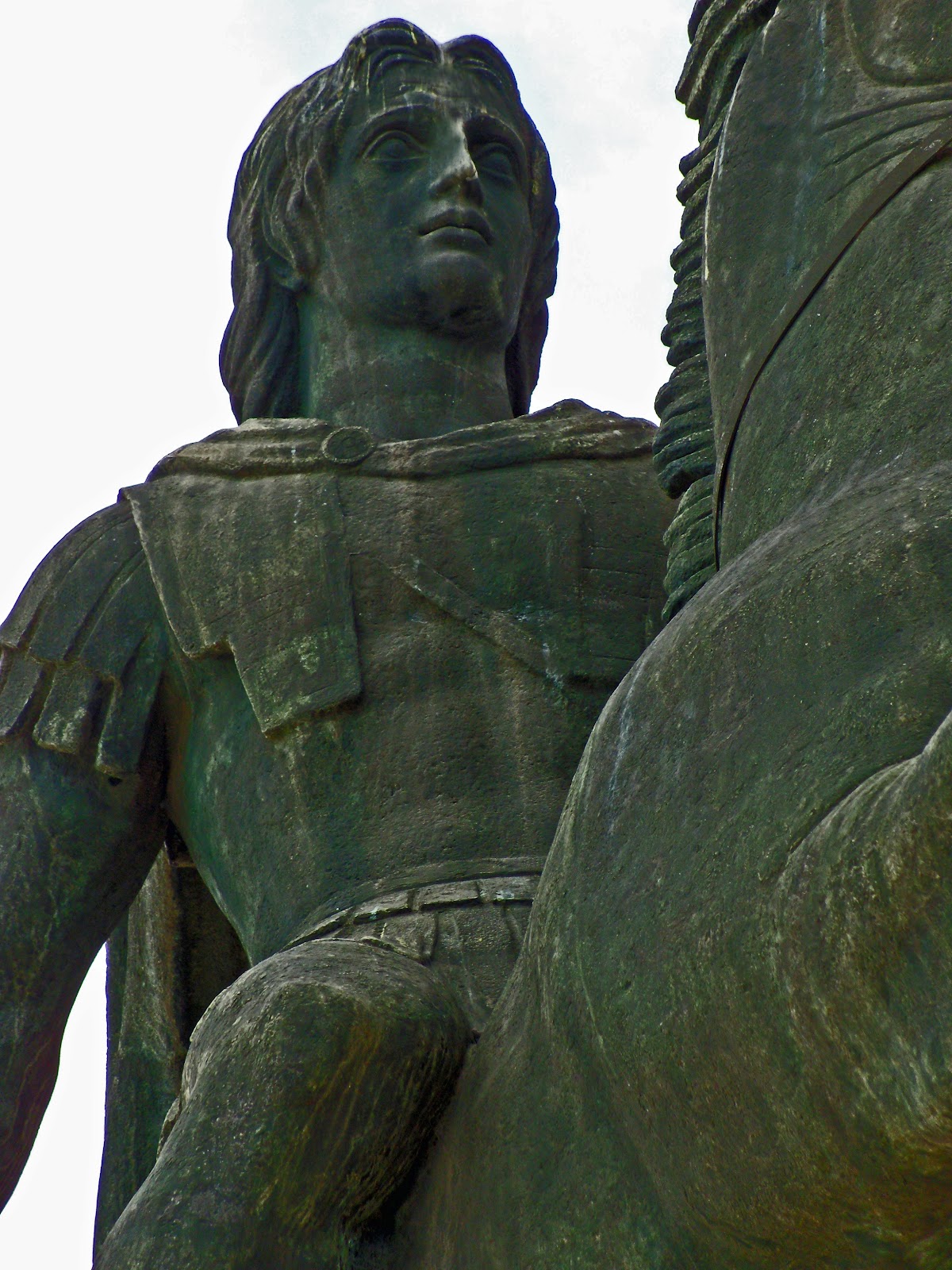

How important was Barsine in the geopolitical world of her time? Barsine was a beneficial source of information about the Persian court, Persian habits, and culture. After all, she had lived at least three years at the court of King Darius. Speaking Greek was an important asset to avoid misunderstandings. Alexander was an excellent judge of character, and having met Artabazus at Pella, he knew that he was a man of his word and could be trusted. Artabazus was loyal to Alexander. Having his daughter at the king’s side was a warranty that worked both ways. Barsine and her father contributed to Alexander’s larger plan. The birth of Heracles disturbed this goal – something Alexander never could or would accept. Barsine no longer fit his purpose in the new world he was building.

Wednesday, January 26, 2022

Who is Alexander? Part II


Alexander heads for Asia at twenty-two, leaving Macedonia in the hands of his father’s trusted general Antipater as Regent. He sets out with an army of about 40,000 infantry and 5,000 cavalry. The gods are with him all the way. The first opposition happens in a tiny corner of Asia Minor, on the banks of the Granicus River. Darius III, King of Persia, King of Kings, believes that his presence is not required and merely delegates the confrontation to a mercenary in his service, a Greek on top of that, called Memnon. Well, Memnon, although a highly skilled general and Alexander’s most formidable opponent, is defeated. Nothing can stop Alexander now from taking one city after another, one port after another, all along the west coast of today’s Turkey. 

A year later, Alexander will face King Darius in person at the Pinarus River near Issus. The Persian army was huge compared to the Macedonian, but it was outmaneuvered during the first minutes of the battle. King Darius panics and flees into the backcountry. By leaving the battlefield, Alexander automatically emerges victorious. 

Both kings meet again, two years onwards, in a decisive confrontation on Persian soil near Arbela, a place better known as Gaugamela. It is a fight worthy of David and Goliath, where Alexander, with his 50,000 men, stands up against Darius’ troops, which may be 250,000 and has been exaggerated to 500,000. Whatever the numbers, his opponent counted many times more soldiers than his own force! From the tactical point of view, the battle proves to be such prowess that it is still taught at the Military Academy of West Point today. Alexander attacked an empire that was ten times bigger than his! 

Alexander’s accomplishments reached far beyond winning battles. He took on the organization of the entire enterprise, working out the logistics, relentlessly inspiring his army, and caring for all involved. Everyone looked up at him for guidance. 

Alexander’s empire extended from Greece to India and from Uzbekistan to Egypt at the height of his power. His army and baggage train in Asia must have counted at least one hundred thousand men. This mass of people inevitably included merchants, peddlers, blacksmiths, tailors, stone cutters, shipbuilders, entertainers, carpenters, cooks, architects, masons, road builders, and whores. Alexander managed to take his dismantled ships and catapult towers with him on the road so he could assemble them whenever needed. The word prefab was invented only eons later. 

The king moved all these people through the scorching deserts of the Karakum and the Gedrosian. He took them over the snow-capped mountains of the Zagros and the Hindu Kush. Also across swift-running rivers such as the Euphrates and Tigris, Oxus and Jaxartes, Indus, and entire Punjab. Just try to picture that crowd of soldiers, horses, followers, and equipment trudging through uncharted territories. It is dazzling! 

Alexander organized a government adapted to each and every land and tribe he conquered. He founded cities at strategic trade-road crossings, many of which still exist today. His task was absolutely colossal, and Alexander always was the driving force. Alexander also was a visionary, one we would love to have around today. He welded the world into one country.

Neither his Macedonians nor the Greeks were ready to comprehend the grandeur of his conquests, their vastness or scale. He made excellent use of the accumulated treasuries kept in the Royal Persian vaults, minting vast amounts of gold, silver, and bronze coins. The coins had Alexander’s image stamped on them, which was a somewhat new concept for until then, only gods were worthy of such a favor. The Alexander coins were known and accepted all over the empire. It was the euro of antiquity! 

Finally, there is Alexander’s legacy, i.e., the impact of Greek fashion, culture, and art on the occupied territories – a phenomenon that went down into history as Hellenism. From Athens to the Indus, the official language was Greek and remained so for nearly one thousand years until Islam took over with the use of Arabic. We owe it to Hellenism that the first statues of Buddha were made, that the first Library of Alexandria in Egypt was created, and that the Romans rose to power. Christianity spread so smoothly thanks to the usage of Greek, and the Renaissance is nothing less than a renewed connection with Hellenism. 

All of Alexander’s cities were built according to the Hippodamian plan with right-angled streets, including familiar buildings like temples, gymnasiums, agoras, theaters, and stadiums. Alexander’s love for games, sports competitions, and theatre contests with playwriters and actors traveling thousands of miles is another tradition that was continued for centuries deep into Central Asia and India. 

Our world would not be what it is today had it not been for Alexander. No other man in history impacted the world as much as Alexander the Great. Nobody conquered and ruled at the level of Alexander’s high standards, and nobody ever will.


Please consult my book for the full story of his conquests and achievements: "Alexander the Greatwas here, and so was I.”

Wednesday, November 5, 2014

The Battle of the Granicus

Strangely enough, the Persian army had made no effort to stop Alexander and his army when crossing the Hellespont, which was a missed opportunity, no doubt. Still, they now awaited the Macedonian king near the Granicus River in Hellespontine Phrygia, a satrapy that stood under the control of Persia.

With my traveling companions from Peter Sommer's In the Footsteps of Alexander the Great, we head in that direction. The landscape is monotonous and uninspiring. After parking the minivan, we walk a short distance over a local asphalted road to the wooden railing of a bridge. Here, I lay eyes on the Granicus River for the first time, a river like so many, a good 25 meters wide and probably not deeper than one meter. I find it hard to believe such a decisive battle was fought on this lazy rivulet. I am itching to go down to the water's edge with an urge to get as close as possible to the thick of the fight.

Meanwhile, locals have stopped by to investigate what we are doing here. I wonder where they all come from so suddenly out of nowhere. They disagree about the location of the fight [proof that even today Alexander is still remembered!] and point us further upstream near the remains of a Roman bridge. Still, Peter has done his research and proven his right based on ancient descriptions of the terrain. At the horizon, I can see the wedge in the mountain range through which the Persians had marched to their position.

Alexander arrived at the Granicus late in the spring afternoon of 334 BC. Still, it is unclear whether he attacked the Persians immediately or waited till the following day as Parmenion cautioned him. Alexander's reply that he would not be stopped by this trickle of water after crossing the Hellespont does not explain either decision. I personally like to think that Alexander attacked immediately as the afternoon sun would shine in the faces of the Persians and might hamper their perception of the enemy – but that is only a personal opinion, of course.

[YouTube with thanks to Jim Cleary]

Both riverbanks are very steep, and we scramble down about four meters to the water level. The grass stands high and is very slippery. It's easier to slide down that to get a good foothold, and I wonder how the hypaspists managed with their leather sandals or boots to keep on their feet, let alone in formation! To actually stand here, however, is absolutely thrilling! Peter opens Arrian's Campaigns of Alexander and starts reading how the fight evolved out loud. It's a story we all know, but hearing it here on the very spot where both armies clashed is quite unique. Many frogs are jumping around the river's edge, and for some reason, they all join in as a loud croaking audience. More frogs have heard the signal and move in, drowning Peter's voice. The louder he speaks, the louder the croaking. When he stops, they stop. It is great fun but has a very unusual deafening chorus. Spirits from the past, I wonder?

Anyway, here I am, facing the entire Persian army lined up along the opposite river bank, and it takes my breath away. They are about 20,000 cavalry, having taken a position on a vast front. At the same time, the infantry (probably not as many as 20,000 as reported by Arrian) behind them – a strange and incomprehensible strategy for the cavalry had no space to charge, and the infantry didn't have the opportunity to fight until it was too late. Peter's reading is so lively that I can almost feel the Persian presence. With Alexander and most of the Companion cavalry, I am standing at the head of the right-wing alongside the phalanx that is flanked on the left by the Thessalian and Thracian cavalry under Parmenion's command.

Arrian writes that there was "a profound hush as both armies stood for a while motionless on the brink of the river." Everybody's adrenaline must have risen to an unbearable level! Who was going to shout the battle cry first? Right, the Macedonians, of course, and hell broke loose! Alexander first sent a small battalion across a new stratagem known as the pawn sacrifice, whereby a small detachment was used as a pawn to split up the enemy ranks. This distraction maneuver kept the Persians occupied while Alexander and the right wing set out to cross the river. I look up and down the bank where I am standing. Surely not here? It is too steep! But Alexander's front spread out over one mile, meaning that he was positioned further upstream where the slope of the riverbank was gentler. The crossing was done diagonally, expanding the Macedonian frontline and enabling them to ride up the opposite riverbank in a continuous formation once again. Parmenion, at the other end, had moved in much the same way. The Persians defended their precious position, and in a hand-to-hand struggle, Alexander's troops ferociously forced their way out of the water while the Persians did all they could to prevent them from getting there. It is impossible to put this clash in a time frame. Still, once Alexander himself was on the Persian bank, he was immediately taken in the thick of the fight and charged straight for the spot where the Persian commanders stood surrounded by serried ranks of their cavalry.

Meanwhile, the Macedonian infantry was making steady progress, and company after company made their way across the river. A fierce fight developed, man against man, horse against horse, each side determined to take the upper hand. Alexander's men had been well trained by his father, and most had years of experience. Armed with their long sarissas, they had a clear advantage over the light lances of the Persians.

In the heat of the fight, Alexander's spear broke, and he called one of his grooms for another, but the groom had only a stub of his own spear left, which he showed to Alexander. He then had to call for one of his bodyguards, who, luckily, could help out his king. At the same time, Alexander caught a glance of Mithridates, Darius' son-in-law riding ahead of a squadron of horses in his direction. He did not hesitate and instantly galloped forward, hitting his opponent in the face with his freshly acquired spear. At this point, Rhoesaces (satrap of Ionia) rode up to revenge Mithridates and hit Alexander on the head with his scimitar, seriously damaging his helmet; but that did not stop Alexander from killing him. Then Spithridates (satrap of Lydia) rode up to him with a raised scimitar but was intercepted by Cleitus (the Black), who chopped off his arm with scimitar and all. Nearly all the troops had come across and were fighting fiercely by now. The Persians were pinned down between the push of the Macedonians and their own infantry that was mingling among their horses. Their rout was complete.

The foreign mercenaries fighting for the Persians under the command of Memnon of Rhodes had been kept aside. They were still holding their original position, apparently struck by the suddenness of the Macedonian attack. Instead of pursuing the fleeing Persian army, Alexander focused on these mercenaries instead, ordering a combined attack of cavalry and infantry to butcher them all. He deeply resented that men from Greece were chosen to side with the Persian king and against him!

Persian losses evidently were high. As for the Macedonians, Arrian mentions that no more than 25 Companion cavalry were killed during the first assault, for which Lysippos was ordered to make bronze statues. The group stood in Dion (Greece), the Macedonian religious center at the foothills of Mount Olympus, until it was moved to Rome in 148 BC by Metellus Macedonicus, having made Macedonia a Roman Province. All in all, about sixty cavalry and thirty infantry are said to have fallen at the Granicus. These figures are subject to debate as logically, they must have been much higher, but the dead were buried in style with their arms and equipment, and their direct family was exempted from taxes. No records of the wounded were kept; I guess that they must have run in the thousands. It is, however, recorded that Alexander visited them all, talking to them about their fight and their injuries and even examining their wounds.

Alexander then made an offering to Athena and, to let the Greeks participate in the honors of his victory, he sent 300 full suits of Persian armor to Athens. The inscription accompanying his gift read as follows: Alexander, son of Philip, and the Greeks (except the Lacedaemonians) dedicate these spoils, taken from the Persians who dwell in Asia. The other spoils, including purple garments, were sent as a present to his mother, except for a few items he kept for himself.

This was Alexander's first victory over the Persians, but he must have realized that although he had won the battle, he had yet to defeat the King of Persia. Another confrontation with Darius was inevitable, but the gods only knew when or where. For now, he had to take advantage of his momentary supremacy and move on to deliver the Ionian cities from their Persian oppressors.

Friday, August 24, 2012

Halicarnassus, capital of Caria

As part of the Persian Achaemenid’s Empire from 545 BC onward, Caria was governed by a succession of uneventful satraps (governors). The first satrap to make Caria more independent was Hyssaldomus of Mylasa – the capital city at that time. He was succeeded by his son, Hecatomnos, followed in turn by his son, Mausolos in 377 BC. Mausolos was a man with ambition and quite a visionary. He really established Caria’s independence, rebuilt the cities of Myndos and Syangela, fortified the city walls of Latmos and Caunos, and as if it were the most evident step, moved everyone else to Halicarnassus, which he proclaimed his new capital to replace Mylasa because its location was more favorable. Mausolos married his sister Artemisia, as was customary, and when he died childless in 353 BC, she was the one to finish the construction of the grand Mausoleum. She continued ruling until she too died from grief, it is said, after which the power went to her younger brother, Idreus. Idreus had married his younger sister Ada, who ruled after her brother’s/husband’s death. But there was still another younger brother, Pixodarus, who hungered for the title of satrap. He expelled the widowed Ada from Halicarnassus and she sought and found refuge in her stronghold of Alinda, further inland. Pixodarus aimed to befriend the Persians and ruled unofficially for a short while next to the Persian satrap Orontobates, who took over after Pixodarus’ death. This is the situation in Caria when Alexander the Great arrives at Halicarnassus in 334 BC.

The city of Halicarnassus was built as a natural theater around its well protected harbor and was, on the land side, defended by a seven kilometres-long wall dating from 365 BC, the reign of King Mausolos. This wall ran along the surrounding hillcrests, meaning that the approaching enemy could be watched and attacked from higher grounds, giving the city an unmistakable advantage. Only a few parts of that city wall are still visible today as most of Halicarnassus is hidden under the modern houses and streets of Bodrum.

Arrian tells us that when Alexander arrived from Mylasa in the east, he set up camp about half a mile from this well-fortified city. The very next day, he faced the first attack without difficulty. A few days later, hoping to find an easier approach, Alexander moved to the other side of Halicarnassus near the road to Myndos (modern Gümüşlük). Luckily for us, this Myndos city gate has been preserved and partially restored, giving us an insight into what Alexander was up against. The imposing towers of andesitic blocks open up into a well-defended courtyard from where another gate led into the city. Next to the Myndos Gate, a short stretch of city wall is still visible surrounded by the remains of the moat which, according to Arrian, ran 45 feet wide and 23 feet deep. These measurements seem to fit with what I see here, including the restored trench that runs over a length of some fifty meters. The feel of it alone is a unique experience and it is very rewarding to stand between the towering walls of the gate itself, where I easily picture Alexander shouting orders amidst the battle-cries of the Macedonians.

The Persians had amassed a substantial force of troops and mercenaries at Halicarnassus, under the leadership of the Rhodian general Memnon whom the Persian King Darius had by now appointed to control all of Asia Minor and to command the Persian fleet anchored in the harbor below. We’ll remember how Memnon, although under the command of the Persian satrap Arsites,  had lost the previous confrontation with Alexander at the Granicus a year earlier, and we can be sure that he was not willing to face another defeat.

Here on the Myndos (western) side of the city, Alexander started to fill the moat without much difficulty and brought his siege engines in position. The Halicarnassians didn’t waste any time either and as soon as darkness fell they set fire to the siege towers, but the Macedonians on guard acted promptly and extinguished the fire.

Meanwhile, it was on the Mylasa (eastern) side that another situation developed, involving two Macedonian infantrymen who one evening were bragging about their bravery. Under the influence of wine, their boasting reached such extremes that they decided to grab their weapons and set out to conquer Halicarnassus single-handed. The guards on the city walls reacted, the two soldiers got support from their mates and friends, the defenders got their own reinforcements, and in no time the brawl turned into a full-blooded battle. Halicarnassus was nearly taken and would have been if the attack had been organized and planned in full force. I’m not sure how Alexander took this incident, I don’t think all too kindly. The next morning, Alexander brought in his siege engines, which were again promptly torched by the town’s people. Yet as soon as the King appeared in person, the brave attackers hurriedly withdrew.

All in all, however, the defenders of Halicarnassus had the advantage of a commanding view over their enemy from the height of the city walls. Alexander personally led a new attack, his catapults hurling heavy stones towards the walls and soon a breach was made. The defenders counterattacked on two fronts, one group pouring out of the gap in the wall and another near the Tripylum Gate (north side). Disaster struck at this gate when the Macedonians had to retreat in force over a bridge across the moat. The narrow bridge collapsed and the soldiers were either trampled or shot by their comrades in the commotion. One such bridge has been reinstalled over the moat at the Myndus Gate, a shivering thought when you know this story. Worst of all was the slaughter which occurred near the city gates where the over-anxious Persians and mercenary soldiers, in order to keep the Macedonians out, were shutting their own men out. Lots of them were stranded before closed doors and turned out to be easy prey for the Macedonians who simply cut them down there and then. Once again, Alexander nearly took the city. This is what Arrian tells us.

If however, we follow Diodorus, we read a rather different story. He tells us that Memnon collected two thousand picked men equipped with lighted torches. At daybreak he threw the city gates wide open, and while one group of his soldiers set fire to the Macedonian siege engines he led the other to attack Alexander’s men who were moving forward to extinguish the fire. At this stage, Alexander himself sounded the attack. Under dense showers of missiles, the Macedonians killed the fires, sustaining heavy losses. That was however too much for the Macedonian veterans who were witnessing these events from a distance as they themselves were exempted from duty. After all, they had served under King Philip, Alexander’s father, and were far more experienced. Besides, they felt that the honor of Macedonia was at stake as well. They joined the fight and with great effort, the Macedonians pushed the enemy back within the city walls and Alexander sounded the recall.

At this point, according to Arrian again, Orontobates and Memnon set up a meeting to discuss further action since part of the city wall was gone and other parts were seriously damaged. It was clear they couldn’t hold out much longer. Besides, they had suffered heavy losses. They still had the harbor with the fleet in their hands, but the ships were of no use in the present situation. It was decided to set the city’s magazine on fire as well as the houses close to the walls, but strong winds spread the flames all over the city. When reports of these fires reached Alexander, he immediately took action and ordered his Macedonians to kill every man they saw setting buildings afire. The inhabitants, however, should be spared and rescued. Meanwhile, the surviving enemy army withdrew to the Arconese, an island stronghold in the harbor of Halicarnassus (where today’s fort is located, probably on top of the Carian Royal Palace - now attached to the land), and on the high grounds of the Acropolis.


Diodorus simply mentions that Memnon decided to abandon the city, moving his best men to the acropolis with sufficient provisions, and sending the rest of the army to the nearby island of Cos. When Alexander discovered this move the next morning, he razed the city (although we may wonder how much of the city was actually razed) and surrounded the citadel with a formidable wall and trench. Arrian, on the other hand, simply tells us that Alexander decided not to besiege the Persians in their strongholds which were difficult to take. Besides, such a siege would not bring him much advantage as the city of Halicarnassus was already his.

Alexander generously handed Caria over to Queen Ada who ruled over her country once again. She probably died in 323 BC, the same year as Alexander the Great. As to Memnon, he organized fierce opposition in the Aegean which could have been a serious threat to Alexander’s back had he not died of illness on Lesbos in 333 BC.

Since I first was here with Peter Sommer on his tour "In the Footsteps of Alexander the Great" I was mesmerized by the locations that spoke to me as if the battle had happened just yesterday. Since then, I have returned several times, and each time I am rewarded with new vivid memories of what happened here 2,500 years ago.

Click on the Label Caria 2012 to read the full story
[Click here to see all the pictures of Halicarnassus]

Thursday, May 5, 2011

All Alexander’s Women. Sisygambis’ Letters by Robbert Bosschart

The title alone made me stop in my tracks: Sisygambis' Letters (ISBN 1439272018)! I got “hooked” on this subject after attending a lecture by Robbert Bosschart at the Zenobia Congress 2010 when I heard his thorough investigation of the women in the life of Alexander the Great for the first time. Besides this book, which is a historic novel, he also wrote another one, All Alexander’s Women, that records his in-depth study of the matter, and I have to admit that I find this quite exciting.

How Bosschart dared talk about “all his women” made me raise my eyebrows at first for Alexander didn’t have that many wives or concubines. But Bosschart is not exactly talking about spouses and mistresses, but rather about the mother figures in Alexander’s life: his own mother Olympias, of course; Queen Ada of Caria; and most of all about Sisygambis, the Queen Mother of Persia. Alexander’s sister Cleopatra also enters the picture, although we know very little about her and most is pure speculation.

This novel gives us a kind of detective story in which a Swiss archaeologist with the significant name of Barsine gets hold of several secret papyri which she is able to decode. These documents turn out to be the private correspondence between Queen Ada and Queen Sisygambis mostly, but there are also a few coded messages written by Alexander personally. This is evidently a very utopian happening, but all in all, through these documents, we are able to shed an entirely new light on the Persian world in which Alexander had to move as a King.

New to me, and this is no fiction, is to hear that women in the East (which includes Persia) were very much emancipated. They occupied high positions, could exercise a profession, and were considered the equals of men! Once you manage to let that knowledge sink in, it is quite amazing and even more unbelievable to realize that thanks to the Romans and the Christian belief we needed more than two thousand years to start the process of emancipation all over again!

Keeping this concept of emancipation in mind, the person of Olympias –whose forefathers came from Troy – is to be seen in an entirely different light. The role of Barsine, the widow of Memnon and mistress of Alexander (she gave him a son, Heracles) cannot be neglected either, particularly if you remember that she spoke Greek and was able to converse with Alexander. Through her, he would have been aware of the protocol at the Persian Court, meaning that when he went to Sisygambis’ tent after the Battle of Issus, he must have known how to carry himself and how to handle this situation with the correct procedure. And let us not forget Queen Ada, who was put back on the throne of Caria by Alexander himself after the siege of Halicarnassus. She was not a queen by name only, but one who had full power to rule. Remember that unlike in other cities, Alexander did not leave a Macedonian garrison behind to have a finger in the pie. That is no small matter!

We are used to looking at Alexander as a conqueror, a fighter, and maybe even as a politician, but rarely as a human being and certainly not in a world where a woman had as much to say as a man. It is an intoxicating thought to even consider what our world would have looked like had Alexander lived long enough to organize his empire, taking this aspect into account! We certainly would not have known a Roman Empire, and Christianity would not have spread (or would have spread differently) in a world of religious tolerance and equality between men and women. I am sure the Greeks and more so the Macedonians will have taken great care to leave that knowledge out of their records!

A subject for deep reflection and lengthy discussions, no doubt! This very book, although it is a historic novel, is no less exciting and makes highly entertaining and intriguing reading!

Tuesday, December 8, 2009

Why Alexander the Great?

People repeatedly ask me: Why are you so interested in Alexander the Great? Why Alexander? What makes him so unique? As it sounds foolish to say, "I don't know," I seriously thought about the matter.

As can be expected, the answer is not simple. The same as when being asked, "Why do you love your wife or your husband?" There is no clear-cut reason; in fact, there are several or several combinations. So too when it comes to my friend, Alexander the Great, for I consider him a friend, someone I know intimately, although he lived two thousand three hundred years ago!

To say the least, he is a fascinating figure. We know his actions rather well from what has been written by ancient historians, but not his personality, which modern historians try to unravel to the bone sometimes, with the most absurd assumptions. In my mind, however, this is the most intriguing side that keeps me digging ever deeper.

I can't remember when or how exactly my passionate interest in Alexander the Great started. I may not have heard of him until my early years in high school, and that is about when I craved everything Greek and Roman.

The walls above my bed were filled with pictures from calendars showing remains of temples and theaters from all over the ancient world – I knew them by heart and still do.

Those were the days when Ben-Hur raced from one movie theater to the next, with me in his wake! I lost track of how many times I watched the movie. It was not only the story, but the setting, the landscapes, the chariots, the circus, the furniture, the ships and galleys, the uniforms and marches of the Roman soldiers, the hair-dresses and outfits of the ladies, the superb music by Miklos Rosza, etc. To me, it simply meant a trip back in time.

Alexander must have popped out somewhere amidst all those events, a hero if ever the world has seen one. Imagine a sixteen-year-old man receiving the seal of Macedonia from his father to rule the country in his absence. Imagine him again at twenty when his father is assassinated, and he has to take charge of Macedonia and all of Greece as well. Philip II was the Hegemon of all Greeks according to the treaty signed in Corinth a few years earlier. If Alexander wanted to walk in his father's footsteps, i.e., to free the Greek cities of Asia Minor from Persian rule, he needed that title. With it came the contributions from all the participating city-states, including more soldiers. Not even in those days would such a young lad be trusted by the elderly or the politicians, so Alexander had to prove himself. He marched his army north and south through Greece to show his competence with such zeal, speed, and victory that two years later, nobody doubted that he could invade Asia. This was planned by his father and approved by the members of the Corinthian League.

So, at twenty-two, Alexander left Macedonia, appointing his trusted general Antipater as regent. At the same time, he set out with an army of about 40,000 infantry and 5,000 cavalry to cross the Hellespont into Asia. The gods were with him all the way! The Persians didn't take Alexander seriously and did nothing to stop him from ferrying his army across. The first opposition happened in a lost corner of Asia Minor, on the banks of the River Granicus. Darius III, King of Persia, King of Kings, did not even bother to be present in person and delegated the attack to a mercenary, a Greek on top of that, called Memnon. Well, Memnon is defeated, and Alexander marches on, taking one city after another, one port after another, all along the coast of today's Turkey.

Amazingly, it takes King Darius more than a year before facing Alexander in person, this time at the tiny Pinarus River near Issus. The Persian army is enormous compared to the Macedonian, but it is outmaneuvered after the first minutes of the battle. Isn't that enough to trigger your interest, your respect, your admiration for this young man? Who is there today at twenty-three to boost such accomplishments, such leadership, and such audacity? How can I not admire such a personality?
King Darius panics and turns around, leaving the Issus' battlefield head over heels… shame on him! Two years later, both kings will meet again in decisive combat on Persian soil near Arbela, a place we know as Gaugamela. This really does the trick, as far as I'm concerned. It is a fight worthy of David and Goliath, where Alexander, with his 50,000 men, stands up against Darius' troops, the number of which may be exaggerated to 500,000 but must have counted at least 250,000 – five times more than Alexander's! The guts alone! The odds may have been against Alexander, but the gods were not, and here too, he is victorious as Darius once again flees into the backcountry. Tactically speaking, this battle was such a remarkable feat that it is still being taught at West Point Military Academy! And speaking of guts, do you realize that Alexander attacked an empire ten times bigger than his home country?

Well, that's about his campaigns. Alexander did much more than win battles. He took on the organization of the entire enterprise, working out the logistics and constantly moving his equipment and soldiers. Everyone looked up to him for guidance, for he was not a puppet king – far from it! His sheer spirit never ceases to amaze me. I read somewhere that he knew thousands of his soldiers by name. Imagine how that feels when the king knows you personally. The more reason for you to be motivated and do a proper job, as there is pride when he recognizes you among your comrades, knowing how well you fought. How inspiring this must have been! 

At the height of his power, his empire stretched from Greece to India and from Uzbekistan to Egypt. His army must have counted at least one hundred thousand men. One has to add the entire baggage train with its merchants, peddlers, blacksmiths, tailors, stone cutters, shipbuilders, entertainers, carpenters, cooks, masons, road builders, and whores. Alexander managed to take his dismantled ships and catapult towers with him on the road - he introduced the prefab concept eons before the word ever existed - so he could assemble them whenever needed! He moved this mass of people across scorching deserts like the Karakum and the Gedrosian, over snowcapped mountains like the Zagros and the Hindu Kush, and traversed swift-running rivers like the Euphrates and Tigris, the Oxus, and the Indus. I try to picture that crowd of soldiers, horses, followers, and equipment trudging through uncharted territories! It is mind-blowing!


Alexander took it upon himself to organize a form of government adapted to each and every country and people he conquered. He founded cities at strategic trade road crossings. We all know Alexandria in Egypt, but don't forget cities like Khodjend in Tajikistan, Kandahar, Herat, and Ai-Khanoum in Afghanistan, and Samarkand in Uzbekistan, to name just a handful – and those cities still exist and still prosper. His task was absolutely colossal, and he just did it! Of course, he had his generals, engineers, and craftsmen to assist him, but Alexander was the power behind it all! He decided where the city would be built, its layout, which veterans no longer fit for service would settle there, etc.

Alexander was also a visionary, one we would love to have around in our modern times! He welded the world into one country, for had he lived long enough, he would have conquered the Romans and the Carthaginians also. As part of that globalization (another modern concept, we think!), the king assimilated local gods to Greek gods and goddesses, making them recognizable to all. He stimulated intra-cultural marriages (after years away from home, all the Macedonian soldiers had children growing up all over Alexander's new empire). The young boys would receive a Greek education and be trained to join his army. Much to the critics and sorrow of his fellow Macedonians, he adopted specific "Persian ways" not only because the Persians expected that from their king, but that too was part of the fusion of cultures. 

The Macedonians were not ready to comprehend the vastness, the scale, or the grandeur of his conquests as Alexander did. He made excellent use of the dormant treasuries from the Persian Royal cities, minting vast amounts of gold, silver, and bronze coins. He paid his army lavishly, and the men spent the money as lavishly on all kinds of extravaganza and exotics. Trade flourished, and the economy was booming to a level unheard of before or after. The coins had Alexander's image stamped on them, and that was a relatively new concept, for until then, only gods were worthy of such a favor. Alexander's father, Philip II, was among the first to put his features on coinage, and now it was Alexander's turn. This started the habit of putting a king's image on coins, which we still do today! All over the empire, the Alexander coins were known and accepted. It was the dollar of antiquity! And we think we invented the single currency!

Finally, we must contemplate Alexander's legacy, i.e., the impact of Greek fashion, culture, and art on the occupied territories that went into history as the Hellenistic Period. Here it is that from Athens to the Indus, the official language was Greek and remained so for several hundred years until Islam took over and Arabic was introduced. Alexander built the cities according to the Greek pattern with right-angled streets, including familiar buildings like temples, gymnasiums, theaters, and stadiums. Alexander's love of games, sporting competitions, and theatrical contests with playwrights and actors traveling thousands of miles to join him is another tradition that has endured for centuries. Architects and sculptors introduced the Hellenistic style far into the East, and it is still very visible today, as in Buddha's features. And if you are familiar with the treasures of  Ai-Khanoum and Tillya-Tepe, which are still traveling the world with the exhibition on "Afghanistan: Hidden Treasures from the National Museum in Kabul," you know exactly what I mean!   [photo source: Musée Guimet]

Our world would not be what it is today had it not been for Alexander the Great. To me, history is simply divided into two periods: before Alexander and after Alexander, instead of splitting time up into BC and AD as we do in our Western world. Whether looking at city ruins, statues, jewelry, pottery, theatre plays, or ancient writers, I'll always place them in the time frame related to Alexander. It's either something that Alexander could have known or was familiar with, or it's something that he created and shaped in such a way that we can still benefit from it today.

No other man in history has had such an impact on the world as Alexander the Great. Some tried to copy him, like Caesar or Napoleon; others simply set out to conquer the world on their own, like Genghis Khan or the Chinese Emperor Qin, but nobody reached his high standards! Nobody ever will. That is why my life is so centered around Alexander, called the Great, and rightfully so.