Alexandria's founded by Alexander

Alexandria's founded by Alexander the Great (by year BC): 334 Alexandria in Troia (Turkey) - 333 Alexandria at Issus/Alexandrette (Iskenderun, Turkey) - 332 Alexandria of Caria/by the Latmos (Alinda, Turkey) - 331 Alexandria Mygdoniae - 331 Alexandria (Egypt) - 330 Alexandria Ariana (Herat, Afghanistan) - 330 Alexandria of the Prophthasia/in Dragiana/Phrada (Farah, Afghanistan) - 330 Alexandria in Arachosia (Kandahar, Afghanistan) - 330 Alexandria in the Caucasus (Begram, Afghanistan) - 329 Alexandria of the Paropanisades (Ghazni, Afghanistan) - 329 Alexandria Eschate or Ultima (Khodjend, Tajikistan) - 329 Alexandria on the Oxus (Termez, Afghanistan) - 328 Alexandria in Margiana (Merv, Turkmenistan) - 326 Alexandria Nicaea (on the Hydaspes, India) - 326 Alexandria Bucephala (on the Hydaspes, India) - 325 Alexandria Sogdia - 325 Alexandria Oreitide - 325 Alexandria in Opiene / Alexandria on the Indus (confluence of Indus & Acesines, India) - 325 Alexandria Rambacia (Bela, Pakistan) - 325 Alexandria Xylinepolis (Patala, India) - 325 Alexandria in Carminia (Gulashkird, Iran) - 324 Alexandria-on-the-Tigris/Antiochia-in-Susiana/Charax (Spasinou Charax on the Tigris, Iraq) - ?Alexandria of Carmahle? (Kahnu)
Showing posts with label Hippocrates. Show all posts

Wednesday, May 6, 2026

How the Arabs saved our knowledge from antiquity

In my post, The story around Alexander’s copy of the Iliad, I briefly mentioned how the Abbasid Caliphs in Persia largely contributed to preserving the knowledge of the ancient Greeks. 

A few years ago, my attention was drawn to the glory days of Baghdad around 1000 AD, a city built inside a circle surrounding the central Abbasid Palace, a symbol of power and unity. More amazing than its shape was the fact that its Caliphs invested in hiring scholars to translate ancient Greek documents into Arabic. 

Baghdad was built along the Tigris River in 762 AD, as the residence of Caliph Al-Mansur, the founder of the Abbasid Caliphate. The Abbasid Dynasty was named after the uncle of Prophet Muhammad. A Caliph was the title of the civil and religious leader of a Muslim state, seen as representing Allah on earth. 

Al-Mansur was the first Caliph to honor astrologers. The most famous astrologer was Mash’allah from Basra, who served the Caliphs from 762 to 809 AD. Al-Mansur was convinced that it was written in the stars that the Abbasids were the legitimate successors of the Persian Sassanid Empire. They had been in power from 224 until 651 AD, when they were conquered by the Muslims. Since astrology did not exist in Arabic, Al-Mansur needed to revert to Persian and Greek astrological texts. As a result, he needed these ancient texts to be translated into Arabic.

By 786 AD, Caliph Harun al-Rashid established the House of Wisdom in Baghdad, which originally may have been a Library, where scholars from across the Muslim world would organize their translations. The idea caught on, and other centers flourished a few centuries later in Cordoba and Granada in Spain, as well as in Cairo, Egypt. 

In the western Roman world, we saw our ancient knowledge and know-how disappear into the dark Middle Ages soon after the Fall of Rome in 476 AD. In the Eastern Roman or Byzantine Empire, however, the science of Antiquity survived despite the rise of Christianity. Constantine the Great had made it the official religion, renaming its capital Byzantium after himself, Constantinople.

When Islam entered the stage in the 7th century AD, the Abbasid Caliphate, established in Damascus, was a serious competitor to Constantinople. In about 750 AD, the Caliphate was transferred from Damascus to Baghdad, meaning that the center of power moved east from a Greek-speaking region to a non-Greek-speaking area. Followed a series of wars between the Caliphate and the Byzantine Empire that lasted until the 11th century. 

All that time, the knowledge from Antiquity flowed into Baghdad, where a vast translation project was set up, and top translators were highly rewarded in gold. They concentrated on matters like astronomy, geometry, arithmetic, and even music theory. Aristotle was still held in high esteem, his works as well as his comments. Later translations included Claudius Ptolemy's Almagest, a mathematical and astronomical treatise on the motions of the stars and planets; Euclid's book on geometry; the medical works of Hippocrates and Galen; and Plato’s Republic and Laws. Many other ancient books were translated from Greek, Pahlavi, Neo-Persian, and Syriac into Arabic. 

Simultaneously with this translation movement, Islamic science developed, involving philosophers and scientists alike. A name that stands out is that of Ibn Sina, better known as Avicenna (980-1037), the Father of Early Medicine, whose work was standard in Europe for centuries. Another figure was Al-Khwarizmi (780-860), the Father of Algebra, who introduced the algorithms.

By the mid-11th century, the ideas of antiquity reached Europe in Arabic, traveling to Sicily and Muslim Spain. Over time, they had been enriched with the knowledge that the Caliphs in the Middle East had acquired and developed. We owe it to the Abbasids that the knowledge from classical antiquity reached Europe, where it was generally translated into Latin. 

The Abbasid Caliphate ended in 1258 when Baghdad was sacked by the Mongols. The city was looted and thoroughly destroyed. The invaders burned piles of books, including those that were held in the House of Wisdom. 

Without Baghdad and its western expansion, we would have remained stuck in the dark Middle Ages, and there would not have been a Renaissance. 

Saturday, December 6, 2025

The use of opium in antiquity

Opium may be best known from the mid-19th-century Opium Wars in China. More recently, it was associated with Afghanistan, which provided nearly the entire world's production of opium, that is, until the Taliban decided in 2022 that it went against their religious beliefs. 

New in this context, however, is to learn that opium was a common good in ancient Egypt! 

[Picture from Phys.org ]

Researchers from the Yale Ancient Pharmacology Program (YAPP) studied the organic residues found on or within ancient vessels, providing insight into the diets and lifestyles of ancient people. 

A close examination of an Egyptian alabaster vase revealed traces of opiates that proved the use of opium in antiquity. This vase carries an inscription in four languages Akkadian, Elamite, Persian, and Egyptian. It is dedicated to King Xerxes I of Persia (486-465 BC), who had conquered Egypt in his expansion wars both westwards and eastwards. Inscriptions on vessels are very rare in ancient Egypt, as fewer than ten examples are known worldwide. This particular vase, 22 centimeters tall, holds a second text in Demotic, a simplified form of Egyptian, indicating that it had a capacity of 1.2 liters. 

The presence of opium has led to further investigation, indicating that far more alabaster vessels contained traces of opiate than expected, including those recovered from the Tomb of Tutankhamun. During its discovery in 1922, Howard Carter had noted the presence of a dark brown, sticky, aromatic substance inside the vessels without being able to identify it. Obviously, it was not some kind of perfume or unguent, but a product important enough to accompany the pharaoh into the afterlife. 

Modern researchers concluded that opium was used well beyond medicinal purposes, as mentioned by Hippocrates (see: A healthy mind in a healthy body – in early antiquity) and Galen (see: Hello? Dr. Galen?). It played a clear ritual role in many cultures, reaching from Mesopotamia to the Aegean. The earliest discovery of opiate residues was made in a merchant’s family tomb in Sedment, south of Cairo, dating back to before the 11th century BC. 

It is amazing that a full century after its discovery, Tutankhamun’s Tomb has not yet revealed all its secrets and presently helps to clarify the role of opium in antiquity.

Monday, January 31, 2022

Healthcare knowledge roughly 300 years before Alexander

Alexander’s medical knowledge is based on the teaching he received from Aristotle. Sophisticated medicine did, however, exist much earlier. Hippocrates of Cos, for instance, lived only one hundred years before their time. The Hippocratic Oath, which may have appeared only after the physician’s death, has survived until today (see: A healthy mind in a healthy body – in early antiquity). This oath was, in fact, a religious document established to ensure that a doctor operated within and for community values. The oath was sworn by Apollo, Hygeia, and Panacea, promising to respect their teacher, not to administer poison or abuse their patients; quite importantly, they swore to keep the confidentiality between doctor and patient. 

[Fragment of a clay tablet from the Library of Ashurbanipal. Kouyunjik (ancient Nineveh), Neo-Assyrian, British Museum]

Three hundred years before Alexander and Aristotle, King Ashurbanipal of the Neo-Assyrian Empire kept the Nineveh Medical Encyclopaedia in his Library. These clay tablets held thousands of remedies and descriptions of the symptoms, which Alexander may have shared with the doctors traveling with the army. His men's lives were precious, and attending to their health and well-being was a priority (see: Alexander caring for the wounded and the dead). 

Plants were most certainly used in early civilizations since their medical effects were recorded around 2000 BC in Mesopotamia. The help of the gods was invoked for more complicated diseases requiring the performance of certain rituals or magic. Throughout antiquity, medicine mainly implied using plants, which were either applied to the affected body part or taken internally as potions. The ancient Egyptians also had a thorough knowledge of medicine, as documented by Herodotus. He reports that each part of the body requires specific treatments. It seems that physicians were actually specialized to treat one particular ailment of any sick patient. 

Anyway, in Mesopotamia, as the collection of medical texts grew over the centuries, the extensive Library of King Ashurbanipal was created in the 7th century BC. Scribes had gathered enough information to compose a medical dictionary, which may well be the first standardized, systematic handbook on therapeutic medicine. 

This Encyclopaedia was divided into twelve sections. The subjects moved from the head, through the torso, to the legs and feet. Each tablet constituted the equivalent of a chapter in our modern books, but some subjects are spread over more than one tablet, and there are 50 tablets in total. These tablets counted at least 250 lines. A note was added at the end of each tablet that referred to its place in the series. 

Today’s merit of this Library is to better understand how people looked at diseases and the best way to treat them in ancient times. Basically, they knew two types of specialists, one corresponding to our modern doctors and the other that could best be described as an alternative healer. 

This precious information collection has only been revealed in recent years because the tablets had been smashed to pieces in 612 BC when Nineveh fell into the hands of the Persians, Medes, and Babylonians. They divided the region between them afterward. Piecing the broken tablets back together was and is a tedious task as only a handful of people can decipher the cuneiform writing and thus reconstruct the texts.
 

Once again, it is amazing, to say the least, that such precious knowledge remained hidden from us for 2,600 years! Where would our medical science be if we had continued elaborating and improving on the knowledge from the reign of King Ashurbanipal? Not only was it known to Alexander through Aristotle (and possibly to other physicians) but also to other key figures like King Philip’s doctor who operated on his eye, and Alexander’s own physician Philip of Acarnania (see: Alexander’s near-fatal dip in the Cydnus River at Tarsus)? So much information from antiquity has been sadly lost to us.

Tuesday, March 31, 2020

Knowledge about atoms in Alexander’s days

The knowledge of people in antiquity, and in this case, of Alexander the Great, never ceases to amaze me.

This time, I came across the ancient Greek philosopher Democritus, who lived in the 5th century BC. The information about this brilliant mind, often called the father of modern science, is very scanty. Some claim he was born in Abdera, in modern Thracian Greece, around 460 BC, whereas others state that he was born in Miletus in 490 BC. His death is also shrouded in mystery, as some sources tell us that he died at the age of 104 or maybe 109. Well, we should not be picky about such details, should we?

Critical, however, is his theory that the universe is made up of tiny “atoms”. On this topic also, historians differ as a similar theory is being attributed to the contemporary philosopher Leucippus, although each one is based on a different principle. Nonetheless, the very concept of ‘atoms’ became the staple of the modern scientific tradition.

According to Democritus, everything in the universe is composed of “atoms”, a kind of invisible building stones. Atoms are in constant motion and are separated by empty space. Their number is endless, and they all differ in shape and size. Noticeable is that Democritus described atoms in different shapes, sizes, and arrangements, connected to each other with some kind of hooks and eyes, balls, and sockets. Most importantly, the concept provided an explanation as to why the idea of a void was necessary in nature. Unlike philosophers such as Plato and Aristotle, who were more concerned about the soul, Democritus looked at the world from the practical point of view.

Democritus came from a wealthy and noble family that had strong ties with the Persian King Xerxes. Eventually, he was influenced and/or instructed by Chaldeans and Magi. Democritus traveled extensively to Asia and EgyptHe may have gone as far as India and Ethiopia. On the road, he may have met Anaxagoras, Hippocrates, and Socrates, although his real mentor was Leucippus of Miletus, who shared his theory of atomism.

As such, Democritus was an incredibly fascinating figure, but when we realize that he lived a good century before Alexander, our view of antiquity takes an entirely different twist. If only because of his teaching by Aristotle, we have no reason at all to doubt that the king was totally familiar with this atomic theory (and many others for that matter).

We still like to file our knowledge away in separate boxes by country or ideology, while in reality, the world in antiquity was at least as vast as ours is today.

Those who want to dig deeper into the atomic theory and the role played by Democritus may want to read this article published in The Universe Today.

[Picture of Democritus from The Universe Today]

Thursday, May 26, 2016

A healthy mind in a healthy body – in early antiquity

The Oath of Hippocrates is still taken today by a physician-to-be, yet not everybody knows that this goes back to the very man who lived in the days of Pericles (5th century BC) and earned the recognition as Father of Western Medicine.

It seems probable that the Hippocratic Oath appeared only after Hippocrates’ death. This oath was actually a religious document established to make sure that a doctor operated within and for the community's values. The oath was sworn by Apollo, Hygeia, and Panacea, promising to respect their teacher, not to administer poison or abuse their patients; and, quite importantly, they swore to keep the confidentiality between doctor and patient – how modern that is! No wonder today’s Hippocratic Oath is formulated along the same line!

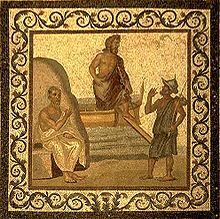
An image of Hippocrates on the floor of the Asclepieion of Kos, with Asklepius in the middle.

Hippocrates of Cos was probably born around 460 BC to become the most famous physician in antiquity, and his great merit is that he “untied” the link with the famous Greek god of healing, Asclepius. Sickness and health were no longer in the hands of the gods but were the result of our living habits, our nutrition, and our environment.

Nothing much has been documented about Hippocrates from his days, and all we have are patchy references written down at a later date. The oldest such document is from the 1st/2nd century AD by the Ephesian physician Soranus, who informs us that Hippocrates traveled extensively throughout his life and died in Larissa around 370 BC. He tells us that Hippocrates acquired his knowledge from his father and Herodicus of Selymbria, a gymnastic trainer. He frequented several sophists of his time, and Plato has it that Hippocrates worked for a fee (just like in our modern world) and basically treated the entire body of his patients. Other ancient sources seem to confirm that Hippocrates believed in a good diet and in exercises to keep the body healthy.

It has been documented, for instance, that he successfully fought the plague that ravaged Athens in 430 BC by lighting fires throughout the city. He also established that King Perdiccas II of Macedonia, a distant ancestor of Alexander the Great, was love-sick and did not suffer from any other obscure ailment.

Unfortunately, his many treatises, speeches, and letters on medicine have not survived, but they were still available at the Library of Alexandria during the reign of the Ptolemies. This Hippocratic Corpus, as it was called, was divided into four separate categories: the diagnosis, biology, treatment of the patient, and a piece of general advice for the doctors. It seems that at least sixty treatises existed, each one focusing on a specific subject: therapy, surgery, physiology, gynecology, the evolution of the disease, and the purging remedies, to name only a few. He even discussed the interaction of medicine with other subjects, like philosophy. Several ancient physicians are known to have written commentaries on his treatises, among which we can name Apollonius of Citium (1st century BC) and the famous Galen (2nd/3rd century AD).

At least we have inherited his school of medicine on the Greek island of Cos, better known as the Asclepion (rather paradoxically), of which important foundations can still be seen today. Hippocrates had three sons who all walked in his footsteps: Thessalus, Dracon, and Polybus.

How about Alexander’s medical knowledge? It is generally accepted that he received some teaching from Aristotle on the subject, but he may well have had direct access to Hippocrates’ treatises, as they were written only one hundred years earlier.