Alexandria's founded by Alexander

Alexandria's founded by Alexander the Great (by year BC): 334 Alexandria in Troia (Turkey) - 333 Alexandria at Issus/Alexandrette (Iskenderun, Turkey) - 332 Alexandria of Caria/by the Latmos (Alinda, Turkey) - 331 Alexandria Mygdoniae - 331 Alexandria (Egypt) - 330 Alexandria Ariana (Herat, Afghanistan) - 330 Alexandria of the Prophthasia/in Dragiana/Phrada (Farah, Afghanistan) - 330 Alexandria in Arachosia (Kandahar, Afghanistan) - 330 Alexandria in the Caucasus (Begram, Afghanistan) - 329 Alexandria of the Paropanisades (Ghazni, Afghanistan) - 329 Alexandria Eschate or Ultima (Khodjend, Tajikistan) - 329 Alexandria on the Oxus (Termez, Afghanistan) - 328 Alexandria in Margiana (Merv, Turkmenistan) - 326 Alexandria Nicaea (on the Hydaspes, India) - 326 Alexandria Bucephala (on the Hydaspes, India) - 325 Alexandria Sogdia - 325 Alexandria Oreitide - 325 Alexandria in Opiene / Alexandria on the Indus (confluence of Indus & Acesines, India) - 325 Alexandria Rambacia (Bela, Pakistan) - 325 Alexandria Xylinepolis (Patala, India) - 325 Alexandria in Carminia (Gulashkird, Iran) - 324 Alexandria-on-the-Tigris/Antiochia-in-Susiana/Charax (Spasinou Charax on the Tigris, Iraq) - ?Alexandria of Carmahle? (Kahnu)
Showing posts with label Olympia (GR). Show all posts

Wednesday, March 11, 2026

Uniqueness of Agrigento’s Gymnasium

Antique Greek and Roman cities come with a standard number of very recognizable monuments, such as the temples to their gods and goddesses, the Bouleuterion, the Theater, and the Stadium. Less impressive but still important is the Gymnasium and/or the Palaestra.
 
Among the many quoted examples, perhaps the most striking one is the impressive Gymnasium of Olympia, home of the Olympic Games. We can easily visualize the layout, with its central courtyard surrounded by a wide Stoa whose roof was supported by a double row of Doric columns. It was 220 meters long and 120 meters wide, a size that is very close to that of a Stadium (see: Olympia, an ongoing excavation project).


Less known is that besides being a center for physical training, the Gymnasium served for intellectual education, where young men studied rhetoric and the duties of civic life. How exactly this formal education was taught remained rather obscure till this year’s excavations in Akragas (modern Agrigento), the largest colony the Greeks founded in Sicily in 580 BC.
 
This Gymnasium from the 2nd century BC revealed a semi-circular covered classroom or auditorium in the style of a theater with eight rows of seating, which could accommodate some 160 youngsters. The orchestra was the central space where teachers and students presented their exercises before the audience. This room is a unique example known so far in the Greek world. Archaeologists found two blocks of white limestone with a Greek inscription that could have been used as a pulpit. This inscription, with traces of red pigment, holds the word gymnasiarchos, the director of the Gymnasium, and tells us about the renovation of the apodyterion, the large changing room that got a new roof. The project was appropriately dedicated to Hermes and Heracles, underscoring the role of the Gymnasium as a center for both physical and intellectual development. These gods were associated with youth athletics, and strength.
 
This inscription is also important because, on the one hand, it is one of the very rare texts found in Akragas and, on the other hand, confirms that the Greek language and customs continued to be used far into Roman times.


The auditorium in Akragas opens onto a 23-meter-long and 11-meter-wide hall that holds benches designed for classes and intellectual competitions. Competitiveness was key in the Greek education!
 
Akragas Gymnasium also housed a Palaestra, i.e., a section reserved for boxing and wrestling. At present, work is underway to define its layout and role within the entire complex. Elsewhere in the antique world and particularly in smaller cities, a Palaestra could exist as a standalone facility, but that certainly is not the case here. 
 
The premise also included a 200-meter running track and a swimming pool. This year (2026), research will focus on the water supply and map the entire hydraulic system. The team will also investigate the western rooms of the Gymnasium, hoping to find traces of its construction’s history that ranged from the 2nd century BC to the early days of the Roman Empire.

Wednesday, November 5, 2025

Herodes Atticus, more than a name

Herodes Atticus is best known for his theater at the foot of Athens Acropolis. For most people, it is only a name to define this historic monument, forgetting who he was and what he achieved in life.

Herodes Atticus was born in Marathon, Greece, into a family of Athenian descent in 101 AD. He is known as an Athenian rhetorician and a Roman senator, spending time between Greece and Italy.
 
He was exceptionally wealthy and moved in the highest social circles. Emperor Hadrian, for instance, appointed him Prefect of the free cities in the Roman Province of Asia in 125 AD. A good year later, he was elected archon (high magistrate) of Athens. And in 140 AD, Emperor Antoninus Pius invited him to Rome to educate his adopted sons, the future Emperors Marcus Aurelius and Lucius Verus. As a Roman citizen, he was appointed Consul of Rome in 143 AD.
 
When he was 40 years old, he married Appia Annia Regilla, a 14-year-old aristocrat related to the family of Antoninus Pius wife.
 
Herodes Atticus was a philanthropic magnate and patron of many public works. What comes immediately to mind is the theater in Athens, which he financed in 161 AD to honor his wife, Regilla. Watching a Greek play performed within these walls or attending a popular or classical concert is a gratifying experience!

However, thousands and perhaps even millions of visitors have left their marks on the white marble construction. It calls for an extensive restoration and conservation process that is expected to take at least three years. During that time, the summer Athens Epidaurus Festival will be relocated elsewhere.
 
The overall deterioration consists of cracks in the Pentelic marble due to the variations in temperature and rainwater infiltration. Another problem is the plants that root in crevices and hold water. The theater had been destroyed in 267 AD and was in ruins until the 1950s, when the seating area and orchestra were restored. These repairs are now in dire need of improvement and require a comprehensive conservation plan.
 
The list of buildings Herodes Atticus funded is quite extensive. The ancient Panathenaic Stadium in Athens,  with a capacity of 50,000 seats, for instance, was one of his projects executed in 144 AD. Elsewhere in Greece, we owe him the Theater of Corinth, the Stadium of Delphi, the Baths of Thermopylae, and a splendid Nymphaeum in Olympia.
 
I was very surprised to read Herodes Atticusname and his wife’s in Olympia. The Nymphaeum stands at the entrance to the Stadium. The two-story-high back wall was filled with statues of Herodes Atticus and several Roman Emperors like Antoninus Pius, HadrianMarcus Aurelius, and their family members. 

Most statues have been moved to the Museum of Olympia. Among them, I noticed Athenais, one of Herodes Atticus’ daughters. She married Lucius Vibullius Rufus, and the couple had six children, but only three survived to adulthood. The eldest daughter, Elpinice, was born in 142 AD and died in 165 AD. The son, Atticus Bradua, was born in 145 AD and was the only child to survive his father. Herodes Atticus was heavily disappointed by his son and left him nothing after his death.
 
Also exhibited in Olympia’s Museum is a life-size bull, which carries an inscription left by Regilla reading: "Regilla, priestess of Demeter offers the water and appendices to Zeus." This brings history to life!
 
Outside Greece, aqueducts donated by Herodes Atticus can be found in Canusium, Puglia region in Italy, and in Alexandria Troas, Asia Minor. In my blog post of February 2024, I mentioned the Baths and Gymnasium of Alexandria Troas built by Herodes Atticus in 135 AD. They were surrounded by vaulted corridors with marble walls, and water was delivered thanks to the aqueducts on the northeast side of town. Most of the building remained intact until it was destroyed by the severe earthquake in the winter of 1809-1810.
 
At the National Archaeological Museum in Athens, I encountered a statue of Polydeukes, also Vibullius Polydeukion, the adopted son of Herodes Atticus, dated to circa 150 AD. Wikipedia, however, mentions the boy as his pupil and lover in a relation resembling that of Hadrian and Antinous. Polydeukes died around 173-174 AD. His loss greatly affected Atticus, who built a Heroon in his memory.
 
Herodes Atticus lived to be 76 years old in 177 AD. Regilla had died in 160 AD, after being brutally kicked in the abdomen while eight months pregnant.  Her brother accused Herodes Atticus of having ordered one of his freedmen to beat her to death. At the trial that ensued, Herodes Atticus was acquitted by Emperor Marcus Aurelius, his former tutor.
 
I’m sure we’ll look at the Theater of Herodes Atticus with different eyes next time we walk through Athens.

Sunday, October 6, 2024

The unique Temple of Apollo in Bassae

Many years ago, I drove around the Peloponnese exploring antique sites other than the well-known remains of Corinth and Olympia. 

One of my roads led me to the Temple of Bassae, which, according to my travel guide, was the only temple of Antiquity to combine Doric, Ionian, and Corinthian styles. Relying on the signposts I drove up a narrow winding road the width of my car through a landscape that seemed untouched by time. It was a most beautiful scenery dotted with circular threshing floors used to separate the grain from the straw and husks by beating it manually. These ‘floors’ also served as dancing on festive occasions. Time had clearly come to a standstill. 

As in the middle of nowhere, the grey columns of a temple appeared with behind it a normal asphalt road… I had found Bassae the hard way but certainly the most beautiful one.

[Picture from Albion Gould]

Just the other day, I came across the picture of an odd-looking temple in Figaleia dressed in ghostly white hailed as the “second Parthenon”. Where? What? It turned out to be the Temple of Apollo Epicurius in Bassae, now heavily studded. It brought me right back to that exciting drive so long ago. What happened here? 

Well, I praise myself lucky to have been there before the series of drastic restorations started. The first works were carried out between 1902 and 1908 but did not affect the appearance of the temple. Later interventions changed the glorious view I had enjoyed forever. In 1985, an anti-seismic scaffold was installed followed by a lightning protection. Since 1987 the entire temple has been wrapped in a tent to protect the monument against extreme weather conditions. This is said to be a temporary measure but after almost forty years we may wonder if this cover will ever be removed. There is not much worth seeing right now, is there? 

The Temple of Apollo Epicurius (the Helper) of 38 x 14.5 meters was erected between 420-400 BC by the citizens of Figaleia to thank the god for delivering them from the plague of 429-427 BC. It was designed by Ictinus, who also was the architect of the Parthenon in Athens. 

The Temple in Bassae built with local grey limestone is remarkable for several reasons. Unlike the general east-west orientation of the Greek temple, this one is set north-south because of the terrain or perhaps to comply with some religious traditions of the people of Figaleia. Access to the temple would be through a door on the east side, another anomaly. And, this temple of Apollo is the only known example from antiquity to combine all three orders of ancient Greece: Doric for the outside columns, Ionian for the inside, and three Corinthian columns at the southern end. What struck me also during my visit were the Ionic columns inside the cella that were attached to the wall. Two Corinthian columns were attached at a 45-degree angle to the wall and the third one stood between them. I was deeply impressed by these exceptional architectural details. 

The temple was abandoned around the 4th-5th century AD. As it stood in a relatively remote area outside the city of Figaleia, it was not plundered. Eventually, the roof collapsed and severely damaged the interior of the temple. The outer colonnade remained standing and that is what I witnessed during my visit. 

The excavations were first started in 1811 by a group of European archaeologists led by Charles Cockerell after receiving permission from the local Pasha. The agreement was that the booty would be split between the Pasha and the archaeologists. After a few weeks, 23 metopes were recovered. Twelve of them depicted the Battle between Greeks and Amazons and the remaining eleven told the mythical Battle between Lapiths and Centaurs. 

When the Pasha saw the reliefs, he was very disappointed as he had expected gold and other precious artifacts. For him, the find had no value and he refused to take his share. After giving him the sum of £400, the archaeologists took the metopes to be auctioned in Zakynthos. The highest bidder was the British Museum, which paid £19,000 for the lot. That is how the entire length of the frieze (31 meters) has been fitted in a room of its own at the BM. 

During a later visit to the Museum of the Louvre in Paris, I came across two sitting Maenads from Bassae. They were clearly resting after their frenzy dances in a state of divine madness and ecstasy which was illustrated by their sweaty wet chiton clinging to their body! Only a highly skilled sculptor could render this state of mind in such a palpable way. 

There must have been a statue of Apollo inside since the sanctuary was dedicated to this god, but I have not heard about its presence. 

It sounds strange to say that I did not miss seeing any metopes or statues in or around the temple. At the time, this isolated sanctuary impressed me by its location, as the roughness of its grey limestone blended in so well with the landscape that the picture seemed complete. 

The white tent covering the temple is said to protect the building against the region's extreme weather conditions. I do not understand this reasoning for after all Apollo protected the temple against the elements for the past 2,500 years.

Tuesday, September 24, 2024

Reading and decoding inscriptions

Today’s visitors will inevitably come across many inscriptions when visiting ancient sites or museums. Reading Greek or Latin is not for everybody, and understanding the meaning of the text and context is reserved only for the happy few. The stone or marble support has more often than not suffered from wear and tear, leaving the untrained eye to merely guess its value. 

We are lucky to find an explanation next to the inscription, rarely a full translation, as those are reserved for scholars. Well, the text may be boring, but it also may contain some exciting twists and turns. Yet, who wants to know? 

In antiquity, people would read the latest laws and decrees, regulations and agreements, peace treaties, manumission of slaves, grave markers, boundary stones, milestones, etc., as they walked through public spaces. Some of these texts are still in situ, particularly those engraved on the walls of still-standing monuments. The majority, however, has found a place in the museum for safekeeping and is often out of sight. 

The most familiar examples of inscriptions are those chiseled on grave steles, sarcophagi, and tombs. They also appear on the pedestals of statues lining the streets, like Phaselis Harbor Street or Olympia’s road to the Stadium. Others serve to identify the deities, kings, and emperors that fill the sanctuaries and agoras, or the niches of theatres, stadiums, libraries, baths, Nymphaeums, and other public buildings. 

But some inscriptions will surprise many of us. 

For instance, this stele at the Louvre Museum holds the accounts of the Parthenon Treasury. The text covers both sides of the stele made of Pentelikon marble and illustrates how democracy works. Athens magistrates submitted the public accounts to the citizens for all to see. The front side, beneath a relief of the Sacred Olive Tree flanked by Athena and the people (demos), displays the expenses for military operations, religious ceremonies, and the Panathenaic festival held in honor of their patron goddess for 410-409 BC. The reverse side has the expenditures for 407-406 BC.

In Butrint, Albania, a striking series of inscriptions is carved on the outside walls of the Roman Theater of Buthrotum, as the city was called in antiquity. 
They are hard to read but worth our attention because these are manumissions, slaves who had gained their freedom for whatever reason. Their sheer number is mind-blowing!


As surprising and revealing are the Edicts on prices! Who would have thought that there were strict rules to define the prices of goods in antiquity! 
The first such example I encountered was at Ptolemais in Libya, proclaimed by Emperor Diocletian in 301 AD.

Also by Diocletian is the Edict on maximum prices for products and labor discovered in Halicarnassus, dated to 301 AD. The Emperor hoped to stave off a financial crisis and prevent inflation. 

Although this tablet was unearthed in Bodrum (the modern name for Halicarnassus), bits of similar Edicts were also found in Pergamon, Aizanoi, Aphrodisias, and Stratonikea. It is quite surprising to read that the Edict from Halicarnassus consists of 37 parts. Part 9, for instance, is about shoes and boots … 27 different kinds and sizes are listed!

Taxes are another matter that deserves attention. One such inscription that is hard to miss can be seen on Curetes Street in Ephesos, close to the Library. 
This tax law was written in the second half of the 4th century AD, during the rule of Emperors Valentian I, Valensand Gratian.

Less obvious is Alexander’s tax remission from the wall of the Temple of Athena in Priene, now exhibited in the British Museum in London
Alexander contributed to the cost of building the unfinished temple, and in return, he was allowed to dedicate it: “King Alexander dedicated the temple of Athena Polias”. 
This text was followed by a longer inscription setting out the terms of an agreement between Alexander and Priene under which the city was to be exempt from taxation. 

Not all inscriptions were written in Greek or Latin, and I find it fascinating to hunt for these exceptions. 

Having a closer look at Lycia’s sarcophagi strewn throughout the landscape, I discovered texts that seemed to be written in Greek but are in Lycian, as they contain several odd letters that do not exist in the Greek alphabet. Antiphellos and Limyra have good illustrations of Lycian texts.

Another case is to be found in Sillyumsome 25 kilometers northeast of Antalya, an often overlooked site, although the hillside is easily spotted in the otherwise flat plain of Pamphylia. 
It takes some detective work to locate the inscription in the Pamphylian language carved in the doorpost of a Hellenistic building – a very rewarding effort though!

The people of ancient Side also had a language of their own. A small inscription has survived and can be seen at the local museum located inside the remains of the Roman Baths.


After Alexander conquered Lycia and Pamphylia, Greek became the lingua franca, and the local tongues disappeared.

Sunday, July 14, 2024

Not all Seven Wonders of the World are the same

We like to believe that the list of the Seven Wonders of the World in antiquity was well-established, but that is not entirely correct. 

In the 1st century BC, Diodorus mentions them by name: the Great Pyramid of Giza, the Hanging Gardens of Babylon, the statue of Zeus in Olympia, the Temple of Artemis in Ephesos, the Mausoleum of Halicarnassus, the Colossus of Rhodes, and the Lighthouse of Alexandria. This is the list we follow nowadays, but the importance of each monument has been subject to personal taste and appreciation of its time. 

Well before Diodorus, many writers had their opinions on the matter. The oldest known is, for instance, Herodotus who, in the 5th century BC does not mention the Hanging Gardens of Babylon but provides a very detailed description of the Walls of Babylon built with baked bricks cemented together with bitumen. The ramparts were 72 kilometers long, 10 meters thick, and 22 meters high! A striking feature is that the top of the wall was wide enough for two four-horse chariots to pass each other. The intermittent towers were 27 meters high. 

Callimachus of Cyrene, who lived in the 3rd century BC, chose to include the Ishtar Gate of Babylon – a marvel that has been reconstructed inside the Pergamon Museum in Berlin (see: A mental reconstruction of Alexander’s triumphal march into Babylon). 

Philo of Byzantium in 225 BC lists the Walls of Babylon, but not the Lighthouse of Alexandria, which had not been built yet. He said he had actually seen the Hanging Gardens but omitted to situate them in Babylon. Their existence remains questionable, and there still is an unconfirmed theory that these gardens were in NinevehThey were described as vaulted terraces, raised one above another, and resting upon cube-shaped pillars. These were hollow and filled with earth to allow trees of the largest size to be planted. The pillars, the vaults, and the terraces were constructed of baked brick and bitumen. The Gardens were initiated by King Nebuchadnezzar II around 575 BC. Philo tells of the Statue of Zeus by Phidias in Olympia, the bronze Colossus of Rhodes featuring Helios (the Sun), and the Temple of Artemis in Ephesos. He further includes the Tomb of King Mausolos in Halicarnassus, and the Pyramids of the Giza plateau, not singling out the Great Pyramid. 

Antipater of Sidon, who lived in the 2nd/1st century BC writes that he laid eyes on the ‘walls of lofty Babylon on which is a road for chariots’, and the Hanging Gardens; the statue of Zeus in Olympia, the Colossus of the Sun in Rhodes, the huge achievement of the high pyramids in Giza, the vast tomb of Mausolos at Halicarnassus; and the Temple of Artemis in Ephesos saying ‘that [as] it mounted to the clouds those other marvels lost their brilliancy’. 

Strabo, in the 1st century BC, gives by far the most detailed description of the Seven Wonders. 

The Great Pyramid of Giza in Egypt, the oldest and only wonder that still exists, was erected around 2560 BC. It is the largest of the three Pyramids at Giza, which are all equally important, as stated by Philo of Byzantium. The proportions of the Great Pyramid are colossal. The original height from the base to the peak was about 147 meters. The length of each side at the base averaged around 230 meters. The theories about its construction and function are widespread and are by no means conclusive. 

The statue of Zeus in Olympia stood inside the Temple of Zeus. The large sitting Zeus was made of ivory and gold by Phidias in 436 BC. Although he was seated, Zeus stood 12.4 meters high, meaning that his head nearly touched the ceiling. Nothing much of the temple remains, but its impressive East and West pediments are exhibited in full glory at the local museum (see: Olympia, in the footsteps of Pausanias). 

The first Temple of Artemis in Ephesus goes back to the 7th century BC. After its destruction, it was completely rebuilt to an unheard scale of 115 x 55 meters, i.e., larger than the Parthenon in Athens. The Artemis venerated in this temple is represented with many breasts, and is clearly not of Greek origin but imported from the East (see: Alexander’s presence in Ephesus). Nothing remains today to prove its grandeur and glory.

The Mausoleum of Halicarnassus (see: Halicarnassus, capital of Caria) from about 350 BC was a rectangular monument measuring 40 x 30 meters, and about 45 meters high. It was decorated with scenes from Greek mythology, such as the battle of the Centaurs with the Lapiths and fighting Amazons, although scholars disagree on their precise position. It is certain, however, that the statues of King Mausolos and his wife/sister Artemesia riding in a four-horse chariot, now at the British Museum, stood at the very top of the Mausoleum. The tomb survived in pretty good condition for many years despite recurrent earthquakes, but the final blow happened in 1494 when the Knights of St John of Rhodes invaded the area and reused the stones of the Mausoleum to build their castle. Remnants are still visible to modern visitors on the walls of Bodrum Castle. 

The Colossus of Helios in Rhodes, the work of Chares of Lindos, was completed in 282 BC. It stood near the entrance of the harbor, although the exact location is unknown. The Colossus wore a crown of sun rays – hence its name, Colossus of Helios - and held up a torch. It was made of bronze and rested on a marble pedestal. With a height of 33 meters, it is considered the tallest bronze from antiquity. It was the shortest-lived ancient wonder that disappeared 60 years after its construction due to a severe earthquake. Its legend lives on, though. 

The Lighthouse or Pharos of Alexandria was the last wonder added to the list of seven, replacing the Walls of BabylonIt was conceived in three stages: a square stone base, an octagonal middle section, and a cylindrical shape at the top. Inside, a fire would guide the seafarers into the harbor of Alexandria. By day, they were led by the smoke, and at night by its bright light (see: Alexandria’s past futures). The Lighthouse stood over 100 meters tall, and its light could be seen 50-60 kilometers out at sea. Its construction was completed between 300 and 280 BC during the reigns of Ptolemy I Soter and his son, Ptolemy II Philadelphus 

The ancient historians of Alexander the Great have spent very little ink on these Seven Wonders – or the texts simply have not reached us. The Temple of Ephesos, which was burnt down the night Alexander was born, was still under construction at the time of his visit. But the king must have witnessed the grand Mausoleum of Halicarnassus and the main features of Babylon, such as its Walls, the Ishtar Gate (which he used to enter the city), and the Gardens if they were indeed part of the Royal Palace. Strangely enough, Giza and its Pyramids are absent from all documents, as if they never existed!

Wednesday, May 8, 2024

The remarkable Illyrian helmet

Illyrian helmets truly stand out and are immediately recognizable. Their particularity is the rectangular opening for the face and two parallel ridges on the top of the crown for the crest.


They may be found all over the Balkans, but also in Macedonia and Greece proper, and evolved from the 8th to the 3rd century BC. The earliest version had a low crown and lacked a neck guard. It was soon followed by a helmet with a more pronounced back guard, the typical horizontal ribs, and a decorative edge around the face, often using a series of studs. The most recent model showed elongated cheek pieces and a simple decoration around the edges.
 
An early example is in the Museum of Olympia, Greece, which dates from the end of the 7th century/beginning of the 6th century BC. It clearly shows the framing studs. The horizontal ribs are already more pronounced than those shown in my previous post, A rare Illyrian Helmet.


The Archaeological Museum in Athens has two beautiful specimens from the 6th century BC. One is this helmet from Pengaion,  550-500 BC
 
The other is the very telling Funerary Mask (see top picture) from 530-510 BC, which is missing the horizontal slit for the crest between the ridges. It is framing the face of the deceased, covered in gold foil.


As expected, the Museum of Tirana in Albania has a well-preserved helmet on display. It has been dated to 550-500 BC.


The Illyrian helmets are in the news after excavations of the burial mounds on the Peljesac Peninsula in Croatia. Several tombs from the 4th century BC yielded well-preserved Illyrian helmets that have been dated to the 6th century BC.
 
The eastern Adriatic coast looks very promising since at least a dozen helmets were found in Dalmatia, and even more in Herzegovina.

Wednesday, March 6, 2024

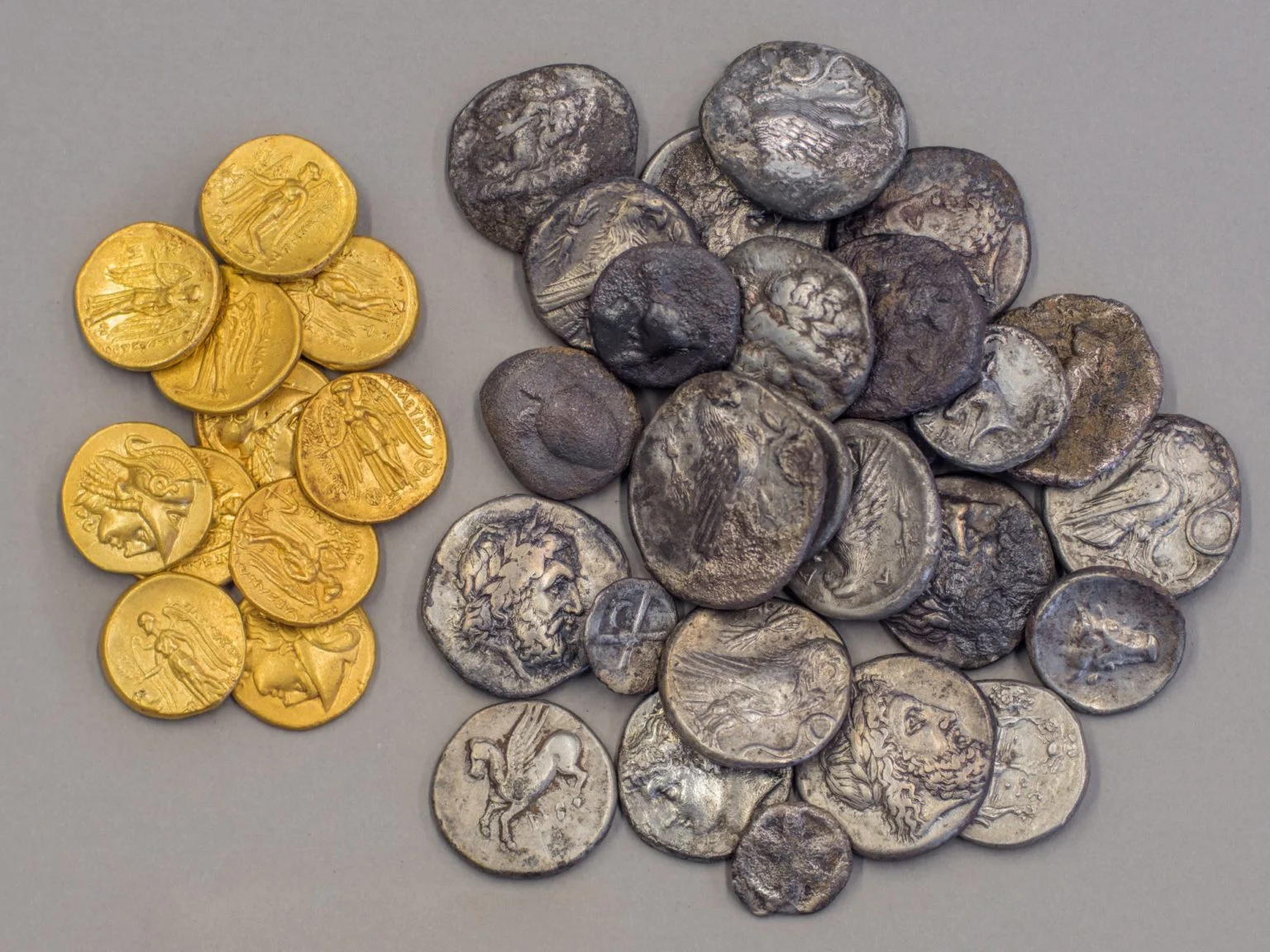
A handful of Alexander coins from Chania

Chania on Crete’s northwestern coast is best known for its beaches and hotels that attract today’s tourists. Its history, however, goes back to the 14th century BC and is centered on the ongoing excavations of the Minoan Palace of Kydonia which was destroyed by an earthquake one century later. 

The Old Town of Chania proper has yielded a cache of 37 rare coins, including eleven gold staters of Alexander. The hoard together with two coins of Kydonia, was hidden in a space behind the wall of the acropolis of Kydonia probably by a mercenary between 300 and 280 BC. That is quite a find considering one gold stater equaled a mercenary month's salary. 

It has been established that the coins were mostly minted after Alexander’s death in the name of Philip Arrhidaeus, Seleucos or Lysimachos in different locations such as Amphipolis, Abydos, Lampsacus, etc. 

[Picture of the two-drachms of Cyrene, Greek Reporter,

The hoard also included 15 silver staters minted in Olympia during the Olympic Games at some time in the 4th century BC. Also one Corinthian stater of the Palace of Acarnania, a colony on the Ionian Sea; and one stater of Praisos (on the peninsula of Sitia at the eastern end of Crete). Further one two-drachms of Cyrene (North Africa), two drachms of Phaistos (62 km south of Heracleion), one drachma of Hyrtakina (in the northwest of Crete), and two pseudo-hemi-drachms of the Aegina type found in Kydonia. Last but not least, there are two early versions from Aegina showing the sea and land turtles.