Alexandria's founded by Alexander

Alexandria's founded by Alexander the Great (by year BC): 334 Alexandria in Troia (Turkey) - 333 Alexandria at Issus/Alexandrette (Iskenderun, Turkey) - 332 Alexandria of Caria/by the Latmos (Alinda, Turkey) - 331 Alexandria Mygdoniae - 331 Alexandria (Egypt) - 330 Alexandria Ariana (Herat, Afghanistan) - 330 Alexandria of the Prophthasia/in Dragiana/Phrada (Farah, Afghanistan) - 330 Alexandria in Arachosia (Kandahar, Afghanistan) - 330 Alexandria in the Caucasus (Begram, Afghanistan) - 329 Alexandria of the Paropanisades (Ghazni, Afghanistan) - 329 Alexandria Eschate or Ultima (Khodjend, Tajikistan) - 329 Alexandria on the Oxus (Termez, Afghanistan) - 328 Alexandria in Margiana (Merv, Turkmenistan) - 326 Alexandria Nicaea (on the Hydaspes, India) - 326 Alexandria Bucephala (on the Hydaspes, India) - 325 Alexandria Sogdia - 325 Alexandria Oreitide - 325 Alexandria in Opiene / Alexandria on the Indus (confluence of Indus & Acesines, India) - 325 Alexandria Rambacia (Bela, Pakistan) - 325 Alexandria Xylinepolis (Patala, India) - 325 Alexandria in Carminia (Gulashkird, Iran) - 324 Alexandria-on-the-Tigris/Antiochia-in-Susiana/Charax (Spasinou Charax on the Tigris, Iraq) - ?Alexandria of Carmahle? (Kahnu)
Showing posts with label Attalus-II. Show all posts

Tuesday, April 2, 2024

Bylazora, the last Macedonian Palace

The Paeonians occupied the land north of ancient Macedonia and functioned as a buffer zone with the Dardanians on their northern border. Bylazora, in fact, was situated in a commanding position at the natural pass leading from Dardania into Macedonia. 


Philip V of Macedonia, who ruled from 221 until 179 BC, captured Bylazora in 217 BC. By blocking the Dardanian access road to Macedonia, he freed his country from its repeated menacing raids. PerseusPhilip’s son, who succeeded his father, sent mercenaries to Bylazora to confront the Romans, but he was defeated in 168 BC. He was taken to Rome to be shown in their victory parade, together with the incredible wealth of Macedonia. The rich kingdom became a mere Roman province. 

Although Bylazora was the largest city of Paeonia and was mentioned by Livy and Polybius, its location remained a mystery. It was tentatively identified with (Titov) Veles, but the results were inconclusive. As so often, the city was discovered by accident in 1994. Road works exposed a buried pool-like building close to modern Sveti Nikole in the Republic of North Macedonia, some 50 kilometers southeast of Skopje, between the Axios and the Strymon Rivers. 

Excavations started in 2008 after the Museum of Sveti Nikole invited the Texas Foundation for Archaeological & Historical Research (TFAHR) to a joint cooperation. 


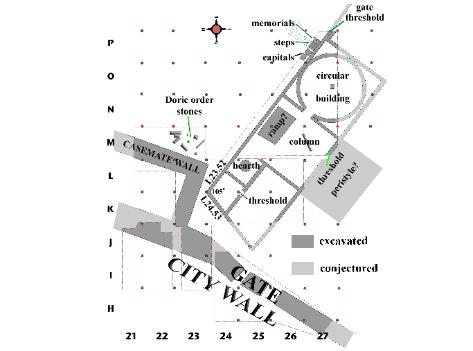
It was a slow process of searching for clues that started at the top of the hill, the Acropolis. Soon, a section of the northern defensive wall was exposed, followed by the discovery of a ramp leading up to the Propylon. Next, a Stoa with Doric columns was identified and dated to the days of Philip V based on a similar gallery built by Attalus II in Athens. 

A long wall and successive rooms were unearthed, making the archaeologists realize they had found the Palace of Philip V and Perseus, the last two kings of Macedonia. 

The first room they explored had all the characteristics of a kitchen, with a fireplace, much pottery, plates, vessels, and amphorae from the 3rd-2nd century BC. The walls were covered with a thick layer of plaster with traces of paint. Followed a room with columns and capitals, which was named Ante-room since it connected to a more important Tholos. For those who visited the Palace of Aegae in Greece, that space is very recognizable. On the other side of this Tholos lies the Entrance Hall, which in turn is connected to the Vestibule. This large room opened onto the Outer Courtyard via a monumental staircase. 

Keeping the layout of the Palace of Aegae in mind, the archaeologists projected the same series of rooms around the Inner Courtyard. The picture seems to fit perfectly. It also matches the Palace of Dimitrias, situated just south of Volos in Greece. The city was built by Demetrios Poliorcetes when he was king of Macedonia, i.e., 294-288 BC. 

Until now, and as opposed to Aegae and Pella, I had no knowledge of the Macedonian Palaces of Bylazora or Dimitrias. The destruction of the Palaces of Aegae and Pella by the Romans is well-documented. Dimitrias, however, was entirely dismantled, and it is assumed that the same happened in Bylazora, although it was never finished. 

Much more pertinent information with clear maps and unique details can be found in this lecture given by Dr.William J. Neidinger of the TFAHR.

[Pictures from TFAHR]

Sunday, December 17, 2023

Pergamese offerings

In one of the rooms of the Archaeological Museum in Naples, I am confronted with a group of statues lying on the floor. It looks like dead bodies that collapsed on the spot. The label near the entrance reads Small Pergamese Votive Offering, Roman copy of the 2nd century AD, from a Greek original of the 2nd century BC. 


The scene makes me feel uncomfortable and I don’t know what to think. It looks spooky. I don’t even realize the connection with the site of Pergamon and if there is one I cannot tie it to anything. 

The figures are a little less than life-size and represent an Amazon, a Giant, a Dead Warrior, and a Wounded Gaul. More examples of this group are, apparently, exhibited in the collections of the Vatican and Venice in Italy, Paris and Aix-en-Provence in France. 

The statues fit the imposing reliefs of Gigantomachy and Amazonomachy that surrounded the Altar of Zeus, created by Eumenes II in Pergamon. This Votive Offering is a copy of the original that was placed along the south wall of the Acropolis in Athens in 167-166 BC, probably by Attalus II. 

They represent four battles, two mythical (the Gigantomachy and the Amazonomachy) and two historical (the Battle of Marathon and the one against the Galatians). According to recent research, discoveries near the Acropolis have led to believe that the Athenian votives were originally made of bronze. They may even be copies of a series located initially at Pergamon. The entire composition, which counted at least 50 sculptures, was meant to celebrate the greatest epic battles between gods and men, and the Pergamene victories over the Galatians, who were a constant threat to the Attalid kingdom. 

The Roman copies were based on the Athenian votives and executed in marble. They portrayed only the victors rather than all the characters from the Greek original, which raises the question of establishing the historical circumstance of their creation. From the stylistic point of view, the Neapolitan copies found in the Baths of Agrippa have been dated to the 2nd century AD. 

These votives have been leading a life of their own, and it is not impossible that more of their history will be revealed in the future.


Monday, October 30, 2023

Rare testimonies from the Palace of Pergamon

Pergamon made a clear statement to take a leading position in the Hellenistic world in which the rulers attracted the best artists, architects, and philosophers. 

The Palace of Pergamon and its adjacent rooms must have been a sight for sore eyes considering the magnificence and action displayed on the famous Altar of Zeus, whose remains have been moved to the Pergamon Museum in Berlin. 

On most maps of Pergamon, we find five consecutive rooms initially labeled as Palaces in their own right. Recent studies have established that the so-called Palace V was the main building used for official purposes. The other “palaces” were rooms for the Royal family and the guests, storage rooms, and arsenals. 

The official rooms with their niches and patios would be filled with elegant statues, statuettes, vessels, and other decorative items created by the best artists from Hellenistic times commissioned by the Attalid kings (see: The Attalids, rulers of Pergamon). 

From the reign of Attalus I, 241 to 197 BC, the most striking examples are the statues of the Dying Gaul and the man and woman known as the Galatian Suicide. Both pieces were taken to Rome to adorn the Gardens of Caesar. Also at the instigation of Attalus I, a new architectural feature appeared, the Pergamene Capital (see: About Greek/Roman columns and capitals). There must be proof that at least bits of these capitals are left in situ but I have not found any. I discovered my first examples in North Africa and in particular in Leptis Magna, the city built by Septimius Severus in the 2nd century AD. 

The reigns of Eumenes II and Attalus II in the 2nd century BC left us with only a handful of artworks that survived the ravages of time. A rare treasure found in the dining room of Palace V with the Hephaistion mosaic is the dancer or light carrier lady. She is 1.20 meters tall and made of white translucent marble. Her right hand which has not survived is raised and her left hand reaches downwards towards her dress. This elegant beauty has been transferred to the Altes Museum of Berlin. Another lady dancer has apparently been moved to the Archaeological Museum of Izmir and the only available picture is on the site of Livius. 

More telling is the colorful mosaic of a parakeet now at the Pergamon Museum in Berlin (see: The beauty of Alexandrine mosaics) retrieved from one of the two dining rooms of the Palace. Here, another remarkable mosaic was discovered that carried the signature of the artist. His name is Hephaistion, which has nothing to do with Alexander’s friend who lived two centuries earlier. This artist very creatively wrote his name on a label that seemed to be stuck to the floor with sealing wax at its corners, except one corner which was already lifted up. The full inscription can be translated as "Hephaistion made it".
 

The balance of the finds in and around the Royal Palace is very meager considering the grandeur and wealth accumulated by the Attalid Kings of Pergamon (see: The Attalids, rulers of Pergamon). It is unclear whether these premises have been thoroughly excavated or if more work remains to be done. I like to believe the latest.

Monday, October 2, 2023

The Attalids, rulers of Pergamon

The Attalid Dynasty of Pergamon started with Philetairos in 282 BC, roughly fifty years after the death of Alexander

It remains difficult to imagine the wealth Alexander had accumulated from his conquest of Asia.  The rise of the Ptolemaic and Seleucid dynasties can hardly be compared to that of Lysimachos, who did not draw the best cards. The War of the Diadochi was a very intricate and complex bickering and conniving from which all parties did not profit equally. However, Lysimachos put his share of the booty to good use and his trusted treasury keeper, Philetairos, did the same giving Pergamon the jump start it needed.

The starting date of the Pergamon Dynasty is much later than for the empires of  Seleucos in 312 BC, and Ptolemy in 305 BC founded at the end of the War of the Diadochy

Philetairos was a eunuch who had served under Antigonus Monophtalmos. In 302 BC he deserted him to join Lysimachos, the king of Northwest Asia Minor. At the death of Antigonus, Lysimachos rewarded Philetairos for his loyalty by putting him in charge of his treasury (inherited from Alexander) in Pergamon

But when Lysimachos, upon the instigation of his wife, murdered his only son, AgathoclesPhiletairos joined Seleucos I. Soon afterwards, Seleucos’ forces murdered Lysimachos leaving Philetairos to rule Pergamon until 263 BC. Seleucos granted him great autonomy, which enabled him to expand his territory. Unable to have children of his own, Philetairos had adopted his nephew, the future Eumenes I, who would succeed him in 263 BC. 

One year into his kingship, Eumenes defeated the Seleucid King Antiochus near Sardes, which enabled him to create an independent city-state of PergamonEumenes did not have children either and the throne went to his nephew and cousin, Attalus, who went down into history as Attalus I SoterAttalus ruled from 241 to 197 BC and many historians still consider him as the founder of the Attalid Dynasty, with Pergamon as its capital. 

The reign of Attalus I was all but peaceful. The Seleucids had lost power over Lysimachos' territories of Pergamon, Bithynia, Nicomedia, and Cappadocia, which gained their independence. Attalus expanded his territory but lost much of it to Seleucos II later on. However, he managed to save Pergamon from the attacks of the Galatians on his northern border and to establish friendly relations with the Romans. That’s how he got involved in the Second Macedonian War (200-197 BC), which opposed the weakening kingdom of Macedonia to Rome, as an ally of Pergamon. Attalus suffered a stroke during peace negotiations in Thebes and was brought back to Pergamonwhere he died in 197 BC. 

Eumenes II took over where his father left off but mingling in the affairs of the Seleucids in Syria did not sit well with the Senate of Rome. No reason for Eumenes to be distracted from carrying out his own large expansion program in Pergamon, where he built the unique Great Altar and the massive Library, second only to that of Alexandria. The Romans resented the power and independence Eumenes displayed, which in their eyes reduced their own sphere of influence in Asia Minor. Sadly, although still in his early sixties, Eumenes’ health began to deteriorate, and he appointed his brother Attalus II as a co-ruler. One year later, in 159 BC, Eumenes died. His own son was still an infant, and consequently, Attalus II, who conveniently married his widow, became the new king. He also adopted his brother’s young son, who was to become the future Attalus III

Attalus II continued Eumenes’ building projects in Pergamon, this time including the Palace. He also funded the construction of a new temple to Hera Basileia between the lower Agora and the Gymnasium. 

He was familiar with the political situation he inherited. He had no real enemies and was careful to recognize the authority of Rome. Instead of going to war, Attalus II expanded his influence by spending lavish amounts of money on prestige projects. For instance, he contributed to the construction of a splendid Stoa in the Agora of Athens, at the foot of the Acropolis. This is the Stoa of Attalus II, which was restored/ reconstructed by the American School of Classical Studies in the early 1950s. Another Stoa carrying his name was built in Termessos next to the Corinthian temple.

As always, all kinds of taxes were raised to pay for these grand expenses, but Attalus equally improved trade in his kingdom, building markets and safe harbors. He certainly needed reliable access to a harbor, and Attalus attempted to subdue Side. In the wake of this failed attempt, he added part of Pamphylia to his kingdom, where he founded an entirely new port. He named it Attaleiaafter himself, i.e., modern Antalya. Attalus II died at the blessed age of 81 or 82 in 138 BC. 

His successor was his nephew and adopted son, Attalus III. However, the new king was not interested in his kingship or in Pergamon. No wonder that he was rather unpopular among his citizens. When he died five years later of disease, he bequeathed Pergamon to Rome, which made it the capital of their Provincia Asia.

Although there may have been one last pretender to the throne, a supposed illegitimate son of Eumenes II, the Attalid Dynasty came to an abrupt end in 133 BC. 

In hardly 150 years, the Attalids had built one of the greatest Hellenistic centers for culture and art, mainly under the reigns of Eumenes II and Attalus II, which still intrigues us.

The end of Pergamon was all but glorious. After being hit by a severe earthquake in 262 AD, its decline was set in motion. The Muslims sacked what remained standing during their raid of 663 AD. More setbacks followed after the conquests by the Byzantine Empire and around 1300 AD by the Ottoman Empire. Slowly, the majestic site deteriorated to the point it was abandoned and forgotten until the first explorers of the 18th and 19th centuries rediscovered Pergamon.

Wednesday, September 20, 2023

The beauty of Alexandrine mosaics

The first time I was confronted with the fine and delicate mosaics created in Alexandria was in Libya. 

Unexpectedly, this was in the eastern city of Ptolemais, seeing the centerpieces of the mosaic floors in the Summer Triclinium of the Palazzo delle Colonne. It was as if I could zoom in time and again to discover ever more details! 

Another striking example was exhibited at the local Museum of Sabratha in western Libya. Here it was a carpet-like mosaic depicting the Triumph of Bacchus. The three central roundels executed in fine Alexandrine mosaics stood out against the otherwise rather rough tesserae of the outer mosaic. The top roundel showed Bacchus, after whom the mosaic was named, followed by a lively lion head and a panther head. 


Another example was presented at the Bozar Museum in Brussels during the Exhibition on Alexandria in 2022. Here the fine centerpiece of the mosaic was a wild Medusa face on loan from the Museum of Alexandria dated also from the 2nd century AD. 


Scenes of gods and goddesses were very common in antiquity, but it seems that animals were generally introduced by the Romans. 

Lesser known is the panel of a colorful parakeet, one of three centerpieces that decorated a floor of Palace V in Pergamon. This is the only one that made it to the Museum of Pergamon; the other two are lost in the mist of time. 

Now the story of this parakeet requires some extra information. To start with, it has been identified as the Psittacula eupatria, noble fatherland or of noble ancestry. Apparently, it was Alexander the Great who sent the first birds from Punjab to the West, where they were received as exotic pets by the rich and famous of his time. 

The mosaic panel was made in Pergamon in the days of Eumenes II or Attalus II to decorate the so-called altar room of Palace V on the city’s acropolis.

The technique also used the opus vermiculatum meant to emphasize the contours of the bird – a parakeet in this case. To that effect, one or more rows of dark tesserae would be inserted around the subject to enhance the pictorial effect and create an extra contrast or a shadow.   

It is hard to imagine how the artisans of those days were still able to see what they were doing handling those tiny bits of stone, marble, and glass varying between 0.5 to 1 millimeter in size and keeping an eye on the contrast effect at the same time. High-skilled craftsmanship, no doubt.

Thursday, September 12, 2013

Alexander avoided the siege of Termessos

You have to see Termessos for yourself to fully assess the importance of its strategic location. Still, the place today is not easily accessible as it lies in the middle of the National Park of Güllük Dagi, which contributes widely to the sense of walking on trails of eons past.

When Alexander was about to wrap up his campaign in Pamphylia after a short while in Perge, he inquired about the best route towards Sagalassos in the north on his way to Gordion, where he was to meet up with Parmenion and the remaining part of the army.  Some uncooperative guides had advised Alexander to take the route through the narrows of Termessos, a nearly impregnable obstacle. Luckily, the people of Selge were kind enough to draw Alexander's attention to another much easier road, meaning there was no need to besiege the strongly defended Termessos

According to Strabo, the people of Termessos called themselves Slymi, a Pisidian population who took their name from Solymeus, an Anatolian deity. Before Alexander's arrival, very little was known about them, and after his death, the city was ruled quite quickly by the Ptolemies. By the second century BC, ties of friendship were established by Attalus II, King of Pergamon, and the two-story high Stoa was built in his honor. These ties probably led to Termessos choosing the side of Rome and consequently was declared an independent city in 71 BC – a long-lived freedom. Termessos was granted several privileges, contributing to its prosperity. The decline gradually came when it fell under the Byzantine Emperors. The city was finally destroyed by a severe earthquake, ending in its abandonment around the end of the fourth/beginning of the fifth century AD. 

Only a little has been excavated in Termessos, which contributes to its charm, although that does not make the visit any easier; on the contrary, it is quite adventurous. The paths are not very obvious and not without danger, especially in rainy weather. My Sunflower Guide warns the intrepid visitor to move cautiously under such circumstances, so I didn't venture inside alone this time. I was lucky to have visited the site during my Alexander tour with Peter Sommer a few years ago, and that has left a deep impression.

It was very early spring when I followed my fellow travelers among the lush bushes and grasses on the narrow trail. I had no idea what to expect and found it quite exciting to discover remains of city walls and grey spots in the thick, bright green undergrowth. I passed crumbling remains of the Roman Baths next to the Gymnasium and vaulted niches where once the shops lined up around the marketplace. The layout of the Temple of Zeus is hard to picture, but its two-storied walls are impressive enough. 

And then I reach the spot I have been waiting for, the gate through which Alexander was expected to enter Termessos. What a view! On a clear day, one can see as far as Antalya and the Mediterranean. It shows how strong the city's position must have been in this narrow, and they could clearly see their enemies approaching from afar. I can picture Alexander facing this siege; he certainly was not afraid. What a task that would have been! 

The following fascinating spot is, as always, the theater, originally a Greek construction that the Romans adapted to their standards. I marvel at its location, count the five gates on the stage, and chuckle at the sight of the windows in the back wall meant to let the wind through and alleviate the pressure on that wall – how ingenious! It is said that this theater can only be compared to that of Taormina in Sicily, although the Termessos theater is relatively small, seating only 4200 spectators. 

My scramble continues. At times, I have to climb on all fours over the huge building blocks, but it adds to the respect we owe to ancient architects and builders. Between the tree tops, I catch a glimpse of the Temple of Artemis (3rd century BC), walking past the back wall of the Bouleuterion, nearly ten meters high; a Heroon for an unknown hero; till I reach the comfortable Roman pavement leading to the central Agora, once the beating heart of the city where grain and fruit, as well as horses and cattle, were bought or exchanged. Another surprise awaits me here, for this is the first time I see huge 10-meter-deep water cisterns hidden underneath the pavement (it later appears to be a common practice to store water in mountainous areas). But this is quite an ingenious idea, solving the space problem in this terrain or during sieges. The Greeks who occupied Termessos before the Romans had their own cisterns in other locations, and I find one just alongside the trail I am following.

There are more remains of buildings to be found, like this one labeled as Corinthian Temple and Stoa of Attalus, two stories high, just like the Temple of Zeus I saw earlier. The Corinthian Temple takes its name from the Corinthian capitals on the outside columns. It measured some 10 x 10 meters with walls over a meter thick, making it the largest temple of Termessos

The site could be made more attractive to the tourists when so many of the walls are still standing, but then it would also lose part of its charm, which is to discover the buildings on your own as if you were the only one to have found them!

The very climax, however, is the Tomb of Alcetas. I was totally unprepared to see it and didn't even know who Alcetas was then. Meanwhile, I have updated my information.

Alcetas, the brother of Perdiccas, is first mentioned as one of Alexander's generals in his Indian campaign by Arrian. After Alexander's death and during the Wars of the Diadochi,  Alcetas was outlawed after murdering the Macedonian Meleandros, and he found refuge in Termessos. The city promised him protection against his Macedonian rival, 
Antigonus Monophthalmus. But then Antigonus showed up in front of the city with an army of 40,000 infantry, 7,000 cavalry, and numerous elephants, demanding the surrender of Alcetas. The city elders wanted to accept the request, but the young men were ready to fight. To settle the internal conflict, the elders used a ruse (promising to continue the fight) and lured the youth out of the city, so Antigonus could walk in – something Alexander had not been able to achieve.


Realizing the betrayal, Alcetas committed suicide. Antigonus Monophthalmos, as a matter of course, refused to bury him. In the end, the young men, by now filled with remorse and shame, buried poor Alcetas with full honors. Over the centuries, the front of the tomb has vanished, but the back wall still survives to this day, and this is what I am confronted with, without any preparation about the history of the picture. Well, this is quite a shock, for it is like looking at Alexander in person! The mounted warrior is dressed in a complete Macedonian outfit, holding his arm up with what may have been a sword or a spear. There is a striking resemblance between this armor and the one Alexander wore in the famous Pompeii mosaic. Unfortunately, the face has been disfigured, so no eyes are looking back at me. On the next wall, I can discern the body of an eagle with a snake in its beak, symbols of kingship. Some niches once held the burial gifts and remains of a carved-out jar for wine, grain, etc. The Macedonian shield, only recognizable around the edges, has been blasted away, but a grave stele still stands in relief against the side wall. Wow! This leaves me speechless …

Saturday, May 18, 2013

Alexander the Great in Antalya’s Museum

In the days of Alexander the Great, Antalya did not exist. The city was founded nearly four hundred years later by Attalus II as a compromise in a political conflict. This happened shortly after 158 BC when said Attalus, King of Pergamon, attempted to subdue Side. His plan failed, but in exchange, he was able to add a part of Pamphylia to his kingdom. This operation was not free of danger because the Pamphylian cities loved their independence and stood officially under the protection of Rome. Attalus II did not want to ruffle Roman feathers and could not simply occupy any harbor while he desperately needed one, as otherwise, his occupation of Pamphylia would be pretty useless. He solved the problem the diplomatic way by building an entirely new port, which eventually was named after him, Attaleia, i.e., modern Antalya.

Under Emperor Hadrian, the Attaleia area became an independent province with a senator as their governor. After serving the Crusaders as a supply port and being conquered by the Seljuks, it was finally incorporated into the Ottoman Empire. The city was famous for its fine wines, but under Islamic law, the tradition of wine-making was lost and replaced by the cultivation of roses. So for the next centuries, rose oil for perfumes became the main source of income. More recently, the farming of silkworms was introduced.


There is nothing left to see from Hellenistic times in today’s Antalya, only a few traces of Roman occupation. It is said that the Atatürk Caddesi follows the outlines of the old city wall, which is only visible near the Arch of Hadrian, built in 130 AD with Corinthian columns in its façade and a worn-out Roman road running underneath. This Arch is flanked by two massive towers, cleared as recently as the 1950s. Another relic is the poor remains of the Temple of Zeus, transformed into a Basilica and later on even into a mosque – now in total ruins and in desperate need of restoration. Otherwise, antique Attaleia remains largely hidden underneath the core of “old Antalya” with its narrow streets and Ottoman houses, widely converted into pensyonlar. The Hidirlik Kulesi at the southern end of the port is thought to date from Roman times, but its role is unclear, as some speculate it was meant to be a mausoleum while others believe it was part of the citadel. In any case, this 17-meter-high tower served as a lighthouse for a while.

But the true treasure of Antalya is – in my eyes at least – the Archaeological Museum, for this is where Alexander is waiting for me.

It is a feast each time I visit this Museum, and the thought of seeing all these marvelous statues and well-organized exhibitions is very exciting, although I must have been here at least four or five times before. There always remains something new to discover, a detail I missed on previous occasions, a statue that now demands my special attention, or simply a name that I now recognize.


Among the archaeologists, for instance, there is the name of Cevdet Bayburtluoğlu, 
which I recognize now as the man who excavated Arykanda and most of Lycia, for that matter, and whose discoveries and analysis are publicized in his precious guide “Lycia.” The showcases filled with mostly Roman glasswork from Perge and Patara are always worth special scrutiny, as are the terracotta bowls, cups, and amphorae; the bronze objects and coins; and especially the rings and other pieces of jewelry. 

Of exceptional quality are the many statues from Perge that once enhanced the large theater, the baths, the stadium, the Nymphaeums (fountains), and the Agora. The walls of these rooms have all been painted in pinkish terracotta, making sure the statues of emperors and dignitaries stand out against them. Almost every statue has its own floodlight that switches on as soon as the visitor moves close enough. What a treat! I am particularly impressed by the Diana/Artemis and the Hermes attaching his Sandal, as I know both statues from the Louvre in Paris.  Upon closer look, they differ in slight details: the dress, the sandal, the hairdo, and the position of the feet. These may all remain unnoticed by the casual visitor. Still, I find this terribly interesting because now I can see for myself that a Roman copy of a Greek original is not always an exact copy!

In the room dedicated to the Theater of Perge, I meet up with Alexander the Great, standing tall against a green marble background, pieced together as much as possible and much larger than life-size. He dominates the room, of course. Hi there! He is in good company with an oversized Hermes, Dionysus, and Satyr. Here I also find Plancia Magna, the female demiurge of Perge (literally worker at the service of the people,  a kind of governor that is), who received a place of honor inside the Hellenistic Gate of the city around 120 AD (the base of this statue is still in situ). This shows how emancipated some Romans were in those days! Well, besides this official title, Plancia Magna was also a priestess of Artemis and of the Mother of Gods – quite a lady to reckon with!

After an open space filled with mosaics badly needing a scrub down, I arrive among the sarcophagi – a rich collection in all sorts of styles and from different provenances. I’m happy to find the one belonging to the Lyciarch Mausoleum in Olympos with a top lid on which a couple attends a banquet. It pays off to return to the museum after visiting more excavation sites, for what previously was only a name can now be mentally placed in its original context. This happened, for instance, after visiting Limyra, as I can now find the long frieze belonging to the Temple together with the special caryatid from the Heoron that was built for the Lycian King Pericles in the 4th century BC; I also get a better idea of the Cenotaph of Caius Caesar, for which a detailed reconstruction is shown here.


It is a lot of information and a lot of beauty to take in, and I’m happy to relax for a moment in the museum courtyard to enjoy a cup of tea. After that, I take a last stroll under the awning, along the objects that are not considered good enough to be taken inside. I’m amazed by the many huge amphorae that somehow remind me of Crete and have not suffered any damage at all. Unbelievable!