Alexandria's founded by Alexander

Alexandria's founded by Alexander the Great (by year BC): 334 Alexandria in Troia (Turkey) - 333 Alexandria at Issus/Alexandrette (Iskenderun, Turkey) - 332 Alexandria of Caria/by the Latmos (Alinda, Turkey) - 331 Alexandria Mygdoniae - 331 Alexandria (Egypt) - 330 Alexandria Ariana (Herat, Afghanistan) - 330 Alexandria of the Prophthasia/in Dragiana/Phrada (Farah, Afghanistan) - 330 Alexandria in Arachosia (Kandahar, Afghanistan) - 330 Alexandria in the Caucasus (Begram, Afghanistan) - 329 Alexandria of the Paropanisades (Ghazni, Afghanistan) - 329 Alexandria Eschate or Ultima (Khodjend, Tajikistan) - 329 Alexandria on the Oxus (Termez, Afghanistan) - 328 Alexandria in Margiana (Merv, Turkmenistan) - 326 Alexandria Nicaea (on the Hydaspes, India) - 326 Alexandria Bucephala (on the Hydaspes, India) - 325 Alexandria Sogdia - 325 Alexandria Oreitide - 325 Alexandria in Opiene / Alexandria on the Indus (confluence of Indus & Acesines, India) - 325 Alexandria Rambacia (Bela, Pakistan) - 325 Alexandria Xylinepolis (Patala, India) - 325 Alexandria in Carminia (Gulashkird, Iran) - 324 Alexandria-on-the-Tigris/Antiochia-in-Susiana/Charax (Spasinou Charax on the Tigris, Iraq) - ?Alexandria of Carmahle? (Kahnu)
Showing posts with label Praxiteles. Show all posts

Tuesday, January 23, 2024

The Periplus of the Euxine Sea by Arrian – Part 2

The second part of the Periplus covers the section From the Thracian Bosporus to Trapezus. 

As mentioned earlier in About Arrian’s Periplus of the Euxine Sea, it could not be established whether this chapter reflects Arrian's personal experience or not. One theory is that he wrote it upon arrival in Trapezus after Hadrian appointed him governor of Cappadocia in 131 AD. 

We should also keep in mind that Arrian was a native of Bithynia, which bordered the south shores of the Black Sea over approximately one-third of its total length. Consequently, he knew the people and the geography of that area very well. As an admirer of Xenophon, he was familiar with the route followed by the Ten Thousand as they marched from Trapezus to Byzantium following the seashore.

[Bust of Xenophon, Carole Raddato (CC BY-NC-SA)]

Whatever the case, this section of the Periplus includes an impressive list of the harbors and rivers on the southern shore of the Black Sea among which are the cities of Herakleia-Pontus founded by the Megarians and the Boeotians at the mouth of the Lycus River; Tios, at the mouth of the Billaeus River and a colony of Miletus; Amastris (modern Amasra) that had a harbor 17 kilometers from the River Parthenius; Sinope, another colony of Miletus and home of Diogenes; Amisus, an Athenian colony between the Halys and the Iris River deltas; and, finally, Cotyora, a colony of Sinope. 

Ever since the days of the Hittite Empire, which reached its height in the 14th century BC, the Halys River was the border between several kingdoms; first between Lydia and the Persian Empire, then between the Pontic Kingdom and the Kingdom of Cappadocia. By the 6th century BC, it separated Lydia from Media until King Croesus crossed the river to attack Cyrus the Great and was defeated. 

[From the Greek Reporter]

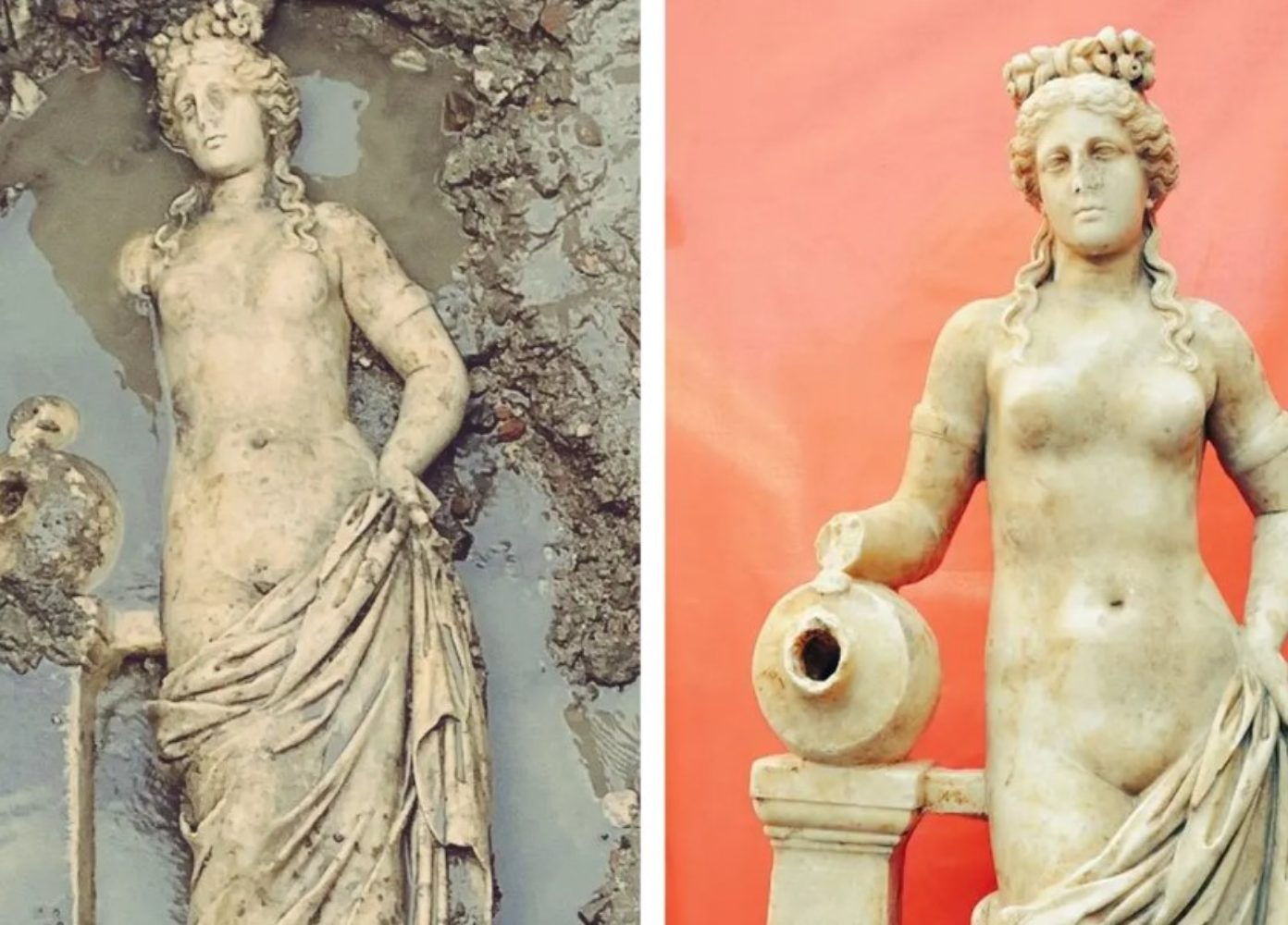
It is worth mentioning that a 1.50-meter-tall statue of Aphrodite has been discovered recently in ancient Amastris. It could be established that it is a Roman copy from between 180 and 200 AD that was inspired by Praxiteles’ school in the 4th century BC. The ancient city was named after Amastris, the niece of King Darius III, who married Dionysos, the tyrant of Herakleia-Pontus.

The map included in my post About Arrian’s Periplus of the Euxine Sea is most useful for locating all the cities, harbors, and rivers mentioned above. 

It should be said that while inspecting the Cappadocian frontier harbors in 123 AD, Emperor Hadrian had already visited part of the southern Euxine Sea, including Trapezus. With this in mind, Arrian now informed the emperor that Trapezus was building a new harbor, replacing the mooring where ships could only anchor in summer. 

It is quite amazing to see so much geography and history being exchanged. We tend to forget the many lines of communication that existed in antiquity, with traders, merchants, scholars, philosophers, astronomers, kings, and emperors traveling far and wide, by land and by sea.

[to be continued in Part 3]

Monday, May 15, 2023

Leptis Magna or What Rome must have looked like - Conclusion

( continued from Leptis Magna or what Rome must have looked like - Part II)

The city of Leptis Magna covered far more ground than the official buildings I just visited tend to imply. Two major constructions are still waiting for me, the Amphitheater and the Hippodrome. 

The Amphitheater lies approximately one kilometer from the center of Leptis Magna, close to the sea. It has been excavated in the natural rocky depression or possibly an ancient quarry. 

Thanks to an inscription, we know that it was inaugurated by the ruling governor, Marcus Pompeius Silvanus Staberius Flavinus, in his third year in office. He and his deputy dedicated the monument to Emperor Nero, meaning it was finished in 56 AD. 

The Amphitheater measured 57 x 47 meters and would accommodate as many as 16,000 people. Compared to the 50,000 seats in Rome’s Coliseum, it may seem small, but looking at it from the higher ground, it appears more impressive. The elite of Leptis Magna would elect to sit on the southeastern side of the Amphitheater, where they could enjoy a gentle breeze. 

The games were an all-day event. Typically, the early morning starts with animals fighting each other. Around noon, the criminals would be executed, i.e., thrown to the wild beasts. The afternoon was reserved for gladiators of different kinds and named after their equipment. 

In the southeastern corner of this monument stood a temple from the time of Hadrian dedicated to the goddess Artemis. Excavations early in the 20th century yielded a statue similar to the one in Ephesus, which is now exhibited at the Museum in Tripoli.

Closer to the sea are the remains of the Hippodrome or Circus built under Trajan in 112 AD. It roughly runs parallel to the coastline and is 450 meters long and 100 meters wide. Two tall vaulted passageways connected the Amphitheater to the Hippodrome. From my vantage point above, I can clearly see the spina, the central spine of the Hippodrome. Since it is not entirely excavated, the only visible rows of seats are at the far end, seemingly resting on the side of the dunes facing inland. It is estimated it could seat 23,000 spectators. 


Exceptionally, I would like to underscore the beauties of the Archaeological Museum of Tripoli because so many of the most exquisite statues and artifacts from 
Leptis Magna (and other antique cities on Libya’s coastline) are exhibited there. 

Leptis Magna has a small museum of its own, which collects artifacts whose quality does not rise to the standards of Tripoli. In front of the building stands a beautiful bronze statue of Septimius Severus, created by the Italians in 1940. 

At the entrance of this museum stands a welcoming marble African elephant who lost his trunk. A place of honor is reserved for the original Arch of Septimius Severus reliefs. Otherwise, there are many statues from the Theater and Hadrian’s Baths. In the corner, a group of headless figures in a toga gathers, generally larger than life-size, retrieved from the Old Forum and the Forum Novum Severianum. Rather striking and very lifelike is the face of Isis with inlaid glass eyes. The glassware and other vessels in various shapes and sizes, as well as the small frescos, merit attention. 

We mentally have to put the artwork from this museum and the one in Tripoli back into place. Still, we hardly catch a fraction of the magnificence and wealth Leptis Magna displayed in its time of glory. Picturing the wealth and opulence of Rome is clearly beyond reach!

It is evident that life in Libya has changed since my last visit. I expressed my concern in an earlier blog: Still hope, though scant, for Libya’s cultural heritage, but that was almost ten years ago. Nothing much has transpired since, and it seems the country's cultural heritage is not a priority, yet. I sincerely hope for the best!

Tuesday, March 29, 2022

Bringing the Doryphoros home

Thanks to the many copies the Romans made of original Greek sculptures, the initial artist of most works can be traced back. It is the case of the unique marble Doryphoros by Polycleitus, created in bronze around 440 BC. The bronze original was a little larger than life-size. 

[Picture from the Archaeology News Network]

The best-preserved copy of a Doryphoros or Spear Bearer was retrieved from the volcanic ashes of Vesuvius in the buried city of Stabiae on the Gulf of Naples. The Roman copy was created between 27 BC and 68 AD, shortly before the eruption of 79 AD. It was looted in the 1970s and ended up in Minneapolis' Institute of Arts. 

Investigations led to the reconstruction of the trail, followed by this important artifact after being stolen from Castellammare. This occurred between the end of 1975 and the beginning of 1976. 

The looters sold the statue to an antique dealer in Basel, Switzerland. From there, it made its way to the USA and hence to Germany. It was exhibited at the Glyptothek of the Antikenmuseum in Munich for several years, labeled as "Doryphoros aus Stabia." When identified by the Italia investigators in 1984, it was seized by the Naples Public Prosecutor. However, a year later, it was released and disappeared again to be sold in 1985 to the MIA in Minneapolis.  

It makes one wonder how it is still possible to drag around illegal antiquities without being detected, especially in the present case of a full-sized statue! 

The mayor of Stabia is asking to bring the Doryphoros back home to the Archaeological Museum Libero D'Orsi. The Italian authorities introduced a new official request to Minneapolis to return the Doryphoros to Italy. A close-up study followed to establish that this was indeed Stabia's stolen statue, which initially had a damaged arm, a missing finger, and a missing right foot. 

The Doryphoros stands out because of the perfection of its proportions, as Polycleitus is the first artist to establish the absolutely balanced and harmonious dimensions of the human body in his sculptures. He described its mathematical proportions in a lost treatise, the Canon of Polycleitus. His attitude was called contrapposto, in which the body's weight rested on one leg, and the other leg relaxed. Apparently, the sculptor has created 1500 works, none of which have survived. 

Polycleitus' search for perfection fits entirely with the typical mentality of the Greeks in his time, in which artists, intellectuals, and statesmen strived for excellence. This idea lived on long afterward since it was still practiced by Alexander and his contemporaries. 

With Phidias and Praxiteles, Polycleitus is considered one of the most important sculptors of the Classical Greek era. So significant was his influence that later artists like Skopas and Lysippos (Alexander's personal sculptor) worked using the same references.

[Bottom picture from Positano News]

Wednesday, December 16, 2020

About the Olympian gods

Walking through the history of Greece, we cannot escape the ever presence of the gods – in this case, the Olympian gods. Besides the written history, they all came to us in many shapes and forms, such as statues, reliefs, mosaics, and even paintings, which are widely lost. Some of those earthly creations are true masterpieces, which I'd like to share at present.

The Greek pantheon counted twelve gods: Zeus, Hera, Athena, Apollo, Artemis, Poseidon, Ares, Demeter, Aphrodite, Dionysos, Hermes, and Hephaistos. This number, however, was flexible, and at times one of the lesser gods was replaced by another one.

We will remember how King Philip, Alexander's father, proclaimed himself the 13th god when he made his triumphal entry into the Theater of Aegae, where he was murdered that same day.

The Greek gods were very human and constituted one big family.

Zeus was the father of the gods, and as such, he ruled over heaven and earth. He was the god of thunder, so he is generally depicted holding a thunderbolt in his hand. The most magnificent rendition, in my opinion, is the bronze Zeus from the Sea of Artemisia, c. 450 BC, that dominates the room at the National Archaeological Museum of Athens.

Hera was Zeus' wife and Queen of Mount Olympus. She was the goddess of marriage and the family. Although she was a very jealous spouse, she remained faithful to Zeus despite his many escapades. Her temple in Olympia left us with many unusual artifacts, among which there is this (restored) terracotta Acroterium, which is now displayed in the local museum.

Athena was born from the head of Zeus and was the goddess of war and wisdom. Her name is closely tied to Athens after she donated the olive tree to symbolize peace and plenty. A sacred olive tree stood on the Acropolis, where a more recent specimen had replaced its ancestor. In her honor, the famous Temple of the Parthenon was built in the 5th century BC. The New Museum of the Acropolis exhibits a relatively uncommon marble statue of a striding Athena that was part of the pediment of the archaic temple from c. 520 BC.

Apollo is the most loved of the gods and is generally associated with music. He also stands for youth, beauty, and the source of life and healing. Delphi was one of his favorite places of worship. Still, I was very impressed by the larger-than-life statue of Apollo playing the Lyre exhibited at the Archaeological Museum of Tripoli in Libya. It was retrieved from the Bath of Hadrian in Leptis Magna, Libya.

Artemis was the twin sister of Apollo, and often her temple stood right next to her brother's – as we know from Didyma and Letoon (Turkey), for instance. She was best known as the protector of women in childbirth, although she was also famous as the goddess of hunting. We'll remember that Artemis was so occupied in assisting the birth of Alexander that she neglected her tasks in Ephesos and let her temple burn down that same night. She is represented in the archaic eastern form with many breasts in this city, but that is not my favorite picture. There is, of course, the nearly intact Diana, the Roman version, at the Louvre in Paris, but I'd prefer this cute little hairnet from the National Archaeological Museum in Athens.

Poseidon, the later Roman Neptune, is best known as the god of the sea. He was famous for bringing floods and storms, but was also responsible for earthquakes. Yet, he had a good side also, since he protected the seafarers. My favorite is this relief from the 1st or 2nd century AD on display at the Museum of Burdur (famous for the artifacts retrieved in Sagalassos) in Turkey.

Ares was the son of Zeus and Hera and a very bellicose god with a quick temper. His beauty and courage made him the perfect seducer of women, the most famous of whom was Aphrodite. This scene is beautifully depicted in a fresco from the House of Lucretius Fronto in Pompeii, exhibited at the National Archaeological Museum of Naples, Italy.   


Demeter was Zeus' sister and the mother of Persephone, who was raped by the god of the underworld, Hades. She was one of the oldest gods in the Greek pantheon, and as such, she provided the earth's fertility and protected the harvest. The votive relief from Eleusis is probably the most famous picture, but I have a special connection with this remarkable relief tucked away in the Museum of Dion in Greece.

Aphrodite was born on the island of Cyprus near the city of Paphos, where her memory is still alive. According to some sources, she is said to be the daughter of Zeus. Aphrodite, who later became the Roman Venus, is widely known as the goddess of love, beauty, and sex. She not only protected the courtesans and prostitutes but also the seafarers. Quite uniquely, she was a favorite among men and women alike and played an essential role in commerce, politics, and warfare. There are many statues of Aphrodite and Venus to entice us. After in-depth comparisons, however, I chose this one from the Louvre in Paris.

Dionysos was another son of Zeus, but from his liaison with Semele. Hera was very jealous of that relationship and killed Semele. However, Zeus took the unborn child and reared him in his thigh. Dionysus turned out to be the bad boy of Olympus and is best known as the god of wine – always playful and good-natured. He is often represented in the presence of a Satyr, and the example from Sagalassos exhibited at the Museum of Burdur is one of the finest Hellenistic statues.

Hermes. In the crowded family on Mount Olympus, Hermes was another son of Zeus, but this time by the nymph Maia. He is often seen in the company of Pan, his son, and is the patron of the shepherds. He was engaged in many fields and was the god of commerce and thieves, clearly illustrating his colorful personage. He was also active as the god of travel, wealth, luck, and language. His later Roman name, Mercury, highlights his versatility. The most perfect rendition is the splendid Hermes with the child Dionysus, which Praxiteles created for the Temple of Hera in Olympia.

Hephaistos was the brilliant blacksmith on Mount Olympus. He was the god of fire and metallurgy. Since he was born to Hera without a father, he appeared as an ugly figure – the only one among the overall near-perfect gods and goddesses. That may be why I didn't find (or photograph) a statue of Hephaistos, who has left us his well-preserved temple in Athens.

Thursday, May 28, 2020

Food for thoughts

Strolling through the Graeco-Roman section of a museum, I often come face to face with a statue or a head of Antinoüs, the lover of Emperor Hadrian. His outstanding beauty and the perfect traits of his being are true eye-catchers.

Hadrian, who lived 76-138 AD, was a world traveler in our modern concept. He regularly visited many cities of the prosperous Roman Empire, and the occasion was often thankfully remembered by the citizens who built a triumphal arch. Many such monuments are still visible today. They have become so familiar that I genuinely miss them when they are absent. This was the case, for instance, in Albania. In the historical context, that is not surprising, but as it turned out, I got used to the comforting idea of having Hadrian around.

As the arches remained in place, the statues of the emperor were generally safely removed to a museum. It is there that Antinoüs pops up next to him. In the back of my mind, I am confident that when you see one, you are almost certain to find the other nearby.

In antiquity, a man having a male friend or lover was a way of living. Such relations were commonly accepted, not like today when many people raise their eyebrows, to put it mildly, and condemn the relation entirely. In our modern world, people belonging to LGBTQ groups are still far from being accepted. But that is not the point I want to make, and this is not the place to discuss the matter either.

We’ll find various examples of such relationships in Classical Greece. The Theban Band, which was ultimately destroyed by Alexander at Chaironeia, consisted of elite pairs of lovers. It was a fierce and unbeatable Band of Brothers precisely because they were lovers and would defend their partner to the very end. It was a great honor to belong to this Band famed to be invincible, that is, till they were defeated by Alexander.

Achilles and Patroclus, as described by Homer, is another example. They were so vividly remembered that when Alexander reached the tomb of Achilles in Asia Minor, he and Hephaistion stripped their clothes and ran around the burial mound. They identified themselves with Achilles and Patroclus.

Another famous pair of lovers was Harmodius and Aristogeiton from Athens, who became the symbol of democracy after committing an act of political assassination in 514 BC. They killed Hipparchus, the last tyrant of the city, during the Panathenaic Festival. The Athenians recognized them as the founders of democracy and erected a bronze statue group in their honor. It stood on the Acropolis till it was robbed by Xerxes during the Persian War in 480 BC, and it was installed in Susa. This is where Alexander found the group in 330 BC, and he sent it back to Athens.

Clearly, the friendship/love between Alexander and Hephaistion was nothing new. It was common knowledge among the troops, who accepted it for what it was. The special place Hephaistion occupied in Alexander’s life was, however, a source of envy and even resentment among the other Companions and generals. They must have watched that relationship with Argus’ eyes as they all coveted Hephaistion’s privileged position. Yet, Hephaistion never took advantage of that position. He must have walked a tightrope trying to stay aloft and still accomplish the missions Alexander entrusted to him. He must have been a gifted diplomat, blessed with a huge dose of self-control and endless love for Alexander.

I find it quite intriguing that most of the statues of Hadrian and Antinoüs were made during their lifetime and have survived to this day. This is not the case for Alexander, whose statues were made after his death. Most are Roman copies from the 1st and 2nd century AD based on originals by Lysippos, Praxiteles, and other great artists whose works no longer exist. The images of Hephaistion are even scarcer, and one could wrongly assume that his relationship with Alexander was not important enough to be underscored in the art world.

On the other hand, we know that after the death of Hephaistion, many effigies were made. They were presented to the mourning Alexander by his generals. Perhaps they hoped to clear their own conscience or to find a way to console Alexander. It remains to be seen whether that gesture was genuine or only a way to plead their own case to obtain favors. It is not impossible that after Alexander’s own death, his generals destroyed the effigies of Hephaistion in an ultimate urge to satisfy their own desire for revenge.

The fact remains that Alexander and Hephaistion are rarely seen together. I have come across only two such cases. One set of statues stood in a showcase at the National Archaeological Museum of Athens (see: Alexander and Hephaistion side by side). Those statues, found in Alexandria, are a little less than life-size and date from the 1st century BC. The other example is their respective heads on display at the Getty Museum in Malibu, California (see: Ode to Alexander and Hephaistion). They once belonged to a larger group made as early as 320 BC and found in Megara, near Athens. Both heads have been reworked in antiquity, and Hephaistion’s hair has been trimmed in the process.

Both men are evidently also depicted on the famous Alexander sarcophagus, now at the Archaeological Museum in Istanbul. However, they are not placed next to each other but on either side of the sarcophagus. Alexander is depicted fighting a Persian on one panel and Hephaistion is part of a hunting scene on the opposite side.

Wednesday, May 29, 2019

Massive plundering of art in the early years of the Roman Empire

The plundering and looting of artwork have been ongoing for centuries, and it was not Emperor Augustus’ scoop. In a previous blog, Wartime Looting in antiquity, I covered many ancient artifacts that changed owners over the centuries. This time, I want to focus on Augustus’ contribution, among which are some treasures related to Alexander the Great.

Octavian's conquest of Egypt and the Eastern Mediterranean clearly went to his head. He was now the most powerful man on earth for all to see and respect. To underscore his role, he proclaimed himself emperor, taking the name of Augustus, which means majestic and venerable. Modesty was not his virtue.

The greatest treasures that fell into Octavian's hands came from Alexandria, where the Ptolemies had amassed many artworks from the most famous Greek artists like Apelles, Alexander’s privileged painter, and Antiphilus, a contemporary of Apelles and maybe a rival. However, he worked mainly for Philip II and for Ptolemy I. Egypt was an untouched trophy, and besides their Greek heritage, they had gathered spoils from Africa and collected other precious Orientalist Greek-Egyptian works of art, all to be added to their own centuries-old cultural heritage. Obviously, Octavian’s army helped itself during what must have been quite a rampage after the downfall of Cleopatra VII in 30 BC. Upon their return to Rome, blinded by the wealth that poured into the city, everybody of name and fame wanted a piece of the pie and acquired what they could by all possible means: from honest purchases and authentic gifts to robbery, haggling, blackmail, or bribery.

Egypt was not the first victim, and we will remember that only a good one hundred years before, the Romans had helped themselves to the treasures of Macedonia in 168 BC when they won the decisive Battle of Pydna. Aemilius Paulus took the royal library of Macedonia with him, and Sulla followed suit in 86 BC, helping himself to Aristotle’s personal library in Athens. Marc Antony simply dispatched the 200,000 parchment rolls from the Library of Pergamon to Cleopatra in 43 BC as a wedding gift. Papyri and parchment rolls were no booty to show off with, but paintings, statues, and jewelry enabled you to brag. As kingdoms like Macedonia and Pergamon were subdued by Rome, they became treasure troves for art lovers and the nouveau riche.

Julius Caesar was already a great “collector,” and Octavian, as the new Emperor Augustus, would not stay behind. With the increase of its wealth, Rome developed further refinement. Several private connoisseurs are known by name, like L. Lucinius Luculius and Novius Vindex, who highly appreciated Greek bronze and marble statues made by Lysippos (he acquired a statuette of Heracles, which was previously owned by Alexander, Hannibal, and Sulla), Praxiteles, Phidias, Skopas, and Polycleitus, and the paintings by Apelles were among their prized objects.

Augustus “bought” a famous painting of Aphrodite by Apelles, a controversial transaction that officially enabled the citizens of Cos to pay their outstanding taxes, but some obscure blackmail is more likely. The painting was exhibited for the opening of the Temple of the deified Julius Caesar in the Forum Romanum in 29 BC. Despite the eulogy written by several Latin poets, it remains unclear whether this Aphrodite was painted in the nude, rising from the sea and wringing her hair, or if only her upper body was showing. Two more paintings by Apelles were put on public display on the Forum, probably because they featured Alexander the Great. They were “Castor and Pollux with Victory and Alexander the Great” and “The Figure of War with his Hands tied behind him following the Triumphal Chariot of Alexander.”

Everything tied to Alexander was a prime possession as Augustus was a great admirer of the world conqueror and visited his tomb while he was in Alexandria. So it seems that the bronze Nike statues that supported each corner of the canopy over Alexander’s funeral chariot, as described by Diodorus, found their way to Rome as two of them were placed in front of the Temple of Mars Ultor and the two others stood in front of the Regia. These Nikes originally were covered with gold foil or gilt and not made of massive gold, as often assumed, for that would have made the statues too heavy for the funeral chariot.

Another close relation to Alexander was found in the Temple of Apollo Palatinus. According to Pliny the Elder, inside this temple stood a magnificent bronze chandelier “with the lights fixed like apples on a tree,” which had been taken by Alexander from Thebes in 335 BC (another earlier spoil of war!). Alexander had dedicated it as his votive offering after victory at the Battle of the Granicus.

The Alexandrian painter Antiphilus was another favorite artist of the Roman emperor. A group representing “Alexander with Philip and Athena” was placed in Rome’s Portico of Octavia with ”Noble Hesione.” In the nearby Portico of Philippi, three more works found a place: “Alexander portrayed in his early teens,” “Dionysus,” and the “Death of Hippolytos.”

Augustus’ greed was boundless, and he did not hesitate to confiscate the chryselephantine statue of Athena from Tegea, made by a certain Endoios, to place it on the Forum Augusti. At the time of his conquest of Egypt, he also seized the statue of Zeus made by Myron from Samos and moved it to the Capitol Hill in Rome.

These are, of course, only a few examples, for it is impossible to know how many works of art Augustus brought to Rome and how many pieces from previous acquisitions changed hands in those days. Yet the quantities and mainly their quality were unheard of, and we must thank Pliny the Elder for documenting the works displayed in Rome’s many public buildings and porticoes. Pausanias, also, during his extensive travels, highlighted the prized collection. Plutarch, in turn, had an eye for Cleopatra’s treasures, including precious metals, jewels, pearls, and ivory.

It is hard to imagine the wealth and luxury displayed in the heyday of Rome, for this is far beyond anything we can imagine. Opulence was the common good; the Romans ruled the world, and they showed it.

[The above is based on an article published by Academia.edu: Plundered art in the galleries of Augustan Rome, uploaded by Tomasz Polański. The pictures are mine.]