Alexandria's founded by Alexander

Alexandria's founded by Alexander the Great (by year BC): 334 Alexandria in Troia (Turkey) - 333 Alexandria at Issus/Alexandrette (Iskenderun, Turkey) - 332 Alexandria of Caria/by the Latmos (Alinda, Turkey) - 331 Alexandria Mygdoniae - 331 Alexandria (Egypt) - 330 Alexandria Ariana (Herat, Afghanistan) - 330 Alexandria of the Prophthasia/in Dragiana/Phrada (Farah, Afghanistan) - 330 Alexandria in Arachosia (Kandahar, Afghanistan) - 330 Alexandria in the Caucasus (Begram, Afghanistan) - 329 Alexandria of the Paropanisades (Ghazni, Afghanistan) - 329 Alexandria Eschate or Ultima (Khodjend, Tajikistan) - 329 Alexandria on the Oxus (Termez, Afghanistan) - 328 Alexandria in Margiana (Merv, Turkmenistan) - 326 Alexandria Nicaea (on the Hydaspes, India) - 326 Alexandria Bucephala (on the Hydaspes, India) - 325 Alexandria Sogdia - 325 Alexandria Oreitide - 325 Alexandria in Opiene / Alexandria on the Indus (confluence of Indus & Acesines, India) - 325 Alexandria Rambacia (Bela, Pakistan) - 325 Alexandria Xylinepolis (Patala, India) - 325 Alexandria in Carminia (Gulashkird, Iran) - 324 Alexandria-on-the-Tigris/Antiochia-in-Susiana/Charax (Spasinou Charax on the Tigris, Iraq) - ?Alexandria of Carmahle? (Kahnu)
Showing posts with label Cassander. Show all posts

Friday, June 21, 2024

The roaring times of the Antigonid dynasty

The Wars of the Diadochi broke out after Alexander’s death in 323 BC and his huge Empire went to “the strongest” as he may have intended to say on his deathbed in Babylon. However, it did not go to one single ruler as none of his generals had his vision or charisma. 

After endless battles, intermarriages, and lots of intrigues, Alexander’s generals eliminated each other and, in the end, started four distinct dynasties. Ptolemy initiated the Ptolemaic dynasty in Egypt, and Seleucos the Seleucid dynasty in Asia. Cassander, the son of Antipater, founded the Antipatrid dynasty (the ancient Kingdom of Macedonia). In 306 BC, Antigonus Monophthalmus (the One-Eyed) declared himself and his son Demetrios kings. By doing so, the Antigonid dynasty replaced the Antipatrid dynasty. 

Antigonus may well have served under Philip II and lost an eye during the Siege of Perinthus in 340 BC. He later joined Alexander on his Persian campaign and was promoted to satrap of Phrygia in 334 BC. His main duty was to maintain Alexander’s line of communication and supply. As a result of the Partition of Babylon following Alexander’s death, he also received Pamphylia and Lycia. 

During the Wars of the Diadochi, Antigonus picked up momentum and managed to rule over all of Asia Minor, Greece, Syria, Phoenicia, and northern Mesopotamia. Fearing his increasing power, Seleucos, Ptolemy, Lysimachos, and Cassander joined forces against him. Antigonus was defeated and killed at the Battle of Ipsus in 301 BC after which his realm was split between Lysimachos and Seleucos. 

However, Antigonus son Demetrios Poliorcetes, by now having earned his stripes as Besieger survived said battle and took control of Macedonia in 294 BC. Cassander died in 297 BC without a successor as his sons had eliminated each other, paving the way for Demetrios to become King of Macedonia. Not for long because in 288 BC he was driven out by Pyrrhus and Lysimachos, and died as a prisoner of Seleucos. 

It was not until 277 BC that Demetrios son, Antigonus II Gonatas, regained the title of King of Macedonia. He ruled till about 239 BC, to be succeeded by Demetrios II Aetolicus, followed by Antigonus III Doson ten years later. 

Meanwhile, Rome became the rising power in the eastern Mediterranean, and soon the first conflicts with Antigonid Macedonia led by King Philip V (221-179 BC) erupted. His successor, Perseus, put up a fierce resistance against the expanding Roman Empire that coveted Macedonia’s wealth. The Romans conquered Antigonid Macedonia in 168 BC at the Battle of Pydna, turning Alexander’s homeland into a mere Roman Province. 

Although very eventful, the Antigonid dynasty was short-lived and lasted less than 150 years. 

Macedonia’s grand palaces of Aegae, Pella, Bylazora, and Dimitrias were thoroughly looted, and the houses of the wealthy Macedonians were plundered. Statues, paintings, jewelry, and other wonderful, precious artifacts from Greece and Asia were up for grabs. Roman generals and common soldiers alike took as much as they could carry. Only the gods know what happened to the collection of Macedonia’s precious libraries.

Monday, April 3, 2023

Seuthes III, king of Thracia

Seuthes III, King of Thracia or, more precisely, of the Odrysian tribe, caught my attention after seeing pictures of his splendid bronze head. The work is of such high quality that it could easily fit the heyday of Hellenism or the Renaissance. Some scholars claim that it was made by Lysippos or in his style. It emanates a sense of power as the face stares back with alabaster and glass-paste-inlaid eyes glancing from under the eyelashes and brows made of copper strips. 

The head of Seuthes was found in his tomb, not far from Kazanlak in modern Bulgaria. The gravesite is one of the many in the Valley of the Thracian Kings and not far from the so-called Tomb of Kazanlak (see: Valley of the Thracian Kings), initially attributed to King Seuthes. 

Seuthes rule is roughly dated to 331-300 BC. The news of his ascent to the throne reached Alexander after he set out for Asia in 334 BC. Antipater certainly informed him of this new power on his northern borders. The King of Thracia outlived Alexander (see: Thracian Tombs at Doxipara, Greece) and got involved in the War of the Diadochi. 

Seuthes rebelled against the arrival of Lysimachos, who inherited Thrace after Alexander’s death. In the early stage, Lysimachos occupied only the coastal region, but soon his ambition brought him to conquer the hinterland. He faced Seuthes in combat twice, and eventually, Lysimachos established his authority, and they signed a peace treaty. 

Seuthes has preserved his autonomy, although history does not focus much on him after 310 BC. Coins reveal that he still ruled in 297 BC when Cassander of Macedonia died. Another source is the inscription from Seuthopolis, tentatively dated between the 290s and the 280s BC. It mentions Seuthes III, his wife or widow Berenice (possibly a member of Lysimachos family), and their sons, Hebryzelmis, Teres, Satocus, and Sadalas, treating with King Spartocus of Cabyle. Cabyle had been conquered by Philip II in 341 BC and populated with rebellious Macedonians. 

King Seuthes built his capital of Seuthopolis around 320 BC (see: Philip’s Macedonia also included today’s Bulgaria). It was a well-planned city whose remains were flooded after the construction of a dam on the Tundzha River in 1956. 

Initially, the king’s tomb was part of a monumental temple inside the Kosmatka Mound, one of the largest in Thrace. The mound from the second half of the 5th century BC is approximately 20 meters high with a diameter of 90 meters! It contains a corridor, a circular domed room, and a small chamber made of granite blocks. The space may have been used as a sanctuary for Orphic rites. Shortly before the death of Seuthes, the construction was entirely renovated, and the small chamber was converted into a funerary room. It was closed with a two-folding marble door, not unlike what we know from Macedonian tombs. After Seuthes funeral, access to the circular room and the grave chamber was walled; the corridor was filled with stones and soil. The very façade had been carefully buried under the mound. 

Seuthestomb was discovered in 2004 and yielded an impressive number of artifacts. In the passageway, archaeologists found the skeleton of a horse. Inside the funerary chamber was a full suit of armor: a bronze helmet showing a picture of Nike, a pair of greaves, remains of a leather breastplate, two iron swords, and ten spearheads. Also in the room were two iron strigils, gold and silver kylices, a bronze and a silver phial, a pair of scissors (how unique!), a silver and two alabaster jugs, a box with silver and bronze jewels, and three wine amphorae from Thasos, one of which was still sealed. Smaller items were also recovered, such as golden horse trappings with pictures of humans, animals, and plants, and sword sheath decorations. On the funeral bed, they found a golden oak wreath, otherwise known from Macedonian graves. 

It is noteworthy that the helmet and some of the silver objects carried the inscription ΣΕΥΘΟΥ, connecting the tomb to King Seuthes III – also confirmed by the gold coins and the bronze bust of the owner found some seven meters in front of the façade. 

We can only dream about the wealth still hidden inside the many mounds of Bugaria’s Valley of the Thracian Kings.

Monday, February 27, 2023

About daily life after Alexander the Great

How exciting to read about daily life as it was after the conquests of Alexander! It sounds like a fiction story, but the truth may be closer than we think! 

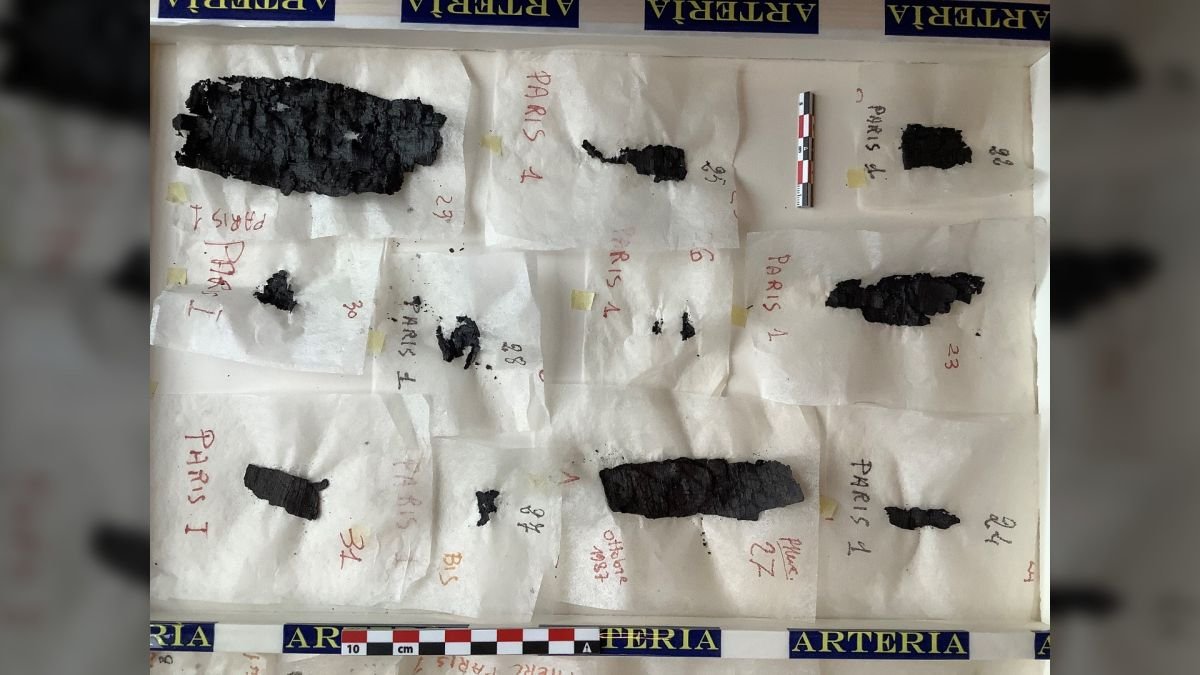
Artificial Intelligence, AI, in short, is a relatively new digital means that offers endless possibilities with unexpected results. Machine learning is a branch of AI researchers use to read faint traces of ink on still rolled-up papyrus scrolls. If successful, this technology opens exciting possibilities to decipher Herculaneum's thousands of carbonized scrolls. 

These latest results have been published in Live Science. The study concentrates on an otherwise “lost book” that supposedly discusses the dynasties that succeeded Alexander. 

Although till now only small fragments can be read, hopes are high to learn more about the Macedonian leaders that followed in the wake of Alexander. So far, the names of Seleucos and Cassander have been recognized together with “several mentions of Alexander himself!” 

[Picture from Live Science, credit Michèle Hannoosh]

The “lost book” is one of the many works discovered at the Villa dei Papiri in Herculaneum. Other books contain writings by Philodemus of Gadara, an Epicurean philosopher who lived from c. 110 until 30 BC and resided in the city. 

The fragile carbonized scrolls ended up at the Institut de France in Paris. Over the years, several attempts were made to unroll the scrolls, but they failed. The papyri crumbled into bits and pieces or volatilized into pure dust. 

Clearly, AI gives us new hope to unravel more about our past.

Friday, February 17, 2023

An introduction to Pyrrhus of Epirus

It was quite a surprise to stand face-to-face with Pyrrhus in Albania. It happened at the entrance to the Skanderberg Museum in Kruje, where his life-sized bust stood right next to the imposing relief figure of Skanderbeg, Albania’s hero. 

Pyrrhus of Epirus was a great-nephew of Olympias and cousin of Alexander the Great – not a small introduction. He was born in c.319 BC – not the right time to be the heir to the Molossian throne of Epirus. He got caught up in the fiery dispute between the sons of Cassander and Thessalonica, and, reigning briefly as a minor, he had to flee his homeland. He joined the court of Demetrios I (Poliorketes) as an exile, and in 301 BC, aged 18, he fought at the Battle of Ipsus

As a pawn in the War of the Diadochi, Demetrios, to befriend Ptolemy, gave him Pyrrhus as a hostage. That’s how Pyrrhus arrived in Alexandria. Well, it was not the worst place to grow up, and Pyrrhus most certainly took advantage of the situation, not unlike what Philip II had done at the court of Thebes. He made his way in Egypt and eventually married one of Ptolemy’s daughters, Antigone

Four years later, in 297 BC, with Ptolemy’s support, Pyrrhus returned to Epirus and began taking control of his own life. He started expanding his kingdom by annexing Illyria. His ambitions were not small, for when Antigone died, Pyrrhus made three diplomatic marriages to live peacefully with his neighbors. His first wife was Lanassa, the daughter of Agathocles, tyrant of Syracuse. Her dowry was the islands of Leucas and Corcyra (modern Corfu). The next bride was the daughter of King Audoleon of the Paeonians living north of Macedonia. His third marriage was to Bircenna, daughter of the Illyrian King Bardylis II. Demetrios Poliorcetes as king of Macedonia, it should be said, had married Pyrrhus sister. 

By 288 BC, Pyrrhus turned against Demetrios and succeeded in getting the Macedonian army on his side. With Lysimachos as his new ally, they jointly ruled over Macedonia. Only for a while, though, since Lysimachos still had his mind set on all of Macedonia and expelled Pyrrhus. 

Once more, Demetrios and Pyrrhus made peace, which was again short-lived. When in 286 BC, Demetrios invaded Asia Minor, ruled by Lysimachos, the latter asked Pyrrhus to invade Thessaly to attack Demetrios from GreecePyrrhus soon defeated Antigonus GonatasDemetrios’ son, who surrendered Thessaly to him to make peace. 

Pyrrhus’ empire now included half of Macedonia, larger Epirus, and Thessaly. Yet, he still wanted more and eyed Magna Graecia, including the wealth of Sicily. His opportunity arose when Taras (modern Taranto) called for his help to repel an imminent Roman attack. Pyrrhus led his army across the Adriatic Sea, including 20 war elephants. He was victorious at Heraclea (modern Policoro, southwest of Metaponto) in 280 BC and a year later at Ausculum (modern Ascoli Satriano south of Foggia)

At this point, Pyrrhus decided to stay in Italy, offering his help to Syracuse. He successfully lifted the Carthaginians’ siege in 278 BC and, in return, was proclaimed King of Sicily. The Medagliere, the strongbox room at Syracuse’s Museum, proudly exhibits coins of King Pyrrhus

His moment of glory would not last either because of the renewed threat from Carthage, ending Pyrrhus siege of Lilybaeum (modern Marsala) in a disaster. The people of Syracuse then decided not to continue the war. The Carthaginians defeated Pyrrhus in 275 BC on his return to Syracuse

At the end of that same year, Pyrrhus sailed back to Epirus, which, in his mind, offered new opportunities as his son, Ptolemy, tried to expand the kingdom. The next campaign took Pyrrhus to Argos in the Peloponnesus, where caught in a narrow street, he was killed by a woman who threw a tile from the housetop. 

This was not the death a man like Pyrrhus would have planned. He had fought in so many battles, always leading his men. He had been schooled by Demetrios Poliorketes, who had walked in the footsteps of Alexander and his father, Philip. He was not meant to die such an inglorious death. 

In the 2nd century AD, Pausanias witnessed a memorial to King Pyrrhus at Argos, integrating a panorama ‘carved in relief.’ The king was buried in his capital, Ambracia (a colony of Corinth in Epirus). 

Pyrrhus may have led a glorious life, but the Macedonians resented him because he let his Gauls plunder the tombs of the Macedonian kings at Aegae – an unforgivable crime!

Monday, June 27, 2022

Lysimachos in the wake of Alexander – Part II

 [continued from Lysimachos in the wake of Alexander - Part I]

Skipping the many details and intertwined relationships, let us pick up the story when Seleucos added his forces to those of Lysimachos and his allies to fight the elderly Antigonus Monophthalmus and his son Demetrios Poliorcetes. The battle took place in 301 BC at Ipsus and ended with Antigonus’ defeat and death. The victors subsequently divided his territory among them. Lysimachos acquired a significant share with Lydia, Ionia, and Phrygia, including the entire north coast of Asia Minor. Seleucos received Syria, and Cassander was now secure in Macedonia and Greece. 

Until then, Antigonus Monophthalmus had been the most successful among the generals in recreating Alexander’s empire. His son Demetrios attempted to follow in his father’s footsteps, but he lacked a broader view. 

Around that time, Nicaea died, and Lysimachos honored her by naming a city in Asia Minor after her, modern Iznik in Turkey. 

As Seleucos was growing ever more powerful, Lysimachos thought it wise to seek the support of Ptolemy. Around 300 BC, he elected to marry Arsinoe, the daughter of Ptolemy, and his mistress Berenice. Amastris, as said above, stepped back and divorced herself from Lysimachos, moving back to Herakleia Pontus. 

Although this marriage of Lysimachos was not a happy one, Arsinoe stayed with her husband till his death. She bore him three sons: Ptolemy I Epigonos, Lysimachos, and Philip. Her jealousy, however, incited her to convince her husband to kill his oldest son and heir, Agathocles (from his marriage to Nicaea), based on treason. The murder happened in 284 BC despite the young man successfully leading his father’s army in combat. Although he was only in his early thirties, his men loved him much. 

Meanwhile, Cassander died in 297 BC. His sons were more interested in fighting each other for power than ruling the country. Macedonia eventually fell into the hands of Demetrios. So, in 287 BC, Lysimachos agreed to fight alongside Pyrrhus to drive Demetrios out of Macedonia. They successfully ruled the country jointly until Lysimachos broke up with Pyrrhus and seized Macedonia for himself. 

Lysimachosgreed and thirst for power equaled that of the other generals, now kings in their realms. The fighting was not over yet. 

Seleucos, in 282 BC, broke his alliance with Lysimachos as he attempted to take his territory in Asia Minor. The final clash happened in Lydia at Corupedium in 281 BC. It ended with the death of Lysimachos. By then, the King of Thracia must have been in his late 70s. He had lived a life of almost continuous and repeated battles, inspired by the greatest conqueror of all times, Alexander the Great. 

Like the other new self-proclaimed kings, Lysimachos had minted his own coins. However, he did not follow them by stamping his personal image on these coins but kept using the effigy of Alexander instead. Could that be seen as a late posthumous homage and tribute to his boyhood friend? 

Lysimachos is also being honored as a friend and benefactor of Samothrace. He received the title of Lysimachos Euergetes as inscribed on the altar erected in his honor and used during annual festivals. A stele found on the island reads a dedication of King Lysimachos from between 288 and 281 BC. Based on the surviving first fifteen lines, Lysimachos was honored for restoring sacred lands on the mainland initially granted to Samothrace by either Philip II or Alexander the Great or by Philip Arrhidaeus III and Alexander IV. There were boundary stones for said sacred land near Alexandroupolis in Greece. 

Money was never an issue throughout all those years of bickering, conniving, and fighting. Lysimachos, like all the other generals, had cashed his share of Alexander’s fortune. In his case, it was a mere 9,000 talents in silver and gold, roughly worth several billion in today’s value. The money was safely kept on the Acropolis of Pergamon. However, when Attalus III gave the city to Rome in 133 BC, the entire treasure (not limited to Lysimachos share) fell into Roman hands. This fortune contributed largely to the rise of the Roman Empire – but that is another story.

Friday, June 10, 2022

Lysimachos in the wake of Alexander – Part I

Lysimachos was in Babylon at the time of Alexander’s death in 323 BC. Almost immediately, anarchy erupted as the king had no successor. Every single one of his generals felt entitled to succeed Alexander pending the coming of age of his yet unborn son. 

The War of the Diadochi had begun and would last for the next forty years or so. The generals took sides, changed sides, and made peace treaties but coveted each other’s possessions soon after. Their lust for power led them to conquer ever more land. They eliminated each other systematically until around 280 BC; four contenders remained: Ptolemy in Egypt, Seleucos in Asia, Antipater / Cassander in Macedonia/Greece, and Lysimachos in Thrace. 

Lysimachos’ origin is obscure, and the best guess is that he was born around 361 BC to Thessalian parents living in Pella. He was educated at the court of Philip and was probably one of his Bodyguards. He was only a few years older than Alexander, and we can safely assume that he joined the young prince in Mieza to attend Aristotle’s teaching with the other selected young men. 

Historians hardly mention Lysimachos in Alexander’s early campaigns, although he was present throughout the king’s conquests of Persia as one of his trusted Bodyguards. This lack of information does not imply that Lysimachos was not a valued element in Alexander’s organization. Many positions beyond that of a general were of the utmost importance. Take, for instance, the logistics of the entire enterprise, or the scouting parties to locate otherwise hidden enemies or find the appropriate location for the following camping site, or escorting Queen Sisygambis and her retinue till their arrival at Susa, and many other tasks. 

Lysimachos joined the ranks of the Companion Cavalry, maybe after several of Alexander’s masterly reshuffling of the army according to his needs. 

Except for him being mauled by a lion in Syria, he was not documented until 328 BC, when Alexander crossed the Hydaspes River. There is no further information. 

Lysimachos participated in the siege of Sangala (see: The siege of Sangala). Alexander lost less than one hundred men in this fierce fight, but an excessive number of 1200 soldiers were wounded, including Lysimachos. 

He was evidently present at the Susa Wedding in 324 BC, but we don’t know the name of his bride. Since she is not mentioned when he moves to Thracia, we may conclude that he left her behind after Alexander’s death, at which time he became ruler of Thracia. 

The position of Thracia was strategically crucial as the land extended to the Black Sea and the Hellespont, both major links with Asia. Upon arrival, Lysimachos faced the rebellious Thracian tribes fighting each other. Their most powerful dynasty was the Seuthes. However, Lysimachos was quickly able to establish his authority. 

As the War of Alexander’s Successors raged on with the other generals fighting among themselves, Lysimachos managed to stay away from their intrigues. 

In 321 BC, to stabilize his position further, he decided to marry Nicaea, Antipater’s daughter, after Perdiccas had refused her hand. This alliance secured his position vis-à-vis both Antipater and Cassander. The couple would have three children: one son, Agathocles, and two daughters. 

In 315 BC, a revolt broke out among the cities on the Black Sea. Antigonus Monophthalmus, who reigned over most of Asia Minor, saw an opportunity to annex Thrace to his own territory and stirred up the local tribes against their king. Once again, Lysimachos managed to suppress the revolt and consolidate his power. Peace was reached in 311 BC. 

This revolt drew him into the Succession Wars, and he sided with Cassander, Ptolemy, and Seleucos against Antigonus Monophthalmus. In 309 BC, to secure the Hellespont, he built a new city, Lysimachia, in a commanding location on the Chersonese peninsula. 

By 305 BC, all the contestants in the Wars of the Diadochi adopted the title of king and Lysimachos followed suit by assuming the royal title as well. He was now an equal player in the succession game of the thrones. 

In 302 BC, Lysimachos again joined forces with Cassander to conquer Asia Minor from Antigonus Monophthalmus. As winter approached, he set up camp in Herakleia Pontus, where he met Amastris, granddaughter of Queen Sisygambis, who had been given as wife to Craterus at the Susa Wedding. She left her husband after he took Arsinoe of Egypt as his wife, who became the widowed Queen of Herakleia. So, Lysimachos married Amastris, but this marriage didn’t last long, for soon afterward, he decided to take as spouse Arsinoe, daughter of Ptolemy. Consequently, Amastris left Lysimachos and returned to Herakleia Pontus (see: Time to reconnect with Princess Amastris). 

In fact, with his marriages, Lysimachos was in line with the other Successors or contenders who still aimed at re-establishing Alexander’s empire. Marriage was much cheaper than war to conquer more land.

 [continued in Part II]

Thursday, April 14, 2022

How important was Barsine?

The question is actually double: How important was Barsine for Alexander? And how important was Barsine in the geopolitical world of her time? 

Authors from antiquity have not spent much ink on her, and she is only mentioned when she comes to the foreground, which isn’t often.  

Barsine was the daughter of Artabazus II, satrap of Hellespontine Phrygia in northwestern Turkey. Artabazus’ first wife was from Rhodes and was the sister of two capable generals, Mentor and Memnon. 

Artabazus revolted against the newly appointed Persian king, Artaxerxes III Ochus. Artaxerxes had ordered the dismantling of his mercenary army, which the satrap did not accept. Artabazus and his family (including Memnon) went into exile and found refuge at the court of Philip II in PellaBarsine, who was fluent in Greek, must have met the younger Alexander during their stay. We don’t know the nature of their encounters or conversations, but we may safely assume that Alexander inquired about life and customs in Persia. After all, he impressed the Persian envoys at a young age as he questioned them pending his father’s return to the Palace. 

Three years later, Artabazus reconciled with the Persian king, and he returned to Persia, taking Barsine and his family with him. That happened in 343 BC, about one year after Aristotle arrived on the scene to teach Prince Alexander. Over the years, the entire company probably met the philosopher along with other distinguished visitors to the Macedonian court. 

Barsine married her uncle Mentor, a Greek mercenary general in Persian service, while she still was young. Mentor died soon afterward, leaving her with a daughter. In those circumstances, Memnon took her as his wife that same year, 338 BC. He already had several sons from a previous marriage. We can safely assume that Barsine’s opinion in these matters didn’t count. What’s more, she became a second mother to her husband's (teenage?) sons. Just as MentorMemnon led an army of mercenaries for the Great King. Having a lovely wife familiar with the Greek language and culture, no doubt, added to his prestige. 

In 334 BC, when Alexander, now king of Macedonia, faced the Persian army at the Granicus RiverMemnon fought on the enemy’s side. Although the battle was lost, the general’s capabilities were recognized by Darius, and he was appointed as commander of the Persian fleet in the Aegean. This honor may be a questionable trust because, in exchange, Barsine had to stay at King Darius’ court with her father, Artabazus. 

A year later, during the siege of Lesbos Memnon fell ill and died. Barsine was widowed for a second time. 

Around that time, Alexander had reached Issus where he defeated Darius in November 333 BC. When Parmenion rode to Damascus to take hold of the Persian treasury, the baggage train, and the women of the aristocrats, he met Barsine and brought her to Alexander. 

Her relationship with Alexander lasted five or six years. I wonder whether she traveled with Darius’ mother, wife, and children, who had been taken in Issus. Alexander was constantly on the move, conquering the eastern Mediterranean and Egypt and marching to Babylon and Susa, where he finally installed the Persian Royal Family. Barsine stayed at Alexander’s side, and we can only guess which quarters she occupied when the army was on the road. 

During that time, Artabazus remained faithful to Darius until the Great King was murdered by Bessus, who then proclaimed himself the new king of PersiaArtabazus refused to submit to Bessus and left, taking his mercenaries with him. He joined Alexander, who rewarded him with the satrapy of Bactria. Here he was reunited with Barsine. 

She is mentioned again by ancient historians about 327 BC at the end of Alexander’s campaign in Sogdia. However, it is unclear in which order the events unfolded precisely. 

The fact is that Barsine became pregnant and gave birth to Heracles. Alexander never recognized his son, his first-born, although he must have loved him, giving him the name of his ancestors. Is it possible that Alexander resented Barsine for having Heracles without his consent? She and little Heracles stood in his way for his bigger plans, meaning to marry Princess Stateira as – probably – agreed with SisygambisBarsine must have known of those plans, so she had no excuse. 

It is, in any case, a strange coincidence that Alexander almost immediately married Roxane, the daughter of a local chieftain. This was not love at first sight, as most authors claim. It was a purely political move to end the three-year wars through Bactria and Sogdia. 

Artabazus requested to be relieved of his duties in Bactria because of his old age. Alexander accepted his resignation and Artabazus left for Pergamon taking Barsine and the little boy with him. Artabazus seems to have produced an elegant way to retire, and, at the same time, he created the best solution for Barsine since there was no longer a place for her at Alexander’s court. She had to say goodbye to the snow-topped mountains of the Hindu Kush after sharing so many miles with the Macedonian troops and her great love.

Barsine met Alexander again in 324 BC when she attended the mass wedding at Susa. Her daughter from Mentor married Nearchus. Two of her sisters were also given in marriage to Alexander’s companions, but the sources (Plutarch and Arrian) are at odds with each other about the names. 

Hardly a year later, Alexander died in Babylon. I wonder whether Barsine was still in nearby Susa, close enough to say her goodbyes to the man she once loved? If she returned to Pergamon after the wedding, she could never make it to Babylon in time. 

She and Heracles quietly spent the next decade in PergamonIn 310 BC, Cassander as king of Macedonia, summoned Alexander IV, Alexander’s 14-year-old legitimate son with Roxane, to Pella to be poisoned. 

The news traveled fast and eventually reached Pergamon, as poor Heracles was now at the center stage in the drama of the Succession War. Initially, general Polyperchon had been defending the cause of the now 17-year-old Heracles, but in 309 BC, he fell into Cassander’s vicious trap. Cassander made many great promises of money and power in exchange for eliminating Heracles. For one hundred talents, Polyperchon tricked Heracles into accepting an invitation for dinner and poisoned him. Barsine, who had traveled with her son, was murdered shortly afterward, although some sources pretend she was murdered simultaneously. Sadly, Heracles didn’t even receive a proper burial in the cemetery of his ancestors, and neither did Barsine. 

Now about my questions formulated at the beginning of my post. How important was Barsine for Alexander? Well, she was important enough to keep her at his side for about six years. All this time, she managed not to get pregnant. Barsine knew that Alexander dearly wanted and needed an heir during those years of intimacy. She also knew that his plan was to marry a Persian princess. Barsine spoiled this by wanting a child of her own. Alexander had his principles and stuck to them. Nobody, not even sweet and gentle Barsine, was allowed to interfere. His sudden marriage to Roxane may be seen as a statement toward Barsine. Historians say Alexander fell in love with Roxane because of her beauty. In my mind, her beauty may be a nice bonus, but it was not the main reason. 

How important was Barsine in the geopolitical world of her time? Barsine was a beneficial source of information about the Persian court, Persian habits, and culture. After all, she had lived at least three years at the court of King Darius. Speaking Greek was an important asset to avoid misunderstandings. Alexander was an excellent judge of character, and having met Artabazus at Pella, he knew that he was a man of his word and could be trusted. Artabazus was loyal to Alexander. Having his daughter at the king’s side was a warranty that worked both ways. Barsine and her father contributed to Alexander’s larger plan. The birth of Heracles disturbed this goal – something Alexander never could or would accept. Barsine no longer fit his purpose in the new world he was building.