Alexandria's founded by Alexander

Alexandria's founded by Alexander the Great (by year BC): 334 Alexandria in Troia (Turkey) - 333 Alexandria at Issus/Alexandrette (Iskenderun, Turkey) - 332 Alexandria of Caria/by the Latmos (Alinda, Turkey) - 331 Alexandria Mygdoniae - 331 Alexandria (Egypt) - 330 Alexandria Ariana (Herat, Afghanistan) - 330 Alexandria of the Prophthasia/in Dragiana/Phrada (Farah, Afghanistan) - 330 Alexandria in Arachosia (Kandahar, Afghanistan) - 330 Alexandria in the Caucasus (Begram, Afghanistan) - 329 Alexandria of the Paropanisades (Ghazni, Afghanistan) - 329 Alexandria Eschate or Ultima (Khodjend, Tajikistan) - 329 Alexandria on the Oxus (Termez, Afghanistan) - 328 Alexandria in Margiana (Merv, Turkmenistan) - 326 Alexandria Nicaea (on the Hydaspes, India) - 326 Alexandria Bucephala (on the Hydaspes, India) - 325 Alexandria Sogdia - 325 Alexandria Oreitide - 325 Alexandria in Opiene / Alexandria on the Indus (confluence of Indus & Acesines, India) - 325 Alexandria Rambacia (Bela, Pakistan) - 325 Alexandria Xylinepolis (Patala, India) - 325 Alexandria in Carminia (Gulashkird, Iran) - 324 Alexandria-on-the-Tigris/Antiochia-in-Susiana/Charax (Spasinou Charax on the Tigris, Iraq) - ?Alexandria of Carmahle? (Kahnu)
Showing posts with label Tillya Tepe. Show all posts

Saturday, February 4, 2023

Afghanistan, where history keeps repeating itself

The war in Afghanistan is no longer making headline news since the U.S. withdrew its troops in a sudden and short-term operation. What’s new, we might ask. The answer is nothing. 

Alexander spent three years of his life in Central Asia fighting an ever-elusive enemy of tribes that no longer fought each other but joined forces against the invader. In the 5th century, the Huns wreaked havoc; Genghis Khan, at the head of the Mongols, rampaged the region in the 13th century; Tamerlane repeated the operation a century later; and the Mughal dynasty followed suit in the 16th century. Even Islam spreading brotherhood among men could not achieve any result. The more recent invasions by Britain in 1839-1842 and 1870-1880, the Soviet Union in 1979-1989, and the United States in 2001-2021 only repeated their predecessors’ fatal outcomes.  

Who are we to call Alexander’s campaign in Central Asia a failure when later invaders with far more sophisticated means did not fare any better? Alexander was a military genius, and no one has been able to surpass him – certainly not here in Afghanistan. 

Those looking for a complete analysis on the situation in Afghanistan will find useful information in Frank Holt’s book Into the Land of Bones, Alexander the Great in Afghanistan. The author draws an excellent comparison of Alexander’s achievements with those of later invaders. He asserts that the only way to rule the country should imply that the conqueror subdues every warlord because one single exception would erase all previous successes. Isn’t that precisely what Alexander tried to achieve? 

The French archaeologists who worked in Afghanistan early in the last century, upon the invitation of King Mohammed Zahir, were confronted with the double face of the local population. During the day, they gathered around to look and give a helping hand, while at night, they would destroy the statues and steal the precious artifacts. Tribal elderly, generally strong Islamic believers, destroyed many human statues as soon as they were unearthed. Altogether, many unique artifacts were destroyed overnight or disappeared on their way to the Museum in Kabul (see: Le trésor perdu des rois d’Afghanistan by Philippe Flandrin). Typically for Afghanistan, not even the king could overrule the tribe's elders! 

Under these circumstances, it is impressive that the gold treasure from Tillya Tepe, a tomb hill in the northwest corner of Afghanistan, has survived. The content of these six tombs was barely rescued when the Soviet Union entered Afghanistan in 1979 and safely transferred to the Museum in Kabul (see: Bactrian Gold, the Hidden Treasures from the Museum of Kabul). The Museum suffered greatly from the ensuing civil wars and was repeatedly plundered, and artifacts were stolen. The worst, however, was still to come when, in 2001, the Taliban decided not only to destroy the huge Buddha statues at Bamyan but also to annihilate the 2,500 statues and reliefs of the Museum. However, a handful of brave Afghans rescued the Tillya Tepe treasure and locked it away in the vaults of the Presidential Palace. They managed to keep the place a secret. By 2004 the government of Afghanistan decided that the situation was safe enough to bring the gold artifacts out in the open again, but the Museum in Kabul was no longer fit to shelter this precious collection. Based on their earlier collaboration, they contacted the Musée Guimet in Paris and, together, they agreed to send these rich finds on a traveling tour around the world. 

Today, with the ruling Taliban, the country is still dominated by its warlords, who consistently cling to their traditions and mistrust all foreign intrusion.

Saturday, August 6, 2022

Hidden treasures of Central Asia

In a recent article, The Greek Reporter focused on the achievements of the prominent archaeologist Viktor Sarianidi (which they misspelled as Victor Sarigiannidis). 

His name is closely tied to the excavations at Tillya Tepe in Afghanistan, which had to be interrupted when the USSR invaded the country. The treasures from that tomb were safely transferred to the Museum of Kabul for safekeeping. When the Taliban rose to power in 2001, they decided to destroy the 2,500 statues and reliefs kept at the Museum. The Afghans managed to move and hide the precious artifacts from the tomb. In 2004, the government of Afghanistan decided the situation was safe enough to bring the gold treasures out in the open again. As the Museum in Kabul could no longer shelter this precious collection, they agreed with the Musée Guimet in Paris to send these rich finds on a traveling tour (see: Bactrian Gold, the Hidden Treasures from the Museum of Kabul). The Greek Reporter mentions that the artifacts have instead disappeared!

[Picture from The Telegraph, CREDIT: ©Thierry Ollivier / Musée Guimet]

Viktor Sarianidi lived an interesting life, to say the least. He was born in Tashkent, then USSR, and now Uzbekistan, to Greek parents. His archaeological career took off in 1949, and he excavated actively in Central Asia and Afghanistan. At this time, he exposed the necropolis of Tillya Tepe. It is noteworthy that Sarianidi proved the intercultural influences of the findings with links to Greece, Iran, India, Egypt, China, and even Siberia! The most striking example is the cute little Greek goddess Aphrodite, complemented with wings conforming to local winged deities and the dot on the forehead that shows influence from India

Sarianidi spent the last 30 years of his life excavating in the Desert of the Karakum in Turkmenistan, where he discovered the hitherto unknown Margian Kingdom (end of the 3rd millennium BC). This discovery earned him the Honorary citizenship of Turkmenistan in 2000. Three years earlier, he had received Greek citizenship. These rewards have led to widespread confusion about his nationality, and he is quoted alternatively as Russian, Greek, or Turkmen. 

[Kyzylkum Desert and Oxus River]

With such a background, he promoted the Greek presence in the greater Black Sea area and identified Greek roots in modern Afghanistan, Turkmenistan, and Uzbekistan. Sarianidi also developed a theory that Hellenism (I believe he means Greek) influences reached Central Asia some 1600 years before Alexander the Great arrived on the scene. This means that the culture of the Oxus River could be associated with the Minoan-Mycenaean culture. He was a prolific writer, and his books have been translated into English and Greek. 

The Greek Reporter further insists that Sarianidi discovered “the city” of Bactria! This is very confusing because Bactria was a region in Central Asia, and its capital was named Bactra, modern Balkh. Linking Bactra and the vast necropolis of Gonur Tepe apparently confirms Sarianidi’s theory that Greek influences (not Hellenism) were present many centuries before Alexander conquered Central Asia.

Monday, February 21, 2022

Wreaths and crowns of leaves or gold

Exploring the rooms of an archaeological museum, one inevitably comes across a concentration of gold and silver jewelry. Among them, the gold crowns with their quivering leaves call for our attention. 

The gold wreaths and crowns originated in ancient times when leaves and flowers were commonly used to mark festive occasions like processions or special dinners. Golden crowns were the privilege reserved for honors on behalf of the community or as funerary reverence. 

Wreaths of leaves were recognized as prizes for those victorious at competition games, marking a moment of triumph for the athlete. The most famous event was the Olympic Games, where the winner received a crown of olive leaves. Variants are laurel, Apollo’s sacred tree, at Delphi, dried celery at the Isthmian games, and green celery at the Nemean games. 

However, they were also appropriate on many other occasions. Those attending a Symposium would wear wreaths made of roses, violets, or myrtle leaves. Such wreaths appear clearly in Oliver Stone's movie Alexander in the wedding scene of King Philip.


They were also a sign of exceptional merit and military conduct and were worn by orators and priests as they performed their sacrifices. The Maenads and other followers of Dionysus wore wreaths of ivy or vine leaves, and so did the Chorus in ancient Greek theater. 

The ritual of crowning even extended to altars, statues, and temples. Wreaths were also part of funerary practices as the deceased would be crowned; the urns containing their ashes had a wreath, or the wreath was placed inside the tomb. 

Many such examples made in gold have reached us and found their way to the museums. For instance, the crown of oak leaves and acorns discovered in the tomb of King Philip in Aegae and the silver funerary urn from an unspecified Macedonian tomb are at the Museum of Vergina. 

However, most of the finds are on display at the Archaeological Museum of Thessaloniki (see: Exploring the Archaeological Museum of Thessaloniki). The wreaths come, for instance, from Cassandreia, Apollonia, Sedes, Aenea, and the greater area around Thessaloniki and ancient Aegae. These precious grave goods may be the legacy of Alexander’s conquests and the wealth Macedonia amassed in his wake. 

It is a pure pleasure to wander through the museum’s rich collections to find, for instance, two myrtle wreaths, one splendidly executed with colored flowers, and another funerary one with bronze gilt leaves and clay gilt fruit (Aenea) from 350-325 BC. Two olive crowns, one from Tomb A and another very elaborated one with the knot of Heracles from Cassandreia (3rd century BC). The gold ivy wreath was found in Apollonia and dated 350-325 BC. The gold oak crown, very typical for the Macedonian court, was also unearthed in Cassandreia and carried the fascinating knot of Heracles as well. 

Although Athens holds far fewer examples, they may be kept in their reserves. The National Archaeological Museum exhibits a myrtle wreath with berries from the 4th century BC. The lesser-known Benaki Museum displays an oak leaves crown from the late 2nd/early 1st century BC found in Alexandria and another crown with gold ivy and flowers from Macedonia, 1st century BC. 

Eventually, wreaths appeared on funerary monuments or were painted on their walls. In time, a wreath might be carved on the tomb to mark the site. 

It is noteworthy that wreaths were sacred objects. It was a sacrilege to wear somebody else’s crown without authorization. It was also forbidden to remove a wreath or dispose of it if you were not supposed to touch it. 

Crowns were not a privilege of Greece. Earlier Thracian gold wreaths were found in Bulgaria and are now at the Museum of Sofia. 

A most striking and uncommon crown surfaced at Tillya-Tepe in northern Afghanistan (see: Bactrian Gold, the Hidden Treasures from the Museum of Kabul). The burial site belongs to some steppe people. It has been dated to the first century AD revealing a true mixture of art from the steppes (possibly Scythian art), Greek, Indian, and Chinese art. The princess’ crown is a travel crown with gold spangles and flowers. It can be taken apart as it consists of five separate pieces mounted around a tiny stem holding flattened branches that fit into the band of the crown itself. The spangles are gently shaking as people walk by, so imagine this crown out in the open steppe where the wind can play freely with every tiny detail! A true gem! 

How many more such treasures remain hidden, waiting for us to discover them?

[Picture from Oliver Stone's movie AlexanderThe crown from Tillya Tepe is from the Australian]

Friday, November 23, 2018

After Tillya Tepe, a gold treasure from Eastern Kazakhstan

The remote Tarbagatai Mountains in eastern Kazakhstan have kept their secret for 2,800 years, hiding a stash of “royal gold” and other precious items inside a burial mound.

[Picture from Archaeology News Network (Credit: Oleg Belyalov-east2west news])

Some of these artifacts show close resemblance to the treasures recovered from Tillya Tepe in nearby Afghanistan which travelled around the world since the destruction of the Kabul Museum (see: Bactrian Gold, the Hidden Treasures from the Museum of Kabul).

This time, however, the treasure trove seems to belong to the Saka people – a branch of the Scythians - who lived in Central Asia around the 8th century BC. The highly skilled gold beads meant to be sewn on clothes as well as gold plates with rivets, chains, earrings and a necklace inlaid with precious stones testify of exceptional craftsmanship. Because of the finesse of the 3,000 golden artifacts, the find is believed to belong to royalty or some prestigious people, probably a couple.

The tumulus site was not found entirely unlooted and it seems that even in the days of Peter the Great part of the treasure has been removed. Excavations started two years ago but the grave of the wealthy man and woman has not yet been opened. Let’s hope no illegal treasure hunters will destroy this tomb so that professional archaeologists can complete the meticulous job they started.

The area on the Eleke Sazy Plateau counts some 200 tumuli most of which were robbed over the centuries. Gold always had and still has a magic attraction.

Sunday, February 4, 2018

Le trésor perdu des rois d’Afghanistan by Philippe Flandrin

Le trésor perdu des rois d’Afghanistan (ISBN 2-268-03977-3) translates into The Lost Treasure of the Kings of Afghanistan and is written by Philippe Flandrin, journalist and war correspondent.

This book is the best work about the history of Afghanistan. In a most pleasant and comprehensive way, the auteur manages to mix Afghanistan’s recent history with that of antiquity. After an introduction to the times of Cyrus the Great and Alexander the Great, he seeks and finds the transition to the days of Graeco-Buddhist art.


The catalyst agent in opening up the country of Afghanistan in recent times was, in fact, its last king, Mohammed Zahir Shah, who ruled for forty years. Unhappy about the British interference in the 19th and early 20th centuries, he turned to France for archaeological expertise. He had studied in France, and this created a natural bond. The king was deposed in a coup in 1973, and soon afterward, the Soviets invaded the now Republic of Afghanistan. Political changes always prevail in the way of life in any country. The archaeological teams soon withdrew from Afghanistan because tribal powers were still powerful. We all remember how the Taliban “liberated” the country from the Soviets and then imposed their own religious ideas.


Philippe Flandrin takes us by the hand and leads us through the mazes of Afghanistan’s stirring history as it has been forged over the centuries. People like Cyrus, Alexander, Genghis Khan, and Tamerlane have left their marks, followed by Buddhist and Chinese travelers on the Silk Road.

He starts his book with the first discoveries of sites like Ai-Khanoum, Tillya Tepe, and Haddaincluding the hardships the archaeologists encountered and the opposition from the local people – generally strong Islamic believers who smashed and destroyed many of the human statues as soon as they were unearthed. Tribal elderly had their say, as even the king could not overrule or control them. Many wondrous finds have thus disappeared before reaching Kabul. Half of the artifacts that made it were entered into the newly built Museum of Kabul, and the other half were shipped off to France, finding a home at the Musée Guimet in Paris. And luckily so, because soon after the Soviet occupation, the Museum of Kabul was plundered. The gorgeous statues from the Gandhara era were destroyed, and the smaller pieces slowly but surely found their way to the illegal markets, mainly through Peshawar in Pakistan. This procedure is detailed in the second part of this book - an unfortunate episode indeed.

This exciting book's third and last part discusses the world of legal and illegal art trading worldwide. The conclusion is that most of Afghanistan's precious finds have vanished from Ai-Khanoum, Begram, Tillya Tepe, Hadda, and other key excavation sites. The sites proper have been trampled or bulldozed, and all that remains of the Museum of Kabul is a skeleton building; people are still determining what became of its rich collection. The gold, jewels, and coins from the excavations had been locked up safely in the vaults of the Central Bank in Kabul. It was a miracle to find these pieces intact when a team of local and international experts and archaeologists laid eyes on them in 2004. This treasure was luckily saved and is now part of an exhibition traveling around the world as it would not be safe in its homeland 
 (see: Bactrian Gold, The Hidden Treasures from the Museum of Kabul).

It is a sad story that clearly illustrates how the Afghans have been nearly entirely stripped of their history – a story much less known than the destructive path the IS has left behind in neighboring Iraq and Syria. Still, the drama in Afghanistan is at least as devastating and radical.

Monday, June 30, 2014

Bactrian Gold, the Hidden Treasures from the Museum of Kabul

Bactria, to me, is Alexander-country, the lands of Central Asia where he spent two years of his life in 228 and 227 BC. The exceptional exhibition Afghanistan, hidden treasures from the National Museum, Kabul” covers this period and is presently traveling worldwide. It centers on four excavation sites covering roughly 2,500 years, i.e., from two thousand BC to the third century AD.


[Map from National Geographic showing Alexander's Route]

I knew French and Russian archaeologists had been working in the area for years, entrusting their treasures to the National Museum in Kabul. That is till 1979 when the troops of the USSR invaded Afghanistan. Archaeological diggings by Frenchman Paul Bernard at Ai-Khanoum, for instance, had to be interrupted abruptly, and when he returned to the site recently, it was thoroughly plundered and destroyed. Most damage was, however, done a few years later when the Taliban considered it their duty to obliterate every image of people wherever they found it: on frescoes, mosaics, paintings, reliefs, or statues. We all have witnessed what happened to the giant Buddha statues in Bamyan. Still, not many people know that the Museum of Kabul was one heap of rubble after the Taliban had thoroughly ravaged it – a frightening experience! A precious heritage that survived for centuries is being totally destroyed with just one single blow!


To use the old name, Bactria is located in Central Asia, right on the crossroads of old caravan routes, later the Silk Road, the meeting point of all trade routes between East and West. It is not surprising that Alexander the Great put so much time and effort into the conquest of this area, for it meant not only a way to secure his back while heading for India but also an economic asset precisely because of the geographic location of Bactria. His marriage to Roxana, the local chief's daughter, was, after all, a high political move rather than real or impulsive love, as some suggest. Who knows?

The first objects I encounter as I enter the exhibition are three statues from the Musée Guimet in Paris, dating from Buddhist times but showing a definite Hellenistic influence. You can’t miss them; the way they are presented in the floodlights against a black background instantly gives you a taste of what to expect. This magnificent high relief of a Genius with Flowers from the 4th-5th century AD was found in the Buddhist monastery of Hadda in remote northern Afghanistan, yet still magnificently Hellenistic.

At a right angle, right in front of me, stands a showcase filled with one hundred Buddhist heads, sorted by size, i.e., the smaller ones on the lower steps and the bigger ones at the top. It is a fascinating group, for all the heads are different, and as I take a closer look at each and every one of them, either at eye level or from the side, I see how they stare back at me or ignore me, looking away in an absent glance. I take my time to inspect and admire each face, some more Hellenistic than others, with a more elongated or rounder face, longer ears, closed eyelids, or just peeping at us visitors. All in all, an amazing group!

From here, the way leads to the movie theater, where this French documentary is shown about their exploration and excavations in the magnificent Afghan landscape. It is well documented with clear maps and a captivating view behind the scenes – absolutely worth watching. 

The oldest finds (2,000 BC) come from Tepe Fullol. There are only a handful of gold bowls and beakers made of thinly beaten gold that somehow remind me of old Mycenae and the death mask of Agamemnon. Archaeologists disagree about the origins of this form of art, and the link to other cultures remains obscure. To complicate things, most of the treasures had disappeared, first because the gold was split up between the local tribal chiefs of Northern Afghanistan when it was discovered, and secondly, because the entire collection at the Museum of Kabul fell apart. These pieces are a little out of the way. That is unfortunate, for they deserve better after being hidden for four thousand years, don’t they?

The section about Ai-Khanoum is the most important one, at least in my eyes, for it is the reason for my visit, as this city was built in the wake of Alexander the Great’s conquest of the area in 328-327 BC. I am very much impressed by the idea of discovering this Hellenistic city at the banks of the Amu Daria River (modern Oxus River), complete with a Gymnasium, a Citadel, a Theater, and temples. It is not as evident as it would seem! The Greeks even built a Palace here. It is unlike anything else, for they never had a king to build it for. This one is based on the Persian model but decorated in Greek style with monumental Corinthian capitals on top of the columns and flat roofs with the so-called antefix decorations at the edge. A capital and several antefixes are on display here, together with objects like a water jet in the shape of a theatrical mask, a couple of sundials (which I didn’t expect to find here at all), a Hellenistic Hermes pillar of high quality from the Gymnasium, a face of either a man or a woman, bronze decorative elements, etc.

Eye-catcher is the Disk of Cybele from the 3rd century BC, made of gilded silver, picturing the goddess Cybele on a chariot in Greek style mixed with several eastern influences, featuring the fire altar and Helios.


What excites me is the stone pedestal bearing the Delphic precepts. This wisdom comes from Delphi in the 5th century BC, and teaches us something along the lines of “As a child, learn good manners. As a young man, learn to control your passions. In middle age, be just. In old age, give good advice. When you die, do so without regret.” Can you imagine the impact of this old text, this old wisdom that traveled from Greece to resurface unexpectedly 2,500 years later at the very edge of the desert steppes? That leaves me utterly speechless for a while!


Next comes the collection from Begram, a small town north of Kabul. In the years before WWII, two sealed chambers were uncovered, still containing their treasures of ivory furniture from India, plaster medallions, and, most strikingly, an extensive collection of glasswork of Hellenistic origin. Here too, each archaeologist seems to have their own theory of whether these chambers were set up as storage areas (since all the ivory was put together, and so was all the bronze and all the glass), as religious offerings, or maybe this is a hidden treasure. 


In any case, the glasswork alone is absolutely fabulous and unique in shape, color, and decoration. There are, for instance, these three goblets (they look more like vases to me, so tall). The countless pieces have been glued back together, but just by looking at the colors of these fishing and hunting scenes, you would swear they were painted only yesterday – so vivid and lively! Now try to imagine the impact of such a find, for these drinking beakers were produced in Alexandria in the first century AD and traveled all the way from Egypt to Kabul.


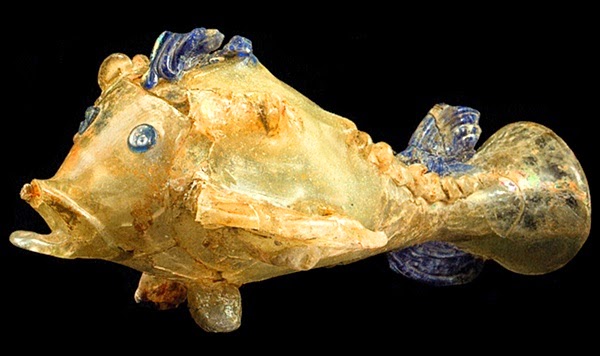
You have to admit that you are looking at something very exceptional. We all know there was an active exchange of goods in antiquity, and it comes to us like a simple statement from a history book, but here you are faced with the very product of such trade! I keep staring at this glasswork with wide-open eyes. Wow! Next to these painted glasses are a couple of glass drinking goblets or vases in the shape of fish, blue and off-white, with shiny eyes and sharp fins. I’ve never seen anything like this. There are glass-blown vases with honeycomb motives or wrapped in a net of glass lace; an elegant black glass vase with a high handle next to a translucent one covered with designs applied with gold leaf; for me, an unprecedented variety of delicate, colored, and painted glass that makes the cut-crystal bowl look rather primitive and dull. Amazing!

In another showcase, all the ivory artifacts have been brought together.

These objects from the first century AD originally all came from India, but again are drenched in a Hellenistic sauce. Unique is the ivory River Goddesses, approximately 45 cm high, clearly from a Buddhist background, among the exquisite openwork ivory panels showing Indian ladies in exotic gardens with fountains and temple-like buildings, a few monster figures, etc. Strange is the odd-shaped earthenware jar with blue-green glaze representing a bird-woman, for I cannot tie this style or shape to anything I have seen before.

The bronze artifacts somehow don’t add anything new. I only remember the cute figurine of Amor carrying a lamp and the young rider who seems to refer to Alexander the Great because of the way he is sitting on the horse that is lost from underneath him.

I stop to admire the row of plaster medallions, each about 15 cm in diameter, also dating from the first century AD. They look like oversized molds for the production of coins, but were used to create the bottom motives for silver plates and goblets as the silver was poured and hammered around these molds. There are a few striking designs, like the Winged Amor or the high relief of a youth. Just imagine these portraits staring back at you from the bottom of your silver goblet filled with water or wine. I certainly would love to give this a try, wouldn’t you?

Finally, there is the gold treasure from Tillya Tepe, a tomb hill just outside the Greek Bactrian city of Emshi-Tepe in the oasis of Sherberghan. The content of these six tombs was barely rescued when the Soviet Union entered Afghanistan in 1979, and it was safely transferred to the Museum in Kabul. There was a seventh tomb on that hill at the Turkmenistan border, but Viktor Sarianidi, the Russian archaeologist who had led these excavations together with his Afghan colleagues, ran out of time, and when he recently returned, the tomb had been thoroughly plundered. Such a shame! Luckily for us, Sarianidi managed to travel to the Museum of Kabul in the 1980s in order to take pictures of all 20,000 excavated objects, and he published an impressive book. So at least we know exactly what was found at Tillya Tepe.

What followed were uncertain times for the art world, and we owe it to a handful of brave Afghans that this treasure was rescued, safely locked away in the vaults of the Presidential Palace. They managed to keep the place a secret. The Museum itself has suffered a great deal from the civil wars, as it was repeatedly plundered and artifacts were stolen, and in 1994 it was hit by a rocket, setting it on fire. How dreadful! The worst, however, was still to come when in 2001, the Taliban decided not only to destroy the huge Buddha statues at Bamyan but also to annihilate the 2,500 statues and reliefs of the Museum. We had to wait till 2004 when the government of Afghanistan decided that the situation was safe enough to bring the gold treasures out in the open again, but as the Museum in Kabul could not shelter this precious collection yet, they contacted the Musée Guimet in Paris. Together, they agreed to send these rich finds on a traveling tour. After Paris and Turin (Italy), the collection can presently be seen in Amsterdam, moved on to the United States, and is now touring Australia.


The tombs are beautifully presented in high rectangular boxes covered with a glass plate showing the contours of the deceased with underneath each piece of jewelry in its original place. They unearthed one warrior and five women, the man lying at the top of the hill between the two most beautifully dressed women, the other three women being found on the hillside, which should have looked like a kurgan according to the nomads’ rituals.

This part of the exhibition clearly states that Northern Afghanistan was the melting pot of different cultures, where the influence of China and Greece is interwoven with the lifestyle of the steppe people. Each tomb is an exploration by itself, where all kinds of artifacts of different origins keep each other company in breathtaking harmony.

Of course, they all have gold bracelets and anklets inlaid or not with semi-precious stones, but I notice how some women hold a Chinese mirror, from the Han Dynasty apparently; gold pins with on top a gold flower with open petals and vibrant pistils; hairpins as I know them from Japanese geishas but executed in thin flaky gold and tiny pearls; a ring engraved with an Athena figure and Greek inscription, and rings inlaid with precious stones; ornaments for the neck of the robe laid out as a necklace made of gold, turquoise, garnet, carnelian, and pyrite; gold earrings preferably inlaid with turquoise; pendants like those of the Dragon Master with turquoise, garnet, lapis-lazuli, carnelian and pearls in a rare symbiosis of Greek, Indian and Chinese elements; a set of gold clasps showing Amor riding a dolphin with turquoise and mother of pearl; even gold foot soles! 

The warrior, supposedly a prince, carries an iron dagger with a gold-covered handle depicting animals and inlaid with turquoise. His belt, made of braided gold-thread strings connecting nine gold medallions showing a warrior riding a lion, is an exceptional masterpiece. His head rested on a phial, a plate used for offerings, made of pure gold and measuring nothing less than 23 cm in diameter!

The list seems endless, for besides the most striking objects, the collection contains numerous coins, pendants, and various decorative items. As the most recent coin found in these tombs is that of Emperor Tiberius (who ruled from 14 to 37 AD), they could be dated with certainty to the first century AD. We see a true amalgamation of art from the steppes (I would personally call this Scythian art), Greek, Indian, and Chinese art.

I am terribly excited to finally catch up with the Aphrodite of Bactria, a five-centimeter-high gold appliqué inlaid with turquoise. I know the piece from pictures and references, but here she is. I go down on my knees to look closer; for an instant, she is mine alone. The piece de resistance, however, seems to be the gold crown with gold spangles and flowers. It is, in fact, a travel crown that can be taken apart as it consists of five separate pieces mounted around a tiny stem holding flattened branches that fit into the band of the crown itself. The spangles gently shake as people walk by, so imagine this crown in the open steppe where the wind can play freely with every tiny detail! A true gem!

It is still unclear to which nomad tribes the tombs of Tillya Tepe belong and how far this melting pot of civilizations reached out. Generally, these steppe people came from northwestern China or Parthia (now part of Iran and Turkmenistan), but who knows? Further investigations will tell us. For now, we have to accept that this territory is vast, for we have jade from China, garnets from India, turquoise from eastern Iran, and lapis lazuli from the mines of Badakhshan (today’s Afghanistan), all found together in this area. And yet we have not mentioned the traders and artists who were constantly moving between China, India, and the Roman Empire to produce these beautiful artifacts. It’s a small world – or is it not so small after all?


Anyway, I am convinced that this wide exchange of art and knowledge would not have been possible without Alexander the Great conquering these territories and organizing his Empire as he did.


[Pictures from The Australian by Ollivier Thierry]